Get the simplified Extra Questions for Class 9 Maths and Ganita Manjari Class 9 Maths Chapter 5 I’m Up and Down and Round and Round Extra Questions with complete explanation.
Class 9 I’m Up and Down and Round and Round Extra Questions
Extra Questions on I’m Up and Down and Round and Round Class 9
Class 9 Ganita Manjari Chapter 5 Extra Questions
Question 1.
How many unique circles can be drawn passing through three non-collinear points?
Solution:
Only one unique circle can be drawn through three non-collinear points.
Question 2.
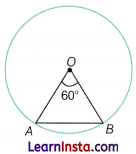
In the given figure, chord AB subtends an angle equal to 60° at the centre of the circle.
If OA = 5 cm, then find the length of AB.
Solution:
∆AOB is an equilateral triangle.
AB = 5 cm

Question 3.
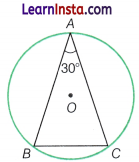
In the given figure, ABC is a triangle, in which ∠BAC = 30°. Show that the length of BC is equal to the radius of the circumcircle of ∆ABC, whose centre is O.
Solution:
Join OB and OC.
Now, ∠BOC = 2∠BAC
[∵ angle subtended by the chord at the centre is double the angle subtended by it on any other point on the remaining part of the circle]
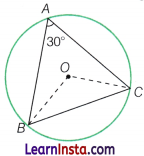
∴ ∠BOC = 60°
In ∆BOC, OB = OC [radii of circle]
∴ ∠OBC = ∠OCB = 60°
So, ∆BOC is an equilateral triangle.
∴ BC = OB [radii of circle]
Question 4.
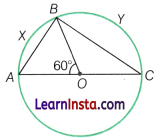
In the given figure, AOC is a diameter of the circle and arc AXB = \(\frac {1}{2}\) arc BYC. Find ∠BOC.
Solution:
arc AXB = \(\frac {1}{2}\) × arc BYC
∴ ∠AOB = \(\frac {1}{2}\) × ∠BOC
= \(\frac {1}{2}\) × 240°
= 120°
I’m Up and Down and Round and Round Class 9 Very Short Question Answer
Question 1.
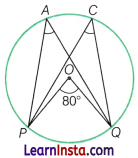
In the given figure, if ∠POQ = 80°, then find ∠PAQ and ∠PCQ.
Solution:
We know that the angle subtended by an arc at the centre is double the angle subtended by it at any point on the remaining part of the circle.
∠PAQ = 40°
∠PCQ = 40°
Question 2.
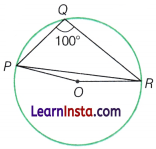
In the given figure, ∠PQR = 100°, where P, Q, and R are the points on a circle with centre O. Find reflex ∠POR.
Solution:
The angle subtended by an arc at the centre is double the angle subtended by it at any point on the remaining part of the circle.
Reflex ∠POR = 200°
Question 3.
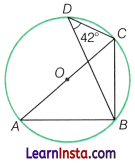
In the given figure, O is the centre of the circle and ∠BDC = 42°. Find the measure of ∠ACB.
Solution:
∠BDC = ∠BAC [angles in the same segment]
and ∠ABC = 90° [angle in a semi-circle]
∠ACB = 48°
Question 4.
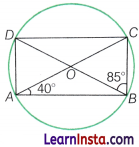
ABCD is a cyclic quadrilateral whose diagonals intersect at a point O. If ∠DBC = 85°, ∠BAC = 40°, find ∠BCD. Further, if AB = BC, find ∠OCD.
Solution:
∠BDC = ∠BAC [angles in the same segment]
∴ ∠BDC = 40°
In ∆BCD, we have
∠BDC + ∠DBC + ∠BCD = 180° [angle sum property of triangle]
⇒ 40° + 85° + ∠BCD = 180°
⇒ ∠BCD = 180° – 40° – 85°
= 180° – 125°
= 55°
If AB = BC, then ∠BCA = ∠BAC = 40° [∵ angles opposite to equal sides in a triangle are equal]
Now, ∠OCD = ∠BCD – ∠BCA
= 55° – 40°
= 15°
∴ ∠BCD = 55° and ∠OCD = 15°
Question 5.
In the given figure, ABCD is a cyclic quadrilateral, in which AC and BD are its diagonals.
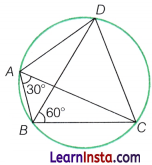
If ∠DBC = 60° and ∠BAC = 30°, then find ∠BCD.
Solution:
∠DBC = ∠DAC [angles in the same segment]
⇒ ∠DAC = 60° [∵ DBC = 60 °]
∴ ∠DAB = ∠BAC + ∠DAC
= 30° + 60°
= 90°
Now, ∠DAB + ∠BCD = 180° [cyclic quadrilateral property]
⇒ 90° + ∠BCD = 180°
∴ ∠BCD = 90°
Question 6.
If ABCD is a cyclic quadrilateral, in which AD || BC, then prove that ∠B = ∠C.
Solution:
Given that ABCD is a cyclic quadrilateral and AD || BC.
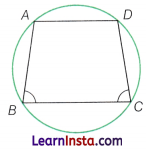
∴ ∠A + ∠B = 180° …..(i)
[co-interior angles on the same side of transversal AB]
Also, ∠A + ∠C = 180° ……(ii)
[sum of opposite angles of a cyclic quadrilateral]
On subtracting Eq. (ii) from Eq. (i), we get
∠A + ∠B – ∠A – ∠C = 0
∴ ∠B = ∠C
Hence proved.
I’m Up and Down and Round and Round Class 9 Short Question Answer
Question 1.
What is the rotational symmetry of a circle? Also, define its lines of reflection symmetry.
Solution:
A circle has rotational symmetry about its centre.
It looks the same after rotation through any angle about its centre.
So, a circle has infinite order of rotational symmetry.
Every diameter of a circle is a line of symmetry.
It divides the circle into two equal mirror-image parts.
So, a circle has infinitely many lines of symmetry.
Question 2.
If the length of a chord of a circle is 16 cm and is at a distance of 15 cm from the centre of the circle, then find the radius of the circle.
Solution:
Draw OL ⊥ chord AB.
Join OA.
Let radius, OA = r
∴ AL = \(\frac {AB}{2}\) = 8 cm
and OL = 15 cm
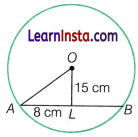
Now, OA2 = AL2 + OL2
OA2 = 152 + 82
= 225 + 64
= 289
∴ OA = 17 cm
Question 3.
If the perpendicular bisector of a chord AB of a circle intersects the circle at P and Q, then prove that arc PXA ≅ arc PYB.
Solution:
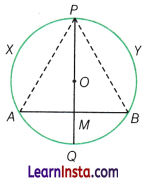
In ∆AMP and ∆BMP,
AM = MB [PM bisects AB]
∠AMP = ∠BMP [each 90°]
and PM = PM [common]
∴ ∆AMP ≅ ∆BMP [by SAS congruence rule]
⇒ PA = PB [by CPCT]
∴ arc PXA ≅ arc PYB
Question 4.
Prove that the right bisector of a chord of a circle bisects the corresponding arc of the circle.
Solution:
Let AB be a chord of a circle having its centre O.
Let PQ be the right bisector of the chord AB, intersecting AB at L.
Since the right bisector of a chord always passes through the centre.
So, PQ must pass through the centre O.
Join OA and OB.
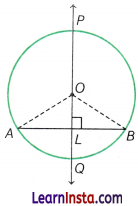
In ∆OLA and ∆OLB, we have
OA = OB [radii of the same circle]
∠ALO = ∠BLO [each 90°]
and OL = OL [common]
∴ ∆OLA ≅ ∆OLB [by RHS congruence rule]
Then, ∠AOL = ∠BOL [by CPCT]
⇒ ∠AOQ = ∠BOQ
∴ \(\overparen{A Q}=\overparen{B Q}\)
Hence proved.
Question 5.
Prove that the line joining the mid-points of two parallel chords of a circle passes through the centre.
Solution:
Let AB and CD be two parallel chords having P and Q as their midpoints, respectively.
Let O be the centre of the circle.
Join OP and OQ and draw OX || AB || CD.
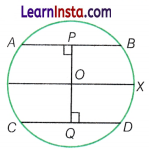
Now, P is the midpoint of AB.
Then, OP ⊥ AB
⇒ ∠APO = ∠BPO = 90°
But OX || AB
∴ ∠POX = ∠APO [alternate interior angles]
⇒ ∠POX = 90°
Similarly, ∠XOQ = ∠CQO = 90° [alternate interior angles]
Now, ∠POX + ∠XOQ
= 90° + 90°
= 180°
So, POQ is a straight line.
Hence, PQ is a straight line passing through the centre of the circle.
Hence proved.
Question 6.
AB and AC are two equal chords of a circle. Prove that the bisector of the ∠BAC passes through the centre of the circle.
Solution:
Given that AB and AC are two equal chords of a circle, whose centre is M.
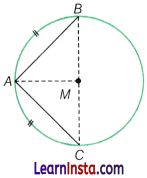
Join BC and draw the bisector AD of ∠BAC.
In ΔBAM and ΔCAM, we have
AB = AC [given]
∠BAM = ∠CAM [given]
and AM = AM [common]
∴ ΔBAM ≅ ΔCAM [by SAS congruence rule]
⇒ BM = CM [by CPCT]
and ∠BMA = ∠CMA [by CPCT]
So, BM = CM and ∠BMA = ∠CMA = 90 °
∴ AM is the perpendicular bisector of chord BC.
Hence, the bisector of ∠BAC, i.e., AD, passes through the centre M.
Hence proved.
Question 7.
If a line segment joining the midpoints of two chords of a circle passes through the centre of the circle. Prove that the two chords are parallel.
Solution:
L is the midpoint of AB.
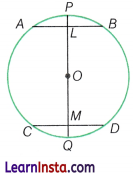
∴ OL ⊥ AB [since the line joining the centre of a circle to the mid-point of a chord is perpendicular to the chord]
∴ ∠ALO = 90° ……(i)
Similarly, OM ⊥ CD
∴ ∠OMD = 90° ……(ii)
∠ALO = ∠OMD [alternate angles]
∴ AB || CD
Hence proved.
Question 8.
If BM and CN are the perpendiculars drawn on the sides AC and AB of the ΔABC, then prove that the points B, C, M, and N are concyclic.
Solution:
Draw a circle passing through the points B, C, M, and N.
∴ ∠BMC = ∠BNC = 90°
If a line segment joining two points subtends equal angles at two other points lying on the same side of the line containing the line segment, then the four points lie on a circle.
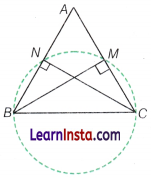
Therefore, B, C, M, and N are concylic.
Hence proved.
Question 9.
Bisector AD of ∠BAC of ∆ABC passes through the centre O of the circumcircle of ∆ABC, as shown in the figure. Prove that AB = AC.
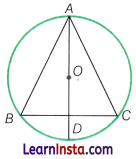
Solution:
Draw OP ⊥ AB and OQ ⊥ AC
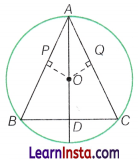
In ∆AOP and ∆AOQ,
∠OPA = ∠OQA = 90° [by construction]
∠OAP = ∠OAQ [given]
and OA = OA [common]
∴ ∆AOP ≅ ∆AOQ [by AAS congruence rule]
⇒ OP = OQ [by CPCT]
∴ AB = AC [∵ chords equidistant from the centre of the circle are equal in length]
Question 10.
In the given figure, AB and AC are two equal chords of a circle whose centre is O. If OD ⊥ AB, OE ⊥ AC, and AO bisects ∠DAE, prove that ΔADE is an isosceles triangle and ∠ABC = ∠ACB.
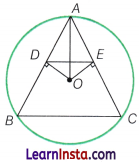
Solution:
∵ AB = AC
⇒ OD = OE [∵ equal chords are equidistant from the centre]
In ΔAOD and ΔAOB,
OA = OA [common]
∠ADO = ∠AEO [each 90°]
and OD = OE
∴ ΔAOD ≅ ΔAOE [RHS congruence rule]
∴ AD = AE
Thus, ΔADE is an isosceles triangle.
∵ In ΔABC, AB = AC [given]
∴ ∠ABC = ∠ACB [∵ angles opposite to equal sides in a triangle are equal]
Question 11.
In the following figure, O is the centre of the circle, BD = OD, and CD ⊥ AB. Find ∠CAB.
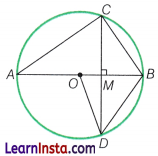
Solution:
In ΔOBD, BD = OD [given]
OD = OB [ radii of same circle]
∴ OB = OD = BD
So, ΔODB is an equilateral triangle.
Then, ∠BOD = ∠OBD = ∠ODB = 60°
In ΔBMC and ΔBMD, we have
MB = MB [common]
∠CMB = ∠BMD = 90° [∵ CD ⊥ AB]
and CM = DM [chord bisector]
∴ ΔBMC ≅ ΔBMD [by SAS congruence rule]
Then, ∠MBC = ∠MBD = 60° [∵ ∠OBD = 60°]
Since AB is a diameter of the circle.
∴ ∠ACB = 90°
In ΔACB, ∠CAB + ∠CBA + ∠ACB = 180° [by angle sum property of a triangle]
⇒ ∠CAB + 60° + 90° = 180° [∵ ∠CBA = ∠MBC]
⇒ ∠CAB = 180° – (60° + 90°)
⇒ ∠CAB = 30°
Question 12.
Three students, Priyanka, Sonia, and David, are protesting against killing innocent animals for commercial purposes in a circular park of radius 20 m. They are standing at equal distances on its boundary by holding banners in their hands.
(i) Find the distance between each of them.
(ii) Find the area of a triangle inscribed in a circle.
Solution:
(i) Let us assume that A, B, and C are the positions of Priyanka, Sonia, and David, respectively, on the boundary of the circular park with centre O.
Draw AD ⊥ BC.
Since the centre of the circle coincides with the centroid of the equilateral ΔABC.
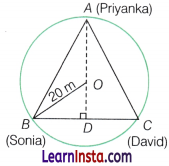
∴ Radius of circumscribed circle = \(\frac {2}{3}\)AD
⇒ 20 = \(\frac {2}{3}\)AD
⇒ AD = 20 × \(\frac {3}{2}\)
⇒ AD = 30 m
Now, AD ⊥ BC and let AB = BC = CA = x m
⇒ BD = CD = \(\frac {1}{2}\)BC = \(\frac {x}{2}\) m
In right-angled ΔBDA, ∠D = 90°
∴ By Pythagoras’ theorem, we have
AB2 = BD2 + AD2
⇒ \(x^2=\left(\frac{x}{2}\right)^2+(30)^2\)
⇒ \(x^2-\frac{x^2}{4}=900\)
⇒ \(\frac{3}{4} x^2=900\)
⇒ \(x^2=900 \times \frac{4}{3}\)
⇒ x2 = 1200
⇒ x = √1200 = 20√3
Hence, the distance between each of them is 20√3 m.
(ii) Since ΔABC is an equilateral triangle.
Therefore, area of ΔABC = \(\frac{\sqrt{3}}{4}(\text { side })^2\)
= \(\frac{\sqrt{3}}{4} \times(20 \sqrt{3})^2\)
= \(\frac{\sqrt{3}}{4}\) × 400 × 3
= 300√3 m2
Question 13.
In the given figure, ∠BAC = 55°, and the altitude BE produced meets the circle at D. Also, ∠AOC = 100°
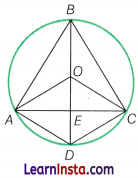
Determine
(i) ∠ABE
(ii) ∠ABC
Solution:
(i) In ΔBAE,
∠ABE + ∠BAE + ∠AEB = 180° [by angle sum property of triangle]
⇒ ∠ABE = 180° – 90° – 55°
⇒ ∠ABE = 35°
(ii) ∠ABC = \(\frac {1}{2}\)∠AOC
[since the angle subtended by an arc at the centre is twice the angle subtended by it at any point on the remaining part of the circle]
∴ ∠ABC = \(\frac {1}{2}\) × 100° = 50°
∴ ∠ABE = 35°, ∠ABC = 50°
Question 14.
The circumcentre of the ΔABC is O. Prove that ∠OBC + ∠BAC = 90°.
Solution:
Let ∠OBC = ∠OCB = θ [radii of same circle]
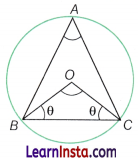
In ΔOBC,
∠BOC + ∠OBC + ∠OCB = 180°
∠BOC + θ + θ = 180°
∠BOC = 180° – 2θ
∵ ∠BAC = \(\frac{\angle B O C}{2}\)
[since the angle subtended by an arc at the centre is twice the angle subtended by it at any point on the remaining part of the circle]
∴ ∠BAC = \(\frac{180^{\circ}-2 \theta}{2}\) = 90° – θ
⇒ ∠BAC = 90° – ∠OBC [∵ ∠OBC = θ]
⇒ ∠BAC + ∠OBC = 90°
Hence proved.
Question 15.
O is the circumcentre of the ΔABC, and D is the midpoint of the base BC. Prove that ∠BOD = ∠A.
Solution:
Prove ΔODB ≅ ΔODC
By the SSS congruence rule, then ∠BOD = ∠COD
∴ ∠BOC = 2∠BOD ……(i)
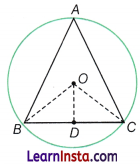
Also, ∠BAC = \(\frac {1}{2}\)∠BOC
[since the angle subtended by an arc at the centre is twice the angle subtended by it at any point on the remaining part of the circle]
⇒ ∠BAC = \(\frac {2}{2}\) ∠BOD
⇒ ∠BOD = ∠A [from Eq. (i)]
Hence proved.
Question 16.
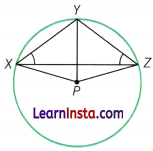
In the given figure, P is the centre of the circle. Prove that ∠XPZ = 2(∠XZY + ∠YXZ).
Solution:
Since arc XY subtends ∠XPY at the centre and ∠XZY at a point Z in the remaining part of the circle.
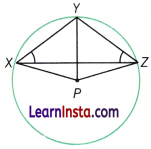
∴ ∠XPY = 2∠XZY ……(i)
[since the angle subtended by an arc at the centre is twice the angle subtended by it at any point on the remaining part of the circle]
Similarly, arc YZ subtends ∠YPZ at the centre and ∠YXZ at a point X in the remaining part of the circle.
∴ ∠YPZ = 2∠YXZ ……(ii)
On adding Eqs. (i) and (ii), we get
∠XPY + ∠YPZ = 2∠XZY + 2∠YXZ
⇒ ∠XPZ = 2(∠XZY + ∠YXZ)
Hence proved.
Question 17.
A circle has a radius √2 cm. It is divided into two segments by a chord of length 2 cm. Prove that the angle subtended by the chord at a point in a major segment is 45°.
Solution:
Given: A circle with centre O has radius √2 cm.
Construction: A chord of a circle AS = 2 cm, which is divided by the perpendicular line OM into two equal segments.
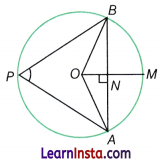
To prove: ∠APB = 45°
Proof: Here, AN = NB = 1 cm and OA = OB = √2 cm.
In ∆ONB, by Pythagoras’ theorem,
OB2 = ON2 + NB2
⇒ (√2)2 = ON2 + (1)2
⇒ ON2 = 2 – 1 = 1
⇒ ON = 1 cm
Since, NB = ON
So, ∆ONB is an isosceles triangle.
∵ ∠ONB = 90° [since, ON is the perpendicular bisector of the chord AB]
∴ ∠NOB = ∠NBO = 45 ° [∵ NB = ON]
Similarly, ∠AON = 45°
Now, ∠AOB = ∠AON + ∠NOB
= 45° + 45°
= 90°
∴ ∠APB = \(\frac {1}{2}\)∠AOB
[since the angle subtended by an arc at the centre is twice the angle subtended by it at any point on the remaining part of the circle]
∴ ∠APB = \(\frac{90^{\circ}}{2}\) = 45°
Hence proved.
Question 18.
Three STD booths situated at A, B, and C, as shown in the figure are operated by handicapped persons. These three booths are equidistant having length 2 cm from each other as shown in the figure.
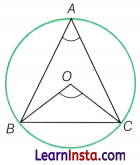
(i) Find ∠BAC.
(ii) Find ∠OBC.
(iii) Find the area of ΔABC.
Solution:
Here, A, B, and C represented 3 STD booths.
(i) As A, B, and C are equidistant from each other.
∴ AB = BC = CA
Then, ΔABC is an equilateral triangle.
Hence, ∠BAC = ∠ABC = ∠BCA = 60°
(ii) We know that the angle subtended by an arc at the centre of the circle is twice the angle subtended by it at any point on the remaining part of the circle.
∴ ∠BOC = 2∠BAC
From part (i), ∠BAC = 60°
Hence, ∠BOC = 2 × 60° = 120°
In ΔBOC, OB = OC [radii of same circle]
∴ ∠OBC = ∠OCB [∵ angles opposite to equal sides in a triangle are equal]
Then, in ΔBOC,
∠OBC + ∠OCB + ∠BOC = 180
⇒ ∠OBC + ∠OBC + 120° = 180
⇒ ∠OBC = \(\frac{180^{\circ}-120^{\circ}}{2}\) = 30°
(iii) Since ΔABC is an equilateral triangle.
∴ Area of ΔABC = \(\frac{\sqrt{3}}{4}(\text { side })^2\)
= \(\frac{\sqrt{3}}{4} \times(2)^2\)
= √3 cm2
Question 19.
In the given figure, the points M, R, N, P, S, and Q are concyclic. Find ∠PQR + ∠OPR + ∠NMS + ∠OSN if O is the centre of the circle.
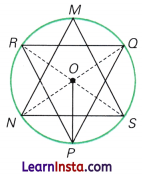
Solution:
Given M, R, N, P, S, and Q are concyclic.
Clearly, ∠PQR = \(\frac {1}{2}\) ∠POR …… (i)
∠NMS = \(\frac {1}{2}\) ∠NOS ……(ii)
[since the angle subtended by an arc at the centre is double the angle subtended by it at any point on the remaining part of the circle]
Let ∠OPR = x
Then, ∠POR = 180° – 2x
i.e. ∠POR = 180° – 2∠OPR
Similarly, ∠NOS = 180° – 2∠OSN
On substituting these values in Eqs. (i) and (ii), we get
∠PQR = \(\frac {1}{2}\)(180° – 2∠OPR)
⇒ ∠PQR = 90° – ∠OPR …..(iii)
and ∠NMS = \(\frac {1}{2}\)(180° – 2∠OSN)
⇒ ∠NMS = 90° – ∠OSN ……(iv)
On adding Eqs. (iii) and (iv), we get
∠PQR + ∠NMS + ∠OPR + ∠OSN = 180°
Question 20.
In the given figure, O is the centre of the circle, ∠ADB = 30°, and ∠ABC = 40°. Find the measure of ∠CAB.
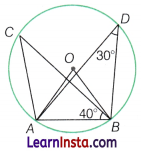
Solution:
∠ACB = ∠ADB = 30° [angles in the same segment]
In ∆CAB, ∠CAB + ∠ACB + ∠ABC = 180° [by angles sum property of triangle]
⇒ ∠CAB + 30° + 40° = 180°
⇒ ∠CAB = 110°
Question 21.
In the given figure, ABCD is a cyclic quadrilateral, in which AC and BD are its diagonals. If ∠DBC = 55° and ∠BAC = 45°, then find ∠BCD.
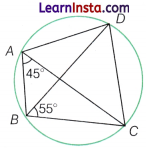
Solution:
∠DBC = ∠CAD = 55° [angles in the same segment]
Also, ∠BAC = ∠BDC = 45° [angles in the same segment]
In ∆BCD,
∠BCD + ∠DBC + ∠BDC = 180° [angle sum property of triangle]
⇒ ∠BCD + 55°+ 45° = 180°
⇒ ∠BCD = 80°
Question 22.
In the given figure, the chord ED is parallel to the diameter AC. Determine ∠CED.
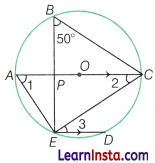
Solution:
Join OE.
∴ ∠EOC = 2∠EBC
[angle subtended by the arc at the centre is double the angle subtended by it at any point on the remaining part of the circle]
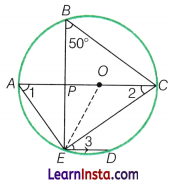
∴ ∠EOC = 2 × 50° = 100°
In ∆OEC,
∠OEC + ∠OCE + ∠EOC = 180°
⇒ ∠OCE + ∠OEC+ 100° = 180°
⇒ ∠OCE + ∠OCE = 80° [∵ OE = OC = radii of same circle]
⇒ ∠OCE = 40°
∴ AC || ED
∴ ∠CED = ∠OCE = 40°
Question 23.
A quadrilateral ABCD is inscribed in a circle such that AB is a diameter and ∠ADC = 130°. Find ∠BAC.
Solution:
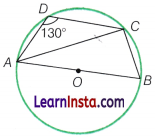
Here, ∠ADC + ∠ABC = 180° [∵ sum of opposite angles of a cyclic quadrilateral is 180°]
⇒ 130°+ ∠ABC = 180°
⇒ ∠ABC = 50°
∴ ∠ACB = 90° [angle in a semi-circle]
In ∆ABC,
∠BAC + ∠ACB + ∠ABC = 180°
⇒ ∠BAC + 90° + 50° = 180°
⇒ ∠BAC = 40°
Question 24.
The Indian Hockey Federation organised a friendly hockey match between India and Pakistan on a circular ground. The sale proceeds of this match shall be donated to an orphanage. A rectangular turf is spread on the ground as shown in the figure.
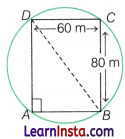
(i) Specify the name of the chord BD.
(ii) Find the radius of the ground.
(iii) Find the area of ΔBCD.
Solution:
(i) As ABCD is a rectangle, each angle of a rectangle is 90°.
We know that if any chord subtends a right angle, then the chord BD is said to be the diameter of a circle.
(ii) Diagonal of the rectangular turf = \(\sqrt{(60)^2+(80)^2}\) = 100 m
Since rectangular turf is spread on the ground.
So, its diagonal will be the diameter of the ground.
Hence, radius of circular ground = \(\frac {100}{2}\) = 50 m
(iii) ∴ Area of ΔBCD = \(\frac {1}{2}\) × BC × CD
= \(\frac {1}{2}\) × 80 × 60
= 2400 m2
Question 25.
On a common hypotenuse AB, two right-angled triangles, ΔACB and ΔADB, are situated on opposite sides. Prove that ∠BAC = ∠BDC.
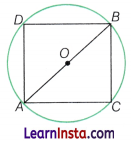
Solution:
Join CD.
Let O be the midpoint of AB.
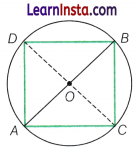
∴ OA = OB = OC = OD
Since the midpoint of the hypotenuse of a right-angled triangle is equidistant from its vertices.
Therefore, O is the centre of the circle passing through A, C, B, and D.
∴ ∠BAC = ∠BDC [angles in the same segment]
Hence proved.
Question 26.
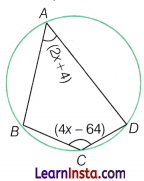
In the given figure, find the value of x.
Solution:
In the given figure, ABCD is a cyclic quadrilateral.
∴ (2x + 4) + (4x – 64) = 180°
[∵ sum of opposite angles of a cyclic quadrilateral is 180°]
∴ x = 40°
Question 27.
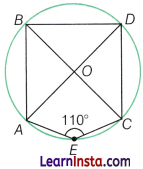
In the given figure, ABCE is a cyclic quadrilateral, and O is the centre of the circle. If ∠AEC = 110°, then find ∠ABC and ∠ADC.
Solution:
∵ The sum of opposite angles of a cyclic quadrilateral is 180°.
∴ ∠AEC + ∠ABC = 180°
⇒ 110° + ∠ABC = 180°
∴ ∠ABC = 70° and ∠ADC = ∠ABC [angles in the same segment]
∴ ∠ADC = 70°
Question 28.
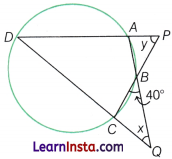
In the given figure, if y = 3x, then find the magnitude of x.
Solution:
∵ ∠CBQ = ∠ABP = 40°
∴ ∠DCB = x + 40° and ∠DAB = y + 40°
[∵ exterior angle of a triangle is equal to the sum of two interior opposite angles]
Now, use the property that the sum of opposite angles of a cyclic quadrilateral is 180°.
∴ x = 25°
Question 29.
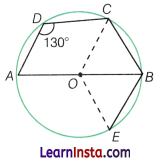
In the given figure, ∠ADC = 130° and chord BC = chord BE. Find ∠CBE.
Solution:
The points A, B, C, and D form a cyclic quadrilateral.
Then, the sum of opposite angles of a quadrilateral is 180°.
∴ ∠ADC + ∠OBC = 180° [∵ ∠ABC = ∠OBC]
⇒ 130° + ∠OBC = 180°
⇒ ∠OBC = 180° – 130°= 50° ……(i)
Now, in ∆BOC and ∆BOE,
BC = BE [given]
OC = OE [radii of the same circle]
and OB = OB [common]
∴ ∆BOC ≅ ∆BOE [by SSS congruence rule]
Then, ∠OBC = ∠OBE [by CPCT]
∴ ∠OBE = ∠OBC = 50° [from Eq. (i)]
∴ ∠CBE = ∠OBC + ∠OBE
= 50° + 50°
= 100°
Question 30.
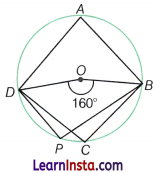
In the given figure, ABCD is a cyclic quadrilateral, and O is the centre of the circle. If ∠BOD = 160°, then find the measure of ∠BPD and ∠BCD.
Solution:
∠BAD = \(\frac {1}{2}\)∠BOD
[angle subtended by the arc at the centre is double the angle subtended by it at any point on the remaining part of the circle]
Also, ∠BAD + ∠BPD = 180° [∵ sum of opposite angles of cyclic quadrilateral is 180°]
and ∠BCD = ∠BPD [angle in same segment]
∴ ∠BPD = 100° and ∠BCD = 100°
Question 31.
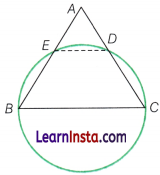
If a line is drawn parallel to the base of an isosceles triangle to intersect its equal sides, then prove that the quadrilateral so formed is cyclic.
Solution:
Given: ∆ABC is an isosceles triangle such that AB = AC and DE || BC.
To prove: Quadrilateral BCDE is a cyclic quadrilateral.
Construction: Draw a circle that passes through the points B, C, D, and E.
Proof: In ∆ABC, AB = AC [equal sides of an isosceles triangle]
⇒ ∠ACB = ∠ABC ……(i)
[∵ Angles opposite to the equal sides in a triangle are equal]
∵ DE || BC
⇒ ∠ADE = ∠ACB ……(ii)
On adding ∠EDC to both sides in (ii), we get
∠ADE + ∠EDC = ∠ACB + ∠EDC
⇒ 180° = ∠ACB + ∠EDC
⇒ 180° = ∠ABC + ∠EDC [from Eq. (i)]
∴ BCDE is a cyclic quadrilateral because the sum of opposite angles of a quadrilateral is 180°.
Hence proved.
Question 32.
In the given figure, sides AB and DC of a cyclic quadrilateral ABCD are produced to meet at E. Sides AD and BC are produced to meet at F. If ∠ADC = 80° and ∠BEC = 50°, then find ∠BAD and ∠CFD.
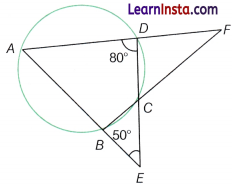
Solution:
The sum of opposite angles of a cyclic quadrilateral is 180°.
∴ ∠ABC = 180° – 80° = 100°
and ∠ABC + ∠CBE = 180° [linear pair]
⇒ ∠CBE = 80° …….(i)
In ∆BCE,
∠CBE + ∠BCE + ∠CEB = 180° [By angle sum property of a triangle]
⇒ 80° + ∠BCE + 50°= 180° [∵ ∠CEB = 50°, given]
∴ ∠BCE = 50° …… (ii)
Now, ∠BCD + ∠BCE = 180° [linear pair]
⇒ ∠BCD = 180° – 50° = 130°
and ∠BAD + ∠BCD = 180° [∵ sum of opposite angles of cyclic quadrilateral is 180°]
∴ ∠BAD = 50°
Now, ∠CDF = 180° – ∠ADC [linear pair]
∠CDF = 100° ….. (iii)
and ∠DCF = ∠BCE = 50° [vertically opposite angles]
In ∆DCE,
∠CDF + ∠DCF + ∠CFD = 180° [by angle sum property of triangle]
⇒ ∠CFD = 30°
Question 33.
In the given figure, AOB is a diameter of the circle, and C, D, and E are any three points on the semicircle. Find the value of ∠ACD + ∠BED.
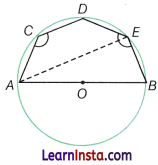
Solution:
Since ACDE is a cyclic quadrilateral.
∴ ∠ACD + ∠AED = 180° ……(i)
[∵ sum of opposite angles in a cyclic quadrilateral is 180°]
Also, ∠AEB = 90° [angle in a semi-circle] …..(ii)
On adding Eqs. (i) and (ii), we get
∠ACD + (∠AED + ∠AEB) = 180° + 90°
⇒ ∠ACD + ∠BED = 270°
Hence, the value of (∠ACD + ∠BED) is 270°.
Question 34.
A rangoli competition is held at Delhi Public School. In which the student makes a different type of rangoli by using different colours. One of the students makes a rangoli, which is shown in the figure.
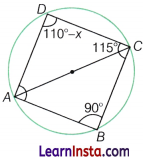
(i) Find the value of x.
(ii) Find the value of ∠A.
(iii) Is it true that the line joining points A and C passes through a centre?
Solution:
(i) Since points A, B, C, and D lie on a circle.
Therefore, ABCD is a cyclic quadrilateral.
In a cyclic quadrilateral, the sum of opposite angles is 180°.
∴ ∠D + ∠B = 180°
⇒ 110° – x + 90° = 180°
⇒ x = 200° – 180°
⇒ x = 20°
(ii) Also, ∠A + ∠C = 180°
⇒ ∠A + 115° = 180°
⇒ ∠A = 65°
(iii) Here, ∠D = 110° – 20° = 90°
We know that if any chord subtends a right angle to the circumference, then that chord AC will be the diameter of the circle.
Hence, chord AC passes through the centre of the circle.
I’m Up and Down and Round and Round Class 9 Long Question Answer
Question 1.
A, B, and C are three points on a circle. Prove that the perpendicular bisectors of AB, BC, and CA are concurrent.
Solution:
Given: A, B, and C are three points on a circle.
To prove: The perpendicular bisectors of AB, BC, and CA are concurrent.
Construction: Join AB, BC, and CA.
Draw ST, PM, and QR as perpendicular bisectors of AB, BC, and CA, respectively.
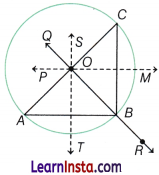
Proof: Since O lies on the perpendicular bisectors ST, PM, and QR of AB, BC, and CA, respectively.
∴ OA = OB ……(i)
Also, OB = OC …….(ii)
and OC = OA ……(iii)
∴ OA = OB = OC [say r]
[from Eqs. (i), (ii), and (iii)]
Now, with O as centre and r as radius, draw a circle that passes through A, B, and C.
∴ Circle passes through the points A, B, and C.
Since ST, PM, and QR cut each other at O.
∴ O is the only point equidistant from A, B, and C.
∴ The perpendicular bisectors of AB, BC, and CA are concurrent.
Hence proved.
Question 2.
AB and AC are two chords of a circle of radius r such that AB = 2AC. If p and q are the distances of AB and AC from the centre, then prove that 4q2 = p2 + 3r2.
Solution:
Let AC = a then AB = 2a
From centre O, perpendiculars are drawn to the chords AC and AB at M and N, respectively.
∴ AM = MC = \(\frac {a}{2}\) and AN = NB = a
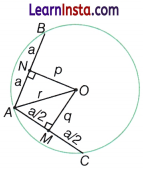
In ∆OMA and ∆ONA, by Pythagoras’ theorem,
AO2 = AM2 + MO2
⇒ AO2 = \(\left(\frac{a}{2}\right)^2+q^2\) [Let MO = q] ……(i)
and AO2 = (AN)2 + (NO)2
⇒ AO2 = a2 + p2 [Let NO = p] ……(ii)
From Eqs. (i) and (ii), we get
\(\left(\frac{a}{2}\right)^2+q^2\) = a2 + p2
⇒ 4q2 = 4p2 + 3a2 = p2 + 3(p2 + a2)
⇒ 4q2 = p2 + 3r2
[∵ In right-angled ∆ONA, r2 = a2 + p2]
Hence proved.
Question 3.
In the given figure, O is the centre of the circle and ∠BCO = 30°. Find x and y.
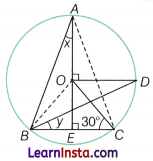
Solution:
In ∆BOC,
BO = CO [radii of a circle]
∴ ∠OCB = ∠OBC = 30°
[∵ Angles opposite to equal sides in a triangle are equal]
∴ ∠BOC = 180° – (∠OBC + ∠OCB) [by angle sum property of a triangle]
⇒ ∠BOC = 180° – (30° + 30°)
⇒ ∠BOC = 120°……(i)
Also, ∠BOC = 2∠BAC
[∵ angle subtended by the arc at the centre is double the angle subtended by it at any point on the remaining part of the circle]
∴ ∠BAC = \(\frac{120^{\circ}}{2}\) = 60° [dividing by 2]
Also, ∠BAE = ∠CAE = \(\frac{\angle B A C}{2}\) = 30°
⇒ ∠BAE = x = 30°
Then, ∠COE = ∠BOE = \(\frac {1}{2}\)∠BOC [using Eq. (i)]
= \(\frac {1}{2}\) × 120°
= 60°
Now, ∠DOE = 90° [∵ OD ⊥ AE]
∠DOC + ∠COE =90°
⇒ ∠DOC + 60° = 90°
⇒ ∠DOC = 90° – 60° = 30°
We know that ∠DOC = 2∠DBC
[∵ angle subtended by the arc at the centre is double the angle subtended by it at any point on the remaining part of the circle]
⇒ ∠DBC = \(\frac {1}{2}\) × ∠DOC
⇒ y = \(\frac {1}{2}\) × 30°
⇒ y = 15°
Question 4.
Prove that any angle subtended by a minor arc in the alternate segment is acute, and any angle subtended by a major arc in the alternate segment is obtuse.
Solution:
We know that the angles subtended by the arc of a circle at its centre are twice the angle subtended by it at any point on the remaining part of the circle.
Since \(\overparen{P Q}\) is a minor arc, ∠PRQ is the angle formed by it in the alternate segment.
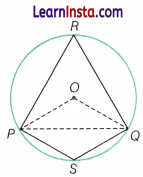
∴ 2∠PRQ = ∠POQ
⇒ 2∠PRQ < 180° [since ∠POQ is an angle of ∆POQ]
⇒ ∠PRQ < 90° So, ∠PRQ is an acute angle.
Now, \(\overparen{Q P}\) is a major arc and ∠PSQ is the angle formed by it in the alternate segment.
∴ 2∠PSQ = Reflex ∠POQ
⇒ 2∠PSQ = 360° – ∠POQ
⇒ 2∠PSQ > 360° – 180° [∵ ∠POQ < 180°]
⇒ 2∠PSQ > 180°
⇒ ∠PSQ > 90°
Hence, ∠PSQ is an obtuse angle.
Hence proved.
Question 5.
Prove that the midpoint of the hypotenuse of a right-angled triangle is equidistant from its vertices.
Solution:
Let ∆ABC be a right-angled triangle such that ∠BAC = 90°.
Let O be the midpoint of the hypotenuse BC.
Then, OB = OC with O as centre and OB as radius, draw a circle.
Clearly, this circle passes through the points B and C.
Now, suppose this circle does not pass through A.
Let BA (or its extension) meet the circle at A’.
Then, ∠BA’C = 90° [∵ angle in a semi-circle is 90°]
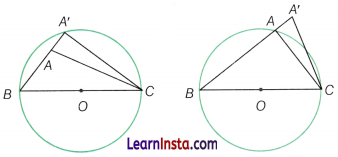
But, ∠BAC = 90°
∴ ∠BA’C = ∠BAC
This is possible only when A coincides with A’.
So, the circle that passes through B and C also passes through A.
Consequently, OA = OB = OC = Radius of the circle
Hence, the midpoint O of the hypotenuse BC of right-angled ∆ABC is equidistant from its vertices.
Hence proved.
I’m Up and Down and Round and Round Class 9 Case Based Questions
Question 1.The
Government of India is working regularly for the upliftment of handicapped persons by making them self-dependent. For this, three STD booths to be operated by handicapped persons were installed at A, B, and C, as shown in the figure. These three booths are equidistant from each other.
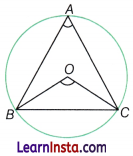
Based on the given information, answer the following questions.
(i) Which type of ΔABC is given in the figure?
(ii) Find the measure of ∠ABC.
(iii) (a) If AB = 6 cm then find the value of BC + CA.
Or
(b) Find the measure of ∠BOC.
Solution:
(i) Here, A, B, and C represent three STD booths.
As A, B, and C are equidistant from each other.
∴ AB = BC = CA
Hence, ΔABC is an equilateral triangle.
(ii) ∵ ΔABC is an equilateral triangle.
∴ AB = BC = CA
So, ∠ABC = ∠BAC = ∠BCA = 60°
(iii) (a) ∴ ΔABC is an equilateral triangle.
∴ AB = BC = CA
So, BC = CA = 6 cm [∵ AB = 6 cm, given]
Now, BC + CA = 6 + 6 = 12 cm
Or
(b) We know that the angle subtended by an arc at the centre of the circle is twice the angle subtended by it at any point on the remaining part of the circle.
∴ ∠BOC = 2∠BAC
⇒ ∠BOC = 2 × 60° = 120°
Question 2.
Given below is the figure of a circle with centre O. The measure of ∠BOC = 88°.
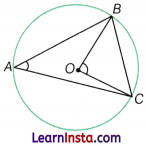
Based on the above information, answer the following questions.
(i) Find the measure of ∠BAC.
(ii) Priya claims, ‘The length of OB is equal to the length of OC. Siya and Aditi provide different justifications for Priya’s claim. Siya says, ‘OB and OC are radii of the same circle’. Aditi says, ‘OC is the base of ∆BOC’. Who has given the correct justification for Priya’s claim?
(iii) (a) Find the measure of ∠OBC.
Or
(b) If OB = 5 cm and BC = 8 cm, find the area of ΔBOC.
Solution:
(i) The angle subtended by the arc at the centre is double the angle subtended by it on the remaining part of the circle.
∴ ∠BOC = 2∠BAC
⇒ 88° = 2∠BAC
⇒ ∠BAC = \(\frac{88^{\circ}}{2}\) = 44°
∴ ∠BAC = 44°
(ii) OB and OC are the two radii of the same circle; OB and OC are equal.
Siya has given the correct justification.
(iii) (a) In ∆BOC, we have ∠BOC = 88°
and OB = OC [radii of same circle]
∴ ∠OBC = ∠OCB [∵ angles opposite to equal sides of a triangle are equal]
Now, ∠BOC + ∠OBC + ∠OCB = 180° [by angle sum property of a triangle]
⇒ 88° + ∠OBC + ∠OBC = 180° [∵ ∠OBC = ∠OCB]
⇒ 88 + 2∠OBC = 180°
⇒ 2∠OBC = 180°-88°
⇒ 2∠OBC = 92°
⇒ ∠OBC = 46°
Hence, ∠OBC = 46°
Or
(b) In ΔBOC, we have
OB = OC [radii of same circle]
∵ OB = 5 cm [given]
∴ OC = 5 cm and BC = 8 cm [given]
Draw OM ⊥ BC.
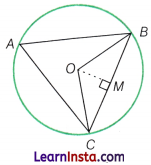
∴ MC = MB = \(\frac {1}{2}\)BC [∵ perpendicular from the centre to a chord bisects the chord]
= \(\frac {1}{2}\) × 8 [∵ BC = 8 cm]
= 4 cm
In right-angled ∆OMB, by Pythagoras’ theorem,
OB2 = OM2 + MB2
⇒ 52 = OM2 + 42 [∵ OB = 5 cm and MB = 4 cm]
⇒ OM2 = 25 – 16 = 9
⇒ OM = 3 cm
Now, area of ∆OMB = \(\frac {1}{2}\) × base × height
= \(\frac {1}{2}\) × BC × OM
= \(\frac {1}{2}\) × 8 × 3
= 12 cm2
Question 3.
Given below is the map giving the positions of four housing societies in a township, connected by a circular Road A.
Society 2 and 3 are connected by straight Road B, Society 4 and 2 are connected by straight Road C, and Society 4 and 3 are connected by Road D. Point P denotes the position of a park. The park is equidistant from all four societies. Rubina claims that it is not possible to construct another circular road connecting all four societies.
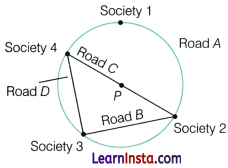
Based on the above information, answer the following questions.
(i) If P is the centre of a circular road, then find the angle at which Road B and Road D are connected.
(ii) What is the position of the Park P with respect to Road A?
(iii) (a) If the length of Road B is equal to the length of Road D and P is the centre of the circular road, then find the area of the region bounded by Road B, Road D, and Road C.
Or
(b) Alex says, ‘The angle made by Road B on Road D is a right angle.’ Jai and Angad give different justifications to support Alex’s claim. Jai says, ‘Angles in the same segment of a circle are equal.’ Angad says, ‘The angle in a semi-circle is a right angle’. Who has given the correct justification?
Solution:
(i) Since P is the centre of the circular road, Road C passes through P.
∴ Road C is the diameter of the circular road.
∴ Road D and Road B are connected at 90°.
[∵ angle in a semi-circle is a right angle]
(ii) The position of the Park P with respect to Road A is the centre of Road A.
(iii) (a) Given, length of Road B = length of Road D
Let the length of Road B = a
Then, the length of Road D = a
Road B and Road D are connected at 90°.
[∵ angle in a semi-circle is a right angle]
∴ Road B, Road D, and Road C make a right triangular region.
Now, area of the region bounded by Road D, Road B, and Road C = \(\frac {1}{2}\) × Base × Height
= \(\frac {1}{2}\) × a × a
= \(\frac{1}{2} a^2\) sq units
Or
(b) The angle made by Road B on Road D is a right angle because it lies in a semicircle.
Angad has given the correct justification.