MCQ on Prime Time Class 6
Class 6 Maths Chapter 5 MCQ Prime Time
Multiple Choice Questions
Question 1.
If 365 is divided by 24 and 90, then there will be a remainder ____________ in each case.
(a) 5
(b) 7
(c) 15
(d) 6
Answer:
(a) 5
Question 2.
Which of the following are pair of co-prime number?
(a) 9, 15
(b) 8, 30
(c) 7, 21
(d) 12, 35
Answer:
(d) 12, 35

Question 3.
The prime factorisation of 48 is
(a) 3 × 4 × 4
(b) 2 × 2 × 2 × 2 × 3
(c) 2 × 4 × 6
(d) None of these
Answer:
(b) 2 × 2 × 2 × 2 × 3
Question 4.
Which of the following is not a prime number?
(a) 31
(b) 41
(c) 51
(d) 71
Answer:
(c) 51
Question 5.
The number 28 is a
(a) Composite number
(b) Perfect number
(c) prime number
(d) Both (a) and (b)
Answer:
(d) Both (a) and (b)
Question 6.
72 is not a multiple of
(a) 8
(b) 12
(c) 18
(d) 16
Answer:
Option (d) is correct.
Explanation:
8, 12 and 18 are factors of 72.
Question 7.
______ is the only even prime number.
Answer:
2
Explanation:
2 is the only even prime number; rest all prime numbers are odd :
Question 8.
Which of the following is a pair of twin prime well as co-prime.
(a) 15, 17
(b) 63, 65
(c) 29, 31
(d) 43,45
Answer:
Option (c) is correct.
Explanation:
29 and 31 are twin prime as their difference is 2.
29 and 31 are co-prime as their common factor is 1.
Question 9.
Which of the following pairs is not coprime?
(a) 11, 12
(b) 1, 3
(c) 8, 10
(d) 31, 33
Answer:
Option (c) is correct.
Explanation:
Two numbers are coprime numbers if they have no other common factor except 1. In the given pairs of numbers, 8 and 10 have 1 as well as 2 as their common factor. So, these are not coprime number.
Question 10.
Which of the following numbers is not a factor of 342?
(a) 2
(b) 3
(c) 6
(d) 12
Answer:
Option (d) is correct.
Explanation:
The factors of 342 are 1, 2, 3, 6, 9, 18, 19, 38, 57, 114, 171, and 342
So, 12 is not a factor of 342.
Question 11.
Assertion (A) : The number 48 has 10 factors.
Reason (R) : Number of factors of a given number are finite.
(a) Both A and R are true and R is the correct explanation of A
(b) Both A and R are true and R is not the correct explanation of A.
(c) A is true but R is false
(d) A is false but R is true
Answer:
Option (a) is correct.
Explanation:
48 has 10 factors i.e., 1, 2, 3, 4, 6, 8, 12, 16, 24,48 and they can be counted.
Objective Type Questions
Question 1.
Write the number, which is:
(i) the factor of every number.
Answer:
1
(ii) having exactly one factor.
Answer:
1
(iii) the smallest prime number.
Answer:
2
(iv) the only even prime number.
Answer:
2
(v) the greatest one-digit prime number.
Answer:
7
Question 2.
Write the number, which is
(i) neither a prime number nor a composite number.
Answer:
1
(ii) the smallest composite number.
Answer:
4
(iii) the greatest one-digit composite number.
Answer:
9
(iv) the smallest odd composite number.
Answer:
9
(v) the smallest two-digit composite number.
Answer:
10
Fill in the blanks:
(i) There are ____________ prime numbers up to 100.
Answer:
25
(ii) A set of three consecutive prime numbers differing by ____________ is called a prime triplet.
[Note: Three consecutive prime numbers in which the second and third primes have a difference of two is called “prime triplet”.]
Answer:
2
(iii) A number for which the sum of all its factors is equal to twice the number is called a ____________ number.
Answer:
perfect
(iv) A ____________ of a number is an exact divisor of that number.
Answer:
factor
(v) Every number is a factor of ____________
Answer:
itself
Write:
(i) The seven consecutive composite numbers less than 100, having no prime number between them.
Answer:
90, 91, 92, 93, 94, 95, 96
(ii) A pair of twin primes between 40 and 50.
Answer:
(41, 43)
(iii) A prime triplet.
Answer:
(3, 5, 7)
(iv) A prime number between 90 and 100.
Answer:
97
Fun Activity
Question 1.
Complete the following crossword puzzle:
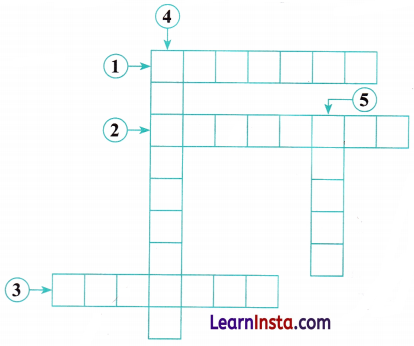
Directions:
Across:
(1) Two numbers are said to be ____________ numbers if they have no common factor other than 1.
(2) A number is said to be a ____________ of any of its factors.
(3) All those numbers which divide a given number exactly are called ____________ of the number.
Down:
(4) Numbers having more than two factors are called ____________ numbers.
(5) A number which is divisible by 1 and itself only is called a ____________ number.
Answer:
Across:
(1) Coprime
(2) Multiple
(3) Factors
Down:
(4) Composite
(5) Prime
Answer the following.
Question 1.
Find the common factors of:
(i) 15 and 18
Answer:
1 and 3
(ii) 9 and 12
Answer:
1 and 3
(iii) 12 and 18
Answer:
1, 2, 3 and 6
(iv) 24 and 90
Answer:
1, 2, 3 and 6
(v) 48 and 60
Answer:
1, 2, 3, 4, 6 and 12
(vi) 18 and 77
Answer:
1
(vii) 20, 25 and 30
Answer:
1 and 5
(viii) 40, 45 and 48
Answer:
1
Question 2.
Find the smallest number which when divided by 18,24 and 36 leaves a remainder 3 in each case.
Answer:
75
Question 3.
Find the smallest number of six digits which is divisible by 8, 15 and 21.
Answer:
100800
Question 4.
Fill the grid with prime numbers only so that the product of each row and each column is the number to the right of the row and below the column.
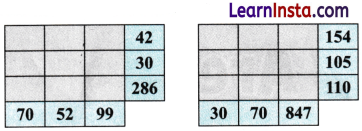
Answer:
