Students often refer to Ganita Manjari Class 9 Solutions and Part 1 Class 9 Maths Chapter 6 Measuring Space Perimeter and Area Solutions to verify their answers.
Measuring Space Perimeter and Area Class 9 Solutions
Class 9 Ganita Manjari Chapter 6 Solutions
Class 9 Maths Ganita Manjari Chapter 6 Solutions Measuring Space Perimeter and Area
Think and Reflect (NCERT Page 118)
Question 1.
In my school, the playground is too small to have a 400 m track, so the school constructed a 200 m track instead. Does this mean that we need a smaller stagger for the race tracks in my school (i.e., smaller than the stagger used in the Olympics), for the same 4 × 100 m relay race?
Solution:
Stagger compensates for the extra distance runners in outer lanes travel while going around curves.
In a 400 m race on a 400 m track, runners only navigate two curves, but in a 400 m race on a 200 m track, runners must navigate four curves.
Since running around the curves more times, the distance advantage of the inner lanes is doubled.
Therefore, the starting positions must be staggered even further forward for the outer lanes to ensure everyone runs exactly 400 m.
Hence, we would actually need a larger stagger for a 200 m track compared to the standard 400 m Olympic track for a 4 × 100 m relay.
Think and Reflect (NCERT Page 131)
Question 1.
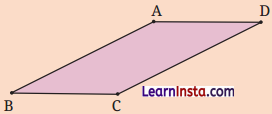
What happens if the parallelogram is ‘thin’ and the foot of the perpendicular from C to AD does not lie on side AD? The construction then does not seem to work. How do we fix this ‘gap’?
Solution:
In parallelogram ABCD, suppose we take BC as the base.
Now, when the parallelogram is thin, the perpendicular drawn from C to AD does not meet the side AD, but meets the extended line of DA.
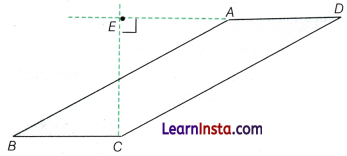
Therefore, we extend the side DA to a point E.
Now, draw CE ⊥ AD such that E lies on the extended line of DA.
From the diagram, CE is perpendicular to AD, and hence it represents the height corresponding to the base BC.
Then, area of parallelogram = Base × Height = BC × CE

Question 2.
The area of a rectangle can be found when we know the lengths of its sides. Is the same true for a parallelogram? That is, can we find the area of a parallelogram when we know the lengths of its sides? Why or why not?
Solution:
In a rectangle, we know that Area = Length × Breadth,
and both are sides; the area is found using side lengths.
Now, in a parallelogram,
Area = Base × Height
Also, the height is not equal to the side in general, and it depends on the angle between the sides.
Therefore, knowing only the lengths of the sides is not enough.
Hence, we cannot find the area of a parallelogram using only its side lengths; we also need the height (or angle).
Think and Reflect (NCERT Page 133)
Question 1.
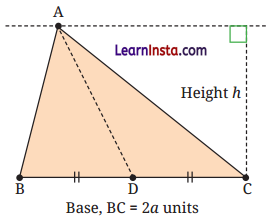
Since ∆ABD and ∆ACD have equal area, you may wonder: Can we divide ∆ABD using straight cuts into two or more pieces that we can then rearrange to exactly cover ∆ACD? What do you think? Is it possible?
Solution:
Yes, it is possible.
Since, BD = DC = a
∆ABD and ∆ACD have the same base and the same height h.
Now, area of ∆ABD = \(\frac {1}{2}\) × BD × h = \(\frac {1}{2}\) × a × h
Also, area of ∆ACD = \(\frac {1}{2}\) × DC × h = \(\frac {1}{2}\) × a × h
Here, the area of ∆ABD = the area of ∆ACD
So, ∆ABD can be cut into suitable straight pieces and rearranged to exactly cover ∆ACD, because both triangles have equal area.
Think and Reflect (NCERT Page 134)
Question 1.
Suppose we are given two polygons P and Q with equal area. Will it always be possible to divide one of them using straight cuts into two or more pieces and then rearrange the pieces to exactly cover the other polygon? Try this out for familiar shapes. e.g.,
1. A square and a non-square rectangle with equal area.
2. Two triangles with different shapes but equal area.
3. A triangle and a square with equal area. Formulate a conjecture of your own about this.
Solution:
Yes, it is always possible to divide one polygon into two or more pieces by straight cuts and then rearrange these pieces to exactly cover another polygon of equal area.
1. A square can be cut into suitable parts by straight cuts and then rearranged to form a rectangle of the same area.
Hence, a square and a rectangle of equal area can cover each other by rearrangement.
2. Two triangles may have different shapes, but if their areas are equal, then one triangle can be divided into pieces and rearranged to form the other triangle.
Hence, triangles of equal area can also cover each other.
3. A triangle can also be cut into suitable pieces and rearranged to form a square of the same area.
Hence, a triangle and a square of equal area can cover each other by rearrangement.
Question 2.
Think of various rectangles with a perimeter of 40 units (the sides do not have to be integers).
1. How many such rectangles are there?
2. Among them, is there one whose area is the largest? What are its dimensions?
3. Among all these rectangles, is there one whose area is the smallest? What are its dimensions? Do either of these answers come as a surprise to you?
Solution:
1. Let the length and breadth of a rectangle be l and b units.
Given, perimeter = 40 units
⇒ 2(l + b) = 40
⇒ l + b = 20
So, b = 20 – l
Since the sides need not be integers, l can take infinitely many values between 0 and 20.
Hence, there are infinitely many such rectangles.
2. Now, the area of a rectangle is A = l × b
= l(20 – l)
= 20l – l2
This area is maximum when l = 10.
Then, b = 20 – 10 = 10
Hence, the rectangle with the largest area is a square of side 10 units.
Its dimensions are 10 units × 10 units.
3. If l is taken very close to 0, then b is close to 20, and the area becomes very close to 0.
But l cannot be 0, because then it will not form a rectangle.
Hence, there is no rectangle with the smallest area.
The area can be made as small as we want, but it cannot be 0.
Think and Reflect (NCERT Page 142)
Question 1.
What procedure would you use to square a given triangle? Here, the task is to construct a square whose area is equal to the area of some given triangle. Think carefully. How would you proceed?
Solution:
Let the given triangle be ∆ABC.
Now, take BC as the base and draw the altitude AD from A to BC.
Then, area of triangle = \(\frac {1}{2}\) × BC × AD
Now, construct a rectangle having the same area as the triangle.
Take a rectangle with one side = \(\frac {BC}{2}\) and the other side = AD.
Then, area of rectangle = \(\frac {BC}{2}\) × AD = \(\frac {1}{2}\) × BC × AD
Hence, the rectangle has the same area as the triangle.
Now, convert this rectangle into a square of equal area.
Let the sides of the rectangle be l and b.
Construct a segment equal to l + b, and then find the mean proportional between l and b.
Thus, construct a square, whose side = \(\sqrt{l \times b}\)
Hence, area of square = \((\sqrt{l b})^2\) = l × b.
So, this square has the same area as the rectangle and also the given triangle.
Hence, a square equal in area to the given triangle is constructed.
Think and Reflect (NCERT Page 144)
Question 1.
Why were human beings so fond of using circular shapes? Was this only for practical reasons, or could there have been other reasons too? What kinds of uses have human beings found for the circular shape?
Solution:
Human beings liked circular shapes for both practical and other reasons.
Practical reasons: A circle can roll easily, so it is useful in wheels, pots, and tools.
Also, all points on a circle are at equal distance from the centre, so it is strong and balanced.
Other reasons: Circular shapes are seen in nature, like the Sun, Moon, and ripples in water, and they also look simple and pleasing.
Uses of circular shape: Used in wheels, coins, clocks, plates, buildings (domes), and many machines.
Hence, circular shapes are useful, strong, and also naturally appealing.
Ex 6.1 Class 9 Ganita Manjari Solutions – Ganita Manjari Class 9 Exercise 6.1 Solutions
Exercise 6.1 Class 9 Ganita Manjari Solutions – Ganita Manjari Class 9 Ex 6.1 Solutions
Unless stated otherwise, use the approximation \(\frac {22}{7}\) for π.
Question 1.
The perimeter of a circle is 44 cm. What is its radius?
Solution:
Given: The circumference of a circle, C = 44 cm
We know that C = 2πr
⇒ 44 = 2 × \(\frac {22}{7}\) × r
⇒ r = \(\frac{44}{2} \times \frac{7}{22}\) = 7 cm
Question 2.
Calculate, correct to 3 significant figures, the circumference of a circle with
(i) radius 7 cm
(ii) radius 10 cm
(iii) radius 12 cm
Solution:
(i) Given, radius (r) = 7 cm
Now, the circumference of a circle = 2πr
= 2 × \(\frac {22}{7}\) × 7
= 44 cm
Hence, the circumference correct to 3 significant figures is 44.0 cm.
(ii) Given, radius (r) = 10 cm
Now, the circumference of a circle = 2πr
= 2 × \(\frac {22}{7}\) × 10
= \(\frac {440}{7}\)
= 62.857 cm
Hence, the circumference correct to 3 significant figures is 62.9 cm.
(iii) Given, radius (r) = 12 cm
Now, the circumference of a circle = 2πr
= 2 × \(\frac {22}{7}\) × 12
= \(\frac {528}{7}\)
= 75.429 cm
Hence, the circumference correct to 3 significant figures is 75.4 cm.
Question 3.
Calculate the length of the arc of a circle if
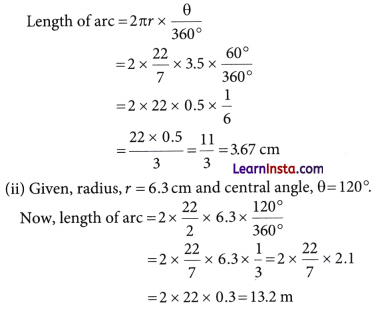
(i) The radius is 3.5 cm, and the angle at the centre is 60° and
(ii) The radius is 6.3 m, and the angle at the centre is 120°.
Solution:
(i) Given, radius, r = 3.5 cm and central angle, θ = 60°.
We know that
Question 4.
Find the perimeter of a sector (i.e., the curved portion as well as the two straight portions) of a circle of radius 14 cm and sector angle 75°.
Solution:
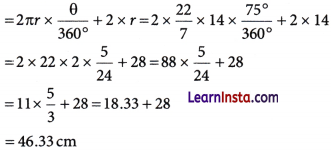
Given, radius (r) = 14 cm and sector angle (θ) = 75°.
Now, the perimeter of the sector = Length of arc + Length of two straight portions
= Length of arc + 2 × Radius
Question 5.
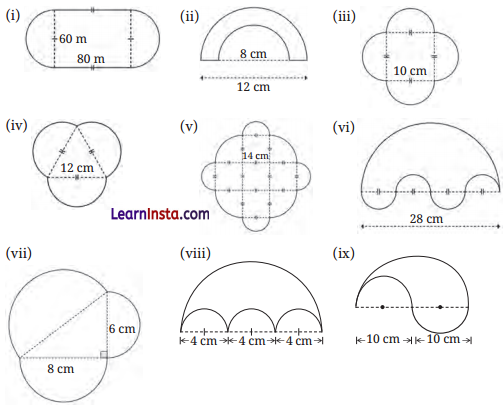
Find the perimeters of the following shapes (taking the arcs to be quarter or half or three-quarters of a circle, as appropriate).
Solution:
(i) The given shape consists of two semi-circles and two straight line segments.
Given the diameter of each semi-circle = 60 m.
So, radius (r) = 30 m
Also, the length of each straight side = 80 m
Now, perimeter = 2 × (Length of arc) of semi-circle + 2 × Length of straight side
= 2 × \(\frac{2 \pi r}{2}\) + 2 × 80
= 2 × \(\frac {22}{7}\) × 30 + 160
= 188.57 + 160
= 348.57 m
(ii) The given shape consists of a large outer semi-circle arc of radius, r1 = \(\frac {12}{2}\) = 6 cm
a small inner semi-circle arc of radius, r2 = \(\frac {8}{2}\) = 4 cm
and two flat base segment each measuring = \(\frac{12-8}{2}\) = 2 cm
Now, perimeter = \(\frac{2 \pi r_1}{2}+\frac{2 \pi r_2}{2}+2 \times 2\)
= \(\frac{22}{7} \times 6+\frac{22}{7} \times 4+4\)
= 18.86 + 12.57 + 4
= 35.43 cm
(iii) The given shape consists of four identical semi-circles, each with radius,
r = \(\frac {10}{2}\) = 5 cm
Now, perimeter = 4 × \(\frac{2 \pi r}{2}\)
= 4 × \(\frac {22}{7}\) × 5
= 62.86 cm
(iv) The shape consists of three identical semi-circles, each with radius,
r = \(\frac {12}{2}\) = 6 cm
Now, the perimeter = the sum of the arcs of three semi-circles
= 3 × \(\frac{2 \pi r}{2}\)
= 3 × \(\frac {22}{7}\) × 6
= 56.57 cm
(v) The given shape consists of four identical semi-circles, each with a radius,
r = \(\frac {14}{2}\) = 7 cm
and four identical quarters of circle of radius, r1 = \(\frac {14}{2}\) = 7 cm
Now, perimeter = Arcs of semi-circles + Arcs of quarter circles
= \(4 \times \frac{2 \pi r}{2}+4 \times 2 \pi r_1 \times \frac{1}{4}\)
= \(4 \times \frac{22}{7} \times 7+2 \times \frac{22}{7} \times 7\)
= 88 + 44
= 132 cm
(vi) The given shape consists of one large semi-circle of radius,
r = \(\frac {28}{2}\) = 14 cm
and four small identical semi-circles of radius, r1 = \(\frac{1}{2}\left(\frac{28}{4}\right)=\frac{7}{2} \mathrm{~cm}\)
Now, perimeter = Arc of large semi-circle + Arcs of four small semi-circles
= \(\frac{2 \pi r}{2}+4\left(\frac{2 \pi r_1}{2}\right)\)
= \(\frac{22}{7} \times 14+4 \times \frac{22}{7} \times \frac{7}{2}\)
= 44 + 44
= 88 cm
(vii) The given shape consists of three semi-circles, whose diameters are the sides of a right-angled triangle.
Given the sides are 6 cm and 8 cm.
Then, hypotenuse of triangle = \(\sqrt{8^2+6^2}\)
= \(\sqrt{64+36}\)
= √100
= 10 cm
So, the radii of the three semi-circles,
r1 = \(\frac {10}{2}\) = 5 cm, r2 = \(\frac {6}{2}\) = 3 cm, and r3 = \(\frac {8}{2}\) = 4 cm
Now, the perimeter of the shape = the sum of the arcs of three semi-circles
= \(\frac{2 \pi r_1}{2}+\frac{2 \pi r_2}{2}+\frac{2 \pi r_3}{2}\)
= πr1 + πr2 + πr3
= π(r1 + r2 + r3)
= π[5 + 3 + 4]
= \(\frac {22}{7}\) × 12
= 37.71 cm
(viii) The given shape consists of one large semi-circle of radius, r = \(\frac{4+4+4}{2}\) = 6 cm
and three small identical semi-circles each of radius, r1 = \(\frac {4}{2}\) = 2 cm
Now, perimeter = Arc of large semi-circle + Arcs of three small semi-circles
= \(\frac{2 \pi r}{2}+3 \times \frac{2 \pi r_1}{2}\)
= \(\frac{22}{7} \times 6+3 \times \frac{22}{7} \times 2\)
= \(\frac {22}{7}\)(6 + 6)
= \(\frac{22 \times 12}{7}\)
= 37.71 cm
(ix) The given shape consists of one large semicircle of radius, r = \(\frac{10+10}{2}\) = 10 cm
and two small identical semi-circles of radius, r1 = \(\frac {10}{2}\) = 5 cm
Now, perimeter = Arc of large semi-circle + Arcs of two small semi-circles
= \(\frac{2 \pi r}{2}+2 \times \frac{2 \pi r_1}{2}\)
= \(\frac{22}{7} \times 10+2 \times \frac{22}{7} \times 5\)
= \(\frac {22}{7}\)(10 + 10)
= \(\frac{22 \times 20}{7}\)
= 62.86 cm
Question 6.
If the diameter of a car tyre is 56 cm, then:
(i) How far does the car need to travel for the tyre to complete one revolution?
(ii) How many revolutions does the tyre make if the car travels 10 km?
Solution:
(i) One full revolution of a tyre is equal to its circumference.
The formula for circumference using diameter (d) is C = πd
Given: d = 56 cm
C = \(\frac {22}{7}\) × 56
= 176 cm
The car travels approximately 1.76 m for every one revolution.
(ii) To find the number of revolutions, we divide the total distance by the distance of one revolution (the circumference).
First, we must ensure the units match.
10 km = 10000 m
Number of revolutions = 10000 ÷ 1.76 ~ 5,681.8
The tyre makes approximately 5,682 revolutions to travel 10 km.
Question 7.
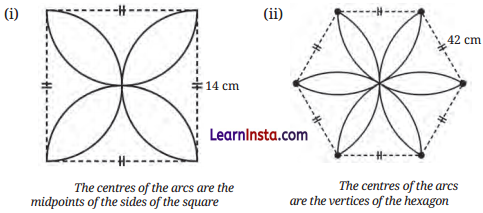
Find the total perimeter of all the petals in each of the given flowers.
Solution:
(i) From the given figure, the side of the square = 14 cm.
Each petal is formed by two arcs and each arc is quarter of circle of radius,
r = \(\frac {14}{2}\) = 7 cm
There are 4 petals, and each petal has 2 arcs.
Therefore, total number of arcs = 4 × 2 = 8 cm
Now, total perimeter of petals = \(8 \times 2 \pi r \times \frac{90^{\circ}}{360^{\circ}}\)
= \(8 \times 2 \times \frac{22}{7} \times 7 \times \frac{1}{4}\)
= 2 × 2 × 22
= 88 cm
(ii) From the given figure, each petal is formed by arcs centred at the vertices of a regular hexagon of side 42 cm.
Also, the arcs meet at the centre of the hexagon, and the distance from a vertex to the centre is equal to the side length;
therefore, r = 42 cm.
Since there are 6 petals and each petal consists of two 60° arcs. [∵ \(\frac{360^{\circ}}{6}=60^{\circ}\)]
∴ Number of arcs = 6 petals × 2 arcs/petal = 12 arcs
Now, length of each arc = \(2 \pi r \times \frac{60^{\circ}}{360^{\circ}}\)
= \(2 \times \frac{22}{7} \times 42 \times \frac{1}{6}\)
= 44 cm
Therefore, total perimeter = 12 × 44 = 528 cm
Hence, the total perimeter of all the petals is 528 cm.
Question 8.
The ratio of the perimeters of two circles is 5 : 4. What is the ratio of their radii?
Solution:
Let the radii of the two circles be r1 and r2, respectively.
Then, their perimeters (circumferences) will be 2πr1 and 2πr2, respectively.
Given: C1 : C2 = 5 : 4
⇒ 2πr1 : 2πr2 = 5 : 4
⇒ r1 : r2 = 5 : 4
Ex 6.2 Class 9 Ganita Manjari Solutions – Ganita Manjari Class 9 Exercise 6.2 Solutions
Exercise 6.2 Class 9 Ganita Manjari Solutions – Ganita Manjari Class 9 Ex 6.2 Solutions
Question 1.
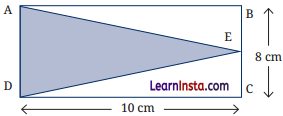
Find the area of ∆ADE in the figure below.
Solution:
Given, base AD = 10 cm and height DC = 8 cm.
Now, area of ∆ADE = \(\frac {1}{2}\) × Base × Height
= \(\frac {1}{2}\) × AD × DC
= \(\frac {1}{2}\) × 8 × 10
= 40 cm2
Question 2.
The parallel sides of a trapezium are 40 cm and 20 cm. If its non-parallel sides are both equal, each being 26 cm, find the area of the trapezium.
Solution:
Given the parallel sides of the trapezium are 40 cm and 20 cm.
Also, the non-parallel sides are equal, each 26 cm.
Since the non-parallel sides are equal, the trapezium is an isosceles trapezium, and hence it is a cyclic quadrilateral.
Now, using Brahmagupta’s formula,
Area = \(\sqrt{(s-a)(s-b)(s-c)(s-d)}\)
Where, s = \(\frac{a+b+c+d}{2}\)
= \(\frac{40+20+26+26}{2}\)
= \(\frac {112}{2}\)
= 56 cm
Hence, area = \(\sqrt{(56-40)(56-20)(56-26)(56-26)}\)
= \(\sqrt{16 \times 36 \times 30 \times 30}\)
= 4 × 6 × 30
= 720 cm2
Question 3.
Find the area of a triangle, given that its sides are 8 cm and 11 cm long and its perimeter is 32 cm.
Solution:
Sides: a = 8 cm, b = 11 cm.
Perimeter: 2s = 32 cm
⇒ Semi-perimeter (s) = 16 cm.
Third side (c): 32 – (8 + 11) = 13 cm.
Area of triangle = \(\sqrt{s(s-a)(s-b)(s-c)}\)
= \(\sqrt{16(16-8)(16-11)(16-13)}\)
= \(\sqrt{16 \times 8 \times 5 \times 3}\)
= 8√30 cm2
= 43.82 cm2
Question 4.
The sides of a triangular plot are in the ratio 3 : 5 : 7, its perimeter is 300 m. Find its area.
Solution:
Given that the sides of the triangular plot are in the ratio 3 : 5 : 7 and the perimeter = 300 m.
Let the sides of the plot be a = 3x, b = 5x, and c = 7x.
∴ 3x + 5x + 7x = 300
⇒ 15x = 300
⇒ x = 20
Therefore, the sides of the plot are a = 60 m, b = 100 m, and c = 140 m.
Using Heron’s formula,
Area of plot = \(\sqrt{s(s-a)(s-b)(s-c)}\)
s = \(\frac{\text { Perimeter }}{2}=\frac{300}{2}\) = 150 m
Hence, area of the triangular plot = \(\sqrt{150(150-60)(150-100)(150-140)}\)
= \(\sqrt{150 \times 90 \times 50 \times 10}\)
= \(\sqrt{6750000}\)
= 1500√3 m2
Question 5.
One diagonal of a rhombus is twice as long as the other diagonal. If the rhombus has an area of 128 cm2, find the length of the shorter diagonal.
Solution:
Given that one diagonal of the rhombus is twice the other diagonal.
Also, the area of the rhombus = 128 cm2
Let d be the shorter diagonal.
Then, the longer diagonal = 2d
Now, area of rhombus = \(\frac {1}{2}\) × d × 2d
⇒ 128 = d2
⇒ d = √128
⇒ d = 8√2 cm
Hence, the length of the shorter diagonal is 8√2 cm.
Question 6.
ABCD is a parallelogram. P and Q are any two points on side AB. What can you say about the ratio ar(ΔPCD) : ar(ΔQCD)?
Solution:
Since ABCD is a parallelogram, AB || CD.
Also, P and Q lie on AB.
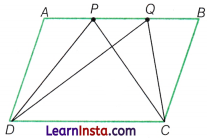
Now, the triangles PCD and QCD lie between the same parallel lines (AB and CD).
Hence, their height is the same, and also both the triangles have the base CD.
Therefore, the two triangles have the same area.
Hence, ar(ΔPCD) : ar(ΔQCD) = 1 : 1
Question 7.
O is any point on the diagonal PR of a parallelogram PQRS. Prove that the areas of triangles PSO and PQO are equal.
Solution:
Given, O is any point on the diagonal PR of the parallelogram PQRS.
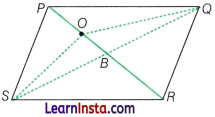
Join SQ, which intersects PR at B.
We know that the diagonals of a parallelogram bisect each other.
So, B is the midpoint of SQ.
Since the median of a triangle divides it into two triangles of equal areas.
Therefore, ar(ΔPSB) = ar(ΔPQB) ……(i)
[∵ PB is the median of ΔPQR]
Also, ar(ΔOSB) = ar(ΔOQB) ……(ii)
[∵ OB is the median of ΔOSQ]
On subtracting Eq. (ii) from Eq. (i), we get
ar(ΔPSB) – ar(ΔOSB) = ar(ΔPQB) – ar(ΔOQB)
⇒ ar(ΔPSO) = ar(ΔPQO)
Hence proved.
Question 8.
If the midpoints of the sides of a 4-gon (also known as a quadrilateral, but we prefer to call it a 4-gon) are joined in order, prove that the area of the parallelogram thus formed will be half of the area of the given 4-gon. (You may wonder whether the 4-gon thus formed is always a parallelogram and, if so, why? These questions will be tackled and answered in the chapter on quadrilaterals.)
Solution:
Consider a 4-gon ABCD with P, Q, R, and S as the midpoints of sides AB, BC, CD, and DA, respectively.
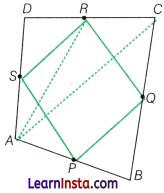
Join AC and AB.
Now, AR is the median of the ΔACD.
So, ar(ΔARD) = \(\frac {1}{2}\) ar(ΔACD) ……(i)
[∵ median divides a triangle into two triangles of equal area]
Also, RS is the median of the ΔARD.
So, ar (ΔSRD) = \(\frac {1}{2}\) ar (ΔARD) ……(ii)
Using Eqs. (i) and (ii), we get
ar (ΔSRD) = \(\frac {1}{2}\)[\(\frac {1}{2}\) ar (ΔACD)]
⇒ ar (ΔSRD) = \(\frac {1}{4}\) ar (ΔACD) …..(iii)
Similarly, ar (ΔPBQ) = \(\frac {1}{4}\) ar (ΔABC) …..(iv)
On adding Eqs. (iii) and (iv), we get
ar (ΔSRD) + ar (ΔPBQ) = \(\frac {1}{4}\) ar (ΔACD) + \(\frac {1}{4}\) ar (ΔABC)
⇒ ar (ΔSRD) + ar (ΔPBQ) = \(\frac {1}{4}\) ar (ABCD) ……(v)
Similarly, ar (ΔCRQ) + ar (ΔASP) = \(\frac {1}{4}\) ar (ABCD) …… (vi)
On adding Eqs. (v) and (vi), we get
ar (ΔSRD) + ar (ΔPBQ) + ar (ΔCRQ) + ar (ΔASP) = \(\frac {1}{4}\) ar (ABCD) + \(\frac {1}{4}\) ar (ABCD)
But, ar (ΔSRD) + ar (ΔPBQ) + ar (ΔCRQ) + ar (ΔASP) = ar (ABCD) – ar(PQRS)
∴ ar (ABCD) – ar (PQRS) = \(\frac {2}{4}\) ar (ABCD)
⇒ ar (ABCD) – \(\frac {1}{2}\) ar (ABCD) = ar (PQRS)
⇒ \(\frac {1}{2}\) (ABCD) = ar (PQRS)
⇒ ar (PQRS) = \(\frac {1}{2}\) ar (ABCD)
Hence, the area of the parallelogram formed is half of the area of the given quadrilateral.
Question 9.
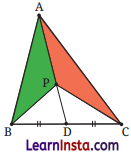
In ΔABC, the midpoint of BC is D. Median AD is drawn. P is any point on AD. Show that ar (ΔABP) = ar (ΔACP).
Solution:
Given: BD = DC
To prove: Area (∆ABP) = Area (∆ACP)
Proof: Since AD is the median of ∆ABC.
Area (∆ABD) = Area (∆ACD) …..(i)
(The median of a triangle divides it into two triangles of equal area)
Also, in ∆PBC, PD is the median.
Area (∆PBD) = Area (∆PCD) ….(ii)
(Median of a triangle divides it into two triangles of equal area)
Subtracting eqn. (ii) from eqn. (i),
Area (∆ABD) – Area (∆PBD) = Area (∆ACD) – Area (∆PCD)
⇒ Area (∆ABP) = Area (∆ACP)
Question 10.
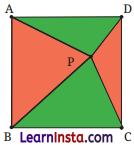
Given a square ABCD. Let P be a point within it. Join PA, PB, PC, and PD. What is the ratio of the areas of the red region (ΔPAB and ΔPCD) and the green region (ΔPBC and ΔPDA)?
Solution:
Let s be the side of the square, and h1 be the perpendicular distance of P from AB, and h2 be the perpendicular distance of P from CD.
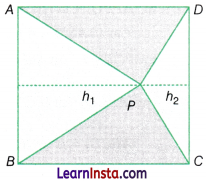
Since AB || CD
h1 + h2 = s
Now, area of ΔPAB = \(\frac {1}{2}\) × AB × h1 …..(i)
area of ΔPDC = \(\frac {1}{2}\) × DC × h2
⇒ area of ΔPDC = \(\frac {1}{2}\) × AB × h2 ……(ii)
[∵ AB = DC]
On adding Eqs. (i) and (ii), we get
ar (ΔPAB) + ar (ΔPDC) = \(\frac{1}{2} \times A B \times h_1+\frac{1}{2} \times A B \times h_2\)
= \(\frac{1}{2} \times A B\left(h_1+h_2\right)\)
= \(\frac {1}{2}\) × AB × s
= \(\frac {1}{2}\) × s × s
⇒ ar (ΔPAB) + ar (ΔPDC) = \(\frac{1}{2} s^2\) ……(iii)
Now, ar (ΔPAD) + ar (ΔPBC) = Area of square – [ar (ΔPAB) + ar (ΔPDC)]
= \(s^2-\frac{1}{2} s^2\)
⇒ ar (ΔPAD) + ar (ΔPBC) = \(\frac{1}{2} s^2\) ……(iv)
From Eqs. (iii) and (iv), we have
ar (ΔPAB) + ar (ΔPCD) = ar (ΔPBC) + ar (ΔPDA)
So, the areas of the green region and the red region are equal to \(\frac{1}{2} s^2\).
Hence, ar (red region) : ar (green region) = 1 : 1.
Question 11.
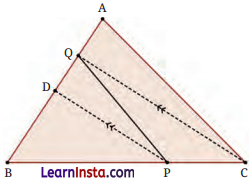
In ΔABC, D is the midpoint of AB. P is any point on BC, and Q is a point on AB such that CQ || PD. PQ is joined. Prove that ar (ΔBPQ) = \(\frac {1}{2}\) ar (ΔABC).
Solution:
Given, D is the midpoint of AB, and join CD.
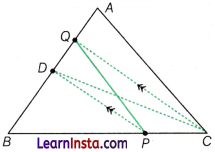
Since D is the midpoint of AB and CD is the median of ΔABC.
Therefore, ar (ΔBCD) = \(\frac {1}{2}\) ar (ΔABC)
Also, ar (ΔBCD) = ar (ΔBPD) + ar (ΔDPC)
So, ar (ΔBPD) + ar (ΔDPC) = \(\frac {1}{2}\) ar (ΔABC) ……. (i)
Now, triangles DPQ and DPC have the same base DP and lie between the same parallel lines DP and QC, thus having the same height.
Hence, the triangles have the same area.
∴ ar (ΔDPQ) = ar (ΔDPC) …….(ii)
On substituting Eq. (ii) in Eq. (i), we get
ar (ΔBPD) + ar (ΔDPQ) = \(\frac {1}{2}\) ar (ΔABC) ……(iii)
Now, ar (ΔBPD) + ar (ΔDPQ) = ar (ΔBPQ)
Therefore, from Eq. (iii), we get
ar (ΔBPQ) = \(\frac {1}{2}\) ar (ΔABC)
Hence proved.
Ex 6.3 Class 9 Ganita Manjari Solutions – Ganita Manjari Class 9 Exercise 6.3 Solutions
Exercise 6.3 Class 9 Ganita Manjari Solutions – Ganita Manjari Class 9 Ex 6.3 Solutions
Unless stated otherwise, use the approximation \(\frac {22}{7}\) for π.
Question 1.
Find the area of a sector of a circle with radius 7 cm if the angle of the sector is 60°.
Solution:
Given, radius (r) = 7 cm and angle (θ) = 60°.
We know that area of sector = \(\pi r^2 \times \frac{\theta}{360^{\circ}}\)
= \(\frac{22}{7} \times 7 \times 7 \times \frac{60^{\circ}}{360^{\circ}}\)
= 22 × 7 × \(\frac {1}{6}\)
= 25.67 cm2
Question 2.
Find the area of a quadrant of a circle, whose circumference is 44 cm.
Solution:
Let r be the radius of the circle.
Given, the circumference of the circle = 44 cm
∴ 2πr = 44
⇒ 2 × \(\frac {22}{7}\) × r = 44
⇒ \(\frac {r}{7}\) = 1
⇒ r = 7 cm
In a quadrant of a circle, the central angle (θ) = 90°.
∴ Area of the quadrant of the circle = \(\frac{\theta}{360^{\circ}} \times \pi r^2\)
= \(\frac{90^{\circ}}{360^{\circ}} \times \pi r^2\)
= \(\frac{1}{4} \times \frac{22}{7} \times 7 \times 7\)
= \(\frac {11}{2}\) × 7
= 38.5 cm2
Question 3.
The length of the minute hand of a clock is 7 cm. Find the area swept by the minute hand in 10 min.
Solution:
Given, length of minute hand = 7 cm
So, radius (r) = 7 cm
The minute hand covers one full circle in 60 min.
Now, angle covered in 1 min = \(\frac{360^{\circ}}{60}\) = 6°
So, angle covered in 10 min = 6° × 10 = 60°
Now, area swept by minute hand in 10 min = \(\frac{\theta}{360^{\circ}} \times \pi r^2\)
= \(\frac{60^{\circ}}{360^{\circ}} \times \frac{22}{7} \times 7 \times 7\)
= \(\frac {1}{6}\) × 22 × 7
= 25.67 cm2
Question 4.
A chord of a circle of radius 10 cm subtends 90° at the centre. Find the area of the corresponding (i) minor sector (that subtends 90° at the centre) and (ii) major sector (that subtends 270° at the centre), [use π = 3.14]
Solution:
Given, radius (r) = 10 cm and angle (θ) = 90°.
We know that area of sector = \(\frac{\theta}{360^{\circ}} \times \pi r^2\)
(i) Area of minor sector = \(\frac{90^{\circ}}{360^{\circ}} \times \pi \times 10^2\)
= \(\frac {1}{4}\) × 3.14 × 10 × 10
= 78.5 cm2
(ii) Area of major sector = Area of the circle – Area of minor sector
= πr2 – 78.5
= 3.14 × 10 × 10 – 78.5
= 314 – 78.5
= 235.5 cm2
Question 5.
A chord of a circle of radius 15 cm subtends an angle of 60° at the centre of the circle. Find the areas of the corresponding minor and major segments of the circle, [use π ~ 3.14 and √3 ~ 1.73]
Solution:
Let AB be the chord, which subtends a 60° angle at the centre O.
Here, r = 15 cm
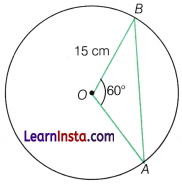
Given, angle of minor sector = 60°.
So, area ot minor sector = \(\frac{60^{\circ}}{360^{\circ}} \times \pi r^2\)
= \(\frac {1}{6}\) × 3.14 × 15 × 15
= 117.75 cm2
In ∆OAB,
OA = OB = 15 cm
∴ ∠OAB = ∠OBA [∵ angles opposite to equal sides are equal]
Now, in ∆OAB,
∠OAB + ∠OBA + ∠AOB = 180°
⇒ ∠OAB + ∠OAB + 60° = 180°
⇒ 2∠OAB = 180° – 60°
⇒ 2∠OAB = 120°
⇒ ∠OAB = 60°
Since, ∠OAB = ∠OBA = ∠AOB = 60°
So, ∆AOB is an equilateral triangle.
Now, area of ∆AOB = \(\frac{\sqrt{3}}{4}\) × (Side)2
= \(\frac{\sqrt{3}}{4}\) × 15 × 15
= \(\frac{1.73 \times 15 \times 15}{4}\)
= 97.31 cm2
Now, the area of the minor segment = Area of sector OAB – Area of ∆OAB
= 117.75 – 97.31
= 20.44 cm2
Therefore, the area of the major segment = Area of the circle – Area of the minor segment
= π × (15)2 – 20.44
= 3.14 × 225 – 20.44
= 706.5 – 20.44
= 686.06 cm2
Question 6.
A car has two wipers, which do not overlap. Each wiper has a blade of length 28 cm and sweeps through an angle of 120°. Find the total area cleaned at each sweep of the blades.
Solution:
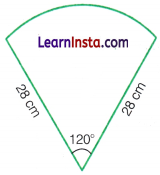
Now, the area cleaned by the sweep of the blades of each wiper = Area of a sector with angle 120° at the centre and radius of 28 cm.
Given two wipers of the same blade length and the same angle of sweeping, there is no area of overlap for the wipers.
Now, total area cleaned by both wipers = \(2 \times \pi r^2 \times \frac{\theta}{360^{\circ}}\)
= \(2 \times \frac{22}{7} \times 28 \times 28 \times \frac{120^{\circ}}{360^{\circ}}\)
= 2 × 22 × 4 × 28 × \(\frac {1}{3}\)
= 1642.67 cm2
Question 7.
A chord of a circle of radius r subtends an angle of 60° at the centre of the circle. Show that the area of the corresponding minor segment of the circle is equal to \(2 \times \frac{22}{7} \times 28 \times 28 \times \frac{120^{\circ}}{360^{\circ}}\).
Solution:
Let AB be the chord subtending a 60° angle at the centre.
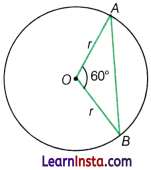
In ∆OAB,
OA = OB = r
⇒ ∠OAB = ∠OBA [∵ angles opposite equal sides are equal]
Now, in ∆OAB,
∠OAB + ∠OBA + ∠BOA = 180°
⇒ ∠OAB + ∠OAB + 60° = 180°
⇒ 2∠OAB = 180° – 60°
⇒ 2∠OAB = 120°
⇒ ∠OAB = 60°
∵ ∠OAB = ∠OBA = ∠AOB = 60°
∴ ∆OAB is an equilateral triangle.
Now, area of ∆OAB = \(\frac{\sqrt{3}}{4}\) × (Side)2 = \(\frac{\sqrt{3}}{4}\) × r2
Therefore, the area of the minor segment = Area of the minor sector – Area of ∆OAB
= \(\pi r^2 \times \frac{60^{\circ}}{360^{\circ}}-\frac{\sqrt{3}}{4} \times r^2\)
= \(\pi r^2 \times \frac{1}{6}-\frac{\sqrt{3}}{4} \times r^2\)
= \(r^2\left[\frac{\pi}{6}-\frac{\sqrt{3}}{4}\right]\)
Hence proved.
Question 8.
An equilateral triangle is inscribed in a circle of radius r. Show that the ratio of the area of the triangle to the area of the circle is equal to \(\frac{3 \sqrt{3}}{4 \pi} \approx 0.413\).
Solution:
Let a be the side of an equilateral triangle inscribed in a circle of radius r.
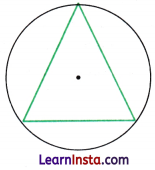
Now, the area of the triangle inside the circle with radius (r) = \(\frac{a \cdot a \cdot a}{4 r}=\frac{a^3}{4 r}\)
Also, area of equilateral triangle = \(\frac{\sqrt{3}}{4} a^2\)
Thus, we have \(\frac{\sqrt{3}}{4} a^2=\frac{a^3}{4 r}\)
⇒ √3r = a
⇒ a = √3r
Now, area of triangle inside circle = \(\frac{(\sqrt{3} r)^3}{4 r}\)
= \(\frac{3 \sqrt{3} r^3}{4 r}\)
= \(\frac{3 \sqrt{3} r^2}{4}\)
Also, the area of a circle = πr2
Thus, the ratio of the area of the triangle to the area of the circle = \(\frac{3 \sqrt{3} r^2}{4}: \pi r^2\)
= \(\frac{3 \sqrt{3}}{4}: \pi\)
= \(\frac{3 \sqrt{3}}{4 \pi} \approx 0.413\)
Hence proved.
Question 9.
A square is inscribed in a circle of radius r. Show that the ratio of the area of the square to the area of the circle is equal to \(\frac{2}{\pi} \approx 0.637\).
Solution:
Let the side of the square inscribed in a circle of radius r be a.
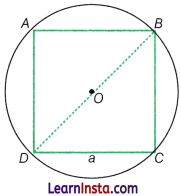
Here, BD is the diameter of the circle.
BD = 2r
Also, BD2 = DC2 + CB2
⇒ (2r)2 = a2 + a2
⇒ 4r2 = 2a2
⇒ a = √2r
Now, area of the square = a2 = (√2r)2 = 2r2
Also, the area of the circle = πr2
Therefore, \(\frac{\text { area of the square }}{\text { area of the circle }}=\frac{2 r^2}{\pi r^2}=\frac{2}{\pi} \approx 0.637\).
Hence proved.
Question 10.
A hexagon is inscribed in a circle of radius r. Show that the ratio of the area of the hexagon to the area of the circle is equal to \(\frac{3 \sqrt{3}}{2 \pi} \approx 0.827\). Can you see why the answer is exactly twice the answer to Question 8?
Solution:
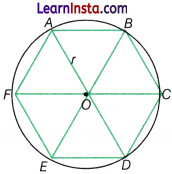
Let ABCDEF be the hexagon inscribed in a circle of centre O and radius r.
Join O to all the vertices of the hexagon.
Since ABCDEF is a regular hexagon, the angle subtended by each of its sides at the centre is \(\frac{360^{\circ}}{6}\) = 60°.
Consider ∆AOB; we have AO = BO = r
⇒ ∠OAB = ∠OBA [∵ angles opposite equal sides are equal]
Now, ∠OAB + ∠OBA + ∠AOB = 180°
⇒ ∠OAB + ∠OAB + 60° = 180°
⇒ 2∠OAB = 180° – 60°
⇒ 2∠OAB = 120°
⇒ ∠OAB = 60°
So, ∆OAB is an equilateral triangle with side r.
Similarly, all 6 triangles formed by the hexagon are equilateral.
So, area of the hexagon = \(6 \times \frac{\sqrt{3}}{4} r^2\) = \(\frac{3 \sqrt{3} r^2}{2}\)
Therefore, \(\frac{\text { area of the hexagon }}{\text { area of the circle }}=\frac{3 \sqrt{3} r^2}{2 \times \pi r^2}\) = \(\frac{3 \sqrt{3}}{2 \pi} \approx 0.827\)
Since the number of sides of a hexagon is twice the number of sides of a triangle, and both are being compared to the same circle.
Therefore, the ratio for the hexagon is exactly twice the ratio for the triangle.
Ganita Manjari Class 9 Maths Chapter 6 End of Chapter Exercise Solutions
Measuring Space Perimeter and Area End of Chapter Exercise Solutions
In the problems below, unless stated otherwise, use the approximation \(\frac {22}{7}\) for π.
Question 1.
Identities in algebra can sometimes be shown as area relationships. For example:
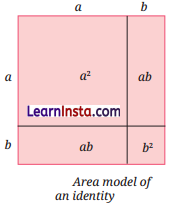
The figure shown corresponds to the identity (a + b)2 = a2 + 2ab + b2. Do you see how?
Draw figures corresponding to the identities (a + b)(a – b) = a2 – b2 and (a + b + c)2 = a2 + b2 + c2 + 2ab + 2bc + 2ca.
Solution:
The big square has each side a + b.
∴ Area of the big square = (a + b)2
The big square is divided into four smaller parts: one square of area a2, one square of area b2, and two rectangles, each of area ab.
Now, sum of squares of all parts = a2 + ab + ab + b2
= a2 + 2ab + b2
= (a + b)2
= Area of big square
For, (a + b)(a – b) = a2 – b2
This identity is shown by taking a large square of side a and removing a smaller square of side b from one corner.
Step 1: Start with a square of area a2.
Step 2: Cut out a small square of area b2 from the bottom right. The remaining area is a2 – b2.
Step 3: The remaining shape (an L-shape) can be cut and rearranged into a rectangle with sides (a + b) and (a – b).
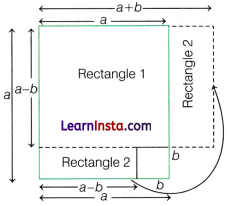
Here, a(a – b) + b(a – b) = a2 – ab + ba – b2 = a2 – b2
For, (a + b + c)2 = a2 + b2 + c2 + 2ab + 2bc + 2ca
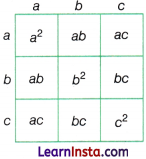
Here, the square of side = (a + b + c)
The area of the square is (a + b + c)2
The square can be divided into smaller parts consisting of three squares of area a2, b2, and c2, and six rectangles, whose total area is 2ab + 2bc + 2ca.
Thus, the total area of the square is equal to a2 + b2 + c2 + 2ab + 2bc + 2ca.
Question 2.
An isosceles triangle has a perimeter of 40 cm, and the equal sides are 15 cm each. Find the area of the triangle.
Solution:
Let ABC be an isosceles triangle with AB = AC = 15 cm.
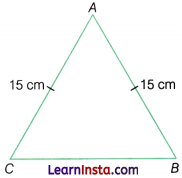
Given the perimeter of ∆ABC = 40 cm
Now, BC = 40 – 15 – 15
⇒ BC = 10 cm
Also, semi-perimeter
s = \(\frac{a+b+c}{2}\)
= \(\frac{15+15+10}{2}\)
= 20 cm
Using Heron’s formula,
Area of ∆ABC = \(\sqrt{s(s-a)(s-b)(s-c)}\)
= \(\sqrt{20(20-15)(20-15)(20-10)}\)
= \(\sqrt{20 \times 5 \times 5 \times 10}\)
= 5 × 10 × √2
= 50√2 cm2
Question 3.
An isosceles triangle has a base of 10 cm, and its area is 60 cm2. What are the lengths of the equal sides?
Solution:
Let the lengths of the equal sides be x.
Using Heron’s formula,
Area of triangle = \(\sqrt{s(s-a)(s-b)(s-c)}\) = \(\sqrt{s(s-x)(s-x)(s-10)}\)
⇒ 60 = (s – x) \(\sqrt{s(s-10)}\)
Also, s = \(\frac{x+x+10}{2}=\frac{2 x+10}{2}\)
⇒ s = x + 5
So, 60 = (x + 5 – x) \(\sqrt{(x+5)(x+5-10)}\)
⇒ 60 = \(5 \sqrt{(x+5)(x-5)}\)
⇒ 60 = \(5 \sqrt{x^2-25}\)
⇒ 12 = \(\sqrt{x^2-25}\)
On squaring both sides, we get
⇒ 144 = x2 – 25
⇒ x2 = 144 + 25
⇒ x2 = 169
⇒ x = ±13
Since x can’t be negative, x = 13.
Hence, the equal sides are 13 cm.
Question 4.
The area of a right-angled triangle is 54 cm2. One of its legs has a length of 12 cm. Find its perimeter.
Solution:
Let the legs of the right-angled triangle be AB = 12 cm and BC.
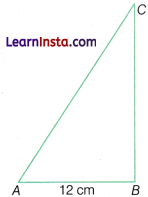
Area of a right triangle, A = \(\frac {1}{2}\) × base × height
⇒ 54 = \(\frac {1}{2}\) × b × 12
⇒ b = 9 cm
Using Baudhayana-Pythagoras theorem,
h = \(\sqrt{12^2+9^2}=\sqrt{225}\) = 15 cm
So, the perimeter of the triangle = 12 + 9 + 15 = 36 cm.
Question 5.
The sides of a triangle are in the ratio 2 : 3 : 4, and its perimeter is 45 cm. Find its area.
Solution:
Let the sides of the triangle be 2x, 3x, and 4x.
Given, perimeter = 45 cm
∴ 2x + 3x + 4x = 45
⇒ 9x = 45
⇒ x = 5
Thus, the sides of the triangle are 10 cm, 15 cm, and 20 cm.
Also, s = \(\frac{10+15+20}{2}\) = 22.5 cm
Using Heron’s formula,
Area = \(\sqrt{s(s-a)(s-b)(s-c)}\)
= \(\sqrt{22.5(22.5-10)(22.5-15)(22.5-20)}\)
= \(\sqrt{22.5 \times 12.5 \times 7.5 \times 2.5}\)
= \(\frac{1}{4} \times 75 \sqrt{15}\)
= \(\frac{75 \sqrt{15}}{4}\) cm
Question 6
The sides of a triangle have lengths 7 cm, 24 cm, and 25 cm. Find the area of the triangle in two different ways.
Solution:
Let the sides be a = 7 cm, b = 24 cm, and c = 25 cm.
Then, the semi-perimeter, s = \(\frac{a+b+c}{2}=\frac{7+24+25}{2}=\frac{56}{2}\) = 28 cm
Now, using Heron’s formula,
Area = \(\sqrt{s(s-a)(s-b)(s-c)}\)
= \(\sqrt{28(28-7)(28-24)(28-25)}\)
= \(\sqrt{28 \times 21 \times 4 \times 3}\)
= \(\sqrt{7 \times 4 \times 7 \times 3 \times 4 \times 3}\)
= \(\sqrt{7^2 \times 3^2 \times 4^2}\)
= 7 × 3 × 4
= 84 cm2
Now, 72 + 242 = 49 + 576 = 625 = 252
So, 7, 24, and 25 form a Pythagorean triplet.
Hence, these sides form a right-angled triangle.
Now, area of right angled triangle = \(\frac {1}{2}\) × Product of lengths its legs
= \(\frac {1}{2}\) × 7 × 24
= 12 × 7
= 84 cm2
Question 7.
If the wheel of a bicycle has a diameter of 60 cm, find how far a cyclist will have travelled after the wheel has rotated 100 times.
Solution:
Given, diameter of the wheel = 60 cm
and number of rotations = 100
Now, the circumference of the wheel = 2πr
= 2π × 30
= 60π
Distance travelled in one rotation = 60π cm
Therefore, the distance u travelled in 100 rotations = 100 × 60π
= 6000π
= 6000 × \(\frac {22}{7}\)
= 18857.14 cm
Question 8.
Find the area of a quadrant of a circle, whose circumference is 66 cm.
Solution:
Given, circumference of the circle = 66 cm
Now, we know that circumference = 2πr
So, 2πr = 66
⇒ r = \(\frac{66}{2 \pi}\)
⇒ r = \(\frac{66}{2 \times \frac{22}{7}}\)
⇒ r = \(\frac{66 \times 7}{44}\)
⇒ r = 10.5 cm
Now, area of a quadrant = \(\frac{1}{4} \pi r^2\)
= \(\frac{1}{4} \times \frac{22}{7} \times(10.5)^2\)
= \(\frac{1}{4} \times \frac{22}{7} \times 110.25\)
= \(\frac {1}{4}\) × 346.5
= 86.625 cm2
Hence, the area of the quadrant is 86.625 cm2.
Question 9.
The wheel of a car has an outer radius of 28 cm. Calculate how far the car travels after one complete turn of the wheel and how many times the wheel turns during a journey of 1 km.
Solution:
Given the outer radius of the wheel, r = 28 cm
Now, the distance travelled in one complete turn = the circumference of the wheel
= 2πr
= 2 × \(\frac {22}{7}\) × 28
= 176 cm
Hence, distance travelled in one complete turn = 176 cm.
Now, the total distance of the journey = 1 km
= 1000 m
= 100000 cm
∴ Number of turns = \(\frac{\text { Total distance }}{\text { Distance in one turn }}\)
= \(\frac {100000}{176}\)
= 568.18 (approx)
Since the number of turns is taken as a whole number.
Hence, the number of complete turns is 568.
Question 10.
Two rectangles have the same area and the same perimeter. Does this mean that they are congruent to each other?
Solution:
Yes. If two rectangles have the same area (A) and the same perimeter (P), they must be congruent (meaning their lengths and widths are identical).
Congruent Dimensions: For rectangles, the Area (A = l × b) and Perimeter [P = 2(l + b)] systems of equations have only one unique solution for l and b.
Unique Shape: If both l1 × b1 = l2 × b2 and 2(l1 + b1) = 2(l2 + b2), the rectangles must be identical.
Counter-Example Logic: While a 4 × 4 square (A = 16 and P = 16) and a 2 × 6 rectangle (A = 12 and P = 16) have the same perimeter, their areas differ.
If the areas are also forced to be 16, only the 4 × 4 square works, forcing congruence.
Question 11.
You know that the area of a parallelogram is base × height. Using this and the figure, show that the area of a trapezium is half the sum of the parallel sides × height, i.e., \(\frac {1}{2}\)(a + b)h.
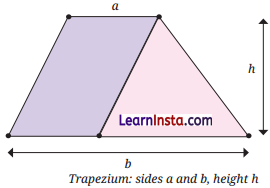
Solution:
Given the parallel sides of the trapezium are a and b, and its height is h.
From the figure, the trapezium is divided into a parallelogram and a triangle.
Now, area of parallelogram = Base × Height
= a × h
= ah
Now, the remaining part is a triangle.
So, the base of the triangle = b – a and the height of the triangle = h
Now, area of triangle = \(\frac {1}{2}\)(b – a)h
Hence, area of trapezium = ah + \(\frac {1}{2}\)(b – a)h
= \(\frac{2 a h+(b-a) h}{2}\)
= \(\frac{(2 a+b-a) h}{2}\)
= \(\frac{(a+b) h}{2}\)
Question 12.
By dividing a trapezium into two triangles, show that its area is half the sum of the parallel sides multiplied by the height (the same formula as the one given in the question above).
Solution:
Let ABCD be a trapezium in which AB || CD, where AB = a, CD = b, and the height is h.
Join diagonal AC.
Then, the trapezium is divided into two triangles ABC and ADC.
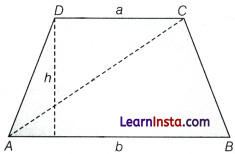
Now, area of ∆ABC = \(\frac {1}{2}\) × AB × h = \(\frac {1}{2}\)ah
and area of ∆ADC = \(\frac {1}{2}\) × CD × h = \(\frac {1}{2}\)bh
Hence, the area of trapezium ABCD = the area of ∆ABC + the area of ∆ADC
= \(\frac {1}{2}\)ah + \(\frac {1}{2}\)bh
= \(\frac {1}{2}\)(a + b)h
Hence, the area of a trapezium is half the sum of the parallel sides multiplied by the height.
Question 13.
Show how we can use two identical copies of a trapezium to make a parallelogram. How will this give us the formula for the area of a trapezium?
Solution:
Let a trapezium have parallel sides a and b, and height h.
Now, take two identical copies of this trapezium.
Place one of them inverted and adjacent to the other so that together they form a parallelogram.
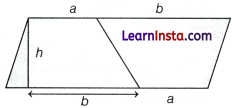
Now, in this parallelogram, base = a + b and height = h.
So, area of parallelogram = Base × Height = (a + b)h
Also, this parallelogram is made of two identical trapezoids.
So, area of one trapezium = \(\frac {1}{2}\) × Area of parallelogram = \(\frac {1}{2}\)(a + b)h
Question 14.
Show that the area of a kite is half the product of its diagonals. Show this (i) using algebra and (ii) using geometry.
Solution:
Let ABCD be a kite in which diagonals AC and BD intersect at O.
Let AC = d1 and BD = d2
(i) Using Algebra: In a kite, the diagonals are perpendicular and one diagonal bisects the other.
So, AC ⊥ BD and BO = OD = \(\frac{d_2}{2}\)
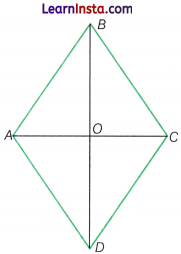
Now, Area of kite ABCD = Area of ∆ABC + Area of ∆ADC
Now, Area of ∆ABC = \(\frac {1}{2}\) × AC × BC = \(\frac{1}{2} \times d_1 \times \frac{d_2}{2}\)
Also, Area of ∆ADC = \(\frac {1}{2}\) × AC × OD = \(\frac{1}{2} \times d_1 \times \frac{d_2}{2}\)
Now, adding both, we get
Area of kite = \(\frac{1}{2} d_1 \cdot \frac{d_2}{2}+\frac{1}{2} d_1 \cdot \frac{d_2}{2}\) = \(\frac{1}{2} d_1 d_2\)
(ii) Using Geometry, draw diagonals AC and BD intersecting at O.
Since AB = AD and BC = CD, the diagonals of a kite are perpendicular and one diagonal bisects the other.
Now, the kite is divided into four right triangles.
Area of kite = Sum of areas of all four triangles
Also, each pair of triangles on the same diagonal can be combined.
So, total area = \(\frac {1}{2}\) × AC × BD
Hence, the area of a kite is half the product of its diagonals.
Question 15.
Three problems about fitting congruent shapes together.
(i) Rectangle ABCD has sides a and b, and rectangle PQRS has sides 2a and 2b. Show that PQRS has 4 times the area of ABCD. Does this mean that 4 copies of rectangle ABCD will fit into rectangle PQRS? Check and see!
(ii) ∆ABC has sides a, b, and c, and ∆PQR has sides 2a, 2b, and 2c. Show that ∆PQR has 4 times the area of ∆ABC. Does this mean that 4 copies of ∆ABC will fit into ∆PQR? Check and see!
(iii) ∆ABC has sides a, b, and c, and ∆PQR has sides 3a, 3b, and 3c. Show that ∆PQR has 9 times the area of ∆ABC. Does this mean that 9 copies of ∆ABC will fit into ∆PQR? Check and see!
Solution:
(i) Rectangle ABCD has sides a and b.
So, area of rectangle ABCD = a × b = ab
Also, rectangle PQRS has sides 2a and 2b.
So, area of rectangle PQRS = 2a × 2b
= 4ab
= 4 × Area of ABCD
Hence, rectangle PQRS has 4 times the area of rectangle ABCD.
Since both length and breadth are doubled, 4 copies of rectangle ABCD will exactly fit into rectangle PQRS.
(ii) In ∆PQReach, the side is double the corresponding side of ∆ABC.
So, ∆PQR is similar to ∆ABC.
Now, when all sides of a triangle are doubled, its height is also doubled.
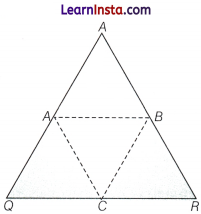
∴ Area of ∆ABC = \(\frac {1}{2}\) × Base × Height
and area of ∆PQR = \(\frac {1}{2}\) × 2 × Base × 2 × Height = 4(\(\frac {1}{2}\) × Base × Height)
So, ∆PQR has 4 times the area of ∆ABC.
Hence, 4 copies of ∆ABC will fit into ∆PQR.
(iii) In ∆PQR, each side is three times the corresponding side of ∆ABC.
So, ∆PQR is similar to ∆ABC.
Now, when all sides of a triangle are tripled, its height is also tripled.
So, area of ∆ABC = \(\frac {1}{2}\) × Base × Height
and area of ∆PQR = \(\frac {1}{2}\) × 3 × Base × 3 × Height = 9(\(\frac {1}{2}\) × Base × Height)
Hence, ∆PQR has 9 times the area of ∆ABC.
Also, 9 copies of ∆ABC will fit exactly in ∆PQR by dividing each side of ∆PQR into 3 equal parts and joining the corresponding points.
Question 16.
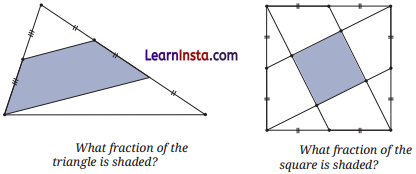
Solution:
(i) Let the triangle be ABC.
On AB, point D is the midpoint, so AD = DB.
On BC, points E and F divide BC into three equal parts, so BE = EF = FC.
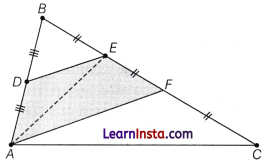
Join AE. Also, DR is already drawn.
Now, D is the midpoint of AB.
So, in ∆ABE, ED is a median.
Hence, ar (∆ADE) = ar (∆BDE)
Also, since BE = EF = FC, the three triangles ∆ABE, ∆AEF, and ∆AFC have equal bases on the same line BC and the same height from A.
Therefore, ar (∆ABE) = ar (∆AEF) = ar (∆AFC)
So, each is \(\frac {1}{3}\) of the whole triangle.
Now, ar (∆ADE) = \(\frac {1}{2}\) × ar (∆ABE)
= \(\frac {1}{2}\) × \(\frac {1}{3}\) × ar (∆ABC)
= \(\frac {1}{6}\) ar (∆ABC)
Also, ar(∆AEF) = \(\frac {1}{3}\) ar (∆ABC)
Hence, shaded area = \(\frac {1}{6}\) ar (∆ABC) + \(\frac {1}{3}\) ar (∆ABC)
= \(\frac {1}{6}\) ar (∆ABC) + \(\frac {2}{6}\) ar (∆ABC)
= \(\frac {3}{6}\) ar (∆ABC)
= \(\frac {1}{2}\) ar (∆ABC)
(ii) Let the side of the outer square be 2a.
Since the marks show that each side is divided into two equal parts, each small part is a.
Now, each corner triangle has base a and height 2a.
∴ Area of one corner triangle = \(\frac {1}{2}\) × a × 2a = a2
There are 4 such corner triangles.
Total area of 4 corner triangles = 4a2
Also, area of outer square = (2a)2 = 4a2
But the four corner triangles do not cover the whole square directly; by the arrangement of the four slanting lines, the shaded middle square comes out to be one-fifth of the outer square.
Hence, fraction of the square shaded = \(\frac {1}{5}\)
Question 17.
Solution:
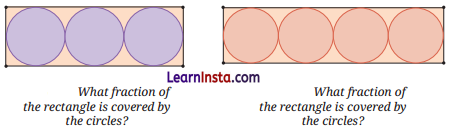
(i) Let the radius of each circle be r.
The rectangle contains 3 equal circles placed side by side, each touching the top and bottom.
So, the height of the rectangle = 2r
and length = 3 × 2r = 6r
Area ofrectangle = 6r × 2r = 12r2
Now, area of 3 circles = 3 × πr2 = 3πr2
Hence, required fraction = \(\frac{3 \pi r^2}{12 r^2}=\frac{\pi}{4}\)
(ii) Let the radius of each circle be r.
The rectangle contains 4 equal circles of radius r placed side by side.
So, height = 2r and length = 4 × 2r = 8r.
∴ Area of rectangle = 8r × 2r = 16r2
Now, area of 4 circles = 4 × πr2 = 4πr2
Hence, required fraction = \(\frac{4 \pi r^2}{16 r^2}=\frac{\pi}{4}\)
Question 18.
Use the above to make a conjecture about the area occupied by circles fitted into a rectangle in the manner shown. Test your conjecture for particular cases: 10 circles, 20 circles, 50 circles. Then, prove your conjecture.
Solution:
Let the radius of each circle be r, and let there be n equal circles in the rectangle.
Then, the height of the rectangle = 2r
and length of rectangle = n × 2r = 2nr
Now, area of rectangle = 2nr × 2r = 4nr2
Also, the area of n circles = nπr2
Hence, fraction covered by circles = \(\frac{n \pi r^2}{4 \pi r^2}=\frac{\pi}{4}\)
So, for 10 circles, 20 circles, and 50 circles, the fraction covered is \(\frac{\pi}{4}\).
Hence, the conjecture is proved.
Question 19.
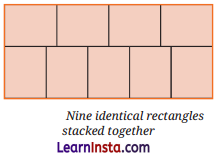
The figure shows nine identical rectangles fitted together to make a large rectangle, whose area is 72 cm2. Find the perimeter of each small rectangle.
Solution:
Let the length and breadth of each small rectangle be l and b.
From the figure, 4l = 5b
So, l : b = 5 : 4
Let l = 5x and b = 4x.
Now, the length of the large rectangle,
4l = 4(5x) = 20x
and the breadth of the large rectangle,
l + b = 5x + 4x = 9x
Given, area of large rectangle = 72
⇒ 20x × 9x = 72
⇒ 180x2 = 72
⇒ x2 = \(\frac {2}{5}\)
⇒ x = \(\sqrt{\frac{2}{5}}\)
Now, perimeter of each small rectangle = 2(l + b)
= 2(5x + 4x)
= 18x
= 18\(\sqrt{\frac{2}{5}}\)
= \(\frac{18 \sqrt{10}}{5}\)
Question 20.
Show that the areas of the shaded blue triangle and the shaded red triangle are equal.
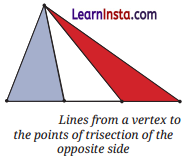
Find a way of cutting up the blue triangle into some number of pieces and rearranging the pieces to cover the red triangle.
Solution:
Since the baseline is divided into three equal parts, the base of the blue triangle is equal to the base of the red triangle.
Also, both triangles have the same vertex, and their bases lie on the same straight line.
So, their heights are equal.
Now, area of triangle = \(\frac {1}{2}\) × Base × Height
Since both triangles have equal bases and equal heights.
∴ Area of blue triangle = Area of red triangle
For cutting and rearranging, cut the blue triangle into smaller pieces along lines parallel to the red triangle’s sides.
Then, these pieces can be rearranged to cover the red triangle completely.
Question 21.
The figure shows a quarter circle in a square. Its centre is at one vertex, and it passes through two adjacent vertices. There are two semi-circles on two adjacent sides as diameters. They create the shaded regions A and B. Show that A and B have equal area.
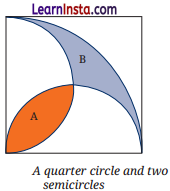
Solution:
Let the side of the square be s.
The quarter circle is drawn with centre at the bottom-left vertex and radius s.
Hence, area of the quarter circle = \(\frac{1}{4} \pi s^2\)
Also, each semicircle has a diameter equal to the side of the square, so its radius is \(\frac {s}{2}\).
Hence, area of one semicircle = \(\frac{1}{2} \pi\left(\frac{s}{2}\right)^2=\frac{1}{8} \pi s^2\)
Now, the area of the union of the two semi-circles = Area of semi-circle 1 + Area of semi-circle 2 – Area of their intersection A
= \(\frac{1}{8} \pi s^2+\frac{1}{8} \pi s^2\) – Area (A)
= \(\frac{1}{4} \pi s^2\) – Area (A)
Now, region B is the part of the quarter circle not covered by the semicircles.
So, the area of region B = the area of a quarter circle – the area of the union
= \(\frac{1}{4} \pi s^2-\left[\frac{1}{4} \pi s^2-{Area}(A)\right]\)
= Area (A)
Hence, the area of region B is equal to the area of region A.
Question 22.
In the figure, four semi-circles have been drawn within the given square, whose side is 2 units. The centres of these semicircles are the midpoints of the sides. They create a 4-petalled flower (shown in blue). Find the perimeter and the area of this flower.
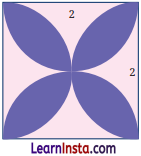
Solution:
Given the side of the square is 2 units.
So, radius of each semi-circle, r = \(\frac {2}{2}\) = 1 unit.
Each petal is formed by two quadrant arcs of radius 1.
Now, perimeter of one petal = \(\frac {1}{4}\)(2πr) + \(\frac {1}{4}\) (2πr)
= \(\frac{\pi}{2}+\frac{\pi}{2}\)
= π
Hence, the perimeter of 4 petals is 4π units.
Now, area of one petal = 2(Area of quadrant – Area of right triangle)
= \(2\left(\frac{\pi(1)^2}{4}-\frac{1}{2} \times 1 \times 1\right)\)
= \(2\left(\frac{\pi}{4}-\frac{1}{2}\right)\)
= \(\frac{\pi}{2}-1\)
Hence, area of 4 petals = 4(\(\frac{\pi}{2}-1\)) = 2π – 4
Question 23.
In the figure, we see two concentric circles with a common centre O. A chord BC of the larger circle is drawn, touching the smaller circle at A. The length of BC is l. Show that the area of the green region enclosed between the two circles is \(\frac{1}{4} \pi l^2\).
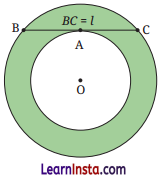
Solution:
Let the radius of the larger circle be R, and the radius of the smaller circle be r.
Since chord BC touches the smaller circle at A, OA ⊥ BC.
Also, a perpendicular from the centre to a chord bisects the chord.
AB = AC = \(\frac {l}{2}\)
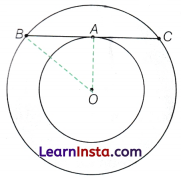
In right ∆OAB, OB2 = OA2 + AB2
⇒ R2 = r2 + \(\left(\frac{l}{2}\right)^2\)
⇒ R2 – r2 = \(\frac{l^2}{4}\)
Now, the area of the green region = πR2 – πr2
= π(R2 – r2)
= \(\pi \times \frac{l^2}{4}\)
= \(\frac{1}{4} \pi l^2\)
Hence proved.
Question 24.
In the figure, semi-circles have been drawn on all the sides of a right-angled triangle as shown. Show that Area (A) + Area (B) = Area (C).
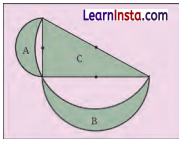
Solution:
Let the sides of the right-angled triangle be a, b, and c, where c is the hypotenuse.
Now, area of semi-circle on side a = \(\frac{1}{2} \pi\left(\frac{a}{2}\right)^2=\frac{\pi a^2}{8}\)
Also, area of semi-circle on side b = \(\frac{\pi b^2}{8}\)
Now, the sum of the areas of the semi-circles on the two perpendicular sides = \(\frac{\pi a^2}{8}+\frac{\pi b^2}{8}\)
= \(\frac{\pi}{8}\left(a^2+b^2\right)\)
= \(\frac{\pi c^2}{8}\) [∵ a2 + b2 = c2]
So, the sum of the areas of semi-circles on the two smaller sides is equal to the area of the semi-circle on the hypotenuse.
Now, from these equal semi-circular areas, if the common curved parts are removed, the remaining parts are A + B on one side and the triangular region C on the other side.
Therefore, Area (A) + Area (B) = Area (C)
Hence proved.
Question 25.
The figure shows two circles passing through each other’s centres. Find the area of the region enclosed by the two circles in terms of the common radius r.
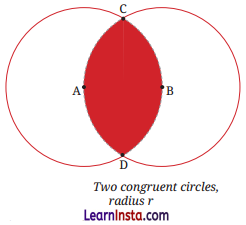
Solution:
Given that the centres of the two circles are A and B.
Since each circle passes through the other’s centre.
Therefore, AB = AC = BC = AD = BD = r
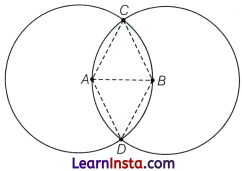
Now, ∆ABC and ∆ABD are equilateral triangles.
Hence, ∠CAB = 60° and ∠DAB = 60°.
Therefore, ∠CAD = 120°
Similarly, ∠CBD = 120°
Now, area of shaded region = 2 × area of sector of angle 120° – 2 × area of equilateral triangle of side r
= \(2 \times \frac{120^{\circ}}{360^{\circ}} \pi r^2-2 \times \frac{\sqrt{3}}{4} r^2\)
= \(\frac{2 \pi r^2}{3}-\frac{\sqrt{3} r^2}{2}\)
Hence, the required area is \(\left(\frac{2 \pi}{3}-\frac{\sqrt{3}}{2}\right) r^2\).
Question 26.
In the figure, we see three triangles within a rectangle. The areas of the triangles are A, B, and C, as marked. Show that the area of the rectangle is \(\frac{2(A+C)(B+C)}{C}\).
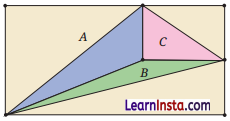
Solution:
Let the common vertical side of triangles A and C be h.
Let the horizontal distance on the left be x and on the right be y.
Also, let the height below the common vertical side be k.
Then, A = \(\frac {1}{2}\)xh and C = \(\frac {1}{2}\)yh
Also, ∠B has base y and height k, so B = \(\frac {1}{2}\)yk.
Now, A + C = \(\frac {1}{2}\)xh + \(\frac {1}{2}\)yh
⇒ A + C = \(\frac {1}{2}\)(x + y)h
Also, B + C = \(\frac {1}{2}\)yk + \(\frac {1}{2}\)yh
⇒ B + C = \(\frac {1}{2}\)y(k + h)
Now, \(\frac{2(A+C)(B+C)}{C}=\frac{2\left[\frac{1}{2}(x+y) h\right]\left[\frac{1}{2} y(k+h)\right]}{\frac{1}{2} y h}\) = (x + y) (k + h)
But (x + y) is the length of the rectangle and (k + h) is the breadth of the rectangle.
Hence, area of rectangle = \(\frac{2(A+C)(B+C)}{C}\)
Question 27.
In the figure, we see two shaded regions formed by a quarter circle, a semi-circle, and a triangle.
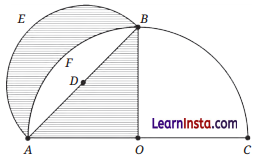
Show that the areas of the two shaded regions are equal.
Solution:
Let OA = OB = r.
Then, AB = √2r (using the Baudhayana-Pythagoras theorem)
The area of ∆OAB = \(\frac {1}{2}\) × OA × OB = \(\frac {1}{2}\)r2
The area of the shaded portion AFBE = Area of the semicircle with centre D + Area of the triangle OAB -Area of the quarter circle with centre O
= \(\frac{1}{2} \times \pi\left(\frac{\sqrt{2} r}{2}\right)^2+\frac{1}{2} r^2-\frac{1}{4} \pi r^2\)
= \(\frac{1}{4} \pi r^2+\frac{1}{2} r^2-\frac{1}{4} \pi r^2\)
= \(\frac {1}{2}\)r2
Thus, the area of triangle OAB = the area of the shaded portion AFBE.