Including Kaushal Bodh Class 8 Solutions Project 2 and Class 8 Vocational Education Chapter 2 Feeding and Caring for Farm Animals Question Answer in your preparation can make learning more organized.
Class 8 Vocational Education Chapter 2 Question Answer
Kaushal Bodh Class 8 Chapter 2 Question Answer
What did I learn from others? [Page No. 56]
Question 1.
What did you learn from farmers/animal owners and friends while doing the project?
Answer:
From farmers and animal owners, I learned how to take care of livestopk properly. They taught me about feeding animals with green and dry fodder, maintaining clean shelters, and regular health check-ups.
I also learned how to observe animal behaviour, measure body parameters, and understand thfe importance of vaccination and timely treatment for better productivity.
Question 2.
Name any three skill that you have learnt while working with the experts.
Answer:
The three skills that I have learnt while working with the experts are as follows
- Measuring body dimensions of animals using a tape to estimate their weight.
- Preparing a proper feeding chart based on the animal’s weight and fodder requirements.
- Identifying basic health issues in livestock and understanding simple first-aid and preventive care methods.
Think and Answer [Page No. 58]
Question 1.
What were the challenges you faced?
Answer:
I faced the following challenges during these activities.
- Approaching large animals like cows and buffaloes was difficult as they can be unpredictable.
- Measuring the girth and length accurately required the animal to stand still, which was not always possible.
- Collecting 30-50 kg of green fodder for making silage was physically demanding.
- Ensuring that the silage bag was fully airtight was also tricky.
- Farmers and animal owners were sometimes unavailable for interaction or had limited time to answer questions.
Question 2.
What will you do differently next time?
Answer:
I will do the following things differently next time
- The farm visit can be planned more carefully by fixing an appointment with the farmer in advance.
- A well-organised list of questions should be prepared before visiting.
- For making silage, a proper airtight container or bag must be kept ready beforehand.
- Practising body measurements with a tape measure before visiting the farm would also help in recording data more accurately.
- More time should be given to observe the animal’s behaviour calmly rather than rushing through the process.
Question 3.
In your opinion, do We provide proper care and health treatments to our farm animals? Do we have appropriate technologies and infrastructure (veterinary clinic, hospitals) to care forfarm animals?
Answer:
In my opinion, proper care and health treatments for farm animals are not uniformly available everywhere. In some areas, farmers provide good nutrition, vaccination, and timely veterinary care.
However, in many rural regions, animals still lack access to veterinary clinics, hospitals, and trained professionals. The infrastructure is improving with mobile veterinary units and ICAR technologies, but it needs to be expanded and made more accessible to all farmers for better animal health.
Question 4.
How has the role of farm animals changed with changes in human society (for example, the use of farm machinery, reduced animal-based transport requirements)?
Answer:
The role of farm animals has changed with the development of human society in the following ways
- Earlier, animals were mainly used for ploughing fields, carrying loads, and transport, but now machines like tractors and trucks have replaced them.
- Their use as working animals has reduced significantly.
- Today, they are mainly used for milk, meat, eggs, and wool production.
- They also provide manure, biogas, and emotional and cultural value in society.
Question 5.
Identify a few examples of jobs related to the work you just did, for example, a veterinarian, scientist, herder or farmer.
Answer:
Many job opportunities are related to animal care and husbandry are as follows
- A veterinarian diagnoses and treats sick animals and performs surgeries and vaccinations.
- An animal nutritionist plans the diet and feeding charts for livestock to ensure their healthy growth.
- A dairy farmer or goat herder manages the daily care and productivity of animals.
- A livestock research scientist works on developing better breeds, vaccines and feed formulations.
- A veterinary pharmacist prepares and supplies medicines for animals.
Feeding and Caring for Farm Animals Class 8 Question Answer
Activity 1: Visit to a farm
Purpose of the Activity
This activity helps students understand the daily care routine of farm animals by observing and interacting with a farmer or animal owner. Students learn about feeding, watering, shelter, bathing, healthcare and waste management in real-life conditions.
Pre-Planning
- Decide whether you will visit a nearby farmer, animal owner, gaushala ortabela. If you rear livestock at home, use your own experiences.
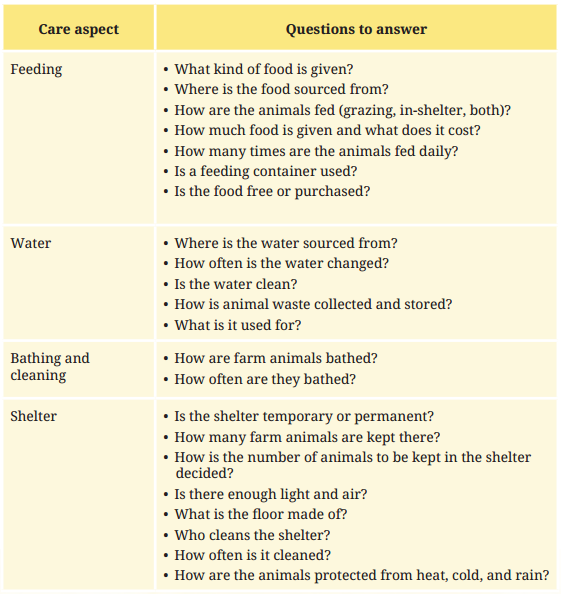
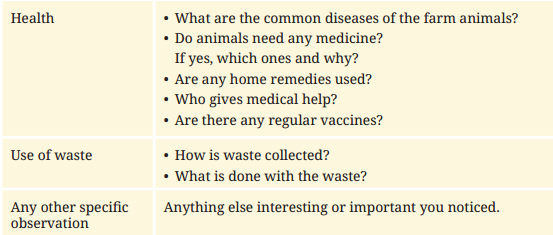
- Make a list of questions you want to ask under each care area — feeding, water, bathing, shelter, health and waste.
- Prepare a notebook or diary to record your observations during the visit.
- Discuss with your group how to behave safely around the animals during the visit.
- Review the safety rules before approaching any animal.
Observation and Recording Tasks
Note the following details during your visit
- Name of the place or farmer/animal owner visited.
- Types and number of animals owned.
- Important activities of the day.
- Number of people involved in the activities.
- Description of daily activities.
Questions for Recording the Care Aspects of Farm Animals
Question 1.
The relationship between the farmer/animal owner and the animal is essential for its well-being. Does the animal recognise its owner? How does it react to the presence of the owner?
Answer:
Yes, farm animals do recognise their owners. When the owner approaches, animals like cows and goats often move towards them, make sounds (mooing or bleating), wag their tails, or appear calm and relaxed. This shows that animals form a bond with people who care for them regularly. They may also show signs of excitement, such as raising their head or moving eagerly towards the owner at feeding time.
Question 2.
Does the farmer/animal owner have a specific name for the animals? What criteria were used for naming animals? How do they recognise individual animals?
Answer:
Yes, farmers generally give individual names to their animals, especially cows and goats. Animals are often named based on their colour (e.g., Kali for a black cow), physical features (e.g., Moti for a big animal), or the day they were born.
Farmers recognise individual animals by their colour patterns, size, shape of ears, or special marks on the body, in some places, ear tags or paint marks are also used for identification, especially in larger herds.
Question 3.
What are the reasons for keeping animals on the farm (e.g., farm labour, dairy, wool)?
Answer:
The reasons for keeping animals on the farm are as follows
- They provide essential food products such as milk, eggs, meat, and wool for human consumption and income.
- They help in farm work like ploughing fields, carrying loads, and transporting goods, reducing manual labour.
Question 4.
Talk to a farmer/animal owner or your friends, and find a story about the relationship between a farmer/animal owner and the animal, or find a local poem or folk song about farm animals.
Answer:
Many Indian folk songs celebrate the bond between farmers and their animals. For example, in Maharashtra, the festival of Bendur (also called Pola) is celebrated to honour bullocks for their hard work in the fields.
A well-known folk story tells of a farmer who nursed his sick cow back to health through months of care, and the cow later alerted the farmer to a fire in the field at night. This reflects the deep emotional connection that exists between farmers and their animals.
Such relationships have inspired folk songs, proverbs and stories across India’s diverse cultures.
Question 5.
How does proper care (feeding, shelter, and healthcare) affect the health and productivity of farm animals?
Answer:
Proper care (feeding, shelter, and healthcare) affects the health and productivity of farm animals in the following ways
- Nutritious food helps animals stay healthy and grow properly.
- Clean and safe shelter protects them from weather, diseases, and injuries.
Kaushal Bodh Class 8 Feeding and Caring for Farm Animals Question Answer
Activity 2: Field visit to a veterinary clinic/animal healthcare centre
Purpose of the Activity
This activity helps students learn standard healthcare practices and treatment required for livestock. By visiting a veterinary centre or interacting with a veterinary doctor, students understand how animals are diagnosed, treated -. and vaccinated, and learn about local breeds and their food requirements.
Pre-Planning
- Identify the nearest veterinary clinic or animal healthcare centre, or plan to invite a veterinary doctor or practitioner to your school.
- Prepare questions about common animats in your area, their breeds and their uses for
- Think about which fodder crops or food sources are used for livestock in your area.
- Discuss with your group how you will record information from the expert.
Observation and Recording Tasks
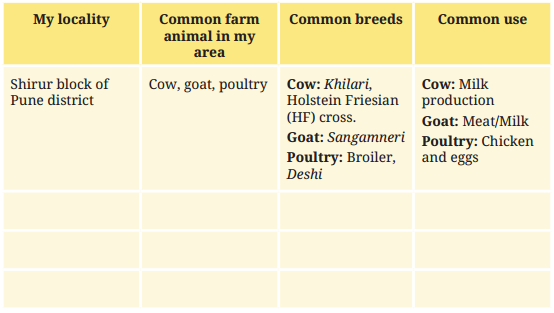
Gather information about the livestock in your locality with the help of the expert and fill the tables below
Record of Information about Local Farm Animals
Question 1.
What are the most common livestock in your locality?
Answer:
The most common livestock in most Indian localities include cows, buffaloes, goats, sheep, pigs and poultry birds like hens and ducks.
In rural areas of northern India, bullocks and horses are also common.
In coastal areas, ducks and geese may be more common. The exact type of livestock depends on the region, climate and economic needs of the community.
Question 2.
List the important breeds of livestock in your locality. Are they indigenous or brought from other places?
Answer:
The important breeds of livestock in my locality are as follows
- Gir, Sahiwal, Tharparkar, and Red Sindhi cattle are indigenous breeds of India.
- Sangamneri and Barbari goat breeds are also indigenous to India.

Question 3.
Which fodder crops or food sources are used for livestock in your area?
Answer:
The following fodder crops or food sources are used for livestock in my area
- Common fodder crops used for livestock in India include rpaize, napier grass, berseem, lucerne, jowar, bajra and paddy straw.
- Green fodder is usually grown on the farm or sourced from nearby fields.
- Dry fodder like wheat straw, paddy straw, and jowar straw is stored for use when green fodder is unavailable.
- Concentrates such as oil cakes, bran, and grain mixes are given as supplements. In some areas, kitchen waste and grains are also used, especially for poultry.
Question 4.
What types of healthcare services (treatment, vaccination, check-ups) are provided at the veterinary clinic?
Answer:
The following types of healthcare services (treatment, vaccination, check-ups) are provided at the veterinary clinic
- Diagnosis and treatment of diseases to keep animals healthy and prevent serious illness.
- Regular health check-ups to monitor growth, weight, and overall condition of animals.
Question 5.
Why is it important for farmers to regularly consult a veterinary doctor for their animals?
Answer:
It is important for farmers to regularly consult a veterinary doctor for their animals because it helps in early disease detection, proper treatment, timely vaccination, and better nutrition guidance, ensuring healthy animals, improved productivity, and reduced risk of serious health problems.
Activity 3: Participation in vaccination or health check-up drives for animals
Purpose of the Activity
This activity helps students understand the importance of animal vaccination and healthcare by participating in a vaccination drive and interacting with a veterinary doctor. It enables them to learn about common livestock diseases, preventive measures, and challenges faced in animal healthcare.
Pre-Planning
- Find out if there is a vaccination drive happening in your area organised by the government or a local vet.
- Prepare questions about common diseases, vaccines used and challenges farmers face in vaccinating animals.
- Discuss the yearly vaccination schedule and why timely vaccination is important.
- Think about whether farmers have any beliefs about vaccination and how those can be addressed.
- Review Annual Vaccination Schedule format so you know what to fill in after the visit.
Record the following details during your interaction with a veterinary doctor or visit (if available)
| Aspect | Details to Record |
| Clinic/Visit Details | Name and location of the veterinary clinic or healthcare centre |
| Animals Attended | Types of animals brought for vaccination or treatment |
| Diseases | Common diseases discussed or observed |
| Vaccination/Treatment | Vaccines or treatments given to animals |
| Veterinary Role | Role of the veterinary doctor and staff |
| Challenges | Challenges faced during vaccination or treatment |
| Farmer Awareness | Beliefs or awareness of farmers about vaccination |
Question 1.
List the common infectious diseases that affect livestock.
Answer:
Some common infectious diseases that affect livestock are as follows
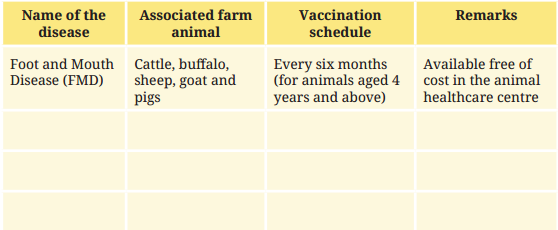
- Some Foot and Mouth Disease (FMD): It is a highly contagious viral disease affecting cattle, buffaloes, goats, sheep, and pigs. It causes fever, blisters in the mouth, and difficulty in eating.
- Brucellosis :It mainly affects cattle and leads to reproductive problems such as abortion and reduced milk production. It also weakens the animal’s overall health.
Question 2.
Mention two major difficulties farmers face while vaccinating their livestock.
Answer:
The two major difficulties farmers face while vaccinating their livestock are
(i) Lack of Awareness Many farmers, especially in remote areas, are unaware of the benefits of vaccination or the correct vaccination schedule.
(ii) Inaccessibility of Veterinary Services Veterinary clinics or qualified doctors may not be easily available in rural or hilly areas, making it hard to get animals vaccinated on time.
Question 3.
What are the other standard healthcare measures farmers take to protect their animals besides vaccination?
Answer:
Farmers take several standard healthcare measures to protect their animals apart from vaccination.
- Regular deworming is done to remove internal parasites.
- Anti-tick and anti-lice solutions are sprayed to control ectoparasites.
Question 4.
Are there any beliefs associated with vaccinating livestock among farmers?
Answer:
Yes, there are certain beliefs associated with vaccinating livestock are common among farmers, such as ‘the milk becomes poisonous after vaccination’ or ‘the animal becomes weak and sick after the vaccine is given.’ These are myths.
Question 5.
Are there any homemade medicines or home-based remedies for livestock? List any two with their uses.
Answer:
Yes, there are many homemade medicines or remedies for livestock. The two remedies are
(i) Neem leaves are used to repel ticks and other external parasites by applying a paste or neem leaf extract on the animal’s skin.
(ii) Turmeric mixed with oil is applied on wounds or skin infections to reduce inflammation and promote healing.
Question 6.
What medical facilities are available for animals in the area?
Answer:
In most areas, the following medical facilities are available for animals
- Government-run veterinary clinics or animal healthcare centres.
- Private veterinary clinics run by qualified veterinary doctors.
- Mobile veterinary units that visit remote villages.
Question 7.
Record the yearly vaccination schedule for the livestock.
Answer:
Yearly vaccination schedule for the livestock are Vaccination helps in preventing diseases and improving productivity.
Annual Vaccination Schedule
Activity 4: Preparing a health record of the selected animal
Purpose of the Activity
This activity will help students to record important health parameters of selected livestock. Select at least two animals for this activity and work in a group of 5-6 students. You can visit a nearby farmer/animal owner or ask them to visit your school with their animals.
Pre-Planning
- Select small and friendly animals that are easy to handle, such as a goat or sheep, instead of a bullock, buffalo or cow.
- Remember that male goats (bucks/bully goats) are more aggressive than females.
- Ensure that the teacher/farmer/anima! owner or a veterinary professional is present before approaching the animal.
- Stand at a distance from the animal, and take care not to stand behind the animal.
- Understand what a healthy animal looks like by reviewing the visual observation points before the activity.
- Perform a visual observation and check the respiration rate.
Procedure of Visual Observations of the Animal
Visual observations will help you assess the health of the animal without any medical tests. Observe the following
- Eyes Should be bright, moist and clean.
- Nostrils Should be clean, wet and without any discharge.
- Skin Should be glossy, clean and free from parasites (e.g., tick, mite, lice, etc.).
- Behaviour Should be alert, inquisitive and interested in its surroundings.
- Appetite Should have a good appetite and no signs of diarrhoea.
Checking Respiration Rate
- Identify the flank region of the animal — the area of flesh on either side of the body, between the rear leg and the last rib.
- Count the number of either falls orrises of the flank region in one minute using a stopwatch. Never count both rises and falls.
- Normal respiration for cattle is about 25 to 50 breaths per minute.
- Normal respiration for goats is about 12 to 25 breaths per minute.
Recording Health Parameters
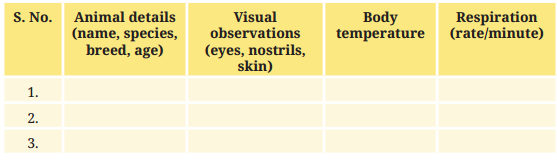
Question 1.
How do respiration rate and body temperature relate to animal health? Explain it in relation to your own health.
Answer:
Respiration rate and body temperature are two important indicators of health, both in animals and humans.
A healthy adult person breathes about 12-20 times per minute and has a body temperature of about 37°C. If we have a fever or infection, our temperature rises and breathing becomes faster.
Similarly, in farm animals, the normal respiration rate for cattle is 25-50 breaths per minute, and for goats it is 12-25 breaths per minute. If these values are higher or lower than normal, it may indicate illness, infection, stress or heat stroke.
Question 2.
Why should only a veterinary professional record the body temperature of animals?
Answer:
A veterinary professional should records the body temperature of animals because of the following reasons
- They are trained to handle animals safely and avoid injury to both the animal and the person.
- They know the correct method of using a thermometer without causing harm.
Question 3.
What precautions should be taken while handling animals during health checks?
Answer:
The following precautions should be taken while handling animals during health checks
- Handle animals gently and calmly to avoid stress or aggressive behaviour.
- Maintain a safe distance and never stand behind large animals.
Question 4.
How can visual observation help in identifying a healthy or unhealthy animal?
Answer:
Visual observation helps in identifying a healthy or unhealthy animal in the following ways
- Bright eyes and clean nostrils indicate good health, while dull eyes or discharge show illness.
- Clean, glossy skin without parasites reflects a healthy condition.
Question 5.
Why is it important to maintain a health record of farm animals?
Answer:
It is important to maintain a health record of farm animals because it helps track their health status, detect diseases early, ensure timely treatment and vaccination, and improve overall productivity and management of livestock.
Activity 5: Estimating the weight of farm animals
Purpose of the Activity
This activity will help students to estimate the body weight of a farm animal using body measurements like length and chest girth, when a weighing scale is not available. This helps in deciding feed requirements and treatment doses for the animal.
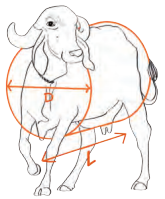
Figure: Taking body measurements of large farm animals to estimate weight
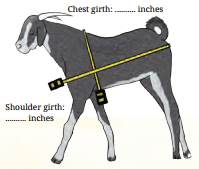
Figure : Taking the body measurements of a goat
Pre-Planning
- Select a small and friendly animal such as a goat or sheep. You can also measure a larger animal which is gentle and calm.
- Take the help of a farmer/animal owner or veterinary professional before approaching the animal.
- Measure Length (from shoulder to tail) and Girth (chest circumference) in inches. Body weight is recorded in kilograms (1 inch = 2.54 cm).
- Understand the two formulas to be used before taking measurements.
Observation and Recording Tasks
Body Measurement of Animal
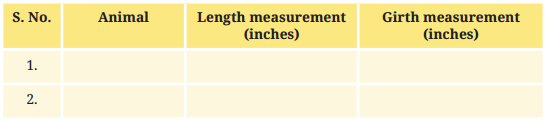
Record of Weight of Animals Using Body Measurement

Question 1.
Are there any other methods farmers or animal owners use for weight estimation?
Answer:
Yes, there are other methods that farmers use for weight estimation as follows
- Some farmers use specially designed weighing scales or cattle weighbridges where available.
- Experienced farmers in some areas estimate weight by touch and visual assessment based on years of experience.
Question 2.
Do farmers feel weight estimation is an important activity in animal care? If not, what are the reasons?
Answer:
No, farmers do not always feel that weight estimation is an important activity in animal care because of the following reasons
- Many small farmers depend on visual judgment and experience instead of scientific methods.
- They often do not have access to weighing scales or modern tools in rural areas.
Question 3.
Why is chest girth measurement important in estimating the weight of animals?
Answer:
Chest girth measurement is important in estimating the weight of animals because it reflects the body size and volume of the animal.
It helps in calculating weight more accurately when used with length measurements, especially when a weighing scale is not available.
Question 4.
What precautions should be taken while measuring the length and girth of an animal?
Answer:
The following precautions should be taken while measuring the length and girth of an animal
- Ensure the animal is calm and properly restrained to avoid sudden movement.
- Take help from a farmer or veterinary professional for safe handling.
Question 5.
How does accurate weight estimation help in proper feeding and treatment of animals?
Answer:
Accurate weight estimation helps in proper feeding and treatment of animals in the following ways
- It helps in deciding the correct quantity of feed required for healthy growth.
- It ensures proper dosage of medicines and prevents underdosing or overdosing.
Activity 6: Preparing a feeding chart
Purpose of the Activity
The students will be able to calculate the daily feed requirement of farm animals using their body weight and prepare a feeding chart. They will also compare the calculated feeding needs with the actuaL feed provided by the animal owner.
Pre-Planning
- Select at least two animals for which you have already estimated body weight.
- Revise the concept of Dry Matter (DM) and feeding requirements.
- Keep a calculator, notebook, and pen ready for calculations and recording.
- Take guidance from a teacher, farmer, or veterinary professional if needed.
Observation and Recording Tasks
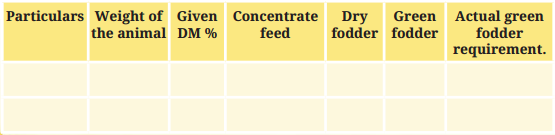
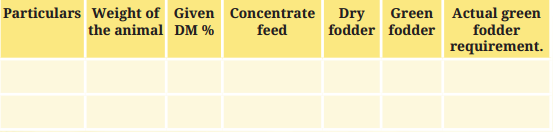
Feeding Chart for Animals
Question 1.
Following the example of Feed Requirements of Goat, calculate the feeding requirement for your selected animals.
Answer:
Example of feeding requirements calculation for a 40 kg goat
- DM = 3% of 40,000 g = 1200 g/day.
- Concentrate Feed = 25% of 1200 g = 300 g.
- Total Fodder (Wet + Dry) = 75% of 1200 g = 900 g.
- Dry Fodder = 25% of 900 g = 225 g.
- Green Fodder = 75% of 900 g = 675 g.
- Actual Green Fodder Requirement (since green fodder has 80% water, multiply by 5) = 675 × 5 = 3375 g (approximately 3.4 kg).
- This should be given 2-3 times daily in equal portions at dawn, midday and early evening.
Question 2.
Compare the actual feed given by the animal owner versus your calculated feeding need. Is there a difference? Why?
Answer:
The comparison between actual feed given by animal owner versus my calculated feeding need is as follows
Yes, there is a difference between calculated and actual feed. Farmers often depend on traditional knowledge rather than scientific formulas. Feed variation occurs due to high cost of concentrates, seasonal shortage of green fodder, and lack of awareness about exact nutritional requirements of animals.
Question 3.
Why is it important to calculate the correct feeding requirement for animals?
Answer:
It is important to calculate the correct feeding requirement for animals because it ensures they receive proper nutrition for healthy growth.
It helps prevent underfeeding or overfeeding, improves productivity, maintains good health, and supports efficient use of feed resources.
Question 4.
What may happen if animals are given less or more feed than required?
Answer:
If animals are given less or more feed than required, their health and productivity are affected. Underfeeding leads to weakness, poor growth, and reduced production.
Overfeeding may cause obesity, digestive disorders, and higher feed costs. Balanced feeding is essential for maintaining proper health and efficiency in farm animals.
Question 5.
How does a balanced diet affect the health and productivity of farm animals?
Answer:
A balanced diet affects the health and productivity of farm animals in the following ways
- It provides essential nutrients for proper growth and strong body development.
- It improves immunity, helping animals resist diseases and stay healthy.
Activity 7: Feed formulation – Making silage and cost calculation
Purpose of the Activity
This activity will help students to make silage from green fodder using controlled fermentation in an anaerobic environment. This is especially useful when fresh green fodder is not available. Students will also understand the costand challenges of silage making by interacting with farmers.
Pre-Planning
- Collect approximately 30-50 kg of green fodder — any green fodder like maize, sugarcane leaves or Napier grass can be used.
- You can collect chopped fodder from a farmer/animal owner or do this activity directly in the fields.
- If silage bags are unavailable, use any polyethylene or High-Density Polyethylene (HDPE) bag or container.
- Revise the science of silage making and understand how fermentation preserves the fodder.
- Understand how to test silage quality, colour, smell, texture and pH.
Steps to make Silage
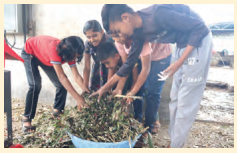
Step 1: Chop the fodder into 2–3 cm pieces using a fodder chopping machine. You can collect chopped fodder from a farmer/animal owner or do this activity directly in the fields.
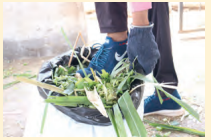
Step 2: Fill the chopped fodder into the silage bag while pressing it firmly with your foot.

Step 3: Tie the upper end of the bag firmly with a thread. You can also seal it using adhesive tape to minimise air entry.
How to Know the Silage Is Ready (after 2-3 weeks)
- Golden browp colour.
- Free-flowing and non-sticky texture.
- Mildly acidic taste with an optimum pH of around 4.0-4.5 (add 25 g of silage to 100 mL of water; check pH after 15 minutes).
Important Warning
- Do not open the bag during the 2-3 week process.
- If you observe mould of white or black colour or a bad smell — throw away the silage. Do not feed it to the animal. It will lead to food poisoning, serious illness and even death of the animal.
- Once ready, feed goats/sheep (1 to 1.5 kg per day) or cows/buffaloes (10 to 15 kg per day), only after taking approval of the farmer/animal owner. Do not feed the animal without permission.
Question 1.
Have you seen storage spaces for green fodder in farms or animal shelters? How do farmers/animal owners store green fodder?
Answer:
Yes, I have seen storage spaces for green fodder in farms and animal shelters.
Farmers usually cut fresh green fodder daily and feed it directly to animals. However, during dry seaso’ns they store fodder by making silage in pits, bags or tanks.
Sometimes, excess green fodder is sun-dried to prepare dry fodder for long-term use. In organised farms, silage bags or cement silos are used.
Question 2.
How is the fodder requirement calculated? Is there any wastage of fodder?
Answer:
Fodder requirement is calculated based on the animal’s body weight. Dry Matter (DM) equal to 2-3% of body weight is the daily requirement.
This is divided into concentrate feed (25%) and fodder (75%), which is further split into dry and green fodder.
Question 3.
What are the key challenges in gathering green fodder, silage bags, and chopping?
Answer:
Farmers face several challenges in silage preparation as follows
- Gathering 30-50 kg of green fodder requires labour and land.
- Silage bags can be expensive or unavailable in remote areas, though polyethylene bags can be used as alternatives.
Question 4.
What were the key difficulties you faced while making silage? What, in your opinion, would you do differently next time?
Answer:
The key difficulties I faced while making silage are
- Collecting 30-50 kg of green fodder was physically tiring and time-consuming.
- Chopping fodder into small, uniform pieces was difficult without a machine.
Next time, I would use a fodder chopping machine, ensure stronger airtight sealing with tape and rope, and mark the preparation date clearly for better monitoring.
Question 5.
Why is it important to remove air while preparing silage?
Answer:
It is important to remove air while preparing silage because of the following reasons
- It creates anaerobic conditions needed for proper fermentation by lactic acid bacteria.
- It prevents the growth of harmful fungi and mould.
Activity 8: Feed formulation – Making a healthy dry fodder mixture
Purpose of the Activity
This activity will help students to treat dry fodder with jaggery, salt and a mineral mixture to improve its palatability and digestibility. This activity can be done directly in a farmer’s field or in school with the help of a farmer/animal owner.
Pre Planning
- Collect chopped dry fodder (5-10 kg), jaggery, salt, and a mineral mixture (if available).
- Arrange a clean space, polyethylene bags or sheets, and water for mixing.
- Take guidance from a teacher, farmer, or animal owner before starting the activity.
- Understand the proportions of ingredients to be used for preparing the mixture.
Preparing dry fodder mixture
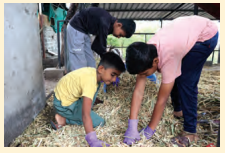
Step 1: Collect chopped dry fodder (5 to 10 kg). It can be rice, wheat, jawar, hilly grass straw, or any legume crop stubble that farmers usually burn in the fields after crop harvest.
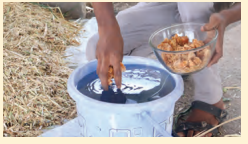
Step 2: Add 3% jaggery (300 g for 10 kg fodder) and common salt 1% (100 g for 10 kg fodder) in 5 L of water. If jaggery is unavailable, you can use the waste flour of wheat, rice, jawar, etc. You can also add 100 g of mineral mixture (optional).
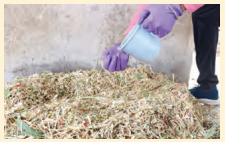
Step 3: Spread the chopped fodder on the flour and sprinkle the jaggery-salt-mineral mix with your hands. Ensure the mineral mixture is spread equally and sticks to the chopped fodder.
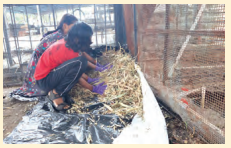
Step 4: Make a heap of fodder and then fill in the polyethylene bag as before, or press the fodder towards the corner of the wall and cover it with a polythene sheet.
After 2–3 hours, the treated feed is ready
Question 1.
How do farmers/animal owners store dry fodder? Do they chop dry fodder before feeding it to the animals? If not, why?
Answer:
Farmers store dry fodder in haystacks, storage rooms, or covered sheds to protect it from rain and moisture. Many traditional farmers feed dry fodder without chopping it. This is because chopping requires a machine or extra labour, and farmers may not have access to these.
Chopped dry fodder is easier to eat, reduces wastage, and can be mixed more evenly with jaggery, salt and mineral supplements to improve palatability and digestibility.
Question 2.
Do you see any advantages of chopping dry or green fodder?
Answer:
Chopping fodder has several advantages as follows
- It reduces wastage because animals can eat smaller pieces completely without scattering them.
- It improves digestibility as smaller pieces are easier for the animal’s digestive system to break down.
Question 3.
What were the key difficulties you faced while making dry fodder? What, in your opinion, would you do differently next time?
Answer:
I faced the following key difficulties while making dry fodder
- Evenly spreading the jaggery-salt-mineral solution on dry fodder was difficult.
- Mixing a large quantity (10 kg) of fodder by hand was physically tiring.
Next time, I would work in a group to share the effort, use a spray bottle for even distribution, and turn the fodder repeatedly on a clean flat surface for better mixing and uniform coating.
Question 4.
Why are jaggery and salt added to dry fodder?
Answer:
Jaggery and salt are added to dry fodder because they improve its taste and increase palatability, encouraging animals to eat more. Jaggery provides energy, while salt supplies essential minerals. Together, they enhance digestion, nutrient absorption, and overall health and productivity of farm animals.
Question 5.
How does this treatment improve the digestibility and intake of fodder by animals?
Answer:
This treatment improves the digestibility and intake of fodder by animals in the following ways
- Jaggery enhances taste, making fodder more palatable and increasing intake.
- Moistening softens dry fodder, making it easier to chew and digest.
Activity 9: Offering feed to animals and observing their response
Purpose of the Activity
This activity will help students to understand the acceptability of different types of feed by animals and observe their feeding behaviour. It will also help them learn howto record responses and gather feedback from farmers or animal owners.
Pre-Pianning
- While feeding the animal, ensure that the owner is close by at all times.
- Open the silage bag and check the quality — free from mould and not smelling bad.
- Ask the farmer/animal owner to confirm your assessment of the quality of the fodder before offering it to the animal.
- Have both the silage and treated dry fodder ready to offer one after the other.
Observation and Recording Tasks
Record your observations while offering the feed to the animal
| Aspect | Observation |
| Type of Feed | Silage / Treated Dry Fodder |
| Animal Response | Accepted willingly / Hesitant / Rejected |
| Eating Behaviour | Fast/Slow/Normal |
| Quantity Consumed | Full / Partial / Very little |
| Time Taken to Eat | |
| Farmer/Owner Feedback | |
| Any Other Observation |
Question 1.
Does the animal accept the silage and treated dry fodder?
Answer:
Animals generally accept well-prepared silage and treated dry fodder once introduced gradually. If the silage is of good quality, golden brown colour, pleasant aroma, correct pH, animals consume it eagerly, indicating they enjoy the taste.
Question 2.
what was the farmer/animal owner’s reaction or feedback on the fodder you prepared?
Answer:
Farmers and animal owners generally appreciate the effort of preparing silage and dry fodder mixture, and are positive about the concept of silage as it helps store feed for the dry season.
They may point out that using a proper silage bag is important for successful preparation. They might also suggest that the mineral mixture proportions need to be adjusted based on the specific needs of their animal.
Question 3.
Which type of feed was preferred by the animal and why?
Answer:
The animal preferred the feed that was more palatable, such as silage or treated dry fodder, because it had a better taste, smell, and texture. These qualities make the feed more appealing and easier to consume, leading to higher acceptance by the animal.
Question 4.
How can the feeding behaviour of an animal indicate its health or feed quality?
Answer:
The feeding behaviour of an animal can indicate its health or feed quality. A healthy animal eats actively and shows interest in feed, while poor appetite may indicate illness.
If the feed is of good quality, the animal consumes it willingly, whereas refusal or slow eating may suggest poor taste, smell, or nutritional value.
Question 5.
What changes would you suggest to improve the acceptability of the feed?
Answer:
I would suggest the following changes to improve the acceptability of the feed
- Improve taste by adding jaggery, salt, or mineral mixture.
- Ensure fodder is fresh, clean, and free from mould or bad smell.
Activity 10: Preparing home remedies for livestock
Purpose of the Activity
This activity will help students to learn about common home-based and Ayurvedic medicines used by farmers to treat common illnesses of farm animals. The students will collect information from farmers, animal owners and elders, and use it to design a first-aid box for livestock.
Pre-Planning
- Ask farmers/animal owners in your vicinity about typical home-based remedies they use for common animal health problems.
- You may also ask elders in your locality about common home remedies for cows, goats and other animals.
- Understand the exact ingredients and precise measures used in each home remedy.
- Discuss when a home remedy is enough and when a veterinarian must be called.
- Think about what items should go into a first-aid box for a farm animal.
Observation and Recording Tasks
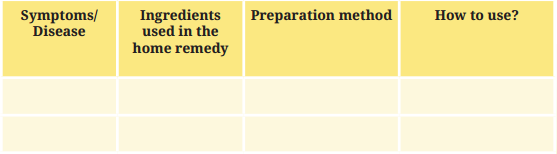
Preparation of home diseases
Question 1.
Design a first-aid medical box for livestock. List the materials you will add to the box, with ingredients and precise measures.
Answer:
A first-aid box for livestock should contain the following items
(i) Digital thermometer
(ii) Cotton and antiseptic
(iii) Bandage roll
(iv) Indigestion remedy
(v) Neem leaf paste or neem oil
(vi) Turmeric powder and coconut oil
(vii) A Deworming tablet
(viii) Emergency Information
Question 2.
Do you use similar home remedies at home? List a few examples.
Answer:
Yes, I use similar home remedies at my home. Some home remedies are
• Turmeric (haldi) mixed in warm milk is given for cold, cough and internal infections in humans.
• Ginger (adrak) is used in home remedies for indigestion and stomach ache in humans and cows.
Question 3.
Why is it important to know home remedies for treating minor livestock diseases?
Answer:
It is important to know home remedies for treating minor livestock diseases because of the following reasons:
- They provide quick and simple treatment for common health problems.
- They are cost-effective and use easily available local ingredients.
Question 4.
How do farmers decide whether to use a home remedy or consult a veterinary doctor?
Answer:
Farmers decide whether to use a home remedy or consult a veterinary doctor based on the severity of the illness.
For minor issues like mild cold, loss of appetite, or small wounds, they use home remedies. For serious symptoms, high fever, or long-lasting illness, they consult a veterinary doctor immediately.
Question 5.
What essential items should be included in a livestock first-aid box and why?
Answer:
A livestock first-aid box should include antiseptic solution, cotton, bandages, thermometer, scissors, gloves, and basic, herbal medicines.
These items are essential to clean wounds, prevent infections, measure temperature, and provide immediate care during minor injuries or emergencies until veterinary help is available.