Each of our Ganita Prakash Class 8 Worksheet and NCERT Class 8 Maths Chapter 5 Number Play Worksheet with Answers focuses on conceptual clarity.
Number Play Worksheet Class 8
Class 8 Maths Number Play Worksheet
Worksheet On Number Play Class 8 – Number Play Class 8 Ganita Prakash Worksheet
Tick (✓) for the correct option
Question 1.
The middle number of three consecutive numbers is 40. What are the other two numbers?
(a) 41 and 42
(b) 30 and 50
(c) 20 and 60
(d) 39 and 41
Question 2.
Which of the following is the next consecutive number of series (n – 2), (n – 1), n,
(a) (n- 3)
(b) (n + 1)
(c) 0
(d) 2n
Question 3.
What is the next number of given odd number series 47, 49, 51, 53, …
(a) 57
(b) 55
(c) 50
(d) 52
Question 4.
If a number Y” is divisible by 12. Then what will be the remainder when ‘Y’ is divided by 3?
(a) Y – 12
(b) 0
(c) 3Y
(d) Y – 3
Question 5.
If 6 + 30 is multiple of 6, what is the possible value of a ?
(a) 45
(b) 32
(c) 42
(d) 50
Question 6.
Two numbers ‘a’ and ‘b’ are multiples of 4 and their sum is 48. What are the possible values of a and 6?
(a) 38 and 10
(b) 30 and 18
(c) 20 and 28
(d) 22 and 26
Question 7.
A number ‘z’ is divisible by ‘6’, then what will be the remainder when 3z is divided by hP.
(a) 3z – k
(b) z – k
(c) 0
(d) 3k

Question 8.
Which of the following numbers is divisible by 11?
(a) 6587
(b) 6864
(c) 4238
(d) 5486
Question 9.
The digital root of a number is 7. What is the digital root of the number plus 14?
(a) 8
(b) 3
(c) 14
(d) 7
Question 10.
What is the remainder when 850776 is divided by 9?
(a) 3
(6) 0
(c) 4
(d) 6
Question 11.
The number 2388 is divisible by
(a) Only 6
(b) 2, 3 and 6
(c) Only 2
(d) 2 and 3
Question 12.
The solution of the question AB × B = 8A is
(a) 42 × 2 = 84
(b) 14 × 6 = 84
(c) 21 × 4 = 84
(d) 12 × 784
Question 13.
The values of A and B for the following are A × B = AB
(a) A = 5, B = 9
(b) A = 9, B = 5
(c) A = 6, B = 7
(d) B = 7, A = 6
Question 14.
If 8A5B is a multiple of 36, what are the possible pairs of value for A and B?
(a) 3, 1
(b) 3, 2
(c) 4, 1
(d) 2, 6
Question 15.
What is the possible value of A in the following:
AZY × 5 = PA5
(a) 2
(b) 1
(c) 0
(d) 5
Assertion Reason Questions
In questions 1-4, a statement of Assertion (A) is followed by a statement of Reason (R). Choose the correct option.
Question 1.
Assertion (A): The product of two consecutive integers is always even.
Reason (R): One of the two consecutive integers will always be even.
(a) Both (A) and (R) are true and (R) is the correct explanation of (A).
(ib) Both (A) and (R) are true but (R) is not the correct explanation of (A).
(c) (A) is true but (R) is false.
(d) (A) is false but (R) is true.
Question 2.
Assertion (A): If a number is divisible by 4 and 6, then it is divisible by 24.
Reason (R): The least common multiple (L.C.M.) of 4 and 6 is 12.
(a) Both (A) and (R) are true and (R) is the correct explanation of (A).
(b) Both (A) and (R) are true but (R) is not the correct explanation of (A).
(c) (A) is true but (R) is false.
(d) (A) is false but (R) is true.
Question 3.
Assertion (A): The sum of two odd numbers is always even.
Reason (R): The sum of two numbers with the same parity is always odd.
(a) Both (A) and (R) are true and (R) is the correct explanation of (A).
(b) Both (A) and (R) are true but (R) is not the correct explanation of (A).
(c) (A) is true but (R) is false.
(d) (A) is false but (R) is true.
Question 4.
Assertion (A): If the digital root of a number is 3, then the number is divisible by 3.
Reason (R): A number is divisible by 3 if the sum of its digits is divisible by 3.
(а) Both (A) and (R) are true and (R) is the correct explanation of (A).
(б) Both (A) and (R) are true but (R) is not the correct explanation of (A).
(c) (A) is true but (R) is false.
(d) (A) is false but (R) is true.
Fill in the blanks
1. The difference of two odd integers a and b would be _____________ integer.
2. If the value of expression (a + b + c – d) is an odd integer, then the value of expression (a – b + c – d) would be _____________ integer.
3. The sum of three consecutive numbers starting from 15 is _____________.
4. If the numbers have different parity, their difference will be _____________.
5. The sum of 4x and 4y is multiple of _____________.
6. 98 is divisible by 7, then 98m will be divisible by _____________ as it has a factor of _____________.
7. If a number is divisible by 5, then all multiples of that number will be divisible by 5. It is _____________ true statement.
8. The sum of two even numbers will always give a multiple of _____________.
9. The multiple of 6 that is closest to the number 2000 is _____________
10. The digital root of 5218 is _____________.
11. The remainder when 4326 is divided by 3 is _____________
12. The digital root of multiples of 9 is always _____________.
13. If AB × 5 – XY, then value of Y will be always ____________.
14. If PQR is multiple of 10. The value of R will be _________.
15. AA × 6 = 66, the value of A is ___________.
16. 4036 is multiple of 9. The possible value of 6 is ____________.
Write (T) for true or (F) for false for the given statements
1. Consecutive numbers cannot be negative.
2. If both numbers have the same parity, their sum will be even.
3. 33, 34, 35, 37 are consecutive odd numbers.
4. If‘a’ represents the first number, then the next consecutive number can be (a + 1)
5. The sum of any two multiples of 6 is a multiple of 6.
6. If a number is divisible by 4, then 4 also divides any two numbers (separately) that add up to the number. The statement is sometimes true.
7. The sum of an odd number and an even number will be an odd number. The statement is always true.
8. The expression 3k + 2 expresses that a number when divided by 3 leaves a remainder 2.
9. Number 8760 is divisible by 2, 3, 4 and 24.
10. The digital root of number 9999 is 9.
11. Number 4,08,624 is divisible by 11.
12. If a number is divisible by 4 and 6 then it is also divisible by 24.
13. A number ‘AB’ is divisible by 2, if its digits are reversed, the new number ‘BA’ will still be divisible by 2.
14. The product of multiple of 6 and a multiple of 3 is a multiple of 18.
15. 12(a + 6) is a multiple of 4.
16. A two digit number when multiplied by a single digit number always gives a three digit number.
Very Short Answer Type Questions
Question 1.
What is the sum of 4 consecutive numbers starting from 15.
Solution:
__________________________________
__________________________________
__________________________________
Question 2.
Find the numbers if the sum of three consecutive numbers is 30.
Solution:
__________________________________
__________________________________
__________________________________
Question 3.
Circle the number which cannot be the value of expression 4m + 2q: 43, 38, 9, 10
Solution:
__________________________________
__________________________________
__________________________________
Question 4.
Write an algebraic expression for the number that leaves a remainder of 5 when divided by 7.
Solution:
__________________________________
__________________________________
__________________________________
Question 5.
A number when divided by 5 leaves a remainder 1. What are four such numbers?
Solution:
__________________________________
__________________________________
__________________________________
Question 6.
Find three consecutive numbers such that the first is a multiple of 7, the second is a multiple of 5, and the third is a multiple of 4.
Solution:
__________________________________
__________________________________
__________________________________
Question 7.
The digital root of a 6-digit number is 8. What will be the digital root of 20 more than that number?
Solution:
__________________________________
__________________________________
__________________________________
Question 8.
If 42 ‘a’ 3 is a multiple of 3 where ‘a’ is a digit, what could be the value of a?
Solution:
__________________________________
__________________________________
__________________________________
Question 9.
Find the smallest number that is divisible by 18 and 24.
Solution:
__________________________________
__________________________________
__________________________________
Question 10.
Solve the Cryptarithm
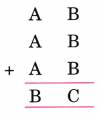
Solution:
__________________________________
__________________________________
__________________________________
Question 11.
Write three multiples of 36 between 10,000 and 12,000.
Solution:
__________________________________
__________________________________
__________________________________
Question 12.
The sum of two digit number (AB) and the number formed by reversing the digit (BA) is 99. If digit ‘B’ is 1 more than the digit ‘A’, what are the values of A and B?
Solution:
__________________________________
__________________________________
__________________________________
Short Answer Type Questions
Question 1.
The middle number in a sequence of 5 consecutive numbers is 22. Express the other numbers in terms of this middle number and find their sum.
Solution:
__________________________________
__________________________________
__________________________________
Question 2.
For consecutive numbers 4, 5, 6 and 7, write all possible 8 combinations by placing ‘+’ and ‘-‘ signs, also verify all the expressions have same parity.
Solution:
__________________________________
__________________________________
__________________________________
Question 3.
When divided by 8, the number 761 leaves a remainder of 1, and 5874 leaves a remainder of 2. Without calculating, find remainders of the following expressions, when divided by 8. Show the steps of your solving:
(a) 5874 – 761
(b) 5874 + 761
Solution:
__________________________________
__________________________________
__________________________________
Question 4.
Find the smallest number that leaves a remainder of 3 when divided by 5, a remainder of 2 when divided by 7, and a remainder of 1 when divided by 3.
The statement “Sum of multiple of 6 and a multiple of 9 is a multiple of 3” is always true. Justify the statement using algebra.
Solution:
__________________________________
__________________________________
__________________________________
Question 5.
Find digital roots of some consecutive multiples of
(a) 8
(b) 5
Solution:
__________________________________
__________________________________
__________________________________
Question 6.
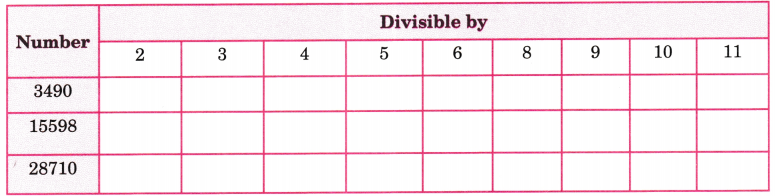
Write Y for the number that is divisible by the number on top and ‘N’ which is not divisible.
Solution:
__________________________________
__________________________________
__________________________________
Question 7.
How many multiples of 9 are there between the numbers 1680 and 1780?
Solution:
__________________________________
__________________________________
__________________________________
Question 8.
The sum of three consecutive even numbers is divisible by 6. Is-statement always true, never true or sometimes true? Provide example in support of your answer.
Solution:
__________________________________
__________________________________
__________________________________
Question 9.
Solve the Cryptarithms
(a) AB × 3 = BC
Solution:
__________________________________
__________________________________
__________________________________
Question 10.
Rahul claims “The sum of the given two digit number and the number obtained by reversing their digits is divisible by 11.” Explain your conclusion by giving two examples.
Solution:
__________________________________
__________________________________
__________________________________
Question 11.
Find three consecutive two-digit numbers such that the first is a multiple of 6, the second number is a multiple of 5, and the third number is a multiple of 7. Are there more such triplets?
Solution:
__________________________________
__________________________________
__________________________________
Question 12.
Find the greatest value of ‘a’ and ‘b’ so that the odd number ‘8a426’ is divisible by both 3 and 5.
Solution:
__________________________________
__________________________________
__________________________________
Case Based Questions
Shobhit has some amount of money which is a 3-digit number. The number is divisible by 2 and 9. If Shobhit has amount more than 400 but less than 500, answer the following questions:
Question 1.
What are the possible values of the last digit of the number?
Solution:
__________________________________
__________________________________
__________________________________
Question 2.
If the sum of the digits of the number is 18, what are the possible values of the number?
Solution:
__________________________________
__________________________________
__________________________________
Question 3.
What is the largest possible value of money Shobhit have?
Solution:
__________________________________
__________________________________
__________________________________