Get the simplified Extra Questions for Class 9 Maths and Ganita Manjari Class 9 Maths Chapter 14 Math of Space Surface Area and Volume Extra Questions with complete explanation.
Class 9 Math of Space Surface Area and Volume Extra Questions
Extra Questions on Math of Space Surface Area and Volume Class 9
Class 9 Ganita Manjari Chapter 14 Extra Questions
Question 1.
Find the slant height of a cone whose radius is 7 cm and height is 24 cm.
Solution:
Here, h = 24 cm and r = 7 cm
Since l = \(\sqrt{h^2+r^2}\)
= \(\sqrt{24^2+7^2}\)
= \(\sqrt{576+49}=\sqrt{625}\) = 25 cms
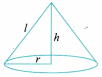
Slant height = 25 cm.
Question 2.
The radii of two cylinders are in the ratio of 2 : 3 and heights are in the ratio of 5 : 3. Find the ratio of their volumes.
Solution:
Ratio of the radii = 2:3
Let the radii be 2r and 3r
Also, their heights are in the ratio of 5 : 3
Let the heights be 5h and 3h
Ratio of their volumes = \(\frac{\pi(2 r)^2 \times 5 h}{\pi(3 r)^2 \times 3 h}=\frac{2^2 \times 5}{3^2 \times 3}=\frac{20}{27}\)
Question 3.
If the volume of a right circular cone of height 9 cm is 4871 cm3, find the diameter of its base.
Solution:
Volume of the cone = 487r cm3
Height of the cone (h) = 9 cm
Let r be its base radius.
∴ \(\frac{1}{3}\)πr2h = 48π
⇒ r2 = \(\frac{48 \times \pi \times 3}{9 \times \pi}\) = 16 = 4
⇒ r = \(\sqrt{4^2}\) = 4 cm
Diameter = 2 × Radius
∴ Diameter of the base of the cone = 2 × 4 = 8 cm.
Math of Space Surface Area and Volume Class 9 Short Question Answer
Question 1.
Find the cost of digging a cuboidal pit 8 m long, 6 m wide, and 3 m deep at the rate of ₹ 30 per m3.
Solution:
Length (l) = 8 m
Width (w) = 6 m
Depth (h) = 3 m
∴ Volume of the cuboidal pit = l × w × h
= 8 × 6 × 3
= 144 m3
Since rate of digging the pit is ₹ 30 per m3
∴ Cost of digging = ₹ 30 × 144 = ₹ 4320.

Question 2.
The radius of a cylinder is 7 cm. If its volume is 2002 cm3, then find its height and total surface area.
Solution:
Here, radius (r) = 7 cm
∴ Volume of the cylinder = πr²h = \(\frac{22}{7}\) × 7 × 7 × h
Now, \(\frac{22}{7}\) × 7 × 7 × h = 2002
⇒ h = \(\frac{2002 \times 7}{22 \times 7 \times 7}\) cm = 13 cm
Now, total surface area of the cylinder
= 2πr² + 2πrh = 2πr(r + h)
= 2 × \(\frac{22}{7}\) × 7 × (7 + 13) cm2
= 44 × 20 cm2
= 880 cm2
Question 3.
A conical tent of radius 7 m and height 24 m is to be made. Find the cost of the 5 m wide cloth required at the rate of ₹ 50 per metre.
Solution:
Radius of the base of the tent (r) = 7m
Height (h) = 24 m
Slant height (l) = \(\sqrt{r^2+h^2}=\sqrt{7^2+24^2}\)
= \(\sqrt{49+576}=\sqrt{625}\) = 25 m
Now, curved surface area of the conical tent = πrl
= 22 × 25 m2 = 550 m2
Let l be the length of the cloth.
∴ l × b = 550
⇒ l × 5 = 550
⇒ l = \(\frac{550}{5}\) m = 110m
∴ Cost of the cloth = ₹ 50 × 110 = ₹ 5500.
Question 4.
How many lead balls, each of radius 1 cm, can be made from a sphere of radius 8 cm?
Solution:
Radius of the lead ball (r) = 1 cm
∴ Volume of a lead ball = \(\frac{4}{3}\)πr3
= \(\frac{4}{3} \times \frac{22}{7}\) × 1 × 1 × 1 cm3 = \(\frac{4}{3} \times \frac{22}{7}\) cm
Radius of the sphere (R) = 8 cm
∴ Volume of the sphere = \(\frac{4}{3}\)πr3
= \(\frac{4}{3} \times \frac{22}{7}\) × 8 × 8 × 8 cm
Let the required number of balls be n.
∴ [Volume of n lead balls] = [Volume of the sphere]
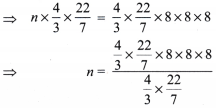
⇒ n = 8 × 8 × 8 = 512
Thus, the required number of balls is 512.
Math of Space Surface Area and Volume Class 9 Long Question Answer
Question 1.
A heap of wheat is in the form of a cone whose diameter is 10.5 m and height is 3 m. Find its volume. The heap is to be covered by canvas to protect it from rain. Find the area of the canvas required.
Solution:
Here, the heap of wheat is in the form of a cone
Base diameter = 10.5 m
⇒ Base radius (r) = \(\frac{10.5}{2}\)m = \(\frac{105}{20}\)m
Height (h) = 3 m
Volume of the heap = \(\frac{1}{3}\)πr2h
= \(\frac{1}{3} \times \frac{22}{7} \times\left(\frac{105}{20}\right)^2\) × 3 m3
= \(\frac{11 \times 15 \times 105}{200}\)m3
= \(\frac{17325}{200}\)m3
= 86.625 m3
Thus, the volume of the heap is 86.625 m3.
The area of the canvas to cover the heap must be equal to the curved surface area of the conical heap.
∴ Area of the canvas = πrl where l = \(\sqrt{r^2+h^2}\)
= \(\sqrt{\left(\frac{10.5}{2}\right)^2+3^2}\)
= \(\sqrt{\frac{110.25}{4}+9}=\sqrt{\frac{146.25}{4}}\)
= \(\frac{1}{2}\) = 6.047 m (approx)
= 6.05 m (approx)
= \(\sqrt{36.5625}\) = 6.047 m (approx.)
= 6.05 m (approx.)
Now, πrl = \(\frac{22}{7} \times \frac{10.5}{2}\) × 6.05 m
= 11 × 1.5 × 6.05 m2
= 99.825 m2
Thus, the required area of the canvas is 99.825 m2.
Question 2.
A hemispherical tank is emptied by a pipe at the rate of 5 litres per minute. How long will it take to half empty the tank if it is 1 \(\frac{1}{2}\) metres in diameter.
[Take π = \(\frac{22}{7}\) and 1l = 1000 cm3]
Solution:
Radius = 1\(\frac{1}{2}\) ÷ 2
= \(\frac{3}{4}\) m
Volume of the hemisphere = \(\frac{2}{3}\)πr3
= \(\frac{2}{3} \times \frac{22}{7} \times \frac{3}{4} \times \frac{3}{4} \times \frac{3}{4}\) m3
= \(\frac{99}{112}\) m3
Volume to be empited = \(\frac{1}{2} \times \frac{99}{112}\)m
= \(\frac{1}{2} \times \frac{99}{112}\) x 1000000 cm
= \(\frac{49500000}{112}\) cm
= \(\frac{49500}{112}\) litres
∵ \(\frac{49500}{112}\) litres will be emptied in \(\frac{1}{5} \times \frac{49500}{112}\) minutes
= \(\frac{1}{5} \times \frac{49500}{112 \times 60}\) hours
= \(\frac{165}{112}\) hours = 1\(\frac{53}{112}\) hours
Math of Space Surface Area and Volume Class 9 Case Based Questions
Question 1.
Students of class IX of the Sagar School plan to have their school bus stand barricaded from the remaining part of the road to avoid inconvenience of the people. For this purpose, they use 50 hollow cones made of recycled cardboard. Each cone has a diameter of 40 cm and a height of 1 m. They paint the outer curved surface of each cone. The cost of painting is ₹ 12 per m2.
(i) Find the radius of each cone.
(ii) Find the slant height of each cone.
(iii) Calculate the curve surface area of all 50 cones.
(iv) Find the cost of painting of all these cones.
[use π = 3.14 and \(\sqrt{1.04}\) = 1.02]
Solution:
(i) Diameter of a cone = 40 cm
∴ Radius of a cone (r) = \(\frac{40}{2}\) cm = 20 cm
= \(\frac{20}{100}\) = 0.2 m
(ii) Height of a cone (h) = 1 m
Slant height of a cone (l) = \(\sqrt{r^2+h^2}\)
l = \(\sqrt{(0.2)^2+(1)^2}\)
= \(\sqrt{0.04+1}=\sqrt{1.04}\) = 1.02 m
[v It is given that \(\sqrt{1.04}\) = 1.02]
(iii) Now, curved surface area of a cone = πrl
= 3.14 × 0.2 × 1.02 m2
= \(\frac{1}{2}\) m
Curved surface area of 50 cones
= 50 × \(\frac{1}{2}\)m
= \(\frac{1}{2}\) × m2 = 32.028 m2
(iv) The rate of painting is ₹ 12 per m2
Total cost of painting 50 cones = 12x
= 12 x× \(\left[\frac{314}{10} \times \frac{102}{100}\right]\)
= ₹\(\frac{384336}{1000}\)
= 384.34(approx)
Math of Space Surface Area and Volume Class 9 Competency Based Questions
Question 1.
The edge of a cube is doubled. What is the ratio of the volume of the resultant cube to the volume of the original cube?
(a) 2 : 1
(b) 4 : 1
(c) 6 : 1
(d) 8 : 1
Solution:
Let the original side of the cube be a.
Volume of original cube = a3
New side = 2a
Volume of new cube = (2a)3 = 8a5
Required ratio = Volume of resultant cube: Volume of
original cube = 8a3: a3 = 8 : 1.
Hence, (d) is the correct answer.
Question 2.
Two right circular cones have equal curved surface areas. Their slant heights are in the ratio 3 : 5, then the ratio of their radii is
(a) 3 : 5
(b) 5 : 3
(c) 9 : 25
(d) 25 :9
Solution:
Curved surface area of a cone = πrl
For the two cones: πr1l1 = πr2l2
⇒ r1l1 = r2l2
Given: l1 : l2 = 3 : 5
Therefore, r1 × 2a = r2 × 5a
⇒ \(\frac{r_1}{r_2}=\frac{5}{3}\)
Thus, the ratio of their radii is 5 : 3.
Hence, (b) is the correct answer.
Question 3.
Nitin used to save a part of his pocket money. He wish to buy paint for a community-centre from his savings. He buys paint in a certain container which is sufficient to paint an area equal to 9.375 m2. How many bricks of dimensions 22.5 cm × 10 cm × 7.5 cm can be painted out of this container?
Solution:
Since a brick is a cuboid having
l = 22.5 cm, w = 10 cm, h = 7.5 cm
∴ Total surface area of a brick
= 2 [lw + wh + hl]
= 2 [(22.5 × 10) + (10 × 7.5) + (7.5 × 22.5)] cm2
= 2 [225 + 75 + 168.75] cm2
= 2 [468.75] cm2
= 937.5 cm2
Let the required number of bricks be n.
∴ Total Surface area of ‘n’ bricks = n × \(\frac{937.5}{10000}\) m
⇒ n × \(\frac{937.5}{10000}=\frac{9375}{1000}\) [The paint is sufficient for 9.375 m2 of area]
⇒ n × \(\frac{9375}{1000} \times \frac{100000}{9375}\)
Thus, the required number of bricks is 100.
Question 4.
If h, C, and V are the height, the curved surface area and the volume of a cone, respectively, prove that 3πVh3 – C2h2 + 9V2 = 0.
Solution:
Let r be the radius of the base and h be the height of the cone.
Curved surface area (C) = πrl = πr\(\sqrt{r^2+h^2}\)
⇒ C2 = π2r2(r2 + h2)
Now 3πVh3 – C2h2 + 9V2
= 3π(\(\frac{1}{3}\)πr2h)h3 – π2r2(r2 + h2)h2 + 9(\(\frac{1}{9}\)π2r4h2)
= π2r2h4 – π2r4h2 – π2r2h4 + π2r4h2 = 0
Hence, 3πVh3 – C2h2 + 9V2 = 0.
Question 5.
A sphere and a right circular cylinder of the same radius have equal volumes. By what percentage does the diameter
of the cylinder exceeds its height?
Solution:
Volume of sphere = \(\frac{4}{3}\)πr3
and volume of right circular cylinder = πrh
Volume of sphere = Volume of right circular cylinder
[Given]
⇒ \(\frac{4}{3}\)πr3 = πr2h
⇒ h = \(\frac{4}{3}\)r
Diameter of the cylinder exceeds its height by
2r – \(\frac{4}{3}\)r = \(\frac{2r}{3}\)
Percentage by which the diameter of the cylinder exceeds its height
\(\frac{\frac{2 r}{3}}{\frac{4 r}{3}}\) × 100 = \(\frac{2 \times 3}{3 \times 4}\) × 100
= 50%
Math of Space Surface Area and Volume Extra Questions for Practice
Multiple Choice Questions
Question 1.
If the volume and surface area of a sphere are numerically equal, then its radius is
(a) 1 unit
(b) 2 units
(c) 3 unit
(d) 4 units
Question 2.
The diameter of the base of a cone is 10.5 cm, and its slant height is 10 cm. Find its curved surface area.
(a) 150 cm2
(b) 165 cm2
(c) 175 cm2
(d) 210 cm2
Question 3.
Two cubes of side 5 cm are joined together to form a cuboid. What is the volume of the resulting cuboid?
(a) 125 cm3
(b) 50 cm3
(c) 250 cm3
(d) 500 cm3
Assertion-Reason Questions
Two statements are given, one labelled as Assertion (A) and the other labelled as Reason (R). Select the correct answer from the options (a), (b), (c), and (d) given below.
(a) Both Assertion (A) and Reason (R) are true and Reason (R) is the correct explanation of the Assertion (A).
(b) Both Assertion (A) and Reason (R) are true, but Reason (R) is not the correct explanation of the Assertion (A).
(c) Assertion (A) is true, but Reason (R) is false.
(d) Assertion (A) is false, but Reason (R) is true.
Question 1.
Assertion (A): If the height of a cone is 24 cm and diameter of the base is 14 cm, then the slant height of the cone is 15 cm.
Reason (R): For a cone, slant height = \(\sqrt{h^2+r^2}\).
Short Answer Type Questions
Question 1.
A matchbox measures 4 cm × 2.5 cm × 1.5 cm. What will be the volume of a packet containing 12 such boxes?
Question 2.
The diameter of a roller is 84 cm, and its length is 120 cm. It takes 500 complete revolutions to move once over to level a playground. Find the area of the playground in m2.
Question 3.
The radius of a spherical balloon increases from 7 cm to 14 cm as air is being pumped into it. Find the ratio of the surface areas of the balloon in the two cases.
Question 4.
A hemispherical bowl made of brass has an inner diameter of 10.5 cm. Find the cost of tin-plating it on the inside at the rate of ₹ 16 per 100 cm2.
Question 5.
A conical tent of radius 7 m and height 24 m is to be made. Find the cost of the 5 m wide cloth required at the rate of ₹ 50 per metre.
Question 6.
The radius and slant height of a cone are in the ratio 4 : 7. If its curved surface area is 792 cm2, find its radius.
Long Answer Type Questions
Question 1.
A bus stop is barricaded from the remaining part of the road by using 50 hollow cones made of recycled cardboard. Each cone has a base diameter of 40 cm and height 1 m. If the outer side of each of the cones is to be painted and the cost of painting is ₹ 12 per m2, what will be the cost of painting all these cones? (Use π = 3.14 and take \(\frac{1}{2}\) = 1.02)
Question 2.
A solid is hemispherical at the bottom and conical above. If the surface areas of the two parts are equal, find the ratio of its radius and height of conical part.