Practice with Understanding Society India and Beyond Class 9 Solutions and Class 9 Social Science SST Part 2 Chapter 6 From Ideas to Startups Social Science Question Answer NCERT Solutions to improve your exam performance.
From Ideas to Startups Class 9 Questions and Answers
Class 9 From Ideas to Startups Question Answer
The Big Questions? (Page No. 125)
Question 1.
How does entrepreneurship impact society and the economy?
Answer:
- Entrepreneurship creates employment opportunities.
- It encourages innovation and the development of new products and services.
- It helps solve real-world problems.
- It supports economic growth and development.
- Entrepreneurs contribute to the vision of building a Viksit Bharat by 2047.
Question 2.
What are some functional areas of a business?
Answer:
- Management and operations look after day-to-day activities and efficient processes.
- Finance and accounting manage money, budgeting, and financial records.
- Human resources manages employees, hiring, and training.
- Marketing and sales create awareness and promote products or services.
- Together, these areas help a business use its resources properly and grow successfully.
Question 3.
How to develop a business plan?
Answer:
- Identify the business idea and understand the needs of potential customers.
- Conduct market research to understand existing products and customer needs.
- Describe the product or service, its features, benefits, and price.
- Identify the required resources, such as finance, materials, technology, and human resources.
- Prepare an operations plan and marketing plan to explain how the business will work and reach customers.

From Ideas to Startups Question Answer Class 9
InText Questions
Let’s Explore
Question 1.
Interview two people in your vicinity who run a business (tailor, shopkeeper, factory owner, etc.) and find out about their journey of starting the business by asking them the following questions: (Page No. 136)
(a) Why did they start the business?
(b) What were the challenges they faced?
(c) What were the risks taken?
(d) What did they learn from the process?
Answer:
Interview 1: Tailor
(a) They started the tailoring business because they had good stitching skills and wanted to earn a regular income.
(b) They faced challenges such as finding customers, buying sewing equipment, and managing the business in the beginning.
(c) They invested their savings in sewing machines, materials, and setting up the shop without knowing how many customers they would get.
(d) They learned that hard work, good-quality work, customer satisfaction, and proper management are important for running a successful business.
Interview 2: Shopkeeper
(a) They started the shop to meet the needs of people in the neighbourhood and earn a livelihood.
(b) They faced challenges such as attracting customers, managing stock, and competing with other shops.
(c) They invested money in purchasing goods and setting up the shop, taking the risk that the products would sell.
(d) They learned the importance of understanding customers, maintaining proper stock, managing money carefully, and providing good service.
Question 2.
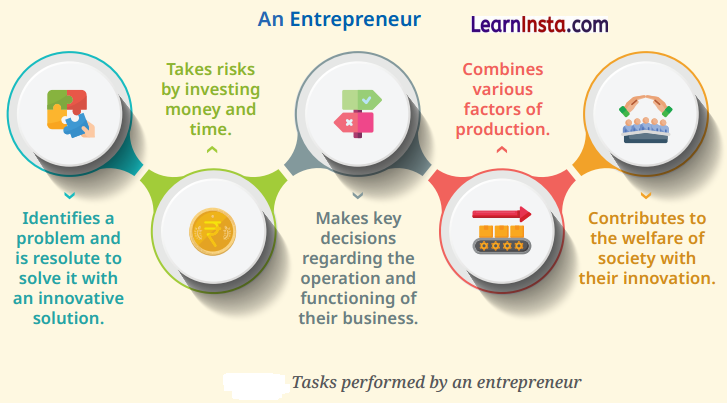
Prepare a short report on the tasks an entrepreneur performs at each stage, with reference to the figure given below. (Page No. 136)
Answer:
entrepreneur performs several important tasks at different stages of running a business:
- Identifies a problem and finds an innovative solution to solve it.
- Takes risks by investing money and time in the business.
- Makes key decisions about the operation and functioning of the business.
- Combines various factors of production, such as resources, people, and processes, to produce goods or services.
- Contributes to the welfare of society through their innovation and business activities.
Question 3.
Based on the case study of Mohan Singh Oberoi on Page 128, which functional area helped improve the quality of the company’s products? How did different functional areas work together to make the business successful? Now that you know about the functional areas of a business, create a business plan for your business idea using the template given in NCERT question no. 11. (Page No. 136)
Answer:
The management and operations functional area helped improve the quality of the company’s products. In the case of Mohan Singh Oberoi, efficient operations, renovation of hotels, and maintaining high standards helped improve the quality of services.
The different functional areas worked together in the following ways:
- Management and operations helped maintain efficient hotel operations, improve facilities, and provide quality services.
- Human resources helped by hiring and training skilled staff to provide excellent hospitality.
- Finance and accounting helped manage money carefully and support business growth and expansion.
- Marketing and sales helped build a trusted brand known for luxury and quality service.
- All these areas worked together, with customer satisfaction as an important priority, helping the business grow successfully.
Business idea: Healthy Tiffin Service
(a) Business idea
- Name of the business: Healthy Tiffin Hub
- Product/Service: Fresh and healthy homemade meals
- Tagline: Healthy Food, Happy Life
(b) Entrepreneur profile
Founder: Student entrepreneur
Why did you choose this business idea?
To provide fresh, healthy, and affordable meals to people who have limited time to cook.
What problem does your business solve?
It provides convenient and nutritious food to customers.
(c) Target customers
Target customers: Students, parents, local residents, and office workers.
They need affordable, fresh, and convenient meals.
(d) Market research
- Customers need fresh, affordable, and healthy meals.
- Other tiffin services may already be available.
- Our service will be different by offering healthy meals, flexible menus, and eco-friendly packaging.
(e) Product or service description
The business will provide fresh homemade meals such as dal, vegetables, roti, rice, and salad. Customers can choose daily or weekly meal plans.
(f) Resources required
- Human Resources – cooks, helpers, and delivery staff
- Finance – money for equipment, ingredients, and packaging
- Materials – vegetables, grains, spices, and packaging
- Technology – mobile phone and online ordering system
- Infrastructure – kitchen and storage space
(g) Operations plan
- Buy fresh ingredients.
- Prepare and cook the meals.
- Pack the food safely.
- Deliver the meals to customers.
- Collect feedback and improve the service.
(h) Marketing plan: The business will be promoted through social media, posters, word of mouth, and special offers.
(i) Financial plan: Source of finance: Personal savings and family support.
Main costs: Ingredients, packaging, kitchen equipment, salaries, and delivery.
Revenue: Money received from selling tiffin meals.
Expected profit: Total revenue – total expenses.
(j) Risks and challenges: The business may face competition, rising prices of ingredients, changing customer preferences, and fluctuating demand.
(k) Social and environmental impact: The business will provide healthy food and create employment. It will use recyclable packaging to reduce waste.
(l) Conclusion: The business can succeed by providing good-quality food, maintaining reasonable prices, understanding customer needs, and managing all functional areas properly.
Question 4.
Find out more about other regional communities who have excelled as entrepreneurs. (Page No. 137)
Answer:
India has several regional communities with a long history of entrepreneurship. Some examples are:
(i) Marwaris: Traditionally associated with trade, finance, and business, the Marwari community has produced many successful business families and entrepreneurs.
(ii) Gujaratis: Gujarati communities have a long history of trading and commercial activities, including maritime trade and industry.
(iii) Parsis: The Parsi community has contributed significantly to Indian industry and entrepreneurship, with business families such as the Tatas and Godrejs.
(iv) Chettiars: The Chettiar community of South India traditionally engaged in banking and trade and later developed businesses in industries such as manufacturing and hospitality.
(v) Sindhis: Sindhi business communities have been active in trade and entrepreneurship and have developed businesses in India and other parts of the world.
These examples show that entrepreneurship has developed across different regions and communities of India. Business networks, trading experience, skills, and adaptation to new opportunities have played a role in their entrepreneurial activities.
Think About It
Question 1.
Read the source given below and answer the following questions: (Pages No. 127 – 128)
From Rooftop to Revolution
In 1959, seven ordinary homemakers from a Mumbai chawl gathered on a rooftop with borrowed equipment, a recipe, and ₹ 80. Their goal was modest-to earn some extra income by making and selling papads. They had no business degrees, no investors, and no master plan; instead, what they had was grit and unity.
There were no factories at first. Each woman took raw dough home every morning, rolled papads through the day between household tasks, and returned the finished pieces by evening, with the condition that the quality had to be consistent. They decided to start a cooperative society where every member who joined would be an equal owner, and profits would be shared equally regardless of seniority.
In 1962, they registered the venture as Shri Mahila Griha Udyog Lijjat Papad, a cooperative society, where ‘Lijjat’ means tasty in Gujarati. Afterwards, many branches opened across India and garnered thousands of members. In the 1980s and 90s, Lijjat expanded into other products like flour, masalas, and soaps, and exports began too, crossing a turnover of ₹ 1oo crore. By 2023, the cooperative had over 45,000 women members, 83 branches, and an annual turnover of ₹ 1,600 crore.
The women begin work early in the morning, facilitated by pick-up and drop-off bus services. Lijjat also provides scholarships to the school- going children of the members to encourage them to pursue further education. The organisation has helped thousands of women become financially independent, empowered communities, and built a large-scale business while being completely self- reliant.
1. What problem was Lijjat solving beyond just selling papads?
Answer:
Lijjat helped women earn an income and become financially independent. It also empowered communities by providing women with opportunities to work together and build a self-reliant business.
2. What challenges do you think the founders could have faced at the start? How might they have overcome them?
Answer:
The founders could have faced challenges such as limited money, lack of equipment, and managing work along with household responsibilities. They overcame such difficulties through unity, hard work, consistent quality, and by working together as a cooperative.
Question 3.
Can you think of a similar cooperative idea you could start in your community?
Answer:
A group of people in the community could start a cooperative to make and sell homemade food products such as pickles, snacks, or spices. Each member could contribute their skills, share the work, and divide the profits equally.
Class 9 SST Part 2 Chapter 6 Question Answer
Questions and Activities (Pages No. 140 – 145)
Question 1.
Explain why a business can fail even with a great idea if one functional area [finance, human resources (HR), operations, or marketing] is weak. If you were running a bakery, which functional area would you prioritise first and why?
Answer:
A great business idea alone cannot ensure success. All four functional areas-finance and accounting, human resources, management and operations, and marketing and sales-work together to make a business successful. If one area is weak, the business may face problems.
- Finance and Accounting: Poor financial management can lead to shortage of money and difficulty in meeting expenses.
- Human Resources: Without skilled and trained employees, the quality of products and services may suffer.
- Management and Operations: Poor operations can cause delays, wastage, and inconsistent quality.
- Marketing and Sales: Without proper marketing, customers may not know about the product.
If I were running a bakery, I would first prioritise management and operations because the bakery needs efficient production, good quality, proper handling of ingredients, and smooth daily operations. Other areas such as finance, HR, and marketing would also need to work together for the bakery to succeed.
Question 2.
Do you think innovation alone is enough to make a business successful? Why or why not?
Answer:
No, innovation alone is not enough to make a business successful. An entrepreneur must also plan properly, manage resources, understand customer needs, and control costs.
- A good idea must solve a real problem or meet a customer need.
- Proper finance is needed to produce and sell the product.
- Skilled employees and efficient operations are needed to maintain quality.
- Marketing and sales are necessary to attract customers.
For example, the Dandekar brothers improved their products after identifying the need for better art materials in India. They studied colour chemistry and developed products suited to Indian needs. Their success involved innovation along with planning, resources, and improvement.
Question 3.
“A business plan is a dynamic roadmap for a startup.” Explain this statement with suitable examples. When should one change the business plan?
Answer:
A business plan is a written document that explains the goals of a business and the steps needed to achieve them. It acts as a roadmap by helping an entrepreneur organise resources, make decisions, and manage the business.
It is called a dynamic roadmap because a business plan may need to change when conditions change. For example, a bakery may initially plan to sell cakes and pastries to local customers. Later, if customers show greater demand for healthy products, the bakery may add whole-wheat products. it may also change its marketing method, prices, resources, or operations.
A business plan should be changed when:
- Customer needs or preferences change.
- The products or services are changed.
- Costs, income, or sources of finance change.
- The business enters a new market or faces new competition.
- New risks or challenges arise.
Thus, a business plan should be reviewed and modified according to the changing needs and conditions of the business.
Question 4.
Do you think every entrepreneur should think about the impact of their goods or services on society and the environment? Explain using relevant examples.
Answer:
Yes, entrepreneurs should consider the impact of their goods and services on society and the environment. A business is not only meant to earn profit; it can also create value for society and contribute to sustainable development.
- Entrepreneurs should provide useful and safe products to customers.
- They should consider the needs and well-being of workers and communities.
- They should reduce waste and use resources responsibly.
- They can use recyclable or eco-friendly packaging to reduce environmental harm.
For example, a bakery can use recyclable packaging and avoid unnecessary food wastage. The Lijjat Papad cooperative also shows how a business can create social value by helping thousands of women become financially independent and empowering communities.
Therefore, considering social and environmental impact can help businesses contribute positively to society while growing economically.
Question 5.
In 1931, two brothers, Digambar and Govind Dandekar, started a small business in South Mumbai selling ink powder. They began with limited resources, using recycled glass bottles to sell liquid ink. At first, they faced financial problems and struggled to convince customers to trust their products. Instead of giving up, they focused on providing good-quality stationery at affordable prices. As the business grew, they noticed that artists in India did not have access to good art materials.
Seeing this as an opportunity, they travelled to Glasgow to study colour chemistry and improve their products. After returning to India, they set up a laboratory to develop colours and art supplies suited to Indian needs. Over time, the company expanded into pencils, crayons, geometry boxes, and paints, eventually becoming a well-known brand.
(i) What entrepreneurial qualities did the Dandekar brothers display?
Answer:
The Dandekar brothers displayed several entrepreneurial qualities:
- They took risks despite having limited resources.
- They did not give up when they faced financial problems.
- They focused on providing good-quality products at affordable prices.
- They identified new opportunities in the market.
- They worked to improve and expand their products.
(ii) What opportunity did they identify in the market?
Answer:
They noticed that artists in India did not have easy access to good-quality art materials. They identified this as a market opportunity and worked to develop colours and art supplies suited to Indian needs.
(iii) Was travelling to Glasgow a risky decision?
Answer:
Yes, travelling to Glasgow involved risk because it required time, money, and effort. However, the Dandekars saw it as an opportunity to gain knowledge of colour chemistry and improve their products. This knowledge helped them develop better colours and art supplies.
(iv) Which functional area helped the company improve its products?
Answer:
The research and development function helped the company improve its products. By studying colour chemistry and setting up a laboratory, the Dandekars developed colours and art supplies suited to Indian needs. This helped the company expand its range of products.
(v) How did they serve society apart from earning profits?
Answer:
The Dandekars served society by providing good-quality and affordable stationery and art materials. They developed products suited to the needs of Indian artists and expanded their range to include pencils, crayons, geometry boxes, and paints. Their products made useful stationery and art materials more accessible to people.
Question 6.
How do you think entrepreneurship is important for India’s goal of becoming a developed nation by 2047?
Answer:
Entrepreneurship is important for India’s goal of becoming a developed nation by 2047 because entrepreneurs:
- Create new businesses and generate employment opportunities.
- Develop innovative products and services to solve real-world problems.
- Encourage self-reliance by using local skills, resources, and ideas.
- Contribute to economic growth through business activities and investment.
- Help develop new technologies and industries.
Thus, entrepreneurship can promote innovation, create jobs, solve problems, and contribute to India’s economic development. The chapter also highlights that startups and entrepreneurs contribute to the vision of Viksit Bharat 2047. The Government of India also describes innovation and entrepreneurship as important drivers of India’s transformation towards Viksit Bharat 2047.
Question 7.
Choose a product or service and develop a business plan for it using the following template:
Business name
Business idea
Target customers
Product/service and price
Marketing idea
Basic cost and expected profit
Answer:
Do it yourself.
Question 8.
Find out about various government schemes to promote entrepreneurs in India. Learn about the eligibility requirements of these schemes. Prepare a write-up and discuss in the class.
Answer:
Do it yourself.
Question 9.
Take any popular brand and identify:
The problem it tackles
Its initial target customers
How it differentiated itself from other competitors or brands
The resources it may have started with
Answer:
Example – Amul
- Problem it tackles: Amul was developed through a cooperative model to help milk producers get better returns for their milk and reduce the role of middlemen, while providing quality dairy products to consumers.
- Initial target customers: Its products were aimed at consumers who needed milk and other dairy products, while the cooperative model also directly supported milk-producing farmers.
- Differentiation: Amul differentiated itself through its cooperative structure, direct connection between milk producers and consumers, quality products, and value-for-money pricing.
- Resources it may have started with: The early cooperative movement began with milk-producing farmers, village-level cooperative societies, milk collection and processing facilities, and the support of cooperative leadership and professional management.
This example shows how identifying a problem, understanding customers, using available resources, and creating a different business model can help develop a successful brand.
Question 10.
Over the next week, observe your daily routine at school and home. Identify 2-3 problems or inconveniences you or others face. For each problem, answer the following questions in a tabular format:
Who faces this problem?
How often does it occur?
Why hasn’t it been solved yet?
What business idea could solve it?
Would people pay for your solution?
Answer:
Identifying everyday problems and thinking of solutions is an important part of finding entrepreneurial opportunities.
| Problem or Inconvenience | Who faces this problem? | How often does it occur? | Why hasn’t it been solved yet? | What business idea could solve it? | Would people pay for the solution? |
| Long queues at the school canteen | Students and teachers | Almost every school day | Many students buy food during the same break | Pre-order food through a simple school ordering system | Yes, if it saves time and provides convenient service |
| Wastage of unused notebooks and stationery | Students and schools | Frequently during the school year | Students may not know where to give unused materials | Collect and redistribute unused stationery to students who need it | Yes, schools or families may pay a small amount for collection and delivery |
| Difficulty finding healthy snacks near school | Students and teachers | Daily | Nearby shops may mainly sell packaged or less healthy snacks | A small healthy snack delivery service for schools | Yes, if the food is affordable and convenient |
Question 11.
These are sample answers. Students can replace them with problems they actually observe during their one-week observation. Think of your startup idea and fill in the business plan template given below:
(a) Business idea
Name of the company or shop:
Product/service: ………………………………….. .
Tagline (optional): ……………………………… .
(b) Entrepreneur profile
Founder(s): ………………………………… .
Why did you choose this business idea?
What problem does your business solve?
(c) Target customers
Who will buy your product or service?
▭ Students
▭ Parents
▭ Local residents
▭ Tourists
▭ Farmers
▭ Businesses
▭ Others: …………………………………
Describe your target customers:
………………………………………………………………………
……………………………………………………………………….
(d) Market research
Find answers to the following questions about potential customers.
| Question | Findings |
| What do the customers need? | |
| What products or services already exist? | |
| How is your idea different? |
(e) Product or service description: Describe your product or service. List its key features and benefits:
………………………………………………………………………………………………………………………………
………………………………………………………………………………………………………………………………
………………………………………………………………………………………………………………………………
(f) Resources required
| Resource | What is needed and how much? |
| Human Resources | |
| Finance | |
| Materials | |
| Technology | |
| Infrastructure |
(g) Operations plan: How will the business work? Write the steps. You may depict this using a flow chart.
(h) Marketing plan
How will customers learn about your business?
▭ Posters
▭ School events
▭ Social media
▭ Local market
▭ Word of mouth
▭ Newspapers
▭ Others: ……………………………………………
(i) Financial plan
Source(s) of finance:
Estimated monthly cost on various items:
| Item | Cost (₹) |
| Total Cost |
Details of expected monthly revenue sources:
| Source of Income | Amount (₹) |
| Total Revenue |
Expected Profit:
Revenue – Cost
₹ ……………………………… .
(j) Risks and challenges: What challenges might your business face?
……………………………………………………………………
……………………………………………………………………
(k) Social and environmental impact: How will your business help people or the environment?
……………………………………………………………………….
……………………………………………………………………….
(l) Conclusion: Why do you believe your business will succeed?
………………………………………………………………………
………………………………………………………………………
………………………………………………………………………
Answer:
Do it yourself.
Question 12.
Visit a factory or a production unit. Explore how a business operates by visiting a factory or production unit that manufactures a product. Prepare questions for the owner or manager, such as:
What product does the factory produce?
Who are its customers?
How did the business start?
What challenges did the business face in its early years?
How does the business manage its finances?
How are employees recruited and trained?
How are products supplied to wholesalers, retailers, or consumers?
During the visit, observe the production process carefully. Note the resources used, such as raw materials, machinery and technology, workers, and managers. Interact with the owner or manager and record key information. Take notes and photographs (if permitted).
After the visit:
Understand the manufacturing process and create a process map showing the journey of the product from raw materials to the final customer.
Identify barriers to growth, such as:
Financial Barriers: Lack of capital, difficulty obtaining loans or credit, etc.
Technical Barriers: Outdated machinery, limited access to technology, etc.
Human Resource Barriers: Skill shortages, difficulty hiring or retaining workers, etc.
Market Barriers: Competition, limited access to suppliers or customers, etc.
Regulatory Barriers: Complex procedures, licences, approvals, or paperwork, etc.
Recommend some practical solutions through which the business could overcome these challenges. Share your findings by preparing a presentation and a report highlighting your observations, analysis, and recommendations.
The format of the report may be as follows:
Introduction
Production or service delivery process (with diagrams or flowcharts)
Resources required
Barriers identified (supported by observations or evidence)
Suggested solutions
Reflection: key lessons learned from the visit
Answer:
Do it yourself.