Get the simplified Extra Questions for Class 9 Maths and Ganita Manjari Class 9 Maths Chapter 13 Two Variables One Line Extra Questions with complete explanation.
Class 9 Two Variables One Line Extra Questions
Extra Questions on Two Variables One Line Class 9
Class 9 Ganita Manjari Chapter 13 Extra Questions
Question 1.
The cost of a notebook is twice the cost of a pen. Write a linear equation in two variables to represent this statement. (Take the cost of a notebook to be ₹ x and that of a pen to be ₹ y).
Solution:
Let the cost of a notebook = ₹ x
The cost of a pen = ₹ y
ATQ:
x = 2 × y
or x = 2y
or x – 2y = 0
Thus, the required linear equation is x – 2y = 0.
Question 2.
For what value of c, the linear equation 2x + cy = 8 has equal values of x and y for its solution?
Solution:
The value of c for which the linear equation 2x + cy = 8 has equal values of x and y
i. e., x = y for its solution is
2x + cy = 8
⇒ 2x + cx = 8 [∵ y = x]
cx = 8 – 2x
c = \(\frac{8-2 x}{x}\), x ≠ 0
Question 3.
Find the value of m if the point (3, 7) lies on the line 2x + my = 20
Solution:
Substitute x = 3, y = 7 in the given equation 2x + my = 20
2(3) + m(7) = 20
⇒ 6 + 1m = 20
⇒ 1m = 14
⇒ m = 2
Question 4.
Find the slope of the line passing through the points (2, 5) and (6, 13).
Solution:
Given points (2, 5) and (6, 13)
Slope = \(\frac{y_2-y_1}{x_2-x_1}\)
= \(\frac{13-5}{6-2}=\frac{8}{4}\) = 2
Therefore, the slope is 2.

Two Variables One Line Class 9 Short Question Answer
Question 1.
Solve the following pair of linear equations by the substitution method.
(i) x + y = 14
x – y = 4
Solution:
x + y = 14
x – y = 4
From the equation (1), we get
x = (14 – y)
Substituting this value of x in (2), we have:
(14 – y) – y = 4
⇒ 14 – 2y = 4
⇒ – 2y = 4 – 14
⇒ – 2y = – 10 or y = \(\frac{10}{2}\)
i.e., y = 5
Now, substituting y = 5 in (1), we get
x + 5 = 14
⇒ x = 14 – 5
⇒ x = 9
Thus, x = 9 andy = 5
(ii) 0.2x + 0.3y = 1.3
0.4x + 0.5y = 2.3
Solution:
0.2x + 0.3y = 1.3
0. 4x + 0.5y = 2.3
From the equations (1), we get
0. 3y = (1.3 – 0.2x)
1.3 – 0.2x
⇒ y = \(\frac{1.3-0.2 x}{0.3}\)
From (2) and (3), we have:
0.4x + 0.5\(\left[\frac{1.3-0.2 x}{0.3}\right]\) = 2.3
0.4x + \(\frac{1}{2}\) = 2.3
0.3 × 0.4x + 0.65 – 0. 1x = 0.3 × 2.3
0.12x + 0.65 – 0.1x = 0.69
0.12x – 0.1x = 0.69 – 0.65
0.02x = 0.04 0.04
x = \(\frac{0.04}{0.02}\) = 2
From (3),
y = \(\frac{1.3-0.2(2)}{0.3}\)
y = \(\frac{1.3-0.4}{0.3}=\frac{0.9}{0.3}\) = 3
x = 2 and y = 3
Question 2.
A fraction becomes if 1 is added to both the numerator and the denominator. If 5 is subtracted from both the numerator and the denominator, it becomes \(\frac{1}{2}\). Find the fraction.
Solution:
Let the fraction be \(\frac{1}{2}\), where x is the numerator and y is the denominator.
ATQ:
Adding 1 to both the numerator and denominator gives \(\frac{4}{5}\)
\(\frac{x+1}{y+1}=\frac{4}{5}\)
Cross-multiplying, we get
⇒ 5(x + 1) = 4(y + 1)
⇒ 5x + 5 = 4y + 4
⇒ 5x – 4y = -1 …(1)
Subtracting 5 from both the numerator and denominator gives \(\frac{1}{2}\)
\(\frac{x-5}{y-5}=\frac{1}{2}\)
Cross-multiplying, we get
⇒ 2(x – 5) = 1(y – 5)
⇒ 2x – 10 = y – 5
⇒ 2x – y = 5
⇒ y = 2x – 5
Substitute Equation 2 into Equation 1, we get
⇒ 5x – 4(2x – 5) = -1
⇒ 5x – 8x + 20 = -1
⇒ -3x = -21
⇒ x = 7
Substitute the value of y in (1), we get
y = 2(7) – 5 = 14 – 5 = 9
So, the required fraction is \(\frac{7}{9}\).
Question 3.
Six years ago, Rahul was four times as old as Amit. Six years later, Rahul will be twice as old as Amit. How old are Rahul and Amit now?
Solution:
Let present age of Rahul = x years
Let present age of Amit = y years
Condition 1:
x – 6 = 4(y – 6)
⇒ x – 6 = 4y – 24
⇒ x – 4y = -18
Condition 2:
⇒ x + 6 = 2 (y + 6)
⇒ x + 6 = 2y + 12
⇒ x – 2y = 6
Subtracting Equation (1) from Equation (2):
⇒ (x – 2y) – (x – 4y) = 6 – (-18)
⇒ 2y = 24
⇒ y = 12
Substituting y = 12 in Equation (2):
⇒ x – 2(12) = 6
⇒ x – 24=6
⇒ x = 30
Rahul’s age = 30 years Amit’s age = 12 years
Two Variables One Line Class 9 Long Question Answer
Question 1.
A school is organising a science exhibition. Two types of entry tickets are sold. Student tickets cost ₹ 30 each, and teacher tickets cost ₹ 50 each. The school collects ₹ 4200 by selling 100 tickets. Find the number of student and teacher tickets sold using a pair of linear equations.
Solution:
Let the number of student tickets = x
Let the number of teacher tickets = y
ATQ:
x + y = 100 …(1)
30x + 50y = 4200 …(2)
Divide equation (2) by 10, we get,
3x + 5y = 420 …(3)
From equation (1), we get,
x = 100 – y
Substitute in equation (3), we get,
3(100 – y) + 5y = 420
⇒ 3(100 – y) + 5y= 420
⇒ 300 – 3y + 5y = 420
⇒ 2y = 120
⇒ y = 60
So, putting the value of y is x = 100 – y, we get
x = 100 – 60 = 40
Therefore, Number of student tickets = 40 and Number of teacher tickets = 60
Question 2.
The taxi fare in a town is ₹ 10 for the first kilometre and ₹ 6 per km for the subsequent distance. Taking the distance as V km and total fare as ₹ y, write a linear equation for this information, what will be the total fare for 15 km?
Solution:
Total distance is x km.
Total fare = ₹ y
∴ x = First km + subsequent kms
= 1 + (x- 1)
Since, fare for the first km = ₹ 10
∴ Fare for the remaining distance
= ₹ 6 x (x – 1) = ₹ 6x – ₹ 6
⇒ Total taxi fare = ₹ 10 + ₹ 6x – ₹ 6
= ₹4 + ₹6x
∴ y = 4 + 6x
⇒ y – 6x = 4
⇒ 6x – y + 4=0
It is the required equation.
Now, total fare for 15 km
6 × 15 – y + 4 = 0
[Substituting x = 15]
⇒ 90 – y + 4 = 0
⇒ 94 – y = 0
⇒ y = 94
∴ Total fare = ₹ 94
Two Variables One Line Class 9 Case Based Questions
Question 1.
Puneet went for shopping in the evening by metro with his father, who is an expert in mathematics. He told Puneet that the path of metro A is given by the equation 2x + 4y = 8 and the path of metro B is given by the equation 3x + 6y = 18. His father put some question to Puneet. Help Puneet to solve the questions.
Answer the questions based on the given information.
(i) Write the coordinates of the points at which the equation 2x + 4y = 8 intersects the x-axis andy-axis, respectively.
(ii) Write the coordinates of the point of intersection of the two given lines.
(iii) Check whether the graphs of the given linear equations is parallel or coincident.
Solution:
(i) At x-axis, y = 0
2x + 4y = 8
⇒ x = 4
At y-axis, x = 0
Hence, 2x + 4y = 8
⇒ y = 2
⇒ The required coordinates are (4, 0), (0, 2).
(ii) Since \(\frac{1}{2}\)
Hence, the lines are parallel.
So, the point of intersection of these lines does not exist.
(iii) Since the lines are parallel.
2x + 4y = 8

3x + 6y = 18
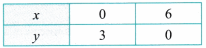
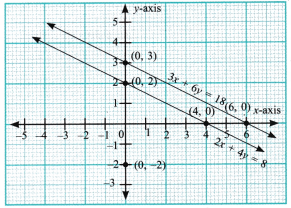
⇒ These equations have no solution, so the graph of the system of linear equations is parallel.
Question 2.
Arvind owns a dry-fruits store. He sells cashew nuts at ₹ 600/kg and pistachio nuts at ₹ 750/kg. A customer asks for a mixture of cashew nuts and pistachio nuts with the following conditions:
- Both the items should together weigh 500 g.
- Both the items should together cost ₹ 360.
Answer the questions based on the given information,
(i) If Arvind packs x kg of cashew nuts and y kg of pistachio nuts for the customer, frame the equations that represent the given context.
(ii) Find the weights of cashew nuts and pistachio nuts that Arvind packed for the customer.
(iii) Name the two methods to solve a pair of linear equations.
OR
Name the two methods to solve an algebraic equation.
Solution:
(i) The pair of linear equations in two variables representing the given context as:
x + y = \(\frac{1}{2}\)
600x + 750y = 360
(ii) x + y = \(\frac{1}{2}\) …(1)
⇒ 600x + 750y = 360 …(2)
Multiply equation (1) by 600 we get,
⇒ 600x + 600y = 300
Subtract equation (1) from equation (2) we get,
600x + 750y = 600x – 600y
= 360 – 300
⇒ 150y = 60
⇒ y = \(\frac{60}{150}=\frac{2}{5}\)
Substititing the value ofy in equation (1), we get
⇒ x + \(\frac{2}{5}=\frac{1}{2}\)
⇒ x = \(\frac{1}{2}-\frac{2}{5}=\frac{5-4}{10}=\frac{1}{10}\)
On solving, we get values of x = \(\frac{1}{10}\) and y =\(\frac{2}{5}\) and concludes that Arvind packed \(\frac{1}{10}\) kg of cashew nuts and \(\frac{2}{5}\) kg of pistachio nuts for the customer.
(iii) (1) Algebraic method (2) graphical method,
OR
(1) Substitution method (2) Elimination method.
Two Variables One Line Class 9 Competency Based Questions
Multiple Choice Questions
Question 1.
The linear equation 2x – 5y = 7 has
(a) a unique solution
(b) two solutions
(c) infinitely many solutions
(d) no solution.
Solution:
2x – 5y = 7 is a linear equation in two variables. A linear equation in two variables has infinitely many solutions. Hence, (c) is the correct option.
Question 2.
Any solution of the linear equation 2x + 0y + 9 = 0 in two variables is of the form:
(a) (\(-\frac{9}{2}\), m)
(b) (n, \(-\frac{9}{2}\))
(c) (0, \(-\frac{9}{2}\))
(d) (-9, 0)
Solution:
The given linear equation is 2x + 0y + 9 = 0
2x = -9 ⇒ x = –\(\frac{9}{2}\)
Since the coefficient of y is 0 in the given equation, the solution can be given as (\(-\frac{9}{2}\), m).
Hence, (a) is the correct option.
Question 3.
The graph of y = 6 is a line
(a) parallel to x-axis at a distance of 6 units from the origin.
(b) parallel toy-axis at a distance of 6 units from the origin.
(c) making an intercept 6 on the x-axis.
(d) making an intercept 6 on both the axes.
Solution:
The given equation y = 6 does not contain x.
Its graph is a line parallel to x-axis.
So, the graph ofy = 6 is a line parallel to x-axis at a distance of 6 units from the origin.
Hence, (a) is correct option.
Question 4.
A student says that the equation x = 5 is not a linear equation because it has only one variable. Do you agree? Give a reason.
Solution:
No, the given equation can be written as x + 0y = 5, which is a linear equation in two variables. Its graph is a vertical straight line.
Therefore, the statement is incorrect.
Question 5.
Find the value of k so that the point (3, k) lies on the line represented by x – 5y = 5.
Solution:
Substituting (3, k) in x – 5y = 5, we have:
3 – 5k = 5 ,
⇒ -5k = 5 – 3 = 2
⇒ k = – \(\frac{2}{5}\)
Two Variables One Line Extra Questions for Practice
Multiple Choice Questions
Question 1.
The y-intercept of the liney = 4x – 7 is
(a) 4
(b) -7
(c) 7
(d) -4
Question 2.
Which of the following points lies in the fourth quadrant?
(a) (5, 3)
(b) (-5, 3)
(c) (-5,-3)
(d) (5,-3)
Question 3.
The graph of the equation x = 7 is a line parallel to the
(a) x-axis
(b) y-axis
(c) line y = x
(d) origin
Question 4.
The equation 4x + 2y = 8 can be written in slope-intercept form as:
(a) y = 2x +4
(b) y = -4x + 2
(c) y = -2x + 4
(d) y = -2x – 4
Assertion-Reason Questions
Two statements are given, one labelled as Assertion (A) and the other labelled as Reason (R). Select the correct answer from the options (a), (b), (c), and (d) given below.
(a) Both Assertion (A) and Reason (R) are true and Reason (R) is the correct explanation of the Assertion (A).
(b) Both Assertion (A) and Reason (R) are true, but Reason (R) is not the correct explanation of the Assertion (A).
(c) Assertion (A) is true, but Reason (R) is false.
(d) Assertion (A) is false, but Reason (R) is true.
Question 1.
Assertion (A): Two parallel lines have no common solution.
Reason (R): Parallel lines never intersect.
Question 2.
Assertion (A): y = 2x represents a line passing through the origin.
Reason (R): Any line parallel to the x-axis at a distance a is y = a.
Short Answer Type Questions
Question 1.
Find the value of k so that the graphs of 2x – ky = 9 and 6x – 9y = 18 will be parallel.
Question 2.
Find the value of k, so that the point (2, k) lies on the line represented by 3x – 4y = 14.
Question 3.
The sum of the digits of a two-digit number is 8. Also, seven times this number is four times the number obtained by reversing the order of the digits. Find the number.
Question 4.
Solve 2x + 3y = 11 and 2x – 4y = – 24 and hence find the value of ‘m’ for which y = mx+ 3.
Question 5.
Two numbers are in the ratio 5 : 6. If 8 is subtracted from each of the numbers, the ratio becomes 4 : 5. Find the numbers.
Long Answer Type Questions
Question 1.
In a ∆ABC, ∠C = 3∠B = 2(∠A + ∠B). Find the three angles.
Question 2.
The sum of the numerator and denominator of a fraction is 8. If 3 is added to both the numerator and denominator, the fraction becomes \(\frac{3}{4}\). Find the fraction.
Question 3.
In a bag containing white and red balls, half the number of white balls is equal to one third the number of red balls. Twice the total number of balls exceeds three times the number of red balls by 8. How many balls of each type does the bag contain?