Students can refer to the NCERT Class 9 Advanced Maths Solutions and Chapter 5 Combinatorics Extra Questions and Answers whenever they need help with difficult questions.
Class 9 Combinatorics Extra Questions
Combinatorics Class 9 Short Question Answer
Question 1.
A new car model comes in 6 colours, 3 transmission types (manual, automatic, CVT) and 2 engine options (petrol, diesel). How many different configurations of the car are possible?
Concept Applied: Fundamental Principle of Counting (FPC)(multiplication rule)
Solution:
Number of colours = 6
Number of transmissions = 3
Number of engine options = 2
Using the Fundamental Principle of Counting:
6 × 3 × 2 = 36
Therefore, 36 different configurations are possible.
Question 2.
A school offers 5 language courses (French, Spanish, German, Mandarin, Japanese) and 4 science courses (Physics, Chemistry, Biology, Environmental Science).
(a) How many ways to choose one language course AND one science course?
(b) How many ways to choose one language course OR one science course?
Solution:
(a) AND rule (Multiplication principle): 5 × 4 = 20 ways
(b) OR rule (Addition principle) (mutually exclusive – cannot take both in this selection):
5 + 4 = 9 ways
Question 3.
A 3-character password is to be formed using letters A – Z (26) and digits 0 – 9 (10). The password must start with a letter. Repetition is allowed. How many passwords are possible?
Concept Applied: Fundamental Principle of Counting and repetition allowed.
Solution:
Stage 1 : 1st character (must be a letter): 26 choices
Stage 2 : 2nd character (any letter OR digit).
Total choices:
26 + 10 = 36
Stage 3: 3rd character: Again (any letter OR digit) = 36 choices
Use the Multiplication principle:
26 × 36 × 36 = 26 × 1296
= 33,696
Therefore, 33,696 passwords are possible
Question 4.
Draw a tree diagram for choosing a drink (Tea, Coffee, Juice) and a snack (Cookie, Muffin). Using the Fundamental Principle of Counting, find the total number of possible combinations.
Solution:
The tree diagram is shown below:
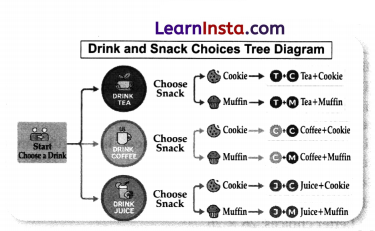
Number of drink choices = 3
Number of snack choices = 2
Use the Multiplication principle: 3 × 2 = 6
Therefore, the total number of possible combinations is 6.

Question 5.
A pizza shop offers 3 types of crust (thin, thick, stuffed), 4 types of cheese (mozzarella, Cheddar, parmesan, feta) and 6 toppings. A customer must choose 1 crust, 1 cheese and can choose any number of toppings from 0 to 6.
(i) How many crust-cheese combinations are possible?
(ii) If the customer can choose any subset of the 6 toppings, how many topping choices exist?
(iii) How many different pizzas are possible?
Concept Applied: Fundamental principle of counting
Solution:
(i) Crust choices are 3, and Cheese choices are 4.
Use the Multiplication principle:
Crust (3) × Cheese (4) = 3 × 4 = 12
There are 12 combinations.
(ii) For each topping:
• choose it
OR
• do not choose it
So, each topping has: 2 choices
Since there are 6 toppings, therefore: 26 = 64
So, there are 64 topping combinations.
(iii) Multiply all independent choices.
Total pizzas = Crust and Cheese combinations × Topping combinations.
= 12 × 64 = 768
There are 768 different pizzas.
Question 6.
A license plate consists of 2 letters followed by 3 digits. Find:
(i) Total possible plates if letters and digits can repeat.
(ii) Total plates if letters cannot repeat, but digits can repeat.
(iii) Total plates if letters can repeat, but digits cannot repeat.
Solution:
There are 26 letters.
Here, repetition is allowed.
(i) Letter choices: 26 × 26
Digit choices: 10 × 10 × 10
Apply the multiplication principle:
262 × 103 = 676 × 1000
= 676,000 plates
(ii) Letters cannot repeat, but digits can repeat.
Letters without repetition: 26 × 25
Digits repeat: 103
Apply the multiplication principle: (26 × 25) × 1000 = 650 × 1000
= 650,000 plates
(iii) Letters can repeat, but digits cannot repeat.
Letters repeat: 262
Digits no repeat: 10 × 9 × 8
Apply the multiplication principle: 676 × (10 × 9 × 8) = 676 × 720 = 486,720 plates
Question 7.
A teacher must select a captain, vice-captain and treasurer from a class of 30 students. No student can hold more than one position. Find the total number of different ways these three roles can be assigned.
Solution:
Stage 1 : Choose captain: 30 choices
Stage 2 : Choose vice-captain: 29 choices (all except captain)
Stage 3 : Choose treasurer: 28 choices (all except captain and vice-captain)
Using the Fundamental Principle of Counting:
30 × 29 × 28 = 30 × 812 = 24,360
Therefore, there are 24,360 different ways to select the three positions.
Question 8.
A bag contains 3 red socks, 4 blue socks and 2 green socks. A person picks one sock, then another (without replacement). Draw a tree diagram to show all possibilities and calculate the total number of outcomes.
Concept Applied: Tree diagram, multiplication principle, without replacement.
Solution:
The tree diagram is shown below:

Total outcomes (counting distinct socks, not colours):
First pick: 9 choices
Second pick: 8 choices
Number of outcomes = 9 × 8 = 72
Question 9.
Find the HCF and LCM of (4!) and (6!).
Concept Applied: Factorial, HCF and LCM
Solution:
Use the formula: n! = n × (n – 1) × (n – 2) × … × 1
4! = 4 × 3 × 2 × 1 = 24
6! = 6 × 5 × 4 × 3 × 2 × 1 = 720
The Highest Common Factor (HCF) is the greatest number dividing both.
Since 24 divides 720, therefore:
HCF = 24
The Least Common Multiple (LCM) is the smallest number divisible by both.
Since 720 is already divisible by 24 and 720, the LCM is:
LCM = 720
Question 10.
Find (n) if \(\frac{n!}{(n-1)!}\) = 7.
Solution:
Use the formula: n! = n × (n – 1)!
Substitute n! = n × (n – 1)! into the given equation:
\(\frac{n!}{(n-1)!}\) = 7
\(\frac{n \times(n-1)!}{(n-1)!}\) = 7
n = 7
Question 11.
Evaluate: (a) \(\frac{8!}{6!}\),
(b) 0! + 1! + 2! + 3! 6!
Solution:
(a) \(\frac{8!}{6!}\) = \(\frac{8 \times 7 \times 6!}{6!}\)
= 8 × 7 = 56
(b) Use 0! = 1.
0! + 1! + 2! + 3! = 1 + 1 + 2 × 1 + 3 × 2 × 1
= 1 + 1 + 2 + 6
= 10
Question 12.
A pizza shop offers 8 toppings. A customer can choose exactly 3 toppings. How many different pizzas can be ordered?
Solution:
Order of toppings does not matter → combination.
C(8,3) = \(\frac{8!}{3!\times 5!}\)
= \(\frac{8 \times 7 \times 6}{3 \times 2 \times 1}\)
= \(\frac{336}{6}\) = 56
Question 13.
A school debate team is to be formed with 2 students from Grade 9 (out of 6) and 3 students from Grade 10 (out of 8). In how many ways can the team be formed?
Concept Applied: Use the combination formula and the fundamental principle of counting.
Solution:
Select 2 from Grade 9 (6 students):
C(6, 2) = \(\frac{6!}{2!\times 4!}\)
= \(\frac{6 \times 5}{2 \times 1}\) = 15
Select 3 from Grade 10 (8 students):
C(8, 3) = \(\frac{8!}{3!\times 5!}\)
= \(\frac{8 \times 7 \times 6}{3 \times 2 \times 1}\)
= \(\frac{336}{6}\)
= 56
Both selections must happen (AND).
Use the multiplication principle:
Total = 15 × 56 = 840.
Question 14.
A committee of 4 is to be formed from 6 men and 5 women.
(i) How many committees can be formed?
(ii) How many committees have exactly 2 men and 2 women?
Solution:
(i) Total people = 11; choose 4:
C(11, 4) = \(\frac{11 \times 10 \times 9 \times 8}{4 \times 3 \times 2 \times 1}\)
= \(\frac{7920}{24}\)
= 330
(ii) Choose 2 men from 6 AND 2 women from 5:
C(6, 2) × C(5, 2) = \(\frac{6 \times 5}{2}\) × \(\frac{5 \times 4}{2}\)
= 15 × 10
= 150
Question 15.
A lock has a 3-digit code where each digit is chosen from 1-9, and digits may not repeat. How many codes are possible? Also, how many codes have 5 as the first digit?
Solution:
Digits available: 1 to 9, which are 9 digits.
First digit: 9 choices
Second digit: 8 choices (no repetition)
Third digit: 7 choices
Use the multiplication principle to find total codes:
= 9 × 8 × 7 = 504
Codes starting with 5:
The first digit is fixed as 5.
Remaining 2 digits chosen from 8 remaining digits: P(8, 2)
P(8, 2) = \(\frac{8!}{6!}\)
= 8 × 7 = 56
Reasoning: Fixing one digit reduces the available choices for the remaining positions.
Question 16.
Find (x), if \(\frac{1}{4!}+\frac{1}{5!}=\frac{x}{5!}\)
Solution:
Use the formula: n! = n × (n – 1)!
4! = 4 × 3 × 2 × 1
= 24
5! = 5 × 4 × 3 × 2 × 1
= 120
\(\frac{1}{24}\) + \(\frac{1}{120}\) = \(\frac{x}{120}\)
\(\frac{5 + 1}{120}\) = \(\frac{x}{120}\)
\(\frac{6}{120}\) = \(\frac{x}{120}\)
This implies x = 6.
Question 17.
A school canteen offers 3 types of sandwiches, 4 types of cold drinks and 2 types of desserts. Using the Fundamental Principle of Counting, find the total number of different meal combinations a student can choose (one item from each category). Also, construct a brief outline of the tree diagram for just the first two stages.
Concept Applied: Fundamental principle of counting, Multiplication Rule and Tree Diagram for visualisation
Solution:
Identify the rule:
Choosing a sandwich AND a drink AND a dessert, so use the Multiplication Rule.
The tree diagram is shown below:

Apply the Fundamental principle of counting:
Total meals = Sandwiches × Drinks × Desserts
Total meals = 3 × 4 × 2
= 24
Therefore, the total number of different meal combinations is 24.
Tree outline (first two stages):
Sandwich 1 [4 drink branches], Sandwich 2 [4 drink branches], Sandwich 3 [4 drink branches]
Each drink branch then splits into 2 dessert branches, so the total leaves are:
3 × 4 × 2 = 24
The tree confirms this by having 24 terminal branches. The diagram is shown below:

Question 18.
Simplify: \(\frac{10!}{7!3!}\)
Solution:
Use the formula: n! = n × (n – 1) … 3 × 2 × 1
\(\frac{10!}{7!3!}\) = \(\frac{10 \times 9 \times 8 \times 7!}{7!\times 3 \times 2 \times 1}\)
= \(\frac{10 \times 9 \times 8}{6}\)
= \(\frac{720}{6}\)
= 120
Question 19.
(i) A school needs to select 3 students from 15 to represent the school at a competition. How many different teams can be formed?
(ii) If the team has a captain, vice-captain and member (different roles), how many ways?
Concept Applied: Combination: Selection (order NOT important) and Permutation: Arrangement (order important)
Solution:
(i) Order doesn’t matter (just the team), so use the combination formula:
C(n, r) = \(\frac{n!}{r!(n-r)!}\)
Substitute n = 15 and r = 3 into the formula.
C(15, 3) = \(\frac{15!}{3!12!}\)
= \(\frac{15 \times 14 \times 13}{6}\)
= \(\frac{2730}{6}\) = 455
(ii) This is a permutation problem because order matters (positions are distinct), so use the permutation formula:
P(n, r) = \(\frac{n!}{(n-r)!}\)
Substitute n = 15 and r = 3 into the formula.
P(15, 3) = \(\frac{15!}{12!}\)
= 15 × 14 × 13
= 2,730
Question 20.
A travel app shows 3 routes from Delhi to Jaipur and 4 routes from Jaipur to Mumbai. Using a tree diagram (sketch the structure), find:
(i) the total number of ways to travel from Delhi to Mumbai via Jaipur
(ii) the total number of ways if a traveller can also take a direct flight (1 option) from Delhi to Mumbai.
Concept Applied: Multiplication and addition principle, Tree Diagram
Solution:
(i) Delhi to Jaipur AND Jaipur to Mumbai (sequential stages):
Tree: Delhi [3 branches to Jaipur] to each Jaipur node [4 branches to Mumbai]
The diagram is shown below:

AND Rule applies → Use multiplication principle
Total = 3 × 4 = 12
There are 12 ways to travel via Jaipur.
(ii) Via Jaipur (12 ways) OR Direct flight (1 way):
These are alternative options: a traveller takes ONE OR the other.
OR Rule applies → Use the addition principle
Total = 12 + 1
There are 13 total travel options.
Question 21.
Find n if P(n, 4) = 12 × P(n, 2)
Solution:
Use permutation formula:
P(n, r) = \(\frac{n!}{(n-r)!}\)
Write formulas:
P(n, 4) = \(\frac{n!}{(n-4)!}\)
= n(n – 1)(n – 2)(n – 3)
P(n, 2) = \(\frac{n!}{(n-2)!}\)
= n(n – 1)
Substitute the values of P(n, 4) and P(n, 2) into the given equation.
n(n – 1 )(n – 2)(n – 3) = 12 × n(n – 1)
Assuming n(n – 1 ) ≠ 0 divide both sides:
(n – 2)(n – 3) = 12
n2 – 5n – 6 = 12
n2 – 5n – 6 = 0
(n – 6)(n + 1) = 0
n = 6 (since n ≥ 3)
Question 22.
In how many ways can 5 boys and 3 girls be arranged in a row such that all girls sit together?
(ii) In how many ways can 5 boys and 3 girls be arranged in a row such that no two girls sit together?
(iii) In how many ways can 5 boys and 3 girls be arranged in a row such that girls occupy odd positions only?
Concept Applied: Permutations with restricted arrangements.
Solution:
(i) Treat all 3 girls as a single block:
Number of items to arrange = 5 boys + 1 block = 6 items
Arrange 6 items: 6! = 720 ways
Arrange 3 girls within the block: 3! = 6 ways
Total = 720 × 6 = 4320
(ii) No two girls together – arrange boys first:
5 boys can be arranged in 5! = 120 ways
This creates 6 gaps (before 1st boy, between boys, after last boy)
Choose 3 gaps from 6 for girls: C(6, 3) = 20
ways Arrange 3 girls in chosen positions: 3! = 6 ways
Total:
120 × 20 × 6 = 120 × 120
= 14,400
(iii) Girls occupy odd positions only:
Total positions = 8 (positions 1 to 8)
Odd positions: 1, 3, 5, 7 (4 positions)
Need to choose 3 of these 4 positions for girls:
C(4, 3) = 4 ways
Arrange 3 girls: 3! = 6 ways
Arrange 5 boys in the remaining 5 positions:
5! = 120 ways
Total:
4 × 6 × 120 = 4 × 720 = 2880
Combinatorics Class 9 Long Question Answer
Question 1.
A school is forming a student council. They need to select a president, secretary and treasurer from Grade 11 (25 students) and a vice-president from Grade 12 (30 students). The same person cannot hold two positions. Find the number of different councils possible.
Solution:
Understand the structure as follows:
• The President, Secretary and Treasurer are all from Grade 11 (25 students)
• The Vice-President is from Grade 12 (30 students)
• All positions are distinct
• No person can hold two positions
Count ways to fill Grade 11 positions as follows:
• President: 25 choices
• Secretary: 24 choices (cannot be president)
• Treasurer: 23 choices (cannot be president or secretary)
Number of ways for Grade 11 positions:
25 × 24 × 23 = 25 × 552
= 13,800
Count ways to fill Vice-President:
Vice-President from Grade 12: 30 choices
(This is independent of Grade 11 selections since different grades)
Apply the Fundamental Principle of Counting:
Total councils = (Grade 11 arrangements) × (Grade 12 choice)
13,800 × 30 = 414,000
Question 2.
Using tree diagrams and the Fundamental Principle of Counting, solve the following:
(i) A coin is tossed 3 times. Draw a tree diagram and find the total number of outcomes.
(ii) A coin is tossed, and then a spinner with 4 colours (Red, Blue, Green, Yellow) is spun. Draw a tree diagram and find the total outcomes.
(iii) Compare the two methods – Fundamental Principle of Counting vs tree diagram – for counting outcomes.
Solution:
(i) Each toss has heads and tails.
So, each toss has = 2 outcomes.
Apply Fundamental Principle of Counting (FPC):
2 × 2 × 2 = 8 So, the total outcomes are 8.
Tree diagram for 3-coin tosses:

Outcomes: {HHH, HHT, HTH, HTT, THH, THT, TTH, TTT}
(ii) Coin toss = 2, spinner spun = 4
Apply the Fundamental Principle of Counting (FPC): 2 × 4 = 8
Tree diagram for coin + spinner:
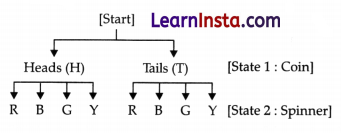
Outcomes: {(H, R), (H, B), (H, G), (H, Y), (T, R), (T, B), (T, G), (T, Y)
(iii) Comparison:
| Fundamental Principle of Counting | Tree Diagram |
| Uses multiplication directly | Shows all outcomes visually |
| Faster for large problems | Easier to understand small problems |
| Efficient for calculations | Helps avoid missing outcomes |
| Best for advanced counting | Best for beginners |
Conclusion: The Fundamental Principle of Counting is quicker and mathematical and Tree diagrams are visual and explanatory. Both methods give the same answer.
Question 3.
A restaurant menu has:
(a) 4 appetizers (Soup, Salad, Spring Roll, Bruschetta)
(b) 6 main courses (Pizza, Pasta, Burger, Steak, Fish, Vegetarian)
(c) 5 desserts (Cake, Ice Cream, Pie, Fruit, Pudding)
(d) 3 beverages (Water, Juice, Soda)
Answer the following:
How many complete meals (appetizer + main + dessert + beverage) are possible?
(ii) How many meals if a person skips the appetizer (i.e., chooses none as an option)?
(iii) How many meals if the person chooses EITHER a dessert OR a beverage (but not both)?
Solution:
(i) AND rule (all four items):
4 × 6 × 5 × 3 = 120 × 3 = 360 meals
(ii) If a person skips the appetizer, there is only 1 option for that category (”None”). The remaining three categories must still be filled:
Appetizers: 1 option (Skip)
Main courses: 6 options
Desserts: 5 options
Beverages: 3 options
Total Meals = 1 × 6 × 5 × 3 = 90 meals
(iii) Dessert OR beverage (but not both):
Case 1: Dessert only:
4 appetizers × 6 mains × 5 desserts × no beverages
= 4 × 6 × 5 × 1
= 120
(1 way for no beverage)
Case 2: Beverage only:
4 appetizers × 6 mains × no dessert × 3 beverages
= 4 × 6 × 1 × 3
= 72
The total meals are: 120 + 72 = 192
Question 4.
A software company has 15 engineers. They need to form a project team of 5 engineers. However, 2 specific engineers (Priya and Rajan) cannot work together on the same team. How many valid teams are possible?
Concept Applied: The method of subtraction is used whenever a direct count would be complicated. Always compute: Total-(Unwanted cases).
Solution:
Total teams-(teams that include both Priya and Rajan) Total unrestricted teams-Total ways to choose any 5 engineers:
C(15, 5) = \(\frac{15!}{5!\times 10!}\)
= \(\frac{15 \times 14 \times 13 \times 12 \times 11}{5 \times 4 \times 3 \times 2 \times 1}\)
= \(\frac{360360}{120}\) = 3003
Thus, total teams without restrictions: 3,003.
Teams that include both Priya AND Rajan (count invalid teams):
If both are fixed on the team, choose the remaining 3 from the 13 others.
C(13, 3) = \(\frac{13!}{3!\times 10!}\)
= \(\frac{13 \times 12 \times 11}{3 \times 2 \times 1}\)
= \(\frac{1716}{6}\)
= 286 invalid teams
Valid teams: = Total Teams – Invalid Teams
= 3003 – 286 = 2717
Hence, 2,717 valid teams are possible.
Question 5.
A school cultural programme involves three segments: a dance performance, a music act and a drama act. There are 6 different dance groups, 4 music acts and 5 drama groups to choose from. A programme committee must select one group for each segment and then decide the ORDER in which the three segments will be performed. How many different complete programme plans are possible?
Solution:
Choose one group for each segment:
By the Multiplication Rule (choosing all three):
Groups selection = 6 × 4 × 5 = 120 ways
So, there are 120 ways to select the groups.
Arrange the 3 segments in order:
The 3 segments can be arranged in 3! ways (e.g., Dance-Music-Drama or Music-Drama-Dance, etc.).
3! = 3 × 2
= 6
There will be 6 ordering arrangements.
Apply the Fundamental principle of counting (multiplication principle) to combine both decisions:
Total = Groups selection × Segment arrangements
= 120 × 6
= 720
There are 720 different complete programme plans possible.
Question 6.
Find the value of:
\(\frac{8!}{7!+6!}+\frac{7!}{6!+5!}+\frac{6!}{5!+4!}+\frac{5!}{4!+3!}+\frac{4!}{3!+2!}+\frac{3!}{2!+1!}\)
Solution:
We observe that each term can be written as:
\(\frac{(x+1)!}{x!+(x-1)!}\) where x = 2, 3, 4, 5, 6, 7
Simplify the general term:

Question 7.
A group of 10 people consists of 6 men and 4 women. A committee of 5 is to be formed. Find the number of committees that have:
(a) no restriction
(b) at least 3 men
(c) exactly 2 women
(d) more women than men
Concept Applied: Use the combination formula: C(n, r) = \(\frac{n!}{r!(n-r)!}\)
Solution:
(a) Total people = 6 + 4 = 10
Order does not matter, so use the combination formula.
C(10, 5) = \(\frac{10!}{5!5!}\)
= \(\frac{10 \times 9 \times 8 \times 7 \times 6}{5 \times 4 \times 3 \times 2 \times 1}\) = 252
(b) At least 3 men = 3 men, 4 men or 5 men:
3 men + 2 women:
C(6, 3) × C(4, 2) = 20 × 6
= 120
4 men + 1 woman:
C(6, 4) × C(4, 1) = 15 × 4
= 60
5 men + 0 women:
C(6, 5) × C(4, 0) = 6 × 1 = 6
Total = 120 + 60 + 6 = 186
(c) Exactly 2 women = 2 women + 3 men:
C(4, 2) × C(6, 3) = 6 × 20
= 120
(d) More women than men = 3 women + 2 men or 4 women + 1 man:
3 women + 2 men:
C(4, 3) × C(6, 2) = 4 × 15
= 60
4 women + 1 man:
C(4, 4) × C(6, 1) = 1 × 6
= 6
Total = 60 + 6 = 66
Question 8.
A school cultural event has three activities: Drama, Music and Dance. There are 4 drama groups, 5 music acts and 3 dance troupes to choose from. The event committee must:
(a) Select one group for each activity.
(b) Arrange the three selected groups in a performance order (i.e., which goes 1st, 2nd, 3rd).
(c) Additionally, if 2 specific music acts are restricted from performing together with a specific drama group, – how many selections in step (a) are INVALID? Find total valid performance arrangements after excluding invalid selections. Draw a structured diagram to illustrate part (a).
Concept Applied: Fundamental principle of counting,
Permutation, Complementary Counting
Solution:
(a) Select one group per activity (AND Rule):
Groups available: Drama (4), Music (5), Dance (3)
Total selections = 4 × 5 × 3 = 60
There are 60 ways to select one group from each activity.
(b) Arrange the 3 selected groups in performance order (Permutation):
3 groups arranged in a sequence.
So:
3! = 3 × 2 × 1
= 6
6 performance orderings.
Total arrangements without restriction:
Total = Selections × Orderings
= 60 × 6 = 360
360 total performance arrangements (unrestricted).
(c) Count INVALID selections:
1 specific drama group × 2 specific restricted music acts × 3 dance troupes
Invalid selections:
1 × 2 × 3 = 6
Valid selections = 60 – 6 = 54
Valid arrangements = 54 × 6 = 324
Therefore, there are 324 valid performance arrangements.
The diagram is shown below:

Combinatorics Class 9 Case Based Questions
1. Read the passage carefully and answer the questions that follow.
At the Annual Sports Day, 8 students from Grade 9 compete across different events. For the 100 m sprint, medals are awarded for 1st, 2nd and 3rd place. For the relay team event, a team of 4 students is selected from these 8 students. The sports teacher also wants to arrange the 4 relay team members in a specific running order for
practice. After the events, the students choose from arefreshment stall offering 3 types of drinks and 4 types of snacks.
Tree diagram structure for the school sports day


Question 1.
How many ways can the sprint medals (Gold, Silver, Bronze) be awarded among the 8 competing students?
(a) 8
(b) 24
(c) 336
(d) 512
Answer:
Option (c) is correct.
Explanation: Different medals → order matters.
So, use the permutation formula:
P(n, r) = \(\frac{n!}{(n-r)!}\)
P(8, 3) = \(\frac{8!}{5!}\)
= 8 × 7 × 6 = 336
Question 2.
In how many ways can the relay team of 4 be selected from 8 students (no specific roles in selection)?
(a) 70
(b) 56
(c) 32
(d) 330
Answer:
Option (a) is correct
Explanation: No roles in selection.
So, use the combination formula:
C(n, r) = \(\frac{n!}{r!(n-r)!}\)
C(8, 4) = \(\frac{8!}{4!\times 4!}\)
= \(\frac{8 \times 7 \times 6 \times 5}{4 \times 3 \times 2 \times 1}\)
= 70
Question 3.
Once the relay team of 4 is chosen, in how many ways can they be arranged in a running order?
(a) 4
(b) 12
(c) 16
(d) 24
Answer:
Option (d) is correct.
Explanation: Order of running matters P(4, 4) = 4!
= 4 × 3 × 2 × 1 = 24
Question 4.
How many different refreshment combinations (1 drink + 1 snack) are possible from the stall?
(a) 7
(b) 12
(c) 10
(d) 16
Answer:
Option (b) is correct.
Explanation: Refreshment stall offers: 3 drinks and 4 snacks.
1 drink AND 1 snack are chosen.
Use the multiplication principle:
3 × 4 = 12
Question 5.
Assertion (A): The number of ways to select the relay team of 4 from 8 students is less than the number of ways to award the sprint medals to 3 students from the same 8.
Reason (R): C(n, r) = \(\frac{P(n, r)}{r!}\) so combinations are always less than or equal to the corresponding permutation for the same n and r.
(a) Both Assertion and Reason are true; Reason is the correct explanation of Assertion.
(b) Both Assertion and Reason are true; Reason is NOT the correct explanation of Assertion.
(c) Assertion is true, but Reason is false.
(d) Assertion is false, but Reason is true.
Answer:
Option (a) is correct.
Explanation: Relay team selection:
C(8, 4) = 70
Sprint medals:
P(8, 3) = 336
This follows 70 < 336
So, the Assertion is TRUE.
Reason correctly explains: C(n, r) = \(\frac{P(n, r)}{r!}\) and since r! ≥ 1, combinations ≤ permutations.
2. A school librarian is preparing a special reading corner to encourage students to read different subjects. The library has 6 Mathematics books, 4 Science books, and 5 English books available for display. She decides to organize the books so that students can easily explore and select them based on their interest. Students visiting the corner may choose books from different subjects for their reading activity. The arrangement is designed to make selection simple and engaging. This setup also helps students develop balanced reading habits across Mathematics, Science and English.
Based on the given information, answer the following questions.

Question 1.
How many ways can a student select 1 Mathematics book, 1 Science book and 1 English book?
Concept Applied: Fundamental principle of counting, combination and permutation of distinct objects
Solution:
Choices:
• Mathematics book → 6 ways
• Science book → 4 ways
• English book → 5 ways
Number of ways = 6 × 4 × 5 = 120
There are 120 ways to select one book from each subject.
Question 2.
How many ways can a student choose exactly 2 Mathematics books from the 6 available?
Solution:
Order does not matter in selection → Combination
C(6, 2) = \(\frac{6!}{2!\times 4!}\)
= \(\frac{6 \times 5}{2}\) = 15
There are 15 ways to choose 2 Mathematics books.
Question 3.
The librarian arranges the 5 English books on a display shelf in a row. How many different arrangements are possible? Also, if 2 specific English books (a novel and a grammar guide) must always be placed side by side, how many arrangements remain?
Solution:
Part A: All 5 English books in a row:
5! = 5 × 4 × 3 × 2 × 1
= 120
There are 120 total arrangements.
Part B: Treat the:
• novel
• grammar guide as ONE BLOCK.
So, objects become:
• 1 block
• 3 remaining books
Total objects:
Arrange the 4 objects: