Experts have designed these Class 9 Maths Notes and Chapter 5 I’m Up and Down and Round and Round Class 9 Ganita Manjari Notes for effective learning.
Class 9 Maths Chapter 5 I’m Up and Down and Round and Round Notes
Class 9 Maths Ganita Manjari Chapter 5 Notes
Ganita Manjari Class 9 Chapter 5 Notes – Class 9 I’m Up and Down and Round and Round Notes
In this chapter, we will explore the fascinating properties and concepts related to circles, It also covers topics such as the symmetry of circles, angles subtended by arcs at the centre and at points on the circle and various theorems related to circles, such as those involving cyclic quadrilaterals and concyclic points. The chapter emphasizes geometric properties such as equal chords subtending equal angles and the perpendicular bisector of chords passing through the centre.
Circle
A circle is a fundamental geometric shape consisting of all points in a plane that are at a fixed distance from a specific point.
Centre
A fixed point in the middle of the circle from which all points on the boundary are equidistant. It is usually denoted by O.

Radius
The constant distance from the centre to any point on the boundary of the circle. It is usually denoted by r.
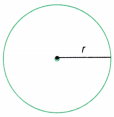
Chord
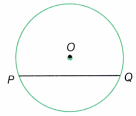
A line segment joining two points on the circumference of the circle is called a chord of the circle. In figure, PQ is a chord of the circle.
Diameter
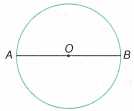
A chord which passes through the centre of the circle is called’a diameter of the circle.
In figure, AB is the diameter of the circle. Diameter is the longest chord and all diameters have same length, which is equal to two times of the radius.

Theorem 1:
Prove that the diameter is the longest chord in a circle.
Given A circle with centre O. AB is the diameter. CD is any other chord.
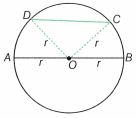
To prove AB > CD
Proof: In ΔOCD, OC = OD = r [∵ radii of same circle]
According to the triangle inequality theorem, the sum of any two sides of a triangle must be greater than the third side.
∴ OC + OD > CD
⇒ r + r > CD
⇒ 2 r > CD
⇒ AB > CD
[∵ AB = OA + OB = r + r = 2r]
Hence, the diameter is the longest chord in a circle.
Hence proved.
Circumference
The boundary length of the complete circle is called its circumference.
Semi-circle
A diameter of a circle divides the circle into two equal parts i.e. into two equal arcs. Each of these two arcs is called a semi-circle.
Arc
A piece of a circle between two points on its circum- ference is called an arc.
In other words, any part of the circumference of a circle is called an arc of that circle.
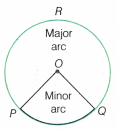
In adjoining figure, there are two pieces, one longer and the other smaller. The longer one is called the major arc PRQ and the smaller one is called the minor arc PQ. The minor arc PQ is denoted by PQ and the major arc PRQ is denoted by \(\overparen{P R Q},\), where R is a point on the major arc between P and Q.
Segment
The region between a chord and either of its arcs is called a segment of the circular region or simply a segment of the circle. This chord is called the base of the segment. The segment formed by minor arc along with chord, is called minor segment and the segment formed by major arc is called the major segment.
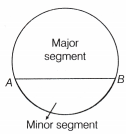
The major and minor segments of a circle are segments of a circular disc but these are generally called segments of a circle.
Sector
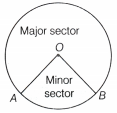
The region between an arc and the two radii joining the centre to the end points of the arc is called a sector.
Sectors are of two types – minor sector and major sector. The sector corresponding to minor arc is called minor sector and the sector corresponding to major arc is called major sector.
Symmetry
Lines of Symmetry: A line of symmetry (or axis of symmetry) is a line that divides a figure into two congruent parts such that when the figure is folded along that line, the two parts overlap exactly,
e.g. Every diameter of a circle is a line of symmetry.
RotationaL Symmetry: After a rotation about a fixed point, if an object looks exactly the same as before, it is said to have rotational symmetry.
Some basic terms and their description are given below.
| Term | Description |
| Centre of Rotation | The fixed point about which the object rotates. |
| Order of Rotational Symmetry | The number of times the figure coincides with itself in one complete turn (360°). |
| Angle of Rotational Symmetry | The smallest angle through which the figure must be rotated to look the same. |
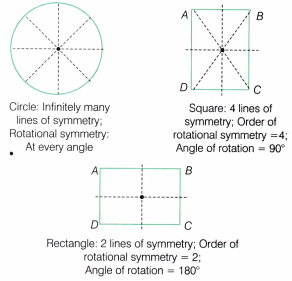
Symmetry of a Circle: A circle is the most symmetric of all plane figures. A circle has complete rotational symmetry. Rotating it by any angle about its centre leaves it unchanged.
Every diameter of a circle is a line of reflection symmetry. Since, there are infinitely many diameters, so a circle has infinitely many lines of symmetry.
Let us observe the lines of symmetry and rotational symmetry of a circle, a square and a rectangle as shown below.
Circle Passing through Three Points
Suppose, we take a point P then there may be as many circles as we like passing through this point.
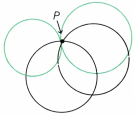
Many circles passing through one point
Suppose, we take two points P and Q then through P and Q infinite number of circles may be drawn.
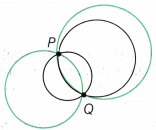
Many circles passing through two points
If we take three collinear points then no circle can be drawn through these three points.
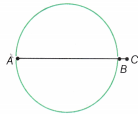
Circle passing through two out of three collinear points
If three points are on a line (collinear) then third point will be either inside or outside the circle, which passing through the two points.
Now, suppose we take three non-collinear points A, B and C (i.e. which are not on the same line). Then, draw perpendicular bisectors of AB and BC, say PQ and RS, respectively, which intersect at point 0. Thus, O is a point, which is at equal distances from points A, B and C because every point on the perpendicular bisector of a line segment is equidistant from its end points.
If we draw a circle with centre O and radius OA then it will also pass through points B and C, which is a circle passing through three non-collinear points.
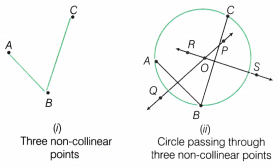
There is one and only one circle passing through three given non-collinear points.
Circumcircle and Circumcentre of a Triangle
Circumcircle:
The circumcircle (circumscribed circle) is the unique circle that passes through all three vertices of a triangle. Every triangle is ‘cyclic’ meaning a circle can always be drawn through its three corners.
The triangle itself is said to be ‘insribed’ in the circle.
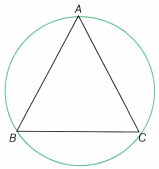
Circumcentre
The cirumcentre is the centre point of the circumcircle. It has two primary characteristics.
- Intersection point It is the exact point where the three perpendicular bisectors of the triangle’s sides meet (concurrent lines).
- Equidistance It is the centre of the circle passing through the vertices. So, the circumcentre is equidistant from all three vertices of the triangle.
Construction of the Circumcentre and Circumcircle of a Triangle
To construct the circumcentre and circumcircle of a triangle, we use following steps.
Steps of Construction
Step I: Use a compass to draw the perpendicular bisectors of any two sides of the ∆ABC .
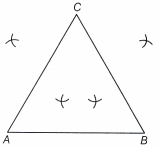
Step II: Extend these bisectors untill they intersect at a point. Mark this point as O, this point is called the circumcentre of the triangle.
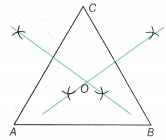
Step III: Place the compass on point O and open it to any vertex i.e. A or B or C. Draw a circle. This circle will pass through all three vertices and is known as the circumcircle.
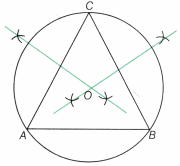
Location of the Circumcentre
The position of the circumcentre changes depending on the triangle’s angles.
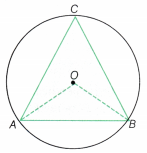
Acute angled triangle The circumcentre is located inside the triangle.
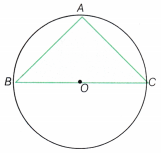
Right angled triangle The circumcentre is located on the hypotenuse specifically, it is the mid-point of the hypotenuse.
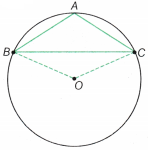
Obtuse angled triangle The circumcentre is located outside the triangle.
Example 1.
Draw ∆PQR with PQ = 6 cm, ∠P = 110° and PR = 5 cm. Draw the circumcircle of ∆PQR. Is the circumcentre inside or outside the triangle?
Solution:
Given, PQ = 6 cm, ∠P = 110°and PR = 5 cm
Step by step constructions
Step I: Draw a line segment PQ = 6 cm using a ruler.

Step II: At pointP, use a protractor to draw an angle of 110°.
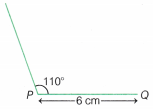
Step III: Use a compass to mark a point R on this ray such that PR = 5 cm. Join QR to complete ∆PQR.
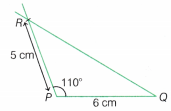
Step IV: Construct the perpendicular bisectors of any two sides of the triangle, say PQ and PR.
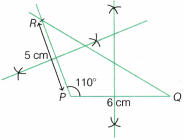
Step V: The point where these bisectors intersect is the circumcentre O. Place the compass point at O and the pencil at P.
Draw the circle passing through all three vertices.
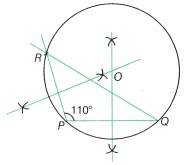
Since, ∠P = 110° (an obtuse angle)
Therefore, the circumcentre lies outside the triangle.
Example 2.
Draw ∆PQRwith sides PQ = 4 cm, QR = 5 cm and PR = 5 cm. Draw the circumcircle of ∆PQR. Let the circumcentre be 0. Measure the lengths OP, OQ and OR
Solution:
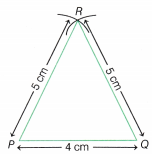
Given,PQ = 4cm,QR = 5 cm and PP = 5 cm
Step by step constructions
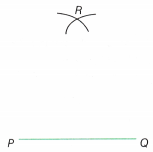
Step I: Draw a line segment PQ = 4 cm using a ruler.
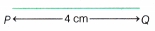
Step II: With P and Q as centres and radius 5 cm, draw arcs above the line segment PQ to intersect at point R.
Step III: Join PR and QR to complete the ∆PQR.
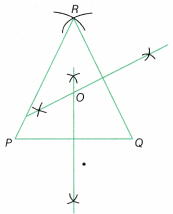
Step IV: Draw the perpendicular bisectors of two sides, say PQ and QR. The point where these two bisectors intersect, is the circumcentre O.
Step 5. Place the compass at point O and adjust it to reach point P. Draw a circle.
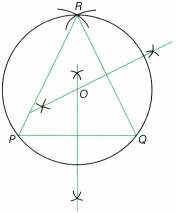
Since, O is the circumcentre, the distances from O to each vertex are equal (all are radii of the same circle).
Hence, OP = OQ = OR = 2.7 cm.
Angle Subtended by a Chord at a Point
We know that if we take a line segment PQ and a point R not lying on the line PQ then by joining PR and RQ, we get ∠PRQ, which is called the angle subtended by the line segment PQ.
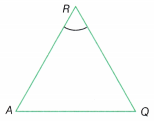
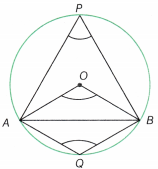
Similarly, in a circle with centre O, let AB be a chord and we take two points P and Q on the circle as shown in figure and join PA, PB, QA and QB.
Then, we get ∠APB and ∠AQB, which are called the angles subtended by the chord AB at the points P and Q, respectively.
Also, ∠AOB is the angle subtended by the chord AB at the centre O.
Theorem 2.
Equal chords of a circle subtend equal angles at the centre.
Given A circle with centre O. AB and CD are two equal chords of the circle which subtend ∠AOB and ∠COD at the centre O.
To prove: ∠AOB = ∠COD
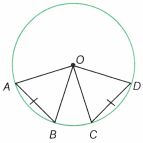
Proof: In ∆AOB and A COD, we have
OA = OC [radii of same circle]
OB = OD [radii of same circle]
and AB = CD [given]
∴ ∆AOB = ∆COD [by SSS congruence rule]
Then, ∠AOB = ∠COD [by CPCT]
Hence proved.
Theorem 3. (Converse of Theorem 1)
If the angles subtended by the chords of a circle at the centre are equal then the chords are equal.
Given A circle with centre O.
Let AB and CD be two chords of a circle such that angles subtended by these chords at the centre O of a circle are equal i.e. ∠AOB = ∠COD.
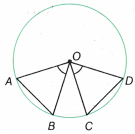
To prove AB = CD
Proof: In ∆AOB and ∆COD, we have
AO = CO [radii of same circle]
∠AOB = ∠COD [given]
and OB = OD [radii of same circle]
AAOB = A COD [by SAS congruence rule]
So, AB = CD [by CPCT]
Hence, chords are equal if they subtend equal angles at the centre of a circle.
Hence proved.
Example 3.
AB is a chord of a circle having centre O. If ∠AOB = 60°then prove that the chord AB is of radius length.
Solution:
Let O be the centre and r be the radius of the circle.
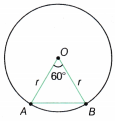
Chord AB subtends ∠AOB = 60° at the centre of the circle.
Here, OB = OA = r [radii of same circle]
⇒ ∠OAB = ∠OBA
i. e. ∠A = ∠B …(i)
[∵ angles opposite to equal sides of a triangle are also equal]
In ∆OAB, ∠O + ∠A + ∠B = 180° [by angle sum property]
⇒ 60° + ∠A + ∠B = 180°
⇒ ∠A + ∠B = 120° …(ii)
From (i) and (ii), we get 2∠A = 120°
⇒ ∠A = \(\frac{1}{2}\) × 120° = 60° and ∠B = 60°
Thus, ∠O = ∠A = ∠B = 60°
Hence, ∆OAB is an equilateral triangle.
AB = OA = OB = r i.e. AB = r
Hence proved.
Example 4.
If A, Band Care three points on a circle such that AB = BC = CA and 0 is the centre of the circle then find the angle subtended by the chords AB, BCand CA at the centre 0.
Solution:
Given, three points A, B and C are on a circle such that AB = BC = CA.
We know that equal chords of a circle subtend equal angles at the centre of circle.
So, ∠AOB = ∠BOC = ∠AOC …(i)
Now, ∠AOB + ∠BOC + ∠AOC = 360°
[∵ sum of angles at a point is 360°]
⇒ 3 ∠AOB = 360° [from Eq. (i)]
⇒ ∠AOB = \(\frac{360^{\circ}}{3}\)
= 120°
Hence, the angle subtended by the chords AB, BC and CA at the centre O is 120°.
Perpendicular from Centre to the Chord
In a circle, the property of a perpendicular drawn from the centre to a chord in the form of a theorem is given below.
Theorem 1: The perpendicular from the centre of a circle to a chord bisects the chord.
Given AB is a chord of a circle with centre O and OM ⊥ AB.
To prove OM bisects AB i.e. AM = MB.
Construction Join OA and OB.
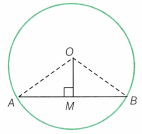
Proof: In ∆AMO and ∆BMO, we have
OA = OB [radii of same circle]
∠AMO = ∠BMO [each 90 °]
and OM = OM [common side]
∴ ∆AMO ≅ ∆BMO [by RHS congruence rule]
Then AM = MB [by CPCT]
Hence proved.
Theorem 2.
(Converse of Theorem 1) The line drawn through the centre of a circle to bisect a chord is perpendicular to the chord.
Given AB is a chord of a circle with centre 0. A line OM is drawn through the centre 0 to chord AB such that M is the mid-point of AB i.e. AM = MB.
To prove OM ⊥ AB.
Construction Join OA and OB.
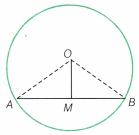
Proof In AOAM and AOBM, we have
AM = BM [∵ M is the mid-point of AB]
OA = OB [radii of same circle]
and OM = OM [common side]
∴ ∆OAM ≅ ∆OBM [by SSS congruence rule]
Then, ∠OMA = ∠OMB … (i) [by CPCT]
Now, AB is a straight line.
So, by linear pair axiom,
∠OMA + ∠OMB = 180°
⇒ 2∠OMA = 180° [using Eq. (i)]
⇒ ∠OMA = \(\frac{180^{\circ}}{2}\) = 90°
Thus, ∠OMA = ∠OMB = 90 °
Then, OM ⊥ AB
Hence proved.
Example 1.
The radius of a circle is 13 cm and the length of one of its chords is 10 cm. Find the distance of the chord from the centre.
Solution:
Let AB be a chord of the given circle with centre O.
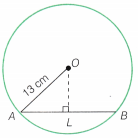
Given, radius, OA = 13 cm and AB = 10 cm
From O, draw OL ⊥ AB.
We know that the perpendicular drawn from the centre of a circle to a chord bisects the chord.
∴ AL = \(\frac{1}{2}\) AB
= \(\frac{1}{2}\) x 10 = 5 cm
Now, in right-angled ∆OLA,
OA2 = OL2 + AL2 [by Pythagoras theorem]
⇒ 132 =OL2 + 52
⇒ OL2 = 132 – 52
= 169 – 25 = 144
⇒ OL = 12 cm [taking positive square root]
Hence, the distance of the chord from the centre is 12 cm.
Example 2.
AS and CDare two chords of a circle such that AB = 6 cm, CD= 12 cm and AB|| CD. If the distance between AB and CD is 3 cm, find the radius of the circle.
Solution:
We have, AB = 6 cm, CD = 12cm and PM = 3cm,
Let the radius of the circle be r cm.
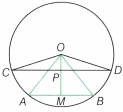
Draw 0M ⊥ AB and OP ⊥ CD.
∴ AM = MB = 3cm
and CP = PD = 6cm
[∵ perpendicular from the centre of a circle to a chord bisects the chord]
Let OP = y
Also, PM = 3 cm [given]
∴In right angled AOPC, using Pythagoras theorem,
CP2 + OP2 = OC2 = r2 …(i)
[radius of circle = r]
and in right angled AOMA, using Pythagoras theorem,
AM2 + OM2 = AO2 = r2 …(ii)
[radius of circle = AO = r]
CP2 + OP2 = AM2 + OM2 = r2 …(iii)
[from Eqs. (i) and (ii)]
⇒ 62 + y2 = 32 + (3 + y)2 [v OM = OP + PM]
⇒ 36 + y2 = 9 + 9 + y2 + 6y
⇒ 6y = 18 ⇒ y = 3 cm
r2 = 62 + y2 = 36 + 9 = 45 [using Eq. (i)]
⇒ r = 3√5 cm = 6.708
r = 6.71cm
Chords and Their Distances from the Centre
Theorem 1.
Equal chords of a circle (or of congruent circles) are equidistant from the centre (or centres).
Given A circle with centre O and two equal chords; AB and PQ.
To prove AB and PQ are equidistant from the centre O.
Construction Draw 0M ⊥ AB and ON ⊥ PQ. Join OA, OB, OP and OQ.
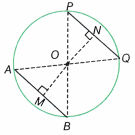
Proof: We know that a perpendicular from the centre to a chord bisects the chord.
AM = MB = \(\frac{1}{2}\)AB [y 0M I AB]
and PN = NQ = \(\frac{1}{2}\)PQ (vON±PQ]
Chord AB = Chord PQ (given)
\(\frac{1}{2}\) AB = \(\frac{1}{2}\) PQ [dividing by 2 on both sides]
Then, AM = MB = PN = NQ
Now, in ∆OMA and ∆ONQ, we have
OA = OQ [radii of same circle J
AM = QN [proved above]
∠OMA = ∠ONQ [each 90°]
∆OMA ≅ ∆ONQ [by RHS congruence rule]
Then, OM = ON [by CPCT]
Hence, PQ and AB are equidistant from the centre O.
Hence proved.
Theorem 2. (Converse of Theorem 1)
Chords equidistant from the centre of a circle are equal in length.
Now, we take an example to illustrate the use of above results.
Example 1.
In the given figure, 0 is the centre of a circle and PO bisects ∠APD. Prove that AB = CD.
Or
If two intersecting chords of a circle make equal angles with the diameter passing through their
point of intersection then prove that the chords are equal in length.
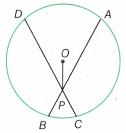
Solution:
Let AB and CD be two chords of a M
circle with centre O intersecting at a point P. MN is a diameter through P such that MN (or OP) bisects ∠APD i.e. ∠APO = ∠DPO.
To prove AB = CD Construction Draw OF ⊥ AB and OF ⊥ CD.
Proof In ∆OEP and ∆OFF,
∠OEP = ∠OFP
∠OPE = ∠OPF and OP = OP
∴ ∆OFF ≅ ∆OFF
Then, OF = OF
Thus, chords AB and CD are equidistant from the centre O of the circle and we know that chords of a circle which are equidistant from the centre, are equal.
∴ AB = CD
Hence proved.
Theorem 3.
Among two unequal chords, the bigger (longer) one is drawn closer to the centre. While the smaller one is farther away.
Given A circle with centre O. AB and CD are two unequal chords of the circle i.e. AB > CD.
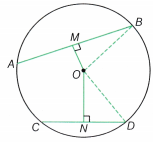
To prove: The longer chord lies nearer to the centre of the circle i.e. OM < ON.
Construction: Join OB and OD.
Proof: In ∆OMB, by Pythagoras theorem,
OB2 = OM2 + MB2
⇒ OB2 = OM2 + MB2
⇒ OB2 = OM2 + \(\left(\frac{A B}{2}\right)^2\) [∵ MB = \(\frac{A B}{2}\)]
⇒ OB2 = OM2 + \(\frac{A B^2}{4}\)
⇒ \(\frac{A B^2}{4}\) = OB2 – OM2
⇒ AB2 = 4 [OB2 – OM2] ….(i)
In ∆OND, by Pythagoras theorem,
OD2 = ON2 + ND2
OD2 = ON2 + \(\left(\frac{C D}{2}\right)^2\) [∵ ND = \(\frac{1}{2}\)]
OD2 – ON2 = \(\frac{C D^2}{4}\)
CD2 = 4[OD2 – ON2]
Now, we know that AB > CD
⇒ AB2 > CD2
⇒ 4[OB2 – OM2] > 4[OD2 – ON2] [from Eqs. (i) and (ii)]
⇒ OB2 -OM2 > OD2 – ON2
⇒ -OM2 > -ON2
[∵ OB = OD = radii of same circle]
⇒ OM2 <ON2
⇒ OM < ON
Hence proved.
Example 2.
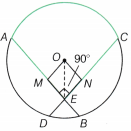
In the following figure, equal chords AB and CD of a circle with centre 0, cut at right angles at E.
If M and N are the mid-points of ABand CD respectively, then prove that OMEN is a square.
Solution:
Given, M and N are the mid-points ofAB and CD, respectively.
∴ ∠OMB = ∠OND = 90°
⇒ ∠OME = ∠ONE = 90°
Since, equal chords of a circle are equidistant from the centre.
OM = ON
Thus, in AO ME and A ONE, we have
OM = ON
∠OME = ∠ONE [each 90°]
and OE = OE [common sides]
∆OME ≅ ∆ONE [by RHS congruence rule]
So, ∠MOE = ∠NOE =45° [by CPCT]
and ∠OEM = ∠OEN = 45° [by CPCT]
Thus, ∠MON = ∠MOE + ∠NOE = 45°+ 45° = 90°
Similarly, ∠MEN = 90°
Also, OM = ON
Hence, OMEN is a square.
Example 3.
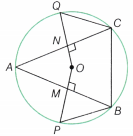
In the following figure, O is the centre of a circle. If AB and ACare chords of the circle such that AB= AC, OP 1 ABand OQ1 AC then prove that PB = QC.
Solution:
Given AB and AC be two equal chords of circle with centre O.
Also, OP ⊥ AB at M and OQ ⊥ AC at N.
To prove PB = QC
Proof We know that the perpendicular from the centre of a circle to a chord bisects the chord.
∴ AM = MB = \(\frac{1}{2}\) AB [v OP ⊥ AB]
and AN = NC = \(\frac{1}{2}\) AC [YOQ ⊥ AC]
Since, AB = AC
∴ \(\frac{1}{2}\)AB = \(\frac{1}{2}\)AC [dividing by 2 on both sides]
⇒ AM = AN or MB = NC …(i)
Now, in ∆PMB and ∆QNC,we have
MB = NC [from Eq. (i)]
∠PMB = ∠QNC [each 90°]
Also, OM = ON ……(ii)
[∵ equal chords of a circle are equidistant from the centre]
and OP = OQ [radii of same circle] …(iii)
⇒ OP – OM = OQ – ON [on subtracting Eq. (ii) from Eq. (iii)]
⇒ PM = QN ….(iv)
∴ ∆PMB ≅ ∆QNC [by SAS congruence rule]
⇒ PB = QC [by CPCT]
Hence proved.
Angle Subtended by an Arc of a Circle and Cyclic Quadrilaterals
Angle Subtended by an Arc of a Circle
We know that a chord (other than diameter) of a circle cuts the circle into two different arcs i.e. major arc and minor arc.
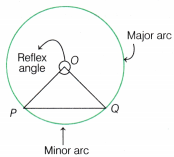
The angle subtended by an arc at the centre is defined as the angle subtended by the corresponding chord at the centre, in the sense that the minor arc subtends the angle and the major arc subtends the reflex angle.
In the given figure, the angle subtended by the minor arc PQ at O is ∠POQ and the angle subtended by the major arc PQ at O is reflex ∠POQ.
Relation between the Angles Subtended by an Arc at the Centre and at a Point on the Circle
Let there be a circle with centre O and AB be its arc. Here, ∠AOB is the angle subtended by an arc AB, (or \(\overparen{A B}\)) at the
centre of the circle.
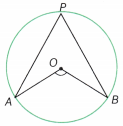
Also, ∠APB is the angle subtended by arc AB (or \(\overparen{A B}\)) at a point P on the remaining part of the circle (i.e. part of the circle, other than \(\overparen{A B}\)).
Theorem 1.
The angle subtended by an arc at the centre is double the angle subtended by it at any point on the remaining part of the circle.
Given A circle with centre O and let PQ be its arc. Arc PQ subtends ∠POQ at the centre and ∠PAQ at any point A on the remaining part of the circle.
Here, from figure, we get three cases (i) when arc PQ is minor, (ii) when arc PQ is semi-circle and (iii) when arc PQ is major.
To prove ∠POQ – 2∠PAQ for cases (i) and (ii) and reflex ∠POQ = 2∠PAQ for case (iii).
Construction Join AO and extend it to a point B.
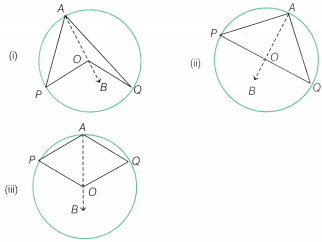
Proof: We know that exterior angle of a triangle is equal to the sum of the two interior opposite angles.
So, for ∆OAQ, ∠BOQ = ∠OAQ + ∠OQA …(i)
and for ∆OAP, ∠BOP = ∠OAP + ∠OPA …(ii)
Now, in ∆OAQ, OA = OQ [radii of same circle]
⇒ ∠OQA = ∠OAQ
[v angles opposite to equal sides of a triangle are equal]
Then, from Eq. (i), we get
∠BOQ = ∠OAQ + ∠OAQ
⇒ ∠BOQ = 2∠OAQ
Similarly, in A OAP, ZOAP =ZOPA
Then, from Eq. (ii), we get
∠BOP = 2∠OAP On adding Eqs. (iii) and (iv), we get
∠BOQ + ∠BOP = 2∠OAQ + 2∠OAP
⇒ ∠POQ = 2 [∠OAQ + ∠OAP]
⇒ ∠POQ = 2 ∠PAQ
For cases (i) and (ii), we have this result and for case (iii), replace ∠POQ by reflex ∠POQ in Eq. (v), we get reflex ∠POQ = 2 ∠PAQ, as PQ is the major arc.
Hence proved.
Theorem 2.
Angles in the same segment of a circle are equal.
Given PQ is a chord of a circle with centre O which divides the circle in two segments and ∠PAQ and ∠PCQ are the angles of the same segment.
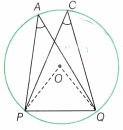
To prove: ∠PAQ = ∠PCQ
Construction: Join OP and OQ.
Proof: Here, minor arc PQ subtends ∠POQ at the centre and ∠PAQ at a point A on the remaining part of the circle.
Then, ∠POQ = 2 ∠PAQ [by theorem 1] …(i)
Similarly, ∠POQ = 2∠PCQ …(ii)
From Eqs. (i) and (ii), we get
2 ∠PAQ = 2 ∠PCQ
⇒ ∠PAQ = ∠PCQ
Hence proved.
Theorem 3.
Angle in a semi-circle is a right angle. Given A semicircle at centre O and diameter is CD. Let A be the point on the semi-circle.
To prove: ∠CAD = 90°.
Construction: Join OA.
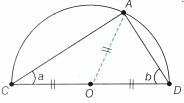
Proof: Here, OA = OC [radii]
∴ ∠OCA = ∠OAC …(i)
[∵ angles opposite to the equal sides of an isosceles triangle are also equal]
Similarly, ∠ODA = ∠OAD [Y OA = OD]… (ii)
On adding Eqs. (i) and (ii), we get
∠OCA + ∠ODA = ∠OAC + ∠OAD
⇒ a + b = ∠CAD …(iii)
In ∆CAD, by angle sum property of a triangle,
∠ACD + ∠CDA + ∠CAD = 180°
⇒ a + b + ∠CAD =180°
⇒ 2∠CAD = 180° [from Eq. (iii)]
⇒ ∠CAD = \(\frac{180^{\circ}}{2}\) = 90°
Hence, the angle in a semicircle is 90 °.
Hence proved.
Theorem 4.
If a line segment joining two points subtends equal angles at two other points lying on the same side of the line containing the line segment, the four points lie on a circle (i.e. they are concyclic).
Given AB is a line segment and C and D are two points lying on the same side of AB such that ∠ACB = ∠ADB
To prove: Points A, B, C and D lie on a circle i.e. concyclic.
Construction: Draw a circle through the points A, C and B.
Proof Suppose, circle does not pass through the point D then it will intersect AD (or extended AD) at a point E say (or E’). join EB (or E’B).
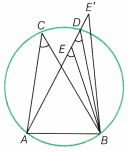
Now, ∠ACB = ∠AEB [angles in the same segment]
But, DACB = ∠ADB [given]
∴ ∠AEB = ∠ADB
This is not possible unless E coincides with D (similarly, E’ coincides with D).
Thus, our assumption that the point D does not lie on the circle was wrong.
Hence, A, B, C and D are concyclic points.
Hence proved.
Example 1.
In the given figure, 0 is the centre of the circle and the measure of ∠AOC is 100°.
Determine ∠ADCand ∠ABC.
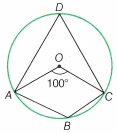
Solution:
Given, arc ABC makes ∠AOC = 100° at the centre of the circle and ∠ADCat a point on the remaining part of the circle.
∴ ∠ADC = \(\frac{1}{2}\)(∠AOQ) = \(\frac{1}{2}\)(100°) = 50° [by theorem 1]
Similarly, ∠ABC = \(\frac{1}{2}\)(Reflex ∠AOC)
⇒ ∠ABC = \(\frac{1}{2}\)(360° – 100°)
= \(\frac{1}{2}\)(260°) = 130°
Hence, ∠ADC = 50° and ∠ABC = 130°.
Example 2.
AB is the diameter of the circle with centre 0 and radius OD is perpendicular to AB. If there is any point C on arc DB then find ∠BAD and ∠ACD.
Solution:
Given AB is diameter of a circle with centre O and DO ⊥ AB.
∴ ∠AOD = ∠BOD = 90°
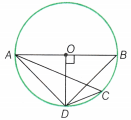
Now, arc BD subtends ∠BOD at the centre and ∠BAD at a point on the remaining part of circle.
So, ∠BOD = 2∠BAD [by theorem 1]
⇒ ∠BAD = \(\frac{1}{2}\)∠BOD = \(\frac{1}{2}\) × 90° = 45°
⇒ ∠BAD = 45°
Similarly, arc AD subtends ∠AOD at the centre and ∠ACD at a point on the remaining part of circle.
So, ∠AOD = 2∠ACD
⇒ ∠ACD = \(\frac{1}{2}\)∠AOD = \(\frac{1}{2}\) × 90° = 45°
Example 3.
In the given figure, 46is a diameter of the circle, CD is a chord equal to the radius of the circle. ACand BD, when extended intersect at a point E.
Find the value of ∠AEB.
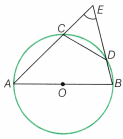
Solution:
In the given figure, join OC, OD and BC.
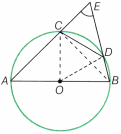
Here, CD = OA = OB = OC = OD
∴ ∆ODC is an equilateral triangle.
Therefore, ∠COD = 60°
Now, ∠CBD = \(\frac{1}{2}\)∠COD
[∵ the angle subtended by the chord at the centre is twice the angle subtended by it at the remaining part of circle]
This gives, ∠CBD = 30°
Again, ∠ACB = 90°
[since, angle in a semi-circle is a right angle]
So, ∠BCE = 180° – ∠ACB
⇒ ∠BCE = 90°
Now, in ∆CBE, ∠BCE + ∠CEB + ∠CBE = 180°
[by angle sum property of a triangle]
⇒ 90°+ ∠CEB + 30° = 180° [∵ ∠CBD = 30°]
⇒ ∠CEB = 180° – 120°
⇒ ∠CEB = 60°
⇒ ∠AEB = 60°
Cyclic Quadrilaterals
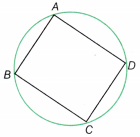
A quadrilateral ABCD is called a cyclic quadrilateral if all the four vertices A, B, C and D are concyclic i.e. A, B, C and D lie on a circle.
In given figure, ABCD is a cyclic quadrilateral.
Theorem 5.
The sum of either pair of opposite angles of a cyclic quadrilateral is 180°.
Given, ABCD be a cyclic quadrilateral with centre O.
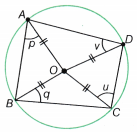
To prove: ∠A + ∠C = 180°
and ∠B + ∠D = 180°
Construction: Join OA, OB, OC and OD.
Proof : OA = OB = OC = OD
So, the triangles formed with O are isosceles triangles.
In ∆OAB, since, OA = OB
∠OAB = ∠OBA = P
In ∆OBC, since, OB = OC
∠OBC = ∠OCB = q
In ∆OCD, since, OC = OD
∠OCD = ∠ODC = u
In ∆ODA,
OD = OA
∠ODA = ∠OAD = v
Now, ∠A = p + v
∠B = p + q
∠C = q + u and ∠D = u + v
Since, the sum of interior angles of any quadrilateral is 360°.
∴ ∠A + ∠B + ∠C + ∠D = 360°
⇒ p + v + p+ q + q+ u + u + v =360°
⇒ 2p + 2q + 2u + 2v = 360°
⇒ 2[p + q + u + v] = 360°
⇒ p + q + u + v = 180°
⇒ (p + v) +(q + u) = 180°
⇒ ∠A + ∠C = 180°
Similarly, ∠B + ∠D = 180°
Therefore, the sum of opposite angles in a cyclic quadrilateral is 180 °.
Hence proved.
Theorem 6.
If the sum of a pair of opposite angles of a quadrilateral is 180° then quadrilateral is cyclic.
Given A quadrilateral ABCD in which ∠A + ∠C = 180° or ∠B + ∠D = 180°.
To prove: ABCD is a cyclic quadrilateral.
Construction: Draw a circle through the points A, B and C.
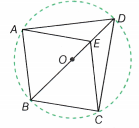
Proof: Suppose, circle does not pass through the point D then it will intersect BD at point E. Join EC and AE.
Then, ABCE is a cyclic quadrilateral.
∴ ∠B + ∠E = 180° …(i)
Also, ∠B + ∠D = 180° [given] …(ii)
From Eqs. (i) and (ii), we get
∠B + ∠E = ∠B + ∠D
⇒ ∠E = ∠D
But, this is possible only when E coincides with D.
Thus, our assumption that the point D does not lie on the circle was wrong.
So, point D lies on the circle.
Therefore, ABCD is a cyclic quadrilateral.
Hence proved.
Example 4.
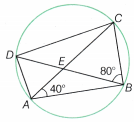
In the given figure, if ∠DBC = 80° and ∠BAC = 40° then find ∠BCD. Further, if AB = BC then find ∠ECD.
Solution:
Given, ∠DBC = 80°and ∠BAC = 40°
Consider, the chord CD, we find that ∠CBD and ∠CAD are angles in the same segment of the circle.
∴ ∠CBD = ∠CAD => ∠CAD = 80°
Now, ∠BAD = ∠BAC + ∠CAD
⇒ ∠BAD = 40° + 80° = 120° …(i)
Since, ABCD is a cyclic quadrilateral.
∴ ∠BAD + ∠BCD = 180°
⇒ 120° + ∠BCD = 180° [using Eq. (i)]
⇒ ∠BCD = 60°
If AB =BC then in ∆ABC, we have ∠ACB = ∠BAC
[∵ angles opposite to equal sides of a triangle are equal]
⇒ ∠ACB = 40° [∵∠BAC = 40°]
∴ ∠ECD = ∠BCD – ∠ACB
= 60°- 40° = 20°