Get the simplified Extra Questions for Class 9 Maths and Ganita Manjari Class 9 Maths Chapter 8 Predicting What Comes Next Exploring Sequences and Progressions Extra Questions with complete explanation.
Class 9 Predicting What Comes Next Exploring Sequences and Progressions Extra Questions
Extra Questions on Predicting What Comes Next Exploring Sequences and Progressions Class 9
Class 9 Ganita Manjari Chapter 8 Extra Questions
Question 1.
Find the 19th term of the following sequence.
\(t_n=\left\{\begin{array}{c}
n^2, \text { where } n \text { is even } \\
n^2-1, \text { where } n \text { is odd }
\end{array}\right.\)
Solution:
For 19th term i.e. for n = 19, which is odd,
we take tn = n2 – 1
= (19)2 – 1
= 360
Question 2.
Find the 7th term of the sequence, whose nth term is given by an = (-1)n-1 . n3.
Solution:
7th term (a7) = (-1)7-1 . (7)3 = 343
Question 3.
What is the difference between consecutive terms of an arithmetic progression -13, -8, -3, 2?
Solution:
a1 = -13, a2 = -8, a3 = -3, a4 = 2
a2 – a1 = -8 – (-13) = 5
a3 – a2 = -3 – (-8) = 5
a4 – a3 = 2 – (-3) = 5
∴ a2 – a1 = a3 – a2 = a4 – a3

Question 4.
Which term of the sequence tn = 4n + 7 for n ≥ 1 is 135?
Solution:
Given, tn = 4n + 7
Let 135 be the nth term of the sequence.
∴ tn = 4n + 7
⇒ 4n + 7 = 135
⇒ 4n = 135 – 7
⇒ 4n = 128
⇒ n = 32
Hence, the 32nd term of the sequence is 135.
Question 5.
For what value of k will k + 9, 2k – 1, and 2k + 7 be the consecutive terms of an AP?
Solution:
a2 – a1 = a3 – a2
⇒ (2k – 1) – (k + 9) = (2k + 7) – (2k – 1)
⇒ k = 18
Predicting What Comes Next Exploring Sequences and Progressions Class 9 Very Short Question Answer
Question 1.
Find the common difference of the AP \(\frac{1}{p}, \frac{1-p}{p}, \frac{1-2 p}{p}, \ldots .\)
Solution:
Common difference = Second term – First term
d = \(\frac{1-p}{p}-\frac{1}{p}\) = -1
Question 2.
√2, √18, √50, √98, …. Is the above pattern in AP? Justify your answer.
Solution:
a1 = √2
a2 = √18 = 3√2
a3 = √50 = 5√2
a4 = √98 = 7√2
So, a2 – a1 = 3√2 – √2 = 2√2
a3 – a2 = 5√2 – 3√2 = 2√2
a4 – a3 = 7√2 – 5√2 = 2√2
Since, a2 – a1 = a3 – a2 = a4 – a3
∴ The given series is an AP because the common difference is 2√2.
Question 3.
In an AP, if the common difference (d) is -4 and the seventh term (a7) is 4, then find the first term.
Solution:
Given, d = -4 and a7 = 4
Let the first term of an AP be a.
∵ an = a + (n – 1)d
∴ a7 = a + (7 – 1)(-4)
⇒ 4 = a + (6)(-4)
⇒ 4 = a – 24
⇒ a = 4 + 24
⇒ a = 28
Question 4.
Find the common difference of the AP 4, 9, 14,……If the first term changes to 6 and the common difference remains the same, then write the new AP.
Solution:
Given AP: 4, 9, 14 ….
Common difference = 9 – 4 = 5
Now, we need to make a new AP with the first term 6 and a common difference of 5.
∴ First term = 6 and second term = 6 + 5 = 11
∴ New AP is 6, 11, 16, 21, …..
Question 5.
If an = 5 – 11n, then find the common difference.
Solution:
Common difference, d = an+1 – an
= 5 – 11(n + 1) – (5 – 11n)
= 5 – 11n – 11 – 5 + 11n
= -11
Question 6.
If the common difference of an AP is 5, then what is a199 – a13?
Solution:
a18 – a13 = (a + 17d) – (a + 12d) = 5d
5d = 5(5) = 25
Question 7.
Find the value of a25 – a15 for the AP: 6, 9, 12, 15,….
Solution:
Given AP: 6, 9, 12, 15 ……
So, a = 6 and d = 9 – 6 = 3
a25 – a15 = a + 24d – (a + 14d)
= a + 24d – a – 14d
= 10d
= 10 × 3
= 30
Question 8.
If 7 times the seventh term of the AP is equal to 5 times the fifth term, then find the value of its 12th term.
Solution:
According to the question,
7 times the 7th term = 5 times the 5th term
7a7 = 5a5
⇒ 7(a + 6d) = 5(a + 4d)
⇒ 7a + 42d = 5a + 20d
⇒ 2a = -22d
⇒ a = -11d
Then, an = a + 11d
= -11d + 11d
= 0
Question 9.
Find first 5 terms of the sequence defined by a1 = -1, an = \(\frac{a_{n-1}}{n}\), for n ≥ 2.
Solution:
Put n = 2, 3, 4, 5 in the nth term.
\(-1,-\frac{1}{2},-\frac{1}{6},-\frac{1}{24},-\frac{1}{120}\)
Question 10.
Find the sum of the first 13 natural numbers.
Solution:
Given, n = 13
The sum of the first 13 natural numbers is
S = \(\frac{n(n+1)}{2}\)
= \(\frac{13(13+1)}{2}\)
= \(\frac{13 \times 14}{2}\)
= 91
Therefore, the sum of the first 13 natural numbers is 91.
Question 11.
Which term of the GP: 3, 6, 12, 24,… is 3072?
Solution:
Given GP is 3, 6, 12, 24, …..
Let the nth term be 3072.
Then, Tn = 3072
∵ First term, a = 3a and common ratio, r = \(\frac {6}{3}\) = 2
Now, Tn = arn-1 = 11th term
Question 12.
The 5th, 8th, and 11th terms of a GP are x, y, z respectively. Show that y2 = xz.
Solution:
Given, ar4 = x, ar7 = y and ar10 = z
⇒ y2 = (ar7)2
= a2r14
= (ar4)(ar10)
Question 13.
How many squares are formed in the 4th step of a fractal with common ratio 5?
Solution:
In 4th step, squares = 1 × 53 = 125
Question 14.
Find the minimum number of moves required for 6 discs in the Tower of Hanoi.
Solution:
Number of moves = 26 – 1 = 63
Predicting What Comes Next Exploring Sequences and Progressions Class 9 Short Question Answer
Question 1.
The 3rd and the 14th terms of an arithmetic progression are -9 and 35, respectively. Which term of this arithmetic progression is five times the 6th term? Show your work.
Solution:
Let the first term and the common difference of the AP be a and d, respectively.
Then, a3 = a + 2d = -9 …….(i)
and a14 = a + 13d = 35 …….(ii)
On subtracting Eq. (i) from Eq. (ii), we get
11d = 44
∴ d = 4
On putting this value in Eq. (i), we get
a + 2 × 4 = -9
⇒ a = -9 – 8
∴ a = -17
Now, let the nth term of this AP be 5 times the 6th term.
∴ an = 5a6
⇒ a + (n – 1)d = 5[a + (6 – 1)d]
⇒ a + (n – 1)d = 5a + 25d
⇒ (n – 1)d = 4a + 25d
⇒ (n – 1) × 4 = 4 × (-17) + 25 × 4
⇒ (n – 1) × 4 = -68 + 100
⇒ n – 1 = 8
⇒ n = 8 + 1 = 9
Hence, the required term is the 9th term.
Question 2.
The 16th term of an AP is 1 more than twice its 8th term. If the 12th term of an AP is 47, then find its nth term.
Solution:
Given, a12 = 47
⇒ a + 11d = 47 ……(i)
and a16 = 1 + 2a8 [by given condition]
⇒ [a + (16 – 1)d] = 1 + 2[a + (8 – 1)d]
⇒ a – d = -1 …..(ii)
On solving Eqs. (i) and (ii), we get
d = 4 and a = 3
∴ an = 3 + (n – 1)4 = 4n – 1
Question 3.
The eighth term of an AP is half its second term, and the eleventh term exceeds one-third of its fourth term by 1. Find the 15th term.
Solution:
We have, \(a_8=\frac{1}{2} a_2\) and \(a_11=\frac{1}{3} a_4\) + 1
⇒ a + 13d = 0 and 2a + 27d = 3
⇒ a15 = 3
Question 4.
The fourth term of an AP is 11. The sum of the fifth and seventh terms of the AP is 24. Find its common difference.
Solution:
Given, a4 = 11
⇒ a + 3d = 11 …..(i)
and a5 + a7 = 24
⇒ a + 5d = 12 ….(ii)
On solving Eqs. (i) and (ii), we get
d = \(\frac {1}{2}\)
Question 5.
The angles of a triangle are in AP. The greatest angle is twice the least. Find all the angles of the triangle.
Solution:
Let the angles be a°, (a + d)°, (a + 2d)°.
Then, we get a + a + d + a + 2d = 180 and a + 2d = 2a
40°, 60°, 80°
Question 6.
Find the number of natural numbers between 101 and 999 which are divisible by both 2 and 5.
Solution:
Natural numbers between 101 and 999 divisible by both 2 and 5
i.e., divisible by 10, are 110, 120, 130, …,990.
Here, 120 – 110 = 130 – 120 =… = 10
So, it is an AP with first term (a) = 110
common difference (d) = 120 – 110 = 10
and last term (l) = 990
Let l = an = a + (n – 1)d
Then, 990 = 110 + (n – 1) × 10
∴ n = 89
Question 7.
If four numbers are in AP such that their sum is 50 and the greatest number is 4 times the least, then find the numbers.
Solution:
Let a + (a + d) + (a + 2d) + (a + 3d) = 50
⇒ 2a + 3d = 25 …..(i)
and a + 3d = 4a
⇒ a = d …..(ii)
On solving Eqs. (i) and Eqs. (ii), we get
∴ a = d = 5
5, 10, 15, and 20.
Question 8.
The 4th term of an AP is zero. Prove that the 25th term of the AP is three times its 11th term.
Solution:
Let a and d be the first term and common difference of the given AP, respectively.
Given a4 = 0
⇒ a + 3d = 0
⇒ a = -3d …..(i)
To prove a25 = a11
Proof: Clearly, a25 = a + 24d = -3d + 24d [from Eq. (i)]
a25 = 21d ……(ii)
Also, a11 = a + 10d = -3d + 10d [from Eq. (i)]
⇒ a11 = 7d
⇒ 3a11 = 21d ……….(iii)
From Eqs. (ii) and (iii), we get
a25 = 3a11
Hence proved.
Question 9.
Split 207 into three parts such that these are in AP and the product of the two smaller parts is 4623.
Solution:
Let the three parts be a, a + d and a + 2d and let d > 0.
Then, a + a + d + a + 2d = 207
⇒ a + d = 69 …(i)
and product of smaller parts = 4623
⇒ a(a + d) = 4623
⇒ a = 67
On putting a = 67 in Eq. (i), we get
⇒ d = 2
First part, a = 67
Second part, a + d = 69
Third part, a + 2d = 71
Hence, the three parts of 207 are 67, 69, and 71.
Question 10.
The sum of the 5th and 9th terms of an AP is 72, and the sum of the 7th and 12th terms is 97. Find the AP.
Solution:
a5 + a9 = 72
⇒ a + 4d + a + 8d = 72
⇒ 2a + 12d = 72 …..(i)
and a7 + a12 = 97
⇒ a + 6d + a + 11d = 97
⇒ 2a + 17d = 97 ……(ii)
Now, solve the Eqs. (i) and (ii).
6, 11, 16, 21, 26,…
Question 11.
The sum of the first three terms of an AP is 33. If the sum of twice the first and the third term exceeds the third term by 28, then find the AP.
Solution:
Let the three terms in AP be a, a + d, a + 2d.
a + a + d + a + 2d = 33
⇒ a + d = 11
By the second condition,
2a + a + 2d = 28 + a + 2d
⇒ a = 14
Thus, d = 11 – 14 = -3
14, 11, 8,…
Question 12.
If a clock strikes one at one O’clock, two at two o’clock, and so on, but does not strike at half hours, then the total number of times the bell will be struck in 24 h is 156. Pradeep at once said, ‘It is true’. Do you agree with Pradeep?
Solution:
Yes, total number of times the bell will be struck in the first 12 h = \(\frac{12(12+1)}{2}\) = 78
∴ Total number of times the bell will be struck in 24 h = 2 × 78 = 156
Question 13.
If ax = by = cz and x, y, z are in GP, then show that \(\log _b a=\log _c b .\).
Solution:
Let ax = by = cz
∴ \(x=\log _a k, y=\log _b k, z=\log _c k\)
Since x, y, z are in GP.
∴ \(\frac{\log _b k}{\log _a k}=\frac{\log _c k}{\log _b k}\)
⇒ \(\frac{\log _k a}{\log _k b}=\frac{\log _k b}{\log _k c}\) [∵ \(\log _y x=\frac{1}{\log _x y}\)]
∴ \(\log _b a=\log _c b\)
Hence proved.
Question 14.
If the 5th and 8th terms of a GP are 48 and 384, respectively, then find the GP, if the terms of the GP are real numbers.
Solution:
Let a be the first term and r be the common ratio of the given GP.
According to the question,
T5 = 48
⇒ ar4 = 48 ……(i)
and T8 = 384
⇒ ar7 = 384 ….(ii)
On dividing Eq. (ii) by Eq. (i), we get
\(\frac{a r^7}{a r^4}=\frac{384}{48}\)
⇒ r3 = 8
⇒ r = 2
On putting r = 2 in Eq. (i), we get a = 3
∴ The required GP is 3, 6, 12, ….
Question 15.
If the 4th, 10th, and 16th terms of a GP are x, y, and z, respectively, then prove that x, y, z are in GP.
Solution:
Let a be the first term and r be the common ratio of the GP.
Given, a4 = ar3 = x …..(i)
a10 = ar9 = y ……(ii)
ar16 = ar15 = z ……(iii)
On dividing Eq. (ii) by Eq. (i) and Eq. (iii) by Eq. (ii), we get
\(\frac{y}{x}=a^6\) and \(\frac{z}{y}=a^6\)
Therefore, \(\frac{y}{x}=\frac{z}{y}\)
Thus, x, y, z are in GP.
Question 16.
The fifth term of a GP is 1875. If the first term is 3, then find the common ratio.
Solution:
Given, T5 = ar4 = 1875 and first term, a = 3
∴ 3r4 = 1875
∴ r = ±5
Question 17.
Find three numbers in GP such that their sum is \(\frac {13}{3}\), and sum of their squares is \(\frac {91}{9}\).
Solution:
Let the three numbers in GP be a, ar, and ar2.
Given, sum of numbers = \(\frac {13}{3}\)
⇒ a + ar + ar2 = \(\frac {13}{3}\) …….(i)
and sum of the square of numbers = \(\frac {91}{9}\)
⇒ \(a^2+(a r)^2+a^2 r^4=\frac{91}{9}\) ……(ii)
Now, on solving Eqs. (i) and (ii) and find the values of a and r.
\(\frac {1}{3}\), 1, 3 or 3, 1, \(\frac {1}{3}\)
Question 18.
Find three numbers in GP, whose sum is 19 and product is 216.
Solution:
Let three numbers in GP be \(\frac {a}{r}\), a, ar.
Then, according to the question,
\(\frac {a}{r}\) + a + ar = 19
and \(\frac {a}{r}\) . a . ar = 216
⇒ a3 = 216
⇒ a = 6
On putting the value a = 6 in Eq. (i), we get
r = \(\frac {2}{3}\) or \(\frac {3}{2}\)
4, 6, 9 or 9, 6, 4
Predicting What Comes Next Exploring Sequences and Progressions Class 9 Long Question Answer
Question 1.
If the mth term of an AP is \(\frac {1}{n}\) and the nth term is \(\frac {1}{m}\), then show that its mnth term is 1.
Solution:
Let a be the first term and d be the common difference of an AP.
mth term = \(\frac {1}{n}\)
So, am = a + (m – 1)d = \(\frac {1}{m}\) …..(i)
nth term = \(\frac {1}{n}\)
So, an = a + (n – 1)d = \(\frac {1}{m}\) ….(ii)
On subtracting Eq. (ii) from Eq. (i), we get
a + (m – 1)d – a – (n – 1)d = \(\frac{1}{n}-\frac{1}{m}\)
⇒ (m – 1 – n + 1)d = \(\frac{m-n}{m n}\)
⇒ (m – n)d = \(\frac{m-n}{m n}\)
⇒ d = \(\frac {1}{mn}\)
From Eq. (i), we get
\(a+(m-1) \cdot \frac{1}{m n}=\frac{1}{n}\)
⇒ a = \(\frac {1}{mn}\)
Now, amn = a + (mn – 1)d
= \(\frac{1}{m n}+(m n-1) \cdot \frac{1}{m n}\)
= 1
Question 2.
14, 21, 28, 35,…. and 26, 39, 52, 65,….. are two arithmetic progressions such that the pth term of the first arithmetic progression is the same as the qth term of the second arithmetic progression. Derive a relationship between p and q. Show your work.
Solution:
Equate the pth term of the first arithmetic progression, ap, to the qth term of the second arithmetic progression, bq, as ap = bq.
Since, ap = bq
⇒ a + (p – 1) × d1 = b + (q – 1) × d2
where a and b are the first terms and d1 and d2 are the common differences of the given arithmetic progressions, respectively.
⇒ 14 + (p – 1) × 7 = 26 + (q – 1) × 13
⇒ (p – 1)7 – 13(q – 1) = 12
⇒ 7p – 13q = 12 + 7 – 13 = 6
⇒ 7p – 13q = 6
Question 3.
Two arithmetic progressions have the same first term. The common difference of one progression is 4 more than the other progression. 124th term of the first arithmetic progression is the same as the 42nd term of the second. Find one set of possible values of the common differences. Show your work.
Solution:
Considers d1 = d2 + 4 or d2 = d1 + 4 …..(i)
where d1 and d2 are the common differences of the two arithmetic progressions.
Also, a124 = b42
⇒ a1 + 123d1 = b1 + 41d2
where a1, a124, b1 and b42 are the 1st, 124th, 1st and 42nd terms of the two arithmetic progressions, respectively.
a1 + 123d1 = a1 + 41d2 [∵ a1 = b1] …..(ii)
Solve the above two equations, and the value of d1 = -2 and d2 = -6 or d1 = 2 and d2 = 6.
One set of possible values of common difference is as follows: when d1 = d2 + 4, then d1 = -2 and d2 = -6.
Question 4.
The pth, qth and rth terms of an AP are a, b, and c, respectively. Show that a(q – r) + b(r – p) + c(p – q) = 0.
Solution:
Let A be the first term, and D be the common difference of AP.
Tp = a = A + (p – 1)D = (A – D) + pD …..(i)
Tq = b = A + (q – 1)D = (A – D) + qD …..(ii)
Tr = c = A + (r – 1)D = (A – D) + rD …..(iii)
Here, we have got two unknowns A and D, which are to be eliminated.
We multiply Eqs. (i), (ii) and (iii) by q – r, r – p and p – q, respectively.
a(q – r) = (A – D)(q – r) + Dp(q – r) ……(iv)
b(r – p) = (A – D)(r – p) + Dq(r – p) …..(v)
c(p – q) = (A – D)(p – q) + Dr(p – q) …..(vi)
On adding the above three Eqs. (iv), (v) and (vi), we get
a(q – r) + b(r – p) + c(p – q) = (A – D)[q – r + r – p + p – q] + D[pq – pr + qr – pq + rp – rq] = 0
Question 5.
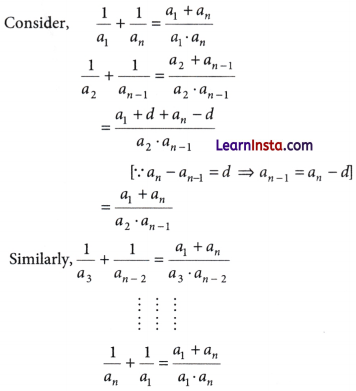
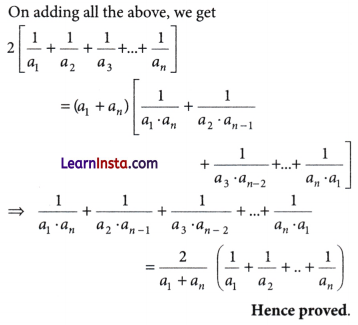
If a1, a2,…,an-2, an-1, an are in AP then prove that \(\frac{1}{a_1 \cdot a_n}+\frac{1}{a_2 \cdot a_{n-1}}+\frac{1}{a_3 \cdot a_{n-2}}+\ldots+\frac{1}{a_n \cdot a_1}\) = \(\frac{2}{a_1+a_n}\left(\frac{1}{a_1}+\frac{1}{a_2}+\ldots+\frac{1}{a_n}\right)\)
Solution:
Question 6.
The sum of the first four terms of an AP is 32, and the ratio of the third and fourth terms is 7 : 8. Find the terms of an AP.
Solution:
Let a1, a2, a3, a4 be the first four terms of an AP.
∴ a1 + a2 + a3 + a4 = 32
a + a + d + a + 2d + a + 3d = 32 [∵ a1 = a, an = a + (n – 1)d]
⇒ 4a + 6d = 32
⇒ 2a + 3d = 16 …..(i)
Now, \(\frac{a_3}{a_4}=\frac{7}{8}\)
⇒ \(\frac{a+2 d}{a+3 d}=\frac{7}{8}\)
⇒ 8a + 16d = 7a + 21d
⇒ a = 5d ……..(ii)
From Eq. (i), 2a + 3d = 16
⇒ 2(5d) + 3d = 16
⇒ 10d + 3d = 16
⇒ 13d = 16
∴ d = \(\frac {16}{13}\)
Then, a = \(5 \times \frac{16}{13}=\frac{80}{13}\)
a + d = \(\frac{80}{13}+\frac{16}{13}=\frac{96}{13}\)
a + 2d = \(\frac{80}{13}+\frac{32}{13}=\frac{112}{13}\)
and a + 3d = \(\frac{80}{13}+\frac{48}{13}=\frac{128}{13}\)
Hence, the required terms of AP are \(\frac{80}{13}, \frac{96}{13}, \frac{112}{13}\), and \(\frac {128}{13}\).
Question 7.
Let S = 1 + 2 + 3 + …+ n be the sum of the first n natural numbers. Prove that S = \(\frac{n(n+1)}{2}\)
Solution:
Ans. 3
The natural numbers 1, 2, 3, 4,… form an arithmetic progression, where the first term is 1, and the common difference is also 1.
To find their sum, we assume
S = 1 + 2 + 3 + ….. + n …(i)
On writing the same sum in reverse order, we get
S = n + (n – 1) + (n – 2) +… + 1 …..(ii)
On adding Eq. (i) and (ii), we get
2S = (1 + n) + (2 + n – 1) + (3 + n – 2) +… + (n + 1)
Each pair gives the same value; we get (n + 1) every time, and since there are n terms, we get
2S = n(n + 1)
On dividing both sides by 2, we get
S = \(\frac{n(n+1)}{2}\)
Hence, the sum of the first n natural numbers is \(\frac{n(n+1)}{2}\).
Predicting What Comes Next Exploring Sequences and Progressions Class 9 Case Based Questions
Question 1.
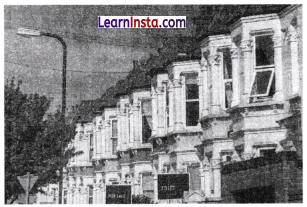
A company produces 500 computers in the third year and 600 computers in the seventh year. Assuming that the production increases uniformly by a constant number every year.
Based on the above information, answer the following questions.
(i) Find the value of the fixed number by which production is increasing every year.
(ii) Find the production in the first year.
(iii) (a) Find the number of computers produced in the 21st year.
Or
(b) Find the difference in the number of computers produced in the 10th year and 8th year.
Solution:
(i) We have, T3 = 500, T7 = 600
Using Tn = a + (n – 1)d, we get
a + 2d = 500 …(i)
a + 6d = 600 …(ii)
On subtracting Eq. (i) from Eq. (ii), we get
4d = 100
⇒ d = 25
Hence, the fixed increase per year is 25.
(ii) From Eq. (i),
a + 2(25) = 500
⇒ a + 50 = 500
⇒ a = 450
Hence, the production in the first year is 450.
(iii) (a) We have, T21 = a + (21 – 1)d
= 450 + 20 × 25
= 450 + 500
= 950
Hence, the production in the 21st year is 950.
Or
(b) We have,
T10 = a + 9d
= 450 + 225
= 675
and T8 = a + 7d
= 450 + 175
= 625
∴ Difference = 675 – 625 = 50
Hence, the required difference is 50.
Question 2.
A school has decided to plant some endangered trees on 51st World Environment Day in the nearest park. They have decided to plant those trees in a few concentric circular rows such that each succeeding row has 20 more trees than the previous one. The first circular row has 50 trees. Based on the above given information, answer the following questions.
(i) How many trees will be planted in the 10th row?
(ii) How many more trees will be planted in the 8th row than in the 5th row?
(iii) (a) If the number of trees planted in the 5th row is 130 and in the 15th row is 330, and the plantation follows an arithmetic progression (AP), find the number of trees planted in the 31st row.
Or
(b) If the number of trees planted in the 4th row is 110 and in the 12th row 270, and the plantation follows an arithmetic progression (AP), find the number of trees planted in the 25th row.
Solution:
Given, number of trees in first circular row = 50
∴ Each succeeding row has 20 more trees than the previous one.
Thus, we get the following list of numbers: 50, 70, 90,…
Clearly, it forms an AP.
(i) Here, a = 50, d = 20, and n = 10
So, the number of trees in the 10th row,
a10 = 50 + (10 – 1) × 20 [∵ an = a + (n – 1)]
⇒ a10 = 50 + 9 × 20
⇒ a10 = 50 + 180
⇒ a10 = 230
(ii) 8th row,
a8 = a + 7d
= 50 + 7 × 20
= 50 + 140
= 190
and 5th row, a5 = a + 4d
= 50 + 4 × 20
= 50 + 80
= 130
So, the difference between 8th row and 5th row = a8 – a5
= 190 – 130
= 60 trees
(iii) (a) We have, T5 = 130, T15 = 330
Using Tn = a + (n – 1)d, we get
a + 4d = 130 ……(iii)
a + 14d = 330 ……(iv)
On subtracting Eq. (iii) from Eq. (iv), we get
10d = 200
⇒ d = 20
From Eq. (iii),
a + 80 = 130
⇒ a = 50
Now, T31 = a + 30d
= 50 + 30 × 20
= 50 + 600
= 650
Hence, the number of trees planted in the 31st row is 650.
Or
(b) We have, T4 = 110, T12 = 270
Using Tn = a + (n – 1)d, we get
a + 3d = 110 …..(v)
a + 11d = 270 ……(vi)
On subtracting Eq. (i) from Eq. (ii), we get
8d = 160
⇒ d = 20
From Eq. (i), a + 60 = 110
⇒ a = 50
Now, T25 = a + 24d
= 50 + 480
= 530
Hence, the number of trees planted in the 25th row is 530.
Question 3.
Your elder brother wants to buy a car and plans to take a loan from a bank for his car. He repays his total loan of ₹ 118000 by paying every month, starting with the first instalment of ₹ 1000, and he increases the instalment by ₹ 100 every month. Based on the information given above, answer the following questions.
(i) Find the amount paid by him in the 30th instalment.
(ii) If the total number of instalments is 40, what is the amount paid in the last instalment?
(iii) (a) Find the ratio of the 15th instalment to the 27th instalment.
Or
(b) Find the ratio of the tenth instalment to the last instalment.
Solution:
Given, total amount of loan = ₹ 118000
Amount paid in first instalment = ₹ 1000
and amount increases every month = ₹ 100
Clearly, the amounts of repayment form an AP with first term (a) = 1000 and common difference (d) = 100
(i) ∵ an = a + (n – 1)d
∴ a30 = a + (30 – 1)d
= 1000 + 29 × 100
= 1000 + 2900
= 3900
(ii) a40 = 1000 + (40 – 1)100
= 1000 + 39 × 100
= 1000 + 3900
= 4900
(iii) (a) We have, a = 1000 and d = 100
a15 = a + (15 – 1)d
= 1000 + 14 × 100
= 2400
and a27 = a + (27 – 1)d
= 100 + 26 × 100
= 3600
∴ Required ratio = 2400 : 3600 = 2 : 3
Or
(b) a10 = 1000 + (10 – 1)100
= 1000 + 9 × 100
= 1000 + 900
= 1900
a40 = 4900 [from part (ii)]
∴ Required ratio = 1900 : 4900 = 19 : 49
Question 4.
An interior designer, Sana, hired two painters, Manan and Bhima, to make paintings for her buildings. Both painters were asked to make 50 different paintings each. The prices quoted by both the painters are given below.
- Manan asked for ₹ 6000 for the first painting, and an increment of ₹ 200 for each following painting.
- Bhima asked for ₹ 4000 for the first painting, and an increment of ₹ 400 for each following painting.
Based on the above information, answer the following question.
(i) How much money did Manan get for his 25th painting? Show your work.
(ii) How much money did Bhima get for his 40th painting? Show your work.
(iii) (a) If both Manan and Bhima make paintings at the same price, find the first painting for which Bhima will get more money than Manan. Show your work.
Or
(b) Find the percentage by which the price of the 10th painting of Manan is more than that of Bhima.
Solution:
(i) a = 6000, d = 200, n = 25
an = a + (n – 1)d
a25 = 10800
(ii) a = 4000, d = 400, n = 40
a40 = 4000 + (40 – 1)400 = 19600
(iii) (a) 6000 + (n – 1)200 = 4000 + (n – 1)400
⇒ n = 11
Since they both earn the same amount for the 11th painting.
So, Bhima gets more money than Manan for the 12th painting.
Or
(b) For Manan,
a10 = 6000 + (10 – 1)200
= 6000 + 1800
= 780
For Bhima,
a10 = 4000 + (10 – 1)400
= 4000 + 3600
= 7600
∴ Difference = 7800 – 7600 = 200
Here, Manan’s 10th painting price is ₹ 200 more than Bhima’s.
∴ Required percentage = \(\frac {200}{7600}\) × 100
= \(\frac {100}{38}\)
= 2.63% (approx)
Hence, the price of Manan’s 10th painting is approximately 2.63% more than that of Bhima.
Question 5.
Ms Sheela visited a store near her house and found that the glass jars are arranged one above the other in a specific pattern. On the top layer, there are 3 jars. In the next layer, there are 6 jars. In the 3rd layer from the top, there are 9 jars, and so on till the 8th layer. Based on the above situation, answer the following questions.
(i) Write an AP whose terms represent the number of jars in different layers starting from the top. Also, find the common difference.
(ii) Is it possible to arrange 34 jars in a layer if this pattern is continued? Justify your answer.
(iii) (a) If the shopkeeper starts with 9 jars in the first layer and increases by 7 jars in each layer, find the number of jars in the 14 th layer from the top.
Or
(b) The shopkeeper added 3 jars in each layer, starting from 6 jars. How many jars are there in the 5th layer from the top?
Solution:
(i) According to the given condition,
First term = 3,
AP is 3, 6, 9, 12,…. 24
∴ Common difference, d = 6 – 3 = 3
(ii) Since the nth term = 34
∴ a + (n – 1)d = 34 [∵ Tn = a + (n – 1)d]
⇒ 3 + (n – 1)3 = 34
⇒ n = \(\frac{34}{3}=11 \frac{1}{3},\) which is not a positive integer.
Therefore, it is not possible to have 34 jars in a layer if the given pattern is continued.
(iii) (a) Given, the shopkeeper added 7 jars in each layer.
∴ AP will be 9, 16, 23,….
Here, a = 9, d = 7 and n = 14
Now, the number of jars in the 14th layer is T14 = a + (14 – 1)d
= 9 + 13 × 7
= 100
Hence, there are 100 jars in the 14th layer from the top.
Or
(b) Given, the shopkeeper added 3 jars in each layer.
∴ AP will be 6, 9, 12,….
Here, a = 6 and d = 9 – 6 = 3
Now, the number of jars in the 5th layer is,
15 = a + (5 – 1)d [∵ Tn = a + (n – 1)d]
= 6 + 4 × 3
= 18
Hence, there are 18 jars in the 5th layer from the top.
Question 6.
Manpreet Kaur is the national record holder for women in the shot-put discipline. Her throw of 18.86 m at the Asian Grand Prix in 2017 is the biggest distance for an Indian female athlete. Keeping her as a role model, Sanjitha is determined to earn gold in the Olympics one day. Initially, her throw reached 7.56 m only. Being an athlete in school, she regularly practiced both in the mornings and in the evenings and was able to improve the distance by 9 cm every week. During the special camp for 15 days, she started with 40 throws and every day kept increasing the number of throws by 12 to achieve this remarkable progress.

Based on the above information, answer the following questions.
(i) How many throws did Sanjitha practice on the 11th day of the camp?
(ii) (a) What would be Sanjitha’s throw distance at the end of 6 months?
Or
(b) When will she be able to achieve a throw of 11.16 m?
(iii) Find the number of throws practiced by Sanjitha on the 15th day of the camp.
Solution:
(i) Number of throws on first day a = 40
Number of throws on second day = 40 + 12 = 52
AP formed by number of throws is
40, 52, (52 + 12)…
(I day) (II day) (III day)
Here, common difference, d = 12
Number of throws she practiced on the 11th day
a11 = n + (11 – 1)d
= 40 + 10 × 12
= 160
(ii) (a) Distance of Sanjitha’s throw on first day, a = 7.56 m
Distance of Sanjitha throw after a week = (7.56 + 0.09) m = 7.65 m
∴ AP formed by the distances is
7.56, 7.65, 7.65 + 0.09,…
(I week) (II week) (III week)
Here, common difference, d = 0.09 m
Sanjitha’s throw distance at the end of 6 months (i.e. 26 weeks)
a26 = a + (26 – 1 )d
= 7.56 + 25 × 0.09
= 7.56 + 2.25
= 9.81 m
Or
(b) Here, an = 11.16 = a + (n – 1)d
⇒ 7.56 + (n – 1)0.09 = 11.16
⇒ n – 1 = \(\frac {3.6}{0.09}\)
⇒ n = 41
∴ In the 41st week, she will be able to achieve a throw of 11.16 m.
(iii) Number of throws she practiced on the 15th day,
a15 = a + (15 – 1)d
= 40 + 14 × 12 [∵ a = 40, d = 12]
= 40 + 168
= 208
Question 7.
A sequence of non-zero numbers is said to be a geometric progression if the ratio of each term except the first one to its preceding term is always constant. Rahul, being a plant lover, decides to open a nursery, and he bought a few plants with pots. He wants to place pots in such a way that the number of pots in the first row is 2, in the second row is 4, and in the third row is 8, and so on.
Based on the above information, answer the following questions.
(i) Find the constant multiple by which the number of pots is increasing in every row.
(ii) Find the number of pots in the 8th row.
(iii) (a) What is the difference in the number of pots placed in the 7th row and the 5th row?
Or
(b) What is the product of the number of pots placed in the 5th, 6th, and 9th rows?
Solution:
(i) Number of pots in each row is 2, 4, 8,…
This forms a geometric progression,
where a = 2 and r = \(\frac {4}{2}\) = 2
Hence, the constant multiple by which the number of pots is increasing in every row is 2.
(ii) Number of pots in 8th row,
a8 = \(a r^{8-1}=2(2)^7=2^8\) = 256
(iii) (a) Number of pots in 7th row,
a7 = \(2(2)^{7-1}=2 \cdot 2^6=2^7\) = 128
Number of pots in the 5th row,
a5 = \(2(2)^{5-1}=2 \cdot 2^4=2^5\) = 32
∴ Required difference = 128 – 32 = 96
Or
(b) Number of pots in a5 = 2(2)5-1 = 2(2)4 = 32
a6 = 2(2)6-1 = 2(2)5 = 64
a9 = 2(2)9-1 = 2(2)8 = 512
∴ Required product = 32 × 64 × 512 = 1048576