Experts have designed these Class 9 Maths Notes and Chapter 4 Exploring Algebraic Identities Class 9 Ganita Manjari Notes for effective learning.
Class 9 Maths Chapter 4 Exploring Algebraic Identities Notes
Class 9 Maths Ganita Manjari Chapter 4 Notes
Ganita Manjari Class 9 Chapter 4 Notes – Class 9 Exploring Algebraic Identities Notes
This chapter explories algebraic identities deals with understanding and applying standard algebraic identities. It introduces visualisation of identities using geometrical models, factorisation of algebraic and quadratic expressions and techniques to simplify rational expressions using identities with step-by-step methods.
Identities
An identity is an equality, which is true for all the values of the variables,
e.g. (a + 1)(a + 2) = a2 + 3a + 2 is an identity.
Identities are useful in carrying out squares and products of algebraic expressions. These act as alternative methods to calculate products of numbers.
Visualising Identities
(i) The square of the sum of two numbers a and b is equal to the sum of the square of the first number, twice the product of the two numbers and the square of second number b2.
i. e. (a + b)2 = a2 + 2ab + b2.
Geometry Representation
Construct a square of side (a + b) units and partition it into smaller squares and rectangles. Then, the area of the outer square is (a + b)2. The area of the larger square inside the outer square is a2, while the area of the smaller square is b2. The areas of two rectangles are ab each.
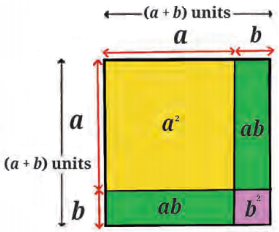
Thus, the total area = a2 + ab + ab + b2 = a2 + 2ab + b2
Hence, (a + b)2 = a2 + 2ab + b2
(ii) The square of the difference of two terms is equal to the square of the first term, minus twice the product of the two terms, plus the square of the second term.
i.e. (a – b)2 = a2 – 2ab + b2.
Geometry Representation
Consider a square of side a units. The area of the square is a2.
Divide one side into two parts a – b and b. Accordingly, the square is partitioned into three parts: one square of area (a – b)2, one rectangle of area ab and another rectangle of area b(a – b).
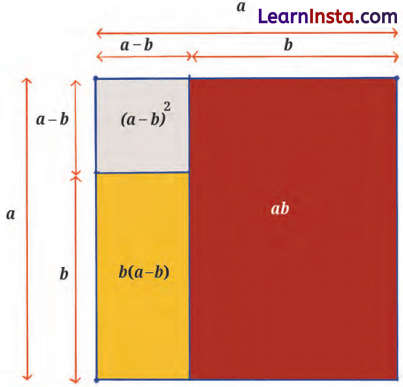
Now, subtract the areas of the two rectangles from the area of the big square.
(a – b)2 = a2 – ab – b(a – b)
= a2 – ab – ba + b2
= a2 – 2ab + b2
Hence, (a – b)2 = a2 – 2ab + b2
(iii) The product of two binomials can be expressed as the sum of four terms obtained using the distributive property
i.e. (x +a) (x + b) = x2 + (a + b)x + ab.

Geometry Representation
Consider a rectangle with sides (x + a) units and (x + b) units. The area of the rectangle is (x + a) (x + b).
Now, divide the rectangle into parts of lengths x and a along one side, and x and b along the other side. The rectangle is partitioned into four regions.
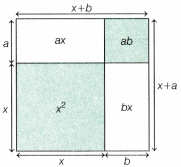
One square of area x2, two rectangles of areas ax and bx and one rectangle of area ab.
Thus, the total area = x2 + ax + bx + ab = x2 + (a + b)x + ab
Hence, (x +a) (x + b) = x2 + (a +b)x + ab
Example 1.
Simplify.
(i) (3xy + 4z)2
Solution:
We have, (3xy + 4z)2 = (3xy)2 + 2(3xy)(4z) + (4z)2
[∵ (a + b)2 = a2 + 2ab + b2, here a = 3xy, b = 4z]
= 9x2y2 + 24xyz + 16z2
(ii) (a2 – b2)2
Solution:
We have, (a2 – b2)2 = (a2)2 – 2(a2)(b2) + (b2)2
[∵ (a – b)2 = a2 – 2ab + b2]
= a4 – 2a2b2 + b4
(iii) (3x + 6)2 – (3x – 6)2
Solution:
We have, (3x + 6)2 – (3x – 6)2
= [(3x)2 + 2(3x)(6) + 62] – [(3x)2 – 2(3x)(6) + 62]
[∵ (a + b)2 = a2 + 2ab + b2 and (a – b)2 = a2 – 2ab + b2]
= (9x2 + 36x + 36) – (9x2 – 36x + 36)
= 72x
Alternate Method (3x + 6)2 – (3x – 6)2 = (3x + 6 + 3x – 6)(3x + 6 – 3x + 6)
[∵ a2 – b2 = (a – b)(a + b)]
= (6x)(12) = 72x
(iv) (6m – 9n)2 + (6m + 9n)2
Solution:
We have, (6m – 9n)2 + (6m + 9n)2 = [(6m)2 – 2(6m)(9n) + (9n)2] + [(6m)2 + 2(6m)(9n) + (9n)2]
= (36m2 – 108mn + 81n2) + (36m2 + 108mn + 81n2)
= 72 m2 + 162 n2
Example 2.
Use suitable identities to find the following products.
(i) (x + 6)(x + 11)
Solution:
We have, (x + 6)(x + 11) = x2 + (6 + 1 l)x + (6)(11)
[∵ (x + a)(x + b) = x2 + (a + b)x + ab]
= x2 + 17x + 66
(ii) (x + 9)(x – 12)
Solution:
We have ,(x + 9)(x – 12) = x2 + (9 – 12)x + (9)(-12)
[∵ (x + a)(x – b) = x2 + (a – b)x – ab]
= x2 – 3x – 108
(iii) (9x – 5)(3x + 11)
Solution:
We have,
(9x – 5)(3x + 11) = (9x) (3x) + 9x.11 – 5.3x -5.11
= 27x2 + 99x – 15x – 55
= 27x2 + 84x – 55
(iv) (3x -5)(3x – 7)
Solution:
We have, (3x – 5)(3x – 7) = (3x)2 – (5 + 7)(3x) + (5)(7)
[∵ (x – a)(x – b) = x2 – (a + b)x + ab]
= 9x2 – 36x + 35
Example 3.
Using suitable identities, solve the following.
(i) (120)2
Solution:
We have, (120)2 =(100 + 20)2
= (100)2 + (20)2 + 2 × 100 × 20
= 10000 + 400 + 4000
= 14400 [using identity (i)]
(ii) (97)2
Solution:
We have, (97)2 = (100 – 3)2
= (100)2 + (3)2 – 2 × 100 × 3
= 10000 + 9 – 600
= 9409 [using identity (ii)]
Example 4.
Using a2 – b2 = (a – b) (a + b), find
(i) 612 – 392
Solution:
We have, 612 – 392 =(61 – 39)(61 + 39)
[∵ a2 – b2 = (a – b)(a + b)]
= 22 × 100
= 2200
(ii) (1.05)2 – (0.95)2
Solution:
We have, (1.05)2 – (0.95)2
=(1.05 + 0.95)(1.05 – 0.95)
[∵ a2 – b2 = (a – b)(a + b)]
= (2) × (0.10) = 0.2
(iii) 13.12 – 6.92
Solution:
We have, 13.12 – 6.92
= (13.1 – 6.9)(13.1 + 6.9)
[∵ a2 – b2 = (a – b)(a + b)]
= 6.2 × 20
= 124
Example 5.
Using suitable identities, find
(i) 104 × 107
Solution:
We have, (104 × 107) = (100 + 4)(100 + 7)
= 1002 + (4 + 7) × 100 + (4 × 7)
[∵ (x + a)(x + b) = x2 + (a + b)x + ab]
= 10000 + 1100 + 28
=11128
(ii) 109 × 95
Solution:
We have, (109 × 95) = (100 + 9)(100 – 5)
= 1002 + (9 – 5) × 100 – (9 × 5)
[∵(x + a)(x – b) = x2 + (a – b)x – ab]
= 10000 + 400 – 45
=10355
(iii) 97 × 106
Solution:
We have, (97 × 106) =(100 – 3)(100 + 6)
= 1002 + (6 – 3) × 100 – (3 × 6)
[∵ (x – a)(x + b) = x2 + (b – a)x – ab]
= 10000 + 300 – 18
= 10282
(iv) 92 × 98
Solution:
We have, (92 × 98) =(100 – 8)(100 – 2)
= 1002 – (8 + 2) × 100 + (8 × 2)
[∵ (x – a)(x – b) = x2 – (a + b)x + ab]
= 10000 – 1000 + 16
= 9016
Example 6.
If x – 3 = \(\frac{1}{5x}\) then find the value of
(i) x2 + \(\frac{1}{25 x^2}\)
Solution:
We have, x – 3 = \(\frac{1}{5x}\)
⇒ x – \(\frac{1}{5x}\) = 3
On squaring both sides, we get (x – \(\frac{1}{5x}\))2 = 32
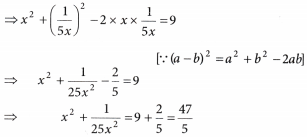
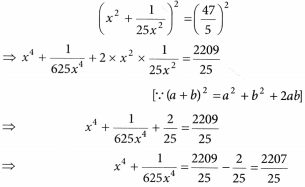
(ii) x4 + \(\frac{1}{25 x^2}=\frac{47}{5}\)
Solution:
(ii) Now, consider x4 + \(\frac{1}{25 x^2}=\frac{47}{5}\)
On squaring both sides, we get
Example 7.
If x2 + \(\frac{1}{x^2}\) = 34 then find the value of each of the following.
(i) x + \(\frac{1}{x}\)
Solution:
We have, x2 + \(\frac{1}{x^2}\) = 34
(i) Consider (x + \(\frac{1}{x}\))2 = x2 + 2
[∵ (a + b)2 = a2 + b2 + 2ab]
= 34 + 2
= 36
Hence, x + \(\frac{1}{x}\) = ±6 [taking square root on both sides]
(ii) Consider (x – \(\frac{1}{x}\))2 = x2 + \(\frac{1}{x^2}\) – 2
[∵ (a – b)2 = a2 + b2 – 2ab]
= 34 – 2
= 32
Hence, x – \(\frac{1}{x}\) = \(\sqrt{32}\) = ± 4√2
[taking square root on both sides]
Identity for the Square of a Trinomial
The square of a trinomial is equal to the sum of the squares of the three terms and twice the sum of their pairwise products
i.e. (x + y + z)2 = x2 + y2 + z2 +2 xy + 2 yz + 2 zx
Geometrical Representation
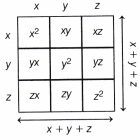
Consider a square of side (x + y + z). The area of the square is (x + y + z)2.
The square can be divided into smaller parts consisting of three squares of areas x2, y2 and z2, and six rectangles, whose total area is 2xy + 2yz + 2zx.
Thus, the total area of the square is equal to x2 + y2 + z2 + 2xy + 2yz + 2zx.
Example 8.
Write the following in the expanded form,
(i) (3x – y + 5z)2
(ii)(5x – 3y – 2z)22
Solution:
(i) We have,(3x – y + 5z)2
On comparing with (a + b + c)2, we get a= 3x, b = -y and c = 5z
We know that
(a + b + c)2 = a2 + b2 + c2 + 2 ab + 2 bc + 2 ca
On putting the values of a, b and c, we get
(3x – y + 5z)2 = (3x)2 + (-y)2 + (5z)2 + 2(3 x)(-y) + 2(-y)(5z) + 2(5z)(3x)
= 9x2 + y2 + 25z2 -6xy – 10yz + 30xz
(ii) We have,(5x – 3y – 2z)2
On comparing with (a + b + c)2, we get a = 5x, b = -3y and c = -2z
We know that
(a + b + c)2 = a2 + b2 + c2 + 2ab + 2bc + 2ca
On putting the values of a, b and c, we get
(5x – 3y – 2z)2 = (5x)2 + (-3y)2 + (-2z)2 + 2(5x) (-3y) + 2(-3y)(-2z) + 2(-2z)(5x)
= 25x2 + 9y2 + 4z2 – 30xy + 12yz – 20xz
Example 9.
Simplify (3x – y + z)2 – (3x + y – z)2.
Solution:
We have,(3x – y + z)2 – (3x + y – z)2
= (3x)2 + (-y)2 + z2 + 2(3x)(-y) + 2(-y)(z) + 2(z)(3x) – [(3x)2 + y2 + (-z)2 + 2(3x)(y) + 2 (y)(-z) + 2(-z)(3x)]
= 9x2 + y2 + z2 – 6xy – 2yz + 6xz – (9x2 + y2 + z2 + 6xy – 2yz – 6xz)
= 9x2 + y2 + z2 – 6xy – 2yz + 6xz – 9x2 – y2 – z2 – 6xy +2yz + 6xz
= -12 xy + 12 xz
Identity for the Cube of a Binomial
(i) (x + y)3 = x3 + y3 + 3xy(x + y)
(ii) (x – y)3 = x3 – y3 – 3xy(x – y)
Geometrical Representation
(i) Consider a cube of edge (x + y). The volume of the cube is (x + y)3. This cube can be divided into smaller solids consisting of one cube of volume x3, one cube of volume y3 and three cuboids each having dimensions x, y and (x + y), so each has volume xy(x + y).
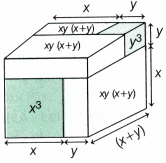
Thus, the total volume of the cube is equal to the sum of the volumes of these solids
i.e. (x + y)3 = x3 + y3 + 3xy(x + y)
(ii) Let us take two cubes of sides x and y, and three cuboids each of dimensions x, y and (x – y).
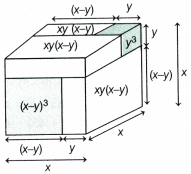
Thus, the volume of this cube is equal to the sum of the volumes of the two cubes and three cuboids.
Hence, x3 =(x – y)3 + y3 + 3xy(x – y)
On rearranging, we get
(x – y)3 = x3 – y3 – 3xy(x – y)
Example 10.
Simplify the following expansions using suitable identities.
(i) (3x + 2y)3
Solution:
We have, (3x + 2y)3 = (3x)3 + (2y)3 + 3 × 3x × 2y × (3x + 2 y)
[∵ (a + b)3 = a3 + b3 + 3ab(a + b)]
= 27 x33 + 8y3 + 18xy(3x + 2 y)
= 27 x3 + 8y3 +54x2y + 36xy2
(ii) (4a – 5b)3
Solution:
We have, (4a – 5b)3
= (4a)3 – (5b)3 – 3 × 4a × 5b × (4a -5b)
[∵ (a – b)3 = a3 – b3 – 3ab(a – b)]
= 64a3 – 125b3 – 60ab(4a – 5b)
= 64a3 – 125b3 – 240a2b + 300ab2
(iii) (6x + 4y)3 – (6x – 4y)3
Solution:
We have, (6x + 4y)3 – (6x – 4y)3
= {(6x)3 + (4y)3 + 3(6x)2(4y) + 3(6x)(4y)2} – {(6x)3 – (4y)3 – 3(6x)2(4y) + 3(6x)(4y)2)
[∵ (a+ b)3 = a3 + b3 + 3a2b + 3ab2 and (a – b)3 = a3 – b3 – 3a2b + 3ab2]
= (216x3 + 64y3 + 432x2y + 288xy2) – (216x3 – 64y3 – 432x2y + 288xy2)
= 216x3 + 64y3 + 432x2y +288xy2 – 216x3 + 64y3 + 432x2y – 288xy2
= 128y3 + 864x2y
Example 11.
Evaluate each of the following by using suitable identities.
(i) (98)3
Solution:
We have, (98)3 = (100 – 2)3
Using the identity (a – b)3 = a3 – b3 – 3ab(a – b), we have
(98)3 = (100)3 – (2)3 – 3(100)(2)(100 -2)
= 1000000 – 8 – 600(98)
= 1000000 – 8 – 58800
= 1000000 – 58808
= 941192
(ii) (1002)3
Solution:
We have, (1002)3 = (1000 + 2)3
Using the identity (a + b)3 = a3 + b3 + 3 ab(a + b),
(1002)3 = (1000)3 + (2)3 + 3(1000) (2) (1000 + 2)
= 1000000000 + 8 + 6000(1002)
= 1000000000 + 8 + 6012000
= 1006012008
Example 12.
If 3x – 4y = 7 and xy = 10 then find the value of 27x3 – 64y3.
Solution:
We have, 3x – 4y = 7 …(i)
and xy = 10 ……….(ii)
On cubing both sides of Eq. (i), we get
(3x – 4y)3 = 73
⇒ (3x)3 – (4y)3 – 3(3x)(4y)(3x – 4y) = 343
[∵ (a – b)3 = a3 – b3 – 3ab(a – b)]
⇒ 27x3 – 64y3 – 36xy(3x – 4y) = 343
⇒ 27x3 – 64y3 – 36(10)(7) = 343
[from Eqs. (i) and (ii)]
⇒ 27x3 – 64y3 – 2520 = 343
⇒ 27x3 – 64y3 = 343 + 2520
= 2863
Example 13.
If x4 + \(\frac{1}{x^4}\) = 287, calculate x3 – \(\frac{1}{x^3}\)
Solution:
We have, x4 + \(\frac{1}{x^4}\) = 287
On adding 2 to both sides, we get
x4 + \(\frac{1}{x^4}\) + 2 = 287
⇒ \(\left(x^2+\frac{1}{x^2}\right)^2\) = 289
⇒ x2 + \(\frac{1}{x^2}\) = \(\sqrt{289}\) = 17
On subtracting 2 from both sides, we get
x2 + \(\frac{1}{x^2}\) – 2 = 17 – 2 = 15
\(\left(x-\frac{1}{x}\right)^2\) = 15
⇒ x – \(\frac{1}{x}\) = \(\sqrt{15}\)
On cubing both sides, we get
\(\left(x-\frac{1}{x}\right)^3=(\sqrt{15})^3\)
x3 – \(\frac{1}{x^3}\) – 3\(\left(x-\frac{1}{x}\right)\) = 15\(\sqrt{15}\)
x3 – \(\frac{1}{x^3}\) – 3\(\sqrt{15}\) = 15\(\sqrt{15}\)
x3 – \(\frac{1}{x^3}\) = 15\(\sqrt{15}\) + 3\(\sqrt{15}\) = 18\(\sqrt{15}\)
Example 14.
If the difference between two positive number is 6 and the difference between their cubes is 756 then find
(i) their product.
(ii) the sum of their squares.
Solution:
Let two positive numbers be x and y, where x > y.
According to the statement, we have
x – y = 6 and x3 – y3 = 756
(i) Consider x – y = 6
On cubing both sides, we get (x – y)3 = 63
⇒ x3 – y3 – 3xy(x – y) = 216
[∵ (a – b)3 = a3 – b3 – 3ab(a – b)]
756 – 3xy(6) =216
[∵ x – y = 6 and x3 – y3 = 756]
⇒ 756 – 216 = 18xy
⇒ 540 = 18xy
⇒ xy = \(\frac{540}{18}\) = 30
(ii) Again, consider x – y = 6
On squaring both sides, we get
(x – y)2 = 62
⇒ x2 + y2 – 2xy = 36
⇒ x2 + y2 – 2(30) = 36
⇒ x2 + y2 – 60 = 36
⇒ x2 + y2 = 96
Sum and Difference of Cubes
- x3 + y3 = (x + y)(x2 – xy + y2)
- x3 – y3 = (x – y)(x2 + xy + y2)
Example 15.
Find the following products by using suitable identities.
(i) (x- 6y)(x2 +6xy + 36y2)
Solution:
We have,
(x – 6y)(x2 + 6xy + 36y2) = x3 – (6y)3
[using the identity, (a – b)(a2 + ab + b2) = a3 – b3]
= x3 – 216y3
(ii) (5x2 + 2y2)(25x4 – 10x2y2 +4y4)
Solution:
We have,
(5x2 + 2y2)(25x4 – 10x2y2 + 4y4)
= (5x2)3 + (2y2)3
[using identity (a + b)(a2 – ab + b2) = a3 + b3]
= 125x6 + 8y6
Some Important Identities
- x3 + y3 + z3 – 3xyz = (x + y + z)(x2 + y2 + z2 – xy – yz – zx)
- If x + y + z = 0 then x3 + y3 + z3 = 3xyz
Example 16.
Find the following product by using appropriate identities.
(a + 3b + 4c)(a2 + 9b2 + 16c2 – 3ab – 12bc – 4ca)
Solution:
(a + 3b + 4c)(a2 + 9b2 + 16c2 – 3ab – 12bc – 4ca)
= (a)3 + (3b)3 + (4c)3 – 3 × a × 3b × 4c
= a3 + 27b3 + 64c3 – 36abc
Example 17.
If a + b + c = 5 and ab + bc + ca = 7, find the value of a3 + b3 + c3 – 3abc.
Solution:
a + b + c = 5
On squaring both sides, we get
(a + b + c)2 = 25
a2 + b2 + c2 + 2 (ab + bc + ca) = 25
⇒ a2 + b2 + c2 + 2(7) = 25
⇒ a2 + b2 + c2 = 25 – 14 = 11
Now, a3 + b3 + c3 – 3abc
= (a + b + c)(a2 + b2 + c2 – ab – bc – ca)
= 5(11 – 7)
= 5 × 4
= 20
Example 18.
If 3x + 5y = 2 then prove that 27x3 + 125y3 + 90xy = 8.
Solution:
Given, 3x + 5y = 2
⇒ 3x + 5y – 2 = 0
⇒ (3x)3 + (5y)3 + (-2)3 = 3(3x)(5y)(-2)
[∵(a + b + c) = 0 then a3 + b3 + c3 = 3abc]
⇒ 21 x3 + 125y3 – 8 = -90xy
⇒ 27x3 + 125y3 + 90xy = 8
Factorisation of Polynomials
Factorisation
The process of expressing an algebraic expression as the product of two or more algebraic expressions is called factorisation, these expressions are called factors of given algebraic expression.
In this chapter, we will study the methods of expressing an algebraic expression as the product of its factors,
e.g .(x + y)(x – y) = x2 – y2
Here, (x + y) and (x – y) are the factors of x2 – y2.
Factorisation by Taking Out Common Factors
Factorisation is done by taking out the common factor from all terms and writing the remaining expression in brackets.
Example 1.
Factorise the following.
(i) 7x – 42
Solution:
7x – 42
In the given expression, we see that each term can be divided by 7. So, 7 is the common term.
7x – 42 = 7\(\left(\frac{7 x}{7}-\frac{42}{7}\right)\)
= 7(x – 6)
which are the required factors of the given expression.
(ii) -16z + 20z3
Solution:
-16z + 20z3
In the given expression, we can see that each term can be divided by 4z. So, 4z is the common term.
-16z + 20z3 = 4z\(\left(\frac{-16 z}{4 z}+\frac{20 z^3}{4 z}\right)\)
= 4z(-4 + 5z2),
which are the required factors of the given expression.
(iii) 10a2 – 15b2 + 20c2
Solution:
10a2 – 15b2 + 20c2
In the given expression, we can see that each term can be divided by 5. So, 5 is the common term.
10a2 – 15b2 + 20c2 = 5\(\left(\frac{10 a^2}{5}-\frac{15 b^2}{5}+\frac{20 c^2}{5}\right)\)
= 5(2a2 – 3b2 + 4c2),
which are the required factors of the given expression.
(iv) 20l2m + 30 alm
Solution:
20l2m + 30 alm
In the given expression, we can see that each term can be divided by 10Im. So, 10Im is common term.
20l2m + 30 alm = 10lm\(\left(\frac{20 l^2 m}{10 l m}+\frac{30 a l m}{10 l m}\right)\)
= 10lm(2l + 3a),
which are the required factors of the given expression.
(v) x2yz + xy2z + xyz2
Solution:
x2yz + xy2z + xyz2
In the given expression, we can see that each term can be divided by xyz. So, xyz is common term.
x2yz + xy2z + xyz2 = xyz\(\left(\frac{x^2 y z}{x y z}+\frac{x y^2 z}{x y z}+\frac{x y z^2}{x y z}\right)\)
= xyz(x + y + z),
which are the required factors of the given expression.
Example 2.
Factorise 27a3b3 – 18a2b3 +75a3b2.
Solution:
In the given expression, we can see that each term can be divided by 3a2b2. So, 3a2b2 is the common term.
27a3b3 – 18a2b3 +75a3b2.
= 3a2b2\(\left(\frac{27 a^3 b^3}{3 a^2 b^2}-\frac{18 a^2 b^3}{3 a^2 b^2}+\frac{75 a^3 b^2}{3 a^2 b^2}\right)\)
= 3a2b2 (9ab-6b + 25d),
which are the required factors of the given expression.
Example 3.
Factorise 18x3y – 45x2yz + 63x3yz2.
Solution:
In the given expression, we see that each term can be divided by 9x2y. So, 9x2y is the common term.
18x3y – 45x2yz + 63x3yz2
= 9x2y\(\left(\frac{18 x^3 y}{9 x^2 y}-\frac{45 x^2 y z}{9 x^2 y}+\frac{63 x^3 y z^2}{9 x^2 y}\right)\)
= 9x2y(2x – 5z + 7xz2)
which are the required factors of the given expression.
Example 4.
Factorise
10x (x + 2y)3 – 15y (x + 2y)2 + 35 (x + 2y)
Solution:
In the given expression, we see that each term can be divided by 5 (x + 2y). So, 5 (x + 2y) is the common term.
5(x + 2y)\(\left[\frac{10 x(x+2 y)^3}{5(x+2 y)}-\frac{15 y(x+2 y)^2}{5(x+2 y)}+\frac{35(x+2 y)}{5(x+2 y)}\right]\)
which are the required factors of the given expression.
Factorisation by Grouping of Terms
Sometimes all the terms in the given expression do not have common factor but different terms can be grouped in such a way that each group has a common factor. In this way, we find a common factor across all the groups and factorise the given expression.
Example 5.
Factorise px -qy + qx – py.
Solution:
We have, px – qy + qx – py
= px + qx – qy – py
= (p + q)x – (q + p)y
= (p+q)x – (p + q)y
Now, (p + q), is common factor across in both groups.
So, (p + q) (x -y), which are the required factors of the given expression.
Example 6.
Factorise a3 – 4a2 + 3a – 12.
Solution:
Here, first two terms have a2 as common factor and last two terms have 3 as common factor.
∴ a3 – 4a2 + 3a – 12 = a2(a – 4) + 3(a – 4).
Now, we see that (a – 4) is common factor in both groups.
So, a3 – 4a2 + 3a -12 = (a – 4)(a2 + 3).
Example 7.
Factorise pq2 – 4pq + 4q -16.
Solution:
Here, first two terms have pq as common factor and last two terms have 4 as common factor.
pq2 – 4pq + 4q – 16
= pq(q – 4) + 4(q – 4)
Now, (q – 4) is common factor in both groups.
So, pq2 – 4pq + 4q – 16 = (pq + 4) (q – 4)
Example 8.
Factorise l(x – y)2 + (mx-my) + 5x – 5y.
Solution:
We have, l(x – y)2 + (mx – my) + (5x – 5y)
= l(x – y)2 + n(x – y) + 5(x – y)
Now, (x – y) is common factor across all the groups.
So, l(x – y)2 + (mx – my) + (5x – 5 y)
= (x – y)[l(x – y) + m + 5],
which are the required factors of the given expression.
Example 9.
Factorise xy (a2 – b2) + ab (x2 – y2).
Solution:
We have, xy(a2 – b2) + ab(x2 – y2)
= xya2 – xyb2 + abx2 – aby2
= xya2 + abx2 – aby2 – xyb2
= ax(ay + bx) – by (ay + bx)
Now, (ay + bx) is common factor for each group.
Example 10.
Factorise 3ax – 6ay – 8by + 4bx + 9az + 12bz.
Solution:
We have, 3ax – 6ay – 8by + 4bx + 9az + 12bz
Now, arranging the given expression into groups,
= (3ax + 4bx) – 6ay – 8by + 9az + 12 bz
= (3ax + 4bx) -(6ay + 8by) + (9az + 12bz)
= x(3a + 4b) – 2y(3a + 4b) + 3z(3a + 4b)
Now, (3a + 4b) is common factor for each group.
So, 3ax – 6ay – 8by + 4bx + 9 az + 12 bz
= (3a + 4b) (x – 2y + 3z),
which are the required factors of the given expression.
Factorisation by Making the Perfect Square
Sometimes a given expression can be written as the perfect square of combination of two or more terms. In this case, the given expression can be expressed as the product of terms involved in perfect square.
(i) a2 + 2ab + b2 = (a + b)22
(ii) a2 – 2ab + b2 = (a – b)2
Example 11.
Factorise 9x2 +12xy + 4y2.
Solution:
We have, 9x2 + 12xy + 4y2
Given expression can be rewritten as (3x)2 + 2 – 3x – 2y + (2y)2
Now, take 3x = a and 2y = b also using the identity a2 + 2ab + b2 = (a + b)
So, the expression becomes (3x + 2y)2.
Hence, the required factors are (3x + 2y) and (3x + 2y).
Example 12.
Factorise 49y2 +84yz + 36z2.
Solution:
We have, 49y2 + 84yz + 36z2
= (7y)2 + 2.(7y).(6z) + (6z)2
Now, take 7y = a and 6z = b also using the identity a2 + 2ab + b2 =(a + b)2.
So, the expression becomes (7y + 6z)2.
Hence, the required factors are (7y + 6z) and (7y + 6z).
Example 13.
Find the factors of 121b2 – 88bc + 16c2.
Solution:
We have, 121b2 – 88bc + 16c2
= (11b)2 – 2.(11b) (4c) + (4c)2
Now, take 11b = A and 4c = B also using the identity A2 – 2AB + B2 = (A – B)2.
So, the expression becomes (11b – 4c)2.
Hence, the required factors are (11b – 4c) and (11b – 4c).
Factorisation of Difference of Two Squares
If the given expression is expressible as the difference of two squares, we use the following identity to factorise it. a2 -b2 = (a + b)(a – b)
Example 14.
Factorise 4x2 – 169y2.
Solution:
We have, 4x2 – 169y2 = (2x)2 – (13y)2
∴ (2x)2 – (13y)2 = (2x + 13y) (2x – 13y),
[∵ a2 – b2 = (a + b)(a – b)]
which are the required factors of the given expression.
Example 15.
Factorise x4 – 81y4.
Solution:
We have x4 – 81y4 =(x2)2 – (9y2)2
[∵ a2 – b2 = (a + b)(a – b)]
(x2)2 – (9y2)2 = (x2 + 9y2) (x2 – 9y2)
We see that x2 – 9y2 is again expressed as a difference of two squares.
∴ (x2 + 9y2)(x2 – 9y2) = (x2 + 9y2)[(x)2 – (3y)2]
= (x2 + 9y2)(x + 3y)(x – 3y),
[∵ a2 – b2 = (a + b)(a – b)]
which are the required factors of the given expression.
Example 16.
Factorise x8 – 256.
Solution:
We have, x8 – 256 = (x4)2 – (16)2
= (x4 + 16)(x4 – 16)
[∵ a2 – b2 = (a + b)(a-b)]
= (x4 + 16)[(x2)4 – 44]
= (x4 + 16)(x2 + 4)(x2 – 4)
= (x4 + 16)(x2 + 4)[(x)2 — (2)2]
= (x4 + 16)(x2 + 4)(x – 2)(x + 2), which are the required factors of the given expression.
Example 17.
Factorise 1 – (p + q)2
Solution:
We have, 1 – (p + q)2 = 12 – (p + q)2
= [1 – (p + q)][1 + (p + q)]
[∵ a2 – b2 = (a – b)(a + b)]
∴ 1 – (p + q)2 = (1 – p – q)(1 + p + q),
which are the required factors of the given expression.
Example 18.
Factorise 5x3 – 125x.
Solution:
We have, 5x2 – 125x = 5x(x2 – 25)
= 5x(x2 – 52)
= 5x(x – 5) (x + 5)
[∵ a2 – b2 = (a + b)(a – b)]
So, 5x3 – 125x = 5x(x – 5)(x + 5),
which are the required factors of the given expression.
Example 19.
Factorise a2 – 3b + ab – 9.
Solution:
We have, a2 – 3b + ab – 9
= a2 – 9 + ab – 3b = a2 – 32 + b(a – 3)
= (a – 3) (a + 3) + b(a – 3)
[∵ a2 – b2 = (a + b) (a – b)]
Now, (a – 3) is common factor in both groups
∴ a2 – 3b + ab – 9 = (a – 3) (a + 3 + b),
which are the required factors of the given expression.
Example 20.
Factorise 2 (ab + cd) – a2 – b2 + c2 + d2.
Solution:
We have,2(ab + cd) – a2 – b2 + c2 + d2
= 2ab + 2cd – a2 – b +c +d
= (c2 + d2 + 2cd) – (a2 + b2 – 2ab)
= (c + d)2 – (a – b)2
[∵ A2 + 2AB + B2 = (A + B)2 and A2 – 2AB + B2 = (A – B)2]
= (c + d + a – b) (c + d – a + b),
[∵ A2 – B2 = (A + B)(A – B)]
which are the required factors of the given expression.
Example 21.
Determine possible expressions for the dimensions of each rectangle, whose areas are given below (in square units).
(i) 16x2 – 24xy + 9y2
Solution:
We have, 16x2 – 24xy + 9y2
= (4x)2 – 2(4x) (3y) + (3y)2
Using identity a2 – 2ab + b2 = (a – b)2, we get
= (4x – 3y)2 = (4x – 3y) (4x – 3y)
Hence, possible length = 4x – 3y and breadth = 4x – 3y.
(ii) 49p2 – 64q2
Solution:
We have, 49p2 – 64q2 = (7p)2 – (8q)2
Using identity a2 – b2 = (a – b) (a + b), we get = (7p – 8q)(7p + 8q)
Hence, possible length = 7p – 8q and breadth =7p + 8q
or length = 7p + 8q and breadth = 7p – 8q.
Factorisation of Algebraic Expressions of the Form
a2 + b2 + c2 + 2ab + 2bc + 2ca = (a + b + c)
Example 22.
Factorise each of the following expressions.
(i) 4x2 + 9y2 + 16z2 + 12xy – 24yz – 16xz
Solution:
We have, 4x2 + 9y2 + 16z2 + 12xy – 24yz – 16xz
= (2x)2 + (3y)2 + (-4z)2 + 2(2x) (3y) + 2(3y) (-4z) + 2(-4z) (2x)
= [2x + (3y) + (-4z)]2
= (2x + 2y – 4z)2
= (2x + 3y – 4z) (2x + 3y – 4z)
(ii) 2x2 + y2 + 8z2 – 2√2xy + 4√2yz – 8xz
Solution:
We have, 2x2 + y2 + 8z2 – 2√2xy + 4√2yz – 8xz
= (-√2x)2 + (y)2 + (2√2z)2 + 2(-√2x) (y) + 2(y) (2√2z) + 2(2√2z) (-√2x)
= (-√2x + y + 2√2z)
= (-√2x + y + 2√2z) (-√2x + y + 2√2z)
Factorisation of Sum and Difference of Two Cubes
The sum and difference of two cubes can be factorised by using the following indentities.
a3 + b3 = (a + b)(a2 – ab + b2)
a3 – b3 = (a – b)(a2 + ab + b2)
Example 23.
Factorise a6 + 512b6.
Solution:
We have, a6 + 512b6 = (a2)3 + (8b2)3
∵ A3 + B3 = (A + B)(A2 – AB + B2)
a6 + 512b6 = (a2 + 8b2)[(a2)2 – a2 × 8b2 + (8b2)2]
= (a2 + 8b2 )(a4 – 8a2b2 + 64b4), which are the required factors of the given expression.
Example 24.
Factorise 8x3 – (3x – 4y)3.
Solution:
We have, 8x3 – (3x – 4y)3= (2x)3 – (3x – 4y)3
∴ (2x)3 – (3x – 4y)3
= [2x – (3x – 4y)]
[(2x)2 + 2x (3x – 4y) + (3x – 4y)2] [∵ a3 – b3 = (a – b)(a2 + ab + b2)]
= (2x – 3x + 4y)
[4x2 + 6x2 – 8xy + 9x2 + 16y2 – 24xy] (∵ (a – b)2 = a2 – 2ab + b2]
= (4y – x) (19x2 – 32xy + 16y2), which are the required factors of the given expression.
Example 25.
Factorise 8(x + y)3 – 27(x – y)3.
Solution:
Let x + y = a and x – y = b.
Then, the given expression reduces to 8a3 – 27b3 and it can be rewritten as (2a)3 – (3b)3.
So, factorise it by using formula
A3 – B3 = (A – B) (A2 + AB + B2), we get (2a)3 – (3b)3
= (2n – 3b) (4a2 + 6ab + 9b2) …..(i)
Now, substituting the values of a and b in Eq. (i), we get
8(x + y)3 – 27(x – y)3
= [2(x + y) – 3 (x – y)] × [4 (x + y)3 + 6(x + y) (x – y) + 9 (x – y)2]
= (2x + 2y – 3x + 3y)
[4(x2 + 2xy + y2) + 6(x2 – y2) + 9(x2 – 2xy + y2)]
[∵ (A + B)2 = A2 + 2AB + B2, (A – B)2 = A2 – 2AB + B2 and (A2 – B2) = (A + B)(A – B)]
= (-x + 5y) (4x2 + 8xy + 4y2 + 6x2 – 6y2 + 9x2 + 9y2 – 18xy)
= (-x + 5y) (19x2 – 10xy + 7y2),
which are the required factors of the given expression.
Example 26.
Factorise a3 – 27b3 + 2a2b – 6ab2.
Solution:
We have, a3 – 27b3 + 2a2b – 6ab2
= (a)3 – (3b)3 + 2ab(a – 3b)
= (a – 3b)(a2 + 9b2 + 3ab) + 2ab(a – 3b)
[∵ x3 – y3 = (x – y) (x2 + xy + y2)]
= (a – 3b) (a2 + 3ab + 9b2 + 2ab) [taking(a – 3b) common]
= (a – 3b) (a2 + 5ab + 9b2),
which are the required factors of the given expression.
Example 27.
Factorise x3 – 3x2y + 3xy2 – 2y3.
Solution:
We have, x3 – 3x2y + 3xy2 – 2y3
= x3 – 3x2y + 3xy2 – y3 – y3
= (x – y)3 – y3
[v(a – b)3 = a3 – 3a2b + 3ab2 – b3]
On putting x – y = p, we get
p3 – y3 = (p – y)(p2 + py + y2)
[∵ (a3 – b3) = (a – b)(a2 + ab + b2)]
On replacing p by x – y, we get
(x – y – y)[(x – y)2 + (x – y)y + y2]
= (x- 2 y)[x2 + y2 – 2 xy + xy – y2 + y2]
= (x – 2y)[x2 – xy + y2],
which are the required factors of the given expression.
Example 28.
Factorise \(\frac{x^6}{343}+\frac{343}{x^6}\)
Solution:
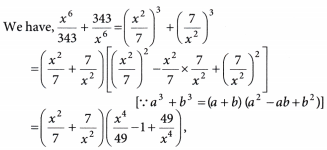
which are the required factors of the given expression.
Example 29.
Factorise a12 – b12.
Solution:
We have, a12 – b12 = (a6)2 – (b6)2
= (a6 + b6)(a6 – b6)
∵ x2 – y2 = (x + y) (x – y)] = [(a2)3 + (b2)3][(a3)2 – (b3)2]
= ((a2)3 + (b2)3](a3 – b3) (a3 + b3)
[∵ x2 – y2 = (x + y)(x-y)]
= [(a2 + b2)(a4 + b4 – a2b2)] [(a – b)(a2 + ab + b2)] [(a + b)(a2 – ab + b2)]
∵ x3 + y3 = (x + y)(x2 – xy + y2) and x3 – y3 = (x – y)(x2 + xy + y2)
= (a + b)(a – b)(a2 + b2)(a2 – ab + b2)
(a2 + ab + b2)(a4 + b4 – a2b2), which are the required factors of the given expression.
Factorisation of Algebraic Expression of the Form
x3 + y3 + z3 – 3xyz = (x + y+ z)(x2 + y2 + z2 – xy – yz – zx)
Example 30.
Factorise each of the following expressions.
(i) 27x2 – 64y2 + 216 + 108xy
Solution:
We have, 27x2 – 64y2 + 216 + 108xy
= (3x)3 + (-4y)3 + (6)3 – 3(3x) (-4y) (6)
= (3x -4y + 6) [(3x)2 + (-4y)2 + 62 – (3x) (-4y) – (-4y) (6) – (6)(3x)]
[∵ x3 + y3 + z3 – 3xyz = (x + y + z) (x2 + y2 + z2 – xy – yz – zx)]
= (3x – 4y + 6) (9x2 + 16y2 + 36 + 12xy + 24y – 18x)
(ii) 8x2 + y2 + z2 – 6xyz
Solution:
We have, 8x3 + y3 + z3 – 6xyz
= (2x)3 + y3 + z3 – 3(2x)(y)(z)
= (2x + y + z)(4x2 + y2 + z2 – 2xy – yz – 2zx)
(iii) x2 – 8y2 + 27z2 + 18xyz
Solution:
We have, x3 – 8y3 + 27z2 + 18xyz
= x3 + (-2y)3 + (3z)3 – 3(x) (-2y)(3z)
= (x – 2y + 3z) (x2 + 4y2 + 9z2 + 2xy – 6yz – 3xz)
Factorisation of Quadratic Expression through Algebra Tiles
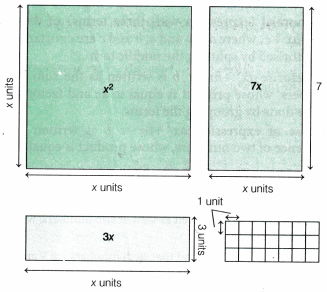
A quadratic expression of the form ax2 + bx + c can be understood and factorised using geometrical models called algebra tiles. Each tile represents a monomial term,
and together they can be arranged into a single large rectangle, whose side lengths reveal the two factors of the expression.
Step I : Consider a Quadratic Expression
Consider a quadratic expression of the form ax2 + bx + c, e.g. x2 + 10x + 21. This can be rewritten as x2 + 7x + 3x + 21
Step II: Arrange Tiles into a Rectangle
Place all tiles together to form one large rectangle. Then, x2 tile occupies the top-left, the lx strip fills the top-right, the 3x strip fills the bottom-left and the 21 unit squares (7 × 3 grid) complete bottom-right corner.
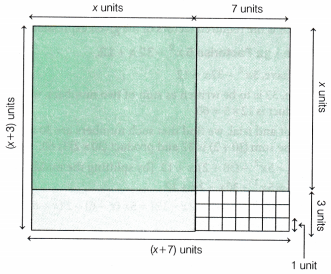
Step III: Read Off the Dimensions
The dimensions of the rectangle formed are (x + 7) units and (x + 3) units.
The total area of the rectangle is the sum of all its parts i.e. x2 + 7x + 3x + 21.
Hence, the total area of resultant rectangle
= Length x Breadth = (x + 7) (x + 3) = x2 + 10x + 21
Therefore, the quadratic polynomial x2 + 10x + 21 is factorised as (x + 7) (x + 3).
Factorisation Without Using Algebra Tiles
A trinomial (expression with three terms) of the form ax2 + bx + c, where a + 0 and a, b and c are constants, can be factorised by splitting the middle term.
To factorise ax2 + bx + c,b is written as the sum of two numbers, whose product is equal to ac and factorisation can be done by grouping the terms.
In case of expression ax2 + bx – c, b is written as the difference of two numbers, whose product is equal to ac.
Example 31.
Factorise 6x2 + 17x +12.
Solution:
We have, 6x2 + 17x + 12
Here, 17 is to be written as sum of two numbers, whose product is 12 × 6 = 72.
By hit and trial, we find that such numbers are 9 and 8, whose sum (9 + 8) is 17 and product (9 × 8) is 72.
= 6x2 + (9 + 8) x + 12 [by splitting the middle term]
= 6x2 + 9x + 8x + 12
= (6x2 + 9x) + (8x + 12)
= 3x (2x + 3) + 4 (2x + 3)
On taking (2x + 3) common from the above expression, we get
6×2 + 17x +12 = (2x + 3) (3x + 4), which is the required factors of the given expression.
Example 32.
Factorise 5x2 – 32x + 12.
Solution:
We have, 5x2 – 32x + 12
Here, 32 is to be written as sum of two numbers, whose product is 12 × 5 = 60.
By hit and trial, we find that such numbers are 30 and 2, whose sum (30 + 2) is 32 and product (30 × 2) is 60.
= 5x2 -(30 + 2) x + 12 [by splitting the middle term]
= 5x2 -30x – 2x + 12
= (5x2 – 30x) – (2x – 12)
= 5x (x – 6) – 2 (x – 6)
= (x – 6)(5x – 2),
which are the required factors of the given expression.
Example 33.
Factorise 2x2 + 5x – 12.
Solution:
We have, 2x2 + 5x – 12
Here, 5 is to be written as difference of two numbers, whose product is 12 × 2 = 24.
By hit and trial, we find that such numbers are 8 and 3, whose difference (8 – 3) is 5 and product (8 × 3) is 24.
= 2x2 + (8 – 3) x -12 [by splitting the middle term]
= 2x2 + 8x – 3x – 12
=(2x2 + 8x) – (3x + 12)
= 2x (x + 4) -3(x + 4)
= (x + 4) (2x – 3), which are the required factors of the given expression.
Example 34.
Factorise (x2 – 4x)2 – 8(x2 – 4x) – 20.
Solution:
We have, (x2 – 4x)2 – 8(x2 – 4x) – 20
On putting x2 – 4x = y, we get y2 – 8y – 20 = y2 – (10 – 2)y – 20
[by splitting the middle term] = y2 – 10y + 2y – 20
= y(y – 10) + 2(y – 10)
= (y – 10)(y + 2)
On replacing y by (x2 -4x), we get (x2 – 4x – 10)(x2 – 4x + 2), which are the required factors of given expression.
Example 35.
Factorise 12 (3x – 2y)2 – 3x + 2y – 1.
Solution:
We have, 12(3x-2y)2 – 3x + 2y – 1
= 12(3x -2y)2 – (3x – 2y) – 1
On putting 3x – 2y = z, we get 12z2 – z – 1
= 12z2 – (4 – 3)z – 1
[by splitting the middle term]
= 12z2 – 4z + 3z – 1
= 4z(3z -1) + 1(3z -1)
= (3z – 1) (4z + 1)
On replacing z by (3x -2y), we get
12(3x – 2y)2 – 3x + 2y – 1
= [3 (3x – 2y) – 1] [4 (3x – 2y) + 1]
= (9x – 6y – 1) (12x – 8y + 1), which are the required factors of the given expression.
Example 36.
Factorise 5 – (3x2 – 2x)(6 – 3x2 + 2x).
Solution:
We have, 5 – (3x2 – 2x) (6 – 3x2 + 2x)
On putting 3x2 – 2x = y, the given expression reduces into
= 5 – y (6 – y)
= 5 – 6y + y2
Now, splitting the middle term, we get
y2 – 6y + 5 = y2 – (5 + 1)y + 5
= y2 – 5y – y + 5 = y (y – 5) – 1(y – 5)
= (y – 5) (y – 1)
On replacing y by 3x2 – 2x, we get
5 – (3x2 – 2x)(6 – 3x2 + 2x) = (3x2 – 2x – 5)(3x2 – 2x – 1)
Now, again splitting the middle term, we get 3x2 -2x – 5 = 3x2 – (5 – 3)x – 5 and 3x2 – 2x – 1 = 3x2 – (3 – 1)x – 1
= (3x2 – 5x + 3x – 5) (3x2 – 3x + x – 1)
Rational Expressions
A rational expression is the algebraic form of a fraction in which both the numerator and the denominator are polynomials. It can be written as \(\frac{P(x)}{Q(x)}\), where P(x) and Q(x) are polynomials and Q(x) ≠ 0.
Thus, a rational expression behaves like a fraction, but instead of numbers, it contains algebraic expressions.
e.g. Rational expressions:
\(\frac{5}{(x-3)}, \frac{\left(x^2-4\right)}{(x+2)} .\)
Non-rational expressions:
\(\frac{1}{\sqrt{x}}\)
[since, √x is not a polynomial]
and \(\frac{\left(x^2-4\right)}{x^x}\)
[since, exponents with variables are not polynomials]
Simplifying Rational Expressions
A rational expression is said to be simplified, when the numerator and denominator have no common factors except 1.
Steps for Simplification
I. Factorise the numerator and denominator completely.
II. Identify common factors.
III. Cancel the common factors.
IV. Write the simplified expression.
Example 37.
Simplify \(\frac{x^2-9}{x^2-x-6}\)
Solution:
Factorise numerator and denominator
x2 – 9 = (x + 3) (x – 3) and x2 – x – 6 = (x – 3) (x + 2)
Now, cancel the common factor (x – 3)
= \(\frac{(x+3)(x-3)}{(x-3)(x+2)}=\frac{x+3}{x+2}\)
Example 38.
Simplify, \(\frac{\left(a^2-b^2\right)^3+\left(b^2-c^2\right)^3+\left(c^2-a^2\right)^3}{(a-b)^3+(b-c)^3+(c-a)^3}\)
Solution:
For the Numerator
Let x = a2 – b2, y = b2 – c2 and z = c2 – a2.
x + y + z = (a2 – b2) + (b2 – c2) + (c2 – a2) = 0
Since, x + y + z = 0 then x3 + y3 + z3 = 3 xyz
∴ Numerator = 3(a2 – b2) (b2 – c2) (c2 – a2)
For the Denominator
Let p = a – b, q = b – c and r = c -a
p + q + r = (a – b) + (b – c) + (c – a) = 0
Since, p + q + r = 0 then p3 + q3 + r3 = 3pqr
∴ Denominator = 3(a -b) (b – c) (c – a)
Simplify the Expression
Given expression = \(\frac{\left(a^2-b^2\right)^3+\left(b^2-c^2\right)^3+\left(c^2-a^2\right)^3}{(a-b)^3+(b-c)^3+(c-a)^3}\)
= \(=\frac{3\left(a^2-b^2\right)\left(b^2-c^2\right)\left(c^2-a^2\right)}{3(a-b)(b-c)(c-a)}\)
Factorise the terms in the numerator using x2 – y2 =(x – y) (x + y), we get
3(a -b) (a + b) (b – c) (b + c) (c – a) (c + a)
= \(\frac{3(a-b)(a+b)(b-c)(b+c)(c-a)(c+a)}{3(a-b)(b-c)(c-a)}\)
= (a + b)(b + c)(c + a)