These Class 6 Social Science Worksheet and Class 6 SST Chapter 11 Grassroots Democracy Part 2 Local Government in Rural Areas Worksheet with Answers are excellent for board exam practice.
Class 6 SST Chapter 11 Grassroots Democracy Part 2 Local Government in Rural Areas Worksheet
Class 6 Grassroots Democracy Part 2 Local Government in Rural Areas Worksheet
Worksheet On Grassroots Democracy Part 2 Local Government in Rural Areas Class 6 – Grassroots Democracy Part 2 Local Government in Rural Areas Worksheet Class 6
Multiple choice questions (MCQs)
Question 1.
Which system is responsible for local governance in rural India?
(a) Municipal Corporation
(b) Panchayati Raj
(c) State Government
(d) Central Government
Question 2.
What is the lowest level in the Panchayati Raj system?
(a) Panchayat Samiti
(b) Gram Panchayat
(c) Zila Parishad
(d) Gram Sabha
Question 3.
What is the primary function of the Zila Parishad?
(a) Making laws
(b) Coordinating development at the district level
(c) Conducting elections
(d) Judging disputes

Question 4.
Which of the following groups participates in the Gram Sabha?
(a) Only men
(b) Only women
(c) All adults in the village
(d) Only elected representatives
Question 5.
The role of the Panchayat Samiti is to:
(a) Execute national policies
(b) Implement rural development programs at the block level
(c) Manage local police forces
(d) Oversee international relations
Question 6.
What percentage of Panchayat seats are reserved for women?
(a) 10%
(b) 25%
(c) 33%
(d) 50%
Question 7.
What was the focus of the Bal Panchayats in Maharashtra?
(a) Eliminating child labour and child marriage
(b) Building roads
(c) Policing the village
(d) Running schools
Question 8.
Which institution is responsible for implementing government schemes in rural areas?
(a) Gram Panchayat
(b) Zila Parishad
(c) Panchayat Samiti
(d) Gram Sabha
Fill in the blanks
1. The head of the Gram Panchayat is known as the _______
2. Panchayats allow villagers to participate in _______
3. The is _______ responsible for keeping land records in a village.
4. Bal Panchayats are set up to include the voices of _______ in governance.
5. Zila Parishad is the governing body at the _______ level.
6. Gram Sabha is composed of all adults _______ of the village.
7. Panchayat Samiti coordinates development projects at the _______ level.
8. The Panchayati Raj system reserves _______ of seats for women.
9. Hiware Bazar became a model village by applying _______ conservation.
10. Panchayati Raj promotes _______ governance at the local level.
Match the table
Read the given statements with their explanation and identify which one of them is correctly paired.
1. Panchayat Samiti: a link between the Gram Panchayat and Zila Parishad.
2. Pradhan Mantri Gram Sadak Yojna: An initiative to provide the villagers with a minimum of 100 days of employment.
3. Bunker Roy: Barefoot college man, you empowered village children between the ages of 8 and 14 with the Bal Panchayat initiative.
4. Dhyaneshwar Ramble: A transgender sarpanch from Maharashtra who won the
election after defeating six contenders and started his service with the motto, “Lok Seva: Gram Seva.” .
Options
(a) Only option II is correct
(b) Options I, II and III are correct
(c) Only I and IV are correct
(d) Options I, III and IV are correct
Who is referred to here?
1. He is head of the Gram Panchayat. _______
2. He maintains all the records of landholdings and ownership. _______
3. The council of children in the village. _______
4. It governs the district-level administration. _______
5. It coordinates block-level development. _______
Assertion Reason-based Questions
Choose the correct option after analysing both the statements of assertion and reason.
(a) Both assertion and reason are correct, and reason is the correct explanation for the assertion.
(b) Both assertion and reason are correct, but reason is not the correct explanation for the assertion.
(c) The assertion is correct, but the reason is incorrect.
(d) The assertion is incorrect, but the reason is correct.
Assertion: The Panchayati Raj system promotes self-governance in rural areas.
Reason: It allows villagers to elect representatives and address local issues.
Very Short Answer Questions
Question 1.
What is the function of the Panchayati Raj system?
____________________________________
____________________________________
Question 2.
What is the role of the Gram Sabha?
____________________________________
____________________________________
Question 3.
How does the Patwari assist in village governance?
____________________________________
____________________________________
Question 4.
What is the role of the Panchayat Samiti?
____________________________________
____________________________________
Short Answer Questions
Question 1.
Explain the structure of the three-tier Panchayati Raj system.
____________________________________
____________________________________
Question 2.
What are the key responsibilities of the Zila Parishad?
____________________________________
____________________________________
Question 3.
Describe the Bal Panchayat and its impact on reducing child labour.
____________________________________
____________________________________
Long Answer Questions
Question 1.
Describe the functions and responsibilities of the three levels in the Panchayati Raj system.
____________________________________
____________________________________
Question 2.
How have Bal Panchayats and Child-Friendly Panchayats helped in social development?
____________________________________
____________________________________
Question 3.
How has Popatrao Baguji Pawar transformed Hiware Bazar into a model village?
____________________________________
____________________________________
Application-Based Questions
How would a Panchayat respond to a village dispute over water usage during a drought? Which levels of Panchayati Raj would be involved?
____________________________________
____________________________________
Logical Thinking-Based Question
Without Panchayats, how would rural villages address local governance and development issues? What issues would local people face if they had to rush to the district headquarters for every small thing?
____________________________________
____________________________________
Map/diagram-based Questions
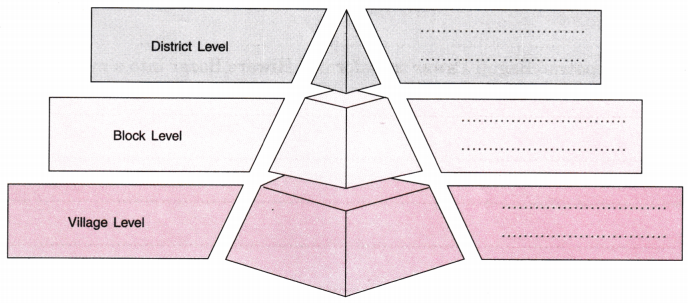
Fill in the blanks to complete the diagram.
Case Study Based Questions
“The Gram Panchayat is closest to the people in rural areas. Its members are elected | I directly by the Gram Sabha, which is a group of adults from a village (or group of neighbouring villages) who are enrolled as voters. In the Gram Sabha, women and men discuss all matters related to their area and make decisions. Each Gram Panchayat elects a head called the ‘Sarpanch’ or ‘Pradhan’. In recent years, more and more women have become Sarpanchs. The Gram Panchayat is assisted by a Panchayat Secretary who performs administrative functions such as calling meetings and maintaining records. A Patwari officer assists most Gram Panchayats in many parts of India and maintains the villagers’ land records. In some cases, the Patwari keeps maps that are generations old!”
. (Source: Exploring Society India and Beyond, NCERT)
Read the following excerpt and answer the following questions:
Question 1.
How is the Panchayat helpful to people by being closest? What would have been the impact on the day-to-day life of the people if the Panchayat had not been in their village?
____________________________________
____________________________________
Question 2.
Who can vote for the Panchayat?
____________________________________
____________________________________
Question 3.
Who is Sarpanch and Panchayat Secretary? What is their relation, and how do they complement each other?
____________________________________
____________________________________
Question 4.
Who is Patwari, and what is his role in the village?
____________________________________
____________________________________
Question 5.
What is the situation of women in village-level politics? Can they vote and contest for the Sarpanch post?
____________________________________
____________________________________
Picture based question
Look at the given picture and answer the following questions:

Question 1.
Can you guess what is happening in this illustration?
____________________________________
____________________________________
Question 2.
A woman is sitting on the platform around the tree. Can women be one of the ‘Panch’ or Sarpanch’?
____________________________________
____________________________________
Question 3.
We can see a child with his mother among people, listening to the “Panch.” Can children be members of the Gram Panchayat?
____________________________________
____________________________________
Question 4.
Why is a Panchayat meeting often held under a tree? Is there any rule related to it?
____________________________________
____________________________________
Question 5.
Why do we have more than one member in the ‘Panchayat?’ What role does ’Panch’ and ‘Sarpanch’ play in a Gram Panchayat?
____________________________________
____________________________________
Activity
Question 1.
Write three slogans that can be used to create awareness regarding cleanliness, sanitation and hygiene.
____________________________________
____________________________________
Question 2.
Write a letter to the Panchayat Secretary to call a meeting of all ward members to discuss the problem of open defecation. Although the government has assisted in constructing toilets in every home, many villagers still do not use toilets, and this should be stopped.
____________________________________
____________________________________