Students can refer to the NCERT Class 9 Advanced Maths Solutions and Chapter 3 Relations and Functions Extra Questions and Answers whenever they need help with difficult questions.
Class 9 Relations and Functions Extra Questions
Relations and Functions Class 9 Short Question Answer
Question 1.
If (x + y, x – y) = (11, 3), find the value of x2 + y2.
Solution:
Since the ordered pairs are equal, equating their first and second components, we get
x + y = 11, x – y = 3
Adding the equations,
2x = 14 ⇒ x = 7
y = 11 – 7 = 4
x2 + y2 = 72 + 42
= 49 + 16 = 65
Question 2.
If A = {1, 3, 5}, B = {2, 3}, find:
(a) A × B
(b) B × A
Solution:
Given, A = {1, 3, 5} and B = {2, 3}
(a) A × B = {1, 3, 5} × {2, 3}
= {(1, 2), (1, 3), (3, 2), (3, 3), (5, 2), (5,3)}
(b) B × A = {2, 3} × {1, 3, 5}
= {(2, 1), (2, 3), (2, 5), (3, 1), (3, 3), (3, 5)}
Question 3.
Let A = {1, 2, 3, 4} and relation R = {(x, y) : y = 2x} from A to A. Write the relation in roster form.
Concept Applied: A relation in roster form is obtained by listing all ordered pairs (x, y) that satisfy the given condition within the set.
Solution:
Given: A = {1, 2, 3, 4} and R = {(x, y): y = 2x}
We check each element of A:
If x = 1, then y = 2(1) = 2 ∈ A i.e., (1, 2)
If x = 2, then y = 2(2) = 4 ∈ A i.e., (2, 4)
If x = 3, then y = 6 ∉ A
If x = 4, then y = 8 ∉ A
Hence, the relation in roster form is: R – {(1, 2), (2, 4)}
Question 4.
Find the domain of the relation, R = {(x, y) : x, y ∈ Z, xy = 4}
Solution:
Given, R = {(x, y): x, y ∈ Z, xy = 4}
R = {(-4, -1), (-2, -2), (-1, -4), (1, 4), (2, 2), (4, 1)}
∴ Domain of R = {-4, -2, -1, 1, 2, 4}

Question 5.
Find the range of the following relations:
R = {(x, \(\frac{1}{x}\)) : x ∈ Z, 0 < x < 6}
Solution:
Given, R = {(x, \(\frac{1}{x}\)) : x ∈ Z, 0 < x < 6}
Thus, R = {(1, \(\frac{1}{1}\)), (2, \(\frac{1}{2}\)), (3, \(\frac{1}{3}\)), (4, \(\frac{1}{4}\)),(5, \(\frac{1}{5}\))}
∴ Range of R = {1, \(\frac{1}{2}\), \(\frac{1}{3}\), \(\frac{1}{4}\), \(\frac{1}{5}\)}
Question 6.
If A = {2, 4, 6, 9}, B = (4, 6, 18, 27, 54} and a relation R from A to B is defined by R = {(a, b): a ∈ A, b ∈ B, a is a factor of b and a < b}, then express it in Roster form. Also, find its domain, codomain and range.
Solution:
Given, A = (2, 4, 6, 9} and B = {4, 6, 18, 27, 54} and R = {(a, b) : a ∈ A, b ∈ B, a is a factor of b and a < b}.
Roster form:
R = {(2, 4), (2, 6), (2, 18), (2, 54), (6, 18), (6, 54), (9, 18), (9, 27), (9, 54)}
Domain of R = {2, 6, 9}
Codomain of R = {4, 6, 18, 27, 54}
Range of R = {4, 6, 18, 27, 54}
Question 7.
Let A = {2, 5}, B = {1, 3, 5} and C = {5, 7}.
Write the set A × (B ∩ C) and verify that A × (B ∩ C) = (A × B) ∩ (A × C).
Solution:
B ∩ C = {1, 3, 5} ∩ {5, 7}
B ∩ C = {5}
A × (B ∩ C) = {2, 5} × {5}
A × (B ∩ C) = {(2, 5), (5, 5)}
Now, A × B = {(2, 1), (2, 3), (2, 5), (5, 1), (5, 3), (5, 5)}
and A × C = {(2, 5), (2, 7), (5, 5), (5, 7)}
Therefore,
(A × B) ∩ (A × C) = {(2, 1), (2, 3), (2, 5), (5, 1), (5, 3), (5, 5)} ∩ {(2, 5), (2, 7), (5, 5), (5,7)} = {(2, 5), (5, 5)}
Hence, A × (B ∩ C) = (A × B) ∩ (A × C)
Question 8.
Find the domain and range of the relation given below:
R = {(1, 3), (2, 5), (3, 7), (4, 9), (5, 11)}
Also identify the rule that defines this relation.
Solution:
Domain:
The domain is the set of all first components of the ordered pairs.
Domain = {1, 2, 3, 4, 5}
Range:
The range is the set of all second components of the ordered pairs.
Range = {3, 5, 7, 9, 11}
Rule of the Relation
Observe that:
3 = 2(1) + 1,
5 = 2(2) + 1,
7 = 2(3) + 1,
Hence, the relation is defined by the rule
y = 2x + 1
Question 9.
Let A = {1, 2, 3,…, 14}. Define a relation R from A to A by R = {(x, y) ; 3x – y = 0, where x, y ∈ A}. Draw arrow diagram. Write down its domain, codomain and range.
Concept Applied: A relation from A to A includes all ordered pairs (x, y) that satisfy the given condition, with domain as first elements, codomain as the given set and range as corresponding second elements.
Solution:
Given, R = {(x, y) : 3x – y = 0, where x, y ∈ A}
R = {(1, 3), (2, 6), (3, 9),(4, 12)}
The corresponding arrow diagram is:

Domain = {1, 2, 3, 4,}
Codomain = {1, 2, 3, 4, …, 14}
and Range = {3, 6, 9, 12}
Question 10.
Is the given relation a function? Give reasons for your answer.
(a) f = {(x, x) : x is a real number}
(b) g = {n, \(\frac{1}{n}\)) : n is a positive integer}
(c) s = {n, n2) : n is a positive integer}
(d) t = {(x, 3) : x is a real number}
Solution:
(a) Given, f = {(x, x) | x is a real number}
The given relation/is a function because every element in the domain has a unique image.
(b) Given, 
The given relation is a function because every element in the domain has a unique image.
(c) Given, S = {(n, n2) | n is a positive integer}
The given relation is a function because the square of any positive integer is unique i.e., every element in the domain has a unique image.
(d) Given, t = {(x, 3) | x is a real number}
The given relation is a function (constant function) because every element in the domain has the image 3.
Question 11.
Determine which of the following rules describe a function. Give a reason for each answer.
| Domain | Rule | Range |
| (a) The set of students in a class | Roll number of each student | The set of roll numbers |
| (b) The set of months of a year | Number of days in each month | The set of natural numbers |
| (c) The set of integers | Reciprocal of a number | The set of rational numbers |
| (d) The set of real numbers | Square root of a number | The set of real numbers |
Solution:
| Function/Not a Function | Reason |
| (a) Function | Each student has exactly one roll number. |
| (b) Function | Each month has a fixed number of days. |
| (c) Not a Function | Reciprocal of 0 is not defined. |
| (d) Not a Function | Negative real numbers do not have real square roots. |
Question 12.
Let f and g be real functions defined by f(x) = 2x + 1 and g(x) = 4x – 7.
(a) For what real numbers x, f(x) = g(x)?
(b) For what real numbers x, f(x) < g(x)?
Concept Applied: To compare functions, equate them for equality and form inequalities to compare their values, then solve for x.
Solution:
Given, f(x) = 2x + 1 and g(x) = 4x – 7
(a)
∵ f(x) = g(x)
∴ 2x + 1 = 4x – 7
2x = 8
x = 4
(b)
∵ f(x) < g(x)
∴ 2x + 1 < 4x – 7
1 + 7 < 4x – 2x
8 < 2x
4 < x Thus, x > 4
Question 13.
Express the following function as a set of ordered pairs and determine its range.
f : x → R, f(x) = x3 + 1, where x = {-1, 0, 3, 9, 7}
Solution:
Given, f : x -+ R,f(x) = x3 + 1, where x = {-1, 0, 3, 9, 7}
when x = -1, then f(-1) = (-1)3 + 1 = -1 + 1 = 0
when x = 0, then f(0) = (0)3 + 1 = 0 + 1 = 1
when x = 3, then f(3) = (3)3 + 1 = 27 + 1= 28
when x = 9, then f(9) = (9)3 + 1 = 729 + 1 = 730
when x = 7, then f(7) = (7)3 + 1 = 343 + 1 = 344
∴ f = {(-1, 0), (0, 1), (3, 28), (9, 730), (7, 344)}
Hence, range of f = {0, 1, 28, 730, 344}.
Question 14.
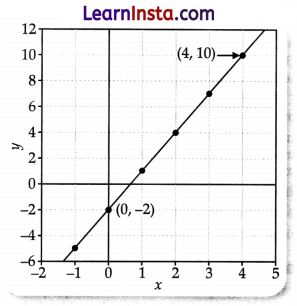
Draw the graph of y = 3x – 2.
Solution:
Here are some coordinate points generated by substituting x values into the equation y = 3x – 2:
| x | 3x – 2 | y | Coordinate (x, y) |
| -1 | 3(-1) – 2 | -5 | (-1, -5) |
| 0 | 3(0) – 2 | -2 | (0, -2) |
| 1 | 3(1) – 2 | 1 | (1, 1) |
| 2 | 3(2) – 2 | 4 | (2, 4) |
| 3 | 3(3) – 2 | 7 | (3, 7) |
| 4 | 3(4) – 2 | 10 | (4, 10) |
Question 15.
If f(x) = \(\frac{x – 1}{x + 1}\)
(i) f(\(\frac{1}{x}\)) = -f(x)
(ii) f(-\(\frac{1}{x}\)) = \(-\frac{1}{f(x)}\)
Solution:


Question 16.
The graph of y = 2|x| – 1 is drawn.
(i) Plot the graph for -4 ≤ x ≤ 4.
(ii) Find the value(s) of x when y = 3.
Concept Applied: Use the modulus definition |x|
=  to graph the function piecewise and solve equations involving |x|.
Solution:
(i) To plot y = 2|x|- 1 for -4 ≤ x ≤ 4, we calculate key coordinate points:
| x | 2|x| – 1 | y | Coordinate (x, y) |
| -4 | 2|-4| – 1 = 8 – 1 | 7 | (-4, 7) |
| -2 | 2|-2| -1 = 4 – 1 | 3 | (-2, 3) |
| 0 | 2|0| -1 = 0 – 1 | -1 | (0, -1) |
| 2 | 2|2| – 1 = 4 – 1 | 3 | (2, 3) |
| 4 | 2|4| – 1 = 8 – 1 | 7 | (4, 7) |
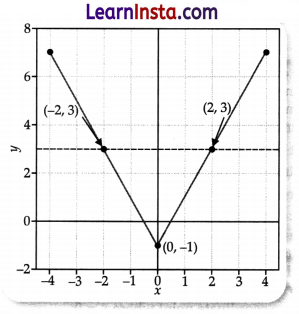
(ii) Substitute y = 3 into the equation and solve for x:
Equation: 3 = 2|x| – 1
Isolate absolute value:
Add 1 to both sides: 4 = 2|x|
Divide by 2: |x| = 2
Remove absolute value bars (accounts for positive and negative paths).
x = 2 or x = – 2
Question 17.
Draw the graph of y = √x + 1 for 0 ≤ x ≤ 9. State the range of the function. m
Solution:
To plot y = √x + 1 for 0 ≤ x ≤ 9, we evaluate the function at several perfect square points for accuracy:
| x | √x + 1 | y | Coordinate (x, y) |
| 0 | √0 + 1 | 1 | (0, 1) |
| 1 | √1 + 1 | 2 | (1, 2) |
| 4 | √4 + 1 | 3 | (4, 3) |
| 9 | √9 + 1 | 4 | (9, 4) |

Range of the Function
The range is the set of all possible output values (y – values) resulting from the domain.
- Minimum Value: When x = 0 (the smallest input), the output is y = √o + 1 = 1.
- Maximum Value: When x = 9 (the largest input), the output is y = √9 + 1 = 4.
Range: 1 ≤ y ≤ 4
Question 18.
The graph of y = 2x passes through the origin. Verify this using the graph. Find the domain and range if the graph is restricted to a specific interval -3 ≤ x ≤ 5.
Solution:
To verify if the graph passes through the origin, we check the coordinate point where x = 0:
| x | 2x | y | Coordinate (x, y) |
| -1 | 2(-1) | -2 | (-1, -2) |
| 0 | 2(0) | 0 | (0, 0) [Origin] |
| 1 | 2(1) | 2 | (1, 2) |
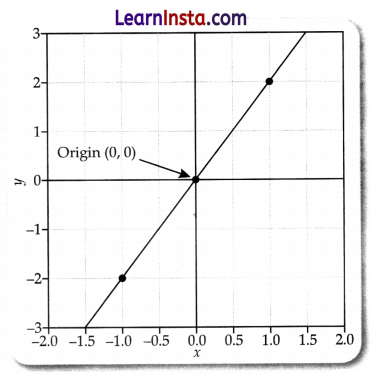
When the graph is restricted to the specific interval -3 ≤ x ≤ 5:
- The interval of allowed x-values is explicitly provided in the restriction.
Domain: -3 ≤ x ≤ 5 or [-3, 5] - Range is found by substituting the minimum and maximum domain boundaries into the function equation y = 2x:
Minimum output value: When x = -3, y = 2(-3) = -6 - Maximum output value: When x = 5, y = 2(5) = 10
Range: – 6 ≤ y ≤ 10 or [-6, 10]
Question 19.
Is g = {(1, 1), (2, 3), (3, 5), (4, 7)} a function? Justify. If this is described by the relation, g(x) = αx + β, then what values should be assigned to α and β?
Solution:
Given, g = {(1, 1), (2, 3), (3, 5), (4, 7)}
Since every element of domain has unique image under g, g is a function.
Also given, g(x) = αx + β
When x = 1, then g(1) = α(1) + β
⇒ 1 = α + β …….. (i)
When x = 2, then g(2) = α(2) + β
⇒ 3 = 2a + β ……. (ii)
On solving eqs. (i) and (ii), we get
α = 2 and β = -1
Question 20.
Find the domain of each of the following functions given by:
(i) f(x) = \(\frac{x^3-x+3}{x^2-1}\)
(ii) f(x) = \(\frac{1}{\sqrt{x+|x|}}\)
Solution:
(i) Given, f(x) = \(\frac{x^3-x+3}{x^2-1}\)
Since, f(x) is defined when
x2 – 1 ≠ 0
⇒ (x + 1)(x – 1) ≠ 0
⇒ x ≠ -1, 1
∴ Domain of f = R – {-1, 1}
(ii) Given, f(x) = \(\frac{1}{\sqrt{x+|x|}}\)
∵ x + |x| = x – x = 0, x < 0 and x + |x| = x + x = 2x, x ≥ 0 Hence, f(x) is defined, if x > 0
Domain of f = R+
Question 21.
If f(x) = y = \(\frac{a x-b}{c x-a}\), then prove that f(y) = x.
Solution:

Question 22.
A = {1, 2, 3, 4, 5}, S = {(x, y): x ∈ A, y ∈ A}, then find the ordered pairs that satisfy the conditions given below.
(i) x + y = 5
(ii) x + y < 5
(iii) x + y > 8
Concept Applied: Form ordered pairs from A × A and select those that satisfy the given conditions on x and y.
Solution:
Given, A – (1, 2, 3, 4, 5} and S = {(x, y): x ∈ A, y ∈ A}
(i) The set of ordered pairs satisfying x + y = 5 is {(1, 4), (2, 3), (3, 2), (4, 1)}.
(ii) The set of ordered pairs satisfying x + y < 5 is {(1, 1), (1, 2), (1, 3), (2, 1), (2, 2), (3, 1)}. (iii) The set of ordered pairs satisfying x + y > 8 is {(4, 5), (5, 4), (5, 5)}.
Question 23.
Let A = {9, 10, 11, 12, 13} and let f : A → N be defined by f(n) = the highest prime factor of n. Find the range of f.
Solution:
Given, A = (9, 10, 11, 12, 13} and f : A → N and f(n) = the highest prime factor of ‘n’.
For n = 9, 9 = 3 × 3
⇒ Highest prime factor of 9 = 3
For n = 10, 10 = 2 × 5
⇒ Highest prime factor of 10 = 5
For n = 11, 11 = 11
⇒ Highest prime factor of 11 = 11
For n = 12, 12 = 2 × 2 × 3
⇒ Highest prime factor of 12 = 3
For n = 13, 13 = 13
⇒ Highest prime factor of 13 = 13
∴ f(n) = {(9, 3), (10, 5), (11, 11), (12, 3), (13, 13)}
⇒ Range = {3, 5, 11, 13).
Relations and Functions Class 9 Long Question Answer
Question 1.
What is the domain and range of the relation given below:
R = {(0, 0), (1, 1), (1, -1), (8, 2), (8, -2)}
Represent R on the graph. Also identify the rule that defines this relation.
Solution:
Domain: The set of all x-coordinates.
Domain = {0, 1, 8}
Range: The set of all y-coordinates.
Range = {-2, -1, 0, 1, 2}
Rule:
Cubing each second element (y) yields its corresponding first element (x):
- 03 = 0
- 13 = 1 and (-1)3 = -1
- 23 = 8 and (-2)3 = – 8
Notice that for the negative coordinates given in this specific set, the absolute values match the cubing rule (|y|3 = x). More cleanly, the rule connecting these points can be defined as: x = |y|3 for x ≥ 0

Question 2.
Let A = {1, 2, 3, 5} and B = {1, 2, 7, 9, 26, 30}. A relation R from A to B is defined by:
R = {(a, b) : a2 + 1 = b; a ∈ A, b ∈ B}
(a) Write the relation R in roster form.
(b) Find the domain, range and codomain of R.
(c) Represent this relation using an arrow diagram (mapping diagram).
Solution:
(a) Test each element a ∈ A using the rule = a2 + 1:
- For a = 1 ⇒ 12 + 1 = 2 (Since 2 ∈ B ⇒ (1, 2) ∈ R)
- For a = 2 ⇒ 22 + 1 = 5 (Since 5 ∉ B, no pair is formed)
- For a = 3 ⇒ 32 + 1 = 10 (Since 10 ∉ B, no pair is formed)
- For a = 5 ⇒ 52 + 1 = 26 (Since 26 ∈ B ⇒ (5, 26) ∈ R)
Roster Form: R = {(1, 2), (5, 26)}
(b)
- Domain: {1, 5}
- Range: {2, 26}
- Codomain: {1, 2, 7, 9, 26, 30}
(c) 
Question 3.
Let A = {1, 2, 3}, B = {3, 4} and C = {4, 5, 6}.
Find (i) A × (B ∩ C)
(ii) (A × B) ∩ (A × C)
Solution:
A = {1, 2, 3}, B = {3, 4}, C = {4, 5, 6}, B ∩ C = {4}
(i) A × (B ∩ C) = {1, 2, 3} × {4}
= {(1, 4), (2, 4), (3, 4)}
(ii) (A × B) ∩ (A × C)
= ({1, 2, 3} × {3, 4}) ∩ ({1, 2, 3} × {4, 5, 6})
= {(1, 3), (1, 4), (2, 3), (2, 4), (3, 3), (3, 4)} ∩ {(1, 4), (1, 5), (1, 6), (2, 4), (2, 5), (2, 6), (3, 4), (3, 5), (3, 6)}
= {(1, 4), (2, 4), (3, 4)}
Question 4.
Draw the graphs of the functions p, q and r on the same coordinate axes. Complete the tables below and use them to draw the graphs.
p(x) = x2 + 2
| x | -2 | -1 | 0 | 1 | 2 |
| y = x2 + 2 |
q(x) = x2
| x | -2 | -1 | 0 | 1 | 2 |
| y = x2 |
y = x2 – 2
| x | -2 | -1 | 0 | 1 | 2 |
| y = x2 – 2 |
After drawing the graphs, describe how the graph changes when a constant is added to or subtracted from a function.
Solution:
| x | p(x) = x2 + 2 | q(x) = x2 | r(x) = x2 – 2 |
| -2 | 6 | 4 | 2 |
| -1 | 3 | 1 | -1 |
| 0 | 2 | 0 | -2 |
| 1 | 3 | 1 | -1 |
| 2 | 6 | 4 | 2 |

Graph Transformation Analysis
Adding or subtracting a constant to a function causes a vertical translation (shift):
- Adding a constant (+c) : Shifts the entire graph upward by c units.
- Subtracting a constant (-c) : Shifts the entire graph downward by c units.
The shape, width and orientation of the parabola remain completely unchanged.
Question 5.
Draw the graphs of the functions f, g and h on the same coordinate axes. Complete the tables and use them to draw the graphs.
f(x) = [x]
| x | -2.5 | -1.5 | -0.5 | 0.5 | 1.5 | 2.5 |
| Y = [x] |
g(x) = [x] + 2
| x | -2.5 | -1.5 | -0.5 | 0.5 | 1.5 | 2.5 |
| Y = [x] + 2 |
h(x) = [x] – 1
| x | -2.5 | -1.5 | -0.5 | 0.5 | 1.5 | 2.5 |
| Y = [x] – 1 |
Draw all three graphs on the same axes.
Here, [x] represents the greatest integer less than or equal to x.
Solution:
The function [x] outputs the greatest integer less than or equal to x.
| x | f(x) = [x] | g(x) = [x] + 2 | h(x) = [x] – 1 |
| -2.5 | -3 | -1 | -4 |
| -1.5 | -2 | 0 | -3 |
| -0.5 | -1 | 1 | -2 |
| 0.5 | 0 | 2 | -1 |
| 1.5 | 1 | 3 | 0 |
| 2.5 | 2 | 4 | 1 |

Question 6.
The functions f and g are defined by f(x) = x3 + 2 and , g(x) = \(\frac{1}{x+3}\)
(a) Complete suitable tables of values and draw the graphs of/ and g on separate coordinate axes.
(b) From the graphs, state:
(i) the domain and range of f(x) = x3 + 2,
(ii) the domain and range of f(x) = \(\frac{1}{x+3}\)
Concept Applied: Determine domain and range from graphs by observing all possible x-values (domain) and corresponding y-values (range), noting restrictions such as discontinuities.
Solution:
(a) Tables of Values
Function f(x) = x3 + 2
| x | -2 | -1 | 0 | 1 | 2 |
| f(x) | -6 | 1 | 2 | 3 | 10 |
Function g(x) = \(\frac{1}{x+3}\)
| x | -5 | -4 | -3.5 | -3 | -2.5 | -2 | -1 | 0 |
| g(x) | -0.5 | -1.0 | -2.0 | Undefind | 2.0 | 1.0 | 0.5 | 0.33 |
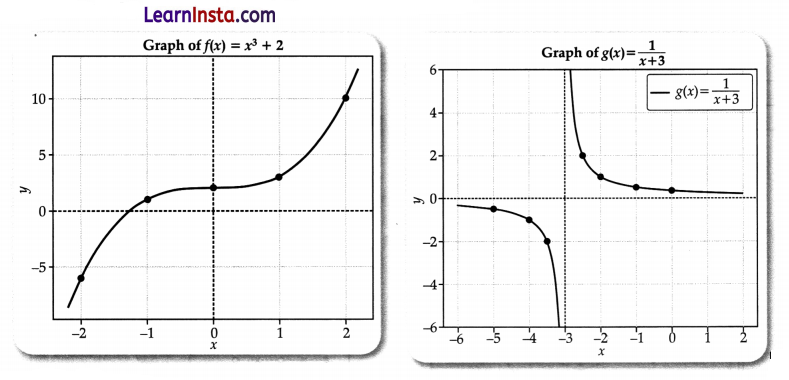
Domain and Range
(b) (i) For f(x) = x3 + 2
Domain: All real numbers (x ∈ R or (-∞, ∞)). The graph extends left and right indefinitely without gaps.
Range: All real numbers (y ∈ R or (-∞, ∞)). The graph extends upwards and downwards infinitely.
(ii) For g(x) = \(\frac{1}{x+3}\)
Domain: All real numbers except x = -3({x ∈ R | x ≠ -3}). At x = -3, where the function is undefined.
Range: All real numbers except y = 0({y ∈ R | y ≠ 0}).
Question 7.
(a) Complete the table of values for Curve A : y = \(\frac{12}{x}\) and Curve B : y = \(\frac{6}{x}\).
| x | 1 | 2 | 3 | 4 | 6 |
| Curve A : y = \(\frac{12}{x}\) | 12 | 6 | – | 3 | 2 |
| Curve B : y = \(\frac{6}{x}\) | 6 | – | 2 | 1.5 | – |
(b) On the same grid, draw the graphs of both functions for the interval 1 ≤ x ≤ 6.
(c) Describe the mathematical relationship between the two plotted curves.
(d) State the range of both functions for the given domain interval 1 ≤ x ≤ 6.
Concept Applied: Functions of the form y = \(\frac{k}{x}\) are inverse
variations; their values, graphs and ranges depend on the constant k and the given domain.
Solution:
(a) To find the missing values, substitute the given x-values into the respective equations:
- For Curve A at x = 3 : y = \(\frac{12}{3}\) = 4
- For Curve B at x = 2 : y = \(\frac{6}{2}\) = 3
- For Curve B at x = 6 : y = \(\frac{6}{6}\) = 1
| x | 1 | 2 | 3 | 4 | 6 |
| Curve A : y = \(\frac{12}{x}\) | 12 | 6 | 4 | 3 | 2 |
| Curve B : y = \(\frac{6}{x}\) | 6 | 3 | 2 | 1.5 | 1 |
(b) Curve Comparison (1 ≤ x ≤ 6)

(c) Relationship Between the Curves
- The output values of Curve A are directly proportional to Curve B, maintaining a constant ratio of 2 : 1 for all identical inputs.
- Since \(\frac{12}{x}\) = 2.(\(\frac{6}{x}\)), Curve A represents exactly double the vertical displacement from the x-axis compared to Curve B.
(d) The range spans from the minimum y-value (at x = 6) to the maximum y-value (at x = 1):
- Range of Curve A: [2, 12] (or 2 ≤ y ≤ 12)
- Range of Curve B: [1, 6] (or 1 ≤ y ≤ 6)
Relations and Functions Class 9 Case Based Questions
7. Read the following texts and answer the following questions on the basis of the same:
A school canteen introduces an online food delivery system during the annual fest. Each volunteer is assigned to deliver food packets to exactly one stall.
The set of volunteers is V = {Aarav, Bhavya, Chetan, Diya}
The set of stalls is S = {S1, S2 S3}
The assignment relation R is given by R = {(Aarav, S1), (Bhavya, S2), (Chetan, S1), (Diya, S3)}

Here, each ordered pair shows the stall assigned to a volunteer.
The event coordinator notices that:
• Every volunteer has exactly one assigned stall.
• More than one volunteer may work at the same stall.
• No volunteer can work at two different stalls simultaneously.
Using this information, answer the following questions.
Question 1.
Which of the following correctly represents the image of Chetan under relation R?
(a) S2
(b) S3
(c) S1
(d) No image exists
Answer:
Option (c) is correct.
Explanation: From the ordered pair (Chetan, S1), the image of Chetan is S1.
Question 2.
Why is relation R considered a function?
(a) Every stall has exactly one volunteer
(b) Every volunteer is assigned exactly one stall
(c) One stall has multiple volunteers
(d) The number of volunteers and stalls are equal
Answer:
Option (b) is correct.
Explanation: A relation is called a function when each element of the first set has exactly one image in the second set.
Here, every volunteer is assigned exactly one stall.
Question 3.
Which of the following statements is true?
(a) Two volunteers cannot have the same image
(b) A function must have equal number of elements in both sets
(c) Different volunteers may have the same image
(d) Every relation must contain only distinct images
Answer:
Option (c) is correct.
Explanation: Both Aarav and Chetan are assigned to S,. Hence, different elements of the domain can have the same image.
Question 4.
Which ordered pair can be added to relation R so that it still remains a function?
(a) (Divya, S1)
(b) (Aarav, S3)
(c) (Bhavya, S2)
(d) (Diya, S1)
Answer:
Option (c) is correct.
Explanation: Repeating the same ordered pair does not change the relation. Therefore, the relation still remains a function.
Question 5.
Assertion (A) : A function may assign the same image to different elements of the domain.
Reason (R) : In a function, each element of the domain must have exactly one image.
(a) Both A and R are true, and R is the correct explanation of A.
(b) Both A and R are true, but R is not the correct explanation of A.
(c) A is true, but R is false.
(d) A is false, but R is true.
Answer:
Option (a) is correct.
Explanation: A function allows different elements of the domain to have the same image. Also, each element of the domain must have exactly one image. Hence, both statements are true. Reason (R) defines what makes a relation a function (uniqueness of output for each input).
8. In a biology lab, students study the growth of a bacterial colony over time. The population size is modelled by a function P(t) = t2 + 1, where t represents the time in hours (t ≥ 0) and P(t) represents the population in
thousands. To analyse a different strain under limited nutrient conditions, they also graph a modified function Q(t) = t2 – 1.
The behaviour of both bacterial cultures over the first 3 hours is visualised below:

Using this information, answer the following questions.
(1) State the domain and range of the function P(t) = t2 + 1 specifically for this biological model (t ≥ 0).
(2) Find the value of P(2) – Q(2) to determine the difference in population size between the two strains at t = 2 hours.
(3) (a) Determine the exact time t when the population of Strain B (Q(t)) reaches exactly 8 thousand bacteria.
OR
(b) Explain the geometric relationship between the graphs of P(t) and Q(t) in terms of vertical shifts. How many units apart are the two curves at any given time f?
Solution:
(1) Domain: Since time cannot be negative, the domain is t e [0, ∞) or t ≥ 0.
Range: At t = 0, P(0) = 1.
As t increases, P(t) increases. Thus, the range is [1, ∞) or P(f) ≥ 1.
(2) P(2) = 22 + 1 = 5
Q(2) = 22 – 1 = 3
P(2) – Q(2) = 5 – 3 = 2 (or 2 thousand bacteria).
(3) (a) Set Q(f) = 8:
t2 – 1 = 8
⇒ t2 = 9
Since time t ≥ 0, we take the positive square root: t = 3 hours.
OR
(b) Relationship: The graph of P(f) = t2 + 1 is a vertical shift of 1 unit upwards from t2, while Q(t) = t2 – 1 is a vertical shift of 1 unit downwards.
Distance: Subtracting the two functions gives P(t) – Q(t) = (t2 + 1) – (t2 – 1) = 2. Therefore, the two curves remain exactly 2 vertical units apart at any given time t.
9. A chemical sensor tracks the oxygen volume in a sealed research chamber during an automated reaction sequence. Engineers regulate the oxygen level using an automated step function system. For a specific phase of the experiment, the oxygen volume in litres is modelled as a function of temperature by a greatest integer function: where T represents the chamber temperature in degrees Celsius (°C) and V(T) represents the resulting oxygen volume in litres (L). The observation window is strictly limited to temperatures from 0°C up to (but not including) 2°C, meaning T ∈ (0, 2).
Pure Oxygen Delivered Under Increased Pressure

(1) Write down the exact step-by-step values that the expression 2T can take given the domain constraint T e (0, 2).
(2) Calculate the initial oxygen volume inside the chamber when the temperature is exactly 0.75°C.
(3) (a) An alert trigger if the oxygen volume inside the chamber hits exactly 8 litres. Determine the interval of temperatures T that will keep the volume stable at exactly 8 litres.
OR
(b) Find the exact range of the function V(T) = [2T] + 5 over the specified domain T ∈ (0, 2). Express your answer as a discrete set of integer values.
Solution:
(1) Given 0 ≤ T < 2, multiplying the entire inequality by 2 yields 0 ≤ 2T < 4.
(2) Substitute T = 0.75 into the function:
V(0.75) = [2 × 0.75] + 5 = [1.5] + 5 Since [1.5] = 1 (the greatest integer less than or equal to 1.5):
V(0.75) = 1 + 5 = 6 litres
(3) (a) Set the volume function equal to 8:
[2T] + 5 = 8 ⇒ [2T] = 3
By the definition of the greatest integer function, [x] = 3 implies 3 ≤ x < 4. Substituting 2T for x:
3 ≤ 2T < 4 ⇒ 1.5 ≤ T < 2
The volume will remain exactly 8 litres for the temperature interval T ∈ [1.5, 2).
OR
(b) Since 0 ≤ 2T < 4, the possible outputs for the greatest integer expression [2T] are the discrete integers 0, 1, 2 and 3.
Adding 5 to each possible value of [2T] gives:
For 0 ≤ 21 < 1 ⇒ [2T] = 0 ⇒ V(T) = 0 + 5 = 5
For 1 ≤ 2T < 2 ⇒ [2T] = 1 ⇒ V(T) = 1 + 5 = 6
For 2 ≤ 2T < 3 ⇒ [2T] = 2 ⇒ V(T) = 2 + 5 = 7
For 3 ≤ 2T < 4 ⇒ [2T] = 3 ⇒ V(T) = 3 + 5 = 8
Therefore, the exact range of the function is the discrete set {5, 6, 7, 8}.