Students can access the CBSE Sample Papers for Class 10 AI with Solutions and marking scheme Set 4 will help students in understanding the difficulty level of the exam.
CBSE Sample Papers for Class 10 AI Set 4 with Solutions
General Instructions
- Please read the instructions carefully.
- This Question Paper consists of 21 questions in two sections: Section A & Section B.
- Section A has Objective type questions whereas Section B contains Subjective type questions.
- Out of the given (5+16)=21 questions, a candidate has to answer (5+10)=15 questions in the allotted (maximum) time of 2 hours.
- All questions of a particular section must be attempted in the correct order.
- Section A: Objective Type Questions (24 Marks)
- This section has 5 questions.
- There is no negative marking.
- Do as per the instructions given.
- Marks allotted are mentioned against each question/part.
- Section B: Subjective Type Questions (26 Marks)
- This section has 16 questions.
- A candidate has to do 10 questions.
- Do as per the instructions given.
- Marks allotted are mentioned against each question/part.
Section A
Objective Type Questions
Question 1.
Answer any 4 out of the given 6 questions on Employability Skills. (4×1=4)
(i) Which of the following is a common challenge associated with sustainable development?
(a) Overreliance on fossil fuels for energy.
(b) Excessive availability of renewable energy sources.
(c) Increased biodiversity and natural habitat preservation.
(d) Universal access to clean water and sanitation.
Answer:
(a) Overreliance on fossil fuels for energy.

(ii) Assertion (A) Non-verbal communication is related to expression of feelings and emotions.
Reason (R) Body language is a kind of verbal communication.
(a) Both A and R are true, and R is the correct explanation of A
(b) Both A and R are true, but R is not the correct explanation of A
(c) A is true, but R is false
(d) A is false, but R is true
Answer:
(c) A is true, but R is false
(iii) Eating healthy balanced food will reduce the negative impact of stress on your ………….. and …………..
(a) Mind, body
(b) Body, soul
(c) Mind, society.
(d) Body, society
Answer:
(a) Mind, body
(iv) John is a system administrator for a large company. He notices that the server’s storage is filling up with SPAM files, which are cluttering the directory and affecting performance. John decides to implement a solution to regularly identify and remove these SPAM files. Which of the following is the best approach for John to manage SPAM files?
(a) Manually delete SPAM files from the server.
(b) Use an automated tool to remove SPAM files.
(c) Ignore the SPAM files and continue with regular operations.
(d) Increase the server’s storage capacity.
Answer:
(b) Use an automated tool to remove SPAM files
(v) Which of the following best describes the ability to work independently?
(a) Constantly needing guidance
(b) Taking initiative and managing time
(c) Waiting for instructions
(d) Delegating tasks to others
Answer:
(b) Taking initiative and managing time
(vi) Which of the following is not a task of an entrepreneur?
(a) Sharing of wealth
(b) Preferably using foreign materials
(c) Fulfilling customer needs
(d) Helping society
Answer:
(b) Preferably using foreign materials
Question 2.
Answer any 5 out of the given 6 questions. (5×1=5)
(i) Which of the following scenarios best exemplifies the use of the bioethics framework in AI?
(a) An AI chatbot helping customers choose a mobile plan based on their data usage.
(b) An Al-enabled robot assisting in surgeries by ensuring patient safety and respecting informed consent.
(c) A facial recognition system used for attendance in schools.
(d) A self-driving car optimizing fuel efficiency during long-distance travel.
Answer:
(b) An AI-enabled robot assisting in surgeries by ensuring patient safety and respecting informed consent.
(ii) Ritika is building a deep learning model to classify images of animals. While designing the architecture, she notices multiple hidden layers between the input and output layers. She wonders why these hidden layers are essential. Based on the scenario, what is the primary function of hidden layers in Ritika’s model?
(a) To directly produce the final output
(b) To store and retrieve training data
(c) To learn different features of the input data step by step
(d) To reduce the complexity of computations
Answer:
(c) To learn different features of the input data step by step
(iii) Which statement is most accurate about the need for ethical frameworks in AI ?
(a) They are designed to improve hardware performance and reduce costs in AI development.
(b) They ensure AI systems make morally aligned decisions, respecting societal values and human rights.
(c) They help reduce the number of programming errors during algorithm design.
(d) They replace human judgement with fully autonomous machine control in all domains.
Answer:
(b) They ensure AI systems make morally aligned decisions, respecting societal values and human rights.
(iv) Assertion (A) Lobe.ai is used for image classification tasks.
Reason (R) Lobe.ai provides a platform to build, train, and export custom deep learning models without writing any code.
(a) Both A and R are true, and R is the correct explanation of A
(b) Both A and R are true, but R is not the correct explanation of A
(c) A is true, but R is false
(d) A is false, but R is true
Answer:
(a) Both A and R are true, and R is the correct explanation of A
(v) Identify the correct domain of AI and a suitable application combination:
(a) Natural Language Processing – Detecting fraudulent financial transactions through image scanning
(b) Computer Vision – Diagnosing skin diseases using image analysis tools
(c) Data Science – Understanding speech commands in smart assistants
(d) Robotics – Predicting weather conditions using satellite data analysis
Answer:
(b) Computer Vision – Diagnosing skin diseases using image analysis tools
(vi) Statement 1 Google Translate is a free service that translates words, phrases, and web pages across multiple languages.
Statement 2 Google Translate uses neural networks to improve the accuracy and fluency of translations.
(a) Both Statement 1 and Statement 2 are correct.
(b) Both Statement 1 and Statement 2 are incorrect.
(c) Statement 1 is correct but Statement 2 is incorrect.
(d) Statement 2 is correct but Statement 1 is incorrect.
Answer:
(a) Both Statement 1 and Statement 2 are correct.
Question 3.
Answer any 5 out of the given 6 questions. (5×1=5)
(i) Which feature of NLP helps in understanding the emotions of the people mentioned with the feedback?
(a) Virtual assistants
(b) Sentiment analysis
(c) Text classification
(d) Automatic summarization
Answer:
(b) Sentiment analysis
(ii) Recall – Evaluation method is
(a) defined as the fraction of positive cases that are correctly identified.
(b) defined as the percentage of true positive cases versus all the cases where the prediction is true.
(c) defined as the percentage of correct predictions out of all the observations.
(d) comparison between the prediction and reality.
Answer:
(a) defined as the fraction of positive cases that are correctly identified.
(iii) How is resolution typically expressed?
(a) By the number of pixels along the width and height, such as 1280×1024
(b) By the brightness level of each pixel, ranging from 0 to 255
(c) By the total number of pixels, such as 5 megapixels
(d) By the arrangement of pixels in a 2 dimensional grid
Answer:
(a) By the number of pixels along the width and height, such as 1280×1024
(iv) Identify the logo of an application of AI given below. It helps us to translate languages in real time and understand text from images.

Answer:
Google Lens
(v) Which of the following correctly differentiates between Machine Learning (ML) and Deep Learning (DL)?
(a) ML requires more training time and computing power than DL.
(b) DL uses algorithms like decision trees and SVM, while ML uses neural networks.
(c) ML models are more interpretable, while DL models are harder to interpret due to complex structures.
(d) DL is mainly used in spam filtering and basic image recognition, while ML is used in autonomous vehicles.
Answer:
(c) ML models are more interpretable, while DL models are harder to interpret due to complex structures.
Mistake Alert
Students often reverse ML and DL roles. DL is complex, used in image/audio, and harder to interpret. ML is simpler and more explainable.
(vi) Which stage in the ML process is best described as: “The student is given a new set of questions they haven’t seen before. They apply what they learned to answer these questions”?
(a) Data Collection
(b) Training the Model
(c) Testing the Model
(d) Evaluation
Answer:
(c) Testing the Model
Question 4.
Answer any 5 out of the given 6 questions. (5×1=5)
(i) Statement 1 Accuracy alone is not always the best metric to evaluate an AI model, especially in imbalanced datasets.
Statement 2 Precision, Recall, and F1 Score provide deeper insights into the model’s performance, particularly when false positives or false negatives are critical.
(a) Both Statement 1 and Statement 2 are correct.
(b) Both Statement 1 and Statement 2 are incorrect.
(c) Statement 1 is correct but Statement 2 is incorrect.
(d) Statement 2 is correct but Statement 1 is incorrect.
Answer:
(a) Both Statement 1 and Statement 2 are correct.
Note
In imbalanced datasets, precision, recall, and F1 score help assess false positives and negatives more accurately than overall accuracy.
(ii) What will be the outcome, if the Prediction is “Yes” and it matches with the Reality? What will be the outcome, if the Prediction is “Yes” and it does not match with the Reality?
(a) True Positive, True Negative
(b) True Negative, False Negative
(c) True Negative, False Positive
(d) True Positive, False Positive
Answer:
(d) True Positive, False Positive
(iii) Which of the following BEST explains why deep learning is more effective for complex data like images and audio?
(a) It relies on simple rule-based systems that are easy to modify.
(b) It processes data without using any layers or structure.
(c) It uses multiple layers to automatically learn complex features and patterns from data.
(d) It uses predefined features and manual instructions for data analysis.
Answer:
(c) It uses multiple layers to automatically learn complex features and patterns from data.
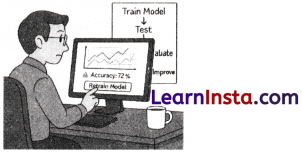
(iv) A data scientist notices that the model’s accuracy is only 72% while comparing predicted vs actual results. He clicks on the “Retrain Model” button to improve performance. Which step of the AI Project Cycle is being performed?
(a) Modelling
(b) Problem Scoping
(c) Evaluation
(d) Data Acquisition
Answer:
(c) Evaluation
(v) In a deep learning network, what is the function of the Hidden Layers?
(a) They output the final result, such as object labels.
(b) They receive raw input data and convert it into binary form.
(c) They learn different features of the data at increasing levels of complexity.
(d) They store the data permanently for long-term memory.
Answer:
(c) They learn different features of the data at increasing levels of complexity.
(vi) Why is Deep Learning preferred over traditional Machine Learning for tasks like facial recognition and handwriting recognition?
(a) It uses fewer computational resources and layers.
(b) It stores rules instead of learning from data.
(c) It automatically learns complex patterns from data using multiple layers.
(d) It depends only on labeled data and avoids feature extraction.
Answer:
(c) It automatically learns complex patterns from data using multiple layers.
Question 5.
Answer any 5 out of the given 6 questions. (5×1=5)
(i) Statement 1 AI-powered virtual assistants like Siri and Alexa can perform tasks such as setting alarms, playing music, and providing weather updates.
Statement 2 These virtual assistants operate using deep learning to process and respond to typed text only.
(a) Both Statement 1 and Statement 2 are correct.
(b) Both Statement 1 and Statement 2 are incorrect.
(c) Statement 1 is correct but Statement 2 is incorrect.
(d) Statement 2 is correct but Statement 1 is incorrect.
Answer:
(c) Statement 1 is correct but Statement 2 is incorrect
(ii) …………… is the last stage of the AI project life cycle.
(a) Problem Scoping
(b) Evaluation
(c) Modelling
(d) Data Acquisition
Answer:
(b) Evaluation
(iii) Which of the following statements is true for the term Evaluation?
(a) Helps in classifying the type and genre of a document.
(b) It helps in predicting the topic for a corpus.
(c) Helps in understanding the reliability of any AI model.
(d) Process to extract the important information out of a corpus.
Answer:
(c) Helps in understanding the reliability of any Al model
(iv) Prediction and Reality can be easily mapped together with the help of
(a) Prediction
(b) Reality
(c) Accuracy
(d) Confusion Matrix
Answer:
(d) Confusion Matrix
(v) Which of the following techniques is commonly used in text classification tasks?
(a) Latent Semantic Analysis (LSA)
(b) Convolutional Neural Networks (CNN)
(c) Principal Component Analysis (PCA)
(d) Support Vector Machines (SVM)
Answer:
(d) Support Vector Machines (SVM)
(vi) Which term best describes the difference between the predicted output and the actual output in a machine learning model?
Answer:
Loss
Section B
Subjective Type Questions
Answer any 3 out of the given 5 questions on Employability skills. Answer each question in 20-30 words. (3×2=6)
Question 6.
Why is entrepreneurship considered important for economic development?
Answer:
Entrepreneurship is crucial for economic development as it stimulates innovation, creates new jobs, and drives economic growth. Entrepreneurs bring new products and services to the market, improve productivity, and can address societal challenges through creative solutions. Their activities contribute to a dynamic and competitive economy.
Question 7.
What steps involved in renaming a folder?
Answer:
The steps to rename a folder are:
- Open File Explorer.
- Navigate to the location where the folder you want to rename is stored.
- Click once on the folder to select it.
- Right-click on the folder and select Rename from the context menu.
- Type the new name for the folder.
- Press Enter to save the new name.
Question 8.
Lipika, a project manager, often finds herself becoming frustrated and overwhelmed when tight deadlines approach. She notices that her stress affects her decision-making and team interactions. To address this, Lipika starts practicing self-regulation techniques, including setting aside time for regular breaks, practicing mindfulness, and prioritizing tasks effectively. How does Lipika’s use of self-regulation techniques benefit her work environment?
Answer:
By implementing self-regulation techniques, Lipika improves her stress management and decision-making abilities, leading to a more focused and productive work environment. Regular breaks and mindfulness help her stay calm and collected, reducing frustration and fostering better team interactions. Prioritizing tasks ensures she meets deadlines efficiently, enhancing overall team performance and morale.
Question 9.
A city is implementing green initiatives to reduce its carbon footprint and improve environmental quality. They focus on renewable energy, waste reduction, and green spaces to promote long-term ecological balance and quality of life. Why is sustainable development crucial for this city’s future?
Answer:
Sustainable development is vital as it ensures long-term ecological balance and resource efficiency. By adopting green initiatives, the city reduces environmental impact, enhances residents’ quality of life, and prepares for future challenges, fostering a healthier and more resilient community.
Question 10.
What are the key principles of effective communication?
Answer:
Effective communication hinges on clarity, conciseness, and active listening. Clear messages avoid jargon, concise information prevents overload, and active listening ensures understanding and engagement. These principles foster mutual respect and prevent misunderstandings, promoting productive and positive interactions.
Answer any 4 out of the given 6 questions in 20-30 words each. (4×2=8)
Question 11.
What are the main types of ethical frameworks discussed in AI?
Answer:
The main ethical frameworks include deontological ethics (duty-based), consequentialism (outcome-based), and virtue ethics (character-based). These frameworks help evaluate AI decisions by focusing on rules, impacts, or moral values, guiding ethical reasoning in various real-life AI applications.
Question 12.
Why is RGB representation important in computer vision?
Answer:
RGB representation is important because it defines colors using Red, Green, and Blue values. Computer Vision systems use these values to process and interpret color images accurately.
Question 13.
What is Tokenisation? Count how many tokens are present in the following statement:
I find that the harder I work, the more luck I seem to have.
Answer:
Tokenisation is the process of breaking down text into individual words or tokens. In the given statement, there are 14 tokens: “I”, “find”, “that”, “the”, “harder”, “T”, “work”, “the”, “more”, “luck”, “T”, “seem”, “to” “have”
Question 14.
How do value-based frameworks contribute to ethical decision-making by emphasizing fundamental principles and values?
Answer:
Value-based frameworks emphasize honesty, fairness, accountability, and respect, ensuring that decisions align with ethical principles rather than just legal compliance.
Question 15.
“Understanding both error and accuracy is crucial for effectively evaluating and improving AI models.” Justify this statement.
Answer:
Accuracy alone may be misleading, especially in imbalanced datasets. Analyzing errors (false positives and false negatives) helps identify weaknesses and improve precision, recall, and F1-score. A balanced evaluation ensures better real-world performance of AI models.
Question 16.
How does deep learning differ from traditional machine learning in handling complex data?
Answer:
Deep learning uses multiple neural network layers to automatically extract complex patterns, while traditional machine learning often requires manual feature selection and struggles with large, unstructured data like images or audio.
Answer any 3 out of the given 5 questions in 50-80 words each. (3×4=12)
Question 17.
Explain the different categories of machine learning models.
Answer:
There are three main categories of machine learning models: Supervised Learning, Unsupervised Learning, and Reinforcement Learning. Supervised learning uses labeled data and includes classification and regression models. Unsupervised learning works on unlabeled data and includes clustering and association models. Reinforcement learning involves agents learning through rewards and punishments from their environment. Each category suits different tasks-supervised for predictions, unsupervised for pattern discovery, and reinforcement for goal-driven decision-making, such as in games or robotics.
Question 18.
Why is it important for a Computer Vision system to distinguish between grayscale and RGB images?
Answer:
Grayscale images contain shades of gray and only one channel, while RGB images use three color channels: Red, Green, and Blue. RGB images offer more visual detail, helping the system distinguish between different colored objects. Understanding the type of image is essential for applying the correct processing techniques. For example, color-based feature extraction won’t work on grayscale images. Hence, recognizing image type helps optimize model performance and choose appropriate filters and algorithms.
Question 19.
Explain how deep learning differs from traditional machine learning in terms of data dependency, feature extraction, and model performance. Support your answer with a real-life example where deep learning is more effective.
Answer:
1. Data Dependency
- Traditional Machine Learning (ML) algorithms work well with smaller datasets.
- Deep Learning (DL) requires large volumes of data for effective learning.
2. Feature Extraction
- In ML, features are manually selected and engineered by experts.
- DL automatically extracts features through multiple hidden layers in neural networks.
3. Model Performance
- ML performance often saturates with more data.
- DL continues to improve in accuracy as data increases, especially in complex tasks.
4. Real-life Example
- Facial Recognition: Deep Learning models like CNNs outperform ML models by detecting facial features automatically, even under different lighting and angles.
Question 20.
Differentiate between sentence tokenization and word tokenization.
Answer:
The differences between sentence tokenization and word tokenization are the following:
| Sentence Tokenization | Word Tokenization |
| Divides text into individual sentences | Divides text into individual words |
| Coarser granularity (larger units) | Finer granularity (smaller units). |
| Output is a list of sentences | Output is a list of words |
| Useful for understanding text structure and context | Useful for text analysis and feature extraction |
| Example: “Hello world. How are you?” → [“Hello world.”, “How are you?”] |
“Hello world.” → [“Hello”, “world.”] |
Question 21.
Confusion Matrix:
| Predicted Positive | Predicted Negative | |
| Actual Positive | 50 (TP) | 20 |
| Actual Negative | 10 (FP) | 90 |
Given the confusion matrix, calculate the accuracy, recall, and precision.
Answer:
In given confusion matrix:
- True Positives TP=80
- False Negatives FN=20
- False Positives FP=10
- True Negatives TN=90
Accuracy =(TP+TN)/(FP+FN+TP+TN )
= (80+90)/(80+90+10+20)
= 170/200
= 0.85
Recall =TP/(FN+TP)
= 80/(80+20)
= 80/100
= 0.8
Precision =TP/(FP+TP)
= 80/(80+10)
= 80/90
0.8889
So, the precision is approximately 0.889 or 88.9%.