Experts have designed these Class 8 Social Science Notes and Class 8 SST Part 2 Chapter 4 The Role of the Judiciary in Our Society Notes for effective learning.
Class 8 The Role of the Judiciary in Our Society Notes
The Role of the Judiciary in Our Society Notes Class 8
→ Advisory Jurisdiction: The power of the Supreme Court to advise the President of India on important legal or constitutional matters.
→ Appeal: A request to a higher court to review a lower court’s decision.
→ Appellate Jurisdiction: The power of the Supreme Court to hear appeals against the decisions of High Courts and certain tribunals.
→ Arbitration: A method of dispute resolution in which an independent arbitrator gives a final and legally binding decision.
→ Constitution: The supreme law of the country that defines rights and duties of citizens and government.
→ Evidence: Proof presented in court to support a claim or argument.
→ Freedom of Speech: The right to express opinions without fear of punishment.
→ Fundamental Rights: Basic rights guaranteed to all citizens, such as freedom of speech and equality.
→ Gram Nyayalayas: Village-level mobile courts established under the Gram Nyayalayas Act, 2008 to provide speedy and affordable justice.
→ Independent Judiciary: A judiciary that works without interference from the government.

→ Judiciary: The system of courts that interprets laws and delivers justice.
→ Justice: Fairness in treatment and decisions, ensuring people get what is rightfully theirs.
→ Law: Rules made by the government to maintain order and ensure justice in society.
→ Litigant: A person involved in a legal case, either as the person filing the case or defending it.
→ LokAdalats: People’s Courts that settle disputes through mutual agreement to reduce the burden on regular courts.
→ Mediation: A method of dispute resolution where a neutral mediator helps parties reach a mutual settlement without imposing a decision.
→ Original Jurisdiction: The exclusive power of the Supreme Court to hear disputes between the Centre and States or between States.
→ Procedural Justice: Fairness in the process of making decisions, where everyone gets a chance to be heard.
→ Public Interest Litigation (PIL): A petition filed to protect public interest or the rights of people who cannot approach the court themselves.
→ Special Leave Petition (SLP): A discretionary power of the Supreme Court to allow an appeal against the decision of any court or tribunal.
→ Substantive Justice: Fairness in the final outcome or decision of a case.
→ Tribunal: A special court dealing with specific types of cases using expert knowledge to lower the burden of higher courts.
→ Watchdog of Democracy: The role of the judiciary in protecting the Constitution and citizens’ rights.
→ Writ Petition: A petition filed in the Supreme Court (Article 32) or High Court (Article 226) for the enforcement of Fundamental Rights.
Introduction
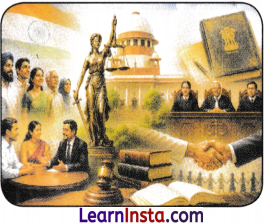
- Justice is a basic value of any society and is essential for its smooth functioning. In India, the importance of justice is clearly stated in the Preamble of the Constitution, which promises social, economic, and political justice to all citizens.
- The makers of the Constitution created a strong judicial framework to maintain a democratic society.
- Justice helps hold society together and ensures that people live with mutual respect, fairness, and concerii for one another.
- The Judiciary is the official institution responsible for resolving disputes fairly according to the law.
- People can resolve their personal or professional conflicts through mutual discussion, mediation or legal courts of law.
- The judiciary acts as the guardian of the Constitution and ensures that the laws made by the legislature and the actions of the executive remain within constitutional limits.
The Connection Between Law and Justice
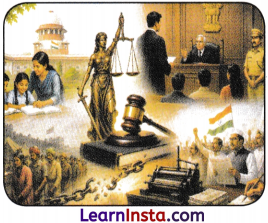
- As human societies expanded and became more organised, the duty of maintaining order and fairness was taken over by the government. It creates laws to regulate human behaviour and deliver justice, and ensures they are followed to maintain peace and stability.
- To maintain justice, the government frames laws that guide people’s actions and set penalties for violations. For instance, the Right to Education Act, 2009 ensures that every child has the right to free education up to the age of 14 yrs.
- These laws must be obeyed by everyone. If someone breaks them, they may face punishments such as fines, compensating victims, or imprisonment.
- The Judicial system provides a structured platform for citizens to raise grievances and present their arguments for fair judgement.
- After Independence, the Indian government reviewed laws and removed over 1500 discriminatory rules.
- Examples of canceled British laws include the Criminal Tribes Act, 1871 which branded communities such as those of tribal people, nomadic people, and some minorities as criminals by birth.
- The members of these tribes had to be registered with the police and were constantly monitored even though , they committed no crime. Their freedom of movement was also curtailed at times, and they were required to live in notified areas or camps.
- The second laws that was canceled was the Vernacular Press Act of 1878, which limited the freedom of press. Removing this law gave Indian newspapers more freedom to speak against British rule.
- There were several other countries in which these unfair laws existed, for instance, in the United States, discriminatory rules known as the Jim Crow laws restricted the rights of non-white (African Americans) citizens from using public facilities untill they w’ere removed.
- During the period of apartheid in South Africa (mid to late 20th century), society was divided on the basis of race. Non-white people were subjected to strict and unfair laws. These laws limited their basic rights, such as access to public places, proper housing, and equal opportunities. They were treated unequally compared to white citizens.
Justice contains two main components, which are Substantive Justice and Procedural Justice:
- Substantive Justice (Fair Result): This focuses on the final decision of the case. It ensures that the outcome is just and based on law. Under Substantive Justice the judgment should be correct and fair, and decisions must depend on facts and legal provisions. It protects the rights of all individuals equally and considers a person innocent untill proven guilty.
- Procedural Justice (Fair Process): This refers to the method followed while handling a case. It ensures that everything is done in a fair and transparent way. It also ensures that every person gets a chance to present their side, lawyers argue from both sides to show different viewpoints, and judges remain neutral and follow proper legal rules without any pressure.
The Judicial System of India
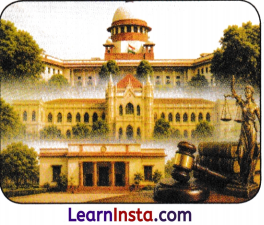
- The Indian judicial system works under a unified, hierarchical structure that serves as one of the three pillars of the government. It functions independently of the legislature and executive branches to ensure that justice is served and laws remain within the framework of the Constitution.
- The hierarchy is organised into three main levels:
- Supreme Court of India: The apex court of the country
- High Courts: The highest judicial authority at the state level
- Subordinate Courts: These include District Courts and Sessions Courts, at the district and local level.
- This structure provides citizens with more than one opportunity to get their grievances rectified in the court of law.
The Supreme Court of India
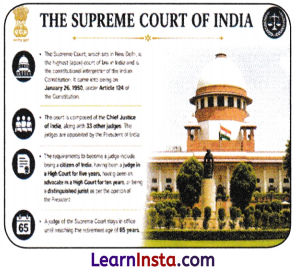
- The Supreme Court, which is in New Delhi, is the highest (apex) court of law in India and is the constitutional interpreter of the Indian Constitution.
- It came into being on January 26, 1950, under Article 124 of the Constitution.
- The court is composed of the Chief Justice of India, along with 33 other judges. The judges are appointed by the President of India.
- The requirements to become a judge include being a citizen of India, having been a judge in a High Court for five years, having been an advocate in a High Court for ten years, or being a distinguished jurist as per the opinion of the President.
- A judge of the Supreme Court stays in office until reaching the retirement age of 65 years.
Logo of The Supreme Court Of India:
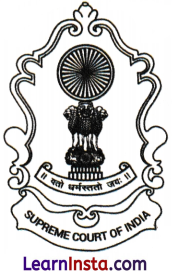
- The emblem of the Supreme Court of India features familiar national symbols, including the Lion Capital of Ashoka and the Dharma Chakra (Wheel of Law).
- The logo prominently displays the Sanskrit motto ‘Yato Dharmastato Jayah”, which translates to ‘Where there is dharma, there is victory.’
- The motto emphasises that true victory and justice are achieved through righteousness and truth.
- This motto originates from the ancient Indian epic, the Mahabharata, and forms a key core principle of the Indian Judicial System.
→ Writ Jurisdictions of the Supreme Court and the High Court
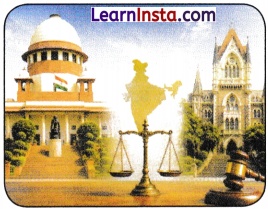
- Jurisdiction in Writs has been guaranteed in the Constitutional Courts in India, that is, the Supreme Court and High Courts, specifically to enforce Fundamental Rights provided for under Part III of the Constitution.
- These rights comprise of equality, liberty, freedom of speech, freedom of religion and the right to life.
- Under Article 32 of the Constitution, the right to file a “writ petition” to the Supreme Court is available to a citizen. Such power is exercised in cases which have all-India ramifications.
- The writ jurisdiction of the High Court comes under Article 226 of the Indian Constitution.
- This is done in case of violations of fundamental rights of citizens in the territory of the State under the jurisdiction of the High Court.
Public Interest Litigation (Pil) Filed Under Articles 32 & 226:
- Public Interest Litigation (PIL) was created by the Supreme Court to address major public issues and strengthen the Right to Life under Article 21. The first PIL case was initiated by a lawyer named Mrs. Kapila Hingorani after reading a news report about under-trial prisoners in Bihar.
- These prisoners had spent more time in jail than the actual legal sentence they would have served if convicted. Mrs. Hingorani filed a writ petition that resulted in the Supreme Court releasing those prisoners and establishing rules to free nearly 40,000 under-trial prisoners nationwide.
- In the case M. C. Mehta v. Union of India, the Supreme Court handled major environmental issues, including the pollution of the River Ganga and the preservation of the Taj Mahal.
- In the 1997 case Vishaka & Ors. v. State of Rajasthan, the Supreme Court set up legal guidelines to protect individuals from sexual harassment at workplaces. These judicial guidelines later led the Indian Government to pass the Sexual Harassment of Women at Workplace Act in the year 2013.
→ Original Jurisdiction of the Supreme Court
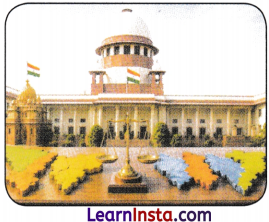
According to Article 131 of the Constitution, the Supreme Court has exclusive original jurisdiction over disputes involving:
- The Government of India (the Centre) and one or more States.
- The Centre and any State or States on one side, and one or more other States on the other.
- Two or more States against each other, such as inter-state river water disputes.
→ Appellate Jurisdiction of the Supreme Court
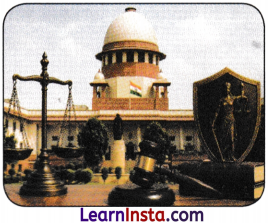
- Under Articles 132, 133 and 134A, the Supreme Court can take up appeal from any order of the High Court that certifies a case as a matter involving crucial legal questions or interpretation of the Constitution.
- According to Articles 134 and 134 A, the Supreme Court hears criminal appeals in cases that relate to a death sentence or where there is certification of fitness of judgment for appeal.
- The Supreme Court is authorised to hear appeals against decisions made by specialised tribunals such as the National Green Tribunal (NGT) and the National Company Law Appellate Tribunal (NCLAT).
→ Advisory Jurisdiction
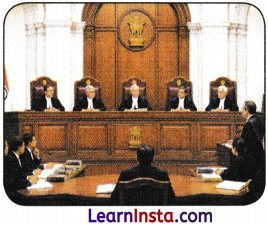
- According to Article 143, the President of India can request the legal opinion of the Supreme Court on important matters of law or public interest.
- All cases that are heard using the advisory jurisdiction are supposed to be conducted before a “Constitution Bench” that comprises at least five (5) judges and is formed to decide important questions of law or Constitutional interpretation.
→ Special Leave Petitions
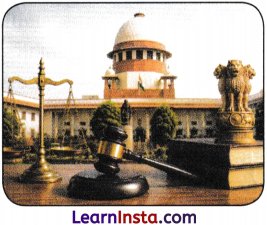
- Article 136 grants discretionary power to the Supreme Court to allow a Special Leave to Appeal against any judgment or order from any court or tribunal in India.
- This power is exercised to address significant legal issues of public importance or to ensure substantive justice for the parties.
- Under Article 141, any law established by the Supreme Court becomes legally binding on all other courts across the nation.
High Court
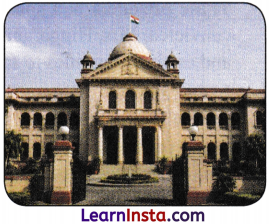
The High Court represents the highest court of law at the State level in India. As per Article 214 of the Constitution, each state is supposed to have a separate High Court, although presently, there are 25 High Courts, as some states and Union-Territories share a single High Court.
| High Court Name | Location (Principal Seat) | Territorial Jurisdiction (States / Union Territories Covered) |
| 1. Allahabad High Court | Prayagraj (Bench: Lucknow) | Uttar Pradesh |
| 2. Andhra Pradesh High Court | Amaravati | Andhra Pradesh |
| 3. Bombay High Court | Mumbai (Benches: Panaji, Aurangabad, Nagpur) | Maharashtra, Goa, Dadra & Nagar Haveli and Daman & Diu |
| 4. Calcutta High Court | Kolkata (Bench: Port Blair, Jalpaiguri) | West Bengal, Andaman and Nicobar Islands |
| 5. Chhattisgarh High Court | Bilaspur | Chhattisgarh |
| 6. Delhi High Court | New Delhi | NCT of Delhi |
| 7. Gauhati High Court | Guwahati (Benches: Kohima, Aizawl, Itanagar) | Assam, Nagaland, Mizoram, Arunachal Pradesh |
| 8. Gujarat High Court | Ahmedabad | Gujarat |
| 9. Himachal Pradesh High Court | Shimla | Himachal Pradesh |
| 10. High Court of Jammu & Kashmir and Ladakh | Srinagar / Jammu | Jammu & Kashmir, Ladakh |
| 11. Jharkhand High Court | Ranchi | Jharkhand |
| 12. Karnataka High Court | Bengaluru (Benches: Dharwad, Kalaburagi) | Karnataka |
| 13. Kerala High Court | Kochi | Kerala, Lakshadweep |
| 14. Madhya Pradesh High Court | Jabalpur (Benches: Gwalior, Indore) | Madhya Pradesh |
| 15. Madras High Court | Chennai (Bench: Madurai) | Tamil Nadu, Puducherry |
| 16. Manipur High Court | Imphal | Manipur |
| 17. Meghalaya High Court | Shillong | Meghalaya |
| 18. Orissa High Court | Cuttack | Odisha |
| 19. Patna High Court | Patna | Bihar |
| 20. Punjab and Haryana High Court | Chandigarh | Punjab, Haryana, Chandigarh |
| 21. Rajasthan High Court | Jodhpur (Bench: Jaipur) | Rajasthan |
| 22. Sikkim High Court | Gangtok | Sikkim |
| 23. Telangana High Court | Hyderabad | Telangana |
| 24. Tripura High Court | Agartala | Tripura |
| 25. Uttarakhand High Court | Nainital | Uttarakhand |
- The composition of a High Court includes the post of Chief Justice along with some other judges, and the number differs according to the requirements of each state.
- Judges are appointed by the President of India after consulting the Chief Justice of India, the Governor of the concerned state and the Chief Justice of that particular High Court.
- For appointment, certain qualifications (Article 217(2)) have to be fulfilled; a person has to be an Indian citizen and he should either have held a judicial office or been an advocate in a High Court for at least ten years. High Court judges retire at the age of 62 years.
→Jurisdiction of the High Courts
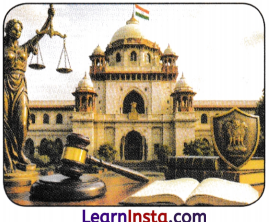
- The High Court has very important powers in the Indian judicial system and is regarded as one of the components of the “basic structure” of the Constitution.
- Under Article 226, the High Courts have the authority to grant writs to protect the Fundamental Rights (equality, liberty, and right to life) of the citizens of their territories.
- In Appellate Jurisdiction, the High Courts entertain appeals from the judgments of the subordinate courts (District and Sessions courts) and specialised tribunals in civil and criminal matters.
- Under Supervisory Jurisdiction (Article 227) each High Court holds the power of supervision over all the courts and tribunals in its territory
- The writ and supervisory powers of High Court are recognised as essential elements of the basic structure of the Indian Constitution.
Subordinate Courts
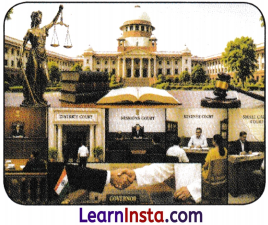
- Subordinate courts function beneath the High Court in every state to handle local judicial matters.
- Articles 233 to 237 of the Constitution outline provisions to structure subordinate courts and protect their independence.
- Subordinate courts form a critical part of the judicial system because they deal directly with the general public.
- The subordinate judiciary includes District Courts, Sessions Courts, Revenue Courts, and Small Causes Courts.
- High Courts are responsible for maintaining the integrity, standards, and honour of subordinate courts within their state.
- Under Article 233, the Governor of a state appoints District Judges in consultation with the state High Court.
Tribunal

- Specialised tribunals are quasi-judicial bodies created by specific laws to resolve distinct categories of disputes.
- Consumer Fora settle disputes related to consumer grievances and unfair trade practices.
- The Central Administrative Tribunal resolves service-related matters and disputes of government employees.
- The National Green Tribunal (NGT) handles cases concerning environmental protection and legal rights related to nature.
- The National Company Law Tribunal (NCLT) decides corporate, commercial, insolvency, and bankruptcy issues.
- The Armed Forces Tribunal resolves service disputes and legal matters related to military personnel.
- The Appellate Tribunal for Electricity (APTEL) handles disputes related to the power and electricity sector.
New Laws:
- The Indian Penal Code of 1860 has been replaced by the Bharatiya Nyaya Sanhita of 2023.
- The Code of Criminal Procedure of 1973 has been replaced by the Bharatiya Nagarik Suraksha Sanhita of 2023.
- The Indian Evidence Act of 1872 has been replaced by the Bharatiya Sakshya Adhiniyam of 2023.
- These new legal codes aim to deliver faster justice, enable the use of digital evidence, and ensure better protection for victims.
- These reforms seek to make the modern Indian judicial system more transparent, efficient, and effective.
Digital Technology and Judicial System
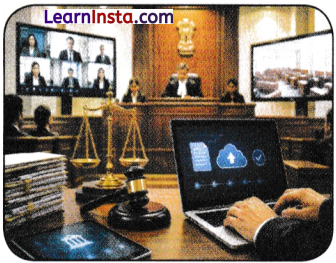
- The use of digital technology in the Indian judiciary system is meant to make the legal process easier to access, more transparent and user-friendly.
- Accessibility for Litigants as programs such as e-filing and hybrid hearings enable the use of electronic filing of legal documents and conducting of court proceedings in both real and virtual formats.
Virtual Justice Clock:
From 2024-2025, a big display screen known as “Virtual Justice Clock” is put up in the Supreme Court in order to provide live information related to judiciary.
Alternate Mode of Dispute Resolution
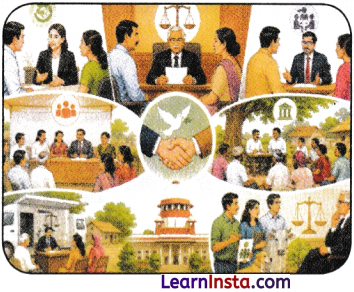
- ADR (Alternative Dispute Resolution) aids in resolving disputes in a non-judicial manner, decreasing the load on the judiciary system and offering faster justice.
- Courts promote alternate dispute resolution methods like arbitration, mediation, negotiation, and Lok Adalats to reduce the burden on the judicial system.
- Arbitration involves an independent individual or panel, such as a retired judge or expert, who hears both sides fairly and makes a legal decision.
- The decision made by an arbitrator is final, legally binding on all involved parties, and enforceable by courts under the Arbitration and Conciliation Act, 1996.
- In mediation, a neutral third party called a mediator helps conflicting parties reach a mutual agreement without forcing any decisions on them.
- Mediation processes in India are governed and regulated by the Mediation Act, 2023.
- Lok Adalats are special forums established under the Legal Services Authorities Act, 1987, that resolve pending court cases or pre-litigation disputes peacefully.
- Acting as people’s courts, Lok Adalats help clear court backlogs and provide easy access to justice without strict court procedures.
- Gram Nyayalayas were set up under the Gram Nyayalayas Act, 2008, to decentralise the judiciary and lower the workload of traditional courts.
- Gram Nyayalayas operate as mobile courts at the village level to resolve local disputes directly in rural areas.
- In the Indian judicial system, citizens have a role in assisting the judiciary by bringing social concerns to its attention that impact the rights of people, animals, and nature.