Students often refer to Maths Mela Class 4 Solutions Chapter 7 The Cleanest Village Question Answer NCERT Solutions to verify their answers.
Class 4 Maths Chapter 7 The Cleanest Village Question Answer Solutions
The Cleanest Village Class 4 Maths Solutions
Class 4 Maths Chapter 7 Solutions
Daisy and Lou Go Shopping (Pages 96-98)

Sapan Dada asks Daisy and Lou to find the costs of different quantities of fruits and vegetables. Help them to complete the tasks. You may use a number line, play money or any other method to calculate.
Answer:
(a) Given, Cost of 1 kg beans =₹ 95
Since, 2 kg beans = 1 kg beans + 1 kg beans
Hence, the cost of 2 kg beans = cost of 1 kg beans + cost of 1 kg beans
= ₹ 95 + ₹ 95 = ₹ 190
(b) Cost of 1 kg custard apple = ₹ 45;
Cost of 1 kg sapota = ₹ 70
Hence, the cost of 1 kg custard apple and 1 kg sapota = cost 1 kg custard apple + cost of 1 kg sapota = ₹ 45 + ₹ 70 = ₹ 115

(c) Cost of 1 kg onion = ₹ 32;
Cost of 1 kg potato = ₹ 37
Hence, the cost of 1 kg onion and 1 kg potato
= cost of 1 kgonion + cost of 1 kgpotato
= ₹ 32 + ₹ 37 = ₹ 69
(d) Cost of 1 kg radish = ₹ 23;
Cost of 1 kg yam = ₹ 45
Hence, the cost of 1 kg radish and 1 kg yam
= cost of 1 kgradish + cost of 1 kgyam
= ₹ 23 + ₹ 45 = ₹ 68
(e) Cost of 2 kg radish
= cost of 1 kgradish + cost of 1 kgradish
= ₹ 23 + ₹ 23 = ₹ 46
Cost of 2 kg papaya
= cost of 1 kgpapaya + cost of 1 kgpapaya
= ₹ 65 + ₹ 65 = ₹ 130
Hence, the cost of 2 kg radish and 2 kg papaya
= cost of 2 kgradish + cost of 2 kgpapaya
= ₹ 46 + ₹ 130 = ₹ 176
(f) Cost of 2 kg onion = cost of 1 kg onion + cost of 1 kg onion
= ₹ 32 + ₹ 32 = ₹ 64
Cost of 2 kg potato = cost of 1 kg potato + cost of 1 kg potato
= ₹ 37 + ₹ 37 = ₹ 74
Hence, the cost of 2 kg onion and 2 kg potato
= cost of 2 kgonion + cost of 2 kgpotato
= ₹ 64 + ₹ 74 = ₹ 138
We notice that the cost of 2 kg of onion and 2 kg of potato is twice that of 1 kg of onion and 1 kg of potato.
Their mother buys things for ₹ 163. What might she have bought? There is more than one possibility.
Answer:
Here, ₹ 163 = ₹ 45 + ₹ 95 + ₹ 23 = ₹ 70 + ₹ 70 + ₹ 23
Hence, the mother might have bought 1 kg custard apple, 1 kg beans, and 1 kg radish or 2 kg sapota and 1 kg radish or 1 kg beans, 1 kg yam and 1 kg radish.
Udaya Didi runs a store selling rice, atta, daal, and spices. Daisy and Lou help Udaya Didi return the balance to customers while their mother buys the groceries. Udaya Didi also asks them some tricky questions.
Help them find the missing numbers in each of the following. Use a number line, play money or any other way to find the balances.


Answer:
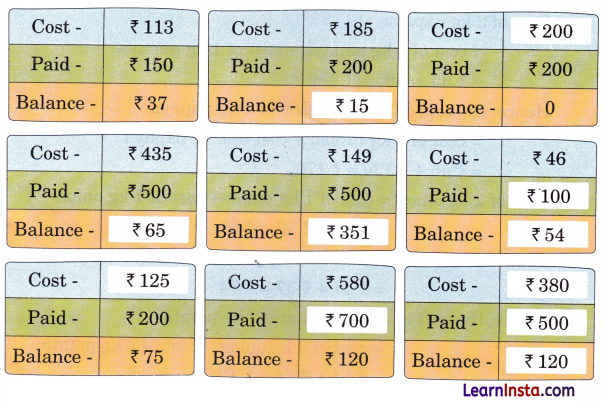
Lou and Daisy buy 3 kg bananas to eat on the way with their friends. Which of the following options can they use to buy the bananas?

Answer:
Here, Cost of 1 kg banana = ₹ 55
Cost of 3 kg banana = ₹ 55 + ₹ 55 + ₹ 55 = ₹ 165
Hence, Lou and Daisy will choose the option (b) to by the bananas.
A Strange Puzzle! (Page 99)

Four naughty kids on a walk come across a fresh orange crop.
They ask the farmer the price of one.
The farmer says, “Each costs ₹ 21”.
Two oranges each they buy.
The farmer gives them with a sigh.
They all reach in to their jackets,
To take out notes from their pockets.
Each one pays a different note,
Krishna a ₹ 50 and Sudama a ₹ 100
Mala a ₹ 200 and Neela a ₹ 500.
What is the balance that they each got?

Answer:
(a) 1 orange = ₹ 21
Here, 2 oranges
= 1 orange + 1 orange
= ₹ 21 + ₹ 21 = ₹ 42
Krishna paid ₹ 50 and bought 2 oranges for ₹ 42. He paid more amount.
Hence, balance =paid amount – cost of 2 oranges
= ₹ 50 – ₹ 42 = ₹ 8.
(b) Sudama paid ₹ 100 and bought 2 oranges for ₹ 42. He paid more than the cost.
Hence, balance = ₹ 100 – ₹ 42 = ₹ 58
(c) Mala paid ₹ 200 and bought 2 oranges for ₹42. She paid more amount.
Hence, balance = ₹ 200 – ₹ 42 = ₹ 158
(d) Neela paid ₹ 500 and bought 2 oranges for ₹ 42. She also paid more amount.
Hence, balance = ₹ 500 – ₹ 42 = ₹ 458
Let Us Play (Page 100)
Place the numbers 1-6 in the blanks in such a way that the sum on each side of the triangle is 9. No numbers should be repeated.

Answer:

Here, 1 + 6 + 2 = 2 + 4 + 3 = 3 + 5 + 1 = 9
Use the same numbers 1-6 and make the sum 10 on each side of the triangle.

Answer:

Here, 1 + 4 + 5 = 5 + 2 + 3=3 + 6 + 1 = 10
What other sums can you make with these 6 numbers?
Answer:

Here, 4 + 5 + 2 = 2 + 3 + 6 = 4 + 1 + 6 = 11
Hence the other sum can we make using these numbers is 11 .
What strategy did you use to place the numbers.
Answer:
I started with the smallest number 1. First I placed 1 and made the sum that required and then placed the other numbers.
Can you make 12 on each side? Can you make 13?
Answer:
Yes we can make 12.
Here, 4 + 3 + 5 = 5 + 1 + 6 = 6 + 2 + 4 = 12

But we cannot make 13 using numbers 1-6 on each side of the triangle without repetition of the numbers.
Add Up (Pages 101-104)
Daisy and Lou leave for the field trip by a bus the next morning. 24 teachers and 438 children are going from their school. 476 children from a neighbourhood school along with 28 teachers are also going to the same village.
Daisy and Lou ate one large piece of pusaw for ₹ 38. They liked it a lot and bought another small piece for ₹ 16. How much did they spend on pusaw?


Answer:
38 + 16

Hence, Daisy and Lou spends ₹ 54.
Daisy and Lou had collected ₹ 185 in their piggy bank. Their mother gave them ₹ 125 more for the trip. How much money did they take for the trip?
Daisy and Lou took ₹ ____ for the trip.
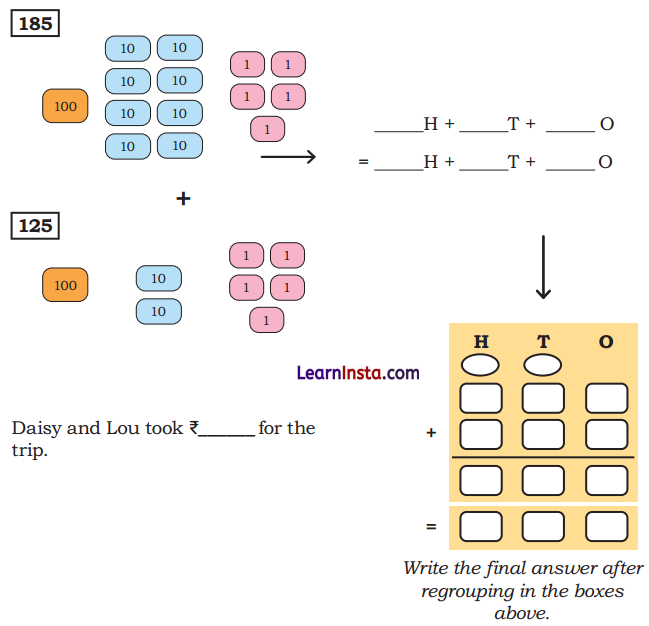
Answer:
185 + 125

Hence, Daisy and Lou took ₹ 3 1 0for the trip.
Let Us Do (Page 105)

1. In Kalakshitij, a school of performing arts, the following number of students are learning to sing and play the tabla. Estimate and then find the total number of students.

Answer:

15 more girls join the music school and they want to learn to play the tabla. How many girls play the tabla now?
Answer:
Here, girls who play tabla = 95
15 more girls want to learn to play tabla.
Hence, total girls who play tabla = 95 + 15 = 110.
2. Add by aligning the numbers in columns in your notebook.
(a) 32 + 47
(b) 654 + 95
(c) 286 + 123
(d) 476 + 324
(e) 700 + 289
(f) 534 + 483
Answer:

3. Preeti’s school has 423 children. Her school has 178 children less than her cousin’s school. How many children study in Preeti’s cousin’s school?
Answer:
Here, Preeti’s cousin’s school has 178 children more than Preeti’s school.
Hence, number of children in Preeti’s cousin’s school = 423 + 178 = 601 children
Let Us Solve (Pages 108-109)
Ram Chacha got 264 mangoes from his mango tree last year. This year he got 527 mangoes. How many more mangoes did he get this year?
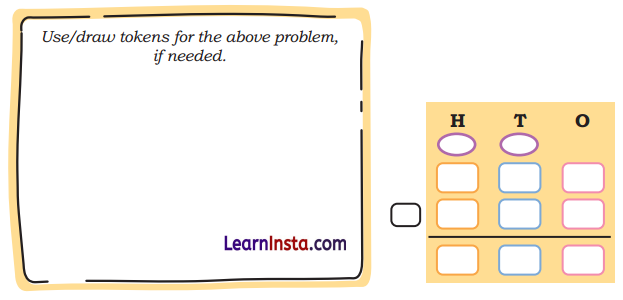
Answer:

Hence, this year Ram Chacha got 263 more mangoes than previous year.
4. During the festival of dolls (Gombe Habba in Dussehra), Ranganna made 639 dolls. He was able to sell 531 dolls. How many dolls are left with him?
No. of dolls left = _____.
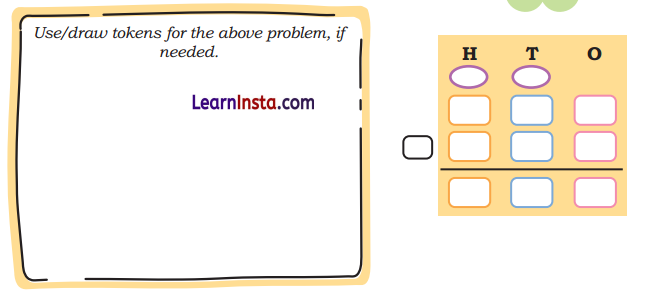
Answer:

5. Subtract by aligning the numbers in columns in your notebook.
(a) 83-29
(b) 345-123
(c) 763-437
(d) 803-350
(e) 900-328
Answer:
(a) Here, 83 – 29

(b) Here, 345 – 123

(c) Here, 763 – 437

(d) Here, 803 – 350

(e) Here, 900 – 328

Let Us Solve (Pages 109-111)
Question 1.
These books are in the community library of Wakanda village. Children borrow these books to read during their vacation.

(a) Rami read Panchatantra Tales during the summer vacation. Kesu read Akbar Birbal, Karadi Tales and Blue Umbrella. Who do you think read more? How many more pages?
(b) Sumi has read 23 pages of Adventures of Feluda. How many more pages are left to complete the book?
(c) Jaggu decides to read all the books listed here during his vacation. He has finished reading Swami and Friends, Akbar Birbal and 50 pages of Feluda in 4 weeks. How many more pages does he have to read to finish reading all the books?
Answer:
(a) Rami read Panchatantra Tales. Hence, the number of pages read by Rami = 236
Kesu read Akbar Birbal, Karadi Tales and Blue Umbrella.
Hence, the number of pages read by Kesu
= 96 + 30 + 90 = 216
Clearly, Rami read more pages.

Hence, Rami read 20 more pages than the Kesu.
(b) Sumi has read 23 pages of Adventures of Feluda.
Total number of pages in Adventures of Feluda = 128
Number of pages left to complete the book = 128 – 23 = 105

(c) Here number of pages read by Jaggu
= Total pages of Swami and Friends + Total pages of Akbar Birbal + 50 pages of Feluda
= 179 + 96 + 50 = 325
and total number of pages in all books
= 179 + 236 + 30 + 96 + 90 + 128 = 759
Hence, remaining pages that Jaggu have to read to finish reading
= 759 – 325 = 434

Question 2.
A daily train between Delhi and Aligarh travels a distance of 131 km . Look at the picture below and answer the questions that follow.

(a) How many passengers are there on the train when it leaves Dadri?
(b) Find the number of people who got off the train at Aligarh.
(c) Were there more people on the train in New Delhi or in Aligarh? How much more/less?
(d) How many people travelled altogether by the train?
Answer:
(a) Here, people boarded train at Delhi =894
People boarded train at Ghaziabad = 158
Total passengers at Ghaziabad after boarding train = 894 + 158 = 1052

Now, passengers left in train at Ghaziabad after alighted train
= 1052 – 23 = 1029

Total passengers in train after boarding at Dadri = 1029 + 67 = 1096
Passengers in train after alighted at Dadri = 1096 – 75 = 1021

Hence, passengers in train when it leaves Dadri = 1021.

(b) Clearly, Aligrah is the last station of the journey.
Hence, Number of people who got off the train at Aligarh
= Number of people in train when it leaves Dadri = 1021
(c) Number of people of New Delhi = 894
Number of people at Aligarh = 1021
Clearly, at Aligarh there were more people in train than at New Delhi.

Hence, 127 more people at Aligarh than at New Delhi.
(d) Total people travelled altogether by the train
= 894 + 158 + 67 = 1119 .
Let Us Solve (Pages 111-112)

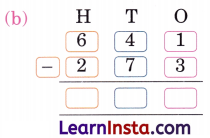
Answer:


(c) Find quick ways of solving. Think about some of the strategies you learnt in Grade 3.

Answer:
Here, 326 + 25 = 325 + 25 + 1 = 350 + 1 = 351
410-12 = 410-10-2 = 400-2 = 398
675 + 5 = 670 + 5 + 5 = 680
204-10 = 200-10 + 4 = 190 + 4 = 194
811 + 99 = 800 + 10 + 1 + 100-1 = 910
945-19 = 940 + 5-20 + 1 = 926
(d) Solve by aligning the numbers in columns in your notebook.
1. 38 + 943
2. 465 + 305
3. 435 + 462
4. 764-657
5. 518-209
6. 879-53

Radha made 840 cakes last year and this year, she made 277 cakes only. How many less toy did she made this year?
Number Pair Hunt (Pages 112-113)
Here is a grid of numbers. There are many number pairs in this grid. A number pair has 2 numbers which are next to each other, vertically or horizontally. For example, the numbers 111 and 185 are number pairs 48 and 185 are number pairs in this grid.

1. Find the number pair whose sum is the greatest.
2. Find the number pair whose sum is the smallest.
3. Find the number pair whose difference is the greatest.
4. Find the number pair whose difference is the smallest.
Answer:
Here, total number of pairs in the given grid = 24
1. The number pair whose sum is the greatest is (225,190) since their sum is 225 + 190 = 415.
2. The number pair whose sum is the smallest is (68,54) since their sum is 68 + 54 = 122.
3. The number pair whose difference is the greatest is (48,321), since their difference is 321-48 = 273.
4. The number pair whose difference is the smallest is (68,54), since their difference is 68-54 = 14.
The Missing Digits (Page 113)
Fill the missing digits below to make each of the following sums correct.


Let Us Do (Page 114)
1. Add.
(a) 23 + 489
(b) 105 + 295
(c) 630 + 56
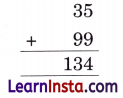
(d) 35 + 99
(e) 409 + 387
(f) 67 + 76
(g) 580 + 207
(h) 333 + 666
(i) 826 + 268
(a) 23 + 489
Answer:

(b) 105 + 295
Answer:

(c) 630 + 56
Answer:

(d) 35 + 99
Answer:
(e) 409 + 387
Answer:

(f) 67 + 76
Answer:

(g) 580 + 207
Answer:

(h) 333 + 666
Answer:

(i) 826 + 268
Answer:

2. Subtract.
(a) 300-45
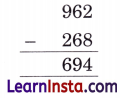
(b) 962-268
(c) 706-209
(d) 842-387
(e) 674-76
(f) 754-409
(g) 403-245
(h) 600-384
(i) 546-538
(a) 300-45
Answer:

(b) 962-268
Answer:
(c) 706-209
Answer:

(d) 842-387
Answer:

(e) 674-76
Answer:

(f) 754-409
Answer:

(g) 403-245
Answer:

(h) 600-384
Answer:

(i) 546-538
Answer:
