Students often refer to Ganita Prakash Class 8 Solutions and Class 8 Maths Chapter 2 Power Play NCERT Solutions Question Answer to verify their answers.
NCERT Class 8 Maths Chapter 2 Power Play Solutions Question Answer
Ganita Prakash Class 8 Chapter 2 Solutions Power Play
NCERT Class 8 Maths Ganita Prakash Chapter 2 Power Play Solutions Question Answer
2.1 Experiencing the Power Play…
An Impossible Venture!
NCERT In-Text Questions (Pages 19-20)
Question 1.
Now, what do you think the thickness would be after 30 folds? 45 folds? Make a guess.
Solution:
Do it yourself.
Question 2.
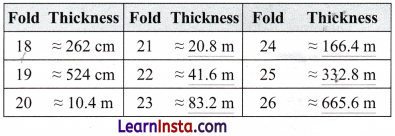
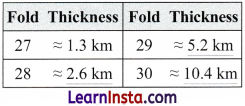
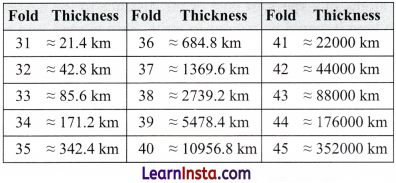
Fill the table below.
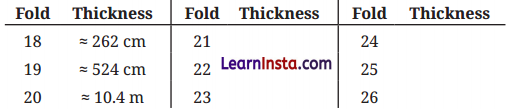
After 26 folds, the thickness is approximately 670 m.
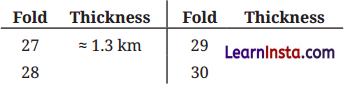
Burj Khalifa in Dubai, the tallest building in the world, is 830 m tall.

After 30 folds, the thickness of the paper is about 10.7 km, the typical height at which planes fly. The deepest point discovered in the oceans is the Mariana Trench, with a depth of 11 km.
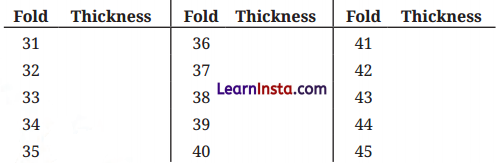
Solution:
2.2 Exponential Notation and Operations
NCERT In-Text Questions (Pages 21-22)
Question 1.
Which expression describes the thickness of a sheet of paper after it is folded 10 times? The initial thickness is represented by the letter-number v.
(i) 10v
(ii) 10 + v
(iii) 2 × 10 × v
(iv) 210
(v) 210 v
(vi) 102 v
Solution:
If the initial thickness of a sheet of paper is v, then the thickness of the sheet of paper after it is folded:
1 time = 2v, 2 times = 2 × 2 v = 22 v, 3 times = 2 × 2 × 2 v = 23 v, …, 10 times = 2 × 2 × 2 × 2 × 2 × 2 × 2 × 2 × 2 × 2 v = 210 v.

Question 2.
What is (-1)5? Is it positive or negative? What about (-1)56?
Solution:
We know that (-1)2 = (-1) × (-1) = +1 (Since, -ve × -ve = +ve)
(-1)3 = [(-1) × (-1)] × (-1) = (+1) × (-1) = -1 (Since, +ve × -ve = -ve)
(-1)4 = [(-1) × (-1)] × [(-1) × (-1)] = (+1) × (+1) = +1 (Since, +ve × +ve = +ve)
From the above, we can generalise that (-1)even = +1 and (-1)odd = -1
Therefore, (-1)5 = -1 and (-1)56 = +1 (Since 5 is odd and 56 is even)
Question 3.
Is (-2)4 = 16? Verify.
Solution:
Yes, (-2)4 = [(-2) × (-2)] × [(-2) × (-2)]
= (+4) × (+4)
= 16
Figure it Out (Pages 22-23)
Question 1.
Express the following in exponential form:
(i) 6 × 6 × 6 × 6
(ii) y × y
(iii) b × b × b × b
(iv) 5 × 5 × 7 × 7 × 7
(v) 2 × 2 × a × a
(vi) a × a × a × c × c × c × c × d
Solution:
(i) 6 × 6 × 6 × 6 = 64
(ii) y × y = y2
(iii) b × b × b × b = b4
(iv) 5 × 5 × 7 × 7 × 7 = 52 × 73
(v) 2 × 2 × a × a = 22 × a2
(vi) a × a × a × c × c × c × c × d = a3 × c4 × d
Question 2.
Express each of the following as a product of powers of their prime factors in exponential form.
(i) 648
(ii) 405
(iii) 540
(iv) 3600
Solution:
By prime factorisation, we have
(i) 648 = 2 × 2 × 2 × 3 × 3 × 3 × 3 = 23 × 34
(ii) 405 = 3 × 3 × 3 × 3 × 5 = 34 × 51
(iii) 540 = 2 × 2 × 3 × 3 × 3 × 5 = 22 × 33 × 51
(iv) 3600 = 2 × 2 × 2 × 2 × 3 × 3 × 5 × 5 = 24 × 32 × 52
Question 3.
Write the numerical value of each of the following:
(i) 2 × 10³
(ii) 72 × 23
(iii) 3 × 44
(iv) (-3)2 × (-5)2
(v) 32 × 104
(vi) (-2)5 × (-10)6
Solution:
(i) 2 × 103 = 2 × 1000 = 2000
(ii) 72 × 23 = 49 × 8 = 392
(iii) 3 × 44 = 3 × 256 = 768
(iv) (-3)2 × (-5)2 = 9 × 25 = 225
(v) 32 × 104 = 9 × 10000 = 90000
(vi) (-2)5 × (-10)6 = -32 × 1000000 = -32000000
The Stones that Shine…
NCERT In-Text Questions (Pages 23-24)
Question 1.
37 can also be written as 32 × 35. Can you reason out why?
Solution:
Yes, 37 = 3 × 3 × 3 × 3 × 3 × 3 × 3
= (3 × 3) × (3 × 3 × 3 × 3 × 3)
= 32 × 35
Question 2.
Use this observation to compute the following.
(i) 29
(ii) 57
Solution:
(i) 29 = (2 × 2 × 2) × (2 × 2 × 2) × (2 × 2 × 2)
= 23 × 23 × 23
= 8 × 8 × 8
= 512
(ii) 57 = (5 × 5 × 5) × (5 × 5 × 5) × 5
= 125 × 125 × 5
= 15625 × 5
= 78125
Question 3.
Write the following expressions as a power of a power in at least two different ways.
(i) 86
(ii) 715
(iii) 914
(iv) 58
Solution:
(i) 86 = (8 × 8 × 8) × (8 × 8 × 8) = 83 × 83 = (83)2
Or, 86 = (8 × 8) × (8 × 8) × (8 × 8)
= 82 × 82 × 82
= (82)3
(ii) 715 = (7 × 7 × 7) × (7 × 7 × 7) × (7 × 7 × 7) × (7 × 7 × 7) × (7 × 7 × 7)
= 73 × 73 × 73 × 73 × 73
= (73)5
Or, 715 = (7 × 7 × 7 × 7 × 7) × (7 × 7 × 7 × 7 × 7) × (7 × 7 × 7 × 7 × 7)
= 75 × 75 × 75
= (75)3
(iii) 914 = (9 × 9) × (9 × 9) × (9 × 9) × (9 × 9) × (9 × 9) × (9 × 9) × (9 × 9)
= 92 × 92 × 92 × 92 × 92 × 92 × 92
= (92)7
Or, 914 = (9 × 9 × 9 × 9 × 9 × 9 × 9) × (9 × 9 × 9 × 9 × 9 × 9 × 9)
= 97 × 97
= (97)2
(iv) 58 = (5 × 5) × (5 × 5) × (5 × 5) × (5 × 5)
= 52 × 52 × 52 × 52
= (52)4
Or, 58 = (5 × 5 × 5 × 5) × (5 × 5 × 5 × 5)
= 54 × 54
= (54)2
Magical Pond
NCERT In-Text Questions (Page 25)
Question 1.
Write the number of lotuses (in exponential form) when the pond was-
(i) fully covered
(ii) half covered
Solution:
Since the number of lotuses doubles every day, the number of lotuses in the pond after:
1 day = 1 × 2 = 21, 2 days = 1 × 2 × 2 = 22, 3 days = 1 × 2 × 2 × 2 = 23, and so on.
(i) The pond was fully covered after 30 days, so the number of lotuses = 230
(ii) The pond was fully covered after 30 days, so it was half covered after 29 days.
Then, the number of lotuses = 229
Question 2.
Use this observation to compute the value of 25 × 55.
Solution:
25 × 55 = (2 × 5)5 [∵ ma × na = (mn)a]
= 105
= 100000
Question 3.
Simplify \(\frac{10^4}{5^4}\) and write it in exponential form.
Solution:
\(\frac{10^4}{5^4}=\frac{10 \times 10 \times 10 \times 10}{5 \times 5 \times 5 \times 5}\)
= 2 × 2 × 2 × 2
= 24
How Many Combinations
NCERT In-Text Questions (Pages 26-27)
Question 1.
Roxie has 7 dresses, 2 hats, and 3 pairs of shoes. How many different ways can Roxie dress up?
Solution:
Do it yourself.
Estu says, “Next time, I will buy a lock that has 6 slots with the letters A to Z. I feel it is safer.”
Question 2.
How many passwords are possible with such a lock?
Solution:
There are 6 slots in the lock, and each slot has 26 choices out of letters A to Z.
So, the total number of possible passwords = 26 × 26 × 26 × 26 × 26 × 26 = 266
Question 3.
Think about how many combinations are possible in different contexts. Some examples are
(i) Pin codes of places in India — The Pin code of Vidisha in Madhya Pradesh is 464001. The Pincode of Zemabawk in Mizoram is 796017.
(ii) Mobile numbers.
(iii) Vehicle registration numbers.
Try to find out how these numbers or codes are allotted/generated.
Solution:
Do it yourself.
2.3 The Other Side of Powers
NCERT In-Text Questions (Pages 27-29)
Question 1.
What is 2100 ÷ 225 in powers of 2?
Solution:
2100 ÷ 225 = 2100 – 25 = 275 [∵ na ÷ nb = na-b]
Question 2.
Why can’t n be 0?
Solution:
If we put n = 0 in \(\frac{n^a}{n^b}\), we get \(\frac{0}{0}\).
We know that division by 0 is not defined.
Therefore, \(\frac{0}{0}\) is not defined.
Thus, we can’t take 0.
Consider the following general forms we have identified.
na × nb = na+b
(na)b = (nb)a= na×b
na ÷ nb = na-b
Question 3.
We had required a and b to be counting numbers. Can a and b be any integers? Will the generalised forms still hold?
Solution:
Yes, the laws are formulated precisely so that they remain consistent and valid for all integers.
Let us examine these laws with examples using both positive and negative integral exponents.
Product Rule
Generalised Form: na × nb = na+b (where a, b are counting numbers.)
It holds for all integers a, b (as long as n ≠ 0).
For example, 24 × 2-3 = 24+(-3) = 21 = 2.
This is correct because 24 × 2-3 = 16 × \(\frac{1}{2^3}\) = 16 × \(\frac {1}{8}\) = 2.
Power of a Power Rule
Generalised Form: \(\left(n^a\right)^b=\left(n^b\right)^a=n^{a b}\) (where a, b are counting numbers.)
It holds for all integers a, b (as long as n ≠ 0).
For example, \(\left(2^2\right)^{-3}=2^{2 \times(-3)}=2^{-6}=\frac{1}{2^6}=\frac{1}{64}\)
and \(\left(2^{-3}\right)^2=2^{(-3) \times 2}=2^{-6}=\frac{1}{2^6}=\frac{1}{64}\)
This is correct because \(\left(2^2\right)^{-3}=(4)^{-3}=\frac{1}{4^3}=\frac{1}{64}\)
and \(\left(2^{-3}\right)^2=\left(\frac{1}{2^3}\right)^2=\left(\frac{1}{8}\right)^2=\frac{1}{8} \times \frac{1}{8}=\frac{1}{64}\)
Quotient Rule
Generalised Form: na ÷ nb = na-b (where a, b are counting numbers).
It holds for all integers a, b (as long as n ≠ 0).
For example, \(3^4 \div 3^{-2}=3^{4-(-2)}=3^{4+2}=3^6=729\)
This is correct because \(3^4 \div 3^{-2}=3^4 \div \frac{1}{3^2}=81 \div \frac{1}{9}=81 \times 9=729\)
Question 4.
Write equivalent forms of the following.
(i) 2-4
(ii) 10-5
(iii) (-7)-2
(iv) (-5)-3
(v) 10-100
Solution:
(i) \(2^{-4}=\frac{1}{2^4}\)
(ii) \(10^{-5}=\frac{1}{10^5}\)
(iii) \((-7)^{-2}=\frac{1}{(-7)^2}\)
(iv) \((-5)^{-3}=\frac{1}{(-5)^3}\)
(v) \(10^{-100}=\frac{1}{10^{100}}\)
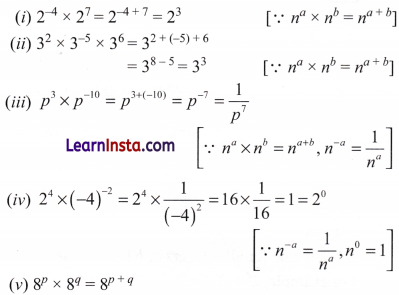
Question 5.
Simplify and write the answers in exponential form.
(i) 2-4 × 27
(ii) 32 × 3-5 × 36
(iii) p3 × p-10
(iv) 24 × (-4)-2
(v) 8p × 8q
Solution:
Power Lines
NCERT In-Text Questions (Pages 29-30)
Question 1.
How many times larger than 4-2 is 42?
Solution:
Since, \(4^2 \div 4^{-2}=4^{2-(-2)}=4^{2+2}=4^4=256\)
So, 42 is 256 times larger than 4-2
Question 2.
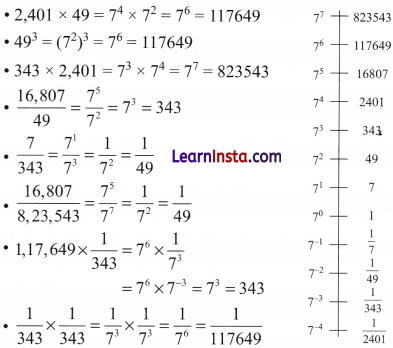
Use the power line for 7 to answer the following questions.
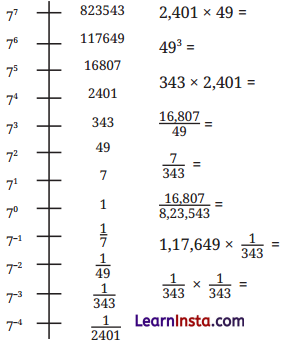
Solution:
2.4 Powers of 10
NCERT In-Text Questions
Question 1.
Write these numbers in the same way: (Page 30)
(i) 172
(ii) 5642
(iii) 6374
Solution:
These numbers can be written using powers of 10 as:
(i) 172 = (1 × 10²) + (7 × 101) + (2 × 100)
(ii) 5642 = (5 × 10³) + (6 × 10²) + (4 × 101) + (2 × 100)
(iii) 6374 = (6 × 10³) + (3 × 10²) + (7 × 101) + (4 × 100)
Scientific Notation
NCERT In-Text Questions (Pages 31-32)
Question 1.
Write the large-number facts we readjusted before in this form.
Solution:
(i) The Sun is located 30,00,00,00,00,00,00,00,00,000 m = 3.0 × 10²⁰ m from the centre of our Milky Way galaxy.
(ii) The number of stars in our galaxy is 1,00,00,00,00,000 = 1.0 × 10¹¹.
(iii) The mass of the Earth is 59,76,00,00,00,00,00,00,00,00,00,000 kg = 5.976 × 1024 kg.
Question 2.
Can you say which of the three distances is the smallest?

Solution:
We have the three distances as: 1.4335 × 10¹² m = 14.335 × 10¹¹ m, 1.439 × 10¹² m = 14.39 × 10¹¹ m and 1.496 × 10¹¹ m
Since powers of 10 are the same, comparing the decimal factors, we have 14.39 > 14.335 > 1.496
Thus, the distance between the Sun and Earth, i.e., 1.496 × 10¹¹ m, is the smallest.
Question 3.
The number line below shows the distance between the Sun and Saturn (1.4335 × 10¹² m). On the number line below, mark the relative position of the Earth. The distance between the Sun and the Earth is 1.496 × 10¹¹ m.

Solution:
1.4335 × 10¹² m = 14.335 × 10¹¹
14.335 × 10¹¹ m ÷ 1.496 × 10¹¹ m ~ 10.
So, the relative position of the Earth on the number line can be marked as shown below:

Question 4.
Express the following numbers in standard form.
(i) 59,853
(ii) 65,950
(iii) 34,30,000
(iv) 70,04,00,00,000
Solution:
(i) 59,853 = 5.9853 × 10⁴
(ii) 65,950 = 6.595 × 10⁴
(iii) 34,30,000 = 3.43 × 10⁶
(iv) 70,04,00,00,000 = 7.004 × 10¹⁰
2.5 Did You Ever Wonder?
NCERT In-Text Questions (Pages 38-42)
Question 1.
With a global human population of about 8 × 10⁹ and about 4 × 10⁵ African elephants, can we say that there are nearly 20,000 people for every African elephant?
Solution:
Yes, we can say that there are nearly 20,000 people for every African elephant because
\(\left(8 \times 10^9\right) \div\left(4 \times 10^5\right)=\frac{8}{4} \times 10^{9-5}=2 \times 10^4=20000\)
Question 2.
Calculate and write the answer using scientific notation:
(i) How many ants are there for every human in the world?
(ii) If a flock of starlings contains 10,000 birds, how many flocks could there be in the world?
(iii) If each tree had about 104 leaves, find the total number of leaves on all the trees in the world.
(iv) If you stacked sheets of paper on top of each other, how many would you need to reach the Moon?
Solution:
(i) Estimated ant population globally = 2 × 10¹⁶
and global human population = 8 × 10⁹
By division, we have (2 × 10¹⁶) ÷ (8 × 10⁹) = \(\frac{2 \times 10^{16}}{8 \times 10^9}\)
= \(\frac{1}{4} \times 10^{16-9}\)
= 0.25 × 107
= 2.5 × 10⁶
So, there are 2.5 × 10⁶ ants for every human in the world.
(ii) The estimated global population of starlings = 1.3 × 10⁹
The population of birds in a flock of starlings = 10,000 = 104
So, the number of flocks of starlings in the world = 1.3 × \(\frac{10^9}{10^4}\) = 1.3 × 10⁵
(iii) The estimated number of trees (2023) globally = 3 × 10¹²
The average number of leaves on each tree = 104
So, the total number of leaves on all the trees in the world = 3 × 1012 × 104
= 3 × 10¹²+4
= 3 × 10¹⁶
(iv) Estimated distance from Earth to Moon = 3.844 × 10⁸ m
Estimated thickness of a standard single sheet of paper = 0.1 mm = 1 × 10⁻⁴ m
∴ Number of Sheets = \(\frac{3.844 \times 10^8}{1 \times 10^{-4}}\) = 3.844 × 10¹²
Question 3.
If you have lived for a million seconds, how old would you be?
Solution:
Since 1 million seconds = 106 seconds = 11.57 days.
So, you would be 11 days and 57 minutes old.
Question 4.
105 seconds ~ 1.16 days and 106 seconds ~ 11.57 days. Think of some events or phenomena whose time is of the order of (i) 105 seconds and (ii) 106 seconds. Write them in scientific notation.
Solution:
(i) Phenomena of the order of 105 seconds (~ 1.16 days).
A major hurricane’s lifetime: The lifespan of a tropical cyclone, from formation to dissipation, can be of the order of a few days, approximately 1 × 10⁵ seconds to 5 × 10⁵ seconds.
The time from a new moon to a quarter moon: The lunar cycle (synodic period) is approximately 29.5 days.
The time from a new moon to the first quarter is approximately one-quarter of this cycle, or 6.5 × 10⁵ seconds.
(ii) Phenomena of the order of 106 seconds (~ 11.57 days)
The orbital period of the International Space Station (ISS) over multiple orbits: The ISS orbits Earth approximately every 90 minutes. Over a period of 1 × 10⁶ seconds, it completes approximately 187 orbits.
A typical period of a solar flare’s activity: The active phase of a major solar flare can last for this duration (1 × 10⁶ seconds), from the initial eruption to the return to a stable state.
The time it takes for a full-term human fetus to develop from conception to birth: The gestation period is approximately 40 weeks ~ 2.4 × 10⁶ seconds.
Question 5.
Calculate and write the answer using scientific notation:
(i) If one star is counted every second, how long would it take to count all the stars in the universe? Answer in terms of the number of seconds using scientific notation.
(ii) If one could drink a glass of water (200 ml) every 10 seconds, how long would it take to finish the entire volume of water on Earth?
Solution:
(i) The estimated number of stars in the observable universe is 2 × 10²³.
If one star is counted every second, then it would take 2 × 10²³ seconds to count all the stars in the universe.
(ii) There are an estimated 2 × 1025 drops of water on Earth.
Assuming 16 drops per millilitre, the volume of water on Earth = 2 × 1025 ÷ 16 ~ 1024 ml
If one could drink a glass of water (200 ml) every 10 seconds, then one would drink 20 ml of water every second.
So, it would take 1024 ÷ 20 = \(\frac{100}{20} \times 10^{24-2}\) = 5 × 10²² seconds to finish the entire volume of water on Earth.
2.5 A Pinch of History
Figure it Out (Pages 44-45)
Question 1.
Find out the units digit in the value of 2224 ÷ 432? [Hint: 4 = 22]
Solution:
We have 2224 ÷ 432 = 2224 ÷ (22)32
= 2224 ÷ 264
= 2224-64
= 2160
Now, 21 = 2, 22 = 4, 23 = 8, 24 = 16, 25 = 32, 26 = 64, and so on.
Here, unit digits follow a pattern 2, 4, 8, 6, 2, 4,… and repeat after every fourth term.
In 2160, exponent 160 = 4 × 40, so the unit digit of 2160 would be 6.
Question 2.
There are 5 bottles in a container. Every day, a new container is brought in. How many bottles would be there after 40 days?
Solution:
If every day a new container with 5 bottles is brought in, then the total number of bottles increases by 5 each day.
To find the total number of bottles after 40 days, we simply multiply:
i.e., 5 bottles/day × 40 days = 200 bottles
∴ Total number of bottles after 40 days = 5 + 200 = 205 bottles
Question 3.
Write the given number as the product of two or more powers in three different ways. The powers can be any integers.
(i) 643
(ii) 1928
(iii) 32-5
Solution:
(i) Way 1: 643 = (22 × 42)3 = (22)3 × (42)3 = 26 × 46
Way 2: 643 = (16 × 4)3 = (16)3 × (4)3 = 163 × 43
Way 3: 643 = (23 × 8)3 = (23)3 × (8)3 = 29 × 83
(ii) Way 1: 1928 = (22 × 42 × 3)8 = (22)8 × (42)8 × 38 = 216 × 38 × 416
Way 2: 1928 = (24 × 4 × 3)8 = (24)8 × (4)8 × 38 = 232 × 38 × 48
Way 3: 1928 = (22 × 16 × 3)8 = (22)8 × (16)8 × 38 = 216 × 38 × 168
(iii) Way 1: 32-5 = (23 × 4)-5 = (23)-5 × (4)-5 = 2-15 × 4-5
Way 2: 32-5 = (8 × 4)-5 = (8)-5 × (4)-5 = 8-5 × 4-5
Way 3: 32-5 = (2 × 42)-5 = (2)-5 × (42)-5 = 2-5 × 4-10
Question 4.
Examine each statement below and find out if it is ‘Always True’, ‘Only Sometimes True’, or ‘Never True’. Explain your reasoning.
(i) Cube numbers are also square numbers.
(ii) Fourth powers are also square numbers.
(iii) The fifth power of a number is divisible by the cube of that number.
(iv) The product of two cube numbers is a cube number.
(v) q46 is both a 4th power and a 6th power (q is a prime number).
Solution:
(i) This statement is ‘Only Sometimes True’.
Justification: Let us consider a few cube numbers, such as 8 = 23, 27 = 33, and 64 = 43.
Here, 8 and 27 are the only perfect cubes.
But 64 = 82 is a perfect square as well as a perfect cube.
(ii) This statement is ‘Always True’.
Justification: Let us consider the fourth power of 2 and 3.
24 = 16 and 16 = 42
Similarly, 34 = 81 and 81 = 92
A fourth power of any number n can be written as n4.
This can be rewritten as (n2)2.
Since n2 is an integer (if n is an integer), (n2)2 is always a perfect square.
(iii) This statement is ‘Always True’.
Justification: Consider 35 = 243 and 33 = 27
Clearly, 243 ÷ 27 = 9 = 32
In general, for any non-zero integer n, the fifth power n5 and the cube n3 are also integers.
Using the rules of exponents, n5 ÷ n3 = n5-3 = n2, which is also an integer.
(iv) This statement is ‘Always True’.
Justification: Consider 23 = 8 and 53 = 125.
Their product is 8 × 125 = 1000, and 1000 = 103.
(v) This statement is ‘Never True’.
Justification: For q46 to be a 4th power, its exponent (46) must be divisible by 4.
But 46 ÷ 4 = 11.5, which is not an integer.
Therefore, q46 cannot be expressed in the form (qk)4.
For q46 to be a 6th power, its exponent (46) must be divisible by 6.
46 ÷ 6 = 7.67, which is not an integer.
Therefore, q46 cannot be expressed in the form (qm)6.
Since it fails both conditions, it is never true.
Question 5.
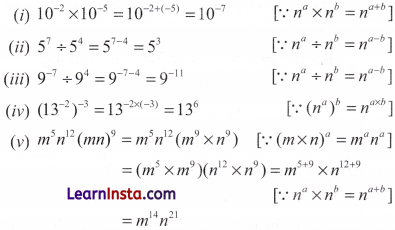
Simplify and write these in the exponential form.
(i) 10-2 × 10⁻⁵
(ii) 57 ÷ 54
(iii) 9-7 ÷ 94
(iv) (13-2)-3
(v) m5 n12 (mn)9
Solution:
Question 6.
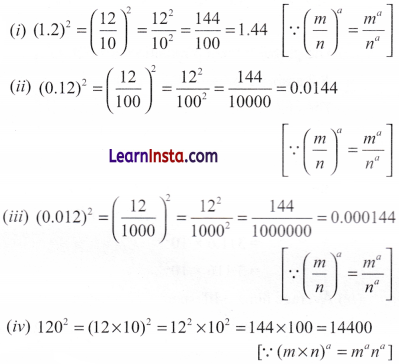
If 122 = 144, what is
(i) (1.2)2
(ii) (0.12)2
(iii) (0.012)2
(iv) 1202
Solution:
Question 7.
Circle the numbers that are the same-
24 × 36, 64 × 32, 610, 182 × 62, 624
Solution:
24 × 36
64 × 32 = (2 × 3)4 × 32
= 24 × 34 × 32
= 24 × 34+2
= 24 × 36
610 = (2 × 3)10 = 210 × 310
182 × 62 = (2 × 32)2 × (2 × 3)2
= (22 × 34) × (22 × 32)
= 22+2 × 34+2
= 24 × 36
624 = (2 × 3)24 = 224 × 324
From the above, we find that 24 × 36 = 64 × 32 = 182 × 62.
Question 8.
Identify the greater number in each of the following.
(i) 43 or 34
(ii) 28 or 82
(iii) 1002 or 2100
Solution:
(i) 43 = 64 and 34 = 81
64 < 81, so 43 < 34
(ii) 28 = 256 and 82 = 64
256 > 64, so 28 > 82
(iii) From the first two parts, we can generalise that
If a > b, then ab < ba, where a and b are positive integers greater than 1, except 3 > 2.
So, we can say that 1002 < 2100.
Question 9.
A dairy plans to produce 8.5 billion packets of milk in a year. They want a unique ID (identifier) code for each packet. If they choose to use the digits 0-9, how many digits should the code consist of?
Solution:
To determine the number of digits needed for a unique ID code, we need to find the smallest number of digits that allows for at least 8.5 billion unique combinations.
Let n be the number of digits in the code.
With digits 0-9, there are 10 possible choices for each digit.
The number of unique codes possible with n digits is 10n.
We need to find the smallest n such that 10n ≥ 8,500,000,000
Let’s test powers of 10:
101 = 10
102 = 100
103 = 1,000
104 = 10,000
105 = 100,000
106 = 1,000,000 (1 million)
107 = 10,000,000 (10 million)
108 = 100,000,000 (100 million)
109 = 1,000,000,000(1 billion)
1010 = 10,000,000,000 (10 billion)
Since the dairy plans to produce 8.5 billion packets, we need enough unique IDs to cover this amount.
Here, 109 < 8.5 billion < 1010
Therefore, the code should consist of 10 digits.
Question 10.
64 is a square number (82) and a cube number (43). Are there other numbers that are both squares and cubes? Is there a way to describe such numbers in general?
Solution:
Yes, other numbers are both squares and cubes.
Here are a few examples:
729: 729 = 272 and 729 = 93. (And 729 = 36)
4096: 4096 = 642 and 4096 = 163. (And 4096 = 46)
15625: 15625 = 1252 and 15625 = 253. (And 15625 = 56)
Any number that is a perfect sixth power will be both a square and a cube.
Question 11.
A digital locker has an alphanumeric (it can have both digits and letters) passcode of length 5. Some example codes are G89P0, 38098, BRJKW, and 003AZ. How many such codes are possible?
Solution:
To calculate the number of possible alphanumeric passcodes, we first determine the number of possibilities for each character position.
Digits: 0, 1, 2, 3, 4, 5, 6, 7, 8, 9 (10 possibilities)
Letters: A-Z (26 possibilities)
So, total possibilities for each position (digits + letters) = 10 + 26 = 36 possibilities.
Given that the passcode has a length of 5 characters.
Since each position can be any of the 36 alphanumeric characters, and the choices for each position are independent, we multiply the number of possibilities for each position.
Total codes = (Possibilities for 1st character) × (Possibilities for 2nd character) × (Possibilities for 3rd character) × (Possibilities for 4th character) × (Possibilities for 5th character)
= 36 × 36 × 36 × 36 × 36
= 365
Now, 365 = 60,466,176
Therefore, there are 60,466,176 possible alphanumeric codes.
Question 12.
The worldwide population of sheep (2024) is about 109, and that of goats is also about the same. What is the total population of sheep and goats?
(i) 209
(ii) 1011
(iii) 1010
(iv) 1018
(v) 2 × 10⁹
(vi) 109 + 109
Solution:
The worldwide population of sheep (2024) ~ 109
The worldwide population of goat (2024) ~ 109
So, the total worldwide population of sheep and goat is ~ 109 + 109 = 2 × 10⁹
Hence, options (v) and (vi) are both correct.
Question 13.
Calculate and write the answer in scientific notation:
(i) If each person in the world had 30 pieces of clothing, find the total number of pieces of clothing.
(ii) There are about 100 million bee colonies in the world. Find the number of honeybees if each colony has about 50,000 bees.
(iii) The human body has about 38 trillion bacterial cells. Find the bacterial population residing in all humans in the world.
(iv) Total time spent eating in a lifetime in seconds.
Solution:
(i) The global human population as of 2025 is 8.2 arab/8.2 billion = (8.2) × 109.
Given, each person in the world had 30 pieces of clothing.
So, the total number of pieces of clothing = 30 × (8.2 × 109)
= 246 × 109
= 2.46 × 10¹¹
(ii) The number of bee colonies in the world = 100 million
= 100 × 106
= 108
Since the number of honeybees in each colony = 50000 = 5 × 10⁴
So, the total number of honeybees in 10s colonies = 108 × (5 × 104) = 5 × 10¹².
(iii) The global human population as of 2025 is 8.2 arab/8.2 billion 8.2 × 10⁹.
The number of bacterial cells in a human body = 38 trillion = 38 × 1012.
So, the bacterial population residing in all humans in the world = (8.2 × 109) × (38 × 1012)
= (8.2 × 38) × (109 × 1012)
= 311.6 × 1021
= 3.116 × 10²³
(iv) Average human lifespan = 73.5 years
Assume an average of 2 hours spent eating per day.
1 hour = 3600 seconds
And 1 year = 365.25 days (accounting for leap years)
Total hours eating in a lifetime of 73.5 years = 2 × 3600 × 365.25 × 73.5 seconds
= 193290300
= 1.93 × 10⁸ seconds
Question 14.
What was the date 1 arab/1 billion seconds ago?
Solution:
1 arab/1 billion seconds = 109 seconds = 31.7 years
The date 109 seconds or 31.7 years ago from July 22, 2025, was November 08, 1993.
The answer will vary depending on the date of calculation.
Puzzle Time! (Page 47)
In Round 2, Roxie wrote 101000 + 101000 + 101000 + 101000, and Estu wrote (101000000) × 9000. Can you say which is greater?

Solution:
Roxiewrote 101000 + 101000 + 101000 + 101000 = 4 × 101000
Estu wrote 101000000 × 9000 = 101000000 × 9 × 103 = 9 × 101000003
So, Estu’s number is greater.