Students often refer to Class 8 Ganita Prakash Solutions and NCERT Class 8 Maths Part 2 Chapter 5 Tales by Dots and Lines Question Answer Solutions to verify their answers.
Class 8 Maths Ganita Prakash Part 2 Chapter 5 Solutions
Ganita Prakash Class 8 Chapter 5 Solutions Tales by Dots and Lines
Class 8 Maths Ganita Prakash Part 2 Chapter 5 Tales by Dots and Lines Solutions Question Answer
5.1 The Balancing Act
NCERT In-Text Questions (Pages 103-105)
Question 1.
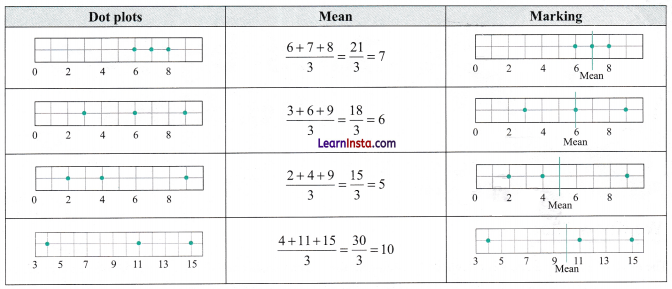
Calculate and mark the mean of each collection of data below.
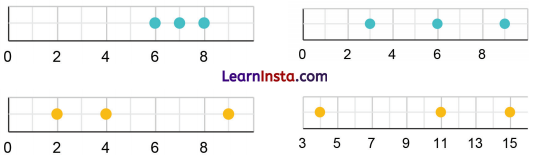
Solution:
Question 2.
Can you explain how the mean is the centre of each collection?
Solution:
In a dot plot, the mean represents the “centre” because the sum of the distances of all points to its left (LHS) is equal to the sum of the distances of all points to its right (RHS).

Question 3.
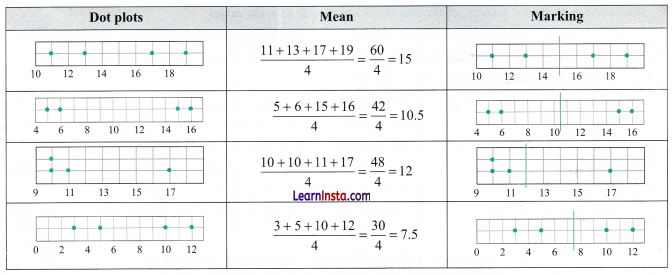
Mark the mean for the collections below.
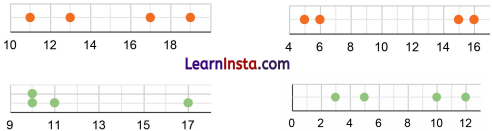
Solution:
Question 4.
Can you explain how the mean is the centre of each collection?
Solution:
Do it yourself.
Question 5.
Can there be more than one such ‘centre’? In other words, is there any other value such that the sum of the distances to the values lower than it and the values higher than it will still be equal?
Solution:
Mathematically, there cannot be more than one such “centre” for a given set of data. The arithmetic mean is the unique value for which the sum of the distances to the values lower than it (LHS) and the values higher than it (RHS) is equal.
Question 6.
What happens to the mean when an existing value is removed? When will the mean increase, decrease, or stay the same?
Solution:
When an existing value is removed, the mean shifts to rebalance the total distances of the remaining data points:
- The mean increases if a value smaller than the mean is removed.
- The mean decreases if a value larger than the mean is removed.
- The mean stays the same if a value exactly equal to the mean is removed.
This happens because the mean is the point where the sum of distances on the left (LHS) equals the sum of distances on the right (RHS).
Removing value from one side causes the mean to shift towards the opposite side to restore balance.
Question 7.
What happens to the mean if a value equal to the mean is included or removed?
Solution:
When a value equal to the mean is included or removed, the mean stays the same. This is because, using the fair-share interpretation, the mean represents an equal distribution of the total sum. Adding or removing a value equal to the mean doesn’t affect this balance, so the mean remains unchanged.
Unchanging Mean!
NCERT In-Text Questions (Page 106)
Question 1.
Explore if it is possible to include or remove 2 values such that the mean is unchanged.
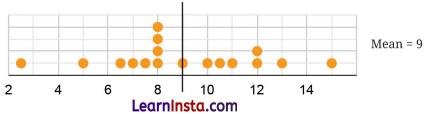
You may use the following data to experiment with.
Solution:
Yes, it is possible to include or remove two values without changing the mean.
Since the mean of the data is 9, if we include 7 and 11, which are equally distant from 9 (the mean), the total increases, but the balance around 9 is maintained, so the mean remains 9.
Similarly, if we remove 8 and 10, their distances from the mean are equal and opposite, so the total distances removed from the left and the right are equal, and the mean remains 9.
Other pairs that can be removed are: (7, 11), (6, 12), (5, 13), so that the mean remains unchanged.
Question 2.
How about including or removing 3 values without changing the mean? Is it possible?
Solution:
Yes, it is possible to include or remove three values without changing the mean.
For example, remove the values: 7, 9, and 11
The distances from the mean (9) for 7 is 2 in the LHS, for 9 it is 0, and for 11 it is 2 in the RHS.
Since the total distance in the LHS of the mean equals the total distance in the RHS of the mean, the mean remains 9.
Further, removing 3 values (unequal distances): 6, 8, and 13.
Distances from the mean (9) for 6 is 3 in the LHS, for 8 it is 1 in the LHS, and for 13 it is 4 in the RHS.
So, total distance on the left of the mean = 3 + 1 = 4
Total distance on the right of the mean = 4
Hence, the mean (9) remains unchanged.
Similarly, add the values: 7, 9, and 11
Average of the added values: (7 + 9 + 11) ÷ 3 = 9
Since their averages equal the original mean, the overall mean remains 9.
Thus, we can include or remove three (or any number of) values without changing the mean, as long as the average of those values is equal to the original mean.
Question 3.
Try to include 2 values greater than the mean and 1 value less than the mean, so that the mean stays the same.
Solution:
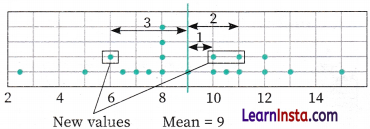
Adding 6, 10, and 11 to the above data does not change the mean.
Relatively Unchanged!
NCERT In-Text Questions (Pages 106-107)
Question 1.
We saw what happens to the mean when values are included or removed from the collection. What happens to the mean if every value in the collection increases by some fixed number?
Solution:
The mean is the sum of all the values divided by the total number of values. If every value in the collection is product increased by a fixed number, the sum of the values increases by the total of that fixed number multiplied by the number of values. Since the number of values remains the same, the mean will increase by the fixed number added to each value.
Question 2.
Consider the data: 8, 3, 10, 13, 4, 6, 7, 7, 8, 8, 5. Calculate its mean.
Solution:
Mean = \(\frac{\text { Sum of all the values }}{\text { Number of values }}\)
= \(\frac{8+3+10+13+4+6+7+7+8+8+5}{11}\)
= \(\frac {79}{11}\)
= 7.18
Question 3.
Try to explain, using algebra, what the average is when a fixed number, e.g., 2, is subtracted from every value in the collection.
Solution:
Let there be n data values: x1, x2, x3, x4, ….. xn
The original sum of n numbers is:
Sum = x1 + x2 + x3 + x4 + … + xn
Average = \(\frac{x_1+x_2+x_3+x_4+\ldots+x_n}{n}\)
Subtracting 2 from every value, the new sum = (x1 – 2) + (x2 – 2) + (x3 – 2) + … + (xn – 2) = (x1 + x2 + x3 + x4 + … + xn) – 2n
New average = \(\frac{\left(x_1+x_2+x_3+x_4+\ldots+x_n\right)-2 n}{n}\)
= \(\frac{\left(x_1+x_2+x_3+x_4+\ldots+x_n\right)}{n}-\frac{2 n}{n}\)
= Original average – 2
Thus, the new average is 2 less than the original average.
Question 4.
Try to explain this using the fair-share interpretation of the average that you learnt last year.
Solution:
Do it yourself.
Spreadsheets
NCERT In-Text Questions (Pages 112 -113)
Question 1.
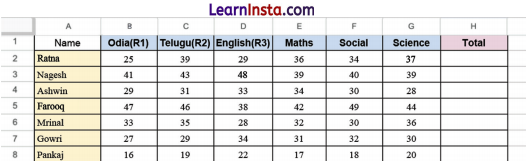
Can you tell what data is in column B7?
Solution:
In cell B7, the data shows Gowri’s marks in Odia, that is, 27.
Question 2.
In which subjects has Ashwin scored more than 30 marks?
Solution:
Ashwin scored more than 30 marks in Telugu, English, and Maths.
Question 3.
What formula would you type to find out the class average marks in Science?
Solution:
To find the class average marks in Science, we would use the formula for AVERAGE on the data range in column G.
Since the students’ marks are located from row 2 to row 8, the formula is = AVERAGE(G2 : G8)
Question 4.
Find out if the class average marks in Odia are greater than the class average marks in Telugu.
Solution:
Marks in Odia (Column B): 25, 41, 29, 47, 33, 27, 16
Average marks in Odia = \(\frac{\text { Total marks in Odia }}{\text { Number of students }}\)
= \(\frac{25+41+29+47+33+27+16}{7}\)
= \(\frac {218}{7}\)
= 31.14
Marks in Telugu (Column C): 39, 43, 31, 46, 35, 29, 19
Average marks in Telugu = \(\frac{39+43+31+46+35+29+19}{7}\)
= \(\frac {242}{7}\)
= 34.57
No, the class average marks in Odia are not greater than the class average marks in Telugu.
In fact, every individual student in the list scored higher in Telugu than they did in Odia.
Question 5.
Show the average marks in other subjects after the last row by typing the appropriate formulae.
Solution:
Formula for average marks in:
English = AVERAGE (D2 : D8)
Maths = AVERAGE (E2 : E8)
Social = AVERAGE (F2 : F8)
Question 6.
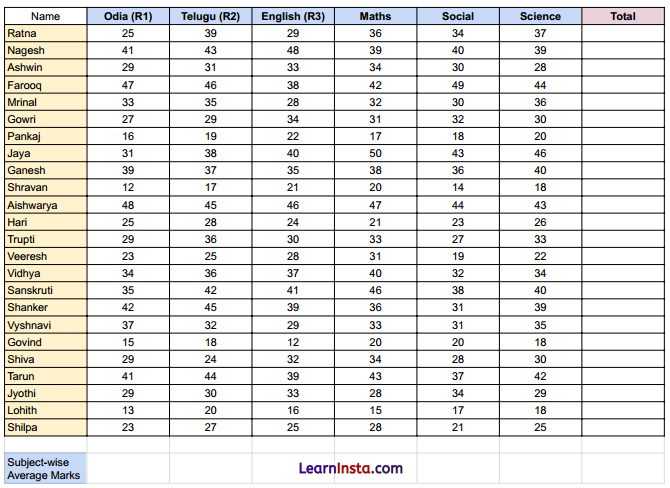
Get the total scores of each student by typing the appropriate formulae.
Solution:
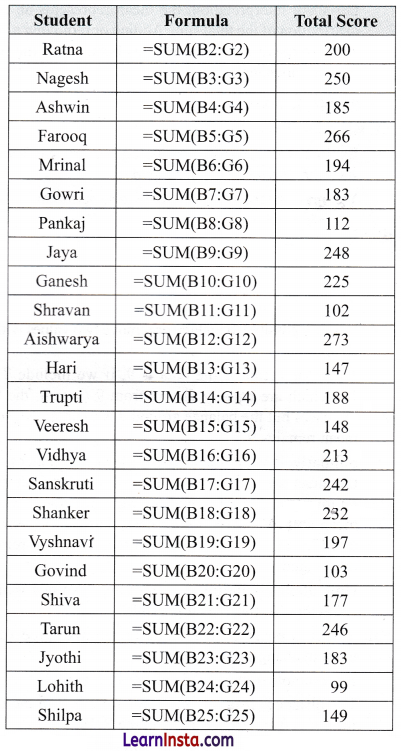
Figure it Out (Pages 113-116)
Question 1.
Find the mean of the following data and share your observations:
(i) The first 50 natural numbers.
(ii) The first 50-odd numbers.
(iii) The first 50 multiples of 4.
Solution:
(i) The sum of the first 50 natural numbers = \(\frac{50(50+1)}{2}\) = 1275
(∵ Sum of the first n natural numbers = \(\frac{n(n+1)}{2}\))
∴ Mean = \(\frac {1275}{50}\) = 25.5
(ii) The sum of the first 50 odd numbers = 502 = 2500
(∵ Sum of the first n odd numbers = n2)
∴ Mean = \(\frac {2500}{50}\) = 50
(iii) The first 50 multiples of 4 are 4, 8, 12,…, 200
So, sum = 4 × Sum of the first 50 natural numbers
= 4 × 1275
= 5100
∴ Mean = \(\frac {5100}{50}\) = 102
Question 2.
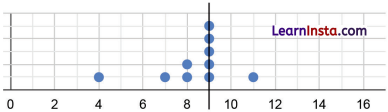
The dot plot below shows a collection of data and its average, but one dot is missing. Mark the missing value so that the mean is 9 (as shown below).
Solution:
We are given that the mean is at 9.
Since 1 dot is at 4, the distance is 4 – 9 = -5
1 dot is at 7, so the distance is 7 – 9 = -2
2 dots are at 8, so the sum of distances is 2 × (8 – 9) = -2
So, the total distance of the dots on the left = -5 + (-2) + (-2) = -9
5 dots are at 9, so the distance is 5 × (9 – 9) = 0 (these don’t affect the balance).
On the right, 1 dot is at 11, so the distance is 11 – 9 = +2
Currently, the sum of all distances = -9 + 0 + 2 = -7
To make the mean exactly 9, the sum of all distances must be 0.
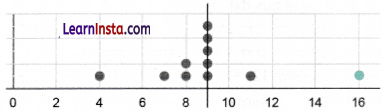
This means our missing dot must provide a distance of +7.
So, the location of the missing dot is 9 + 7 = 16.
Thus, the correct dot plot is:
Question 3.
Sudhakar, the class teacher, asks Shreyas to measure the heights of all 24 students in his class and calculate the average height. Shreyas informs the teacher that the average height is 150.2 cm. Sudhakar discovers that the students were wearing uniform shoes when the measurements were taken, and the shoes added 1 cm to the height.
(i) Should the teacher get all the heights measured again, without the shoes, to find the correct average height? Or is there a simpler way?
(ii) What is the correct average height of the class?
(a) 174.2 cm
(b) 126.2 cm
(c) 150.2 cm
(d) 149.2 cm
(e) 151.2 cm
(f) None of the above
(g) Insufficient information
Solution:
(i) No, the teacher should not get all the heights measured again. Since every student was wearing shoes that added exactly 1 cm to their height, the average height is exactly 1 cm higher than the “true” average. We can simply subtract 1 cm from 150.2 cm to get the correct average height.
(ii) Correct average height of the class = 150.2 cm – 1 cm = 149.2 cm
Therefore, the correct option is (d) 149.2 cm.
Question 4.
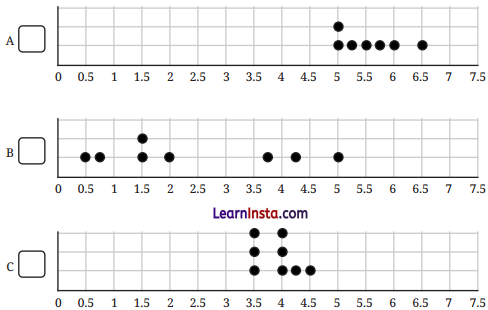
The three dot plots below show the lengths, in minutes, of songs from different albums. Which of these has a mean of 5.57 minutes? Explain how you arrived at the answer.
Solution:
Since only album A has dot plot values ranging from 5 to 6.5, the mean 5.57 must belong to album A.
Further, to confirm this,
Average length of songs of album A = \(\frac{5.0+5.0+5.25+5.5+5.75+6.0+6.5}{7}\)
= \(\frac {39}{7}\)
= 5.57
Question 5.
Find the median of 8, 10, 19, 23, 26, 34, 40, 41, 41, 48, 51, 55, 70, 84, 91, 92.
(i) If we include one value in the data (in the given list) without affecting the median, what could that value be?
(ii) If we include two values in the data without affecting the median, what could the two values be?
(iii) If we remove one value from the data without affecting the median, what could the value be?
Solution:
Given data 8, 10, 19, 23, 26, 34, 40, 41, 41, 48, 51, 55, 70, 84, 91, 92
Here, the number of observations (n) = 16
So, the median = Average of 8th and 9th terms
= \(\frac{41+41}{2}\)
= 41
(i) As we have an even number of data points, adding one value will result in an odd number of data points (n = 17).
The median will then be the middle value (the 9th term).
If we add a value greater than or less than the median, the median will not be affected and will remain 41.
(ii) Adding two values makes the total number of observations 18 (even).
Then, the median will be the average of the 9th and the 10th terms.
To keep this average at 41, we have two main strategies:
Either add two 41s: This keeps the centre of the data clustered at 41.
Or we can add one value ≤ 41 and another value ≥ 41.
For example, 35 and 42 will maintain the median at 41.
(iii) After removing one value, there will be 15 values.
The median will then be the middle value (8th term).
No matter which value is removed, the 8th term remains 41.
So any one value can be removed without changing the median.
For example, the removed value could be 8 or 92, even 41.
Question 6.
Examine the statements below and justify whether the statement is always true, sometimes true, or never true.
(i) Removing a value less than the median will decrease the median.
(ii) Including a value less than the mean will decrease the mean.
(iii) Including any 4 values will not affect the median.
(iv) Including 4 values less than the median will increase the median.
Solution:
(i) Never true: Removing a value that is less than the median does not decrease the median.
Such a removal can either leave the median unchanged or increase it, depending on how the middle position of the data is affected.
For example, if we take the data set: 5, 8, 10, 20, 25, the median is 10, and if we remove 5 (< 10),
The median of data 8, 10, 20, 25 becomes \(\frac{10+20}{2}\) = 15, i.e., it increases.
If we fake the data set: 8, 10, 10, 10, 18, the median is 10, but if we remove 8 (< 10),
The median of data 8, 10, 10, 18 remains 10, as \(\frac{10+10}{2}\) = 10
(ii) Always true: As the mean is the average of all the values, adding a value that is less than the current mean pulls the average down, so the mean must decrease.
For example, mean of 2, 4, 6, 8, 10 = \(\frac{2+4+6+8+10}{5}\) = 6
If we add 5, which is less than the mean (6), into the data,
the new mean = \(\frac{2+4+5+6+8+10}{6}\)
= \(\frac {35}{6}\)
~ 5.8 < 6
(iii) Sometimes true: If we add two values smaller than the median and two values greater than the median, the “middle” stays balanced, and the median remains unchanged. And if we add four values that are all greater than the current median, the centre of the data set will shift to the right, increasing the median.
For example, if we have the data set 10, 20, 30, the median is 20, and if we add two values smaller than 20 and two values greater than 20, such as 1, 2, 10, 20, 30, 40, 50, the median remains 20. Further, if we add four values that are all greater than the current median, such as 10, 20, 30, 40, 50, 60, 70, the middle position will shift from 20 to 40, increasing the median from 20 to 40.
(iv) Never true: Adding values smaller than the median shifts the data towards the lower side.
This can either decrease the median or keep it the same, but it cannot increase the median.
Question 7.
The mean of the numbers 8, 13, 10, 4, 5, 20, y, 10 is 10.375. Find the value of y.
Solution:
Given mean = 10.375
Since, Mean = \(\frac{\text { Sum of all data values }}{\text { Total number of data values }}\)
⇒ Mean = \(\frac{8+13+10+4+5+20+y+10}{8}\)
⇒ \(\frac{70+y}{8}\) = 10.375
⇒ 70 + y = 83
⇒ y = 13
Question 8.
The mean of a set of data with 15 values is 134. Find the sum of the data.
Solution:
Since, mean = \(\frac{\text { Sum of all data values }}{\text { Number of data values }}\)
⇒ 134 = \(\frac{\text { Sum of data all data value }}{15}\)
⇒ Sum of the data = 134 × 15 = 2010
Question 9.
Consider the data: 12, 47, 8, 73, 18, 35, 39, 8, 29, 25, p. Which of the following numbers could be p if the median of this data is 29?
(i) 10
(ii) 25
(iii) 40
(iv) 100
(v) 29
(vi) 47
(vii) 30
Solution:
Given data: 12, 47, 8, 73, 18, 35, 39, 8, 29, 25, p
Arrange the known data in ascending order: 8, 8, 12, 18, 25, 29, 35, 39, 47, 73
Here, the number of known data values = 10
and the number of unknown data values = 1
When we add p, there will be 11 total values.
In a set of 11 values, the median is the 6th value in the sorted list.
For the median of the given data to be 29, the value of p should be ≥ 29
So, the numbers that could be p, so that the median of the data is 29, are (iii) 40, (iv) 100, (v) 29, (vi) 47, and (vii) 30.
Question 10.
The number of times students rode their cycles in a week is shown in the dot plot below. Four students rode their cycles twice that week.
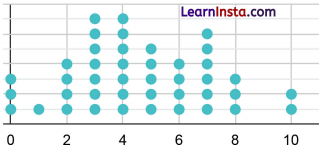
(i) Find the average number of times students rode their cycles.
(ii) Find the median number of times students rode their cycles.
(iii) Which of the following statements are valid? Why?
(a) Everyone used their cycle at least once.
(b) Almost everyone used their cycle a few times.
(c) There are some students who cycled more than once on some days.
(d) Exactly 5 students have used their cycles more than once on some days.
(e) The following week, if all of them cycled 1 more time than they did the previous week, what would be the average and median of the next week’s data?
Solution:
In the given dot plot, we first list the number of students (dots) for each frequency of cycling:
0 times: 3 students
1 time: 1 student
2 times: 4 students
3 times: 7 students
4 times: 7 students
5 times: 5 students
6 times: 4 students
7 times: 6 students
8 times: 3 students
10 times: 2 students
Total number of students = 3 + 1 + 4 + 7 + 7 + 5 + 4 + 6 + 3 + 2 = 42 students.
(i) Average number of times students rode their cycles = \(\frac{\text { Number of rides }}{\text { Total number of students }}\)
= \(\begin{gathered}
0 \times 3+1 \times 1+2 \times 4+3 \times 7+ \\
\frac{4 \times 7+5 \times 5+6 \times 4+7 \times 6+8 \times 3+10 \times 2}{42}
\end{gathered}\)
= \(\frac {193}{42}\)
= 4.6 times
(ii) The median is the middle value.
Since there are 42 students (an even number), the median is the average of the 21st and 22nd values.
Counting from the left: 3 (at 0) + 1 (at 1) + 4 (at 2) + 7 (at 3) = 15 students.
The next 7 students are at “4”. This covers the 16th through 22nd positions.
Both the 21st and 22nd values are 4.
So, the median is 4.
(iii) (a) Invalid: Three students rode their cycles 0 times, so everyone did not use their cycles.
(b) Valid: This is a subjective interpretation, but since the majority of dots (38 out of 42) fall from 2 to 10, it is reasonable to say “almost everyone” used it a few times.
(c) Valid: The question tells the number of times students rode “in a week.” If a student cycled 10 times in 7 days, he/she must have cycled more than once on some days.
(d) Invalid: This cannot be determined exactly. While students who rode 8 or 10 times definitely cycled more than once on some days, many others (such as those who rode 4 or 5 times) might also have cycled twice on one day and not at all on others.
(e) If every student cycled exactly 1 more time than the previous week, the entire data set shifts up by 1.
So, new average = 4.6 + 1 = 5.6
And, new median = 4 + 1 = 5
Question 11.
A dart-throwing competition was organised in a school. The number of throws participants took to hit the bull’s eye (the centre circle) is given in the table below.

Describe the data using its minimum, maximum, mean and median.

Solution:
Minimum: The lowest number of trials taken by a student to hit the bull’s eye is 1.
Maximum: The highest number of trials taken by a student in this data set is 10.
Mean (Average): The mean is the total number of trials divided by the total number of students
= \(\begin{gathered}
1 \times 1+2 \times 0+3 \times 0+4 \times 1+5 \times 4+ \\
\frac{6 \times 9+7 \times 12+8 \times 15+9 \times 10+10 \times 10}{1+1+4+9+12+15+10+10}
\end{gathered}\)
= \(\frac {473}{62}\)
~ 7.6
Median: As the total number of students = 62 (even)
So, the median is the average of the 31st and the 32nd values, i.e., the number of students.
Since up to 7 trials, the number of students is 27, and, up to 8 trials, the number of students is 42, the students in this group occupy positions 28 through 42.
Since both the 31st and the 32nd students fall within this group, both have 8 trials.
So, the median number of trials is 8.
Thus, the data show that while one student was able to hit the bull’s eye on his/her first try, the majority of students required between 7 and 10 trials.
The “average” student took roughly 7.6 to 8 trials to succeed.
5.2 Visualising and Interpreting Data
Space Jam: A Traffic Problem in the Future?
NCERT In-Text Questions (Page 120)
Question 1.
Which of the following statements are valid inferences?
1. From 2012 to 2024, the worldwide count of space object launches increased every year.
2. USA is a major contributor in the years 2022-24, launching about \(\frac {3}{4}\)th of the worldwide count.
3. Nepal did not launch any object in the period 2012-24.
4. The combined count of object launches by China and Russia in 2024 is about 400.
Solution:
1. Invalid: While the general trend is upward, the green “World” line shows a slight decrease between 2014 and 2016, another dip between 2017 and 2018, and another slight dip between 2023 and 2024.
2. Valid: In 2023, for example, the World total is just under 3,000, while the United States (blue line) is at approximately 2,250.
Since \(\frac {2250}{3000}\) = 0.75 = \(\frac {3}{4}\), the USA did indeed launch about \(\frac {3}{4}\)th of the total objects.
3. Invalid: The graph provides specific data for the “World,” “United States,” “China,” and “Russia.”
Since Nepal is not listed individually, we cannot determine from this chart alone whether they launched zero objects or if their launches are included in the “World” total.
4. Valid: In 2024, the grey line (China) is at approximately 300, and the red line (Russia) is at approximately 100.
Their combined total (300 + 100) equals 400.
Question 2.
Identify tw;o consecutive years where the worldwide count increased by 2 times or more.
Solution:
Based on the provided line graph, the two consecutive years during which the worldwide count of space object launches increased by 2 times or more are 2016-2017 and 2019-2020.
In 2016, the worldwide count was approximately 240 objects and in 2017, the count surged to approximately 490 objects.
Since 240 × 2 = 480, the count in 2017 was more than 2 times the previous year’s count.
In 2019, the worldwide count was approximately 600 objects and in 2020, the count increased dramatically to approximately 1,250 objects.
Since 600 × 2 = 1,200, the count in 2020 was more than 2 times the count in 2019.
Catch the (Pattern in) Rain
NCERT In-Text Questions (Page 121)
Question 1.
Read about the south-west monsoon and north-east monsoon, and which regions come under the influence of these, and when.
Solution:
South-west monsoon: The south-west monsoon is the main rainy season in India. It usually begins in June and lasts till September.
Regions under its influence include:
- Western coastal plains, such as Kerala, Karnataka, Goa, and Maharashtra
- Central India
- Northern plains
- North-Eastern states
North-east monsoon: The north-east monsoon occurs after the south-west monsoon and generally lasts from October to December.
Regions under its influence include:
- Tamil Nadu
- Parts of Andhra Pradesh
- Parts of Karnataka
- Parts of Kerala
Figure it Out (Pages 122-123)
Question 1.
The average number of customers visiting a shop and the average number of customers actually purchasing items over different days of the week are shown in the table below. Visualise this data on a line graph.

Solution:
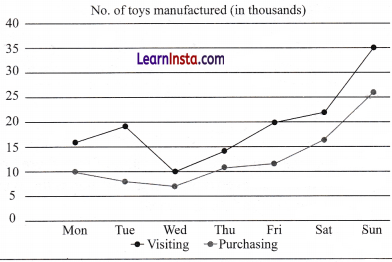
Question 2.
The average number of days of rainfall in each month for a few cities is shown in the table below:
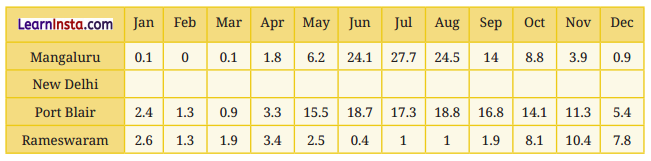
(i) What could be the possible method to compile this data?
(ii) Mark the data for Mangaluru, Port Blair, and Rameswaram in the line graph shown below. You can round off the values to the nearest integer.
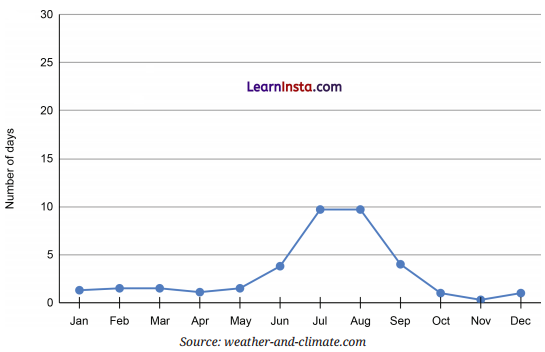
(iii) Based on the line for New Delhi in the graph, fill in the data in the table.
(iv) Which city among these receives the most number of days of rainfall per year? Which city gets the least number of days of rainfall per year?
(v) Looking at the table, when is the rainy season in New Delhi and Rameswaram?
Solution:
(i) The data could be compiled by recording daily rainfall using rain gauges at weather stations over several years and then calculating the monthly average number of rainy days.
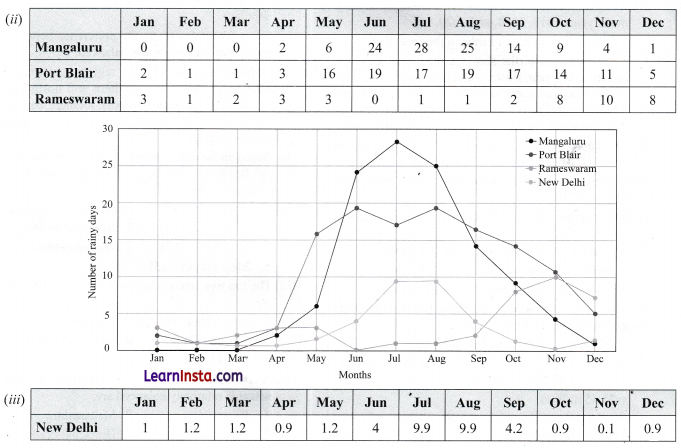
(iv) Mangaluru receives the largest number of days of rainfall in a year due to very high rainfall during the monsoon months, especially from June to September. New Delhi receives the least number of days of rainfall in a year because rainfall is low for most months, except during the monsoon season (June to September).
(v) The rainy season in New Delhi is mainly from June to September, with the highest rainfall in July and August, whereas the rainy season in Rameswaram is mainly from October to December, with the highest rainfall in November.
Question 3.
The following line graph shows the number of births in every month in India over a time period:
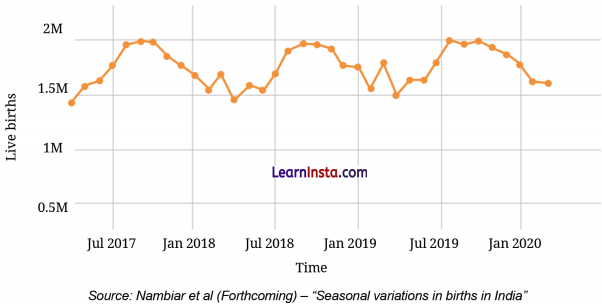
(i) What are your observations?
(ii) What was the approximate number of births in July 2017?
(iii) What time period does the graph capture?
(iv) Compare the number of births in January in the years 2018, 2019, and 2020.
(v) Estimate the number of births in the year 2019.
Solution:
(i) The number of births shows a repeating seasonal pattern every year.
Births increase during the middle of the year and decrease at the beginning and end of each year.
Overall, the number of births remains between about 1.4 million and 1.9 million per month.
(ii) The approximate number of births in July 2017 is about 1.77 million.
(iii) The graph captures the time period from April 2017 to March 2020.
(iv) Comparison of the number of births in January (2018, 2019, and 2020)
- January 2018: approx 1.7 million births
- January 2019: approx 1.76 million births
- January 2020: approx 1.77 million births
The number of births is the highest in January 2020 and the lowest in January 2018.
(v) In 2019, the average number of births = 1.76 + 1.55 + 1.78 + 1.5 + 1.65 + 1.65 + 1.86 + 2 + 1.98 + 2 + 1.95 + 1.85 = 21.45 million
So, the estimated number of births in 2019 = 21.45 million ~ 21 million.
Infographics
NCERT In-Text Questions (Page 124)
Question 1.
Share your observations. Based on this infographic, answer the following:
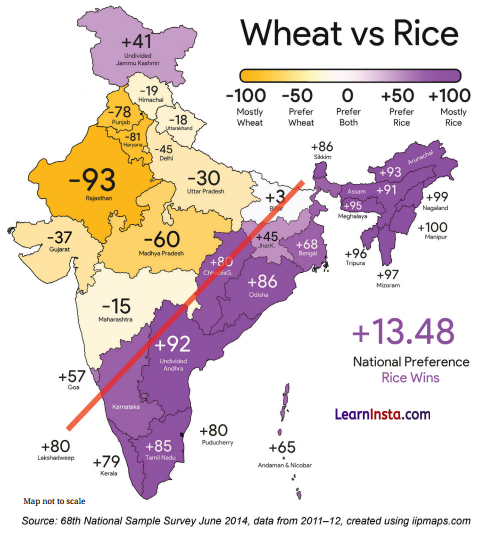
(i) The value of Karnataka is hidden. Can you guess what it could be?
(ii) Which are the top 5 states where rice is the most popular?
(iii) Which are the top 5 states where wheat is the most popular?
(iv) List a few states where the preference between rice and wheat is more or less balanced.
Solution:
The infographic shows a clear regional pattern in food preferences across India.
Northern and north-western states mainly prefer wheat, southern, eastern, and north-eastern states mainly prefer rice.
Overall, national preference slightly favours rice.
(i) Based on the colour intensity, the value of Karnataka can be estimated to be around +70 to +80, indicating a strong preference for rice.
(ii) The top five states where rice is the most popular are:
- Manipur (+100)
- Nagaland (+99)
- Mizoram (+97)
- Tripura (+96)
- Meghalaya (+95)
(iii) The top five states where wheat is the most popular are:
- Rajasthan (-93)
- Haryana (-81)
- Punjab (-78)
- Madhya Pradesh (-60)
- Delhi (-45)
(iv) A few states where the preference between rice and wheat is relatively balanced are:
- Bihar
- Maharashtra
- Uttarakhand
- Himachal Pradesh
What can a Strip Say?
NCERT In-Text Questions (Pages 125-126)
Question 1.
Look at the three coloured strips carefully.
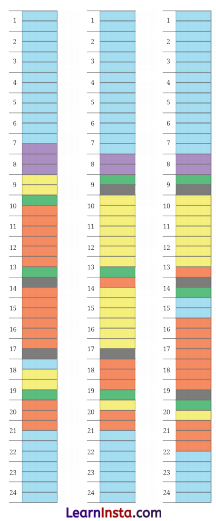
(i) What activity does each colour stand for?
(ii) The three strips correspond to the days Friday – Sunday in some order. Which day do you think each strip represents?
(iii) On one of these days, he went out with friends to watch a long movie. When do you think this happened?
(iv) At what time does his school break for lunch?
(v) What more can the strips tell us?
Solution:
(i) Blue: Sleeping (as it usually shows blocks from 8:30 p.m. to 7 a.m.
Purple: Showering and getting dressed, yoga or exercise (as it usually shows blocks from 7:00 a.m. to 8 a.m.).
Yellow: Attending classes, studying, and doing homework.
Green: Eating (single blocks occurring around breakfast, lunch, and dinner times).
Orange: Meeting friends, hobbies, media, time with family (often happens in the evening or during leisure time).
Grey: Travelling
(ii) The strip with more study hours likely represents Friday, a school day, shown by the second strip.
The strip showing less study time and more family or social time likely represents Saturday, shown by the third strip.
The strip with the longest leisure time for family, friends, and hobbies represents Sunday, shown by the first strip.
(iii) This probably happened on Saturday evening, since there is a block of leisure time from 3 p.m. to 6:30 p.m., as shown.
(iv) The strip shows a change of colour (for eating) from around 12:30 p.m. to 1:00 p.m., which indicates lunchtime.
(v) The strips show how Manoj balances his time between study, rest, exercise, meals, and leisure activities.
They also help him identify patterns, such as when he is the busiest or gets the least sleep.
Question 2.
What would your strip for a weekday look like? How similar or different is it to Manoj’s?
Solution:
Do it yourself.
Question 3.
What would a strip of your typical day during your vacation look like? How similar/different would it look?
Solution:
Do it yourself.
Question 4.
What would a strip for any of the adults in your family look like? Make a strip of a day for any adult at home. Compare your strip with theirs. What do you find interesting?
Solution:
Do it yourself.
Data Story: Sleepy-Deepy
Figure it Out (Pages 127-132)
Question 1.
Mean Grids:

(i) Fill the grid with 9 distinct numbers such that the average along each row, column, and diagonal is 10.
(ii) Can we fill the grid by changing a few numbers and still get 10 as the average in all directions?
Solution:
(i) Here, each row adds up to 30.
Each column adds up to 30.
Each diagonal adds up to 30.
So, the average = \(\frac {30}{3}\) = 10 along each row, column, and diagonal.

(ii) If we keep 10 at the centre and change the other numbers in pairs such that each pair still adds up to 20, the row, column, and diagonal sums will remain 30.
For example:
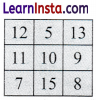
Hence, by changing a few numbers in this balanced way, we can create different grids that still have an average of 10 in all directions.
Question 2.
Give two examples of data that satisfy each of the following conditions:
(i) 3 numbers whose mean is 8.
(ii) 4 numbers whose median is 15.5.
(iii) 5 numbers whose mean is 13.6.
(iv) 6 numbers whose mean = median.
(v) 6 numbers whose mean > median.
Solution:
(i) Let the three numbers be 6, 8, and 10.
Then, the mean = \(\frac{6+8+10}{3}=\frac{24}{3}\) = 8
Let the other three numbers be 4, 9, and 11.
Then the mean = \(\frac{4+9+11}{3}=\frac{24}{3}\) = 8
(ii) Let the four numbers be 12, 15, 16, and 20.
Then, the median = \(\frac{15+16}{2}=\frac{31}{2}\) = 15.5
Let the other four numbers be 11, 14, 17, and 21
Then the median = \(\frac{14+17}{2}=\frac{31}{2}\) = 15.5
(iii) Let the five numbers be 10, 12, 13, 16, and 17.
The mean = \(\frac{10+12+13+16+17}{5}=\frac{68}{5}\) = 13.6
Let the other five numbers be 9, 11, 17, 8, and 23.
The mean = \(\frac{9+11+17+8+23}{5}=\frac{68}{5}\) = 13.6
(iv) Let the six numbers be 10, 12, 13, 15, 16, and 18.
The mean = \(\frac{10+12+13+15+16+18}{6}\)
= \(\frac {84}{6}\)
= 14
And, the median = \(\frac{13+15}{2}=\frac{28}{2}\) = 14
Let the other six numbers be 8, 9, 11, 17, 19, and 20.
The mean = \(\frac{8+9+11+17+19+20}{6}\)
= \(\frac {84}{6}\)
= 14
And, the median = \(\frac{11+17}{2}=\frac{28}{2}\) = 14
(v) Let the six numbers be 5, 7, 9, 10, 12, and 35.
The mean = \(\frac{5+7+9+10+12+35}{6}\)
= \(\frac {78}{6}\)
= 13
And, the median = \(\frac{9+10}{2}=\frac{19}{2}\)
Thus, mean > median.
Let the other six numbers be 6, 8, 11, 13, 14, and 26.
The mean = \(\frac{6+8+11+13+14+26}{6}\)
= \(\frac {78}{6}\)
= 13
And, the median = \(\frac{11+13}{2}=\frac{24}{2}\) = 12
Thus, mean > median.
Question 3.
Fill in the blanks such that the median of the collection is 13: 5, 21, 14, _____, ______, ______. How many possibilities exist if only counting numbers are allowed?
Solution:
Here, we have a collection of six numbers. For a collection with an even number of observations, the median is the average of the 3rd and 4th numbers after arranging the data in ascending order.
For the median to be 13, the average of the 3rd and 4th numbers must be 13.
Therefore, \(\frac{x_3+x_4}{2}\) = 13
x3 + x4 = 26
The given numbers are 5, 14, and 21.
We need to choose three counting numbers such that, after arranging all six numbers in ascending order, the 3rd and 4th numbers add up to 26.
One way this can happen is when the 3rd and 4th numbers are 13 and 13.
For example, if the three missing numbers are 1, 13, and 13, the sorted list becomes: 1, 5, 13, 13, 14, 21
The middle numbers are 13 and 13, and their average is 13.
Another way is when the 3rd and 4th numbers are 12 and 14,
since \(\frac{12+14}{2}\) = 13
This is also a valid possibility.
In general, any choice of three counting numbers that results in the 3rd and 4th numbers summing to 26 after sorting will give a median of 13.
Since counting numbers have no upper limit, such combinations can be formed in infinitely many ways.
Question 4.
Fill in the blanks such that the mean of the collection is 6.5: 3, 11, ____, ____, 15, 6. How many possibilities exist if only counting numbers are allowed?
Solution:
Given, mean = 6.5 and total the number of values = 6
So, the sum = 6.5 × 6 = 39
Current sum = 3 + 11 + 15 + 6 = 35
So, the sum of missing values = 39 – 35 = 4
Since only counting numbers (1, 2, 3, …) are allowed, the possible pairs are: (2, 2) and (3, 1) or (1, 3)
Hence, there are only 2 possibilities to fill the blanks.
Question 5.
Check whether each of the statements below is true. Justify your reasoning. Use algebra, if necessary, to justify.
(i) The average of two even numbers is even.
(ii) The average of any two multiples of 5 will be a multiple of 5.
(iii) The average of any 5 multiples of 5 will also be a multiple of 5.
Solution:
(i) False
The average of two even numbers, 2 and 4 = \(\frac{2+4}{2}=\frac{6}{2}\) = 3 which is an odd.
(ii) False
Let the two multiples of 5 be 15 and 20.
Then the average = \(\frac{15+20}{2}=\frac{35}{2}\) = 17.5, which is not a multiple of 5.
(iii) False
Let the 5 multiples of 5 be 5, 10, 15, 20, and 30.
Then the average = \(\frac{5+10+15+20+30}{5}=\frac{80}{5}\) = 16, which is not a multiple of 5.
Hence, none of the given statements is true.
Question 6.
There were 2 new admissions to Sudhakar’s class just a couple of days after the class average height was found to be 150.2 cm.
(i) Which of the following statements are correct? Why?
(a) The average height of the class will increase as there are 2 new values.
(b) The average height of the class will remain the same.
(c) The heights of the new students have to be measured to find out the new average height.
(d) The heights of everyone in the class have to be measured again to calculate the new average height.
Solution:
(c) The heights of the new students have to be measured to find out the new average height.
To find the new average, we only need the sum of the new data points.
We do not need to re-measure all the students because their total sum is already known from the previous average.
However, without the specific heights of the two new students, it is impossible to know the new average.
(ii) The heights of the two new joinees are 149 cm and 152 cm. Which of the following statements about the class’s average height is correct? Why?
(a) The average will remain the same.
(b) The average will increase.
(c) The average will decrease.
(d) The information is not sufficient to make a claim about the average.
Solution:
(b) The average will increase.
Since the average height of 24 students in Sudhakar’s class is 150.2 cm
So, the total height of the class is 150.2 × 24 = 3604.8 cm
Now, the heights of the two new joinees are 149 cm and 152 cm.
So, the new sum = 3604.8 + 149 + 152 = 3905.8 cm
And the new average = \(\frac{3905.8}{24+2=26}\) ~ 150.22 cm, which is slightly greater than 150.2 cm.
So, the average will increase.
(iii) Which of the following statements about the new class average height is correct? Why?
(a) The median will remain the same.
(b) The median will increase.
(c) The median will decrease.
(d) The information is not sufficient to make a claim about the median.
Solution:
(d) The information is not sufficient to make a claim about the median.
The median depends on the ordered heights of the students in the class.
Since we do not know the individual heights of the students, the median cannot be determined exactly.
Question 7.
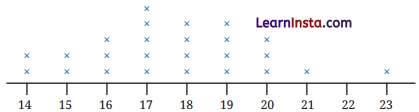
Is 17 the average of the data shown in the dot plot below? Share the method you used to answer this question.
Solution:
By the balance method: The average (mean) is the “centre” of the data set.
If 17 is the average, the “weight” of the data points to the left of 17 must equal the “weight” of the data points to the right.
Here, the data points to the left of 17: There are 7 points (2 at 14, 2 at 15, and 3 at 16).
The data points to the right of 17: There are 13 points (4 at 18, 4 at 19, 3 at 20, 1 at 21, and 1 at 23).
Since the data is “heavier” on the right side.
Specifically, there are many more points greater than 17 (including outliers such as 21 and 23) than there are below it.
Hence, the data is skewed to the right, and the average must be greater than 17.
By the calculation method:
Average = \(\begin{array}{r}
\{(14 \times 2)+(15 \times 2)+(16 \times 3) \\
+(17 \times 5)+(18 \times 4)+(19 \times 4) \\
+(20 \times 3)+(21 \times 1)+(23 \times 1)\} \\
\hline 25
\end{array}\)
= \(\frac{28+30+48+85+72+76+60+21+23}{25}\)
= \(\frac {443}{25}\)
= 17.72
Hence, the average of the shown data is 17.72 and not 17.
Question 8.
The weights of people in a group were measured every month. The average weight for the previous month was 65.3 kg, and the median weight was 67 kg. The data for this month showed that one person has lost 2 kg and two have gained 1 kg. What can we say about the change in mean weight and median weight this month?
Solution:
To find the change in the mean weight, we look at the net change in the total weight of the group.
Since the weight lost is 2 kg (by 1 person) and the weight gained is 1 kg each (by 2 persons)
The net change = 2 kg – 2 kg = 0
Since the total weight of the group has not changed, the mean weight will remain the same (65.3 kg).
The information is not sufficient to determine the change in the median.
If the person who lost weight was just above the median, or the people who gained weight were just below it, they could “shift” across the centre point, causing the median to change.
If the people who changed weight are at the extremes of the distribution (the heaviest and lightest), the middle value will remain unchanged.
Question 9.
The following table shows the retail price (in ₹) of iodised salt in January in a few states over 10 years. For your calculations and plotting, you may round off values to the nearest counting number.
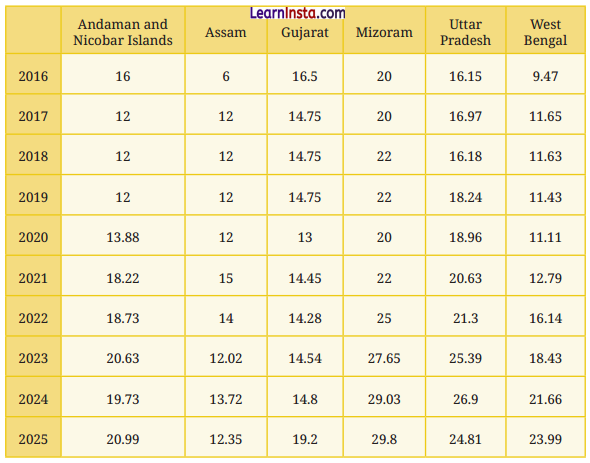
(i) Choose data from any 3 states you find interesting and present it through a line graph using an appropriate scale.
(ii) What do you find interesting in this data? Share your observations.
(iii) Compare the price variation in Gujarat and Uttar Pradesh.
(iv) In which state has the price increased the most from 2016 to 2025?
(v) What are you curious to explore further?
Solution:
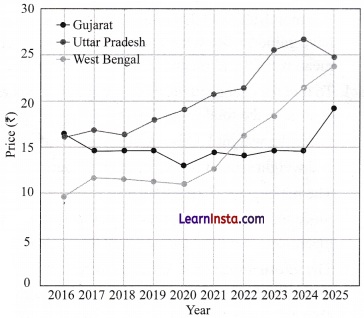
(i) Let the three states be Gujarat, Uttar Pradesh, and West Bengal.
The corresponding line graph for the retail price (in ₹) of iodised salt in these states is as follows:
(ii) The interesting observations in the given data are the following:
Consistent Inflation: Almost every state shows a significant price increase over the past 10 years.
Geographic Variance: Prices in Mizoram (reaching nearly ₹ 30) are consistently double the prices in Assam (around ₹ 12 – ₹ 15), likely due to transportation costs in hilly terrain.
Price Stability: Assam maintained a price of exactly ₹ 12 for four consecutive years (2017-2020), which is unusual compared to the more volatile prices in Uttar Pradesh.
(iii) Gujarat experienced a slight dip in prices from 2016 to 2020, hovering between ₹ 13 and ₹ 16.5.
However, in 2021, the price rose to ₹ 14.45.
Therefore, the price in Gujarat consistently increased over the years and reached ₹ 19.2 in 2025.
On the other hand, Uttar Pradesh started with ₹ 16.15 in 2016, showing a steady increase.
The rise from 2016 to 2025 is notable, especially between 2020 and 2025, when it rose sharply from ₹ 18.96 to ₹ 26.9 and further decreased in 2025.
(iv) To find the maximum increase, we calculate the difference between the prices in 2025 and 2016:
Andaman & Nicobar Islands: 20.99 – 16 = ₹ 4.99
Assam: 12.35 – 6 = ₹ 6.35
Gujarat: 19.2 – 16.5 = ₹ 2.7
Mizoram: 29.8 – 20 = ₹ 9.8
Uttar Pradesh: 24.81 – 16.15 = ₹ 8.66
West Bengal: 23.99 – 9.47 = ₹ 14.52
Hence, West Bengal has the highest price increase of ₹ 14.52 per kg from 2016 to 2025.
(v) Do it yourself.
Question 10.
Referring to the graph below, which of the following statements are valid? Why?
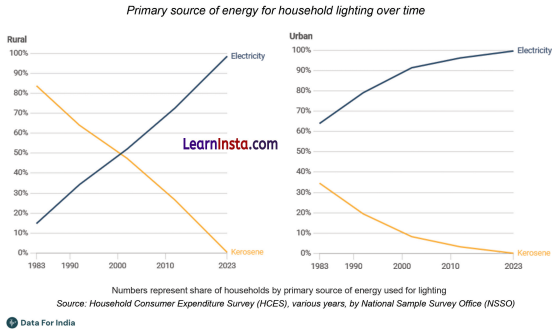
(i) In 1983, the majority in rural areas used kerosene as a primary lighting source, while the majority in urban areas used electricity.
(ii) The use of kerosene as a primary lighting source has decreased over time in both rural and urban areas.
(iii) In the year 2000, 10% of the urban households used electricity as a primary lighting source.
(iv) In 2023, there were no power cuts.
Solution:
(i) Valid.
In rural areas in 1983, the share for kerosene was above 80%, clearly showing a majority.
In urban areas in 1983, the share of electricity was over 60%, also representing a majority.
(ii) Valid.
Since the yellow line (representing kerosene) shows a steep downward trend in both graphs, starting high in 1983 and falling to 0% by 2023.
(iii) Invalid.
Looking at the urban graph for the year 2000, the electricity line is actually at the 90% mark, and not 10% mark.
It was kerosene that had dropped to roughly 10% by that time.
(iv) Invalid.
Since the graphs show the share of households using electricity/kerosene as their primary source of energy for lighting.
It does not provide any data on the frequency of power cuts.
Question 11.
Answer the following questions based on the line graph.
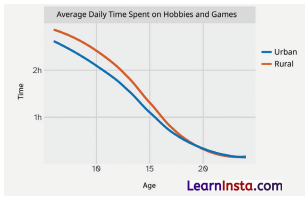
(i) How long do children aged 10 in urban areas spend each day on hobbies and games?
Solution:
Children aged 10 in urban areas spend more than 2 hours each day on hobbies and games.
(ii) At what age is the average time spent daily on hobbies and games by rural kids 1.5 hours?
(a) 8 years
(b) 10 years
(c) 12 years
(d) 14 years
(e) 18 years
Solution:
(d) 14 years
(iii) Are the following statements correct?
(a) The average time spent daily on hobbies and games by kids aged 15 is twice that of kids aged 10.
(b) All rural kids aged 15 spend at least 1 hour on hobbies and games every day.
Solution:
(a) No
(b) No
Question 12.
Individual project: Make your own activity strip for different days of the week.

(i) Do you eat and sleep at regular times every day? Typically how long do you spend outdoors?
(ii) Calculate the average time spent per activity. Represent this average day using a strip.
(iii) Similarly, track the activities of any adult at home. Compare your data with theirs.
Solution:
Do it yourself.
Question 13.
Small group project: Make a group of 3-4 members. Do at least one of the following:
(i) Track daily sleep time of all your family members for a week. Daily sleep time includes nighttime sleep, naps, and any sleep during the day.
(a) Represent this on strips.
(b) Put together the data of all your group members. Calculate the average and median sleep time of children, adults, elderly.
(c) Share your findings and observations.
(ii) When do schools start and end? On a weekday, Manoj’s school starts at 9:30 am and ends at 4:30 pm, i.e., 7 hours, which includes class time and breaks. Collect information on the daily timings of different schools for Grade 8, including class time and break time (the schools can be anywhere in the country. You can ask your neighbours, relatives, parents, and friends to find out). Analyse and present the data collected.
Solution:
Do it yourself.
Question 14.
The following graphs show the sunrise and sunset times across the year at 4 locations in India. Observe how the graphs are organised. Are you able to identify which lines indicate the sunrise and which indicate the sunset?
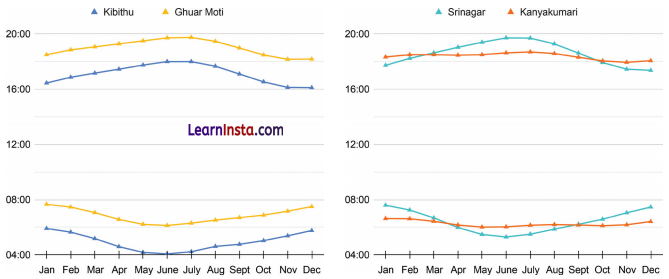
Answer the following questions based on the graphs:
(i) At which place does the sun rise the earliest in January? What is the approximate day length at this place in January?
(ii) Which place has the longest day length over the year?
(iii) Share your observations — what do you find interesting? What are you curious to find out?
Solution:
Sunrise Lines: These are the lines at the bottom of each graph (around 04:00 to 08:00).
Sunset Lines: These are the lines at the top of each graph (around 16:00 to 20:00).
(i) The sunrise is the earliest in January in Kibithu, that is, just before 6 a.m.
Since in January,
The sunrise in Kibithu ~ 05:50
and sunset in Kibithu ~ 16:13
the day length in Kibithu in January ~ 16:30 – 05:50 = 10 hours 40 minutes.
(ii) Kibithu has the longest day length over the year. During the summer months, it shows the earliest sunrises and the latest sunsets, giving it longer days compared to the other locations.
(iii) The given line graphs show that places closer to the northern part of India, such as Kibithu and Srinagar, have larger variations in day length across the year. In contrast, Kanyakumari, which is closer to the equator, has very small variations in sunrise and sunset times. This makes one curious to find out how latitude affects day lengths and why seasonal changes are more noticeable as we move away from the equator.
Question 15.
We all know the typical sunrise and sunset timings. Do you know when the moon rises and sets? Does it follow a regular pattern like the sun? Let’s find out. The following graph shows the moonrise and moonset times over a month:
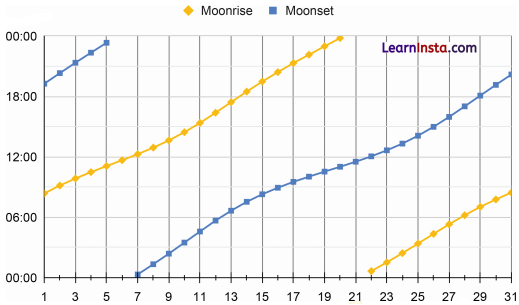
(i) Find out on what dates amavasya (new moon) and purnima (full moon) were in this month.
(ii) What do you notice? What do you wonder?
Solution:
(i) The times of moonrise and moonset depend almost entirely on the Moon’s phase.
A full Moon rises at around 6 PM and sets at around 6 AM.
So, from the given line graph, the full moon (Purnima) day is around day 14.
A new Moon isn’t visible as the Sun lights it from behind.
However, if it were visible, would it rise at around 6 AM and set at around 6 PM?
So, from the given line graph, the new moon (Amavasya) day is around day 27.
(ii) You can notice the following:
- Moonrise shifts later each day by about 50 minutes.
- When moonrise is near sunset (18:00), it is a full moon; when it is near sunrise (06:00), it is a new moon.
- Moonset also shifts similarly, occurring about 12-13 hours after moonrise on average.
You can wonder about the following:
- Why is the delay in moonrise each day about 50 minutes and not 60?
- Does the gap between moonrise and moonset change with the Moon’s phase?
- How does this pattern change with seasons and latitude?