Students often refer to Ganita Prakash Class 8 Solutions and Class 8 Maths Chapter 4 Quadrilaterals NCERT Solutions Question Answer to verify their answers.
NCERT Class 8 Maths Chapter 4 Quadrilaterals Solutions Question Answer
Ganita Prakash Class 8 Chapter 4 Solutions Quadrilaterals
NCERT Class 8 Maths Ganita Prakash Chapter 4 Quadrilaterals Solutions Question Answer
NCERT In-Text Questions (Page 82)
Question 1.
Observe the following figures.
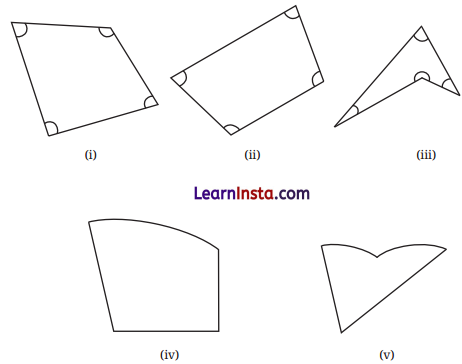
Figures (i), (ii), and (iii) are quadrilaterals, and the others are not. Why?
Solution:
Figure (iv) is not a quadrilateral because one of its “sides” is curved, which does not fulfill the condition that all sides of a polygon (and thus a quadrilateral) must be straight line segments. Similarly, figure (v) is also not a quadrilateral (a polygon with four straight sides and four vertices), for the same above reason.
4.1 Rectangles and Squares
NCERT In-Text Questions (Page 90)
Question 1.
Is it wrong to write ∆BAD ≅ ∆CDB? Why?
Solution:
Yes, it is wrong to write ∆BAD ≅ ∆CDB.
Because in a congruence statement, the order of the vertices is important, because it indicates the corresponding vertices, angles, and sides of the two triangles.
If ∆BAD ≅ ∆CDB, it implies that:
Vertex A corresponds to Vertex D. This would mean ∠A = ∠CDB.
However, ∠A = 90°, while ∠CDB (∠2) is an acute angle and generally not 90°.
For the triangles to be congruent, their corresponding parts (angles and sides) must be equal.
The proposed correspondence in ∆BAD ≅ ∆CDB does not hold for a general rectangle.
The correct correspondence is ∆BAD ≅ ∆CDB, where all corresponding angles and sides are indeed equal.
A Special Rectangle
NCERT In-Text Questions (Page 93)
Question 1.
Using this fact, construct a square with a diagonal of length 8 cm.
Solution:
We need to construct a square using the property that its diagonals are equal in length and bisect each other at right angles.
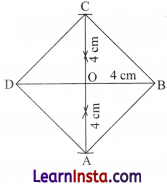
Let the diagonals be AC and BD.
Given diagonal length = 8 cm.
Since diagonals bisect each other, each half of the diagonal will be \(\frac {8}{2}\) cm = 4 cm.
Steps of Construction:
- Draw a line segment DB of length 8 cm. This will be one of the diagonals.
- Draw a perpendicular bisector to DB, intersecting it at point O. The other diagonal will lie on this line.
- Since the diagonals of a square are equal in length (8 cm) and bisect each other, the other diagonal (AC) must also be 8 cm long, and its midpoint must also be O.
- Therefore, from O, measure 4 cm upwards along the perpendicular line to mark point C, and 4 cm downwards along the perpendicular line to mark point A.
- Connect the points A, B, C, and D in order (A to B, B to C, C to D, and D to A) to form the square.
- This will result in a square ABCD with diagonals AC and BD, both of length 8 cm, bisecting each other at right angles at point O.

Figure it Out (Page 94)
Question 1.
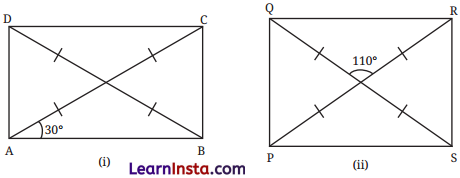
Find all the other angles inside the following rectangles.
Solution:
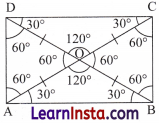
(i) Given: Rectangle ABCD, with diagonals AC and BD, intersecting and ∠CAB = 30°.
Let the diagonals AC and BD bisect each other at point O.
The diagonals AC and BD form two congruent isosceles triangles ∆AOB and ∆COD, and two other isosceles congruent triangles ∆AOD and ∆BOC.
Given, ∠CAB = 30°
Since ∆AOB is an isosceles triangle, the base angles are: ∠OAB = ∠OBA = 30°
Sum of angles in ∆OAB = 180°
∴ ∠AOB = 180° – (30° + 30°) = 120°
In ∆COD, ∠COD = ∠AOB = 120° (vertically opposite angles)
∴ ∠OCD = ∠ODC = \(\frac {1}{2}\) (180° – 120°) = 30°
In ∆AOD, ∠AOD = 180° – 120° = 60° (∵ ∠AOB + ∠AOD = 180°, linear pair)
And, ∠OAD = ∠ODA = 60° (∠OAD + ∠ODA + ∠AOD = 180° and OA = OD)
Similarly, in ∆BOC,
∠BOC = 60° and ∠OBC = ∠OCB = 60°
So, the angles inside rectangle ABCD are as follows:
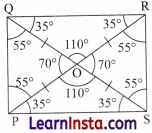
(ii) Given: Rectangle PQRS with diagonals intersecting at an angle of 110°.
Let the diagonals PR and QS bisect each other at point O, and ∠ROQ = 110°.
Since diagonals PR and QS form two congruent isosceles triangles ∆POS and ∆ROQ.
Similarly, diagonals PR and QS form two other isosceles triangles ∆POQ and ∆ROS.
In ∆ROQ,
Given, ∠ROQ = 110°
∴ ∠ORQ = ∠OQR = \(\frac {1}{2}\) (180° – 110°) = 35° [∵ OQ = OR (given)]
In ∆POS,
∠POS = ∠ROQ = 110° (vertically opposite angles)
∴ ∠OPS = ∠OSP = \(\frac {1}{2}\) (180° – 110°) = 35°
In ∆POQ,
∠POQ = 180° – 110° = 70° (∵ ∠POQ + ∠POS = 180°, linear pair)
And, ∠OPQ = ∠OQP = 55° (∠OPQ + ∠OQP + ∠POQ = 180° and OP = OQ)
Similarly, in ∆ROS,
∠ROS = 70° and ∠ORS = ∠OSR = 55°
So, the angles inside rectangle PQRS are as follows:
Question 2.
Draw a quadrilateral whose diagonals have equal lengths of 8 cm that bisect each other, and intersect at an angle of
(i) 30°
(ii) 40°
(iii) 90°
(iv) 140°
Solution:
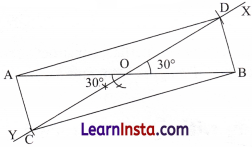
(i) 30°
Steps of Construction:
1. Draw a diagonal AB = 8 cm.
2. Mark the midpoint O at 4 cm.
3. At point O, construct an angle of 30° with the help of a protractor.
4. Produce the other arm of the angle at either side of O to X and Y, cut the arc of radius 4 cm on both sides of XY from point O, and mark it as C and D.
5. Connect the vertices A, B, C, and D to form the required quadrilateral ACBD.
(ii) Do it yourself.
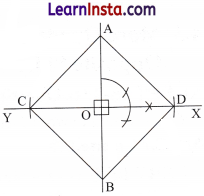
(iii) Steps of Construction:
1. Draw the diagonal AB = 8 cm.
2. Mark the midpoint O at 4 cm.
3. Draw an angle of 90° at O with the help of a compass.
4. Produce the other arm of the angle at either side of O to X and Y. Taking O as centre, cut the arc of radius 4 cm on both sides of XY and mark it as C and D.
5. Join the vertices A, B, C, and D to form the required quadrilateral ACBD.
(iv) Do it yourself.
Question 3.
Consider a circle with centre O. Line segments PL and AM are two perpendicular diameters of the circle. What is the figure APML? Reason and/or experiment to figure this out.
Solution:
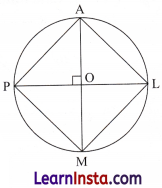
Here, we have given a circle with centre O.
PL and AM are two perpendicular diameters of the circle.
Thus, the figure APML obtained is a square.
PL and AM will be the diagonals of the square APML that bisect each other perpendicular.
OP = OL = OA = OM (All are radii of the circle.)
Question 4.
We have seen how to get 90° using paper folding. Now, suppose we do not have any paper but two sticks of equal length and a thread. How do we make an exact 90° angle using these?
Solution:
We know that if the diagonals of a quadrilateral are equal and they bisect each other, then the angles of the quadrilateral formed are 90° each. Therefore, use the thread to measure the length of one stick, then fold the thread in half and mark the midpoint of the stick.
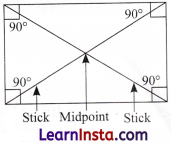
Now, place the second stick in such a way that both sticks intersect each other at their midpoints. Considering the endpoints of the sticks as the vertices of a quadrilateral, draw the quadrilateral. Each angle of the quadrilateral is 90°.
Question 5.
We saw that one of the properties of a rectangle is that its opposite sides are parallel. Can this be chosen as a definition of a rectangle? In other words, is every quadrilateral that has opposite sides parallel and equal a rectangle?
Solution:
We can have a quadrilateral that has opposite sides equal and parallel, but the angles are 60°, 120°, 60°, and 120°.
Therefore, defining a rectangle as a quadrilateral with opposite sides parallel and equal is insufficient.
It must also be included that each angle is 90°.
4.3 More Quadrilaterals with Parallel Opposite Sides
NCERT In-Text Questions (Page 98)
Question 1.
Is it wrong to write ∆ABD ≅ ∆CBD? Why?
Solution:
Do it yourself.
NCERT In-Text Questions (Page 99)
Question 1.
Is it wrong to write ∆AOE ≅ ∆SOY? Why?
Solution:
Do it yourself.
Figure it Out (Page 102)
Question 1.
Find the remaining angles in the following quadrilaterals.

Solution:
(i) Since opposite sides of the quadrilateral PEAR are parallel, this is a parallelogram.
In the given parallelogram, PE is a transversal to the parallel lines PR and EA.
∠RPE and ∠AEP are the internal angles on the same side of parallel lines.
∴ ∠RPE + ∠AEP = 180°
⇒ 40° + ∠AEP = 180°
⇒ ∠AEP = 180° – 40° = 140°
We know that opposite angles of a parallelogram are equal.
∴ ∠EAR = ∠EPR = 40° and ∠ARP = ∠AEP = 140°.
(ii) Since opposite sides of the quadrilateral PQRS are parallel, this is a parallelogram.
In the given parallelogram, PQ is a transversal to the parallel lines PS and QR.
∠SPQ and ∠RQP are the internal angles on the same sides of the parallel lines.
∴ ∠SPQ + ∠RQP = 180°
⇒ 110° + ∠RQP = 180°
⇒ ∠RQP = 180° – 110° = 70°
We know that the opposite angles of a parallelogram are equal.
∴ ∠QRS = ∠QPS = 110° and ∠PSR = ∠RQP = 70°.
(iii) In quadrilateral UVWX,
Given: UV = VW = WX = XU and ∠UVX = 30°
Since quadrilateral UVWX is a rhombus, UV = VW = WX = XU
And diagonal XV bisects ∠UVW in ∠UVX and ∠XVW.
∴ ∠UVX = ∠XVW = 30°
⇒ ∠WXV = 30° [∵ XW = VW]
∴ ∠XWV = 180° – (30° + 30°) = 120°
⇒ ∠XUV = 120° [∵ Opposite angles of a rhombus are equal to each other]
∴ ∠UXV = 180° – (∠XUV + ∠UVX)
= 180° – (120° + 30°)
= 30°
∴ In quadrilateral UVWX, the remaining angles are ∠XUV = 120°, ∠UXV = 30°, ∠XVW = 30°, ∠XWV = 120°, ∠VXW = 30°.
(iv) In quadrilateral AEIO,
Given: AE = EI = IO = OA and ∠OEA = 20°
So, it is a rhombus.
∴ The remaining angles of rhombus AEIO are ∠OEI = 20°, ∠OIE = 140°, ∠IOE = 20°, ∠OAE = 140°, ∠AOE = 20°
Question 2.
Using the diagonal properties, construct a parallelogram whose diagonals are of lengths 7 cm and 5 cm, and intersect at an angle of 140°.
Solution:
Steps of Construction:
1. Draw a line segment AB = 7 cm.
2. Draw the perpendicular bisector of AB, and mark the midpoint of AB as O.
3. Draw ∠BOC = 140° at O using a protractor and produce its arm from X to Y.
4. With O as centre, cut arcs of radius 2.5 cm on both sides of XY and mark them as C and D.
5. Join AC, BC, BD, CD, and DA.
Thus, ACBD is the required parallelogram.
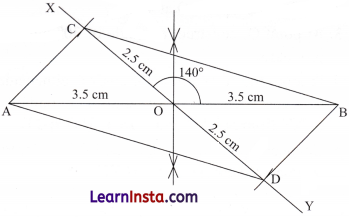
Question 3.
Using the diagonal properties, construct a rhombus whose diagonals are of lengths 4 cm and 5 cm.
Solution:
Do it yourself.
4.5 Playing with Quadrilaterals
NCERT In-Text Questions (Page 103)
Geoboard Activity
Take a geoboard and some rubber bands. If you do not have these, you could just use the dot grid papers given at the end of the book for this activity.

Place two rubber bands perpendicular to each other, forming diagonals of equal length. Join the ends.

What is the quadrilateral that you get? Justify your answer.
Solution:
We observe that:
- The diagonals are perpendicular to each other. The rubber bands are placed perpendicularly.
- The diagonals are of equal length.
- The diagonals bisect each other.
We know that if the diagonals of a quadrilateral are of equal length and bisect each other at right angles, then the quadrilateral is a square. Thus, we get a square.

Extend one of the diagonals on both sides by 2 cm.
What quadrilateral will you get now? Justify your answer.
Solution:
After extending one of the diagonals on both sides by 2 cm, we observe that
- Diagonals bisect each other: This means the figure is a parallelogram.
- Diagonals are perpendicular: This means the parallelogram is a rhombus.
- Diagonals are not equal in length: This means it cannot be a rectangle (and therefore not a square).
- Therefore, the quadrilateral formed will be a rhombus as all sides are still equal.
NCERT In-Text Questions (Pages 104-105)
Joining Triangles
Question 1.
Take two cardboard cutouts of an equilateral triangle of side length 8 cm.

Can you join them to get a quadrilateral?

What type of quadrilateral is this? Justify your answer.
Solution:
The quadrilateral thus formed is a rhombus with four sides of 8 cm and one diagonal of 8 cm.
Justification: Since all four sides are equal in length (8 cm), but none of the angles is 90°.
Hence, a quadrilateral with all four sides equal will be a rhombus.
Question 2.
Take two cardboard cutouts of an isosceles triangle with sidelengths 8 cm, 8 cm, and 6 cm.
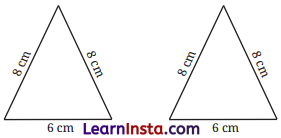
What are the different ways they can be joined to get a quadrilateral?
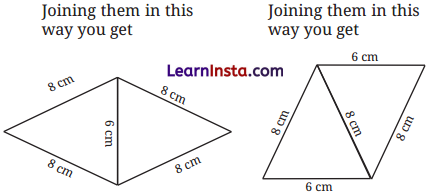
What quadrilaterals are these? Justify your answers.
Solution:
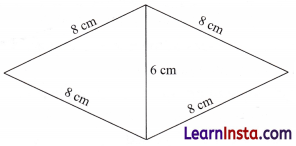
The following quadrilateral is formed by two triangles joined along a common side (which acts as a diagonal for the quadrilateral).
Here, all four sides are equal (8 cm each), and the quadrilateral is a rhombus.

The following quadrilateral is formed by two isosceles triangles joined along a common side, which acts as a diagonal of the quadrilateral.
From the figure, we can see the side lengths and a diagonal:
Top side = 6 cm, Bottom side = 6 cm, Two slanted sides = 8 cm each, Internal diagonal = 8 cm.
This quadrilateral is a parallelogram, as a quadrilateral with opposite sides equal in length is a parallelogram.
Question 3.
Take two cardboard cutouts of a scalene triangle with sides 6 cm, 9 cm, and 12 cm.

What are the different ways they can be joined to get a quadrilateral? Are you able to identify the different quadrilaterals that are obtained by joining the triangles? Justify your answer whenever you identify a quadrilateral.
Solution:
Do it yourself.
Figure it Out (Pages 107-109)
Question 1.
Find all the sides and the angles of the quadrilateral obtained by joining two equilateral triangles with sides 4 cm.
Solution:
We can join them in the following way:
Take two equilateral triangles, each with sides of 4 cm. Join them along one of their 4 cm sides. This common side becomes a diagonal of the resulting quadrilateral.
Sides of the Quadrilateral: Since each triangle has three sides of 4 cm, and we join them along one side, the remaining four “outer” sides will all be 4 cm.
So, all four sides of the quadrilateral are 4 cm.
Angles of the Quadrilateral:
Each angle of an equilateral triangle is 60°.
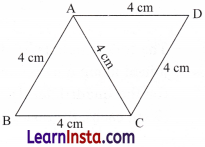
Let the two triangles be ∆ABC and ∆ADC, joined along AC.
In ∆ABC, ∠ABC = 60°.
In ∆ADC, ∠ADC = 60°.
The angle at A in the quadrilateral is:
∠BAD = ∠BAC + ∠CAD = 60° + 60° = 120°
The angle at C in the quadrilateral is:
∠BCD = ∠BCA + ∠DCA = 60° + 60° = 120°
So, the angles of the quadrilateral are 60°, 120°, 60°, and 120°.
Type of Quadrilateral: A quadrilateral with all sides equal is a rhombus.
Since its angles are not 90°, it is not a square but a rhombus.
Question 2.
Construct a kite whose diagonals are of lengths 6 cm and 8 cm.
Solution:
To construct a kite with given diagonal lengths:
Properties of a Kite:
- Diagonals are perpendicular.
- One diagonal bisects the other. (The longer diagonal bisects the shorter one).
- One diagonal is the axis of symmetry.
Steps of Construction:
1. Draw the shorter diagonal: Draw a line segment BD of length 6 cm (say BD).
2. Draw a perpendicular bisector of BD (say XY), which intersects BD at O.
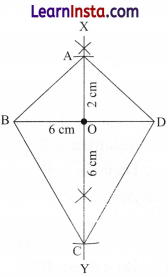
3. On perpendicular XY, at point O, mark points A and C such that AO = 2 cm and OC = 6 cm.
4. Join AB, BC, CD, and DA. Thus, ABCD is the required kite.
Remark: We can draw many kites for the given diagonals.
Question 3.
Find the remaining angles in the following trapeziums.

Solution:
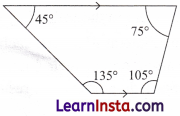
We know that, in a trapezium, consecutive angles between the parallel sides are supplementary (they add up to 180°).
In the given trapezium, the given angles are 135° and 105°.
∴ The angle adjacent to 135° on the same non-parallel side will be 180° – 135° = 45°.
The angle adjacent to 105° on the same non-parallel side will be 180° – 105° = 75°.
So, the remaining angles are 45° and 75°.
Similarly, in the following isosceles trapezium, two consecutive angles on a non-parallel side also add up to 180°.

One of the given angles is 100°.
The angle adjacent to 100° on the same non-parallel side will be 180° – 100° = 80°.
Since it is an isosceles trapezium indicated by the equal non-parallel sides, the angles opposite to the equal sides (adjacent to the same base) are equal.
Therefore, the other two angles are 100° and 80°.
Thus, the angles on the opposite parallel side would be 180° – 100° = 80°.
Since they are marked equal, both of them are 80°.
So, the remaining angles are 80°, 80°, and 100°.
Question 4.
Draw a Venn diagram showing the set of parallelograms, kites, rhombuses, rectangles, and squares. Then, answer the following questions.
(i) What is the quadrilateral that is both a kite and a parallelogram?
(ii) Can there be a quadrilateral that is both a kite and a rectangle?
(iii) Is every kite a rhombus? If not, what is the correct relationship between these two types of quadrilaterals?
Solution:
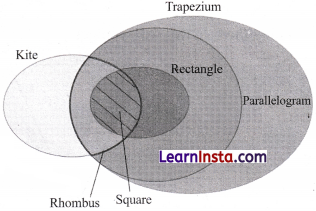
(i) A quadrilateral that is both a kite and a parallelogram is a rhombus, and a square, which is a type of rhombus.
(ii) Yes, a square is a quadrilateral that is both a kite and a rectangle. A rectangle has four right angles. For a kite to be a rectangle, all its angles must be 90°. This is only possible if all its sides are also equal, making it a square.
(iii) No, every kite is not a rhombus.
- Kite: A quadrilateral with two distinct pairs of equal-length adjacent sides. Its diagonals are perpendicular, and one diagonal bisects the other.
- Rhombus: A quadrilateral with all four sides of equal length. Its diagonals bisect each other at right angles, and they also bisect the angles of the rhombus. (A rhombus is a special type of kite where all four sides are equal, and it is also a parallelogram.)
The correct relationship is that a rhombus is a special type of kite (specifically, a kite with all four sides equal). However, not all kites are rhombuses because a kite does not necessarily have all four sides equal.
Question 5.
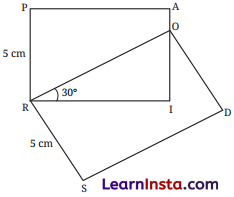
If PAIR and RODS are two rectangles, find ∠IOD.
Solution:
Since PAIR and RODS are two rectangles,
and ROI is a triangle with ∠ORI = 30°,
Here ZOIR = 90°
So, ∠IOR = 180° – (90° + 30°) = 60°
∠IOD = 90° – 60° = 30°

Question 6.
Construct a square with a diagonal of 6 cm without using a protractor.
Solution:
Steps of Construction:
1. Draw a line segment, say DB = 6 cm, using a ruler.
2. Place the compass on point D. Draw arcs above and below the line with a radius more than half of BD.
3. Without changing the compass width, repeat the process from point B to intersect the previous arcs.
4. Draw the perpendicular bisector XY by joining the arc intersections that intersect line BD at O.
This line is perpendicular to BD and will help locate the other two vertices of the square.
5. Set the compass to 3 cm (half of the diagonal).
6. With center O, draw arcs of radius 3 cm to cut the perpendicular bisector XY at two points. Mark these points as A and C.
7. Join the vertices A, B, C, and D.
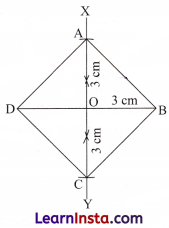
Here, ABCD is the required square.
Question 7.
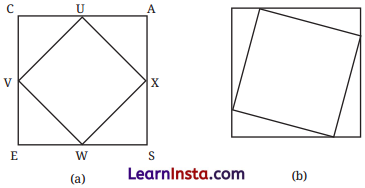
CASE is a square. The points U, V, W, and X are the midpoints of the sides of the square. What type of quadrilateral is UVWX? Find this by using geometric reasoning, as well as by construction and measurement. Find other ways of constructing a square within a square such that the vertices of the inner square lie on the sides of the outer square, as shown in Figure (b).
Solution:
Geometrical Reasoning: Consider ∆CUV and ∆AUX:
CU = AU (∵ U is the midpoint of CA)
CV = AX (∵ CE = AS, and V and X are midpoints)
∠VCU = ∠CAX (Angles of a square)
∴ ∆CUV ≅ ∆AUX (By SAS)

Similarly, we can prove that ∆UCV ≅ ∆VEW, ∆VEW ≅ ∆WSX, ∆WSX ≅ ∆XAU
Therefore, we have UV = VW = WX = XU
Now, consider ∆VEW and ∆WSX:
VE = EW and ∠E = 90°
⇒ ∠EWV = ∠EVW = 45° (Angles made by equal sides of a triangle are equal.)
Similarly, ∠XWS = ∠WXS = 45°
Now, ∠VWE + ∠VWX + ∠XWS = 180°
⇒ 45° + ∠VWX + 45° = 180°
⇒ ∠VWX = 180° – 45° – 45° = 90°
In the same way, ∠WXU = ∠XUV = ∠UVW = 90°
So, in quadrilateral UVWX, all sides are equal and all angles are of 90°.
So, UVWX is a square.
Construction and measurement: Do it yourself.
Question 8.
If a quadrilateral has four equal sides and one angle of 90°, will it be a square? Find the answer using geometric reasoning as well as by construction and measurement.
Solution:
Yes, if a quadrilateral has four equal sides and one angle of 90°, it will be a square.
Geometric Reasoning: A quadrilateral with four equal sides is a rhombus.
If one angle of a rhombus is 90°, then its opposite angle is also 90°.
Due to the property that consecutive angles in a rhombus are supplementary, the remaining two angles must also be 90°.
Thus, all four angles are 90°, so the specified quadrilateral is a square.
Construction and measurement: Do it yourself.
Question 9.
What type of quadrilateral is one in which the opposite sides are equal? Justify your answer.
Hint: Draw a diagonal and check for congruent triangles.
Solution:
A quadrilateral in which the opposite sides are equal is called a parallelogram.
Justification: Consider a quadrilateral ABCD, where AB = CD and AD = BC.
Now, draw diagonal AC. This divides the quadrilateral into two triangles: ∆ABC and ∆CDA.

In these two triangles:
- AB = CD (given)
- AD = BC (given)
- AC is common to both triangles
- So, by SSS (Side-Side-Side) congruence, ∆ABC ≅ ∆CDA.
Since the two triangles are congruent, the corresponding angles are equal, and hence the opposite angles of the quadrilateral are equal too.
Hence, ABCD is a parallelogram.
Question 10.
Will the sum of the angles in a quadrilateral, such as the following one, also be 360°? Find the answer using geometric reasoning as well as by constructing this figure and measuring.
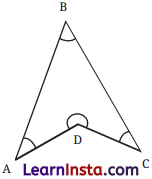
Solution:
Geometric reasoning:
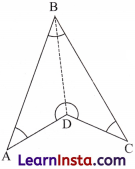
Join BD.
The diagonal BD splits the quadrilateral ABCD into two triangles: ∆ABD and ∆BCD.
Since the sum of the angles of a triangle is 180°.
So, the sum of the angles of triangles ∆ABD and ∆BCD is 180° + 180° = 360°
Hence, the sum of the angles in any quadrilateral is always 360°.
Construction and measurement: Do it yourself.
Question 11.
State whether the following statements are true or false. Justify your answers.
(i) A quadrilateral whose diagonals are equal and bisect each other must be a square.
(ii) A quadrilateral having three right angles must be a rectangle.
(iii) A quadrilateral whose diagonals bisect each other must be a parallelogram.
(iv) A quadrilateral whose diagonals are perpendicular to each other must be a rhombus.
(v) A quadrilateral in which the opposite angles are equal must be a parallelogram.
(vi) A quadrilateral in which all the angles are equal is a rectangle.
(vii) Isosceles trapeziums are parallelograms.
Solution:
(i) False.
Justification: A quadrilateral in which the diagonals are equal and bisect each other is a rectangle, not necessarily a square.
(ii) True.
Justification: In a quadrilateral, the sum of the interior angles is 360°. If three angles are 90°, the fourth must also be 90° (360° – 270° = 90°). So, all four angles are 90°, and hence it is a rectangle.
(iii) True.
Justification: A quadrilateral whose diagonals bisect each other must be a parallelogram.
(iv) False.
Justification: A quadrilateral whose diagonals are perpendicular to each other may be a rhombus, but it might also be a kite.
(v) True.
Justification: A quadrilateral in which the opposite angles are equal must be a parallelogram.
(vi) True.
Justification: A quadrilateral in which all the angles are equal is a rectangle, as the sum of the interior angles of a quadrilateral is 360°. If all angles are equal, then the measure of each angle is 90°. So, the specified quadrilateral is a rectangle.
(vii) False.
Justification: Since isosceles trapeziums have one pair of parallel sides and equal non-parallel sides, whereas parallelograms have two pairs of parallel sides. So, an isosceles trapezium is not a parallelogram.