Students often refer to Class 8 Ganita Prakash Solutions and NCERT Class 8 Maths Part 2 Chapter 4 Exploring Some Geometric Themes Question Answer Solutions to verify their answers.
Class 8 Maths Ganita Prakash Part 2 Chapter 4 Solutions
Ganita Prakash Class 8 Chapter 4 Solutions Exploring Some Geometric Themes
Class 8 Maths Ganita Prakash Part 2 Chapter 4 Exploring Some Geometric Themes Solutions Question Answer
4.1 Fractals
Sierpinski Carpet
NCERT In-Text Questions (Page 71)
Question 1.
Draw the initial few steps (at least till Step 2) of the shape sequence that leads to the Sierpinski Carpet.

Solution:
Steps for the construction of the Sierpinski Carpet:
Step 0: Take a square.
Step 1: Divide it into 9 smaller squares, and then remove the central square.
Step 2: Further divide each of the remaining 8 squares into 9 squares and remove 1 of the central squares.

Sierpinski Gasket
NCERT In-Text Questions (Page 72)
Question 1.
Show that by joining the midpoints of an equilateral triangle, we divide it into 4 identical equilateral triangles.
[Hint: Note that the comer triangles are isosceles.]
Solution:
Let ∆ABC be an equilateral triangle, and let D, E, and F be the midpoints of sides BC, CA, and AB, respectively.
Since D, E, and F are midpoints.
So, BD = DC, CE = EA, AF = FB
In an equilateral triangle, all sides and all angles are equal.
Hence, each corner triangle ∆AEF, ∆BFD, and ∆CDE is isosceles with equal base angles, i.e., 60°.
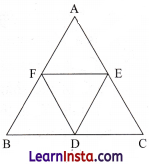
In the corner triangles
∠A = ∠B = ∠C = 60° (Angle of equilateral ∆ABC)
Hence, by the SAS congruence rule, all the corner triangles are congruent to each other.
Therefore, BF = FA = AE = EC = CD = DB = BF = FD = DE = FE
Thus, ∆FED is equilateral and is also congruent to each of the corner triangles by the SSS congruence rule, and hence all the corner triangles are equilateral also.
Therefore, by joining the midpoints of the sides of an equilateral triangle, we divide it into 4 identical equilateral triangles.
Figure it Out (Page 72)
Question 1.
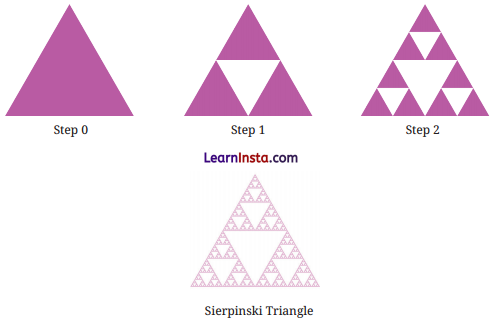
Draw the initial few steps (at least till Step 2) of the shape sequence that leads to the Sierpinski Triangle.
Solution:
Steps for the construction of the Sierpinski triangle:
Step 0: Draw one large equilateral triangle.
Step 1: Divide the triangle into 4 equal, smaller equilateral triangles.
Remove the middle triangle.
Step 2: Take each of the 3 remaining triangles.
Again, divide each into 4 equal smaller triangles.
Remove the middle triangle from each.
Question 2.
Find the number of holes and the triangles that remain at each step of the shape sequence that leads to the Sierpinski Triangle.
Solution:
A “hole” is defined as an inverted triangular region that has been removed.
At each new step, every remaining triangle from the previous step produces exactly 1 new hole.
Step 0: 1 triangle, 0 holes
Step 1: 3 triangles remain, 1 hole
Step 2: 9 triangles remain, 1 + 3 = 4 holes
Step 3: 27 triangles remain, 4 + 9 = 13 holes
We observe that the number of remaining triangles forms the sequence: 1, 3, 9, 27,…
So, at step n, the number of triangles remaining = 3n, where n is a whole number.
Number of holes at step n = 1 + 3 + 32 + … + 3n-1, where n is a whole number.

Question 3.
Find the area of the region remaining at the nth step in each of the shape sequences that lead to the Sierpinski fractals. Take the area of the starting square/triangle to be 1 sq. unit.
Solution:
Sierpinski Square: In each step, the square is divided into 9 equal smaller squares.
The middle square is removed, so 8 squares remain.
So, the remaining fraction of squares at each step is \(\frac {8}{9}\)
Step 0: Area (A0) = 1 sq. units
Step 1: Area (A1) = 1 × \(\frac {8}{9}\) = \(\frac {8}{9}\) sq. units
Step 2: Area (A2) = \(\frac{8}{9} \times \frac{8}{9}=\left(\frac{8}{9}\right)^2\) sq. units
Step n: Area (An) = \(\left(\frac{8}{9}\right)^n\) sq. units.
Sierpinski Triangle: In each step, the triangle is divided into 4 equal smaller triangles.
The middle triangle is removed, so 3 triangles remain.
So, the remaining fraction of triangles at each step is \(\frac {3}{4}\)
Step 0: Area (A0) = 1 sq. units
Step 1: Area (A1) = 1 × \(\frac {3}{4}\) = \(\frac {3}{4}\) sq. units
Step 2: Area (A2) = \(\frac{3}{4} \times \frac{3}{4}=\left(\frac{3}{4}\right)^2\) sq. units
Step n: Area (An) = \(\left(\frac{3}{4}\right)^n\) sq. units
Koch Snowflake
Figure it Out (Page 73)
Question 1.
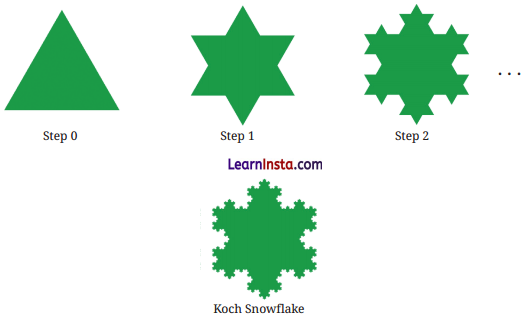
Draw the initial few steps (at least till Step 2) of the shape sequence that leads to the Koch Snowflake.
Solution:
To construct a Koch snowflake, start with an equilateral triangle.
Step 0: Divide each side into three equal parts.
Step 1: Replace the middle part by making an outward triangular bump (_/\_).
So one side becomes four equal sides.
Step 2: Repeat the same bump-making rule on every side of the new figure.

Question 2.
Find the number of sides in the nth step of the shape sequence that leads to the Koch Snowflake.
Solution:
In the Koch snowflake, the construction begins with an equilateral triangle, which has 3 sides.
At each step of the construction, every side is replaced by 4 smaller sides by adding a triangular bump.
Hence, the number of sides becomes four times the number of sides in the previous step, as follows:
Step 0: 3 sides (an equilateral triangle)
Step 1: 3 × 4 = 12 sides
Step 2: 3 × 4 × 4 = 3 × 42 = 48 sides
Let the number of sides at the nth step be Sn.
⇒ Sn = 3 × 4n
Thus, the number of sides at the nth step = 3 × 4n.
Question 3.
Find the perimeter of the shape at the nth step of the sequence. Take the starting equilateral triangle to have a sidelength of 1 unit.
Solution:
The starting figure of the Koch snowflake is an equilateral triangle with a side length of 1 unit.
So, the perimeter at step 0 is 3 × 1 = 3 units.
In the Koch snowflake construction, each side is replaced by 4 smaller sides, and the length of each side is one-third of the previous side.
So, Perimeter at step 0: 3 × 1 = 3 units
Perimeter at step 1: 3 × 4 × \(\frac {1}{3}\) = 3 × (\(\frac {4}{3}\)) units
Perimeter at step 2: \(3 \times 4^2 \times\left(\frac{1}{3}\right)^2=3 \times\left(\frac{4}{3}\right)^2\) units
Hence, the perimeter is multiplied by \(\frac {4}{3}\) at every step.
Let the perimeter at the nth step be Pn, then Pn = \(3\left(\frac{4}{3}\right)^n\)
Thus, the perimeter at the nth step = \(3\left(\frac{4}{3}\right)^n\)
4.2 Visualising Solids
Build it in Your Imagination
NCERT In-Text Questions (Pages 75-77)
Question 1.
Picture your name, then read off the letters backwards. Make sure to do this by sight, not by sound — really see your name! Now try with your friend’s name.
Solution:
Do it yourself.
Question 2.
Cut off the four corners of an imaginary square, with each cut going between midpoints of adjacent edges. What shape is left over? How can you reassemble the four corners to make another square?
Solution:
When the four corners of a square are cut off by joining the midpoints of adjacent sides, the shape left in the centre has four equal sides and four right angles.
Hence, the remaining shape is a square.

The four cut-off corners are congruent right-angled triangles.
These four triangles can be rearranged and joined together to form another square.

Question 3.
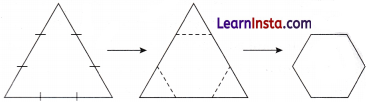
Mark the sides of an equilateral triangle into thirds. Cut off each comer of the triangle, as far as the marks. What shape do you get?
Solution:
When the sides of an equilateral triangle are marked into thirds, and the corners are cut off up to these marks, the remaining shape has six equal sides and equal angles.
Therefore, the shape obtained is a regular hexagon.
Question 4.
Mark the sides of a square into thirds and cut off each of its corners as far as the marks. What shape is left?
Solution:
When the sides of a square are marked into thirds, and each corner is cut off up to the marks, the remaining figure has eight sides.
Hence, the shape left is an octagon.

Can you describe a solid and a viewpoint that would result in each of the following cases?
If it helps, you can imagine the solid passing through a wall like Tom did, and leaving a hole of the appropriate shape.
Solution:
A viewpoint is the direction from which a solid is observed.
Different viewpoints of the same solid can produce different outlines or profiles.
Question 5.
A solid whose profile has a square outline.
Solution:
A cube passing straight through a wall.
From the front view, the hole left in the wall is a square.
Question 6.
A solid whose profile has a circular outline.
Solution:
A cylinder passing through the wall along its axis.
From the front view, the hole left in the wall is a circle.
Question 7.
A solid whose profile has a triangular outline.
Solution:
A triangular pyramid (tetrahedron) passing through a wall.
From the front view, the hole left in the wall is a triangle.
Question 8.
A solid with a rectangular profile from one viewpoint and a circular profile from another viewpoint.
Solution:
A cylinder.
From the side view, the profile is a rectangle.
From the top view, the profile is a circle.
Question 9.
A solid with a circular profile from one viewpoint and a triangular one from another viewpoint.
Solution:
A cone.
From the top view, the profile is a circle.
From a side view through the axis, the profile is a triangle.
Question 10.
A solid with a rectangular profile from one viewpoint and a triangular one from another viewpoint.
Solution:
A triangular prism.
From the side view, the profile is a rectangle.
From the front view, the profile is a triangle.
Question 11.
A solid with a trapezium-shaped profile from one viewpoint and a circular one from another viewpoint.
Solution:
A frustum of a cone.
From the side view, the profile is a trapezium.
From the top view, the profile is a circle.
Question 12.
A solid with a pentagonal profile from one viewpoint and a rectangular one from another viewpoint.
Solution:
A pentagonal prism.
From the front view, the profile is a pentagon.
From the side view, the profile is a rectangle.
Are there unique solids for each of the conditions, or can you come up with multiple possibilities?
Solution:
The solids are not unique. For each condition, more than one solid can give the same pair of profiles, depending on the shape of the solid and the direction of view.
Making Solids
NCERT In-Text Questions (Page 79)
Question 1.
If the congruent polygons of a prism have 10 sides, how many faces, edges, and vertices does the prism have? What if the polygons have n sides?
Solution:
A prism has two congruent polygonal bases and parallelogram-shaped lateral faces.
If the congruent polygons have 10 sides, then each base is a decagon.
Faces: Number of lateral faces = number of sides of the base = 10
Total faces = 10 + 2 = 12
Edges: Edges on the top base = 10
Edges on the bottom base = 10
Vertical edges = 10
Total edges = 10 + 10 + 10 = 30
Vertices: Vertices on the top base = 10
Vertices on the bottom base = 10
Total vertices = 10 + 10 = 20
If the congruent polygons have n sides, then
Faces: Number of lateral faces = n
Total faces = n + 2
Edges: Edges on the top base = n
Edges on the bottom base = n
Vertical edges = n
Total edges = n + n + n = 3n
Vertices: Vertices on the top base = n
Vertices on the bottom base = n
Total vertices = n + n = 2n
Question 2.
If the base of a pyramid has 10 sides, how many faces, edges, and vertices does the pyramid have? What if the base is an n-sided polygon?
Solution:
A pyramid has one polygonal base and triangular faces meeting at a single vertex (apex).
If the base has 10 sides, then
Faces: Number of triangular faces = number of sides of the base = 10
Total faces = 10 + 1 = 11
Edges: Edges of the base = 10, Edges from base vertices to the apex = 10
Total edges = 10 + 10 = 20
Vertices: Vertices of the base = 10, Apex = 1
Total vertices = 10 + 1 = 11
If the base is an n-sided polygon, then
Faces: Number of triangular faces = n
Total faces = n + 1
Edges: Edges of the base = n, Edges from base vertices to the apex = n
Total edges = n + n = 2n
Vertices: Vertices of the base = n, Apex = 1
Total vertices = n + 1
Figure it Out (Pages 80-81)
Question 1.
Which of the following are the nets of a cube? First, try to answer by visualisation. Then, you may use cutouts and try.


Solution:
The nets of a cube must have 6 squares arranged so that they can be folded to form six faces of a cube without overlap.
In the given nets, (ii), (iii), (iv), and (vi) are the nets of a cube.
Question 2.
A cube has 11 possible net structures in total. In this count, two nets are considered the same if one can be obtained from the other by a rotation or a flip. For example, the following nets are all considered the same-
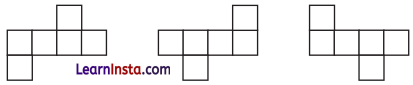
Find all the 11 nets of a cube.
Solution:
The following are the 11 possible nets of a cube.
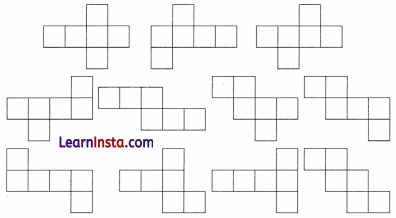
Question 3.
Draw a net of a cuboid having sidelengths:
(i) 5 cm, 3 cm, and 1 cm
(ii) 6 cm, 3 cm, and 2 cm
Solution:
Do it yourself.
NCERT In-Text Questions (Pages 81 -84)
Question 1.
What is a net of a regular tetrahedron? Which of the following are nets of a regular tetrahedron?

Solution:
A net of a regular tetrahedron is a two-dimensional arrangement of four congruent equilateral triangles joined edge to edge such that, when folded along the edges, they form a regular tetrahedron. The adjoining nets are the correct nets of a regular tetrahedron.
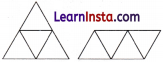
Question 2.
Draw a net with appropriate measurements that can be folded into a regular tetrahedron. Verify if it works by making an actual cutout.
Solution:
Do it yourself.
Question 3.
Draw a net with appropriate measurements that can be folded into a square pyramid. Verily, if it works by making an actual cutout.
Solution:
Do it yourself.
Question 4.
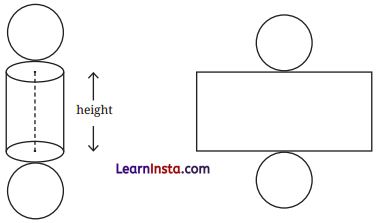
What are the sidelengths of the rectangle obtained?
Solution:
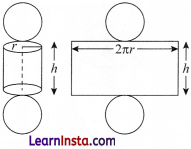
If the radius of the cylinder is r and the height is h, the length of the rectangle obtained will be 2πr, and the width will be h.
(Note: Perimeter of a circle = Circumference of a circle = 2πr, where r = radius)
Question 5.
What surface do you construct by using the above net, in which O is not the centre of the boundary circle? Make a physical model to help you answer this question!
Solution:
Do it yourself.
Question 6.
Draw a net with appropriate measurements that can be folded into a triangular prism. Verify that it works by making an actual cutout.
Solution:
Do it yourself.
Question 7.
Taking all the triangles in the net to be equilateral, make a cutout of the net and fold it to form an octahedron.
Solution:
Do it yourself.
Question 8.
Net of a sphere? Experiment and see if you can make a paper cutout that can perfectly wrap around a ball without leaving any wrinkles, gaps, or overlaps.
Solution:
Do it yourself.
Representation of Solids on a Plane Surface
Projections
NCERT In-Text Questions (Pages 89-91)
Question 1.
Can you now compare the lengths p and l?
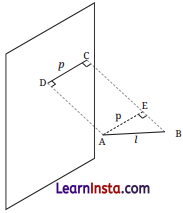
Solution:
In the given figure, it is clear that l is the hypotenuse of a right-angled triangle, while p is the other side of the triangle.
Thus, l > p.
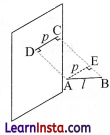
Question 2.
When is the length of the projected line equal to its actual length?
Solution:
If a line is parallel to the plane, none of its length is shortened during projection, so it appears in its true size.
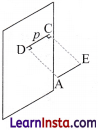
Question 3.
What do you think are the different possible projections of a square that we get based on its orientation?
Solution:
The projection of a square changes dramatically depending on how it is tilted relative to the plane of projection.
- A Square: The projection remains a square with its actual dimensions only when the square’s surface is parallel to the projection plane. This is the only orientation where you see the “True Shape.”
- A Rectangle: If the square is inclined (tilted) about one of its axes but stays perpendicular to the other, it appears as a rectangle.
- A Straight Line (Edge View): When the square is oriented perpendicular to the projection plane, its entire surface collapses into a single straight line. This is known as the “edge view.”
- A Rhombus or Parallelogram: If the square is tilted in two directions (oblique orientation), it will appear as a rhombus or a parallelogram.
Question 4.
What do you think is the projection of a parallelogram under different orientations?
Can this ever be a quadrilateral that is not a parallelogram?
As a starting point, you could think about the projection of a pair of parallel lines.
Solution:
The projection of a parallelogram is always a parallelogram (though its shape and size may change).
This is because projection preserves parallelism, and a parallelogram has two pairs of parallel sides.
It cannot become a quadrilateral that is not a parallelogram, except in degenerate cases where it collapses into a line or a segment.
Question 5.
What can you say about the projection of an n-sided regular polygon?
[Hint: The projection of a polygon is composed of the projections of its sides.]
Solution:
The projection of an n-sided regular polygon is generally an irregular polygon with n sides, since projection preserves straightness of sides but not equal lengths or angles.
In degenerate positions, the projection may have fewer than n sides or may collapse into a line.
Question 6.
Find another object that makes the same projection as that of a given cone.
Solution:
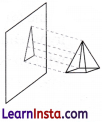
The projection of a pyramid will also give a triangle, similar to the projection of a cone.
Figure it Out (Pages 92-93)
Question 1.
Observe the front view, top view, and side view of the different lines in the figure. Is there any relation between their lengths?

Solution:
The length changes with the views and inclination.
Question 2.
Find the front view, top view, and side view of each of the following solids, fixing its orientation with respect to the vertical, horizontal, and side planes: cube, cuboid, parallelepiped, cylinder, cone, prism, and pyramid. If needed, see the next problem for clues.
Solution:
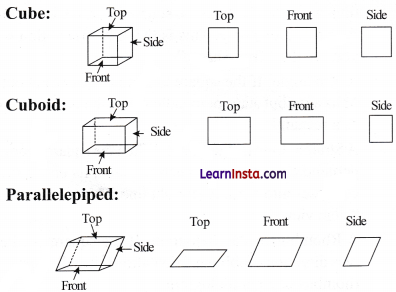

Question 3.
Match each of the following objects with its projections.

Solution:

Shadows
NCERT In-Text Questions (Page 94)
Question 1.
Observe what happens to the size of the shadow as you vary the distance between your torch and your object.
Solution:
When the torch is moved closer to the object, the shadow becomes larger.
When the torch is moved farther away, the shadow becomes smaller.
The shape remains similar, but its size changes.
If the torch always points perpendicular to the wall, then as the distance between the torch and the object increases, the light rays reaching the object become nearly parallel. Because of this, the shadow formed on the wall is no longer enlarged or distorted. In this situation, the shadow has the same shape and size as the object’s projection.
Question 2.
Why does this happen?
Solution:
When the torch is close to the object, the rays spread more before reaching the wall, so the shadow is magnified. When the torch is farther away, the rays are almost parallel, so the shadow becomes smaller and closer to the actual size of the object. Thus, the change in distance changes how much the light spreads, which changes the size of the shadow.
Figure it Out (Pages 95-97)
Question 1.
Draw the top view, front view, and side view of each of the following combinations of identical cubes.
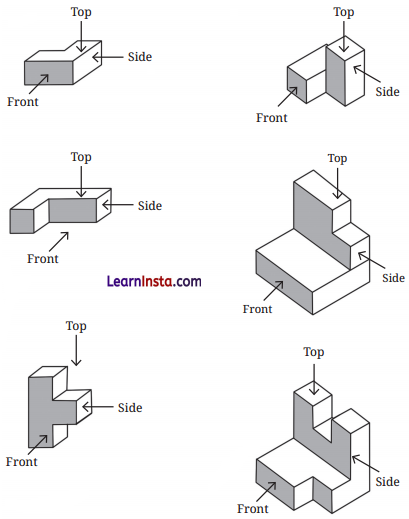
Solution:
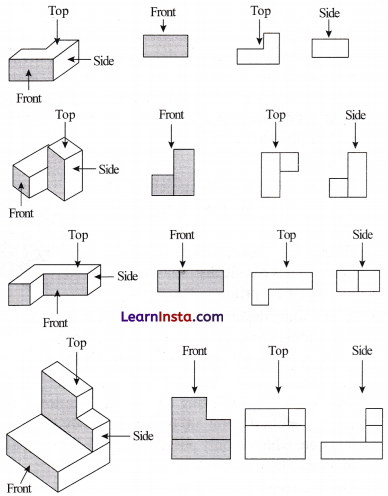

Question 2.
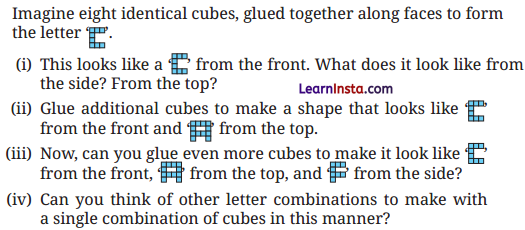
Solution:
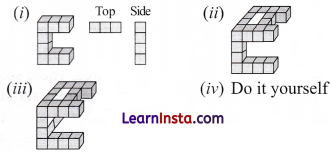
Question 3.
Which solid corresponds to the given top view, front view, and side view?
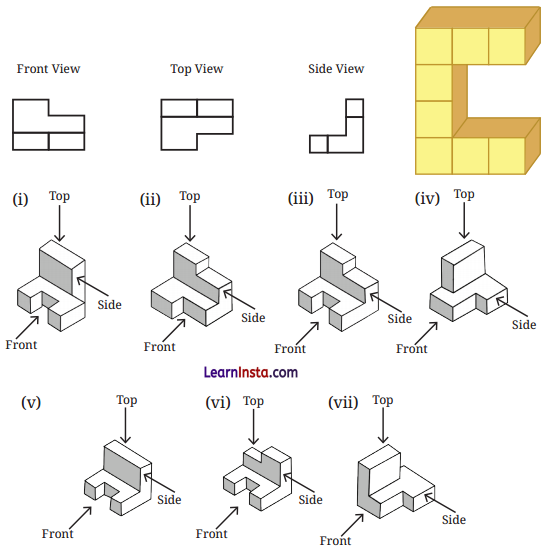
Solution:
The correct answer is option (ii).
Question 4.
Using identical cubes, make a solid that gives the following projections.

Solution:

Question 5.
Find the number of cubes in this stack of identical cubes.

Solution:
There are 20 cubes in the given stack of identical cubes.
Question 6.
What are the different shapes the projection of a cube can make under different orientations?
Solution:
The projection of a cube can result in several different shapes, depending on the orientation of the cube relative to the projection plane or the light source.
These shapes range from simple polygons to more complex six-sided figures.
Square: When a face of the cube is parallel to the plane of projection.
Rectangle: When one face is tilted with respect to the plane, then the projection stretches in one direction, creating a rectangle.
Parallelogram: When the cube is tilted in two directions.
Hexagon: When the cube is oriented so that three faces are visible at the same time (a typical corner view).
In addition to these common shapes, more complex projections that are not perfectly regular can also occur, featuring varying side lengths and angles.
Isometric Projections
NCERT In-Text Questions (Page 97)
Question 1.
Construct a model of a cube and use your hands to keep it balanced on one corner vertex. Can you try to understand why all the projected edges have equal length?
Solution:
Model of a cube: Do it yourself.
The reason all the projected edges have equal length is that the three edges meeting at that vertex make equal angles with the plane. Because of this symmetry, the projections of these three edges are affected in the same way. Since all three original edges of the cube are equal in length and are projected under identical conditions, their projections also have equal lengths. Thus, all the projected edges appear equal because the cube is symmetrically oriented, and the projection shortens all three edges by the same factor.
Drawing on Isometric Grids
NCERT In-Text Questions (Page 99)
Question 1.
Imagine these are cubes, not squares. Draw each of these on your isometric paper (you can find it at the end of the book).
Solution:

Figure it Out (Pages 100-102)
Question 1.
In addition to the 5 ways shown in the figure, are there any additional ways of gluing four cubes together along faces? Can you visualise and draw these as well?

Solution:
The other possible ways are:

Question 2.
Draw the following figures on the isometric grid.
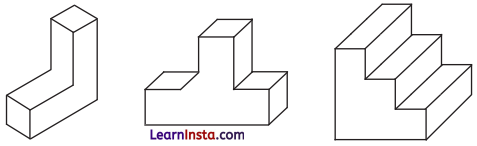
[Hint: It may be useful to determine whether the edge to be currently drawn — say, along the height — goes from down to up or up to down. Accordingly, draw the line segment on the grid either in the direction of the height axis or opposite to it.]
Solution:
Do it yourself.
Question 3.
Is there anything strange about the path of this ball? Recreate it on the isometric grid.
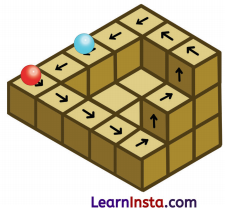
[Hint: Consider a portion of this figure that is physically realisable and identify the 3 primary directions.]
Solution:
If we follow the arrows, the balls appear to be constantly descending (or ascending, depending on the direction), yet they eventually return to exactly where they started. This illusion works because our brains interpret the 2D drawing as representing 3D depth. The lowest point and the highest point are drawn as if they are the same location, which is only possible in a 2D drawing, and not in a real 3D object.
Draw it yourself.
Question 4.
Observe this triangle.

(i) Would it be possible to build a model out of actual cubes? What are the front, top, and side profiles of this impossible triangle?
(ii) Recreate this on an isometric grid.
(iii) Why does the illusion work?
Solution:
(i) It is impossible to build this figure using actual cubes as a single, continuous 3D shape. While you can create a model that looks like this from one specific angle, the three bars cannot meet at three right-angled (90°) corners in 3D space. The profiles are:
- Front view: An inverted ‘L’ shape.
- Top view: Three separate bars that do not touch.
- Side view: Either a straight bar or two bars meeting at a 90° angle, i.e., L shape.
(ii) Do it yourself.
(iii) This illusion works because the brain tries to understand a 2D drawing as a 3D object. Each corner of the triangle looks normal by itself, so the brain assumes the whole figure is possible. However, the parts give conflicting depth information—some parts seem close while others seem far in a way that cannot happen together. As a result, the brain forces the drawing into a single object, even though such an object is geometrically impossible.