Experts have designed these NCERT Class 9 Advanced Maths Solutions and Class 9 Advanced Maths Chapter 1 Sets Notes for effective learning.
Sets Notes Class 9 Advanced Maths
Introduction
Sets are one of the most basic and important concepts in mathematics. In everyday life, we often group objects, such as a set of books, a set of students in a class or a set of fruits in a basket. Mathematics studies these collections in a systematic way using the concept of sets.
The study of sets helps us organise information, compare collections and under-stand relationships between different groups of objects. Concepts such as subsets, unions, intersections and Venn diagrams are widely used not only in mathematics but also in Science, Computer Science, Statistics and daily decision-making.
Learning about sets develop logical thinking and problem-solving skills. It also forms the foundation for advanced topics in mathematics such as relations, functions, probability and algebra. Through this chapter, students will learn how to represent sets, perform operations on them and apply set concepts to real-life situations using Venn diagrams and logical reasoning.
Basics of Sets
Definition of a Set: A set is a well-defined collection of distinct objects. The objects in a set are the elements or members of the set.
The collection “the tallest students of the class” is not a set because the meaning of “tallest” may vary from person to person.
Some examples of sets are as follows:
- A set of planets in the solar system
- A set of colours in a rainbow
- A set of days in a week On the other hand, the collection “favourite movies of students” is not a set because favourite choices differ from person to person.
Representation of Set: There are two methods by which a set can be represented:
(i) Tabular form or Roster form: In this method, all the elements of a set are listed within braces separated by commas.
For example, the set of prime numbers less than 12 is written as P = {2, 3, 5, 7, 11}
The fact that “3 is an element of the set P” is written as 3 ∈ P, where the symbol ‘∈’ means “belongs to”.
Similarly, we use the symbol 1 ∉ P to denote 1 is not an element of the set P.
(ii) The set builder form: In this method, a common property of all the elements of the set is used to describe the set.
For example, the set P = {3, 6, 9,12} can be written using this notation as {x | x is a multiple of 3 and x ≤ 12}
which is read as, “the set of all elements x such that z is a multiple of 3 and x ≤ 12.
Is the Order of Elements Important?
The order in which elements are written does not change the set.
For example, {2, 4, 6} = (6, 2, 4}
Both represent the same set.
Can a Set Have Repeated Elements?
A set contains only distinct elements.
For example, the set formed by the letters of the word “SCHOOL” is {S, C, H, O, L}
Repeated letters are written only once.
Types of Sets
Finite Set: A set having a fixed or limited number of elements, is called a finite set.
For example, A = {2, 4, 6, 8}
The set A contains 4 elements, therefore it is a finite set.
Infinite Set: A set having an unlimited number of elements, is called an infinite set.
For example, N = {1, 2, 3, 4, 5,…}
Since the set of natural numbers has no end, it is an infinite set.
Empty or Null Set: A set having no element is called an empty set or null set and represented as Φ or {}. For example, the set of months in a year having 32 days is an empty set, since no month has 32 days.
Equality of Sets: Two sets are said to be equal, if they contain the same elements.
For example, A = {1, 3, 5, 7}, B = (7, 5, 3, 1}
Then, A = B, both sets contain the same elements.
Subset: A set A is said to be a subset of set B, if every element of A belongs to B and represented as A ⊆ B.
If A is not a subset of B, then it is written as A ⊈ B.
If A ⊆ B and A1B, then A is called a proper subset of B and represented as A ⊂ B.
For example, {2, 4} ⊆ {2,4, 6, 8}
Cardinality of a Set: The number of elements present in a set is called the cardinality of the set and represented as H(A). For example, if A = {a, e, i, o, u}, then n(A) = 5
Power Set: The collection of all subsets of a set is called the power set of the set.
A set containing n elements has 2n subsets. If n(A) = p, where p is a whole number, then n[P(A)] = 2n. For example, If A = (1, 2}, then P(A) = {Φ, {1}, {2}, (1, 2}} is the power set of A.
Universal Set: The set containing all the elements under consideration is called the universal set. It is denoted by U. For example, if A = {2, 4, 6}, B = {1, 3, 5} then a possible universal set is U – {1, 2, 3,4, 5, 6}.
Example 1:
A teacher asked students to write the days on which i they play sports during the week.
Riya wrote: A = {Monday, Wednesday, Friday}
Kabir wrote: B = {Friday, Monday, Wednesday}
Are the sets A and B equal?
Solution:
The order of elements in a set does not matter. I Both sets contain the same elements.
Therefore, A = B
Example 2:
A school library has books arranged according to subjects as shown below:
X = {Mathematics, Science, English}
Find the number of subjects in the set X.
Solution:
The set X = {Mathematics, Science, English} j contains 3 elements.
Therefore, n(X) = 3
Hence, the number of subjects in set X is 3.
Formula:
Number of subsets of a set having n elements: 2n.
Number of proper subsets of a set having n elements i = 2n – 1
If n(A) = p, where p is a whole number, then n[P(A)] = 2p.
Here, P(A) denotes the power set of A.
Fundamental:
- A set contains only distinct elements.
- Order of elements in a set does not matter.
- Empty set is a subset of every set.
- Every set is a subset of itself.
- If A ⊆B and B ⊆ A, then A = B
- If a set contains n elements, then its power set contains 2n elements.
Venn Diagrams and Operations on Sets
Venn Diagrams: A Venn diagram is a pictorial representation of sets using closed curves inside a rectangle repre-senting the universal set. Venn diagrams help in understanding relationships be-tween sets clearly.
Set Operations: Operations on sets are used to combine or compare sets.
The basic operations on sets are:
- Union
- Intersection
- Difference
- Complement
Union of Sets: The union of two sets A and B is the set containing all elements, which belong to A or B or both. It is represented as A ∪ B.
Symbolically, AuB = {x: x ∈ A or x ∈ B}
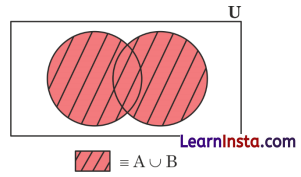
For example, if A = {1, 2, 3, 4} and B = {3, 4, 5, 6}, then A ∪ B = {1, 2, 3, 4, 5, 6}
Intersection of Sets: The intersection of two sets A and B is the set containing all common elements of both sets. It is represented as A ∩ B.
Symbolically, A ∩ B = {x : x ∈ A and x ∈ B}

For example, if A = {2, 4, 6, 8} and B = {4, 6, 10}, then A ∩ B = { 4, 6}
Difference of Sets: The difference of two sets A and B is the set containing elements of A which are not in B. It is represented as A – B.
Symbolically, A – B = {x : x ∈ A and x ∉ B}
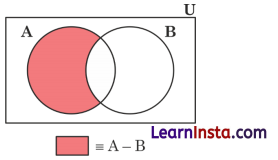
For example, If A = {1, 2, 3, 4, 5}, B = {3, 5, 7}, then A – B = {1, 2, 4}.
Similarly, B – A = {7}
Complement of Sets: The complement of a set A is the set of all elements in the universal set U which are not in A. It is represented as A’.
Symbolically, A’= {x : x ∈ U and x ∉ A}.

For example, if U = {1, 2, 3, 4, 5, 6, 7} and A = {1, 3, 5, 7}, then A’= U – A = {2, 4, 6}.
Disjoint Sets: Two sets are called disjoint sets if they have no common element, i.e., A ∩ B = Φ
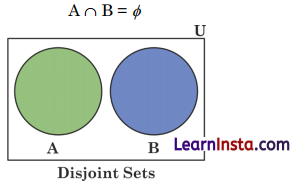
For example, A = {1, 3, 5}, B = {2, 4, 6}. Since A ∩ B = Φ, therefore A and B are disjoint sets.
Cardinal Number Formulae
If A and B are two finite sets, then their cardinal numbers are related as below:
n(Either in A or in B) = n(A ∪ B) = n(A) + n(B) – n(A ∩ B)
n(Only in A, not in B) = n(A -B) — n(A) – n(A ∩ B)
(Neither in A nor in B) = n(A’ ∩ B’) = n(A ∪ B)’
= n(U) – n(A ∪ B)
n(Only in one of them) = n[(A – B) ∪ (B – A)]
= n(A) + n(B) – 2n(A ∩ B)
If A, B and C are three finite sets, then the relation between the cardinal numbers is given below.
n(A ∪ B ∪ C) = n(A) + n(B) + n(C) – [n(A ∩ B) + n(B ∩ C) + n(C ∩ A)] + n(A ∩ B ∩ C)
De Morgan’s Laws:
- De Morgan’s Law 1: (A ∪ B)’ = A’ ∩ B’
- De Morgan’s Law 2: (A ∩ B)’ =A’ ∪ B’
Meaning: The complement of a union/intersection is the intersection/union of complements.
Example 1:
In a school of 60 students, 38 students like Mathematics and 27 students like Science. If every student likes at least one of the two subjects and 5 students like both subjects, find the number of students who like only Mathematics.
Solution:
Let M and S be the set of students who like Mathematics and Science, respectively.
Given, n(M) = 38, n(S) = 27, n(M ∩ S) = 5
Number of students who like only Mathematics
= n(M – S) = n(M) – n(M ∩ S)
= 38 – 5
= 33
Hence, 33 students like only Mathematics.
Example 2:
An organisation awarded certificates to 90 students for participating in at least one of the three activities: Music, Dance and Drama.
- 45 students participated in Music.
- 38 students participated in Dance.
- 30 students participated in Drama.
- 15 students participated in both Music and Dance.
- 12 students participated in both Dance and Drama.
- 10 students participated in both Music and Drama.
- 5 students participated in all three activities.
Find the number of students who participated in ; exactly two activities.
Solution:
Let M = {students participating in Music},
D = {students participating in Dance}, and
T = {students participating in Drama}
Given, n(M ∩ D) = 15, n(D ∩ T) = 12, n(M ∩ T) = 10 and n(M ∩ D ∩ T) = 5
Students participating in exactly two activities:
= (15 – 5) + (12 – 5) + (10 – 5)
= 10 + 7 + 5
= 22
Hence, 22 students participated in exactly two activities.
Fundamental:
Union of two sets contains all elements belonging to either set or both sets.
- Intersection of two sets contains only the common elements of the sets.
- If A ∩ B = Φ, then the sets are called disjoint sets.
- Complement of a set is always taken with respect to the universal set.
- De Morgan’s Laws help in simplifying complements of unions and intersections.
For any set A:
- A ∪ Φ = A
- A ∩ Φ = Φ
- A ∪ li = U
- A ∩ li = A
- A ∪ Φ = A
- A ∩ Φ = Φ