Students can refer to the NCERT Class 9 Advanced Maths Solutions and Chapter 2 Logarithms Extra Questions and Answers whenever they need help with difficult questions.
Class 9 Logarithms Extra Questions
Logarithms Class 9 Short Question Answer
Question 1.
Write as a single logarithm: log11 3 + log11 4 – 2 log11 2.
Solution:
log11 3 + log11 4 – 2 log11 2 = log11 (3 × 4) – 2 log11 2 (Using product Rule) …….. (1)
Second term becomes: 2log11 2 = log11 22 = log11 4 by using Power Rule …….. (2)
Using Quotient Rule in Eqs (1) and (2),
⇒ log11 3 + log11 4 – 2 log11 2 = log11 \(\frac{12}{4}\) = log11 3
Question 2.
Find the value of the expression:
log10 1000 + log10 0.01.
Solution:
First convert the given values to the power of 10: 1000 = 103; 0.01 = 10-2
⇒ log10 1000 + log10 0.01 = log10 103 + log10 10-2
Using loga a = 1 and Power Rule, we get:
⇒ log10 1000 + log10 0.01 = 3 + (-2) = 1
Question 3.
If log13 2 = H and log13 7 = K, express log13 (14)3 in terms H and K.
Solution:
Using Power Rule: log13 (14)3 = 3 log13 14
Express 14 in terms of 7 and 2, and Product Rule:
⇒ 3 log13 14 = 3 log13 (7 × 2) = 3(log13 7 + log13 2 )
= 3 (K + H)
⇒ log13 (14)3 = 3(K + H)
Question 4.
Express as a single logarithm:
(a) 1 + log31 15
Solution:
Using loga a = 1, we can write:
1 + log31 15 = log31 31 + log31 15
Using Product Rule: log31 31 + log31 15 = log31 31 × 15 = log31 465
(b) 2log5 3 + log5 2 – log5 4
Solution:
Use Power Rule in first term: 2log5 3 = log5 32 = log5 9
Now, add both the terms and use Product Rule in the first two terms:
⇒ log5 9 + log5 2 = log5 (9 × 2) = log5 18
Subtract the third term and use Quotient Rule:
⇒ log5 18 – log5 4 = log5\(\frac{18}{4}\) = log5\(\frac{9}{2}\)

Question 5.
Find exact value of log12 (1728).
Solution:
Express the argument in terms of base: 1728 = 123
Substitute in the given expression and use Power Rule: log12 (12)3 = 3 log12 12 = 3
Question 6.
Write equivalent logarithmic form of the following expressions:
(i) \(e^{-\frac{1}{2}}=\frac{1}{\sqrt{e}}\)
Solution:
Exponential form: bx = a, the equivalent logarithmic form: logb a = x, where (b > 0, a > 0, b ≠ 1)
On comparing with the standard form, the equivalent
logarithmic form is: loge = \(\frac{1}{\sqrt{e}}\) = – \(\frac{1}{2}\)
(ii) \(4^{-\frac{3}{2}}=\frac{1}{8}\)
Solution:
Exponential form: bx = a, the equivalent logarithmic form: logb a = x, where (b > 0, a > 0, b ≠ 1)
On comparing with the standard form, the equivalent logarithmic form is:
log4(\(\frac{1}{8}\)) = –\(\frac{3}{2}\)
Question 7.
Find the value of the following:
(i) log5(log2(log4256))
Solution:
Start with the innermost bracket: (log4 256) = log4 44 = 41og4 4 = 4
Next bracket: log24 = log2 22 = 2 log2 2 = 2
Substitute in the given expression:
⇒ Log5 (log2(log4 256)) = log5 2
(ii) log12(log6(log3729)
Solution:
Start with the innermost bracket: (log3 729) = log3 36 = 6 log3 3 = 6
Substitute in the given expression:
⇒ log6(log3729) = log6 6 = 1 (Using: loga a = 1)
Now, the outermost bracket:
⇒ log12 (log6(log3729)) = log12 1 = 0 (Using: loga 1 = 0)
Question 8.
If logb 2 = p, logb 3 = q and logb 5 = r,
express the following entirely in terms of p, q and r.
Concept Applied: Product Rule, log A + log B = log(AB), Power Rule, log(Ak) = k × log A and Change of Base Rule,
loga b = \(\frac{\log _c b}{\log _c a}\)
(i) \(\log _b \sqrt[3]{\frac{24}{25}}\)
Solution:
Using Power Rule: \(\log _b \sqrt[3]{\frac{24}{25}}\) = \(\frac{1}{3}\) logb\(\frac{24}{25}\)
Using Quotient Rule: \(\frac{1}{3}\)logb\(\frac{24}{25}\) = \(\frac{1}{3}\) (logb 24 – logb 25)
Express arguments in terms of 2, 3 and 5 (use Product Rule):
\(\frac{1}{3}\)(logb(23 × 3) – logb 52)
Use Product Rule and Power Rule:
\(\frac{1}{3}\)[3 logb 2 + logb 3 – 2 logb 5]
Use the value of p, q and r: \(\frac{1}{3}\)(3p + q – 2r)
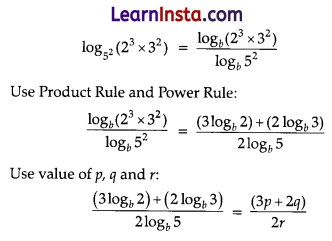
(ii) log25 72
Solution:
Express the base and argument in terms of 2, 3 and 5:
log25 72 = log52 (23 × 32)
Use Change of Base Rule:
Question 9.
Express as a single logarithm: 1 + log5 (x2 – 9) – log5(x + 3)
Solution:
Express the first term as: 1 = log5 5
Using Product and Quotient Rules, we get:
1 + log5(x2 – 9) – log5 (x + 3) = log5 5 + log5\(\frac{\left(x^2-9\right)}{(x+3)}\)
= log5 5 + log 5(x – 3)
(Using (x2 – a2) = (x + a)(x – a))
= log5 5(x – 3)
Question 10.
Determine which is true:
(i) loga(\(\frac{1}{x}\)) = – logx
Solution:
Simplifying LHS:
loga(\(\frac{1}{x}\)) = logax-1 = (-1) logax (Using Power Rule)
Given RHS: – logx
Clearly, LHS is equal to RHS.
Therefore, the given statement is true.
(ii) (\(\frac{\log x}{\log y}\)) = log x – log y
Solution:
Simplifying RHS:
⇒ log x – log y = log\(\frac{x}{y}\) (Using Quotient Rule)
LHS cannot be simplified further. Clearly, LHS is not equal to RHS. Therefore, the given statement is false.
Question 11.
Express the following in logarithmic form:
(a) 63 = 216
(b) 10-3 = 0.001
Solution:
Using ax = b ⇔ loga b = x, we get,
(a) 63 = 216 ⇔ log6 216 = 3
(b) 10-3 = 0.001 ⇔ log100.001 = -3
Question 12.
Evaluate:
(a) log3 81
(b) log10 0.01
Solution:
Using loga (Mk) = k × loga M and loga a = 1
(a) log3 81 = log3 34 = 4 x log3 3 = 4 × 1 = 4
(b) log10 0.01 = log1010-2 = -2 x log1010 = -2 × 1 = -2
Question 13.
Simplify using logarithm laws:
(a) log5 4 + log5 25
(b) log2 64 – log2 8
Solution:
Using the product rule: loga (MN) = loga M + loga N
and Quotient rule: loga(\(\frac{M}{N}\)) = loga M – loga N
(a) log5 4 + log5 25 = log5 (4 × 25) = log5 100
Hence, the simplified form is log5 100.
(b) log2 64 – log2 8 = log2(\(\frac{64}{8}\))
= log2 8 = log2 23
= 3 × log2 2 = 3 × 1 = 3 (Since, loga a = 1)
Hence, the simplified form is 3.
Question 14.
If log2 3 = p. Write the following in terms of p:
(a) log2 27
(b) log2(\(\frac{1}{3}\))
Solution:
Using the power rule: loga(Mk) = k × loga M
(a) log2 27 = log2 33 = 3 × log2 3 = 3 × p = 3p
(b) log2(\(\frac{1}{3}\)) = log2 3-1 = -1 × log2 3 = -1 × p = – p
Question 15.
State whether the following are defined or undefined:
(a) log4 (-16)
(b) log7 1
Solution:
A logarithm is defined only for positive numbers.
(a) Since -16 < 0, log4 (-16) is undefined.
(b) Since 70 = 1, log7 1 = 0 is defined.
Question 16.
Solve the following for x.
log3 x + log3 (x – 8) = 2
Solution:
Using the product rule
log3.x + log3 (x – 8) = log3[x(x – 8)]
Therefore, log3[x(x – 8)] = 2
Converting logarithmic form into exponential form,
x(x – 8) = 32
x2 – 8x = 9
x2 – 8x – 9 = 0
x2 – 9x + x – 9 = 0
x(x – 9) + 1(x – 9) = 0
(x – 9)(x + 1) = 0
Hence, x = 9, -1.
Now, check the conditions for logarithms:
x > 0 and x – 8 > 0
Thus, x > 8.
Therefore, x = -1 is rejected because logarithms of negative numbers are undefined.
Hence, the valid solution is x = 9.
Question 17.
If log 2 = a, log 7 = b, then express log 56 in terms of a and b.
Solution:
56 = 23 × 7
Therefore, log 56 = log (23 × 7) = log23 + log7 (Using the product rule)
log 56 = 3 log 2 + log 7 (Using the power rule)
log 56 = 3a + b (Given, log 2 = a, log 7 = b)
Hence, log 56 = 3a + b
Question 18.
Solve for x:
log4 (x2 – 1) = log4(3x – 1)
Solution:
Since logarithms with the same base are equal, their arguments are equal.
Therefore, x2 – 1 = 3x – 1.
x2 = 3x
x2 – 3x = 0
x(x – 3) = 0
Hence, x = 0, 3.
Now, check the conditions for logarithms:
x2 – 1 > 0 and 3x – 1 > 0
For x = 0, x2 – 1 = -1 < 0.
So, x = 0 is rejected.
For x = 3, x2 – 1 = 8 > 0 and 3x – 1 = 8 > 0.
Thus, the valid solution is x = 3.
Question 19.
x = log\(\frac{1}{2}\) + log\(\frac{2}{3}\) + log\(\frac{3}{4}\) + … + log\(\frac{49}{50}\)
where all logarithms are to base 10, evaluate 10x.
Solution:
Using the product rule logA + logB = log(AB)
x = log\(\frac{1}{2}\) + log\(\frac{2}{3}\) + log\(\frac{3}{4}\) + … + log\(\frac{49}{50}\)
= log(\(\frac{1}{2}\) × \(\frac{2}{3}\) \(\frac{3}{4}\) × …. × \(\frac{49}{50}\)) = log(\(\frac{1}{50}\))
Therefore, x = log(\(\frac{1}{50}\))
Converting logarithmic form into exponential form, we get
10x = \(\frac{1}{50}\)
Question 20.
Solve for x
(log2 x)2 + log2(x2) = 12 Verify all solutions.
Solution:
Let y = log2 x, then log2(x2) = 2 log2 x = 2y.
Now, the given equation becomes y2 + 2y = 12
y2 + 2y – 12 = 0
Using the quadratic formula, we get,
y = \(\frac{-2 \pm \sqrt{(4+48)}}{2}\)
y = \(\frac{-2 \pm \sqrt{52}}{2}\)
y = \(-1 \pm \sqrt{13}\)
Since y = log2 x, log2 x = -1 + \(\sqrt{13}\) or log2 x = – 1 – \(\sqrt{13}\)
Therefore, x = \(2^{-1+\sqrt{13}}\) or x = \(2^{-1-\sqrt{13}}\)
Since both values of x are positive, both solutions are valid.
Hence, x = \(2^{-1+\sqrt{13}}, 2^{-1-\sqrt{13}}\)
Question 21.
A logarithmic expression is valid for two possible values at x = 7 and x = 1, for the expression:
log5 (x – 3) + log5 x
Identify the valid value for which the expression is valid and explain why the other value is not acceptable.
Solution:
For logarithms to be defined x – 3 > 0 and x > 0. Thus, x > 3.
Therefore, x = 1 should be rejected as logarithms of negative numbers are undefined.
Hence, the valid value of the expression is at x = 7.
Question 22.
A student claims:
log3 (9 + 3) = log3 9 + log3 3
without calculating both sides. Is the statement correct? Justify your answer logically.
Solution:
The statement is incorrect as the logarithm law is not applied to addition.
log (a + b) ≠ log a + log b
Therefore,
log3 (9 + 3) ≠ log3 9 + log3 3
Hence, the claim is false.
Question 23.
A mobile battery loses half of its charge every hour during heavy gaming. The remaining battery charge after t hours is modelled by
B = (\(\frac{1}{2}\))t
Answer the following questions:
(i) Find the remaining battery charge after 4 hours.
(ii) After how many hours will the battery become \(\frac{1}{32}\) of its original charge?
(iii) State whether the battery charge represents growth or decay.
Solution:
(i) Given,
B = (\(\frac{1}{2}\))t
For t = 4,
B = (\(\frac{1}{2}\))4
B = \(\frac{1}{16}\)
Hence, the remaining battery charge after 4 hours is \(\frac{1}{16}\) of the original charge.
(ii) Given, (\(\frac{1}{2}\))t = \(\frac{1}{32}\)
Since, \(\frac{1}{32}\) = (\(\frac{1}{2}\))5
Therefore, (\(\frac{1}{2}\))t = (\(\frac{1}{2}\))5
By comparing the exponents, we get, t = 5
Hence, the battery becomes \(\frac{1}{32}\)of its original charge after 5 hours.
(iii) The battery charge decreases continuously with time. Hence, the battery charge represents exponential decay.
Question 24.
A digital photo editor uses an advanced image compression algorithm. The percentage of original image detail retained (D) after x compression passes is modelled by the following logarithmic equation:
log2 (D) = 7 – 2x
If a high-quality print requires the retained detail level to be exactly D = 8, calculate the number of compression passes (x) applied to the image.
Solution:
Given, log2 (D) = 7 – 2x
and D = 8
Substituting D = 8 in the equation, we get,
log2(8) = 7 – 2x
Since, log2 8 = log2 23 = 3 x log2 2
= 3 × 1 = 3 (log2 2 = 1)
Therefore, 3 = 7 – 2x
2x = 7 – 3
2x = 4
x = \(\frac{4}{2}\)
x = 2
Hence, the number of compression passes applied to the image is 2.
Logarithms Class 9 Long Question Answer
Question 1.
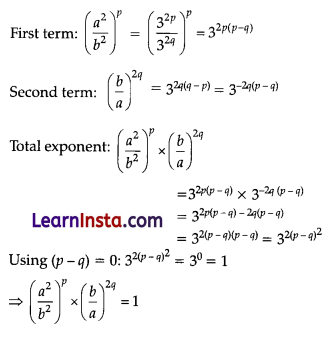
If log3 a = p, log3 b = q, and p – q = 0, find the value of \(\left(\frac{a^2}{b^2}\right)^p\) × \(\left(\frac{b}{a}\right)^{2 q}\).
Solution:
Express in exponential form using logb x = y ⇔ by = x ⇒ a = 3p, b = 3q
Question 2.
Express as a single logarithmic term:
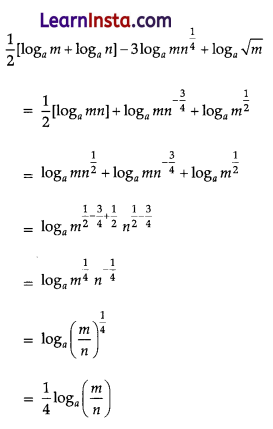
[loga m + loga n] – 3 loga (mn)1/4 + loga √m.
Solution:
Question 3.
If logmp = α, logm q = β, logm r = γ and αβ + βγ + γα = 0, find the value of (pβ. qγ . rα)(α + β + γ).
Solution:
Express the given log terms in exponential form:
logmP = α ⇒ p = mα
logm q = β ⇒ q = mβ
logm r = γ ⇒ r = mγ
Substitute the values of p, q, r in the expression:
⇒ (pβ . qγ . rα)(α + β + γ) = (mα(β) . mβ(γ) . mγ(α))α + β + γ
= (m(αβ + βγ + γα))α + β + γ
Since it is given that
αβ + βγ + γα = 0,(m(αβ + βγ + γα) α + β + γ
=(m0)α + β + γ = m0 = 1
The value of (pβ. qγ . rα)(α + β + γ) = 1.
Question 4.
Simplify and express in single logarithm term:
2log3 6 – \(\frac{1}{\log _4 3}\) + log3\(\frac{2}{3}\) – log3 1
Solution:
2log3 6 – \(\frac{1}{\log _4 3}\) + log3\(\frac{2}{3}\) – log3 1
= log3 6 – log3 4 + log3 \(\frac{2}{3}\) – 0
= \(\log _3 \frac{36 \times \frac{2}{3}}{4}\)
= log3 6
Question 5.
If log3 (log9(log2x)) = \(\frac{1}{2}\) find x.
Concept Applied: Conversion between logarithmic and exponential forms.
Solution:
Starting with the outermost bracket, express in exponential terms using log;, x = y ⇔ by = x:
log3 (log9(log2x)) = \(\frac{1}{2}\)
⇒ log9(log2x) = 31/2 = √3
log9(log2x) = √3
⇒ log2x = 9√3 = 32√3
log2x = 32√3
⇒ x = 232√3
Question 6.
Solve for x:
(i) log2(x – 1) + log2(x – 5) = 4 and verify whether all obtained roots are valid.
(ii) (log3x)2 – 7 log3 x + 12 = 0 and find all possible values of x.
Solution:
(i) Converting into exponential form
(x – 1)(x – 5) = 24
(x – 1)(x – 5) = 16
x2 – 6x + 5 = 16
x2 – 6x – 11 = 0
Using the quadratic formula, we get,
x = \(\frac{6 \pm \sqrt{(36+44)}}{2}\)
x = \(\frac{6 \pm \sqrt{80}}{2}\)
x = 3 ± 2√5
Now, for logarithms to be defined,
x – 1 > 0 and x – 5 > 0
So, x > 5.
Therefore, x = 3 – 2√5 is rejected.
Hence, the valid solution is x = 3 + 2√5
(ii) Let y = log3x, then,
y2 – 7y + 12 =0
y2 – 4y – 3y + 12 = 0
y(y – 4) – 3 (y – 4) = 0
(y – 3)(y – 4) = 0
y = 3 or y = 4
So, log3x = 3 or log3x = 4.
Therefore, x = 33 = 27 or x = 34 = 81.
Hence, the possible values of x are 27 and 81.
Question 7.
The pH value of a solution is given by pH = -log[H+].
(i) Find the pH value if [H+] = 10-4.
(ii) A second solution has [H+] = 10-7. Which solution is more acidic?
(iii) Explain why logarithms are useful in measuring acidity.
Solution:
(i) The pH value of a solution is given by
pH = -log[H+]
pH = -log(10-4)
pH = -(-4)
pH = 4
Hence, the pH value is 4.
(ii) For the second solution:
pH = -log(10-7)
pH = 7
The first solution has pH 4, and the second solution has pH 7.
Since, lower pH means greater acidity, the solution with pH 4 is more acidic. Hence, the first solution is more acidic.
(iii) Hydrogen ion concentration can be very small, such as: 10-4, 10-7, 10-10
Logarithms convert these very small numbers into simple values such as: 4, 7, 10
Therefore, logarithms make acidity easier to measure, compare and understand.
Question 8.
If log 2 = x and log 5 = y, then express the following in terms of x and y.
(i) log 200
(ii) log (\(\frac{4}{5}\))
(iii) log 0.08
Solution:
(i) 200 = 23 × 52
Therefore, log 200 = log 23 × 52
Using the product rule, log A + log B = log(AB), we get log 200 = log 23 + log 52
Using the power rule, log (Ax) = x log A, we get, log 200 = 3 log 2 + 2 log 5
Substituting log 2 = x and log 5 = y, we get, log 200 = 3x + 2y
Hence, log 200 = 3x + 2y
(ii) Using the quotient rule,
log(\(\frac{A}{B}\)) = log A – log B, we get,
log(\(\frac{4}{5}\)) = log 4 – log 5
Since, 4 = 22, we get log 4 = log 22 = 2 log 2 = 2x,
also log 5 = y
Therefore,
log(\(\frac{4}{5}\)) = 2x – y
(iii) 0.08 = \(\frac{8}{100}\) = \(\frac{2^3}{10^2}\)
Therefore, log 0.08 = log(\(\frac{2^3}{10^2}\))
Using the quotient rule, log(\(\frac{A}{B}\)) = log A – log B, we get,
log 0.08 = log 23 – log102
Using Power Rule, log(Ax) = x log A, we get,
log 0.08 = 31og 2 – 21og 10
Since, log 2 = x and log 10 = 1.
Therefore, log 0.08 = 3x – 2 .
Question 9.
Solve for x:
(i) log3 (2x -1) + log3(x – 4) = 2
(ii) logs (3x + 2) – log5 (x – 6) = 1
State the restrictions on x before solving.
Concept Applied: The product rule, log A + log B = log AB
Solution:
(i) For logarithms to be defined:
2x – 1 > 0 and x – 4 > 0
Thus, x > \(\frac{1}{2}\) and x > 4.
Therefore, x > 4.
Using the product rule, we get,
log3 [(2x – 1)(x – 4)] = 2
Converting into exponential form:
(2x – 1)(x – 4) = 32
(2x – 1)(x – 4) = 9
2x2 – 9x + 4 = 9
2x2 – 9x – 5 = 0
Factorising,
2x2 – 10x + x – 5 = 0
2x(x – 5) + 1(x – 5) = 0
(x – 5)(2x + 1) = 0
Hence, x = 5, \(\frac{1}{2}\).
Since x > 4, x = –\(\frac{1}{2}\) is rejected.
Therefore, the valid solution is x = 5.
(ii) For logarithms to be defined:
3x + 2 > 0 and x – 6 > 0
Thus, x > –\(\frac{2}{3}\) and x > 6.
Therefore, x > 6.
Using the quotient rule, we get,
log5(\(\frac{3 x+2}{x-6}\)) = 1
Converting into exponential form,
\(\frac{3 x+2}{x-6}\) = 5
3x + 2 = 5x – 30
32 = 2x
x = 16
Since 16 > 6, the solution is valid.
Hence, x = 16.
Question 10.
If x = log\(\frac{2}{3}\) + log\(\frac{3}{4}\) + log\(\frac{4}{5}\) + … + log\(\frac{100}{101}\), where all logarithms are to the base 10, answer the following:
(i) Express x as a single logarithm.
(ii) Find the value of 10x.
(iii) Evaluate (2x)(3x)(4x)…(101x).
Concept Used: Product Rule, log A + log B = log(AB), Converting Logarithmic Form into Exponential Form.
Solution:
(i) Using the product rule,
log A + log B = log(AB), we get,
x = log(\(\frac{2}{3}\) × \(\frac{3}{4}\) × \(\frac{4}{5}\) …. \(\frac{100}{101}\))
Since, \(\frac{2}{3}\) × \(\frac{3}{4}\) × \(\frac{4}{5}\) × … × \(\frac{100}{101}\) = \(\frac{2}{101}\)
x = log(\(\frac{2}{3}\) × \(\frac{3}{4}\) × \(\frac{4}{5}\) × … ×\(\frac{100}{101}\)) log(\(\frac{2}{101}\))
Therefore, x = log(\(\frac{2}{101}\))
(ii) x = log(\(\frac{2}{101}\))
Converting logarithmic form into exponential form,
10x = \(\frac{2}{101}\)
(iii) Using exponent laws, we get,
(2x)(3x)(4x)…(101x) = (2.3.4…101)x
Substituting x = log(\(\frac{2}{101}\)), we get,
(2x)(3x)(4x)…(101x) = \((2.3 .4 \ldots 101)^{\log \left(\frac{2}{101}\right)}\)
Question 11.
An engineering team designs a smart energy grid where the system’s stability index relies on the number of automated backup units, represented by n. The operational logarithm of the stability ratio is modelled by the expression:
\(\frac{\log _{10}\left(3^{n+4}\right)-\log _{10}\left(3^n\right)}{\log _{10}(9)}\)
An inspector claims that this stability index remains completely constant, regardless of the number of active backup units (n) connected to the grid. Using the laws of logarithms, simplify the expression to determine whether the inspector’s claim is correct.
Solution:
Given, \(\frac{\log _{10}\left(3^{n+4}\right)-\log _{10}\left(3^n\right)}{\log _{10}(9)}\)
Using the Quotient Rule, log A – log B = log(\(\frac{A}{B}\)) we get,
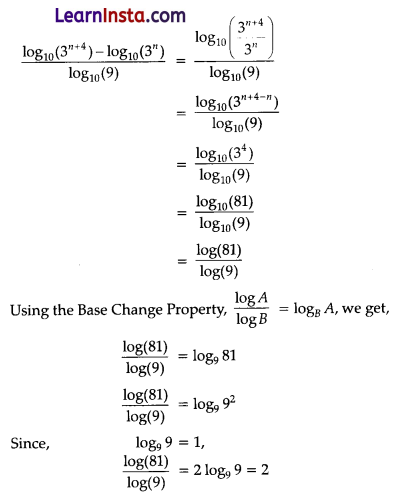
Hence, the given expression simplifies to 2.
Thus, the value of the expression is constant and does not depend on n.
Therefore, the inspector’s claim is correct.
Question 12.
A robotics company tests a robot whose response time improves after every software update. The improvement score S after n updates are modelled by
S = 3n
After some updates, the score becomes 243.
During testing, the engineer also defines an efficiency index:
E = log3 S + log3 (S – 162)
Answer the following:
(a) Find the number of software updates n.
(b) Find the value of S – 162.
(c) Evaluate the efficiency index E.
(d) Mention the logarithm property used in evaluating E.
(e) Check whether all logarithmic terms in E are defined.
Solution:
(a) Given, S = 243
243 = 3n
35 = 3n
n = 5
So, the number of updates is 5.
(b) S = 243
S – 162 = 243 – 162 = 81
(c) E = log3 243 + log3 81
Using the product rule, we get,
E = log3 (243 × 81)
E = log3 (35 × 34)
E = log3 (39)
Using the power rule, we get,
E = 9 log3 3
Since, log3 3 = 1, we get,
E = 9 × 1
E = 9
(d) The properties used are the Product Rule of logarithms:
loga X + logaY = loga (XY), the Power Rule of logarithms:
loga (Xk) = k × loga X,
and the logarithm of a number to the same base:
loga a = 1
(e) S = 243 > 0 and S – 162 = 81 > 0
So, both logarithmic terms are defined.
Question 13.
In music, moving up one octave doubles the frequency of a sound. Thus, the frequency pattern follows powers of 2:
21, 22, 23, …
Suppose the frequency factor of a musical note is represented by f = 2n, where n represents the frequency factor, n represents the number of octaves above the original note.
Answer the following questions:
(a) Find the frequency factor after 3 octaves and 5 octaves.
(b) A musical note has a frequency factor of 32. Find the number of octaves above the original note.
(c) Another musical note has a frequency factor of 128. Using logarithms, determine the number of octaves above the original note.
(d) Explain why logarithms are useful in studying musical frequencies.
(e) State whether the growth in frequency is linear or exponential.
Solution:
(a) For n = 3,
f = 23 = 8
For n = 5,
f = 25 = 32
Hence, the frequency factors are 8 and 32.
(b) Given, 2n = 32.
Converting exponential form into logarithmic form, we get,
log2 32 = n
log2 25 = n
5log2 2 = n
n = 5
Hence, the note is 5 octaves above the original note.
(c) Given, 2n = 128
Converting exponential form into logarithmic form, we get,
n = log2 128
Since, 128 = 27
Therefore, n = log2 27
Using the power rule, we get,
n = 7 log2 2
Since, log2 2 = 1
Therefore, n = 7 × 1
n = 7
Hence, the note is 7 octaves above the original note.
(d) Logarithms help convert exponential relationships into simpler numerical values. Since musical frequencies increase exponentially with octaves, logarithms make it easier to compare frequencies and determine the number of octaves.
(e) The growth in frequency is exponential because the frequency doubles at each octave and follows powers of 2.
Logarithms Class 9 Case Based Questions
Question 1.
The initial population of a town is 5000. The population increases at a steady annual rate of 20%. The growth is represented by:
P(t) = P0(1 + r)t
where P(t) is the population after t years, P0 is the initial population, r is the annual growth rate and t is the time in years.
Answer the following:
(1) Write the population growth model for the town.
(2) Find the population after 3 years.
(3) Find the number of years required for the population to become 10,368.
(4) Why are logarithms useful in population growth problems?
(5) State whether the growth is linear or exponential.
Solution:
(1) Given, P0 = 5000, r = 20% = \(\frac{20}{100}\) = 0.2
Using P(t) = P0(1 + r)t, we get,
P(f) = 5000(1 + 0.2)t
P(t) = 5000(1.2)t
Hence, the population model is P(t) = 5000(1.2)t.
(2) For t = 3,
P(3) = 5000(1.2)3
P(3) = 5000(1.728)
P(3) = 8640
Hence, the population after 3 years is 8640.
(3) Given, P(t) = 10368.
Using P(t) = P0(1 + r)t, we get,
10368 = 5000(1.2)t
\(\frac{10368}{5000}\) = (1.2)t
2.0736 = (1.2)t
Since, (1.2)4 = 2.0736,
(1.2)4 = (1.2)t
By comparing the powers, we get, t = 4
Hence, the population becomes 10,368 after 4 years.
(4) Logarithms help find the unknown time or growth period in exponential growth models. They simplify equations where the variable appears as an exponent.
For example, if P(t) = P0(1 + r)t and t is unknown, logarithms help solve for t.
(5) The growth is exponential because the population increases by a fixed percentage every year, not by a fixed number.
Hence, it follows an exponential pattern.
Question 2.
Sound level is measured on a logarithmic scale.
Suppose the logarithmic sound level is represented by
L = log(\(\frac{I}{I_0}\)),
where I is sound intensity and I is the reference intensity. A music studio records three sounds:
| Sound | Intensity |
| A | 10% |
| B | 10% |
| C | 10% |
Answer the following:
(1) Find the sound level of sounds A, B and C.
(2) By what factor is the intensity of Sound C greater than that of Sound A?
(3) A student claims that Sound B is only a little louder than Sound A because their logarithmic sound levels, 5 and 2, are numerically close. Do you agree? Give a reason for your answer.
(4) Why are logarithms useful in measuring sound intensity?
(5) Using logarithm properties, express L = log(AB) as a sum of logarithms.
Solution:
(1) The sound level is given by L = log(\(\frac{I}{I_0}\))
For sound A, L = log(\(\frac{10^2 I_0}{I_0}\)) = log(102) = 2.
Therefore, the sound level of A is 2.
For sound B, L = log(\(\frac{10^5 I_0}{I_0}\)) = log(105) = 5.
Therefore, the sound level of B is 5.
For sound C, L = log(\(\frac{10^7 I_0}{I_0}\)) = log(107) = 5.
Therefore, the sound level of C is 7.
(2) \(\frac{10^7 I_0}{10^2 I_0}\) = \(\frac{10^7}{10^2}\) = 107 – 2 = 105 = 100,000
Hence, sound C is 100,000 times more intense than sound A.
(3) No, the student is incorrect.
Although the logarithmic values 5 and 2 appear close, the actual intensities differ greatly.
\(\frac{10^5}{10^2}\) = 103 = 1000
So, Sound B is 1000 times more intense than Sound A.
(4) Sound intensities can vary over extremely large ranges. Logarithms help express these large values in a smaller, more manageable form, making comparison and calculation easier.
(5) Using the Product Rule of logarithms
log (AB) = log A + log B
Therefore, L = log A + log B.
Question 3.
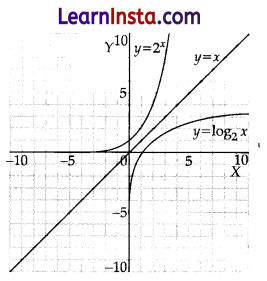
The functions y = 2x and y = log2 x are inverse functions as shown in the graph.
Answer the following:
(1) Find three points on y = 2x.
(2) Find the corresponding three points on y = log2 x.
(3) State the line of reflection between the two graphs.
(4) State the domain (all possible values of x for which the function is defined) of y = log2 x.
(5) State the range (all possible values) of y = log2 x.
(6) Why does the graph of y = log2 x never touch the y-axis?
(7) Which function grows faster for large values of x, y = 2x or y = log2 x? Explain.
Solution:
(1) For y = 2x:
| x | 0 | 1 | 2 |
| y | 1 | 2 | 4 |
So, the points are (0, 1), (1, 2), (2, 4).
(2) For the inverse function y = log2 x, interchange coordinates: (1, 0), (2, 1), (4, 2)
(3) If (a, b) lies on y = 2x, then (b, a) lies on y = log2 x. Hence, the graphs are reflections in the line y = x.
(4) The domain means all possible values of x for which the function is defined.
For logarithmic functions y = log2 x, the value inside the logarithm must always be positive.
Therefore, x > 0.
So, the domain is all positive real numbers.
(5) The range means all possible values of y.
Since the logarithmic function, y = log2 x, takes values greater than 0, it can produce every real number as output. Therefore, the range is all real numbers.
(6) The y-axis corresponds to x = 0, but log2 0 is undefined. Therefore, the graph never intersects the y-axis.
(7) The exponential function y = 2x grows much faster than the logarithmic function y = log2 x, because exponential growth increases rapidly, while logarithmic growth increases slowly.