Experts have designed these NCERT Class 9 Advanced Maths Solutions and Class 9 Advanced Maths Chapter 2 Logarithms Notes for effective learning.
Logarithms Notes Class 9 Advanced Maths
Introduction
Before calculators were invented, mathematicians found multiplication and division of large numbers very difficult and time-consuming. To simplify calculations, John Napier introduced logarithms, which convert multiplication into addition and division into subtraction. A logarithm tells the power to which a base must be raised to obtain a number.For example, 103 = 1000
Therefore, log10 1000 = 3
Later, Henry Briggs developed common logarithms (base 10), which became widely used in mathematics and science.
Logarithms are still important today and are used in sound intensity, Earthquakes, pH scale, Population growth and Calculus.
Introduction to Logarithms and their Properties
Understanding Logarithms as the Inverse of Exponents
Exponent: The exponent (also called power) tells us how many times a number is multiplied by itself.
Base: The base is the number that is multiplied repeatedly in an exponential expression.
Exponential form: When a number is written as a product of the same factor repeated many times, it can be expressed in exponential form.
General form: an
- a is the base;
- n is the exponent.
Logarithmic Form: A logarithmic form is another way of writing an exponential expression. Logarithms and exponents are inverse operations.

If bx = a, then its logarithmic form is logb a = x,
where b = base, x = exponent and a = result.
Exponential Form and Logarithmic Form
| Exponential Form: 10x = 100 | Logarithmic Form: log10100 = x |
| 23 = 8 | log28 = 3 |
| 102 = 100 | log10100 = 2 |
| 54 = 625 | log5625 = 4 |
Understanding Logarithms through Powers of 10
| Powers of 10 | Expressed in logarithmic form: |
| 10°= 1 | log101 = 0 |
| 101 = 10 | log1010 = 1 |
| 102 = 100 | log10100 = 2 |
| 103 = 1000 | log101000 = 3 |
| 104 = 10000 | log1010000 = 4 |
| 10-4 = 0.0001 | log100.0001 = -4 |
| 10-3 = 0.001 | log100.001 = -3 |
| 10-2 = 0.01 | log100.01 = -2 |
| 10-1 = 0.1 | log100.1 = -1 |
| 10°= 1 | log101 = 0 |
Definition of Logarithm
For any positive numbers a and b, where b > 0 and b ≠ 1,
bx = a ⇔ logb a = x
It is read as “Logarithm of a to the base b is x”.
For example:
- Logarithmic form of 113 = 1331 is log11 1331 = 3.
- Exponential form of log3 243 = 5 is 35 = 243.
Logarithmic Properties
Assumptions for Logarithmic Properties: For any base a, a > 0, a ≠ 1 and X, Y > 0 (Positive real number).
(1) Product Rule
Statement: log, (XY) = logaX + logaY
Proof: Let p = loga (XY), q = loga X, r = loga Y
Then, ap = XY, aq = X and ar = Y.
Therefore, aq+r = aq ar = XY → q + r = loga (XY).
Thus, loga X + logay = loga(XY).
What This Property Does: The product rule converts multiplication into addition.
For example: log54 + log525 = log5 (4 × 25) = log5100.
(2) Quotient Rule
Statement: loga\(\left(\frac{X}{Y}\right)\) = logaX – logaY
Proof: Let p = loga\(\left(\frac{X}{Y}\right)\), q = logaX, r = logaY
Then, ap = \(\frac{X}{Y}\), aq = X, and ar = Y.
Therefore, aq-r = \(\frac{a^q}{a^r}=\frac{X}{Y}\) → q – r = loga\(\left(\frac{X}{Y}\right)\).
Thus, logaX – logaY = loga\(\left(\frac{X}{Y}\right)\)
What This Property Does: The quotient rule converts division into subtraction.
For example:
log2 32 – log24 = log2\(\left(\frac{32}{4}\right)\) = log28 = 3
(3) Power Rule
Statement: loga(Xk) = k logaX
Proof: Let p = loga(Xk), q = logaX.
Then, ap = Xk, aq = X.
Therefore, ap = akq → p = kq.
Thus, loga(Xk) = k logaX.
What This Property Does: The power rule brings the exponent in front of the logarithm.
For example: log5252 = 2 log525
(4) Change of Base Formula
Statement: loga(X)
Proof: Let p = loga(X) → ap = X.
Now taking log with base b on both sides, logb(ap) = logb X → p logba = logb X
Thus, p = loga(X) = \(\frac{\log _b X}{\log _b a}\).
What This Property Does: This property changes logarithms from one base to another base,
For example: log28 = \(\frac{\log 8}{\log 2}\)
(5) Log of 1
Statement: loga(1) = 0
Proof: Let p = loga(1) → ap = 1.
Since, a° = 1, for any a > 0, a ≠ 1,
a°= 1 = ap → p = 0
Thus, p = loga(1) = 0.
What This Property Does: The logarithm of 1 to any valid base is always 0.
For example: log71 = 0
(6) Log of a Number to the Same Base
Statement: loga(a) = 1
Proof: Let p = loga(a) → ap = a.
Since, a1 = ap ⇒ p = 1.
Thus, p = loga a = 1.
What This Property Does: The logarithm of a number to its own base is always 1.
For example: log55 = 1
Logarithm to Base 10
A logarithm with base 10 is called a common logarithm.
It is written as: log10N
Usually, the base 10 is not written explicitly. So, instead of writing logl0x, we simply write log10 x.
Rules of Common Logarithms:
The rules of the common logarithm given below are similar to those derived earlier:
- Product Rule: log(XY) = logX + logY
- Quotient Rule: log\(\left(\frac{X}{Y}\right)\) = logX – logY
- Power Rule: log(Xn) = n × log X
- Log of 1: log1 = 0
- Log of a number to the same base: log 10 = 1
For example:
- log 4 + log 25 = log(4 × 25) = log 100
- log 18 – log 3 = log\(\left(\frac{18}{3}\right)\) = log 6
- 2 + log 5 = 2 log 10 + log 5 = log 100 + log 5 = log 500 (log 10 = 1)
Representation of Large Numbers: 1000000 = 106
So, log 1000000 = 6.
This means 10 must be raised to the power 6 to get 1000000.
Representation of Small Numbers: 0.000001 = 10-6
So, log 0.000001 = -6.
This means 10 must be raised to the power – 6 to get 0.000001.
Natural Logarithm
A logarithm with base e is called a natural logarithm. The natural logarithm is written as: ln x, where 2 < e < 3 and e is an irrational number.
Example 1:
Two bacterial cultures contain: • 103 bacteria and • 105 bacteria.
Using logarithms, find the logarithm of the total product of the two cultures.
Solution:
We need to evaluate log(103) + log(105).
Using the product rule, log X + log Y = log(XY),
we get, log(103) + log(105) = log(103 × 105)
log(103) + log(105) = log(108)
Since, log(Xn) = n × log X,
log(103) + log(105) = 8 log10
Since, log10 = 1,
log(103) + log(105) = 8 × 1
log(103) + log(105) = 8
Example 2:
A sound engineer compares two sound systems. The first system has intensity 108 units and the second has intensity 102 units. Using logarithms, simplify log\(\left(\frac{10^8}{10^2}\right)^2\), and find its value.
Solution:
Using the Power Rule, log(Xn) = n × logX, we get,
log\(\left(\frac{10^8}{10^2}\right)^2\) = 2log\(\left(\frac{10^8}{10^2}\right)\)
Now using the Quotient Rule,
log\(\left(\frac{X}{Y}\right)\) = logX – logY
we get, log\(\left(\frac{10^8}{10^2}\right)^2\) = 2log\(\left(\frac{10^8}{10^2}\right)\)
2(log108 – log102)
Again, using the Power Rule, we get,
2(log108 – log102) = 2(8 log 10 – 2 log 10)
Since, log10 = 1,
2(log108 – log102) = 2(8 × 1 – 2 × 1)
= 2(8 – 2) = 2 × 6 = 12.
Hence, the required value is 12.
Formula:
- bp = a ⇔ logb a = p, for positive numbers a and b, where b > 0 and b ≠ 1
- Product Rule: loga(X × Y) = logaX + logaY
- Quotient Rule: loga\(\left(\frac{X}{Y}\right)\) = loga X – logaY
- Power Rule: loga(Xk) = k × logaX
- Log of a Number to the Same Base: loga(a) = 1
- Log of 1: loga(1) = 0
- Base Changing Property: logan = \(\frac{\log _b n}{\log _b a}\)
Fundamental:
- Logarithms are defined only for positive numbers.
- The base of a logarithm must satisfy a > 0, a ≠ 1.
- If no base is written, base 10 is assumed.
- Common logarithms use base 10.
- For positive values of X, Y, p, q and a > 0, a ≠ 1,
- loga (X + Y) ≠ loga X + logaY
- loga (x – X) ≠ loga x – logaY
- If P ≠ q, then loga p ≠ logaq
Applications and Advanced Understanding
Logarithms Across Subjects
Logarithms are widely used in science, music, geography and social sciences to manage quantities that grow or decrease rapidly.
Applications of Logarithms
| Field | Application | Description |
| Chemistry | The pH Scale | The acidity of a solution is measured using logarithms. pH = -log[H+] Very small hydrogen ion concentrations can be represented easily using logarithms. |
| Music | Frequency and Octaves | When a musician moves up one octave, the frequency doubles: 21, 22, 23,… Human hearing responds logarithmically to sound intensity. |
| Social Science | Population Growth | Population growth often follows exponential patterns: P = P0 (1 + r)t Logarithms help determine the time required for a population to double. |
| Geography | Richter Scale for Earthquakes | Earthquake intensity is measured logarithmically using the Richter scale. An increase of 1 unit means 10 times stronger. |
Solving Logarithmic Equations: The Search for ‘x’
Logarithmic Applications of Logarithmsequations are solved by converting logarithmic expressions into exponential form.
Golden Rule of Logarithmic Equations
Always check your solutions carefully. Since, the domain of a logarithmic function includes only positive numbers, logba is defined only when a > 0. Also, the base b must be positive and cannot be equal to 1; i.e., b > 0 and b ≠ 1. Any solution producing zero or a negative number inside a logarithm is rejected as an extraneous root.
Steps for Solving Logarithmic Equations
- Simplify logarithms using logarithm laws.
- Convert logarithmic form into exponential form.
- Solve the algebraic equation.
- Check whether the solution satisfies the logarithm conditions.
For example:
(1) Solve: log4(x + 3) = 2
First, convert it into exponential form x + 3 = 42
→ x + 3 = 16 ⇒ x = 13.
Now, check the condition x + 3 = 13 + 3 = 16 > 0, 4 > 0 and 4 ≠ 1.
Hence, the required solution is x = 13.
(2) Solve: log2x + log2(x – 6) = 4
First, use the product rule: log2[x(x – 6)] = 4.
Then, convert it into exponential form x(x – 6) = 24 → x2 – 6x – 16 = 0 ⇒ (x – 8)(x + 2) = 0 ⇒ x = 8, – 2
Now, check the condition for x = -2,
log2(-2) + log2(-8), both logarithms are undefined because logarithms of negative numbers do not exist.
Therefore, x = -2 is rejected.
Hence, the valid solution is x = 8.
(3) Solve: (log5x)2 – 41og5 x + 3 = 0
Let y = log5 x, then y2 – 4y + 3 = 0 ⇒ (y – 3)(y – 1) = 0
⇒ y = 3 or 1.
So, log5 x = 3 or log5 x = 1 ⇒ x = 125 or 5.
Both satisfy x > 0.
Hence, the required solutions are x = 125, 5
Enrichment – Graph of logarithmic and Exponential functions
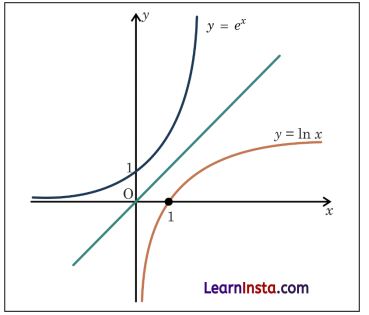
The graphs of the logarithmic function and the exponential function are inverse of each other.
The graphs are reflections of each other in the line: y = x.
| Function Type | Standard Equation | Important Features |
| Exponential Function | y = ax where (a > 0, a ≠ 1) | Variable is in the exponent |
| Logarithmic Function | y = log, x where {a > 0, a ≠ 1) | Inverse of exponential function |
Consider the following graph of the logarithm function and the exponential function:
Example 1:
The pH value of a chemical solution is calculated using pH = -log[H+], where [H+] represents the hydrogen ion concentration.
Find the pH value of the following solution:
(a) [H+] = 10-3
(b) [H+] = 10-6
Solution:
(a) pH = -log[10-3]
Converting logarithmic form into exponential form, we get, ;
log[10-3] = -3 log 10 = – 3 × 1 = -3 (Since log 10 = 1)
Therefore, pH = -log[10-3] = – (-3) = 3.
Hence, the pH value of the solution is 3.
(b) pH = -log[10-6]
Converting logarithmic form into exponential form, we get,
log[10-6] = -6 log 10 = -6 × 1 = -6 (Since log 10 = 1)
Therefore, pH = -log[10-6] = -(- 6) = 6
Hence, the pH value of the solution is 6.
Example 2:
The intensity of sound is measured using the decibel scale, which is logarithmic. A sound has intensity : 106 times greater than the reference intensity. Find its logarithmic sound level.
Solution:
106 = 1000000
Therefore, log101000000 = log10106 = 6 log1010 = 6 × 1 = 6. (Since log1010 = 1)
Hence, the logarithmic sound level is 6.
Example 3:
A scientist observes that a bacterial culture doubles I every hour. After several hours, the number of bacteria becomes 128 times the original amount. Using logarithms, determine the number of hours required i for the growth.
Solution:
Since the bacteria double every hour, the growth I pattern is 2x = 128, where x represents the number of hours.
Converting 2x = 128 into logarithmic form, we get,
log2128 = x
Since, 128 = 27
log227 = x
Using the power rule, loga(Xk) = k x logaX, we get,
7 log22 = x
Since, log22 = 1
7 × 1 = x
x = 7
Hence, the bacterial culture took 7 hours to become 128 times the original amount.
Formula:
- logba = x ⇔ bx = a
- pH = -log[H+]
- P = P0(1 + r)t
- y = ax
- y = logax
Fundamental:
- Exponential and logarithmic graphs are reflections i along the line y = x.
- Logarithmic equations are solved by converting j them into exponential form.
- The argument of a logarithm must always be positive.
- Extraneous roots must be rejected, as logarithms are undefined for zero or negative values.
- Logarithmic scales are used in earthquakes, sound intensity, chemistry and population growth.
- Human hearing responds logarithmically to sound intensity.
- Exponential functions grow rapidly, while logarithmic functions grow slowly.