Students often refer to NCERT Class 9 Advanced Maths Solutions Chapter 6 Exploring Some More Progressions Ex 6.1 to verify their answers.
Advanced Maths Class 9 Exercise 6.1 Solutions
Class 9 Advanced Maths Ex 6.1 Solutions
Question 1.
Find the sum of the series 0.15 + 0.015 + 0.0015 + … to 15 terms.
Solution:
Here, we have
Series = 0.15 + 0.015 + 0.0015 + …, number of terms n = 15
To Find: S15 (Sum of first 15 terms)
Here, common ratio: r = \(\frac{t_2}{t_1}=\frac{0.015}{0.15}\) = 0.1
and \(\frac{t_3}{t_2}=\frac{0.0015}{0.015}\) = 0.1
So, this is a GP with a = 0.15 and r = 0.1
Using the sum formula, we have –
Sn = \(\frac{a\left(1-r^n\right)}{1-r}\)
Put a = 0.15, r = 0.1, n = 15, we have
S15 = 0.15 × \(\frac{\left[1-(0.1)^{15}\right]}{1-0.1}\)
⇒ S15 = 0.15 × \(\frac{\left[1-(0.1)^{15}\right]}{0.9}\)
\(\begin{aligned}
& =\left(\frac{15}{100}\right) \times \frac{\left[1-(0.1)^{15}\right]}{\left(\frac{9}{10}\right)} \\
& =\left(\frac{15}{100}\right) \times\left(\frac{10}{9}\right) \times\left[1-(0.1)^{15}\right] \\
& =\left(\frac{150}{900}\right) \times\left[1-(0.1)^{15}\right] \\
S_{15} & =\left(\frac{1}{6}\right) \times\left[1-(0.1)^{15}\right]
\end{aligned}\)
Note: (0.1)15 is an extremely small number (essentially negligible).
Hence, S15 ≈ \(\frac{1}{6}\)

Question 2.
Find the sum to n terms of the series 0.9 + 0.99 + 0.999 + …
[Hint: Write (0.9 = 1 – 0.1) and (0.99 = 1 – 0.01) and so on…]
Solution:
Here, we have,
Series = 0.9 + 0.99 + 0.999 + … up to n terms
To Find: Sn
Rewrite each term using the hint.
0.9 = 1 – 0.1 = 1 – \(\left(\frac{1}{10}\right)\)
0.99 = 1 – 0.01 = 1 – \(\left(\frac{1}{10}\right)^2\)
0.999 = 1 – 0.001 = 1 – \(\left(\frac{1}{10}\right)^3\)
General term = 1 – \(\left(\frac{1}{10}\right)^n\)
Write Sn by summing all terms.Now, we separate the sums.
Sn = \(\begin{aligned}
{\left[1-\left(\frac{1}{10}\right)\right]+\left[1-\left(\frac{1}{10}\right)^2\right]+[ } & \left.1-\left(\frac{1}{10}\right)^3\right]+ \\
& \ldots+\left[1-\left(\frac{1}{10}\right)^n\right]
\end{aligned}\) …(i)
Now, we separate the sums.
Sn = n – \(\left[\left(\frac{1}{10}\right)+\left(\frac{1}{10}\right)^2+\left(\frac{1}{10}\right)^3+\ldots+\left(\frac{1}{10}\right)^n\right]\)
The series inside bracket is a GP with a = \(\frac{1}{10}\), r = \(\frac{\left(\frac{1}{100}\right)}{\left(\frac{1}{10}\right)}\)
= \(\frac{10}{100}=\frac{1}{10}\), n terms.
Sum of series inside bracket
= \(\left(\frac{1}{10}\right) \times \frac{\left[1-\left(\frac{1}{10}\right)^n\right]}{\left[1-\left(\frac{1}{10}\right)\right]}\)
\(\begin{aligned}
& =\left(\frac{1}{10}\right) \times \frac{\left[1-\left(\frac{1}{10}\right)^n\right]}{\left(\frac{9}{10}\right)} \\
& =\left(\frac{1}{9}\right) \times\left[1-\left(\frac{1}{10}\right)^n\right]
\end{aligned}\)
Substitute back in EQuestion (i), we have-
S = n – \(\left(\frac{1}{9}\right)\left[1-\left(\frac{1}{10}\right)^n\right]\)
Question 3.
Find the sum to n terms of the series 5 + 55 + 555 + …
Solution:
Here, we have
Series = 5 + 55 + 555 + … up to n terms
To Find: Sn
Factor out 5 from each term.
Sn = 5(1 + 11 + 111 + … up to n terms)
Multiply and divide by 9.
Sn = \(\left(\frac{5}{9}\right)\) (9 + 99 + 999 + … up to n terms)
Rewrite each term as (10″ -1).
Sn = \(\left(\frac{5}{9}\right)\) [(10 -1) + (100 -1) + (1000 – 1) + …]
because there are n occurrences of (-1)
Sn = \(\left(\frac{5}{9}\right)\) [(10 + 100 + 1000 + … up to n terms) – n] …(i)
The series (10 + 100 + 1000 + …) is a GP with a = 10,
r = \(\frac{100}{10}\) = 10.
Sum = \(\frac{10\left(10^n-1\right)}{10-1}=\frac{10\left(10^n-1\right)}{9}\)
Substitute back in EQuestion (i), we have-
Sn = \(\left(\frac{5}{9}\right)\left[\left(\frac{10}{9}\right)\left(10^n-1\right)-n\right]\)
Sn = \(\left(\frac{50}{81}\right)\left(10^n-1\right)-\frac{5 n}{9}\)
Question 4.
The sum of the first n terms of the sequence 3, 6, 12,… is 381. Find n.
Solution:
Here, we have GP: 3,6,12,… and Sn = 381
To Find: n
Identify a and r.
a = 3, r = \(\frac{6}{3}\) = 2 (GP confirmed as \(\frac{12}{6}\) = 2)
Apply sum formula. Since r = 2 > 1, use:
⇒ Sn = \(\frac{a\left(r^n-1\right)}{r-1}\)
⇒ 381 = \(\frac{3\left(2^n-1\right)}{2-1}\)
⇒ 381 = 3(2n – 1)
⇒ 2n – 1 = \(\frac{381}{3}\) = 127
⇒ 2n = 128
⇒ 2n = 27
Hence, n = 7
Question 5.
Find the sum to n terms of the series x(x + y) + x2(x2 + y2) + x3(x3 + y3) + …
Solution:
Here, we have
Series: x(x + y) + x2(x2 + y2) + x3(x3 + y3) + …
To Find: Sn
Expand each term.
t1 = x(x + y) = x2 + xy
t2 = x2(x2 + y2) = x4 + x2y2
t3 = x3(x3 + y3) = x6 + x3y3
Split the series into two parts.
Sn = (x2 + x4 + x6 + … + x2n) + (xy + x2y2 + x3y3 + … + xnyn)
Find the sum of the first GP
GP1: a = x2, r = x2
Sum1 = \(\frac{x^2\left(x^{2 n}-1\right)}{x^2-1}\) [r ≠ 1]
Find the sum of the second GP
GP2: a = xy,r = xy
Sum2 = \(x y \frac{\left[(x y)^n-1\right]}{x y-1}\) [r ≠ 1]
Combine both sums.
Sn = \(\frac{x^2\left(x^{2 n}-1\right)}{x^2-1}\) + xy\(\frac{\left[(x y)^n-1\right]}{(x y-1)}\)
Question 6.
Find the sum of the infinite terms of the series
1 + \(\frac{1}{2}+\frac{1}{3^2}+\frac{1}{2^2}+\frac{1}{3^4}+\frac{1}{2^3}+\frac{1}{3^6}\) + ……..
Solution:
Here, we have
Series: 1 + \(\frac{1}{2}+\frac{1}{3^2}+\frac{1}{2^2}+\frac{1}{3^4}+\frac{1}{2^3}+\frac{1}{3^6}\) + ……..
To Find: S∞
Identify the two interleaved series.
Series A (odd positions): 1 + \(\frac{1}{3^2}+\frac{1}{3^4}\) +… (powers of \(\frac{1}{9}\))
Series B (even positions): \(\frac{1}{2}+\frac{1}{2^2}+\frac{1}{2^3}\) +… (powers of \(\frac{1}{2}\))
Find the sum of Series A.
a = 1, r = \(\frac{\left(\frac{1}{9}\right)}{1}=\frac{1}{9}\) and |\(\frac{1}{9}\)| < 1
S = \(\frac{1}{\left(1-\frac{1}{9}\right)}=\frac{1}{\left(\frac{8}{9}\right)}=\frac{9}{8}\) = 1
Add both sums:
S∞ = SA + SB
= \(\frac{9}{8}\) + 1 = \(\frac{9+8}{8}=\frac{17}{8}\)
Hence, S∞ = \(\frac{17}{8}\)
Question 7.
Find the sum of Series B.Add both sums.Hence,8 7. The sum of an infinite series of GP is 6 and sum of the squares of these terms is 12. Find the common ratio of the original GE
Solution:
Here, we have S∞ = 6, sum of squares = 12
To Find: Common ratio r
Use S∞ of original GP.
\(\frac{a}{1-r}\) = 6
a = 6(1 – r) …(i)
The series formed by squares: a2 + a2r2 + a2r4 + … is a GP with first term a2 and ratio r2.
\(\frac{a^2}{1-r^2}\) = 12 …(ii)
Squaring EQuestion (i), we get-
a2 = 36(1 – r)2 …(iii)
Substitute EQuestion (iii) into EQuestion (ii),
⇒ \(\frac{36(1-r)^2}{1-r^2}\) = 12
⇒ \(\frac{36(1-r)^2}{[(1-r)(1+r)]}\) = 12
⇒ \(\frac{36(1-r)}{1+r}\) = 12
Cross multiply and solve.
⇒ 36(1 – r) = 12(1 + r)
⇒ 36 – 36r = 12 + 12r
⇒ 24 = 48r
⇒ r = \(\frac{24}{48}=\frac{1}{2}\)
⇒ r = \(\frac{1}{2}\)
Question 8.
If the sum to infinity of the series 1 + r + r2 + r3 + … is S, given that | r | < 1, write r in terms of S.
Solution:
Sos = S∞ = 1 + r + r2 + r3 +…,|r| < 1
To Find: r in terms of S
Concept Used: S∞ = \(\frac{a}{1-r}\) with a = 1
Apply the infinite GP formula.
Here a = 1 and ratio = r
⇒ S = \(\frac{1}{1-r}\)
⇒ S(1 – r) = 1
⇒ S – Sr = 1
⇒ Sr = S – 1
⇒ r = \(\frac{S-1}{S}\)
Question 9.
Find the value of \(4^{\frac{1}{2}} \cdot 4^{\frac{1}{4}} \cdot 4^{\frac{1}{8}} \cdot 4^{\frac{1}{16}}\)… to ∞.
Solution:
Let Product P = \(4^{\frac{1}{2}} \cdot 4^{\frac{1}{4}} \cdot 4^{\frac{1}{8}} \cdot 4^{\frac{1}{16}}\)…
To Find: P
P = \(4^{\left(\frac{1}{2}+\frac{1}{4}+\frac{1}{8}+\frac{1}{16}+\ldots\right)}\) …(i)
Find the sum of the infinite GP in the exponent.
Exponent series: \(\frac{1}{2}+\frac{1}{4}+\frac{1}{8}\) + …
This is a GP with a = \(\frac{1}{2}\) and r = \(\frac{1}{2}\) and |\(\frac{1}{2}\)| < 1
S∞ = \(\frac{\frac{1}{2}}{\left(1-\frac{1}{2}\right)}=\frac{\frac{1}{2}}{\frac{1}{2}}\) = 1
Substitute back in EQuestion (i),
P = 41 = 4
Question 10.
The midpoints D, E and F of the sides of an equilateral triangle ∆ABC are joined to form another smaller equilateral triangle. This process is repeated in the ∆DEE and so on indefinitely, getting smaller and smaller triangles. If each side of the ∆ABC is 16 cm, find – the sum of the perimeters of all the triangles, so formed.

Solution:
Side of ∆ABC = 16 cm. The midpoints are joined to form inner triangles infinitely.
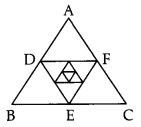
To Find: Sum of perimeters of all triangles
Find the sides of successive triangles:
When midpoints of sides of an equilateral triangle are joined, each side of the new triangle = half of the original side.
Each side of ∆ABC = 16 cm
Each side of ∆DEF = \(\frac{16}{2}\) = 8 cm
Each side of next triangle = \(\frac{8}{2}\) = 4 cm
So, sides form a GP: 16, 8, 4, 2,… with a = 16, r = \(\frac{1}{2}\)
Find perimeter of each triangle:
Perimeter of equilateral triangle = 3 × side
Perimeter of ∆ABC = 3 × 16 = 48 cm
Perimeter of ∆DEF = 3 × 8 = 24 cm
Perimeter of next triangle = 3 × 4 = 12 cm
Perimeters: 48, 24, 12,… → GP with a = 48, r = \(\frac{1}{2}\)
Apply infinite GP sum formula (| r | = \(\frac{1}{2}\) < 1).
S∞ = \(\frac{a}{1-r}=\frac{48}{\left(1-\frac{1}{2}\right)}\)
= \(\frac{48}{\left(\frac{1}{2}\right)}\) = 96 cm
Hence, sum of perimeters of all triangles = 96 cm
Question 11.
Let f(x) = 2x + 1. Find the number of values of x for which f(x), f(2x), f(4x) are in GP.
Solution:
Here, we have/(x) = 2x + 1; f(x), f(2x), f(4x) are in GP To Find: Number of values of x for which f(x), f(2x), f(4x) are in GP
f(x) = 2x + 1
⇒ f(2x) = 2(2x) + 1 = 4x + 1
⇒ f(4x) = 2(4x) + 1 = 8x + 1
Apply the GP condition: [f(2x)]2 = f(x).f(4x).
(4x + 1)2 = (2x + 1)(8x + 1)
⇒ 16x2 + 8x + 1 = 16x2 + 2x + 8x + 1
⇒ 16x2 + 8x + 1 = 16x2 + 10x + 1
⇒ 8x = 10x
0 = 2x
x = 0
Number of values of x = 1 (i.e., x = 0)
Question 12.
If t1, t2, t3, t4, … are the terms of a GP whose common ratio is r such that -1 < r < 1, then evaluate the following:
\(\frac{t_1-t_3+t_5-\ldots}{t_2-t_4+t_6-\ldots}\)
Solution:
GP with first term a, common ratio r, |r| < 1
To Find: Value of the given expression
\(\frac{t_1-t_3+t_5-\ldots}{t_2-t_4+t_6-\ldots}\)
Write the numerator series.
Numerator = t1 – t3 + t5 – …
= a – ar2 + ar4 – …..
This is a GP with first term a and common ratio -r2.
Since | r | < 1, |-r2| = r2 < 1, so the infinite sum exists.
Numerator = \(\frac{a}{1-\left(-r^2\right)}=\frac{a}{1+r^2}\)
Write the denominator series.
Denominator = t2 – t4 + t6 – …
= ar – ar3 + ar5 – …
This is a GP with first term ar and common ratio -r2.
Denominator = \(\frac{a r}{1+r^2}\)
Divide numerator by denominator.
\(\left[\frac{a}{1+r^2}\right] \div\left[\frac{a r}{1+r^2}\right]\) = \(\frac{a}{a r}=\frac{1}{r}\)
Hence, \(\frac{t^1-t^3+t^5-\ldots}{t^2-t^4+t^6-\ldots}=\frac{1}{r}\)
Question 13.
A particular ball rebounds \(\left(\frac{3}{5}\right)^{\text {th }}\) of the height from which it falls, whenever it strikes the floor. Find the total distance it covers before coming to rest, if it falls due to gravity from a height of 90 metres.
Solution:
Initial height = 90 m; rebound ratio = \(\frac{3}{5}\)
To Find: Total distance covered
The ball:
Falls 90 m (downward)
Bounces up: 90 × \(\left(\frac{3}{5}\right)\) = 54 m
Falls down: 54 m
Bounces up: 54 × \(\left(\frac{3}{5}\right)\) = 32.4 m
And so on…
Calculate total distance.
Total distance = first downward fall + (all bounces up + falls down)
D = 90 + 2(54) + 2\(\left(54 \times \frac{3}{5}\right)+2\left(54 \times\left(\frac{3}{5}\right)^2\right)\) + ….
D = 90 + 2 × \(\left[54+54\left(\frac{3}{5}\right)+54\left(\frac{3}{5}\right)^2+\ldots\right]\)
The bracket is an infinite GP with a = 54, r = \(\frac{3}{5}\).
S∞ = \(\frac{54}{\left(1-\frac{3}{5}\right)}=\frac{54}{\frac{2}{5}}\)
= 54 x \(\frac{5}{2}\) = 135
Final total distance.
D = 90 + 2 × 135
= 90 + 270 = 360 m
∴ Total distance covered = 360 metres