Experts have designed these NCERT Class 9 Advanced Maths Solutions and Class 9 Advanced Maths Chapter 3 Relations and Functions Notes for effective learning.
Relations and Functions Notes Class 9 Advanced Maths
Introduction
In daily life, many quantities depend on one another. The cost of a taxi ride depends on distance travelled, the area of a circle depends on its radius and the marks obtained in a test depend on the number of correct ariswers. Mathematics studies these connections using relations and functions. This chapter helps students understand how quantities are linked, how graphs represent these links and how functions are used in higher mathematics, science, economics and computer applications.
Relations and Cartesian Product
Before studying functions, we first learn how elements of different sets can be connected mathematically through ordered pairs and relations.
Ordered Pair: The basic building block of relations is an ordered pair, which represents two elements written in a fixed order.
An ordered pair is written as: (a, b)
- o → first element
- b → second element
Important Point: (2, 5) ≠ (5, 2), which means Order matters.
Two ordered pairs are equal only if corresponding elements are equal.
(a, b) = (c, d) ⇒ a = c,b = d
Example: If (2x + 3, y – 2) = (11, 5), find x and y.
Solution:
Since the ordered pairs are equal, equating their first and second components, we get
Then,
2x + 3 = 11 ⇒ x = 4
y – 2 = 5 ⇒ y = 7

Cartesian Product of Sets
Using ordered pairs, we now form all possible combinations between two sets.
This collection is called the Cartesian product.
For sets A and B,
A × B = {(a, b) : a ∈ A, b ∈ B}
Let A = {1, 2), B = {x, y, z}
Then, A × B = {(1, x), (1, y), (1, z), (2, x), (2, y), (2, z)}
Properties of Cartesian product:
- n(A × B) = n(A) × n(B).
- A × (B ∪ C)= (A × B) ∪ (A × C) and A × (B ∩ C) = (A × B) ∩ (A × C).
If A ⊆ B, then A × C ⊆ B × C for any set C.
Example:
Let A = {Delhi, Mumbai} be departure cities and B = {Jaipur, Chennai} be arrival cities.
Find:
(i) Cartesian products × B
(ii) Number of possible routes
Solution:
Cartesian Product:
A x B = {(Delhi, Jaipur), (Delhi, Chennai), (Mumbai, Jaipur), (Mumbai, Chennai)}
Number of Possible Routes
n(A × B) = n(A) × n(B)
= 2 × 2 = 4
Hence, total possible routes are: 4
Number of Relations
Since relations are formed from Cartesian products, we can calculate how many different relations are possible.
If A × B contains n elements, then:
Number of relations = 2n
Let n(A) = 2, n(B) = 3, then n(A × B) = 6
∴ Number of relations = 26 = 64
Relation
A relation selects specific ordered pairs from the Cartesian product according to a given rule.
A relation from set A to set B is: R ⊆ A × B
Domain, Range and Codomain
Every relation has important parts that describe the inputs
and outputs involved.
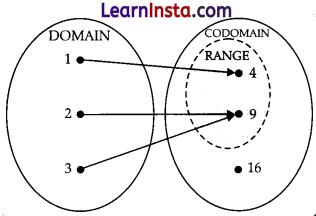
Domain: Set of all first elements.
Range: Set of all second elements actually used.
Codomain: Complete target set.
Let R= {(1, 4), (2, 9), (3, 9)}
Then,
- Domain = {1, 2, 3}
- Range = {4, 9}
If target set is B = {4, 9, 16}, then
Codomain = {4, 9, 16}
Relation in Roster Form
Relations are often represented by listing all ordered pairs satisfying a condition.Let A = {1, 2, 3, 4} and relation defined by: R = {(x, y) : y = x + 2}
Then, R = {(1, 3), (2, 4)}
Fundamentals:
A relation is always a subset of a Cartesian product.
R ⊆ A × B
This means every ordered pair of a relation must come from the Cartesian product.
Range is always a subset of codomain. ;
Range ⊆ Codomain
Every output belongs to the codomain, but every element of codomain may not appear in the range.
If A = Φ or B = Φ, then A × B = Φ.
Example: A university records the subjects chosen by students for a research project.
Let the relation R from set A (students) to set B (subjects) be:
A = {Aditi, Karan, Meera, Rohan}
B = {AI, Robotics, Statistics, Economics, Cyber Security}
R = {(Aditi, AI), (Karan, Robotics), (Meera, AI), (Rohan, Statistics)}
Find:
(i) Domain, Range and Codomain of R
(ii) Which subjects are not chosen by any student?
(iii) Is the range equal to the codomain? Give reason.
Solution:
(i) Domain of R:
The domain contains all first elements of the ordered pairs.
Domain = {Aditi, Karan, Meera, Rohan}
Range of R:
The range contains all second elements actually used.
Range = {AI, Robotics, Statistics}
Codomain of R:
The codomain is the complete target set B.
Codomain = {AI, Robotics, Statistics, Economics, Cyber Security}
(ii) For subjects not chosen by students, we compare range with codomain.
Subjects not appearing in the range are: {Economics, Cyber Security}
(iii) No.
Range ≠ Codomain
because some subjects in the codomain are not assigned to any student.
Special Types of Relations
Certain relations are commonly used in mathematics and help classify different kinds of connections.
(a) Identity Relation: Each element is related to itself.
R = {(1, 1),(2, 2),(3, 3)}
(b) Universal Relation: Every possible ordered pair belongs to the relation.
R = A × A
(c) Empty Relation: No ordered pair satisfies the condition.
R = Φ
Functions and Graphs
Relations only describe connections, but many mathematical situations require exactly one output for every input. Such relations are called functions.
Function
A function is a relation in which every element of the domain is associated with exactly one element of the codomain. A relation becomes a function when:
- Every element of domain has exactly one image.
- No element has more than one image.
Identifying Functions
To check whether a relation is a function, we observe how outputs are assigned to inputs.
Function: {(1, a), (2, b), (3, c)}
Each input has exactly one output.
Hence, it is a function
Not a Function: {(1, a), (1, b), (2, c)}
- Input 1 has two outputs.
- Hence, it is not a function.
Example: An electricity company charges: ₹ 6 per unit
The bill function is: f(x) = 6x
where x is the number of units consumed.
Find the bill amount for:
(i) 50 units
(ii) 120 units
Also state whether the relation is a function.
Solution:
Given, f(x) = 6x
(i) For 50 units
f(50) = 6 × 50
= 300
Bill amount: ₹ 300
(ii) For 120 units
f(120) = 6 × 120
= 720
Bill amount: ₹ 720
Function Check:
Each number of units gives exactly one bill amount.
Therefore, it is a function.
Important Observation About Functions
While checking whether a relation is a function, remember that different elements of the domain may have the same., image. A relation is still a function as long as each element has only one image,
e.g.: {(1, 5), (2, 5), (3, 5)}
This is a function because every input has exactly one output, even though all outputs are the same.
Domain and Range of Functions
The domain and range help describe the allowed inputs and resulting outputs of a function.
Let f(x) = x2, x ∈ {-2, -1, 0, 1, 2}
Outputs: 4, 1, 0, 1, 4
Therefore,
- Domain = {-2, -1, 0, 1, 2}
- Range = {0, 1, 4}
Fundamentals:
- Every function is a relation, but every relation is not 5 a function.
A function follows the additional condition that each input must have exactly one output. - In a function, one input cannot have two different outputs.
- If an element of the domain is associated with more i than one image, then the relation is not a function.
Standard Functions and their Graphs
After learning what functions are, we now study some standard functions that appear frequently in mathematics. Understanding their equations, domains, ranges and graphical behaviour helps in analysing more complex functions later.
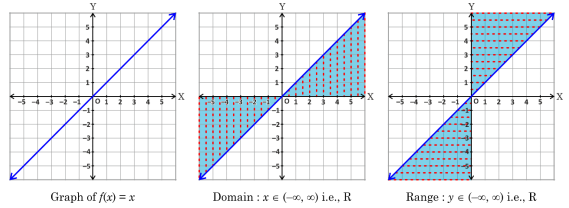
Identity Function: The identity function gives the same output as the input.
f(x) = x
Domain : R; Range: R
Important Features
- Graph is a straight line passing through the origin.
- Every point on the graph has equal x-coordinate and y-coordinate.
e.g.: f(4) =4, f( – 3) = – 3 - Constant Function: In a constant function, every input has the same fixed output.
f(x) = c
where c is a constant.
Domain: R; Range: {c}

Important Features
- Graph is parallel to the x-axis.
- Output never changes for different values of x.
e.g.: If f(x) = 5, then f(-2) = 5, f(0) = 5, f(7) = 5
Quadratic Function
A quadratic function contains the square of the variable.
f(x) = x2
Domain: R; Range: [0, ∞)

Important Features
- Graph is U-shaped.
- Near x = 0 the output changes slowly; for large | x | it grows rapidly.
- Function never gives negative output. e.g.: f(-3) = 9, f(2) = 4
Cubic Function: A cubic function contains the cube of the variable.
f(x) = x3
Domain: R; Range: R

Important Features
- Graph passes through the origin.
- Negative inputs give negative outputs.
- Positive inputs give positive outputs.
e.g.: f(-2) = -8, f(3) = 27
Modulus Function
The modulus function gives the distance of a number from zero.
f(x) =|x|
Definition: |x| = {x, x ≤ 0
-x, x < 0}
Domain: R; Range[0, ∞)

Important Features
- Output is always non-negative.
- Positive and negative values with same magnitude give same output.
e.g.: |-7| = 7, |5| = 5
Reciprocal Function
The reciprocal function is formed by taking the reciprocal of the variable.
f(x) = \(\frac{1}{x}\)
Domain: R – {0}; Range: R- {0}

Important Features
- x = 0 is not allowed because division by zero is undefined.
- For x > 0, as value of x increases, value of \(\frac{1}{x}\) decreases.
e.g.: f(2)= \(\frac{1}{2}\), f(-4)= \(-\frac{1}{4}\)
Square Root Function
The square root function gives the principal square root of a number.
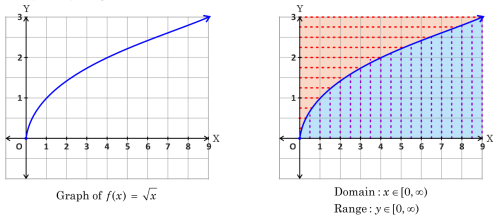
f(x) = \(\sqrt{x}\)
Domain: [0, ∞); Range: [0, ∞)
Important Features
- Negative numbers are not allowed inside the square root.
- Outputs are always non-negative.
e.g.: f(9) = 3, f(25) = 5
Greatest Integer Function
The greatest integer function gives the greatest integer less than or equal to a given number.
f(x) = [x]
Domain: R; Range: Z

Important Features
- Output changes in steps.
- Decimal values are reduced to nearest smaller integer.
e.g.: [4.8] = 4, [-2.3] = -3, [7] = 7
Example: A car moves at a constant speed of 60 km/h The distance travelled after t hours is: d = 60t Find the distance travelled in:
(i) 2 hours
(ii) 5 hours
Also identify the type of graph formed.
Solution:
Given, d = 60t
For 2 hours
d = 60 × 2
= 120 km
For 5 hours
d = 60 × 5
= 300 km
Type of Graph
The graph is a straight line passing through the origin because distance increases uniformly with time.
Vertical Line Test
The vertical line test is a visual method to determine if a graph represents a function.
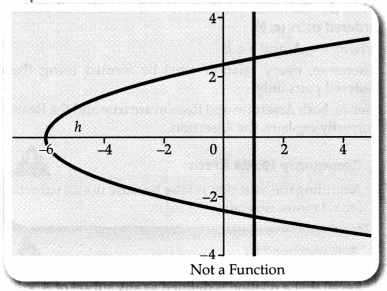
A graph represents a function if and only if any vertical line intersects it at most once.
If any vertical line intersects the curve at two or more points, the graph does not represent a function.


Important Observation About Graphs
The domain of a function can be observed from the values taken along the x-axis, while the range can be observed from the values taken along the y-axis.
Transformation of Graphs
Graphs can be translated vertically (upward or downward) without changing their shape. A vertical translation is a type of graph transformation.
Upward Shift: For y = f(x) + c the graph shifts upward by c units.
Example: y = x2 + 2 is obtained by shifting the graph of y = x2 upward by 2 units.
Downward Shift: For y = f(x) – c the graph shifts down¬ward by c units.
Example: y = x2 – 3 is obtained by shifting the graph of y = x2 downward by 3 units.