Each of our Ganita Manjari Class 9 Worksheet and Class 9 Maths Chapter 5 I’m Up and Down and Round and Round Worksheet with Answers focuses on conceptual clarity.
Class 9 I’m Up and Down and Round and Round Worksheet
Ganita Manjari Class 9 Chapter 1 Worksheet
Multiple Choice Questions
Question 1.
The circumcentre of an acute-angled triangle lies;
(a) Outside the triangle
(b) Inside the triangle
(c) On the hypotenuse
(d) At the midpoint of the longest side
Answer:
(b) Inside the triangle
In an acute-angled triangle, the perpendicular bisectors of the three sides intersect at a point inside the triangle. This point is called the circumcentre.
Question 2.
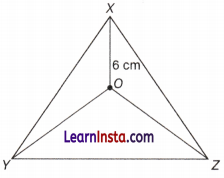
In ∆XYZ,O is the circumcentre and OX = 6 cm. A classmate claims that OY = OZ = 6 cm only if ∆XYZ is equilateral. Is the classmate correct?
(a) Yes, this holds only for equilateral triangles.
(b) .No, OY = OZ = 6 cm for any triangle XYZ, since O is equidistant from all vertices
(c) No, this is true only for isosceles triangles
(d) No, this is true only if the triangle is right-angled
Answer:
(a) Yes, this holds only for equilateral triangles.
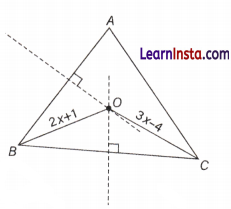
Since, 0 is the circumcentre of ∆ABC, it is equidistant from all the vertices.
So, OB = OC
⇒ 2x + 1 = 3x – 4
⇒ 1 + 4 = 3x – 2x
⇒ 5 = x
Now, OB = 2x + 1
On substituting x = 5, we get
OB = 2(5) + 1
⇒ OB = 11 cm
Also, OA = OB = OC
Hence, OA = 11 cm
Question 3.
In ∆ABC, the perpendicular bisectors of AB and BC meet at point O, the circumcentre, If OB = (2x +1) cm and OC = (3x – 4) cm, find the value of x and hence the length of OA.
(a) x = 5, OA = 11cm
(b) x = 3, OA = 7cm
(c) x = 5, OA = 9cm
(d) x = 4, OA = 9cm
Answer:
(b) x = 3, OA = 7cm
Since O is the circumcentre of ∆XYZ, it is equidistant from all the vertices X, Y and Z
So, OX = OY = OZ
Given, OX = 6 cm
Therefore, 0V = 6 cm and OZ = 6 cm.
Hence, the classmate is not correct. This property is true for any triangle, not only for an equilateral triangle.

Question 4.
In a right-angled triangle, the circumcentre lies:
(a) Inside the triangle
(b) Outside the triangle
(c) At the midpoint of the hypotenuse
(d) At the vertex of the right angle
Answer:
(c) At the midpoint of the hypotenuse
In a right-angled triangle, the hypotenuse is the diameter of the circumcircle. Therefore, the circumcentre is lies at the midpoint of the hypotenuse
Question 5.
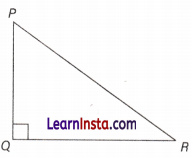
∆PQR is right-angled at Q, Its circumcentre is the point M. Which of the following must be true about M?
(a) M lies inside ∆PQR
(b) M is the midpoint of hypotenuse
(c) M is equidistant from P and R only, not
(d) M lies outside ∆PQR
Answer:
(b) M is the midpoint of hypotenuse
For a right-angled triangle, the circumcentre always lies at the midpoint of the hypotenuse.
Here, PR is the hypotenuse (opposite the right angle at Q), so M is its midpoint.
Question 6.
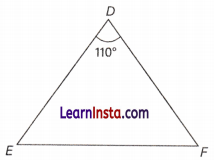
∆DEF has ∠D = 110°. Where will the circumcentre of ADEF lie?
(a) Inside ∆DEF
(b) On side EF
(c) Outside ∆DEF
(d) At vertex D
Answer:
(c) Outside ∆DEF
Given, ∠D = 110°.
Since ∠D is greater than 90°, ADEF is an obtuse-angled triangle.
Now, in an obtuse-angled triangle, the circumcentre lies outside the triangle.
Hence, the circumcentre of A DEF lies outside A DEF.
Question 7.
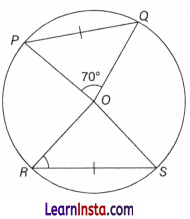
In the given figure, O is the centre of the circle, PQ = RS and ∠POQ = 70°, then find ∠ORS.
(a) 550
(b) 75°
(c) 65°
(d) 60°
Answer:
(a) 550
Since, PQ = RS, equal chords subtend equal angles at the centre.
Therefore, ∠ROS = ∠POQ
Given, ∠POQ = 70°
Then, ∠ROS = 70°
Now, in ∠ORS OR = DS, Since both are radii of the same circle.
So, ∠ORS = ∠OSR
Also, ∠ROS + ∠ORS + ∠OSR = 180°
On substituting the values, we get
70° + ∠ORS + ∠ORS = 180°
⇒ 2∠ORS = 180° – 70°
⇒ ∠ORS = \(\frac{110^{\circ}}{2}\)
⇒ ∠ORS = 55°
Question 8.
If two chords AB and CD of a circle are equidistant from the centre O, Which conclusion is necessarily correct regarding their lengths?
(a) AB is a diameter
(b) AS and CD are equal chords
(c) AB and CD intersect
(d) AB is parallel to CD
Answer:
(b) AS and CD are equal chords
Given Two chords AB and CD are equidistant from the centre 0.
We know that chords which are equidistant from the centre of a circle are equal in length.
Now, AB and CD are equidistant from O.
Hence, AB = CD
So, the necessarily correct conclusion is:
AB and CD are equal chords.
Question 9.
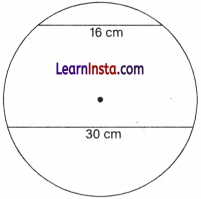
A circle has radius 17 cm. Two parallel chords of lengths 30 cm and 16 cm are drawn on opposite sides of the centre. The distance between the two chords is:
(a) 15 cm
(b) 20 cm
(c) 23 cm
(d) 25 cm
Answer:
(a) 15 cm
Let the two parallel chords be AB = 30 cm and CD = 16 cm Radius of the circle = 17 cm
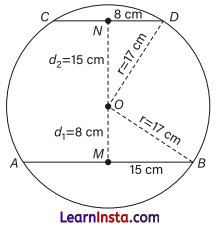
For chord 30 cm, \(\frac{30}{2}\) = 15 cm
Now, distance from centre,
d1 = \(\sqrt{17^2-15^2}\)
d1 = \(\sqrt{289-225}=\sqrt{64}\) = 8 cm
For chord 16 cm,
\(\frac{16}{2}\) = 8 cm
d2 = \(\sqrt{17^2-8^2}\)
d2 = \(\sqrt{289-64}=\sqrt{225}\) = 15 cm
Since the chords are on opposite sides of the centre, distance between chords = 8 + 15 = 23 cm
Question 10.
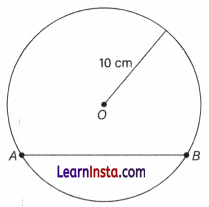
A chord of length 16 cm is drawn in a circle of radius 10 cm. Find the distance of the chord from the centre?
(a) 4 cm
(b) 5 cm
(c) 6 cm
(d) 8 cm
Answer:
(c) 6 cm
Let the distance of the chord from the centre be d cm.
Since the perpendicular from the centre of a circle to a chord bisects the chord,
⇒ Half of chord = \(\frac{16}{2}\) = 8 cm
Now, radius = 10 cm
Using Pythagoras theorem,
d2 + 82 = 102
⇒ d2 + 64 = 100
⇒ d2 = 36
⇒ d = 6 cm
Question 11.
Chords AB and CD of a circle are such that AB = 2 CD. What can be concluded about their distances from the centre, d1 (for AB) and d1 (for CD)?
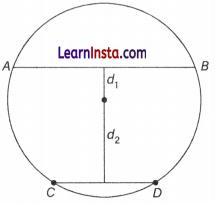
(a) d1 – 2d2
(b) d2 = 2d1
(c) d1 < d2, but not necessarily d2 = 2d1
(d )d1 = d2
Answer:
(c) d1 < d2, but not necessarily d2 = 2d1
Since AB = 2CD therefore chord AB is longer than chord CD.
We know that, in a circle, the longer chord is nearer to the centre.
Now, AB is longer than CD.
So, the distance of AB from the centre is less than the distance of CD from the centre.
∴ d1 < d2
Hence, it can be concluded that d1 < d2
Question 12.
If the angle subtended by an arc of a circle at the centre is 138°, then the angle subtended by the same arc at a point on the major arc is:
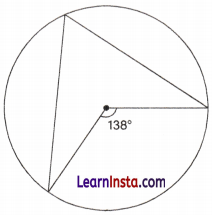
(a) 46°
(b) 69°
(c) 138°
(d) 222°
Answer:
(b) 69°
Tie angle subtended by an arc at the centre is double the angle subtended by the same arc at any point on the circle outside the arc.
So, Angle at the major arc = \(\frac{1}{2}\) × 138° = 69°
Question 13.
In a circle with centre O, chord PQ subtends an angle of 100° at the centre. Find the angle subtended by the major arc PQ at a point ft lying on the minor arc.
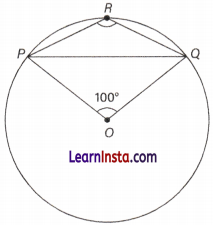
(a) 50°
(b) 100°
(c) 130°
(d) 260°
Answer:
Given, chord PQ subtends an angle of 100° at the centre O.
∠POQ = 100°
Now, minor arc PQ subtends 100° at the centre.
∴ Measure of major ar PQ = 360° – 100° = 260°
Since the angle subtended by an arc at any point on the remaining part of the circle is half the angle subtended by the same arc at the centre.
∠PRQ = \(\frac{1}{2}\) × 260° = 130°
Hence, the angle subtended by the major arc PQ at point R is 130°.
Question 14.
ABCD is a cyclic quadrilateral in which AB is a diameter of the circle. If ∠ADC = 130°, then ∠BAC is:
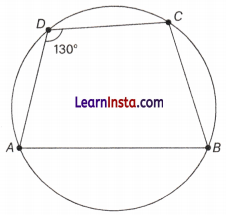
(a) 40°
(b) 50°
(c) 90°
(d) 130°
Answer:
(a) 40°
Given, ∠ADC = 130°
Since ABCD is a cyclic quadrilateral,
∠ADC + ∠ABC = 180°
On substituting the value, we get 130° + ∠ABC = 180°
⇒ ∠ABC = 50°
Also, AB is a diameter of the circle.
So, ∠ACB = 90°
Now, in AABC,
∠BAC + ∠ABC + ∠ACB = 180°
⇒ ∠BAC + 50° + 90° = 180°
⇒ ∠BAC = 40°
Assertion-Reasoning Questions
Direction (Q.Nos 1-6) Select the correct option from (a), (b), (c), (d) as given below.
(a) Both A and R are true and R is the correct explanation of A.
(b) Both A and R are true but R is NOT the correct explanation of A.
(c) A is true but R is false.
(d) A is false but R is true.
Question 1.
Assertion (A) A unique circle always passes through any three given points in a plane.
Reason (R) The perpendicular bisectors of two sides of a triangle meet at a single point.
Answer:
(d) A is false but R is true.
Question 2.
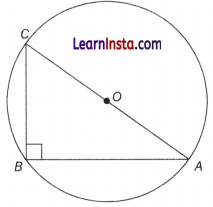
Assertion (A) The circumcentre of a right-angled triangle lies at the midpoint of the hypotenuse.
Reason (R) In a right-angled triangle, the hypotenuse is a diameter of the circumcircle.
Answer:
(a) Both A and R are true and R is the correct explanation of A.
Both statements are true and the reason correctly explains the assertion. In a right-angled triangle, the circumcentre is the midpoint of the hypotenuse.
Question 3.
Assertion (A) The circumcentre of an obtuse-angled triangle lies outside the triangle,
Reason (R) The perpendicular bisectors of its sides meet outside the triangle.
Answer:
(a) Both A and R are true and R is the correct explanation of A.
In an obtuse-angled triangle, the circumcentre lies outside the triangle.
Also, the circumcentre is the point where the perpendicular bisectors of the sides of a triangle meet.
Therefore, in an obtuse-angled triangle, the perpendicular bisectors meet outside the triangle. Hence, both A and R are true, and R is the correct explanation of A.
Question 4.
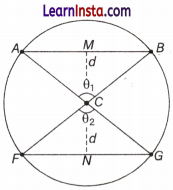
Assertion (A) If the perpendicular distances of two chords of the same circle from the centre are equal, then the chords subtend equal angles at the centre.
Reason (R) Chords equidistant from the centre are equal in length, and equal chords subtend equal angles at the centre.
Answer:
(a) Both A and R are true and R is the correct explanation of A.
If two chords are equidistant from the centre, then they are equal in length.
So, AB = FG
Also, equal chords of a circle subtend equal angles at the centre.
Therefore, ∠ACB = ∠FCG
Hence, the chords subtend equal angles at the centre. So, both Assertion and Reason are true, and Reason is the correct explanation of Assertion.
Question 5.
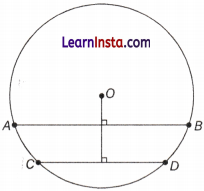
Assertion (A) Two chords of a circle that are unequal in length must also be at unequal distances from the centre.
Reason (R) Equal chords of a circle are equidistant from the centre, and this relationship works only in one direction.
Answer:
(c) A is true but R is false.
Equal chords of a circle are equidistant from the centre, and also chords equidistant from the centre are equal in length.
So, this relationship works in both directions, not only in one direction.
Hence, Assertion is true, but Reason is false.
Question 6.
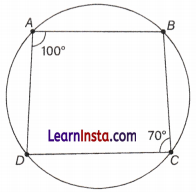
Assertion (A) A quadrilateral with two opposite angles measuring 100° and 70° can be a cyclic quadrilateral.
Reason (R) A quadrilateral is cyclic if and only if the sum of each pair of opposite angles is 180°.
Answer:
(d) A is false but R is true.
For a quadrilateral to be cyclic, the sum of each pair of opposite angles must be 180°.
Here, the given opposite angles are 100° and 70°. 100° + 70° = 170°
Since 170° ≠ 180°, the quadrilateral cannot be cyclic.
Hence, Assertion is false, but Reason is true.
Class 9 Maths I’m Up and Down and Round and Round Worksheet
Worksheet On I’m Up and Down and Round and Round Class 9
Very Short Answer Questions.
Question 1.
Points A, B and C lie on a straight line. Can a circle be drawn passing through all three Points? Justify your answer.
Answer:
No. A circle can be drawn through three points only if the points are non-collinear; collinear points cannot lie on a single circle.
Question 2.
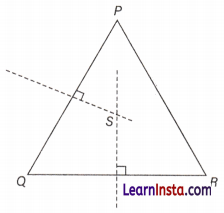
In ∆PQR, the perpendicular bisectors of PQ and QR meet at point S. State the relationship between SP, SQ and
Answer:
Given, the perpendicular bisectors of PQ and QR meet at point S.
So, S is the circumcentre of ∆PQR.
Now, the circumcentre is equidistant from all the vertices of a triangle.
Hence, SP = SQ = SR
Question 3.
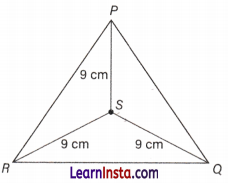
In ∆PQR, the circumradius is 9 cm. If a point S satisfies SP = SQ = SR – 9 cm, what can you conclude about S?
Answer:
Given, SP = SQ = SR = 9 cm.
So, S is equidistant from P, Q and R.
Now, the point which is equidistant from all the vertices of a triangle is the circumcentre of the triangle.
Hence, S is the circumcentre of ∆PQR.
Question 4.
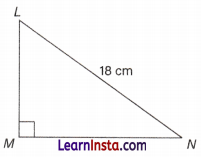
∆LMN is right-angled at M, with hypotenuse LN = 18 cm. Without further construction, state the circumradius of ∆LMN.
Answer:
Given, ∆LMN is right-angled at M and hypotenuse LN = 18 cm.
Now, in a right-angled triangle, the circumcentre lies at the midpoint of the hypotenuse.
So, the circumradius is half of the hypotenuse.
⇒ Circumradius = \(\frac{18}{2}\)cm
⇒ Circumradius = 9 cm
Hence, the circumradius of ∠LMN is 9 cm.
Question 5.
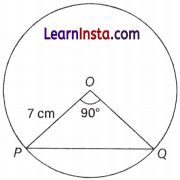
In the given figure, chord PQ subtends an angle of 90° at the centre O of the circle. If OP = 7 cm, then find the length of PQ
Answer:
Since OP = OQ = 7 cm, both are radii of the circle.
Also, ∠POQ = 90°
Now, in ∆OPQ
PQ2 = OP2 + OQ2
⇒ PQ2 = 72 + 72
⇒ PQ2 = 49 + 49 = 98
⇒ PQ = √98 = 7√2
Hence, the length of chord PQ is 7√2 cm.
Question 6.
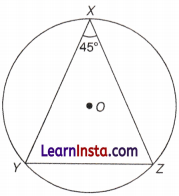
n the given figure, XYZ is a triangle in which ∠YXZ = 45°. Find the length of YZ in terms of the
radius of the circumcircle of ∆XYZ, whose centre is 0.
Answer:
Let the radius of the circumcircle be R.
Since ∠YXZ = 45°, and the angle subtended by an arc at the centre is double the angle subtended by it at any point on the circle,
∠YOZ = 2∠YXZ
⇒ ∠YOZ = 2 × 45° = 90°
Now, in ∠YOZ,
OY = OZ = R
and ∠YOZ = 90°.
Using the Baudhayana-Pythagoras theorem,
YZ2 = OY2 + OZ2
⇒ YZ2 = R22 + R2 = 2R2
⇒ YZ = R√2
Hence, the length of YZ is R√2.
Question 7.
What is the distance from the centre of a circle to a diameter of that circle.
Answer:
A diameter passes through the centre of a circle. Hence, the distance from the centre of a circle to its diameter is 0 cm.
Question 8.
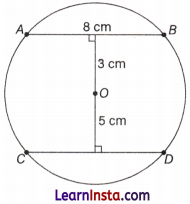
A chord of a circle is 8 cm long and lies 3 cm from the centre. State whether this chord is longer or shorter than another chord lying 5 cm from the centre of the same circle, without calculating lengths.
Answer:
In the same circle, the chord nearer to the centre is longer.
Here, the first chord is 3 cm from the centre and the second chord is 5 cm from the centre.
Since 3 < 5
Therefore, the chord lying 3 cm from the centre is nearer to the centre.
Hence, it is longer than the chord lying 5 cm from the centre.
Question 9.
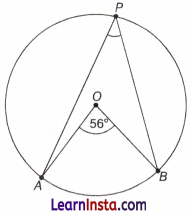
If the angle subtended by an arc at the centre is 56°, what angle does it subtend at a point on the remaining part of the circle?
Answer:
Given, angle subtended by arc AB at the centre O is 56°.
Now, the angle subtended by the same arc at any point on the remaining part of the circle is half the angle subtended by it at the centre.
Therefore,
∠APB = \(\frac{1}{2}\) ∠AOB
On substituting ∠AOB = 56°, we get
∠APB = \(\frac{1}{2}\) × 56°
⇒ ZAPB = 28°
Hence, the required angle is 28°.
Question 10.
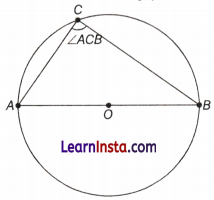
What is the angle subtended by a diameter at any point on the circle?
Answer:
Let AB be a diameter of the circle and C be any point on the circle.
Now, the angle subtended by a diameter at any point on the circle is a right angle.
Therefore, ∠ACB = 90°
Hence, the angle subtended by a diameter at any point on the circle is 90°.
Question 11.
Define ‘concyclic points’ in your own words.
Answer:
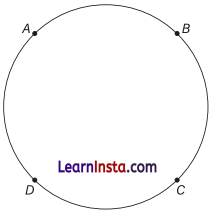
Concyclic points are points that all lie on the circumference of one and the same circle.
Question 12.
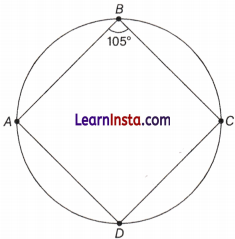
In a cyclic quadrilateral ABCD, if ∠B = 105° then find ∠D.
Answer:
Given, ABCD is a cyclic quadrilateral and
∠B = 105°
Now, in a cyclic quadrilateral, the sum of each pair of opposite angles is 180°.
Therefore, ∠B + ∠D = 180°
On substituting ∠B = 105°, we get
105° + ∠D = 180°
⇒ ∠D = 180° – 105°
⇒ ∠D = 75°
Question 13.
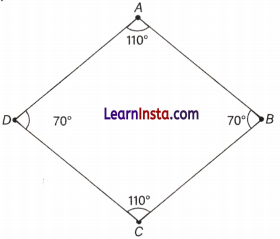
A quadrilateral has opposite angle pairs measuring (70°, 70°) and (110°, 110°). Could it be a cyclic quadrilateral?
Answer:
Given, the opposite angle pairs are 70°, 70° and 110°, 110°.
We know that in a cyclic quadrilateral, the sum of each pair of opposite angles is 180°.
Now, 70° + 70° = 140°
Also, 110° + 110° = 220°
Since neither 140° nor 220° is equal to 180°, the given quadrilateral cannot be a cyclic quadrilateral.
Hence, it could not be a cyclic quadrilateral.
Short Answer Questions
Question 1.
State the rotational symmetry of a circle. Also, explain how many lines of reflection symmetry a circle has.
Answer:
A circle has complete rotational symmetry because it looks exactly the same after rotation through any angle about its centre.
Also, every diameter of a circle is a line of reflection symmetry. Since a circle has infinitely many diameters, hence a circle has infinitely many lines of reflection symmetry.
Question 18.
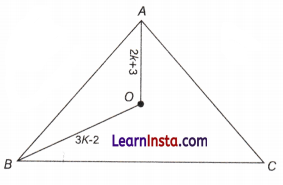
In ∆ABC,thecircumcentre O issuch that OA = (2k + 3) cm and OB = (3k -2) cm. Find the value of k and hence the circumradius of ∆ABC.
Answer:
Since O is the circumcentre of ∆ABC.
Therefore, OA and OB are radii of the circumcircle.
So, OA = OB
⇒ 2k + 3 = 3k – 1
⇒ 3 + 2 = 3k – 2k
⇒ 5 = k
⇒ k = 5
Now, on substituting k = 5 in OA = 2k + 3
⇒ OA = 2(5) + 3
⇒ = 10 + 3
⇒ = 13 cm
Hence, the circumradius of ∆ABC is 13 cm.
Question 2.
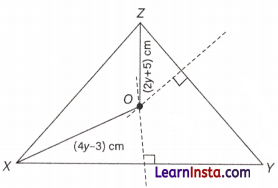
In ∆XYZ, the perpendicular bisectors of XY and YZ meet at the circumcentreO. If OX = (4 y – 3) cm and OZ = (2y + 5) cm, find the value of y and then find the circumradius of ∆XYZ.
Answer:
Since O is the circumcentre of ∆XYZ.
Therefore, OX and OZ are radii of the circumcircle.
So, OX = OZ
⇒ 4y – 3 = 2y + 5
⇒ 4y – 2y = 5 + 3
⇒ 2y = 8
⇒ y = 4
Hence, y = 4
Now, on substituting y = 4 in OX = 4y – 3,
⇒ OX = 4(4) – 3
⇒ OX = 16 – 3
⇒ OX = 13 cm
Hence, the circumradius of ∆XYZ is 13 cm.
Question 3.
Construct the circumcircle of ∆ABC where ∠A = 70°, ∠B = 60° and AB = 5 cm, State whether the circumcentre lies inside or outside the triangle and give reason.
Answer:
Given, ∠A = 70°, ∠B = 60°,
Now, ∠C = 180° -(∠A + ∠B)
= 180° – (70° + 60°)
= 180° -130° = 50°
Since all angles of ∆ABC arc less than 90°, therefore ∆ABC is an acute – angled triangle.
Construction steps:
Step 1 Draw AB = 5 cm.
Step 2 At A construct ∠A = 70°; at B, construct ∠B = 60°. Let the two rays meet at C.
Step 3 Draw the perpendicular bisectors of AB and BC.
Step 4 Let their point of intersection be O. This point is the circumcentre.
Step 5 With O as centre and OA as radius draw a circle passing through A, B and C.
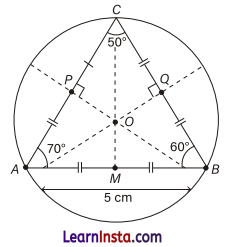
Position Since ∆ABC is acute-angled (all angles < 900), the circumcentre O lies inside the triangle.
Question 4.
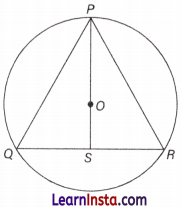
Bisector PS of ∠QPR of ∠PQR passes through the centre O of its circumcircle, as shown in the figure. Prove that PQ = PR.
Answer:
Since O is the centre of the circumcircle of ∆PQR, therefore
OP = OQ = OR
Now, PS is the bisector of ∠QPR and O lies on PS.
So, ∠QPO = ∠OPR
In ∆ PQO and A PRO,
OP = OP (common)
OQ = OR (radii of the same circle)
∠QPO = ∠OPR
Hence, by RHS congruence,
∆ PQO ≅ ∠∆PRO
Therefore, PQ = PR
Question 5.
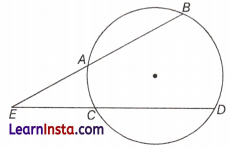
Two equal chords AB and CD of a circle, when produced, meet at a point E outside the circle. Show that EA = EC. (Hint: use the property that equal chords are equidistant from the centre, and consider triangle formed by joining the centre to point E.)
Answer:
Let O be the centre of the circle. Draw perpendiculars OP and OQ from O to chords AB and CD, respectively. Now, equal chords of a circle are equidistant from the centre.
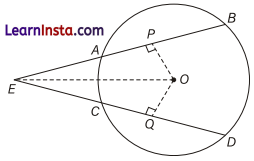
Since AB = CD,
OP = OQ
Also, OP ⊥ AB and OQ ⊥ CD
In right triangles OPE and OQE,
0E = OE (common)
OP = OQ
Therefore, by RHS congruence,
∆OPE ≅ ∆OQE
Hence, EP = EQ
Also, perpendicular from the centre to a chord bisects the chord.
So, AP = \(\frac{AB}{2}\), CD = \(\frac{CD}{2}\)
Since AB = CD,
AP = CQ
Now, EP = EA + AP
and EP = EA + CQ
On putting EP = EQ and AP = CQ we get
EA + AP = EC + CQ
⇒ EA = EC
Hence, EA = EC
Question 6.
Two parallel chords of a circle have lengths 6 cm and 10 cm, and lie on the same side of the centre. If the radius of the circle is 5√2 cm, find the distance between the two chords.
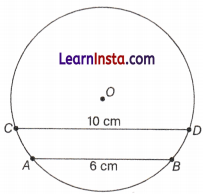
Answer:
Given, radius of the circle r = 5√2 cm
and lengths of two parallel chords are 6 cm and 10 cm.
Now, perpendicular from the centre to a chord bisects the chord
For chord of length 6 cm,
half of chord = \(\frac{6}{2}\) = 3cm
Let its distance from the centre be x.
x2 + (3)2 = (5√2)2
⇒ x2 + 9 = 50
⇒ x2 = 41
⇒ x = √41 cm
For chord of length 10 cm,
half of chord = \(\frac{10}{2}\) = 5 cm
Let its distance from the centre be y.
y2 + (5)2 = (5√2)2
⇒ y2 + 25 = 50
⇒ y2 = 25
⇒ y = 5 cm
Since both chords lie on the same side of the centre, distance between the chords is √41 – 5 cm
Hence, the distance between the two chords is (√41 – 5) cm.
Question 7.
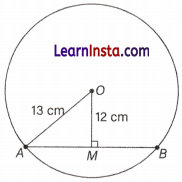
A chord of a circle of radius 13 cm is at a distance of 12 cm from the centre. Find the length of the chord.
Answer:
Let AB be the chord and O be the centre of the circle with radius OA = 13 cm.
The perpendicular from the centre to a chord bisects the chord.
Therefore, OM ⊥ AB and M is the mid-point of AB.
Hence, AM = MB
In right ∆OMA,
By Pythagoras theorem,
OA2 = OM2 + AM2
On substituting OA = 13 cm and OM = 12 cm we get
(13)2 = (12)2 + AM2
⇒ 169 = 144 + AM2
⇒ AM2 = 169 – 144
⇒ AM2 = 25
⇒ AM = 5 cm
Therefore, AB = 2 × AM = 2 × 5 = 10 cm
Hence, the length of the chord is 10 cm.
Question 8.
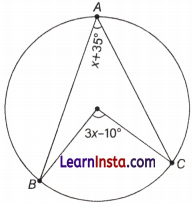
In a circle, an arc subtends an angle of(3x – 10°) at the centre and an angle of (x + 35°) at a point on the remaining part of the circle. Find x and the actual angle subtended at the centre.
Answer:
Given, angle at the centre is (3x – 10°) and angle at the remaining part of the circle is (x + 35°).
Now, the angle subtended by an arc at the centre is double the angle subtended by it at any point on the remaining part of the circle.
Therefore,
3x – 10 = 2(x + 35)
⇒ 3x – 10 = 2x + 70
⇒ 3x – 2x = 70 + 10
⇒ x = 80
Now, angle at the centre = 3x – 10°
On putting x = 80, we get
3(80) – 10° = 240° – 10° = 230°
Hence, x = 80 and the actual angle subtended at the centre is 230°.
Question 9.
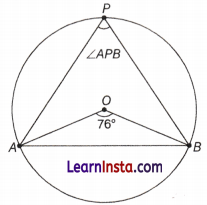
In a circle with centre O, a chord AB subtends an angle of 76° at the centre. Find the angle subtended by AB at a point P lying on the major arc.
Answer:
Given, chord AB subtends an angle of 76° at the centre O.
Now, P lies on the major arc AS.
So, ∠APB is the angle subtended by chord AB at a point on the circumference.
We know that the angle subtended by an arc at the centre is double the angle subtended by it at any point on the remaining part of the circle.
∠AOB = 2 ∠APB
On putting ∠AOB = 76°, we get
76° = 2 ∠APB
⇒ ∠APB = 38°
⇒ ∠APB = 38°
Hence, the angle subtended by chord AB at point P is 38°
Question 10.
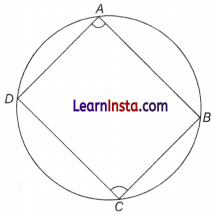
ABCD is a cyclic quadrilateral in which ∠A: ∠C = 4:5. Find the measures of ∠A and ∠C.
Answer:
Given, ABCD is a cyclic quadrilateral and
∠A : ∠C = 4 : 5
Let ∠A = ∠x
and ∠ C = 5x
We know that the sum of opposite angles of a cyclic quadrilateral is 180°.
∠A + ∠C = 180°
On substituting the values,
4x + 5x = 180°
⇒ 9x = 180°
⇒ x = 20°
Now, ∠A = 4x = 4 X 20° = 80°
and ∠C = 5x = 5 x 20° = 100°
Hence, ∠A = 80° and ∠C = 100°
Long Answer Question
Question 1.
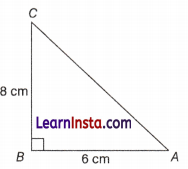
In ∆ABC, AB = 6 cm, BC = 8 cm and ∠B = 90°. Find the circumradius of ∆ABC, and state the exact location of its circumcentre.
Answer:
Since ∠B = 90°, AC is the hypotenuse.
Now, by the Baudhayaha-pythagoras theorem,
AC2 = AB2 + BC2 = 36 + 64 = 100,
⇒ AC = 10 cm
For a right-angled triangle, the circumcentre is the midpoint of the hypotenuse, and the circumradius is half the hypotenuse.
So, circumtadius = \(\frac{10}{2}\) = 5 cm
Hence, the lies at the midpoint of AC.
Question 2.
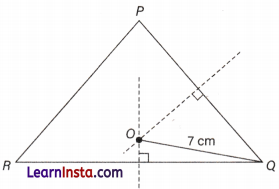
In ∆PQR, the perpendicular bisectors of sides PQ and QR meet at a point O that lies inside the triangle. If OQ = 7 cm, then Analytical, NCERTPg. 96-97
(a) Find OP and OR.
(b) Based on the position of O, State whether ∆PQR is acute-angled, right-angled, or obtuse-angled. Justify your answer.
Answer:
Since O is the point of intersection of the
perpendicular bisectors of PQ and QR, therefore O is the circumcentre of ∆PQR.
So, O is equidistant from the vertices P, Q and R.
OP = OQ = OR
Given, OQ = 7 cm
Hence, OP = 7 cm and OR = 7 cm
Also, O lies inside the triangle. Therefore, A PQR is an acute-angled triangle because the circumcentre of an acute-angled triangle lies inside the triangle.
Question 3.
∆ABC is isosceles with AB = AC. If O is the circumcentre of ∆ABC, prove that O lies on the median drawn from vertex A to side BC.
Answer:
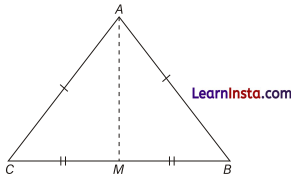
Since, let M be the midpoint of BC, so AM is the median from A.
In ∆ABM and ∆ACM, AB = AC (given),
BM = CM (M is the midpoint),
AM = AM (common).
By SSS congruence, ∆ABM = ∆ACM,
so ∠AMB = ∠AMC.
Since ∠AMB and ∠AMC form a linear pair, 90°.
Therefore, ∠AMB = ∠AMC = 90°
Hence AM ⊥ BC, and since M is also the midpoint of BC, AM is the perpendicular bisector of BC.
The circumcentre O, lies on the perpendicular bisector of every side, including BC.
Question 4.
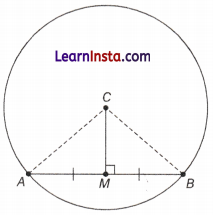
Prove ‘The line joining the centre of a circle and the midpoint of a chord is perpendicular to the chord.’ Provide a diagram, given-to-prove-proof format, and state the congruence criterion used.
Answer:
Given, circle with centre C and Chord AB.
M is the midpoint of AB, so AM = BM.
CM is drawn.
To Prove CM is perpendicular to AB Proof In ∆CMA and ∆CMB,
CA = CB = r (radii of the same circle)
AM = BM [M is midpoint of AB – given)
CM = CM (common side)
By SSS congruence:
⇒ ∠CMA = ∠CMB (corresponding parts of congruent triangles)
But ∠CMA and ∠CMB form a linear pair.
Therefore, ∠CMA = ∠CMB = 90°
Hence, CM ⊥ AB
Hence proved congruence criterion used: SS (side – side – side)
Question 5.
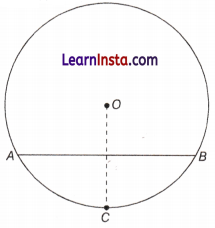
In the figure, O is the centre of a circle and AB is a chord Point. C is the midpoint of arc AB (minor arc). Prove that OC is perpendicular bisector to chord to AB. Use the properties of isosceles triangles and equal arcs/chords in your proof.
Answer:
Given, O is the centre of the circle and AB is a chord.
Also, C is the midpoint of the minor arc AB.
Since C is the midpoint of the minor arc AB,
arc AC = arc CB
Now, equal arcs of a circle subtend equal chords.
AC = CB
Also, OA, OB, and OC are radii of the same circle.
OA = OB = OC
In ∆OAC and ∆OBC,
OA = OB
OC = OC
and AC = CB
Therefore, ∆OAC = ∆OBC
by SSS congruence rule.
Hence, ∠AOC = ∠COB
So, OC bisects ∠AOB.
Now, in AAOB, OA = OB
Thus, AAOB is an isosceles triangle.
In an isosceles triangle, the bisector of the angle between the equal sides is perpendicular to the base and also bisects the base.
Therefore, OC is perpendicular to AB and also bisects AB.
Hence, OC is the perpendicular bisector of chord AB.
Question 6.
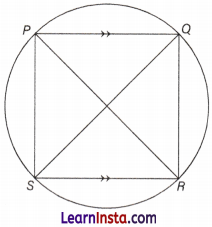
PQRS is a cyclic quadrilateral in which PQ||SR. Prove that PQRS must be an isosceles trapezium and that QS = PR (the diagonals are equal). Justify your answer using the cyclic quadrilateral angle-sum property.
Answer:
Since PQRS is a cyclic quadrilateral,
∠P + ∠R = 180°
Also, PQ || SR and PS is a transversal.
∠P + ∠S = 180°
Hence, ∠P + ∠R = ∠P + ∠S
⇒ ∠R = ∠S
Now, in ∆QRS and ∆PRS,
∠QRS = ∠RSP and RS is common.
Also, equal angles in the same segment give the equal corresponding sides of the trapezium, so
PS = QR
Hence, PQRS is an isosceles trapezium.
Now, in ∆QRS and ∆RSP,
QR = PS
RS = SR
and ∠QRS = ∠RSP
Therefore, by SAS congruence,
∆QRS ≅ ∆RSP
Hence, QS = PR
Thus, PQRS is an isosceles trapezium and its diagonals a
Question 7.
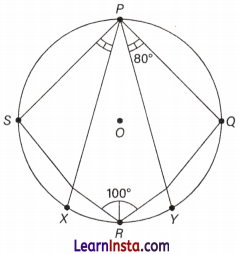
A cyclic quadrilateral PQRS is inscribed in a circle. The internal bisectors of ∠P and ∠R meet the circumcircle again at points X and Y, respectively. If angle ∠P = 80° and ∠R = 100°
(i) verify that the opposite angles are supplementary.
Answer:
Given, PQRS is a cyclic quadrilateral.
Also, ∠P = 80°
and ∠ R = 100°
Now, ∠P + ∠R = 80° +100°
∠P = ∠R = 180°
(ii) find ∠XPQ, ∠YRS, ∠XPS, and ∠QRY.
Answer:
Hence, the opposite angles are supplementary. Since PX is the internal bisector of ∠P,
∠XPQ = ∠XPS = \(\frac{80^{\circ}}{2}\)
⇒ ∠XPQ = ∠XPS = 40°
Also, RY is the internal bisector of ∠R,
∠YRS = ZQRY = =XZ- 2
=> ZYRS =∠QRY = 50°
(iii) hence, verify the required angle relationships.
Answer:
Now, ∠XPQ + ∠QRY = 40° + 50° = 90°
and
∠XPS + ∠YRS = 40° + 50° = 90°
Thus, the required angle relationships are verified.
Case-Based Questions
Question 1.
A landscape designer is laying out a triangular flower bed with three ornamental benches placed at points A, B and C around its boundary. She wants to install a single lamp post at a point that is at an equal distance from all three benches, so that it lights each bench equally at night.
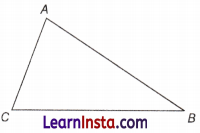
(i) What is the name of the geometric point the designer must locate, and how is it constructed using perpendicular bisectors?
Answer:
The designer must locate the circumcentre of ∆ABC.
The circumcentre is the point of intersection of the perpendicular bisectors of the sides of a triangle.
Also, it is equidistant from all the three vertices.
Hence, the lamp post should be placed at the circumcentre of ∆ABC.
(ii) If the triangle formed by the benches at A, B and C is right-angled at B, where exactly should the designer place the lamp post?
Answer:
If ∆ABC is right-angled at B, then the circumcentre lies at the midpoint of the hypotenuse AC.
Hence, the designer should place the lamp post at the midpoint of AC.
(iii) (a) Suppose AB = 9 m, BC = 12 m and ZB = 90°. Find the distance from the lamp post to each bench.
Answer:
In right ∆ABC,
AB = 9m, BC = 12m and ∠B = 90°
Now, by Pythagoras theorem,
AC2 = AB2 + BC2
= 92 +122 = 81 + 144
⇒ AC = 15 cm
Since the circumcentre of a right triangle lies at the midpoint of the hypotenuse, distance from the lamp post to each bench = radius of circumcircle.
⇒ AC = 15
⇒ Radius = \(\frac{A C}{2}=\frac{15}{2}\) = 7.5
Hence, the distance from the lamp post to each bench is 7.5 m.
OR
(b) If, instead, the triangle formed by the benches were obtuse-angled, would the lamp post fall inside or outside the triangular flower bed? What practical issue might this cause for the designer?
Answer:
If the triangle is obtuse-angled, then the circumcentre lies outside the triangle.
Hence, the lamp post would lie outside the triangular flower bed.
This may cause a practical issue because the lamp post may not be inside the garden area and may not light all benches properly.
Question 2.
A team of archaeologists finds three non-collinear chisel marks A, B and C on the curved boundary of an ancient circular stone wheel. To reconstruct the wheel, they join A, B and C and form triangle ABC. The original circular wheel is the circumcircle of triangle ABC, and its centre is the circumcenter O.
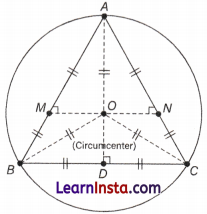
(i) Which point should be located to reconstruct the original circular wheel? How is this point obtained?
Answer:
The point to be located is the circumcenter of triangle ABC.
The circumcenter is the point of intersection of the perpendicular bisectors of the sides of a triangle. Also, it is equidistant from all three vertices of the triangle.
Hence, point O should be located to reconstruct the original circular wheel.
(ii) If the perpendicular bisectors of AB and AC meet at O, prove that OA = OB = OC.
Answer:
Since O lies on the perpendicular bisector of AB,
OA = OB
Also, since O lies on the perpendicular bisector of AC,
OA = OC
Therefore, OA = OB = OC
Hence, O is equidistant from A, B and C.
(iii) (a) If ∠BAC = 50°, find ∠BOC.
Answer:
(a) ∠BAC is an angle subtended by chord BC at the circumference.
Also, ∠BAC is the angle subtended by the same chord BC at the centre.
Now, the angle subtended by an arc at the centre is double the angle subtended by it at any point on the remaining part of the circle.
∠BOC = 2∠BAC = 2 × 50°
⇒ ∠BOC = 100°
Hence, ZBOC = 100°
Or
(b) If triangle ABC is obtuse-angled at A, where will the circumcenter lie? Explain its practical effect in reconstructing the wheel.
Answer:
If triangle ABC is obtuse-angled at A, then its circumceniter lies outside the triangle.
Hence, the centre of the original circular wheel will lie outside triangle ABC, but it will still be the centre of the circumcircle passing through A, B and C.
Question 3.
A Ferris wheel at a fair (mela) has a circular frame with centre O and radius 15 m. Six equally spaced seats A, B, C, D, E, F are on the rim. A support cable ties seats A and D (diametrically opposite). An observer at seat 6 looks at arc AD and measures ∠ABD.
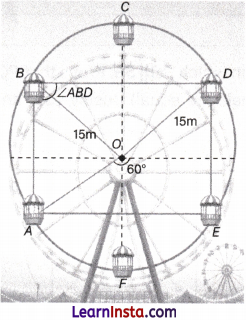
(i) What is the central angle ∠AOB subtended by arc AB? (Hint: 6 equal arcs in 360°)
Answer:
Since six seats are equally spaced on the circular rim, the circle is divided into 6 equal arcs.
Total angle at the centre of a circle is 360°.
∠AOB = \(\frac{360^{\circ}}{6}\)
⇒ ∠AOB = 60°
Hence, the central angle subtended by arc AB is 60°.
(ii) Is AD a diameter? Justify your answer using the number of seats.
Answer:
Since A and D are diametrically opposite points on the circle, AD passes through the centre O.
Hence, AD is a diameter of the circle.
(iii) (a) Find ZABD. Which circle theorem or corollary applies here?
Answer:
Since AD is a diameter and B is a point on the circle, ZABD is the angle in a semicircle.
We know that the angle in a semicircle is a right angle.
∠ABD = 90°
Hence, ∠ABD = 90°.
The corollary used is the angle in a semicircle is 90°.
Or
(b) Find the length of chord AB (the distance between adjacent seats) by using the Baudhayana Pythagoras theorem on the isosceles triangle AOB,
Answer:
In ∆AOB,
OA = OB = 15 m
and ∠AOB = 60°
Now, draw a perpendicular from O to AB, meeting AB at M.
Since OA = OB, ∆AOB is an isosceles triangle.
Therefore, the perpendicular from O to AB bisects AB.
AM = \(\frac{A B}{2}\)
Also, ∠AOM = 30°
In right triangle AOM.
Sin 30° = \(\frac{AM}{OA}\)
On substituting the values, we get
\(\frac{1}{2}\) = \(\frac{AM}{15}\)
⇒ AM = \(\frac{1}{2}\) = 7.5 m
Now, AB = 2AM
⇒ AB = 2 × 7.5
⇒ AB = 15 m
Hence, the distance between two adjacent seats is 15m.
Question 4.
A heritage pond is circular in shape. On the boundary, four bamboo poles are placed at positions P, Q, R, S forming a quadrilateral. From measurements, ∠QPR -40°, ∠QSR = 40°. and ∠PQS = 55°.
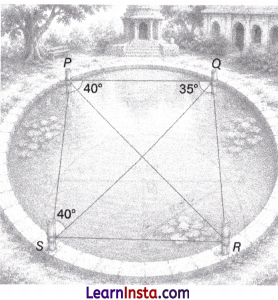
(i) Since ∠QPR – ∠QSR = 40°, what conclusion can you draw? State the theorem used.
Answer:
(i) Since, ∠QPR = ∠QSR = 40°
both angles are subtended by the same chord QR. Hence, angles in the same segment of a circle are equal.
Therefore, P, Q, R, S lie on the same circle.
(ii) If ∠QPR = 40°, find ∠QOR (central angle) where O is the centre of the pond circle.
Answer:
Since the angle subtended by an arc at the centre is double the angle subtended by it at any point on the remaining part of the circle,
∠QOR = ∠QPR
On substituting ∠QPR = 40°, we get
∠QOR = 2 × 40° = 80°
Hence, ∠QOR = 80°
(iii) (a) In cyclic quadrilateral PQRS, if ∠P = 100°, find ∠R.
Answer:
(a) Given, ∠P = 100°
Since PQRS is a cyclic quadrilateral, opposite angles are supplementary
∠P + ∠R = 180°
On putting ∠P = 100°, we get
100° + ∠R = 180°
⇒ ∠R = 180° – 100°
⇒ ∠R = 80°
Hence, ∠R = 80°
OR
(b) If ∠PQS = 55° and ∠SQR = 180°, find ∠PQR and ∠PSR.
Answer:
Given, ∠PQS = 55° and ∠SQR = 35°
Now, ∠PQR = ∠PQS + ∠SQR = 55° + 35°
⇒ ∠PQR = 90°
Also, in cyclic quadrilateral PQRS,
∠PSR + ∠PQR = 180°
On substituting ∠PQR = 90°, we get
∠PSR + 90° = 180°
⇒ ∠PSR = 90°
Hence, ∠PQR = 90° and ∠PSR = 90°.