Students can use Kaveri Class 9 English Book Solutions and Class 9 English Kaveri Book Poem 1 Question Answer Bharat Our Land as a quick reference guide.
Bharat Our Land Poem Class 9 Question Answer
Class 9 English Kaveri Poem 1 Question Answer
Class 9 Kaveri Poem 1 Bharat Our Land Question Answer
Reflect and Respond (NCERT Page 23)
I. Recall the lines of the National Anthem and complete the table given below with the names of the states, mountain ranges, and rivers mentioned in it.
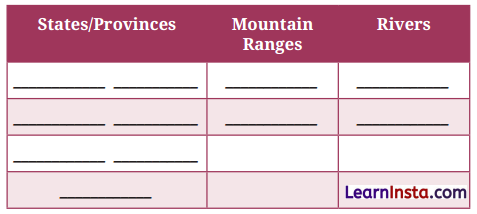
Answer:
States / Provinces Punjab, Sindh, Gujarat, Maharashtra, Dravida (South India), Utkala (Odisha), Banga (Bengal)
Mountain Ranges Vindhya, Himachal (Himalayas)
Rivers Ganga, Yamuna
II. Work in pairs. Discuss what the words ‘जय हे’ (Jaya he) in the last two lines of the National Anthem convey. Share your answer with your classmates and teacher.
Answer:
The last two lines mean that India’s destiny is guided by the Almighty, and the nation’s progress and welfare are protected by divine guidance. They express faith, unity and hope for the country’s future.
III. Read the underlined words in the given lines of the poem. Choose the odd one out that does not correspond with the meaning of the underlined word.
1. She’s peerless, let’s pralise her! valuebale, incomparable, unmatched
Answer: valuable
2. Many a sage has sanctified this land. blessed, purified applauded
Answer: applauded

3. And here all auspicious things are found. fortunate, fantastic, favourable
Answer: fantastic
4. Of hoary antiquity is Bharat, ancient times, recent past, time immemorial
Answer: recent past
Check Your Understanding (NCERT Page 25)
I. Fill in the blanks by choosing appropriate words from the box given below to complete the summary of the poem.
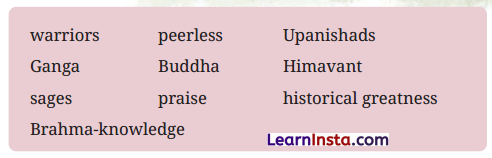
The poem is a tribute to India, celebrating its natural beauty, spiritual heritage, and 1. ________ The poet praises the 2. ________ describing it as mighty and unparalleled. The 3. ________ is depicted as generous and graceful, while the 4. ________ are honoured as sacred and unmatched. The poem highlights the contributions of 5. ________ and 6. ________ who have enriched the land with their bravery and wisdom. It also acknowledges the presence of 7. ________ and the teachings of 8. ________ highlighting India’s deep-rooted spiritual and philosophical traditions. The poet repeatedly asserts that India is 9. ________ urging everyone to 10. ________ her.
Answer:
- historical greatness
- Himavant
- Ganga
- Upanishads
- warriors
- sages
- Brahma-knowledge
- Buddha
- peerless
- praise
II. Complete the following features about the poem.
1. Impact on readers (mood) ________.
Answer:
Patriotic and inspiring
2. Poet’s attitude (tone) ________.
Answer:
Proud and admiring
3. Rhyme scheme ________.
Answer:
No fixed rhyme scheme (free verse)
4. Examples of personification ________.
Answer:
“The generous Ganga”; “This sunny golden land is ours, she’s peerless, let’s praise her!”
III. What is the impact of the refrain, ‘she’s peerless, let’s praise her!’?
Answer:
The refrain repeatedly emphasises India’s greatness and fills readers with pride and admiration, encouraging them to honour and praise the country.
IV. Complete the following sentence appropriately. India is metaphorically described as this sunny golden land’, suggesting ________.
Answer:
that it is rich, prosperous, and glorious
V. The poet uses symbolism. Match the symbols in Column 1 to what they suggest in Column 2.
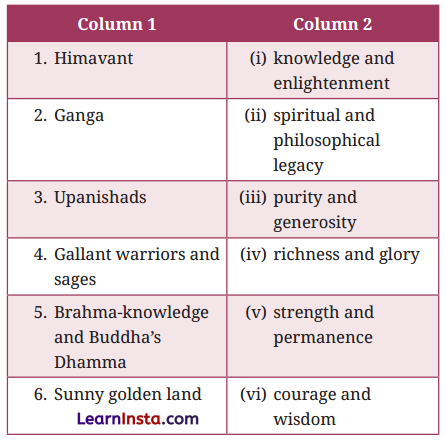
Answer:
| Column 1 | Column 2 |
| 1. Himavant | (v) strength and permanence |
| 2. Ganga | (iii) purity and generosity |
| 3. Upanishads | (ii) spiritual and philosophical legacy |
| 4. Gallant warriors and sages | (vi) courage and wisdom |
| 5. Brahma-knowledge and Buddha’s Dhamma | (i) knowledge and enlightenment |
| 6. Sunny golden land | (iv) richness and glory |
VI. The poet uses imagery (descriptive language to create vivid mental pictures that appeal to the senses). Give any two examples from the poem.
Answer:
Two examples of imagery are
- “The mighty Himavant”
- “The generous Ganga”
VII. What is the impact of the use of hyphens in the first stanza? Select the true options.
1. Creates deliberate pauses to reinforce the sense of admiration and pride
2. Emphasises the contrast between India’s strengths and weaknesses
3. Lends to the lyrical quality, giving it a measured, chant-like rhythm
4. Suggests hesitation or uncertainty in the poet’s claims about India
5. Presents a key element of India’s greatness before the hyphen and makes a strong assertion about its uniqueness after the hyphen
Answer:
The correct options are 1,3 and 5
- The hyphens create pauses that highlight admiration and pride.
- They give the poem a rhythmic, chant-like flow.
- They present India’s greatness first and then strongly emphasise its uniqueness after the hyphen.
IX. The poem is an ode.
An ode is a lyrical poem that expresses deep admiration, praise, or reverence for a person, place, object, or idea. It is often written in an elevated and formal style, celebrating the subject with enthusiasm and emotion.
An ode’s language is often grand and expressive, and it seeks to highlight the extraordinary qualities of its subject.
Now, identify examples from the poem that correspond to it being an ode.
Examples from the poem of an ode are
Answer:
- “The mighty Himavant is ours” – expresses admiration for the Himalayas.
- “The generous Ganga is ours” – praises the sacred river with reverence.
- “The sacred Upanishads are ours” – celebrates India’s spiritual wisdom.
- “This sunny golden land is ours – she’s peerless, let’s praise her!” – shows enthusiasm and pride.
- “Of hoary antiquity is Bharat – she’s peerless, let’s praise her!” – highlights India’s greatness in grand, expressive language.
X. The poet uses allusion in the poem.
Allusion is a literary device where a writer makes an indirect reference to a well-known person, place, event, literary work, or cultural element without explicitly mentioning it. The reader is expected to recognise and understand the reference based on prior knowledge. Allusions can come from mythology, religion, literature, history or popular culture.
For example, he is the real Einstein in mathematics class. (This alludes to Albert Einstein, meaning the student is very intelligent, especially in mathematics or science.)
Now, read the explanations and identify the matching allusions from the poem for the following.
- An allusion to the ancient Indian scriptures that form the philosophical core and symbolise deep wisdom and enlightenment.
- An allusion to the concept of spiritual knowledge associated with self-realisation and ultimate truth.
- An allusion to Gautama Buddha’s teachings, which include compassion, non-violence, and enlightenment. This highlights India’s role in shaping major religious and philosophical traditions.
Answer:
The matching allusions from the poem are
- Ancient Indian scriptures symbolise deep wisdom → “The sacred Upanishads are ours.”
- Spiritual knowledge linked with self-realisation and ultimate truth → “Here Brahma-knowledge has taken root.”
- Gautama Buddha’s teachings → “And the Buddha preached his dhamma here.”
Critical Reflection (NCERT Page 28)
I. Read the extract given below and answer the questions that follow.
- The mighty Himavant is ours; there’s no equal anywhere on earth.
- The generous Ganga is ours; which other river can match her grace?
- The sacred Upanishads are ours; what scriptures else to name with them?
Question 1.
Complete the sentence.
The word ‘mighty’ refers to the ________ of the
Himavant.
Answer:
strength and grandeur
Question 2.
Choose the correct option to complete the sentence given below.
The question mark at the end of the fourth and sixth line of the extract is used to ________.
(i) show doubt and uncertainty
(ii) emphasise a point
(iii) highlight confusion and hesitation
(iv) reveal inquiry and curiosity
Answer:
(ii) emphasise a point
Question 3.
The poet uses the word ‘generous’ to describe the Ganga. Why?
Answer:
The poet uses the word ‘generous’ to describe the Ganga because the river gives life, sustenance, and blessings to the land and its people.
Question 4.
Why has the movement of the river been described as graceful?
Answer:
The river’s movement is described as graceful because it flows smoothly and beautifully, symbolising purity and elegance.
Question 5.
Fill in the blank with the correct option from the words given in the brackets.
The poet is implying that the Upanishads are…………… (unmatched/abundant) in their wisdom and spiritual depth.
Answer:
unmatched
II. Answer the following questions.
Question 1.
How does the poem reflect a strong connection to cultural identity and heritage?
Answer:
The poem reflects a strong connection to cultural identity and heritage by celebrating India’s natural wonders, sacred rivers, ancient scriptures, spiritual traditions, and historical achievements, showing pride in its unique cultural and spiritual legacy.
Question 2.
What can you infer about the poet’s attitude towards India from the repeated phrase ‘she’s peerless, let’s praise her’?
Answer:
The repeated phrase shows the poet’s deep admiration and pride for India. By calling the nation ‘peerless’, the poet expresses the belief that no other country equals its beauty, culture, and spiritual heritage. The call to ‘praise her’ encourages readers to respect, honour, and feel patriotic towards their motherland.
Question 3.
What does the line ‘many a sage has sanctified this land’ suggest about India’s spiritual heritage?
Answer:
The line suggests that India has long been a sacred land blessed by great sages and spiritual leaders. Their teachings, wisdom, and devotion have enriched the country’s traditions and values. It highlights India as a centre of spirituality where deep philosophical and religious knowledge has flourished for centuries.
Question 4.
How does the poet connect warriors and music to India’s greatness?
Answer:
The poet connects warriors and music to India’s greatness by highlighting the courage, valour, and artistic achievements of the nation, showing that both heroism and culture contribute to its enduring glory.
Question 5.
How does this poem foster a sense of national pride?
Answer:
The poem fosters a sense of national pride by celebrating India’s natural beauty, spiritual wisdom, heroic history and cultural achievements. By repeatedly calling the land ‘ours’ and ‘peerless’, the poet creates a strong sense of belonging. Readers feel inspired to admire, respect and honour their country and its glorious heritage.
Vocabulary in Context (NCERT Page 29)
I. Complete the table by choosing words from the poem.
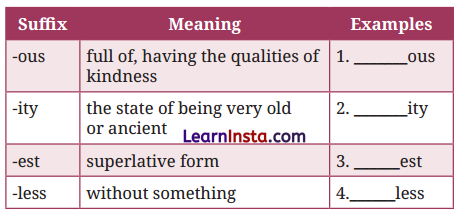
Answer:
- generous
- antiquity
- mightiest
- peerless
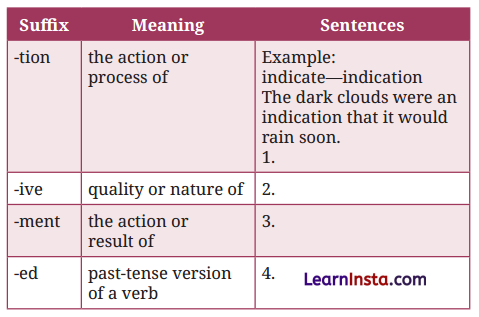
II. Complete the following table by adding a different suffix to form new words. Also, create a sentence using the created word. One example has been done for you.
Answer:
- Education: Education is important for a bright future.
- Creative: She gave a creative answer to the project.
- Achievement: Winning the medal was a great achievement for him.
- Praised: The teacher praised the student for her hard work.
Writing Task (NCERT Page 32)
I. Write a paragraph about a place that you have visited which has stayed in your memory.
Remember to mention the following
- Why did you go there?
- Who did you travel with?
- How did you prepare for the travel?
- Where did you stay?
- What activities did you do there?
Answer:
Last summer, I visited Jaipur with my family during our holidays. We planned the trip to explore the historical places and experience the rich culture of Rajasthan. Before travelling, we booked our hotel, packed light cotton clothes, and made a list of famous places to visit. We stayed in a beautiful heritage hotel that reflected traditional Rajasthani architecture.
During the trip, we visited Amber Fort, Hawa Mahal, and City Palace. We also enjoyed local food and bought handicrafts from the markets. The highlight of the trip was the evening at Nahargarh Fort, where we watched the sunset. This journey remains special because it was full of learning, fun, and memorable family time.