Each of our Ganita Manjari Class 9 Worksheet and Class 9 Maths Chapter 4 Exploring Algebraic Identities Worksheet with Answers focuses on conceptual clarity.
Class 9 Exploring Algebraic Identities Worksheet
Ganita Manjari Class 9 Chapter 1 Worksheet
Multiple Choice Questions
Question 1.
For real numbersp and q, p + q = -6 and pq = 7.
The value of p2 + q2 is
(a) 22
(b) 29
(c) 43
(d) 50
Answer:
(a) 22
Given, p + q = -6 and pq = 7
By using identity, (p + q)2 = p2 + q2 + 2pq
⇒ p2 + q2 =(p + q)2 – 2pq
⇒ p2 + q2 = (-6)2 – 2(7)
⇒ p2 + q2 = 36 – 14 = 22
Question 2.
If a + b = 13 and a – b = 5, then the value of 4ab is
(a) 94
(b) 124
(c) 144
(d) 169
Answer:
(c) 144
Given, a + b = 13 and a – b = 5.
By using identities, (a + b)2 = a2 + b2 + 2ab
and (a – b)2 = a2 + b2 -2ab
⇒ (a + b)2 – (a-b)2 = 4ab
⇒ 4ab = 132 – 52
⇒ 4ab = 169 – 25
⇒ 4ab = 144
Question 3.
Without direct multiplication, 9972 can be most efficiently written as
(a) 10002 – 32
(b) 10002 – 2(1000)(3) +32
(c) 900 2 + 972
(d) (990 + 7) (990 – 7)
Answer:
(b) 10002 – 2(1000)(3) +32
We have, 9972.
Here, 997 = 1000 – 3
By using identity, (a – b)2 = a2 – 2ab + b2
⇒ 9972 = (1000 – 3)2
⇒ 9972 = (1000 – 3)2 + 32
Question 4.
If (m+ n)2 -(m-n)2 = 64, then mn equals
(a) 8
(b) 12
(c) 16
(d) 32
Answer:
(c) 16
Given, (m + n)2 -(m – n)2 = 64.
By using identities, (m + n)2 = m2 + n2 + 2mn.
and (m-n)2 = m2 + n2 – 2mn
⇒ (m + n)2 – (m – n)2 = 4mn
⇒ 4 mn = 64
⇒ mn = 16

Question 5.
For any three consecutive integers n-1, n and n+1. If the sum of the squares of the first and third integers is decreased by twice the square of the middle integer, then the value of this result is
(a) 0
(b) 1
(c) 2
(d) 2n
Answer:
(c) 2
Given that the three consecutive integers are n-1, n and n + 1.
According to the given statement,
Required result = (n -1)2 + (n + 1)2 – 2n2
[∵ v (a + b)2 = a2 + b2 + 2ab (a-b)2 = a2 + b2 – 2ab] =
= (n2 – 2n + 1) + (n2 + 2n + 1) – 2n2
= 2n2 + 2 – 2n2 = 2
Question 6.
If a + b + c = 10 and a2 + b2 + c2 = 35,then ab + bc + ca equals
(a) 24
(b) 27
(c) 31
(d) 38
Answer:
(c) 31
Given, a + b +c = 10 and a2 + b2+ c2 = 38
By using identity,
(a + b + c)2 = a2 + b2 + c2 + 2(ab + be + ca)
⇒ 102 = 38 + 2(ab + be + ca)
⇒ 100 = 38 + 2(ab + be + ca)
⇒ 2(ab + be + ca) = 62
⇒ ab + bc + ca = 31
Question 7.
If A = 10023 – 9983, then A is equal to
(a) 12000016
(b) 12000004
(c) 11999992
(d) 8000000
Answer:
(a) 12000016
Given, A = 10023 – 9983.
By using identity,
a3 – b3 = (a – b)(a3 + ab + b3)
⇒ A = (1002 – 998) (10022 + 1003 × 998 + 9982)
⇒ A = 4 (1004004 + 999996 + 996004)
⇒ A = 4(3000004)
⇒ A = 12000016
Question 8.
Factorise 10pr – 5ps + 6qr – 3qs
(a) (5p + 3q)(2r – s)
(b) (5p – 3q) (2r + s)
(c) (2p + 3g)(5r – s)
(d) (p + 7)(10r – 5s)
Answer:
(a) (5p + 3q)(2r – s)
We have, 10pr – 5ps + 6 qr – 3qs
Group the terms suitably.
10pr – 5ps + 6qr – 3qs = (10pr – 5ps) + (6qr – 3qs)
= 5p(2r – s) + 3q(2r – s)
⇒ = (5p + 3q) (2r – s)
Question 9.
The expression x2 + 2(k – 3)x + (k – 3)2 is always factorised as
(a) (x + k -3)2
(b) (x + K – 3)2
(c) (x + k + 3)2
(d) (x – k – 3)2
Answer:
(a) (x + k -3)2
We have, x2 + 2(k – 3)x + (k – 3)2
By using identity, a2 + 2ab + b2 = (a + b)2
Here, a = x and b = k – 3.
On substituting the values of a and b in the identity, we get
x22 + 2(k – 3)x + (k – 3)2 = (x + k- 3)2
Question 10.
If 75p2 -60pg + 12g2 is written K(αp -(βp)2, then k + α + β equals
(a) 8
(b) 10
(c) 12
(d) 15
Answer:
(b) 10
Given, 75p2 – 60pq + 12q2 = k(αβ – βq)2
Take out common factor 3.
75p2 – 60pq + 12q2 = 3(25p2 – 20pq + 4q2)
⇒ 75p2 – 60pqr + 12q2 = 3(5p – 2g)2
[∵ (a – b)2 = a2 + b2 – 2ab]
So, k = 3, α = 5 and β = 2
⇒ k + α + β = 3 + 5 + 2 = 10
Question 11.
The expression 49a2 – (3b – 2c)2 is equal to AppIicati
(a)(7a – 3b – 2c)(7a + 3b – 2c)
(b)(7a – 3b + 2c)(7a + 3b – 2c)
(c)(49a – 3b + 2c)(a + 3b – 2c)
(d)(7a – 3b + 2c)2
Answer:
(b)(7a – 3b + 2c)(7a + 3b – 2c)
We have, 49a2 – (3b – 2c)2
By using identity, A2 – B2 = (A – B) (A + B)
Here, A = 7a and B = 3b – 2c.
49a2 – (3b – 2c)2 = [7a – (3b – 2c)] [7a + (3b – 2c)]
⇒ 49a2 – (3b – 2c)2 = (7a – 3b + 2c) (7a + 3b – 2c)
Question 12.
If x2 – 2x – 35 = (X + a)(x + b), then |a – b| is
(a) 3
(b) 5
(c) 9
(d) 12
Answer:
(d) 12
Given, x2 – 2x – 35 = (x + a)(x + b)
We need two numbers, whose sum is -2 and product is -35.
The required numbers are 5 and -7.
∴ x2 – 2x – 35 = (x + 5) (x – 7)
So, a = 5 and b = -7.
Now, |a – b| = |5 – (-7)| = 12
Question 13.
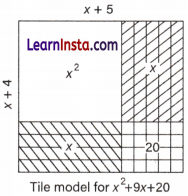
The given algebra-tile arrangement represents which factorisation?
(a) x2 + 9x + 20 = (x + 5)(x + 4)
(b) x2 + 9x + 20 = (x + 9)(x + 20)
(c) x2 + 9x + 20 = (x + 2)(x + 10)
(d) x2 + 9x + 20 = (x + 1)(x + 20)
Answer:
(a) x2 + 9x + 20 = (x + 5)(x + 4)
Given, the tile model contains one x2 -tile, 9x-tiles and 20 unit tiles with side lengths (x + 4) and (x + 5).
The unit tiles form a 5 x 4 rectangle.
So, the dimensions are x + 5 and x + 4.
⇒ x2 + 9x + 20 = (x + 5)(x + 4)
Question 14.
In simplifying (x2 – 10x + 24) / (x2 – 36), which values must still be excluded after cancellation of
a common factor?
(a) x = 4 only
(b) x = 6 only
(c) x = -6 only
(d) x = ± 6
Answer:
(d) x = ± 6
We have, (x2 – 10x + 24) /(x2 – 36)
Factorising numerator and denominator, we get
Numerator, x2 – 10x + 24 = x2 – 6x – 4x + 24
= x(x – 6) – 4(x – 6) = (x – 4) (x – 6)
Denominator, x2 – 36 = x2 – 62 = (x – 6) (x + 6)
[∵ a2 – b2 = (a + b) (a – b)]
⇒ \(\frac{\left(x^2-10 x+24\right)}{\left(x^2-36\right)}=\frac{(x-4)(x-6)}{(x-6)(x+6)}\)
The original denominator is zero if x = 6 and x = -6
So, both values must be excluded even after cancellation.
Assertion-Reason Questions
Direction (Q,Nos. 1-5) Select the correct option from (a), (b), (c), (d) as given below.
(a) Both A and R are true and R is the correct explanation of A.
(b) Both A and R are true but R is not the correct explanation of A.
(c) A is true but R is false.
(d) A is false but R is true.
Question 1.
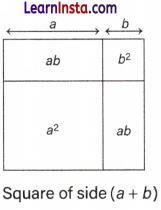
Assertion (A) In the given figure, the area of the two rectangles together is equal to the area of the outer square minus the areas of the two inner squares.
Reason (R)(a + b)2 – a2 – b2 = 2ab
Answer:
(a) Both A and R are true and R is the correct explanation of A.
Given, the outer square has area (a + b)2 and the two inner squares have areas a2 and b2.
The remaining two rectangles have total area
= ab + ab = 2ab
⇒ (a + b)2 – a2 – b2 = 2ab
[∵ (a + b)2 = a2 + b2 + 2 ab]
So, both Assertion and Reason are true, and Reason correctly explains Assertion.
Question 2.
Assertion (A)(p + q + r)2 – (p + q – r)2 = 4r (p + q).
Reason (R) For all real A and B, A2 – B2 = (A + B)(A – B).
Answer:
(a) Both A and R are true and R is the correct explanation of A.
Let A = p + q + r and B = p + q – r.
By using identity, A2 – B2 = (A + B) (A – B)
⇒ A + B = 2 (p + q) and A – B = 2r
⇒ (p + q + r)2 – (p + q – r)2 = 2(p + q) x 2r
⇒ (p + q + r)2 – (p + q – r)2 = 4r(p + q)
So, Reason correctly explains Assertion.
Question 3.
Assertion (A) If u + [/latex]\frac{1}{u}[/latex] = 5 and u ≠ 0,then u3 + \(\frac{1}{u^3}\) = 110.
Reason (R) For any u and v,(u + v)3 = u3 + v3 + 3uv(u + v).
Answer:
(a) Both A and R are true and R is the correct explanation of A.
Given, u + \(\frac{1}{u}\) = 5 and u ≠ 0.
By using identity, (a + b)3 = a3 + b3 + 3ab(a + b)
Then, \(\left(u+\frac{1}{u}\right)^3=u^3+\frac{1}{u^3}+3(u)\left(\frac{1}{u}\right)\left(u+\frac{1}{u}\right)\)
⇒ 53 = u3 + \(\frac{1}{u^3}\) + 3(5)
⇒ 125 = u3 + \(\frac{1}{u^3}\) + 15
⇒ u3 + \(\frac{1}{u^3}\) = 110
So, both Assertion and Reason are true, and Reason correctly explains Assertion.
Question 4.
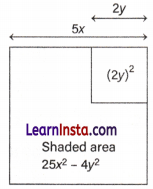
Assertion (A) The shaded region can be factorised as 25x2 -4y2 =(5x -2y)(5x + 2y).
Reason (R) The area left after removing a square of side 2y from a square of side 5x is a difference of two squares.
Answer:
Given, a square of side 2y is removed from a square of side 5x.
Area of shaded region = (5x)2 – (2y)2.
= 25x2 – 4y2
By using identity, a2 – b2 = (a – b)(a + b).
25x2 – 4y2 = (5x – 2y)(5x + 2y)
So, both Assertion and Reason are true, and Reason correctly explains Assertion.
Question 5.
Assertion (A) In \(\frac{\left(x^2-7 x+12\right)}{\left(x^2-5 x+4\right)}\) cancelling (x-4) is vahd only when
x ≠ 4.
Reason (R) A common factor in a rational expression can be cancelled only if that factor is non-zero.
Answer:
(a) Both A and R are true and R is the correct explanation of A.
We have, \(\frac{\left(x^2-7 x+12\right)}{\left(x^2-5 x+4\right)}\)
On factorising, we get
\(\frac{\left(x^2-7 x+12\right)}{\left(x^2-5 x+4\right)}=\frac{x^2-3 x-4 x+12}{x^2-x-4 x+4}\)
= \(\frac{x(x-3)-4(x-3)}{x(x-1)-4(x-1)}=\frac{(x-3)(x-4)}{(x-1)(x-4)}\)
The factor (x — 4) can be cancelled only, when x – 4 ≠ 0
⇒ x ≠ 4
So, both Assertion and Reason are true, and Reason correctly explains Assertion.
Class 9 Maths Exploring Algebraic Identities Worksheet
Worksheet On Exploring Algebraic Identities Class 9
Very Short Answer Questions
Question 1.
Find the value of x, if(x + 1)2 = 49.
Answer:
Given, (x + 1)22 = 49
⇒ x2 + 1 + 2x = 49
[∵ (a + b)2 = a2 + b2 + 2ab]
⇒ x2 + 2X = 48
⇒ x2 + 2x – 48 = 0
⇒ x2 + 8x – 6x – 48 = 0
⇒ x[x + 8) – 6(x + 8) = 0
⇒ (x + 8) (x – 6) = 0
⇒ x = + 6 or -8
Question 2.
State in one sentence how an algebraic identity difference from an algebraic equation.
Answer:
An algebraic identity is true for all admissible values of the variables, while an algebraic equation may be true only for some particular values.
Question 3.
If x + \(\frac{1}{x}\) = 5 and x ≠ 0, find x2 \(\frac{1}{x^2}\)
Answer:
Given, x + \(\frac{1}{x}\) = 5 and x ≠ 0.
On squaring both sides, we get
⇒ \(\left(x+\frac{1}{x}\right)^2=5^2\)
⇒ x2 + 2 + \(\frac{1}{x^2}\) = 25
[∵(a + b)2 = a2 + b2 + 2ab]
⇒ x2 + \(\frac{1}{x^2}\) = 23
Question 4.
Fill the missing term :(2x + 3 y)2 = 4x2 +… + 9y2.
Answer:
We have, (2x + 3y)2 = 4x2 +… + 9y2
By using identity, (a + b)2 = a2 + 2ab + b2
Here, a = 2x and b = 3y
∴ Middle term = 2ab = 2(2x)(3y) = 12xy
Question 5.
If x – 2 = \(\frac{1}{5x}\), then find the value of x2 + \(\frac{1}{25 x^2}\)
Answer:
We have, x – 2 = \(\frac{1}{5 x}\)
⇒ x – \(\frac{1}{5 x}\) = 2
On squaring both sides, we get
⇒ \(\left(x-\frac{1}{5 x}\right)^2=2^2\)
Using the identity (a – b)2 = a2 + b2 – 2ab, we get
⇒ \(x^2+\frac{1}{25 x^2}-2 \cdot x \cdot \frac{1}{5 x}=4\)
⇒ \(x^2+\frac{1}{25 x^2}=4+\frac{2}{5}=\frac{22}{5}\)
Question 6.
If (a + b + c)2 = 100 and a2 + b2 + c2 = 46, find ab + bc + ca.
Answer:
Given, (a + b + c))2 = 100 and a)2 + b)2 + c)2 = 46
By using identity, {a + b + c))2 = a)2 + b)2 + c)2 + 2 (ab + be + ca)
⇒ 100 = 46 + 2 (ab + be + ca)
⇒ 2 (ab + be + ca) = 54
⇒ ab + be + ca = 27
Question 7.
Fill the missing term: x2 – 18x + … = (x – …)2
Answer:
We have, x2 – 18x +… = (x – …)2
By using identity, (a – b)2 = a2 – 2ab + b2
Here, a = x and 2ab = 18x
⇒ b = 9
∴ (x – 9)2 = x2 – 2(x)(9) + 92
= x2 – 18x + 81
So, x2 – 18x + 81 = (x – 9)2.
Hence, the missing terms are 81 and 9.
Question 8.
Factorise:9x2 – 12xy + 4y2.
Answer:
We have, 9x2 – 12xy + 4y2
Here, 9x2 = (3x)2, 4y2 = (2y)2 and 12xy = 2(3x)(2y)
By using identity, (a – b)2 = a2 + b2 – 2ab
9x22 – 12xy + 4y2c = (3x – 2y)2
Question 9.
Factorise 9x2 – 144y2.
Answer:
We have, 9x2 – 144y2c
It can be written as (3x)2 – (12y)2.
By using identity, a2 – b2 = (a – b)(a + b)
⇒ (3x)2 – (12y)2 = (3x – 12y) (3x + 12y)
= 3(x – 4y) 3(x + 4y) = 9(x – 4y) (x + 4y)
Question 10.
Give possible length and breadth of a rectangle whose area is x2 + 11x + 24 square units.
Answer:
Given, area of rectangle = x2 + 11x + 24
We need two numbers whose sum is 11 and product is 24.
The numbers are 3 and 8,
x2 + 11x + 24 = x2 + 3x + 8x + 24 = (x + 3)(x + 8)
So, possible length and breadth are x + 3 and x + 8 units.
Question 11.
Write the two numbers needed to split the middle term of x2 14x + 48.
Answer:
14. Given, x2 – 14x + 48
We need two numbers, whose sum is -14 and product is 48.
The required numbers are -6 and -8.
⇒ -6 + (-8) = -14 and (-6)(-8) = 48.
Question 12.
If x – 3 is a factor of x2 + px -18, find P.
Answer:
Given, x – 3 is a factor of x2 + px -18
So, x = 3 makes the polynomial zero.
∴ 32 + 3p -18 = 0
⇒ 9 + 3p – 18 = 0
⇒ 3p – 9 = 0
⇒ 3p = 9
⇒ p = 3
Section C: Short Answer Questions
Question 1.
If 2x – 5y = 5 and xy = 8, then find the value of 8x3 -125y3.
Answer:
We have, 2x – 5y = 5 …(i)
and xy = 8 …(ii)
On cubing both sides of Eq. (i), we get
(2x – 5y)3 = 53
⇒ 8x3 – 125y3 – 3(2x)(5y)(2x – 5y) = 125
[∵(a – b)3 = a3 – b3 – 3ab (a – b)]
⇒ 8x3 – 125y3 – 30xy (2x – 5y) =125
⇒ 8x3 – 125y3 – 30(8)(5) = 125
[from Eq (i) and (ii]
∴ 8x3 – 125y3 = 125 + 1200 = 1325
Question 2.
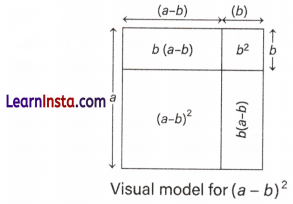
In the given figure, express the area of the remaining small square in terms of the large square and the removed Strips.
Answer:
Given, a square of side a is divided so that the
remaining small square has side a – b.
Area of large square = a2.
The removed parts have areas b2 and 2b(a — b).
Area of remaining square = a3 – b2 -2b(a – b)
⇒ (a – b)2 = a2 – b2 – 2ab + 2b2
⇒ (a – b)2 = a2 – 2ab + b2
Question 3.
Evaluate 503 × 497 by using suitable identity and also write the identity.
Answer:
We have, 503 × 497.
Write 503 = 500+3 and 497 = 500 -3.
By using identity, (a + b)(a – b) = a2 – b2
⇒ 503 × 497 = (500 + 3) (500 – 3)
⇒ 503 × 497 = 5002 – 32
⇒ 503 × 497 = 250000 – 9
∴ 503 × 497 = 249991
Question 4.
Evaluate 1003 – 9983, using a suitable identity.
Answer:
We have, 10023 – 9983.
By using identity, a3 – b3 = (a – b) (a2 + ab + b2)
⇒ 10023 – 9983 = (1002 – 998)
(10022 + 1002 × 998 + 9982)
= 4(1004004 + 999996 + 996004)
= 4(3000004)= 12000016
Question 5.
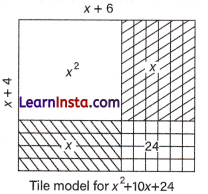
By reading the given tile model, factorise x2 + 10x + 24.
Answer:
Given, the area polynomial is x2 + 10x + 24.
From the tile model, 24 unit tiles are arranged as 6 × 4.
So, 10x is split as 6x + 4x.
= x2 + 10x + 24
= x2 + 6x + 4x + 24
= x(x + 6) + 4(x + 6) = (x + 6)(x+ 4)
Question 6.
Factorise completely: 4x2 – 20xy + 25y2 – 9z2.
Answer:
Given, 4x2 – 20xy + 25y2 – 9z2.
The first three terms form a perfect square.
4x2 – 20xy + 25y2
= (2x – 5y)2
[∵ (a – b)2 = a2 + b2 – 2ab]
So, the expression becomes
⇒ (2x – 5y)2 – (3z)2
By using identity, a2 – b2
= (a – b)[a + b).
⇒ (2x – 5y – 3z)(2x – 5y + 3z)
Question 7.
Factorise 4x2 + 4x(y + z)+ (y + z)2 – 9z2
Answer:
Given, 4x2 + 4x(y + z) + (y + z)2 – 9z2
The first three terms form a perfect square.
4x2 + 4x(y + z) + (y + z)2 = [2x + (y + z)]2
[∵ (a + b)2 = a2 + b2 + 2ab]
So, the expression becomes
⇒ [2x + y + z]2 – (3z)2
By using identity, a2 – b2 = (a – b)[a + b)
⇒ (2x + y + Z)2 -(2Z)2 = (2x + y + z – 3z)
(2x + y+ z + 3z)
⇒ = (2x + y – 2z) (2x + y + 4z)
Question 8.
Using the identity x3 + y3 + z3 – 3xyz = (x + y + z)(x2 + y2 + z2 – xy – yz – zx) factorise x3 + y3 — (x + y)3.
Answer:
Given, x2 + y2 -(x + y)2
Let z = -(x + y)
Then, x + y + z = x + y – (x + y) = 0
By using identity, x3 + y3 + z3 – 3xyz
= (x + y + z) (x2 + y2 + z2 – xy – yz – xz)
when x + y + z = 0, x3 + y3 + z3 = 3xyz
⇒ x3 + y3 – (x + y)3 = 3xy[-(x + y)]
⇒ x3 + y3 – (x + y)3 = -3xy(x + y)
Question 9.
Simplify \(\frac{\left(x^2-5 x+6\right)}{\left(x^2-9\right)}\) stating restrictions.
Answer:
Given, \(\frac{\left(x^2-5 x+6\right)}{\left(x^2-9\right)}\)
On factorising numerator and denominator, we get
\(\frac{\left(x^2-5 x+6\right)}{\left(x^2-9\right)}=\frac{\left(x^2-3 x-2 x+6\right)}{\left(x^2-9\right)}\)
[∵ a2 – b2 =(a – b)[a + b)]
= \(\frac{(x-2)(x-3)}{(x-3)(x+3)}\)
Since, the original denominator is zero, when
x = 3 or x = -3, restrictions are x ≠ 3, -3.
Cancelling (x – 3), we get
\(\frac{\left(x^2-5 x+6\right)}{\left(x^2-9\right)}=\frac{(x-2)}{(x+3)}\)
where x ≠ 3, – 3.
Section D: Long Answer Questions
Question 1.
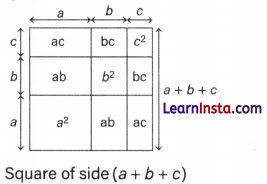
Using the given geometrical model, derive the identity
(a + b + c)2 = a2 + b2 + c2 + 2ab + 2bc + 2ca
Answer:
Given, a square of side a + b+c is divided into smaller squares and rectangles.
Area of the outer square = (a + b + c)2.
Now, the three square regions have areas a2, b2 and c2.
Also, the rectangular regions occur in pairs with areas ab, be and ca.
∴ Total rectangular area = 2ab + 2be + 2ca
Now, area of outer square = Sum of all inner parts
⇒ (a + b + c)2 = a2 + b2 + c2 + 2ab + 2be + 2ca
Question 2.
If a2 + b2 + c2 = 35 and (a – b)2 +(b – c)2 +(c – a)2 = 24,find(a + b + c)2.
Answer:
Given, a2 + b2 + c2 = 35
and (a – b)2 + (b – c)2 + (c – a)2 = 24.
(a – b)2 + (b – c)2 + (c – a)2
= 2(a2 + b2 + c2 – ab – be – ca)
[∵(A – B)2 = A2 + B2 -2AB]
On substituting the values of a2 + b2 + c2 and
(a – b)2 + (b – c)2 +(c – a)2, we get
⇒ 24 = 2(35 – ab – bc – ca)
⇒ 12 = 35 – (ab + be + ca)
⇒ ab + be + ca = 23
Now, (a + b + c)2 = a2 + b2 + c2 + 2(ab + be + ca)
⇒ (a + b + c)2 = 35 + 2(23)
⇒ (a + b + c)2 = 81
Question 3.
Evaluate
(i) (999)3 + 3(999)2 + 3(999) + 1
(ii) (101)3 – 3(101)2 + 3(101) – 1
by identifying the suitable identity.
Answer:
(i) We have, (999)3 + 3(999)2 + 3(999) + 1
This matches the identity,
a3 + 3a2b + 3ab2 + b3 = (a + b)3.
Here, a = 999 and b = 1
⇒ 9993 + 3(999)2 + 3(999)+ 1 = (999 + 1)3
⇒ 9993 + 3(999)2 + 3(999) + 1 = 10003
⇒ 9993 + 3(999)2 + 3(999) + 1 = 1000000000
(ii) We have, (101)3 – 3(101)2 + 3(101) – 1
This matches with the identity,
a3 – b3 – 3a2b + 3ab2 = (a – b)3.
Here, a = 101 and b = 1
⇒ (101)3 – (1)3 – 3(101)2(1) + 3(101)(1)2
⇒ 1030301 – 1 – 30603 + 303
⇒ 1030604 – 30604
⇒ 1000000 = (100)3
Question 4.
Find all positive integer values of q < 40 for which x2 + 13x + q can be factorised into two distinct
linear factors with positive integer constants.
Answer:
Let x2 + 13x + q = (x + a)(x + b),
where a and b are distinct positive integers.
On expansion, we get
⇒ (x + a)(x + b) = x2 + (a + b)x + ab
On comparing with x2 + 13x + q, we get
⇒ a + b = 13 and ab = q
Now, distinct positive integer pairs with sum 13 are (1,12), (2,11), (3,10), (4, 9), (5, 8), (6, 7).
Their products are 12, 22, 30, 36, 40 and 42 respectively.
Since q < 40, the possible values are 12, 22, 30 and 36.
Hence, q = 12, 22, 30, 36
Question 5.
Find the value of a, if (x – 4) is the common factor of x2 – 9x + a and x2 – ax + 64.
Answer:
Given, x – 4 is a common factor of x2 – 9x + a and x2 – ax + 64.
So, x = 4 must make both expressions zero.
For x2 – 9x + a, we have
⇒ 42 – 9(4) + a = 0
⇒ 16 – 36 + a = 0
⇒ a = 20
For x2 – ax + 64, we get
⇒ 42 – 4a + 64 = 0
⇒ 80 – 43 = 0
⇒ a = 20
Hence, the required value of a is 20.
Question 6.
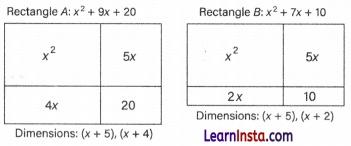
Rectangle A and Rectangle B are represented by the given area models.
Given, Rectangle A has area x2 + 9x + 20 and Rectangle 6 has area x2 + 7x +10.
(i) Factorise the area expression of each rectangle.
Answer:
Factorising both areas, we get
Area A = x2 + 9x + 20
= x2 + 5x + 4x + 20
= x(x + 5) + 4(x + 5)
= (x + 5)(x + 4)
⇒ Area B = x2 + 7x + 10
= x2 + 5x + 2x + 10
= x(x + 5) + 2(x + 5)
= (x + 5)(x + 2)
(ii) Simplify the ratio Area A : Area B.
Answer:
Ratio
Area A: Area B = (x + 5)(x + 4): (x + 5)(x + 2).
= (x + 4) :(x + 2)
(iii) State the restrictions on x before cancellation.
Answer:
Before cancellation, x + 5 ≠ 0 and x + 2 ≠ 0.
⇒ x ≠ -5, -2
Cancelling the common factor, we get
⇒ Area A: Area B = (x + 4) :(x + 2)
(iv) Find the simplified ratio, when x = 6.
Answer:
For x = 6
Ratio = (6 + 4): (6 + 2) = 10 :8 = 5: 4.
Because the ratio of Rectangle A and Rectangle B is 5 : 4.
Therefore, Rectangle A has the greater area.
Question 7.
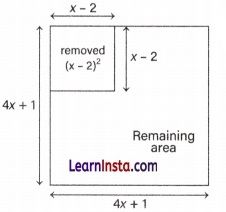
A small square of side x – 2 is removed from a large square of side 4x + 1.
(i) Write the remaining shaded area as a difference of two squares.
Answer:
Given, large square side = 4x + 1 and removed square side = x – 2.
Remaining shaded area
= large square area – removed square area
=(4x + 1)2 – (x – 2)2
(ii) Factorise it completely.
Answer:
By using identity, a2 – b2 = (a – b)[a + b)
⇒ (4x + 1)2 – (x – 2)2 = [(4x + 1) – (x – 2)] [(4x + 1) + (x – 2)]
= (3x + 3)(5x -1)
= 3(x + 1)(5x -1)
(iii) Interpret the factors as possible dimensions of a rectangle.
Answer:
Possible rectangle dimensions are 3x + 3 and 5x -1.
(iv) State the condition on x so that all lengths are positive.
Answer:
For all lengths to be positive, x-2 > 0 and 4x + 1 > 0.
⇒ x > 2
Section E: Case-Based Questions
Question 1.
A square garden has side (a + b) metre. The garden is divided into four parts: One square of area a2, another square of area b2, and two identical rectangular lawns, each of area ab.
(i) Write the total area of the garden by adding the area of all four parts.
Answer:
Given, Area of first square = a2
Area of second square = b2
Area of each rectangle = ab
(i) Since these are two such rectangles,
Total area = a2 + ab + ab + b2
= a2 + 2ab + b2
(ii) Derive the identity (a + b)2 = a2 + 2ab + b2.
Answer:
The garden itself in a square of side (a + b).
Therefore, its area is (a + b)2.
From part (i), the same area equal to
a2 + 2 ab + b2
Since, both experssion represent the area of the same square
{a + b)2 = a2 + b2 + 2ab
Here, the identity is proved.
(iii) If a = 12 m and b = 8m, find the total area of garden using the identity.
Answer:
Given, a = 12 m and b = 8 m.
Using the identity, (a + b)2 = a2 + 2ab + b2
Substitute a = 12 and b = 8, we get
(12 + 8)2 = (12)2 + 82 + 2 × 12 × 8
(20)2 = 144 + 64 + 192
400 = 400
Therefore, the total area of the garden is 400 m2.
Question 2.
Zero-Sum Identity Three coded numbers p, q and r are placed on a balance so that p + q + r = 0. The product pqr is 18 and p2 + q3 + r3 = 21.
(i) Find p3 + q3 + r3.
Answer:
Since, p + q + r = 0 , therefore,
p3 + q3 + r3 = 3 pqr
∵(x + y + z)(x2 + y2 + z2 – xy – xz – yz)
= x3 + y3 + z3 – 3xyz
x3 + y3 + z3
= 3xyz
⇒ p3 + q3 + r3 = 3(18) = 54
(ii) Find pq + qr + rp.
Answer:
Using identity, (p + q + r)2
= p2 + q2 + r2 + 2(pq + qr + rp)
On substituting p + q + r = 0 and
p2 + q2 + r2 = 21 in above equation, we get
⇒ 02 = 21 + 2(pq + qr + rp)
⇒ pq + qr + rp = \(\frac{-21}{2}\)
(iii) Find p3 + q3 + r3 – 3pqr.
Answer:
p3 + q3 + r3 – 3pqr = 54 – 3(18) = 0
[ from (i) and pqr = 18 (given)]
Question 3.
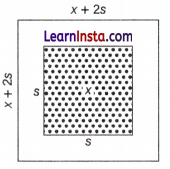
Path Around a Square Garden A path of uniform width s surrounds a square garden of side x. The outer square has side x + 2s.
(i) Write the area of the path.
Answer:
Given, inner square side = x and outer square side = x + 2s.
(i) Area of path = Area of outer square – Area of inner square.
⇒ Area of path = (x + 2s)2 – x2
(ii) Factorise this area.
Answer:
By using identity, a2 – b2
= (a – b)(a + b)
= (x + 2s)2 – x2
= [(x + 2s) – x] [(x + 2s) + x]
⇒ Area of path = 2s(2x +2s) = 4s(x + s)
(iii) (a) If x = 20 and s = 2, find the path area.
Answer:
(a) For x = 20 and s = 2,
Area = 4(2)(20 + 2) = 176 sq. units.
OR
(b) Explain why the factorised form is useful.
Answer:
The factorised form is useful because it gives the area quickly without expanding the square.
Question 4.
Rectangle Dimensions A rectangle has dimensions 2x + 3 and 3x + 4 units. Its are polynomial is to be factorised to recover the dimensions.

(i) Write the area as a product.
Answer:
Given, rectangle dimensions are 2x + 3 and 3x + 4.
Area of rectangle as product = (2x + 3) (3x + 4)
[∵ Area of rectangle = length × width]
(ii) Expand the area.
Answer:
On expansion,
(2x + 3) (3x + 4) = (2x)(3x) + 8x + 9x +12
= 6x2 + 17x + 12
(iii) (a) Factorise 6x2 + 17x + 12.
Answer:
On factorisation, it becomes
6x2 + 17x + 12 = 6x2 + 8x + 9x +12
= 2x(3x + 4) + 3(3x + 4) = (2x + 3)(3x + 4)
OR
(b) Find the area, when x = 1
Answer:
For x = 1, Area = [2(1) + 3)] [3(1) + 4)] = (5) (7)
= 35 sq. units