Students can refer to the NCERT Class 9 Advanced Maths Solutions and Chapter 1 Sets Extra Questions and Answers whenever they need help with difficult questions.
Class 9 Sets Extra Questions
Sets Class 9 Short Question Answer
Question 1.
Which of the following are sets? Justify your answer.
(a) The collection of all the months of a year beginning with letter M.
(b) The collection of difficult topics in Mathematics.
Solution:
(a) The set of all the months of a year beginning with the letter M is {March, May}.
So, this collection is well-defined and hence, it is a set.
(b) The collection of difficult topics in Mathematics is not a set, because the term ‘difficult topic’ is not well-defined.
Question 2.
Which of the following are empty sets? Justify.
(a) A = {x : x ∈ N and 3 < x < 4}
(b) B = {x : x ∈ N and x2 = x}
Solution:
(a) A = {x : x ∈ N and 3 < x < 4} is an empty set, because, there is no natural number which is less than 4 and greater than 3, simultaneously.
(b) B = {x : x ∈ R and x2 = x} is not an empty set, because there is only one natural number, whose square is equal to the number itself i.e., 1 or B = {1}.
Question 3.
Which of the following sets are finite or infinite? Justify.
(a) The set of all the points on the circumference of a circle
(b) B = (x : x ∈ N and x is an even prime number}
Concept Applied : A set is said to be finite if it contains a finite number of elements.
Solution:
(a) This set is infinite because a circle contains infinitely many points on its circumference.
(b) The only even prime number is 2.
So, B = {2}
Hence, the set contains only one element and is therefore finite.
Question 4.
Are sets A = {-2, 2}, B = (x : x ∈ Z, x2 – 4 = 0} equal? Why?
Concept Applied: Sets A and B are said to be equal, if A and B have the same elements.
Solution:
Given, A = {-2, 2} and B – {x : x ∈ Z, x2 – 4 = 0}
Now, x2 – 4 = 0
⇒ (x – 2)(x + 2) = 0
⇒ x = – 2, 2
Then, B = {-2, 2}
Hence, A = B
Question 5.
If A = {Φ, {Φ}, 1, {1, 2}}, find the power set P(A) and state its cardinality n[P(A)].
Solution:
The set A contains exactly 4 distinct elements: Φ, {Φ}, 1, {1, 2}.
P(A) = {Φ, {Φ}, {{Φ}}, {1}, {{1, 2}}, {Φ,{Φ}}, {Φ, 1},
{Φ, {1, 2}}, {{Φ}, 1}, {{Φ}, {1, 2}}, {1, {1, 2}}, {Φ, {Φ}, 1}, {Φ, {Φ}, {1, 2}},
{Φ, 1, (1, 2}}, {{Φ}, 1, {1, 2}}, {Φ, {Φ}, 1, {1, 2}}}
Therefore, the number of elements in its power set = 24 = 16.

Question 6.
Write the sets in the roster form.
(i) A = {x : x ∈ W and 5 < x ≤ 9}
(ii) B = {x : x ∈ N and 4 < x2 < 60}
(iii) C = {3x + 5 : x ∈ N and x ≤ 6}
Solution:
(i) A = {6, 7, 8, 9}
(ii) Since the squares of natural numbers 3, 4, 5, 6, 7 lie between 4 and 60, B = {3, 4, 5, 6, 7}.
(iii) C = {3x + 5 : x ∈ N and x ≤ 6} = (8, 11, 14, 17, 20, 23}
Question 7.
Write the sets in the set-builder form
(i) The counting numbers that are multiples of 7 and less than 40.
(ii) The set of all positive integers whose cube is odd.
(iii) The set of even natural numbers less than 15.
Solution:
(i) {x : x is a multiple of 7 and 0 < x < 40}
(ii) {x : x is an odd positive integer} As we are aware that cube of an odd positive integer is always of an odd positive integer, therefore, the members in the required set are all positive odd integers.
{x : x = 2p + 1 and p ∈ Z+}.
(iii) {x : x is an even natural number and x < 15}
Question 8.
If A = (2, 4}, B = {2, 4, 6} and C = {1, 2, 3, 5, 6, 8}. Write symbolically in the blanks below, whether “is a subset” or “is not a subset”.
(i) Φ….B
(ii) A….B
(iii) A….C
(iv) B….C
Solution:
(i) Since Φ is a subset of every set, thus Φ ⊂ B.
(ii) Since all elements of A are in B, thus A ⊂ B.
(iii) Since 4 ∈ A but 4 ∉ C, thus A ⊄ C.
(iv) Since 4 ∈ B but 4 ∉ C, thus B ⊄ C.
Question 9.
Let A = {a, b, c, d}
Find
(i) the cardinality of set A.
(ii) the number of subsets of A.
(iii) the number of proper subsets of A.
Concept Applied: Let A be any set. If there are exactly m distinct elements in A, we say, cardinality of set A is m.
i. e., n(A) = m.
Solution:
(i) The set A contains 4 elements. Therefore, n(A) = 4
(ii) We know that number of subsets of a set having n elements are 2n.
Thus, the number of subsets of A = 24 = 16
(iii) Number of proper subsets a set having n elements are 2n – 1.
Thus, the number of proper subsets of A = 24 – 1 = 16 – 1 = 15
Question 10.
Let A = {x : x is a natural number less than 6.}
(i) Write set A in roster form.
(ii) Find the cardinality of A.
(iii) Write any two subsets of A.
Solution:
(i) A = {1, 2, 3, 4, 5}
(ii) The set A contains 5 elements. Therefore, n(A) = 5
(iii) Two subsets of A are {1, 2}, {3, 4, 5}.
Question 11.
Find the A ∩ (B ∪ C) if A = {1, 3, 5, 8}; B = {3, 5, 7} and C = {2, 4, 6, 8}.
Solution:
Given, A = {1, 3, 5, 8}, B = {3, 5, 7} and C = {2, 4, 6, 8}
Then, B ∪ C = {2, 3, 4, 5, 6, 7, 8}
Hence, A ∩ (B ∪ C) = {3, 5, 8}
Question 12.
Let A = {All prime numbers less than 10} and B = {all odd numbers less than 10}. Find (A – (A ∩ B)).
Solution:
Here, A = {2, 3, 5, 7} and B = {1, 3, 5, 7, 9}
Then, A ∩ B = {2, 3, 5, 7} ∩ {1, 3, 5, 7, 9} = {3, 5, 7}
Hence, A – (A ∩ B) = {2, 3, 5, 7} – {3, 5, 7} = {2}
Question 13.
Are sets A = {1, 2, 3, 4}, B = {x : x ∈ N and 5 ≤ x ≤ 7} disjoint? Why?
Solution:
Yes, sets A and B are disjoint sets because A ∩ B = Φ
Here, A = {1, 2, 3, 4} and B = {5, 6, 7}
Then, A ∩ B = {1, 2, 3, 4} ∩ {5, 6,7} = Φ
Question 14.
In a class of 35 students, 20 students like English, 15 students like Hindi, and 5 students like both English and Hindi. Find the number of students who like at least one language.
Solution:
Let E = {Students who like English} and
H = {Students who like Hindi}
Given that n(E) = 20, n(H) = 15 and n(E ∩ H) = 5 and we know that
n(E ∪ H) = n(E) + n(H) – n(E ∩ H)
= 20 + 15 – 5
= 30
Hence, 30 students like at least one language.
Question 15.
Let A = {1, 2, 3, 4, 5} and B = {2, 4, 6,8}. Find: (a) A – B (b) A ∪ B
Solution:
(a) Here, A = {1, 2, 3, 4, 5} and B = {2, 4, 6, 8}.
The common elements are 2 and 4.
Therefore, A – B = {1, 3, 5}
(b) The union of two sets contains all distinct elements of both sets.
Therefore, A ∪ B = {1, 2, 3, 4, 5, 6, 8}
Question 16.
If A = set of letters of the word ‘DELHI’ and B = set of letters of the word ‘DOLL’, find
(i) A ∪ B.
(ii) A ∩ B.
(iii) A – B.
Solution:
Here, A = {D, E, H, I, L} and B = {D, L, O}
(i) A ∪ B = {D, E, H, I, L} ∪ {D, L, O} = {D, E, H, I, L, O}
(ii) A ∩ B = {D, E, H, I, L} ∩ {D, L, O} = {D, L}
(iii) A – B = {D, E, H, I, L} – {D, L, O} = {E, H, I}
Question 17.
What is represented by the shaded regions in each of the following Venn diagrams?
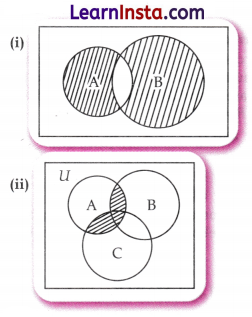
Solution:
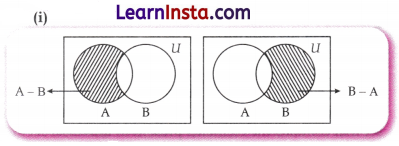
Hence, shaded region = (A – B) ∪ (B – A)
(ii) 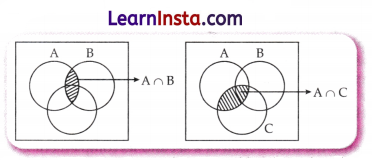
Hence, shaded region = (A ∩ B) ∪ (A ∩ C) = A ∩ (B ∪ C)
Question 18.
Let U = {1, 2, 3, 4, 5, 6, 7, 8}, A = {1, 2, 3, 4} and B = {3, 4, 5, 6}.
Verify by using De Morgan’s Law:
(A ∪ B)’ = A’ ∩ B’
Solution:
First, A ∪ B = {1, 2, 3, 4, 5, 6}
LHS = (A ∪ B)’ = {7, 8}
Now, A’ = {5, 6, 7, 8}
and B’ = {1, 2, 7, 8}
RHS = A’ ∩ B’ = {7, 8}
So, LHS = RHS
Hence, (A ∪ B)’ = A’ ∩ B’ is verified.
Question 19.
Find the union of sets X and Y, i.e., X ∪ Y, in each of the following pairs.
(i) X = {1, 3, 5, 7}, Y = {2, 4, 6, 8}
(ii) X = {x : x is an even natural number less than 8}, Y = {2, 3, 5, 7}
(iii) X = {p, q, r}, Y = {r, s, t, u}
Solution:
(i) X ∪ Y = {1, 2, 3, 4, 5, 6, 7, 8}
(ii) X = {2, 4, 6} and Y = {2, 3, 5, 7} therefore, X ∪ Y = {2, 3, 4, 5, 6, 7}
(iii) X ∪ Y = {p, q, r, s, t, u}
Question 20.
Use the Venn diagram given below to answer the following questions.
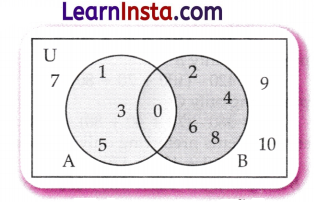
(i) U
(ii) A
(iii) B
Solution:
(i) U = {0, 1, 2, 3, 4, 5, 6, 7, 8, 9, 10}
(ii) A = {0, 1, 3, 5}
(iii) B = (0, 2, 4, 6, 8}
Question 21.
Let the universal set U be the collection of all quadrilaterals and let R denote the set of rectangles. What does the complement set R’ represent?
Solution:
The complement of set R, denoted by R’, represents all quadrilateral shapes that are not rectangles. Thus, R’ = {all quadrilaterals that are not rectangles}
Examples may include trapeziums, kites and general parallelograms which are not rectangles.
Question 22.
A bakery records its daily sales data. Let set A represent the days on which croissants were sold and set B represent the days on which muffins were sold.
(i) What real-life situation is represented by A ∩ B.
(ii) Which set operation represents the days on which at least one of the two items was sold? Explain briefly.
Solution:
(i) A ∩ B represents the days on which both croissants and muffins were sold.
(ii) The required set operation is A ∪ B, which represents the days on which croissants or muffins or both were sold, i.e., at least one of the two bakery items was sold.
Question 23.
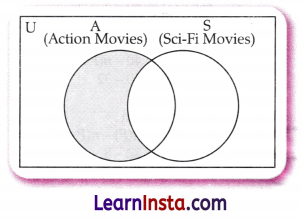
A streaming service categorises movies. Set S contains Sci-Fi movies. Set A contains Action movies. Represent the category “Action movies that are not Sci-Fi” using set operations. Also, draw a simple Venn diagram for it.
Solution:
The category “Action movies that are not Sci-Fi” is represented by:
A – S or A ∩ S’
This represents all movies that belong to the Action category but do not belong to the Sci-Fi category.
Question 24.
A software developer creates a system privilege group G = {x, y, z}. To assign security roles, the developer needs to list all possible subsets of these privileges, including the empty set. Find the power set P(G). Also, verify that the total number of subsets is 2n, where n is the number of elements in G.
Solution:
Given, G = {x, y, z}
The power set of G is the collection of all subsets of G.
P(G) = {Φ, {x}, {y}, {z}, {x, y}, {y, z}, {x, z}, {x, y, z}}
Here, set G has 3 elements.
n(G) = 3
The number of subsets of a set having n elements is 2n.
Therefore, number of subsets of a set = 23 = 8
Hence, P(G) has 8 elements.
Question 25.
A school library arranges books on different shelves according to their book numbers. Shelf A contains books whose numbers belong to the set:
A = {x : x is a multiple of 5 and x ≤ 25}
Shelf B contains books whose numbers belong to the set:
B = {x : x is an odd prime number less than 20}
Answer the following questions:
(i) Write set A and set B in roster (tabular) form.
(ii) Determine whether sets A and B are disjoint sets or not? Justify your answer using intersection notation.
Solution:
Given, A = {x : x is a multiple of 5 and x < 25} and
B = {x : x is an odd prime number less than 20}
(i) Set A: Multiples of 5 less than or equal to 25 are 5, 10, 15, 20, 25.
Therefore, A = {5, 10, 15, 20, 25}
Set B: Odd prime numbers less than 20 are 3, 5, 7,11, 13, 17,19.
Therefore, B = {3, 5, 7, 11, 13, 17, 19}
(ii) To check whether two sets are disjoint, we find their intersection, A ∩ B.
The common element in both sets is 5.
Therefore, A ∩ B = {5}
Since, A ∩ B ≠ Φ
Hence, the sets A and B are not disjoint sets.
Question 26.
In a coding club of 40 students, 22 learn Python, 18 learn Java and 8 learn neither language. Find the number of students who learn only Python. Use an algebraic set equation to solve.
Solution:
Let P = {Students learning Python} and J = {Students learning Java}
Given, n(U) = 40, n(P) = 22, n(J) = 18
Also, 8 students learn neither language.
Therefore, students learning at least one language n(P ∪ J) = 40 – 8 = 32
We know that n(P ∪ J) = n(P) + n(J) – n(P ∩ J), we get
32 = 22 + 18 – n(P ∩ J)
32 = 40 – n(P ∩ J)
n(P ∩ J) = 40 – 32
= 8
Students learning only Python
n(P – J) = n(P) – n(P ∩ J)
= 22 – 8
= 1
Hence, 14 students learn only Python and not Java.
Sets Class 9 Long Question Answer
Question 1.
In a school library, the librarian arranged different categories of books for Class 9 students.
Let U be the universal set representing all books in the library, A = {x : x is a Science book}, B = {Algebra, Geometry, Trigonometry, Statistics} and C = {Grammar, Poetry, Drama, Novel}.
Also, the academic books section is represented by D = {Science books, Mathematics books, English books, SST books}.
Further, the librarian found that Set A contains 6 elements, Set B contains 4 elements and Set C contains 4 elements. Every Mathematics book is also the part of the academic books of section D.
Answer the following questions.
(i) Write the set-builder form of set B.
(ii) Identify whether A and the set of natural numbers are finite or infinite sets.
(iii) State whether B ⊂ D. Give reason.
(iv) Which set among A, B, and C is an empty set?
(v) Write the universal set from the given information.
Solution:
(i) Set-builder form of set B is B = {x : x is a Mathematics book in the library}
(ii) Set A contains 6 elements. Therefore, A is a finite set. The set of natural numbers is N = {1, 2, 3, 4, …}
Since it has unlimited elements, it is an infinite set.
(iii) Yes, B ⊂ D because every Mathematics book belongs to the academic books section D.
(iv) None of the sets A, B and C is an empty set because set A has 6 elements, set B has 4 elements and set C has 4 elements.
(v) The universal set is U = {all books in the school library} Thus, U contains all types of books available in the library.
Question 2.
A school conducted an academic talent programme for Class 9 students. Students were grouped according to the Olympiad exams they qualified for – Mathematics Olympiad, Science Olympiad and English Olympiad.
Let M = {students qualified for Mathematics Olympiad},
S = {students qualified for Science Olympiad},
E = {students qualified for English Olympiad} and U be the universal set representing all students selected for the talent programme.
The following information is given:
M = {Aarav, Bhavya, Charu, Dev, Esha, Farhan}
S = {Bhavya, Dev, Farhan, Gauri, Harsh, Ishita}
E = {Charu, Dev, Gauri, Ishita, Jai}
Answer the following questions carefully.
(i) Write the following in set-builder form.
(a) M
(b) S
(c) E
(ii) Determine whether the following statements are true or false.
(a) Dev ∈ M
(b) Jai ⊂ E
(c) Charu ∉ S
(iii) Find the cardinality of the sets.
(a) n(M)
(b) n(S)
(c) n(E)
Solution:
(i) (a) M = {x : x is a student qualified for Mathematics Olympiad}
(b) S = {x : x is a student qualified for Science Olympiad}
(c) E = {x : x is a student qualified for English Olympiad}
(ii) (a) Dev ∈ M
True, because Dev is an element of set M.
(b) Jai ⊂ E
False, because Jai is an element of E, not a subset. Correct notation is Jai ∈ E.
(c) Charu ∉ S
True, because Charu is not an element of set S.
(iii) (a) n(M) = 6, (b) n(S) = 6, (c) n(E) = 5
Question 3.
A set has 5 elements.
(i) Find the number of subsets of the set.
(ii) Find the number of proper subsets.
(iii) Explain the relation between the number of elements and the number of subsets of a set.
Solution:
(i) Number of subsets of a set having n elements is 2n, Here, n = 5
Therefore, the number of subsets = 25 = 32
(ii) Number of proper subsets of a set having n elements are 2n – 1.
Thus, the number of proper subsets = 25 – 1 = 32 – 1 = 31
(iii) If a set contains n elements, then number of subsets 5 = 2n.
Thus, the number of subsets increases exponentially with the number of elements in the set.
Question 4.
Let U = {1, 2, 3, 4, 5, 6, 7, 8, 9, 10}, A = {2, 4, 6, 8, 10} and B = {1, 2, 3, 4, 5}. Answer the following:
(i) Is A ⊆ U?
(ii) Is B ⊆ U?
(iii) Find the cardinality of sets A and B.
(iv) Write any two subsets of A.
Solution:
(i) Every element of A belongs to U. Therefore, A ⊆ U
(ii) Every element of B belongs to U. Therefore, B ⊆ U
(iii) A = {2, 4, 6, 8, 10} contains 5 elements.
Thus, n(A) = 5
Similarly, n(B) = 5
(iv) Two subsets of A are {2, 4}, {6, 8, 10}.
Question 5.
In an inter-school innovation exhibition, students participated in three activity clubs – Robotics (R), Astronomy (A) and Coding (C). The school created the following sets:
R = {x : x is a student in the Robotics Club}
A = {Neil, Tara, Vihaan, Meera, Kabir}
C = {Tara, Kabir, Arjun, Siya, Meera}
The universal set is U = {Neil, Tara, Vihaan, Meera, Kabir, Arjun, Siya, Raghav}.
It is also known that the Robotics Club contains exactly 4 students.
Answer the following questions:
(i) Write set A in set-builder form.
(ii) Find the cardinality of sets A, C and U.
(iii) State whether the following are true or false with reasons:
(a) Tara ∈ C
(b) R ⊂ U
(c) Raghav ∈ A
Solution:
(i) A = {x : x is a student in the Astronomy Club}
(ii) A = {Neil, Tara, Vihaan, Meera, Kabir}
Therefore, n(A) = 5
Similarly, C = {Tara, Kabir, Arjun, Siya, Meera}
Thus, n(C) = 5
Universal set, U = {Neil, Tara, Vihaan, Meera, Kabir, Arjun, Siya, Raghav}
Hence, n(U) = 8
(iii) (a) Tara ∈ C
True, because Tara is an element of the set C.
(b) R U
True, because every student in the Robotics Club belongs to the universal set U.
(c) Raghav ∈ A
False, because Raghav is not an element of the set A.
Question 6.
In a residential school, students of Class 9 participated in three different clubs – Debate Club (D), Science Club (S) and Music Club (M). The total number of students in the class is 80.
The following information was collected:
• 42 students are in the Debate Club.
• 38 students are in the Science Club.
• 35 students are in the Music Club.
• 18 students are in both the Debate and Science Clubs.
• 15 students are in both Science and Music Clubs.
• 12 students are in both the Debate and Music Clubs.
• 8 students are in all three clubs.
Using the above information, answer the following questions:
(i) Find the number of students who are:
• only in Debate Club.
• only in Science Club.
• only in Music Club.
(ii) Find the number of students who are:
• in exactly two clubs.
• in at least one club.
• in none of the clubs.
(iii) Verify your answer using the cardinal number formula:
n(D ∪ S ∪ M) = n(D) + n(S) + n(M) – (D ∩ S) – n(S ∩ M) – n(D ∩ M) + n(D ∩ S ∩ M)
Solution:
Given, n(D) = 42, n(S) = 38, n(M) = 35,
n(D ∩ S) = 18, n(S ∩ M) = 15, n(D ∩ M) = 12,
n(D ∩ S ∩ M) = 8, n(U) = 80
Students only in Debate and Science Clubs
= n(D ∩ S) – n(D ∩ S ∩ M) = 18 – 8 = 10
Students only in Science and Music Clubs
= n(S ∩ M) – n(D ∩ S ∩ M) = 15 – 8 = 7
Students only in Debate and Music Clubs
= n(D ∩ M) – n(D ∩ S ∩ M) = 12 – 8 = 4
Only in Debate Club
= 42 – (10 + 4 + 8) = 42 – 22 = 20
Only in Science Club
= 38 – (10 + 7 + 8) = 38 – 25 = 13
Only in the Music Club
= 35 – (7 + 4 + 8) = 35 – 19 = 16
Students in exactly two clubs
= 10 + 7 + 4 = 21
Hence, 21 students are in exactly two clubs.
Now, we know that
n(D ∪ S ∪ M) = n(D) + n(S) + n(M) – n(D ∩ S) – n(S ∩ M) – n(D ∩ M) + n(D ∩ S ∩ M)
= 42 + 38 + 35 – 18 – 15 – 12 + 8 = 78
Hence, 78 students are in at least one club.
Students in none of the clubs = 80 – 78 = 2
Hence, 2 students are in none of the clubs.

Question 7.
Verify Y – X = Y ∩ X’ using the Venn diagram given below.

Solution:
From the Venn diagram,
U = {5, 10, 15, 20, 25, 30, 40, 50, 60, 70, 80, 90}
X = (5, 10, 15, 20, 25}
Y = {10, 20, 30, 40, 50}
Now,
LHS = Y – X = {30, 40, 50} (Elements of Y which are not in X)
X = {30, 40, 50, 60, 70, 80, 90}
Now,
RHS = Y ∩ X’
= {10, 20, 30, 40, 50} ∩ {30, 40, 50, 60, 70, 80, 90} = {30, 40, 50}
Since, LHS = RHS
Hence, Y – X = Y ∩ X is verified.
Question 8.
Let U = {1, 2, 3, 4, 5, 6, 7, 8, 9, 10}, P = {1, 2, 3, 4, 5, 6} and Q = {4, 5, 6, 7, 8}. Verify P – (P ∩ Q) = P ∩ Q’.
Solution:
First, P ∩ Q = {4, 5, 6}
Therefore, LHS = P – (P ∩ Q)
= (1, 2, 3, 4, 5, 6} – {4, 5, 6}
= 11, 2, 3}
and Q’ = {1, 2, 3, 9, 10}
RHS = P ∩ Q’ = {1, 2, 3, 4, 5, 6} ∩ {1, 2, 3, 9, 10} = (1, 2, 3}
Since, LHS = RHS
Hence, P – (P ∩ Q) = P ∩ Q’ is verified.
Question 9.
In a survey of 80 students, 45 students study Mathematics, 40 students study Science, and 18 students study both Mathematics and Science. Find:
(i) the number of students who study only Mathematics.
(ii) the number of students who study only Science.
(iii) the number of students who study at least one subject.
(iv) the number of students who study neither Mathematics nor Science.
Solution:
Let M = {students studying Mathematics} and S = {students studying Science}
Given, n(M) = 45, n(S) = 40, n(M ∩ S) = 18
(i) Students studying only Mathematics
= n(M – S) = 45 – 18 = 27
(ii) Students studying only Science
= n(S – M) = 40 – 18 = 22
(iii) Students studying at least one subject
= n(M ∪ S) = 45 + 40 – 18 = 67
(iv) Students studying neither subject
= 80 – 67 = 13
Question 10.
A, survey was conducted among 1200 students regarding their preference for three online learning platforms A, B and C. 480 students preferred platform A, 420 students preferred platform B, 360 students preferred platform C, 180 students preferred both A and B, 150 students preferred both B and C, 120 students preferred both A and C and 80 students preferred all the three platforms.
Find:
(i) the number of students who preferred only one platform.
(ii) the number of students who did not prefer any of the three platforms.
Solution:
Let A, B and C represent the sets of students who preferred platforms A, B and C, respectively.
Given, n(U) = 1200, n(A) = 480, n(B) = 420, n(C) = 360
n(A ∩ B) = 180, n(B ∩ C) = 150, n(A ∩ C) = 120 and n(A ∩ B ∩ C) = 80
Now,
Students preferring only A and B = 180 – 80 = 100
Students preferring only B and C = 150 – 80 = 70
Students preferring only A and C = 120 – 80 = 40
Students preferring only A = 480 – (100 + 40 + 80) = 260
Students preferring only B = 420 – (100 + 70 + 80) = 170
Students preferring only C = 360 – (70 + 40 + 80) = 170
(i) Number of students preferring only one platform –
= 260 + 170 + 170 = 600
(ii) n(A ∪ B ∪ C) = 480 + 420 + 360 – 180 – 150 – 120 + 80 = 890
Therefore, number of students who did not prefer any platform
= 1200 – 890 = 310
Hence, Students preferring only one platform = 600 and Students preferring none of the platforms = 310
Question 11.
A surveyor checks 100 households for internet streaming subscriptions. It is found that 50 households use Platform A, 40 use Platform B, 30 use Platform C, 15 use both A and B, 10 use both B and C, 12 use both A and C and 5 use all three platforms. Find the number of households that do not subscribe to any of the three platforms.
Solution:
Let A, B and C be the sets of households using Platforms A, B and C, respectively.
Given: n(U) = 100, n(A) = 50, n(B) = 40, n(C) = 30
n(A ∩ B) = 15, n(B ∩ C) = 10, n(A ∩ C) = 12
n(A ∩ B ∩ C) = 5
We know that
n(A ∪ B ∪ C) = n(A) + n(B) + n(C) – n(A ∩ B) – n(B ∩ C) – n(A ∩ C) + n(A ∩ B ∩ C)
Then,
n(A ∪ B ∪ Q = 50 + 40 + 30 – 15 – 10 – 12 + 5 = 125 – 37 = 88
So, 88 households subscribe to at least one platform. Number of households that do not subscribe to any platform = 100 – 88 = 12
Hence, 12 households do not subscribe to any of the three platforms.
Sets Class 9 Case Based Questions
1. Read the following text and answer the following questions on the basis of the same:
A maths teacher of class IX writes two sets as given below: A = {x : x is a letter of the word APPLE}, B = {x : x is a letter of the word MAPPLE} and asked the following questions from the students:
Question 1.
A ∩ B is equal to:
(a) A
(b) B
(c) Φ
(d) A ∪ B
Answer:
Option (a) is correct.
Explanation: Since, A = {A, P, L, E} and B = {M, A, P, L, E}
Therefore, A ∩ B = {A, P, L, E} = A
Question 2.
A ∪ B is equal to:
(a) A
(b) B
(c) A ∩ B
(d) Φ
Answer:
Option (b) is correct.
Explanation: A ∪ B = {M, A, P, L, E} = B
Question 3.
A -B is equal to:
(a) B – A
(b) A
(c) B
(d) Φ
Answer:
Option (d) is correct.
Explanation: A – B = {A, P, L, E} – {M, A, P, L, E} = Φ
Question 4.
Number of proper subsets of set A is:
(a) 31
(b) 32
(c) 15
(d) 16
Answer:
Option (c) is correct.
Explanation: Number of elements in set A = 4
Number of proper subset of A = 24 – 1 = 16 – 1 = 15
Question 5.
Assertion (A): In the given question, B – A is equal to {M}.
Reason (R): The difference A – B is the set of all elements
(a) Both Assertion (A) and Reason (R) are true, and Reason (R) is the correct explanation of Assertion (A).
(b) Both Assertion (A) and Reason (R) are true, but Reason (R) is not the correct explanation of Assertion (A).
(c) Both Assertion (A) is true, but Reason (R) is false.
(d) Both Assertion (A) is false, but Reason (R) is true.
Answer:
Option (a) is correct.
Explanation: B – A means the elements of set B which are not present in set A. The only element in B that is not in A is {M}. Therefore, B – A = {M}. So, Assertion (A) is true.
“The difference A – B is the set of all elements of A which do not belong to B.” This statement is also true because it correctly defines the difference of two sets.
Hence, both Assertion and Reason are true, and Reason correctly explains the Assertion.
2. Read the following article and answer the following question:
Soniya, Payal, Geeta and Ramesh are in school hockey team while Geeta, Manish, Pawan and Ritu are in school football team of a school. Let X be the set of students who are in hockey team and Y be the set of students who are in football team. Answer the following questions:
Question 1.
Find X ∪ Y.
Solution:
X = {Soniya, Payal, Geeta, Ramesh} and
Y = {Geeta, Manish, Pawan and Ritu}, then
X ∪ Y = {Soniya, Payal, Geeta, Ramesh, Manish, Pawan and Ritu}
Question 2.
Find X – Y.
Solution:
X = {Soniya, Payal, Geeta, Ramesh}
and Y = {Geeta, Manish, Pawan and Ritu},
then X – Y = {Soniya, Payal, Ramesh}
Question 3.
Are X and Y disjoint sets? Justify your answer.
OR
What is the number of proper subsets of X, if number of proper elements of the set X are 4 i.e., n(X) = 4?
Solution:
No, X and Y are not disjoint sets.
Since, X = {Soniya, Payal, Geeta, Ramesh}
and Y = {Geeta, Manish, Pawan and Ritu},
then X n Y = {Geeta} ≠ Φ, So, X and Y are not disjoint sets.
OR
Number of element in set X, n(X) = n = 4
Now, number of proper subsets n[P(X)] = 2n – 1 = 24 – 1 = 16 – 1 = 15
3. Read the following article and answer the following question:
A supermarket tracked the shopping carts of 120 customers during a weekend. The customers bought three organic items: Avocados, Berries and Cheese.
Let U = {all 120 tracked customers}, A = {x ∈ U : x bought Avocados}, B = {x ∈ U : x bought Berries} and C = {x ∈ U : x bought Cheese}.
Also, n(A) = 55, n(B) = 50, n(C) = 50,
n(A ∩ B) = 20, n(B ∩ C) = 15, n(A ∩ Q = 18 and n(A ∩ B ∩ C) = 7
Answer the following questions:
(1) Find the number of customers who bought both Avocados and Berries but not Cheese.
(2) Find the number of customers who bought only Avocados.
(3) Find the total number of customers who purchased exactly two out of the three organic items.
(4) Find the number of customers who did not buy any of the three organic items.
(5) If the value of n(A ∩ B ∩ C) is changed to 25, while all other values remain the same, explain why the data becomes impossible.
Solution:
Given,
n(U) = 120
n(A) = 55, n(B) = 50, n(C) = 50,
n(A ∩ B) = 20, n(B ∩ C) = 15, n(A ∩ C = 18 n(A ∩ B ∩ C) = 7

(1) Customers who bought both Avocados and Berries but not Cheese
= n(A ∩ B) – n(A ∩ B ∩ C)
= 20 – 7
= 13
Hence, 13 customers bought both Avocados and Berries but not Cheese.
(2) Customers who bought Avocados and Berries only
= Only A ∩ B = 20 – 7 = 13
Customers who bought Avocados and Cheese only
= Only A ∩ C = 18 – 7 = 11
Customers who bought only Avocados
= n(A) – [n(Only A ∩ B) + n(Only A ∩ C) + n(A ∩ B ∩ C)
= 55 – (13 + 11 + 7)
= 55 – 31 = 24
Hence, 24 customers bought only Avocados.
(3) Customers who purchased exactly two organic items Customers who bought Avocados and Berries only = Only A ∩ B = 20 – 7 = 13
Customers who bought Berries and Cheese only = Only B ∩ C = 15 – 7 = 8
Customers who bought Avocados and Cheese only = Only A ∩ C = 18 – 7 = 11 Customers who purchased exactly two organic items = 13 + 8 + 11 = 32
Hence, 32 customers purchased exactly two out of the three organic items.
(4) We know that
n(A ∪ B ∪ C) = ti(A) + n(B) + n(C) – n(A ∩ B) – n(B ∩ C) – n(A ∩ C) + n(A ∩ B ∩ C)
We get, n(A ∪ B ∪ C) = 55 + 50 + 50 – 20 – 15 – 18 + 7 = 109
Customers who did not buy any of the three organic items = 120 – 109 = 11
Hence, 11 customers did not buy any of the three organic items.
(5) If n(A ∩ B ∩ Q = 25 then this is impossible because A ∩ B ∩ C ⊆ B ∩ C.
So, n(A ∩ B ∩ C) ≤ n(B ∩ C)
But, 25 > 15, this is a contradiction.
Hence, the updated data is logically impossible.