Class 6 Science Chapter 1 Notes The Wonderful World of Science
→ I couldn’t agree more! Science has been the driving force behind many solutions to humanity’s most pressing problems. From medical breakthroughs to sustainable energy solutions, science has played a crucial role in exploring, understanding and shaping our world.
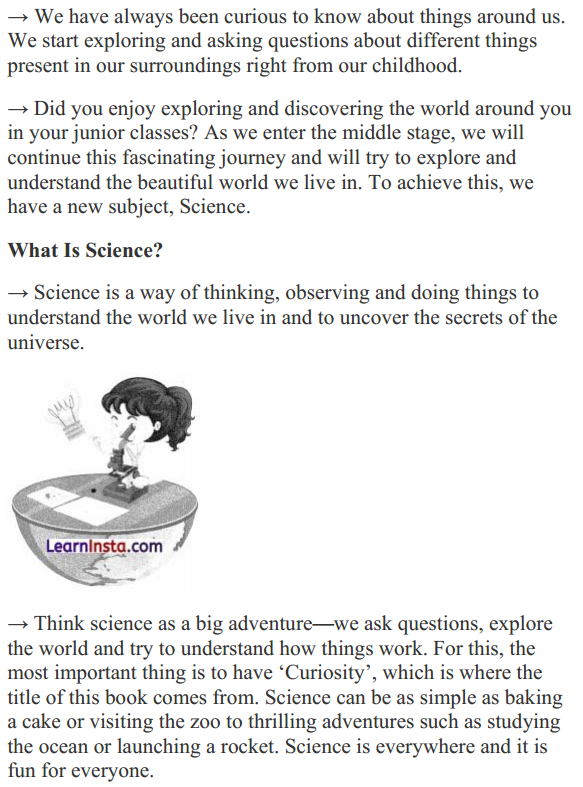
→ Science is a way to learn about the world and the universe by asking questions, observing things, and doing experiments to reach to conclusions which helps us understand how things work.
→ The curiosity to discover new secrets about the world around us is also an important aspect of science. Real questioning of any scientific problem comes from curiosity.
→ Understanding questions related to nature, mountains, rivers, forests, etc, in your nearby areas to quench your curiosity is science.
→ By embracing science and its methodologies, we can:
- Improve our daily lives through technological advancements.
- Develop innovative solutions to combat climate change.
- Discover new medicines to eradicate diseases like COVID-19, AIDS, etc.
- Create sustainable technologies for a greener future and improving air quality in cities.
- Explore space and expand our understanding of the universe.
→ Scientific Method: A systematic process used to develop and test scientific knowledge. Studying science effectively involves several key strategies to understand cbncepts, remember information, and apply knowledge. Here are some ways to study science:
→ Observation: Paying attention without bias prospect in order to gain a better understanding of it.
→ Questioning: Exploring the world and questioning the basic phenomenon involved using relevant questions. We need to question even our own questioning for better understanding.
→ Finding Solutions for any Problem: Observing a curious way to solve problems from our surroundings.
→ Group Study: Discussing concepts with peers for new ideas, reinforces learning and deep understanding.
→ Experiments and Scientific Observations: Conduct demonstrations related to the topics you’re studying for understanding.
→ Seek Clarification: Don’t hesitate to ask questions in class or seek help from teachers, tutors, or online resources when you encounter difficulties.
→ Stay Curious: Approach science with curiosity by asking questions and exploring new ideas.
→ There are numerous everyday problems that can be addressed using principles from science. Here are a few examples:
→ Cooking Temperature: When cooking, using a meat thermometer can ensure that food reaches a safe internal temperature, preventing foodborne illnesses.
→ Water Purification: Using a water filter or purifier at home to remove contaminants and ensure clean drinking water.
→ Traffic Flow: Understanding traffic patterns and using traffic lights with sensors to optimize traffic flow and reduce congestion.
→ Solar Energy: Installing solar panels to harness renewable energy from the sun, reducing reliance on fossil fuels and lowering electricity bills.
→ Gardening: Using composting techniques to recycle organic waste into nutrient-rich soil for healthier plants.
→ Weathef Prediction: Using weather forecasts based on meteorological data to plan activities and prepare for changing weather conditions.
→ Health Monitoring: Using wearable devices that track heart rate, steps taken, and sleep patterns to monitor personal health and fitness.
→ Waste Management: Recycling materials like paper, plastic, and glass to reduce landfill waste and conserve natural resources.
→ Plant Growth: Using fertilisers with specific nutrients to promote plant growth and ensure healthy crops in agriculture.
→ Communication: Using mobile phones and the internet, which rely on principles of electromagnetic waves and data transmission, for instant communication over long distances.