Each of our Ganita Manjari Class 9 Worksheet and Class 9 Maths Chapter 7 The Mathematics of Maybe Introduction to Probability Worksheet with Answers focuses on conceptual clarity.
Class 9 The Mathematics of Maybe Introduction to Probability Worksheet
Ganita Manjari Class 9 Chapter 6 Worksheet
Multiple Choice Questions
Question 1.
In a class of 40 students, 10 students scored above 90%. If a student is chosen at random0 what is the probability of choosing a student who did not score above 90%?
(a) \(\frac{1}{4}\)
(b) \(\frac{3}{4}\)
(c) \(\frac{10}{40}\)
(d) \(\frac{1}{40}\)
Answer:
(b) \(\frac{3}{4}\)
(b) Given, total number of students = 40
and number of students scoring above 90% = 10
∴ Number of students not scoring above 90%
= 40 – 10 = 30
Now, required probability
= \(\frac{Number of students not scoring above 90%}{Total number of students}\)
= \(\frac{30}{40}\) = \(\frac{3}{4}\)
Question 2.
The record of a basketball player shows that out of the last 300 matches, he scored a half-century in 210 matches. Then, the probability that in a randomly selected match he scored a half-century and the probability that he did not score a half-century are respectively.
(a) 0.6,0.4
(b) 0.7,0.3
(c) 0.8,0,2
(d) 0,5,0.5
Answer:
(b) 0.7,0.3
(b) Total matches = 300
Matches with a half-century = 210
P(half-century) = \(\frac{210}{300}\) = 0.7
Matches without a half-century = 300 – 210 = 90
P(not half-century) = \(\frac{90}{300}\) = 0.3
Therefore, the required probabilities are 0.7 and 0.3.

Question 3.
A die is tossed 150 times and the outcomes are recorded as follows
| Outcome | 1 | 2 | 3 | 4 | 5 | 6 |
| Frequency | 30 | 25 | 20 | 35 | 15 | 25 |
The probability of getting the number 4 is
(a) \(\frac{1}{5}\)
(b) \(\frac{7}{30}\)
(c) \(\frac{1}{4}\)
(d) \(\frac{5}{24}\)
Answer:
(b) Here, frequency of getting a number 4 = 35
and total number of trials = 150
∴ p(getting 4) = \(\frac{Frequency of 4}{Total number of trials}\) = \(\frac{35}{150}\) = \(\frac{7}{30}\)
Question 4.
In a city, 400 vehicles registration numbers were noted and the frequency distribution of their last digit is given below.
If a vehicle is selected at random, what is the probability that its last digit is either a prime number or a perfect square?
| Digit | 1 | 2 | 3 | 4 | 5 | 6 | 7 | 8 | 9 | 10 |
| Frequency | 34 | 42 | 28 | 36 | 40 | 38 | 44 | 56 | 54 | 28 |
(a) \(\frac{161}{200}\)
(b) \(\frac{139}{200}\)
(c) \(\frac{141}{200}\)
(d) \(\frac{39}{200}\)
Answer:
(b) Here, prime digits are 2, 3, 5, 7
and perfect square digits are 1, 4, 9.
Total frequency of these digits
= 34 + 42 + 28 + 36 + 40 + 44 + 54 = 278
∴ Number of favourable outcomes = 278
Total vehicles = 400
∴ Total outcomes = 400
Now, required probability
= \(\frac{Number of favourable outcomes}{Total outcomes}\)
= \(\frac{278}{400}\) = \(\frac{139}{200}\)
Question 5.
A bag has 3 red, 5 blue, and 2 green balls. A ball is drawn at random. What is the probability of not getting a red ball?
(a) \(\frac{3}{10}\)
(b) \(\frac{7}{10}\)
(c) \(\frac{1}{2}\)
(d) \(\frac{2}{5}\)
Answer:
(b) \(\frac{7}{10}\)
Total number of balls = 3 + 5 + 2 = 10 balls
∴ Total number of outcomes = 10
and number of non-red balls = 5 + 2 = 7 balls
∴ Number of favourable outcomes = 7
Now, required probability
= \(\frac{Number of favourable outcomes}{Total number of outcomes}\) = \(\frac{7}{10}\)
Question 6.
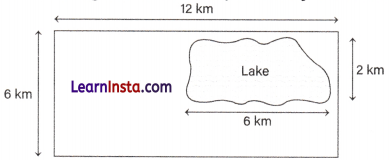
A rescue team is trying to locate a missing climber who may be anywhere in the rectangular region shown in the figure. There is a lake inside the region as shown, If the climber is equally likely to be at any point in the region, what is the probability that the climber is in the lake?
(a) \(\frac{1}{12}\)
(b) \(\frac{1}{6}\)c
(c) \(\frac{1}{4}\)
(d) \(\frac{1}{3}\)
Answer:
(b) \(\frac{1}{6}\)c
Area of the rectangular region = 12 × 6 = 72 km2
The lake is a rectangle of length 6 km and width 2 km.
Area of the lake = 6 × 2 = 12 km2
Required probability = \(\frac{Area of the lake}{Area of the rectangular region}\)
= \(\frac{12}{72}\) = \(\frac{1}{6}\)
Question 7.
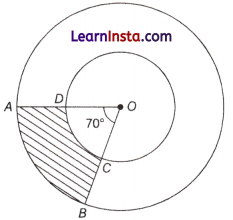
In the given figure, radii of the concentric circles with centre 0 are 10 cm and 18 cm respectively and angle ZAOB = 70°. A point is selected at random from the larger circle. Find the probability that it will be chosen from the shaded area.
(a) \(\frac{98}{729}\)
(b) \(\frac{96}{729}\)
(c) \(\frac{49}{729}\)
(d) \(\frac{14}{729}\)
Answer:
(a) \(\frac{98}{729}\)
Let the radii of the concentric circles r = 10 cm
and R =18 cm.
Angle subtended by the shaded region at the centre, ∠AOB = 70°.
Area of the shaded region (annular sector)
= \(\frac{\theta}{360^{\circ}}\)π(R2 – r2), where θ = 70°.
Area of the larger circle = πR2.
Required probability = \(\frac{Area of shaded region}{Area of the larger circle}\)
= \(\frac{\theta}{360^{\circ}} \frac{\pi\left(R^2-r^2\right)}{\pi R^2}=\frac{\theta}{360^{\circ}}\left(\frac{R^2-r^2}{R^2}\right)\)
= \(\frac{70}{360}\left(\frac{18^2-10^2}{18^2}\right)\)
= \(\frac{7}{36}\left(\frac{324-100}{324}\right)=\frac{7}{36}\left(\frac{224}{324}\right)\)
= \(\frac{7}{36} \times \frac{56}{81}=\frac{7}{9} \times \frac{14}{81}=\frac{98}{729}\)
Question 8.
Thirty bags of rice, each marked 25 kg, actually give the following data:
| Weight of a Bag (in kg) | Number of Bags |
| 24.5-24.8 | 4 |
| 24.8-25.0 | 2 |
| 25.0-25.3 | 9 |
| 25.3-25.6 | 10 |
| 25.6-25.9 | 5 |
The lower limits of the classes are inclusive and the upper limits are exclusive. What is the probability that the bag selected at random (without any reference) weighs 25.0 kg or more?
(a) \(\frac{1}{2}\)
(b) \(\frac{7}{15}\)
(c) \(\frac{4}{5}\)
(d) \(\frac{3}{5}\)
Answer:
(c) \(\frac{4}{5}\)
Number of bags weighing 25.0 kg or more are in the classes = 9 + 10 + 5 = 24
Required probability = \(\frac{Number of bags weighing 25.0 kg or more}{Total number of bags}\)
= \(\frac{24}{30}\) = \(\frac{4}{5}\)
Question 9.
Three unbiased dice are tossed. What is the probability of getting at least two sixes?
(a) \(\frac{1}{18}\)
(b) \(\frac{1}{36}\)
(c) \(\frac{5}{36}\)
(d) \(\frac{2}{27}\)
Answer:
(d) \(\frac{2}{27}\)
Total number of outcomes = 63 = 216
Let E = event of getting at least two sixes.
E consists of the following mutually exclusive cases
Exactly two sixes {(6, 6,1) (6, 6, 2), (6, 6, 3), (6, 6, 4), (6, 6, 5), (6,1, 6), (6, 2, 6), (6, 3, 6), (6, 4, 6), (6, 5, 6), (1, 6, 6), (2, 6, 6), (3, 6, 6), (4, 6, 6), (5, 6, 6)}
Number of outcomes = 15
All three sixes (6, 6, 6)
Number of outcomes = 1
Total favorable outcomes = 15 + 1 = 16
∴p(E) = \(\frac{Number of favorable outcomes}{Total number of outcomes}\) = \(\frac{16}{216}\) = \(\frac{2}{27}\)
Question 10.
A basketball team wins a game with probability 0.7 and loses with probability 0.3. Using a tree diagram, find the probability that the team wins exactly two of their next three games.
(a) 0.343
(b) 0.441
(c) 0.147
(d) 0.063
Answer:
(b) 0.441
Given P(Win) = 0.7
∴ P(Not win) =1 – 0.7 = 0.3
Tree diagram for three games is shown below.
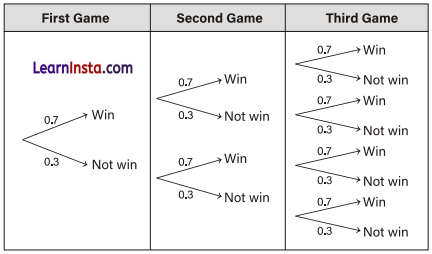
Exactly two win occur in the outcomes
WWL, WLW and LWW.
Required probability = P (WWL) + P (WLW) + P (LWW)
= O.7 × 0.7 × 0.3 + O.7 × 0.3 × 0.7 + O.3 × 0.7 × 0.7
= 0.147 + 0.147 + 0.147 = 0.441
Assertion-Reason Questions
Direction (Question Nos 1-5) Select the correct option from (a), (b), (c), (d) as given below,
(a) Both A and R are true and R is the correct explanation of A.
(b) Both A and R are true but R is not the correct explanation of A.
(c) A is true but R is false.
(d) A is false but R is true.
Question 1.
Assertion (A) If a bag has only red balls, the probability of drawing a blue ball is 0.
Reason (R) Probability =0 implies an impossible event – one that cannot happen under any circumstance.
Answer:
(a) Both A and R are true and R is the correct explanation of A.
Assertion (A) Since, the bag contains only red balls, it is impossible to draw a blue ball. Therefore, the probability of this event is 0.
Reason (R) We know that an event with a probability of 0 is an impossible event.
Hence, both A and R are true and R is the correct explanation of A.
Question 2.
The following data show the participation of students in two sports during a school sports festival.
| Particulars | Number of Students |
| Play cricket | 120 |
| Play football | 90 |
| Play both games | 80 |
| Total students surveyed | 200 |
A student is selected at random from these 200 students.
Assertion (A) The probability that the selected student plays at least one of the two games is \(\frac{17}{20}\)
Reason (R) The number of students who play at least one of the two games is 120 + 90 – 80 = 130.
Answer:
(d) A is false but R is true.
Total number of students = 200
Students playing at least one game
= 120 +90 -80 =130
Therefore, P(students play at least one game)
= \(\frac{130}{200}\) = \(\frac{13}{20}\)
Thus, Assertion is false and the Reason is true.
Question 3.
A survey of 800 office commuters was conducted regarding the mode of transport they use regularly.
| Observation table | |
| Mode of Transport | Number of Commuters |
| Bus only | 220 |
| Metro only | 180 |
| Both bus and metro | 140 |
| Personal vehicle only | 170 |
| None of the above | 90 |
A commuter is selected at random from the survey.
Assertion (A) The probability that the selected commuter uses bus is \(\frac{9}{20}\)
Reason (R) The number of commuters who use bus is obtained by adding those who use bus only and those who use both bus and metro.
Answer:
(a) Both A and R are true and R is the correct explanation of A.
Total number of commuters = 800
Number of commuters using bus
= Bus only + Both bus and metro = 220 +140 = 360
Probability that the selected commuter uses bus
= \(\frac{360}{800}\) = \(\frac{9}{20}\)
Hence, both A and R are true and R is the correct explanation of A.
Question 4.
A card is drawn at random from a well-shuffled deck of 52 playing cards.
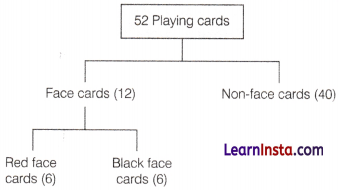
Assertion (A) The probability of drawing a red face card is \(\frac{3}{26}\)
Reason (R) There are 6 red face cards in a standard deck of 52 cards.
Answer:
(a) Both A and R are true and R is the correct explanation of A.
In a standard deck of 52 cards, face cards are kings, queens and jacks.
In each suit, 3 face cards present and there are 2 red suits.
∴ Total red face cards = 2 × 3 = 6
∴ Favourable outcomes = 6
and total outcomes = 52
Now, probability of drawing a red face card
= \(\frac{Favourable outcomes}{Total outcomes}\) = \(\frac{6}{52}\) = \(\frac{3}{26}\)
Hence, both A and R are true and R is the correct explanation of A.
Question 5.
Assertion (A) When two dice are rolled simultaneously, the sample space has 36 equally likely outcomes.
Reason (R) Each dice has 6 faces, for two dice the total outcomes = 6 × 6 = 36.
Answer:
(a) Both A and R are true and R is the correct explanation of A.
Given, two fair dice are rolled simultaneously.
Now, the first dice has 6 possible outcomes (1, 2, 3, 4, 5, 6) and second dice also has 6 possible outcomes.
∴ The total number of outcomes = 6 × 6 = 36
and sample space, S = {(1,1), (1,2), (1,3),…, (6,6)}
Since both dice are fair and independent, each of these 36 ordered pairs equally likely.
∴ The sample space contains 36 equally likely outcomes.
Thus, Assertion (A) is true Also, the reason correctly explains that the total number of outcomes is obtained by multiplying the outcomes of two dice, i.e„ 6 × 6 = 36.
Hence, both A and R are true and R is the correct explanation of A.
Class 9 Maths The Mathematics of Maybe Introduction to Probability Worksheet
Worksheet On The Mathematics of Maybe Introduction to Probability Class 9
Very Short Answer Questions
Question 1.
A card is drawn at random from a well shuffled deck of 52 playing cards. Find the probability of drawing a card that is both a king and a queen.
Answer:
A card cannot be both a king and a queen at the same time. Therefore, the event is impossible. Hence, the required probability is 0.
Question 2.
A weather station recorded weather conditions for 200 days. It observed rainfall on 78 days. Find the probability that a randomly selected day was a rainy day.
Answer:
Total number of days = 200
Number of rainy days = 78
∴ Required probability = \(\frac{Number of rainy days}{Total number of days}\)
= \(\frac{78}{200}\) = \(\frac{39}{100}\)
Question 3.
A spinner numbered 1 to 10 was spun 100 times. The results obtained are given below.
| Outcome | 1 | 2 | 3 | 4 | 5 | 6 | 7 | 8 | 9 | 10 |
| Number of times | 8 | 11 | 9 | 10 | 7 | 12 | 13 | 6 | 14 | 10 |
If a spin is selected at random from the recorded observations, what is the probability of obtaining a prime number?
Answer:
Prime numbers between 1 and 10 are 2, 3, 5 and 7.
Number of times the event occurred = 11 + 9 + 7 + 13 = 40
Total observations = 100
P(prime number) = \(\frac{40}{100}\) = \(\frac{2}{5}\)
Question 4.
A bag contains cards numbered from 1 to 8. A card is drawn 80 times with replacement and the outcomes are recorded below.
| Outcome | 1 | 2 | 3 | 4 | 5 | 6 | 7 | 8 |
| Number of times | 12 | 9 | 14 | 8 | 11 | 10 | 7 | 9 |
If a card is drawn at random from these recorded observations, what is the probability of getting a number greater than 5?
Answer:
Numbers greater than 5 are 6, 7 and 8.
Number of times the event occurred = 10 + 7 + 9 = 26
Total observations = 80
P(number greater than 5) = \(\frac{26}{80}\) = \(\frac{13}{40}\)
Question 5.
The arrival time of a student at school during one week is given below.
| Day | Mon | Tue | Wed | Thu | Fri | sat |
| Arrival Time | 7:55 | 8:10 | 8:05 | 7:58 | 8:12 | 8:00 |
If the school starts at 8:00 am, find the probability that the student arrived late.
Answer:
The student arrived late on
• Tuesday (8:10)
• Wednesday (8:05)
• Friday (8:12)
Number of late arrivals = 3
Total observations = 6
∴ P(late arrival) = \(\frac{Number of late arrivals}{Total observations}\) = \(\frac{3}{6}\) = \(\frac{1}{2}\)
Question 6.
A dice was thrown 80 times and the number 6 appeared 22 times. Find the probability of getting a number other than 6.
Answer:
Given, total number of throws = 80
and number of times 6 appeared = 22
∴ Number of times other than 6 appeared
= 80 – 22 = 58
Therefore, P (not getting 6) = \(\frac{58}{80}=\frac{29}{40}\)
Question 7.
Seema attempted 25 questions in a Mathematics test and answered 18 questions correctly, Find the probability that she will answer the next question correctly.
Answer:
Given, total questions attempted = 25
and number of correct answers = 18
∴ P(correct answer) = \(\frac{Number of correct answers}{Total questions attempted}\) = \(\frac{18}{25}\)
Question 8.
The amount of rainfall (in mm) recorded in a town during the last 10 days was:
12,15,18,14, 20,16,13,19,17, 21
Using the above information, find the probability that the rainfall on the next day will be at least 18 mm.
Answer:
Total observations = 10
Rainfall greater or equal to 18 mm occurred are 18, 20, 19 and 21.
∴ Number of times the event occurred = 4
Now, P (rain fall ≥ 18) = \(\frac{4}{10}\) = \(\frac{2}{5}\)
Thus, the required probability is \(\frac{2}{5}\)
Question 9.
The number of customers visiting a bakery during the last 8 days was recorded as follows:
85, 92, 88, 95, 90, 87, 94, 89
Using the above data, find the probability that the number of customers visiting the bakery tomorrow will be more than 90.
Answer:
Total observations = 8
Number of days on which the customers were more than 90 = 92, 95, 94.
∴ Favourable outcomes = 3
Now, P(customers > 90) = \(\frac{3}{8}\)
Question 10.
A room has 4 lights and 4 switches. Each switch can be either ON or OFF. If all possible switching arrangements are equally likely, find the probability that exactly 3 lights are ON.
Answer:
Each light can be either ON (1) or OFF (0).
∴ Total possible arrangements 2 × 2 × 2 × 2 = 16
The arrangements with exactly 3 lights ON are (1,1,1, 0), (1,1, 0,1), (1, 0,1,1) and (0,1,1,1)
∴ Number of favourable arrangements = 4
Required probability = \(\frac{4}{16}\) =\(\frac{1}{4}\)
Question 11.
The following data were obtained from a survey of families with 2 children:
| Number of Girls in a family | 0 | 1 | 2 |
| Number of Families | 145 | 680 | 175 |
If a family is chosen at random from the surveyed families, find the probability that it has at least 1 girl.
Answer:
Total number of families = 145 + 680 +175 = 1000
Number of families having at least 1 girl
= 680 + 175 = 855
Therefore, P(at least 1 girl) = \(\frac{855}{1000}=\frac{171}{200}\)
Short Answer Questions
Question 1.
A coin is tossed 300 times. Heads appear 135 times. Find the experimental probability of:
(i) getting a head,
(ii) getting a tail.
Answer:
Given, total number of trials = 300
and number of head appear = 135
∴ Number of tails appear = 300 – 135 = 165
(i) Probability (getting a head)
= \(\frac{Number of head appear}{Total number of trials}\) = \(\frac{135}{300}\) = \(\frac{9}{20}\)
(ii) Probability (getting a tail)
= \(\frac{Number of tail appear}{Total number of trials}\)
= \(\frac{165}{300}\) = \(\frac{11}{20}\)
Question 2.
A bag contains 5 white, 8 black, and 7 green balls, A ball is drawn at random. Find the probability that the drawn ball is
(i) green
(ii) not green.
Answer:
Total number of balls = 5 + 8 + 7 = 20 balls
∴ Total outcomes = 20
(i) Number of green ball in the bag = 7
∴ Favourable outcomes = 7
Now, probability that drawn ball Is green
= \(\frac{Number of favourable outcomes}{Total outcomes}\) = \(\frac{7}{20}\)
(ii) Number of balls that are not green = 5 + 8 = 13
∴ Favourable outcomes = 13
Now, probability that drawn ball is not green
\(\frac{Number of favourable outcomes }{Total outcomes}\) = \(\frac{13}{20}\)
Question 3.
Suppose you drop a die at random on the rectangular region shown in figure (4m x 3m) below, What is the probability that it will land inside the circle with a diameter of 2 m?
I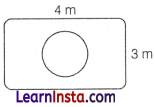
Answer:
Given a rectangular region with length 4 m and breadth 3 m and a circle inside it with a diameter of 2 m.
Let S represents the total rectangular area (the sample space).
∴ Area of rectangle (S) = Length × Breadth
=> A(S) = 4 × 3 = 12 m2
Let E be the event that the die will land inside the circle.
∴ Area of circle = πr2 = π x (1)2 = π m2
Now, P(E) = \(\frac{Area of circle}{Area of rectangle}\) = \(\frac{π}{12}\)
Question 4.
A card is drawn from a deck of 52 cards. Find the probability of drawing a red king card.
Answer:
Total number of cards = 52
∴ Total number of outcomes = 52
Number of red king cards in a deck of 52 cards = 2
∴ Number of favourable outcomes = 2
Now, probability (drawing a red king card)
= \(\frac{Number of favourable outcomes}{Total number of outcomes}\) = \(\frac{2}{25}\) = \(\frac{1}{26}\)
Question 5.
The marks obtained by 600 students in a Mathematics test (out of 100) are given below:
| Marks Secured | Number of Students |
| 0-20 | 60 |
| 21-40 | 180 |
| 41-60 | 210 |
| 61-80 | 120 |
| 81-100 | 30 |
| Total | 600 |
If a student’s report card is selected at random, find the probability that the student has scored more than 60 marks.
Answer:
Total number of students = 600
∴ Total number of outcomes = 600
The students who scored more than 60 marks
= 120 + 30 = 150
∴ Favourable outcomes = 150
Now, probability that student has scored more than 60 marks.
= \(\frac{Favourable outcomes}{Total number of outcomes}\) = \(\frac{150}{600}\) = \(\frac{1}{4}\)
Question 6.
A die is rolled once. Write the sample space and find the probability of getting
(i) an odd number
(ii) a multiple of 3.
Answer:
Given, a die is rolled once.
Let s be the sample space.
Here, S = {1,2,3,4,5,6}
∴ n(S) = 6
(i) Let E be the event of getting an odd number
Here, E = {1,3,5}
∴ n(E) = 3
Now, P(E) = \(\frac{n(F)}{n(S)}\) = \(\frac{3}{6}\) = \(\frac{1}{2}\)
(ii) Let F be the event of getting a multiple of 3.
Here, F = {3,6}
∴ n(F) = 2
Now,p(F) = \(\frac{n(F)}{n(S)}\) = \(\frac{2}{6}\) = \(\frac{1}{3}\)
Question 7.
Two fair dice are rolled simultaneously. Write the sample space and find the probability that the sum of the numbers obtained is a perfect square.
Answer:
Given, two dice are rolled.
Let S be the sample space.
Here, S = {(1,1), (1,2), (1,3),…, (6,6)}
∴ n(S) = 36
Let E be the event that the sum of the numbers is a perfect square.
Here, the minimum sum is 2(1 + 1) and the maximum sum is 12(6 + 6).
So, the perfect squares between 2 and 12 are 4 and 9. Sum of 4 {(1, 3), (2, 2), (3,1)}
Sum of 9 {(3, 6), (4, 5), (5, 4), (6, 3)}
∴ n(E) = 3 + 4 = 7
Now, P(E) = \(\frac{n(F)}{n(S)}\) = \(\frac{7}{36}\)
Question 8.
Two coins are tossed simultaneously. Write the sample space and find the probability of getting (i) at least one head, (ii) no head.
Answer:
Given, two coins are tossed.
Let S be the sample space.
Here, S = {HH, HT, TH, TT).
∴ n(S) = 4
(i) Let E be the event of getting at least one head.
Here, E = {HH, HT, TH}
∴ n{E) = 3
Now, p(E) = \(\frac{n(F)}{n(S)}\) = \(\frac{3}{4}\)
(ii) Let F be the event of getting no head
Here, F = {TT}
∴ n(F) = 1
Now, p(F) = \(\frac{n(F)}{n(S)}\) = \(\frac{1}{4}\)
Question 9.
A fair die is tossed once, Let P( A) be the probability of obtaining a number less than 5 and P(B) be the probability of obtaining a multiple of 3.
Find the value of 15P(A) + 9P(B).
Answer:
Given, a fair die is tossed once.
Let S be the sample space.
Here S = {1,2,3, 4,5,6}
∴ Total possible outcomes = 6
Also, given A is the event of obtaining a number less than 5 and B is the event of obtaining a multiple of 3.
∴ A = {1,2,3,4} and S = {3,6}
So, number of favourable outcomes for A = 4
and number of favourable outcomes for B = 2
∴ p(A) = \(\frac{4}{6}\) = \(\frac{2}{3}\) and P(B) = \(\frac{2}{6}\) = \(\frac{1}{3}\)
Now, 15P(A) + 9P(6) = 15 × \(\frac{2}{3}\) + 9 × \(\frac{1}{3}\) = 10 + 3 = 13
Question 10.
What is the probability of getting a sum of 7 when two dice are thrown?
Answer:
Let S be the sample space.
Here, S = {(1,1), (1,2), (1,3),…, (6,6)}
∴ n(S) = 36
Let E be the event getting a sum of 7.
E = {(1,6), (2,5), (3, 4), (4,3), (5,2), (6,1)}
∴ (E) = 6
Now,p(E) = \(\frac{n(E)}{n(S)}\) = \(\frac{6}{36}\) = \(\frac{1}{6}\)
Long Answer Questions
Question 1.
A die was thrown 600 times and the outcomes obtained are shown below
| Face on Die | 1 | 2 | 3 | 4 | 5 | 6 |
| Frequency | 82 | 94 | 105 | 98 | 123 | 98 |
Find the experimental probability of obtaining
(i) a prime number,
(ii) a composite number.
(iii) a number which is a factor of 6.
Answer:
Total number of trials = 600
(i) Prime numbers on a die are 2,3,5.
∴ Favourable frequency = 94 + 105 + 123 = 322
Now, P(prime number) = \(\frac{322}{600}\) = \(\frac{161}{300}\)
(ii) Composite numbers on a die are 4,6.
∴ Favourable frequency = 98 + 98 = 196
Now, P(composite number) = \(\frac{196}{600}\) = \(\frac{49}{150}\)
(iii) Factors of 6 are 1, 2,3, 6.
∴ Favourable frequency = 82 + 94 +105 + 98 = 379
Now, P(factor of 6) = 379/600
Question 2.
In a locality, 400 households were surveyed and the following data were recorded:
| Particulars | Number of Households |
| Own a car | 180 |
| Own a bike | 120 |
| Own both a car and a bike | 60 |
| Total households | 400 |
A household is chosen at random. Find,
(i) P(owns a car only)
(ii) P(owns a bike only)
(iii) P(owns at least one vehicle)
(iv) P(owns neither)
Answer:
Total number of households = 400
(i) Number of households owning a car only
= 180 – 60 = 120
∴ P(owns a car only) = \(\frac{120}{400}\) = \(\frac{3}{10}\)
(ii) Number of households owning a bike only
= 120 – 60 = 60
∴ P(owns a bike only) = \(\frac{60}{400}\) = \(\frac{3}{20}\)
(iii) Number of households owning at least one vehicle
= 180 + 120 – 60 = 240
∴ P(owns at least one vehicle) = \(\frac{240}{400}\) = \(\frac{3}{5}\)
(iv) Number of households owning neither a car nor a bike
= 400 – 240 = 160
∴ P(owns neither) = \(\frac{160}{400}\) = \(\frac{2}{5}\)
Question 3.
From a pack of 52 cards, a card is drawn at random. Find the probability that the card is
(i) a black card.
(ii) a red ace.
(iii) a queen or a king.
Answer:
In a standard deck, the total number of cards is 52.
∴ Total number of outcomes = 52
(i) There are 26 black cards (13 spades + 13 clubs)
∴ Number of possible outcomes = 26
Now, P(getting a black card)
= \(\frac{Number of possible outcomes}{Total number of outcomes}\) = \(\frac{26}{52}\) = \(\frac{1}{2}\)
(ii) There are 2 red aces (ace of hearts and ace of diamonds)
∴ Number of possible outcomes = 2
Now, P(getting a red ace) = \(\frac{2}{52}\) = \(\frac{1}{26}\)
(iii) There are 4 queens and 4 kings.
∴ Number of possible outcomes = 4 + 4 = 8
Now, P(getting a queen or king) = \(\frac{8}{52}\) = \(\frac{2}{13}\)
(iv) There are only 1 jack of clubs in the deck.
∴ Number of possible outcomes = 1
Now, P(getting a jack of club) = \(\frac{1}{52}\)
Question 4.
A bag contains 15 balls of which x are white. If 5 more white balls are added, then P(white) becomes double of original P(white). Find the original number of white balls.
Answer:
Given, total balls are 15 in which x are white.
∴ P(white balls) = \(\frac{x}{15}\)
After adding 5 more white balls, total balls = 20
and total white balls = x + 5
∴ P(white) = \(\frac{x + 5}{20}\)
According to question,
\(\frac{x + 5}{20}\) = 2(\(\frac{x}{20}\))
⇒\(\frac{x + 5}{20}\) = \(\frac{2x}{15}\)
⇒ 15(x + 5) = 20(2x)
⇒ 15x + 75 = 40x
⇒ 25x = 75
⇒ x = 3
Hence, the original number of white balls was 3.
Question 5.
The following table shows the number of customers visiting a shopping mall on a particular day.
| Time | Number of Customers |
| 9 am-11 am | 180 |
| 11 am-1 pm | 240 |
| 1 pm-3 pm | 310 |
| 3 pm-5 pm | 270 |
| 5 pm-7 pm | 150 |
| 7 pm-9 pm | 50 |
A customer is selected at random,
Find the probability that the customer visited the mall
(i) between 1 pm and 7 pm
(ii) after 3 pm but before 9 pm
(iii) before 1 pm
(iv) between 11 am and 5 pm
Answer:
Total number of customers
= 180 + 240 + 310 + 270 + 150 + 50 = 1200
(i) Between 1 pm and 7 pm
Number of customers = 310 + 270 + 150 = 730
∴ Required probability = \(\frac{730}{1200}=\frac{73}{120}\)
(ii) After 3 pm but before 9 pm
Number of customers = 270 + 150 + 50 = 470
∴ Required probability = \(\frac{470}{1200}=\frac{47}{120}\)
(iii) Before 1 pm
Number of customers = 180 + 240 = 420
∴ Required probability = \(\frac{420}{1200}=\frac{7}{20}\)
(iv) Between 11 am and 5 pm
Number of customers = 240 + 310 + 270 = 820
∴ Required probability = \(\frac{820}{1200}=\frac{41}{60}\)
Question 6.
Two dice are thrown simultaneously, Write the sample space and find the probability of getting
(i) a doublet (both same).
(ii) sum greater than 9,
(iii) sum less than or equal to 4,
(iv) a sum that is a multiple of 4.
Answer:
Given, two dice are thrown.
Let S be the sample space.
Here, S = {(1,1), (1,2), (1,3),…, (6,6)}
∴ n(S) = 36
(i) Let E be the event of getting a doublet.
Here, E = {(1,1), (2,2), (3,3), (4, 4), (5,5), (6,6)}
∴ n(E) = 6
Now, P(E) = \(\frac{n(E)}{n(S)}=\frac{6}{36}=\frac{1}{6}\)
(ii) Let F be the event of getting sum greater than 9.
Here, F = {(4,6), (5,5), (6,4), (5,6),(6,5), (6,6)}
∴ n(F) = 6
Now, P(E) = \(\frac{n(F)}{n(S)}=\frac{6}{36}=\frac{1}{6}\)
(iii) Let G be the event of getting sum lees than or equal to 4.
Here, G = {(1,1), (1,2),(2,1), (1,3), (2,2), (3,1)}
∴ n(G) = 6
Now, P(G) = \(\frac{n(G)}{n(S)}=\frac{6}{36}=\frac{1}{6}\)
(iv) Let H be the event of getting a sum that is multiple of 4.
Here, H = {(1,3),(2,2), (3,1), (2,6),(3,5), (4, 4), (5,3), (6,2), (6,6)}
∴ n(H) = 9
Now, P(H) = \(\frac{n(H)}{n(S)}=\frac{9}{36}=\frac{1}{4}\)
Question 7.
A number x is selected from {1,2,3, ,.„ 20} at random. Find
(i) P(x is even)
(ii) P(x is prime)
(iii) P(x is divisible by 3)
(iv) P{x is a perfect square)
Answer:
Let S be the sample space.
∴ S = {1,2,3,…, 20} and n(S) = 20
(i) Even numbers in the sample space are 2, 4, 6, 8, 10,12,14,16,18 and 20.
∴ Number of possible outcomes = 10
and P(x is even) = \(\frac{10}{20}=\frac{1}{2}\)
(ii) Prime numbers in the sample space are 2, 3, 5, 7, 11,13,17 and 19.
∴ Number of possible outcomes = 8
and P(x is prime) = \(\frac{8}{20}=\frac{4}{5}\)
(iii) Numbers divisible by 3 are 3, 6, 9,12,15 and 18.
∴ Number of possible outcomes = 6
and P(x is divisible by 3) = \(\frac{6}{20}=\frac{3}{10}\)
(iv) Perfect square in the sample are 1, 4, 9 and 16.
∴ Number of possible outcomes = 4
and P(x is a perfect square) = \(\frac{4}{20}=\frac{1}{5}\)
Question 8.
A survey records the blood groups of 100 students, A = 35, B = 28, AB = 12, and O = 25
If a student is selected at random.
Find (i) P(A or O)
(ii) P(not AB)
(iii) P(B or AB).
Also, state which blood group is most likely to be selected.
Answer:
Total number of students = 100
∴ n(S) = 100
Also, given n(A) = 35, n(B) = 28, n(AB) = 12 and n(O) = 25
(i) P(A or O) = \(\frac{35+25}{100}=\frac{60}{100}=\frac{3}{5}\)
(ii) p(not AB) = \(\frac{35+28+25}{100}=\frac{88}{100}=\frac{22}{25}\)
(iii) p(B or AB) = \(\frac{28+12}{100}=\frac{40}{100}=\frac{2}{5}\)
The blood group A is most likely to be selected as it has the highest frequency.
Case-Based Questions
Question 1.
A school conducted a survey among its students to find their favourite sport. The results are represented by the central angles of a pie chart given below. Study the pie-chart carefully and answer the following questions.
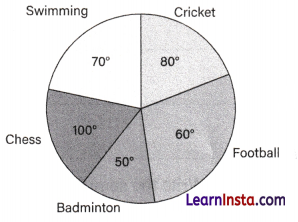
Answer the following questions.
(i) If a student is chosen at random, what is the probability that his/her favourite sport is cricket?
(ii) What is the probability that the favourite sport of a randomly chosen student is football or swimming?
(iii) (a) What is the probability that the favourite sport is neither cricket nor chess?
Or
(b) What is the probability that the favourite sport is badminton or chess?
Answer:
We know that the angle of a pie chart is 360°.
∴ p(a sport) = \(\frac{Central angle for cricket is 800}{360°}\)
(i) Central angle for cricket is 80°
∴ p(cricket) = \(\frac{80}{360}=\frac{2}{9}\)
(ii) Central angle for football or swimming
= 60° + 70°
= 130°
∴ P(football or swimming) = \(\frac{130}{360}=\frac{13}{36}\)
(iii) (a) Central angle corresponding to neither cricket nor chess
= 360° – (80° + 100°)
= 360° – 180° = 180°
∴ P (neither cricket nor chess) = \(\frac{180}{360}=\frac{1}{2}\)
Or
(b) Central angle for badminton or chess
= 50° + 100° = 150°
∴P(Badminton or chess) = \(\frac{150}{360}=\frac{5}{12}\)
Question 2.
Priya has a bag containing 15 marbles of three colours; red, blue and green, She picks one marble at random from the bag. Each marble is equally likely to be picked. Use the diagram and data below to answer the questions.
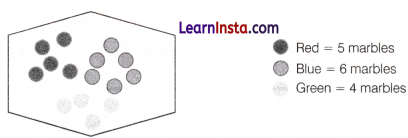
Answer the following questions.
(i) What is the probability that Priya picks a red marble?
(ii) What is the probability that Priya picks a blue marble?
(iii) (a) What is the probability of picking a green marble?
Or
(b) What is the probability of picking either a red or a green marble?
Answer:
Given, the bag contains 15 marbles in which
number of red marbles = 5
number of blue marbles = 6
and number of green marbles = 4
∴ Total number of outcomes = 15
(i) Let E1, be the event that Priya picks a red marble.
∴ Number of outcomes favourable of
E1 = 5
Required probability = \(\frac{5}{15}=\frac{1}{3}\)
(ii) Let E2 be the event that Priya picks a blue marble.
∴ Number of outcomes favourable to
E2 = 6
Required probability = \(\frac{6}{15}=\frac{2}{5}\)
(iii) (a) Let E3 be the event that Priya picks a green marble.
∴ Number of outcomes favourable to
E3 = 4
Required probability = \(\frac{4}{15}\)
Or
(b) Let E4 be the event that Priya picks either a red or green marble.
∴ Number of outcomes favourable to E4 = 5 + 4 = 9
Required probability = \(\frac{9}{15}=\frac{3}{5}\)
Question 3.
A box contains 20 cards numbered 1 to 20. Of these, cards numbered 1 to 9 are coloured red and cards numbered 10 to 20 are coloured blue. The 20 cards are shuffled well and one card is drawn at random.
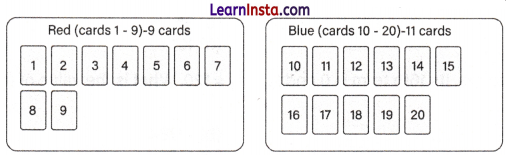
Based on the above information, answer the following questions
(i) What is the probability that the drawn card bears a prime number?
(ii) What is the probability that the drawn card is a blue card and bears an odd number?
(iii) (a) What is the probability that the drawn card bears a number which is a perfect square?
Or
(b) What is the probability that the drawn card bears a number divisible by 3 or 5?
Answer:
Given, total number of cards are 20 in which 1-9 are red cards and 10-20 are blue cards.
Let S be the sample space.
Here, S = {1,2,3,…, 20}.
∴ n(S) = 20
(i) Let E be the event that the drawn card bears a prime number.
Here, E = (2,3,5,7,11,13,17,19}
∴ n(E) = 8
Now, p(E) = \(\frac{n(E)}{n(S)}=\frac{8}{20}=\frac{2}{5}\)
(ii) Let F be the event that the drawn is a blue card and bears an odd number.
Here, F = {11,13,15,17,19}
∴ n(F) = 5
Now, p(G) = \(\frac{n(F)}{n(S)}=\frac{5}{20}=\frac{1}{4}\)
(iii) (a) Let G be the event that the drawn card bears a number which is a perfect square.
Here, G = {1,4,9,16}
∴ n(G) = 4
Now, p(G) = \(\frac{n(G)}{n(S)}=\frac{4}{20}=\frac{1}{5}\)
Or
(b) Let H be the event that the drawn card bears a number divisible by 3 or 5.
Here, H = {3,5,6,9,10,12,15,18,20}
∴ n(H) = 9
Now, P(H) = \(\frac{n(H)}{n(S)}=\frac{9}{20}\)