Practice with Class 9 Social Science Extra Questions and Class 9 SST Part 2 Chapter 2 Life on Earth Extra Questions to improve your exam performance.
Life on Earth Class 9 Extra Question Answer
Extra Questions of Life on Earth Class 9
Life on Earth Class 9 Very Short Question Answer
Question 1.
What is a biome9 Mention any two factors used to classify biomes.
Answer:
A biome is a large natural region where particular types of plants and animals live under similar climatic conditions. Biomes are classified using factors such as temperature and precipitation.
Question 2.
Why are tropical rainforests considered rich storehouses of biodiversity?
Answer:
Tropical rainforests support a wide variety of plants and animals because they remain hot and wet throughout the year. They also contain rich genetic resources and are known as gene banks.

Question 3.
How do humans adapt their lifestyles to different biomes?
Answer:
Humans adapt their occupations and lifestyles according to the climate and resources of their surroundings. They depend on available resources for food, shelter, livelihoods, and other daily needs.
Question 4.
What are non-timber forest products? Give two examples.
Answer:
Non-timber forest products are forest resources other than timber that are collected and used by communities. Examples include honey, fruits, nuts, resins, and medicinal plants.
Question 5.
How do forests support livestock and employment?
Answer:
Forests provide fodder for livestock and support activities such as livestock grazing, small forest-based industries, and ecotourism. These activities provide employment and income to local communities.
Question 6.
What role do women play in forest-dependent communities?
Answer:
Women play an important role in collecting and managing forest resources for household needs. They also help preserve traditional knowledge and contribute to family livelihoods.
Question 7.
What is meant by ecological commons? Give two examples.
Answer:
Ecological commons are natural resources shared and used collectively by a community. Forests, rivers, lakes, grazing lands, air, and biodiversity are examples.
Question 8.
Why are ecological commons important for rural and tribal communities?
Answer:
Communities depend on ecological commons for food, water, fuel, fodder, and medicinal plants. Their protection also helps maintain ecological balance, regulate climate, and conserve biodiversity.
Question 9.
What is a Geographical Indication (GI) tag?
Answer:
A GI tag identifies a product as originating from a specific geographical region whose quality, reputation, or characteristics are linked to that place. It also helps protect regional products and cultural heritage.
Question 10.
How does GI tagging benefit local communities?
Answer:
GI tagging gives region-specific products exclusive market recognition. It helps protect cultural heritage
and can generate economic benefits and better market opportunities for local communities.
Question 11.
How does the Forest Rights Act, 2006 support forest-dependent communities?
Answer:
The Act recognises the rights of eligible communities over forest land and resources they have traditionally depended upon. It also allows them to collect minor forest produce such as bamboo, honey, and medicinal plants.
Question 12.
What is Joint Forest Management (JFM)?
Answer:
Joint Forest Management encourages local communities to participate in protecting forests. It also enables communities to benefit from forest produce while contributing to forest conservation.
Question 13.
How does Mendha Lekha practise community-based forest management?
Answer:
Mendha Lekha makes forest-related decisions collectively through the Gram Sabha. The community regulates tree cutting, prevents forest fires, and promotes sustainable bamboo harvesting.
Question 14.
What are two major problems faced by people living in forests?
Answer:
Forest-dependent people may face limited access to healthcare, education, and clean water. They may also experience economic insecurity due to restrictions on forest use, deforestation, and commercial exploitation of resources.
Question 15.
How does human-wildlife conflict affect forest communities?
Answer:
Animals such as elephants, monkeys, and wild boars may damage crops or sometimes attack people. Such conflicts cause economic losses and create fear and insecurity among forest communities.
Life on Earth Class 9 Short Question Answer
Question 1.
What are the main characteristics of the tundra biome?
Answer:
- It is the coldest biome and is found near the Arctic and Antarctic regions.
- It has long, harsh winters, short summers, and permafrost, which makes tree growth difficult.
- Vegetation mainly includes mosses, lichens, and small shrubs, while animals such as reindeer and Arctic foxes are adapted to freezing temperatures.
Question 2.
How does a rainforest have different layers of vegetation?
Answer:
- The emergent layer consists of the tallest trees rising above the main forest canopy.
- The upper canopy forms a dense layer of tree crowns that receives much sunlight.
- The understory or lower canopy and the forest floor receive less sunlight and support different plants and organisms.
Question 3.
Why are grasslands generally dominated by grasses rather than dense forests?
Answer:
- Grasslands develop in areas receiving moderate rainfall.
- The rainfall is not sufficient to support dense forests.
- Large open areas therefore remain covered mainly with grasses, with very few trees.
Question 4.
How does geography influence biodiversity conservation?
Answer:
- Location, climate, landforms, and ecosystems influence the distribution of living organisms.
- Conservation strategies need to suit different geographical settings, such as mangrove protection along coasts.
- Protected areas and wildlife corridors are planned according to habitats, geographical barriers, and animal movement.
Question 5.
Explain three ways in which forest dwellers are connected with forests.
Answer:
- They collect non-timber forest products such as tendu leaves, mahua flowers, honey, lac, and bamboo for income.
- They collect firewood, fodder, wild fruits, roots, tubers, and medicinal plants for household needs.
- They preserve traditional knowledge and participate in forest-protection and community management activities.
Question 6.
What are the major challenges faced by people living in forests?
Answer:
- They often have limited access to healthcare, education, and clean water.
- Restrictions on forest use, deforestation, and commercial exploitation can limit their access to forest resources.
- They may also face natural disasters, forest fires, human-wildlife conflict, and economic insecurity.
Question 7.
How can forest-based tourism contribute to conservation and local development?
Answer:
- Ecotourism encourages responsible travel with minimal environmental impact.
- It supports conservation programmes and creates income opportunities for local people.
- It promotes environmental learning and respect for local communities and ecosystems.
Question 8.
Explain the importance of Mendha Lekha as an example of community forest management.
Answer:
- The Gram Sabha takes collective decisions regarding the village’s forest resources.
- The community protects about 1,800 hectares of forest by regulating tree cutting and preventing forest fires.
- Sustainable bamboo harvesting generates revenue used for community welfare, including education and infrastructure.
Question 9.
How do traditional practices contribute to forest conservation?
Answer:
- Forest communities possess traditional knowledge about plants, herbs, and other forest resources.
- Cultural practices and rituals promote respect for forests and their resources.
- Community-led movements and forest management practices have helped protect forests and prevent their uncontrolled exploitation.
Question 10.
Why are biodiversity hotspots important for conservation?
Answer:
- Regions such as the Himalaya, Western Ghats, North-East India and Andaman & Nicobar Islands contain many unique species.
- Some species found in these regions occur nowhere else.
- Identifying and protecting these areas helps conserve important habitats and biodiversity.
Life on Earth Class 9 Long Question Answer
Question 1.
Explain the major characteristics of desert biomes and the adaptations of plants, animals and people living there.
Answer:
- Deserts are the driest biomes and receive very little rainfall; they may be hot or cold.
- They generally have sandy soil and sparse vegetation because of extreme dryness.
- Plants such as cacti are adapted to store water and survive dry conditions.
- Animals such as camels, lizards, and snakes are adapted to withstand heat and dryness.
- People in desert regions adapt their activities and livelihoods to the availability of water and other local resources.
Question 2.
Describe the main features of the temperate deciduous and taiga biomes.
Answer:
- Temperate deciduous forests have broad-leaved trees that shed their leaves seasonally.
- They occur in regions with moderate temperatures and distinct seasons.
- Taiga is mainly composed of coniferous forests.
- Common trees of the taiga include pines, spruces, and larches.
- The vegetation of both biomes is closely related to their respective climatic conditions.
Question 3.
Explain the importance of sacred groves in conserving the natural environment.
Answer:
- Sacred groves are small forest patches protected by local communities for religious and cultural purposes.
- They are found across India under different names such as Devrai, Devarakadu, Kavu and Sarna.
- They often preserve rare plants, medicinal species, and wildlife.
- They act as small biodiversity-rich areas even though their size may be limited.
- Some sacred groves are associated with water sources and help maintain streams and groundwater.
Question 4.
Explain the major causes and effects of forest fires in India.
Answer:
- Climate change is one of the major factors contributing to the occurrence of forest fires.
- Human-induced factors also cause or increase the occurrence of forest fires.
- Forest fires can spread rapidly through dense vegetation.
- Severe fires can destroy homes, forest resources, and natural vegetation.
- They can cause extensive damage to human life and the environment, making prevention and human care important.
Question 5.
Explain how forest conservation movements have contributed to protecting forests in India.
Answer:
- Forest communities have traditionally played an important role in protecting forests.
- The Bishnoi Movement in Rajasthan was led by Amrita Devi and reflected strong community commitment to forest protection.
- The Chipko Movement in Uttarakhand involved village women hugging trees to prevent their cutting.
- These movements highlighted the importance of community participation in forest conservation.
- They also demonstrated the connection between traditional knowledge, community action and protection of natural resources.
Question 6.
Explain the major government efforts to support people living in forests.
Answer:
- The Forest Rights Act, 2006 recognises the rights of eligible communities over forest land and resources they have traditionally depended upon.
- It allows eligible communities to collect minor forest produce such as bamboo, honey, and medicinal plants.
- The government runs welfare programmes including education scholarships, healthcare and skill development initiatives.
- Joint Forest Management encourages local communities to participate in forest protection while benefiting from forest produce.
- Initiatives such as PESA, DAJGUA and PM JANMAN aim to promote the welfare of forest-dependent communities.
Question 7.
Explain how forest products can contribute to the economic development of local communities through GI recognition.
Answer:
- A GI tag identifies a product whose quality, reputation, or characteristics are linked to a specific geographical origin.
- It gives region-specific products recognition and helps protect their unique identity.
- GI recognition can help preserve traditional knowledge and cultural heritage associated with the products.
- It provides exclusive market recognition and can create economic benefits for local communities.
- Examples include Ramban Su lai Honey, Channapatna Toys, Kandhamal Haldi and Khasi Mandarin.
Question 8.
Explain the importance of forests for maintaining environmental balance and supporting human life.
Answer:
- Forests provide important resources such as food, fuel, fodder, medicine, shelter, timber, and bamboo.
- They provide non-timber products such as honey, fruits, nuts, resins, and medicinal plants.
- Forests support biodiversity by providing habitats for diverse plants and animals.
- They contribute to maintaining oxygen levels and balancing the Earth’s climate.
- They also support livelihoods, cultural practices, livestock grazing, forest-based industries, and ecotourism.
Life on Earth Class 9 Source Based Questions
Read the sources given below and answer the questions that follow:
Question 1.
Mendha Lekha: A Case Study ¡n Community Forest Management
Mendha Lekha is a small tribal village located in the Gadchiroli district of Maharashtra, known for its effective community-based forest management and self-governance. The village, inhabited mainly by the Gond tribe, became the first in India to gain rights over its forest resources under the Forest Rights Act (2006).
The people of Mendha Lekha follow the principle of Mawa Nate Mawa Raj (our village, our rule), ensuring that all decisions are made collectively through the Gram Sabha. They protect and sustainably utilise their 1,800 hectares of forest by regulating tree cutting, preventing forest fires, and promoting bamboo harvesting as a renewable resource.
The revenue from the forest produce is used for community welfare activities such as education and infrastructure. This also upholds the fundamental rights of the people to participate in governance and control resources that sustain their livelihoods. Simultaneously, the villagers fulfil their fundamental duties by protecting biodiversity and preventing illegal exploitation. This model has not only strengthened local livelihoods but also demonstrates how traditional knowledge, rights, and duties, as well as democratic participation, can coexist to achieve sustainable forest Conservation.
(i) Where is Mendha Lekha located?
Answer:
Mendha Lekha is located in the Gadchiroli district of Maharashtra.
(ii) Which principle do the people of Mendha Lekha follow?
Answer:
They follow the principle of Mawa Nate Mawa Raj, meaning “our village, our rule.”
(iii) How does Mendha Lekha practise sustainable forest management?
Answer:
- The villagers regulate tree cutting, prevent forest fires, and promote sustainable bamboo harvesting.
- The revenue from forest produce is used for community welfare activities such as education and infrastructure.
Question 2.
Case Study of Water Tanks Built by the Gond Kings
Answer:
In India, for centuries, regions with seasonal rainfall have tackled the issue of water demand and management as a collective concern and used common public resources for the same. In fact, between 800 and 1200 CE, the Chandella and Bundela kings built around 8,000 tanks in the Bundelkhand region. Similarly, keres were built in Karnataka, en tanks in Tamil Nadu, and chevuru tanks in Andhra Pradesh and Odisha. Bihar had the famous Ahar-Pans to store water, and the Gond kings funded huge katas-three-sided reservoirs- in the Gondwana region. According to official
estimates, there are more than 15 lakh functional tanks in India at present.
(i) When did the Chandella and Bundela kings build around 8,000 tanks?
Answer:
Between 800 and 1200 CE.
(ii) What were the three-sided reservoirs built by the Gond kings called?
Answer:
Katas.
(iii) Name any two traditional water-storage systems mentioned in the passage and state where they were built.
Answer:
- Keres were built in Karnataka.
- Eri tanks were built in Tamil Nadu.
Life on Earth Class 9 Picture Based Questions
Look at the pictures and answer the questions that follow:
Question 1.
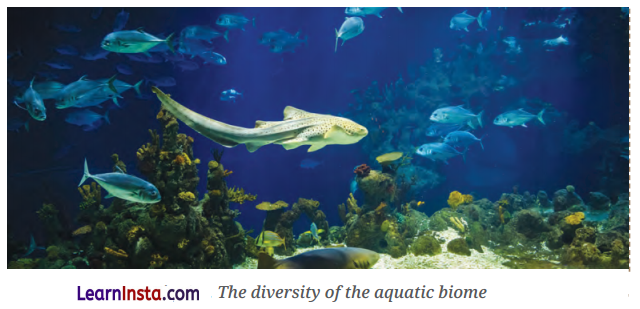
(i) What are the two main types of aquatic biomes?
Answer:
Freshwater biomes and marine biomes.
(ii) Name any one type of freshwater biome.
Answer:
Rivers.
(iii) How are aquatic biomes important for life on Earth?
Answer:
- Freshwater biomes provide drinking water, support agriculture, and provide habitats for species such as fish, frogs, and insects.
- Marine biomes are rich in biodiversity, influence Earth’s climate by storing and distributing heat, and provide food and livelihoods for millions of people.
Question 2.
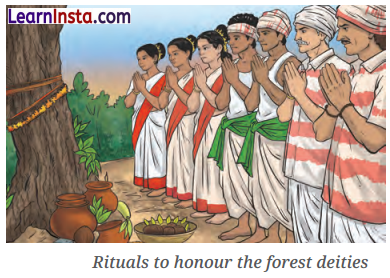
(i) What resources do forests provide to rural and tribal communities?
Answer:
Forests provide food, fuel, fodder, medicine, shelter, timber, bamboo, and firewood.
(ii) Which communities perform rituals to honour forest deities before collecting forest resources?
Answer:
The Gonds and Bhils.
(iii) How do forests support the livelihoods of people?
Answer:
- Forests provide non-timber products such as honey, fruits, nuts, resins and medicinal plants, which help families meet daily needs and earn income.
- They also support livestock grazing, small forest-based industries, ecotourism and employment.
Oceans and Life Class 9 Map Based Questions
On the outline map of India. locate and label the following places:
(i) Thar Desert
(ii) Rann of Kutch
(iii) Western Ghats
(iv) Mendha Lekha
(v) Thenmala
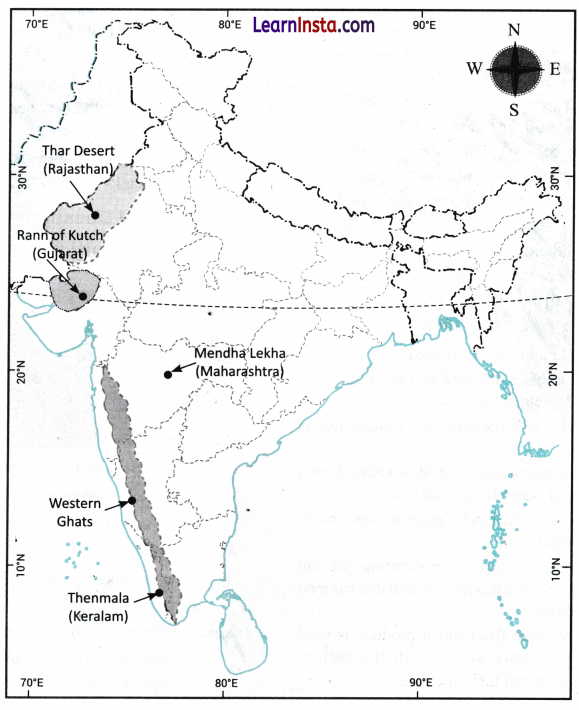
Class 9 Life on Earth Extra Questions for Practice
Multiple Choice Questions
Question 1.
The word ‘biome’ is derived from which Greek word?
(a) Bios
(b) Geo
(c) Oikos
(d) Terra
Question 2.
Which region contains the Amazon Basin, one of the world’s largest tropical rainforests?
(a) South America
(b) Africa
(c) Europe
(d) Australia
Question 3.
Which of the following is mainly associated with the forest floor of a rainforest?
(a) Very tall emergent trees
(b) Dense tree crowns receiving maximum sunlight
(c) Low sunlight and decomposing organic matter
(d) Permanent snow cover
Question 4.
Which of the following is a characteristic of the Rann of Kutch?
(a) It is covered with dense forests throughout the year
(b) It becomes a marshy wetland during the monsoon
(c) It remains permanently frozen
(d) It receives rainfall throughout the year.
Question 5.
Assertion (A): Tropical rainforests are also known as gene banks.
Reason (R): They contain rich genetic resources and preserve unique genetic material.
(a) Both A and (R) are true, and (R) is the correct explanation of(A).
(b) Both (A) and (R) are true, but (R) is not the correct explanation of(A).
(c) (A) is true, but (R) is false.
(d) (A) is false, but (R) is true.
Fill in the blanks
1. The suffix ……………………………… in the word biome denotes a group of a specific type of biological constituents.
2. Tropical rain forests are mainly found between the Tropic of Cancer and the Tropic of ……………………………. .
3. The ……………………………. Basin in South America contains one of the world’s largest tropical rainforests.
4. The traditional water-storage structures called ………………………….. were built in the Bundelkhand region by the Chandella and Bundela kings.
Very Short Answer Type Questions
Question 1.
What is the difference between the emergent layer and the upper canopy of a rainforest?
Question 2.
Why is the Rann of Kutch considered a unique desert environment?
Question 3.
How do climate and vegetation help distinguish different terrestrial biomes?
Question 4.
Why are oceans, seas and coral reefs important components of ¡narine biomes?
Short Answer Type Questions
Question 1.
Explain the relationship between temperature, precipitation, and the distribution of biomes.
Question 2.
Describe the three main features of tropical rainforests that make them highly suitable for diverse forms of life.
Question 3.
Explain the seasonal transformation of the Rann of Kutch and its effect on the landscape.
Question 4.
How do traditional water-storage systems reflect collective approaches to water management in India?
Long Answer Type Questions
Question 1.
Explain the different layers of vegetation in a tropical rainforest and describe how each layer receives and uses
sunlight.
Question 2.
Compare the environmental conditions and vegetation of the tundra, taiga and temperate deciduous biomes.
Question 3.
Explain how GI tagging can protect geographical identity, traditional knowledge, cultural heritage and the economic interests of producers.
Question 4.
Discuss the major challenges faced by people living in forests and explain why better processing, marketing, and access to government programmes are important for improving their livelihoods.