Each of our Ganita Manjari Class 9 Worksheet and Class 9 Maths Chapter 6 Measuring Space Perimeter and Area Worksheet with Answers focuses on conceptual clarity.
Class 9 Measuring Space Perimeter and Area Worksheet
Ganita Manjari Class 9 Chapter 6 Worksheet
Multiple Choice Questions
Question 1.
Let K be the area of a triangle with perimeter P. If all three side lengths are doubled to scale up the triangle, the ratio of the new area to the new perimeter will be
(a) equal to the original ratio \(\frac{K}{P}\)
(b) two times the original ratio 2\(\frac{K}{P}\)
(c) four times the original ratio 4\(\frac{K}{P}\)
(d) half of the original ratio \(\frac{K}{2P}\)
Answer:
(b) two times the original ratio 2\(\frac{K}{P}\)
Given, original area of triangle = K and original perimeter = P
Since, all three sides of the triangle are doubled.
So, the new triangle is similar to the original triangle with scale factor 2.
We know that perimeter depends directly on length.
∴ New perimeter = 2P
Area depends on the square of the scale factor.
∴ New area = 22 K = 4K
Now, the new ratio of area to perimeter is
\(\frac{\text { New area }}{\text { New perimeter }}=\frac{4 K}{2 P}\)
= \(\frac{2 K}{P}=2\left(\frac{K}{P}\right)\)
So, the new ratio is two times the original ratio
Question 2.
The sides of a triangle are 13 cm, 14 cm and 15 cm. If a parallelogram has the same area and base 21 cm, its corresponding height is
(a) 3 cm
(b) 4 cm
(c) 5 cm
(d) 6 cm
Answer:
(b) 4 cm
Given, sides of the triangle are 13 cm, 14 cm and 15 cm.
Let a = 13, b = 14 and c = 15 cm.
Semi-perimeter of the triangle,
s = \(\frac{13+14+15}{2}=\frac{42}{2}\) = 21 cm
By Heron’s formula,
Area of triangle = \(\sqrt{s(s-a)(s-b)(s-c)}\)
= \(\sqrt{21(21-13)(21-14)(21-15)}\)
= \(\sqrt{21 \times 8 \times 7 \times 6}\)
= \(\sqrt{7056}\) = 84 cm2
Now, area of parallelogram = Area of triangle
= 84 sq. cm
Also, base of parallelogram = 21 cm
Let the height of parallelogram be h cm.
Area of parallelogram = base × height
⇒ 84 = 21 × h
⇒ h = \(\frac{84}{21}\) = 4 cm
Hence, the corresponding height of the parallelogram is 4 cm.

Question 3.
An isosceles triangle has an area of A cm2 and a perimeter of 2p cm. If the length of its base is x cm, which of the following algebraic expressions correctly satisfies Heron’s formulation for this triangle? Conceptual,
(a) 16A2 =4px2(p – x)
(b) 16A2 = px2(2p – x)
(c) 16A2 = 4p(p – x)2(2p – x)
(d) 16A2 = p(2p – x)2(p – x)
Answer:
(a) 16A2 =4px2(p – x)
Given, perimeter of isosceles triangle = 2p
So, semi-perimeter 2s = 2p
⇒ s = p
Let each equal side be y. Then,
x + y + y = 2p
Img-1
By Heron’s formula,
∴ Area of isosceles triangle
A2 =p(p – x)(P – y)(p – y)
= p(p – x)\(\left(p-\frac{2 p-x}{2}\right)^2\)
= p(p – x)\(\left(\frac{x}{2}\right)^2\)
= \(\frac{p x^2(p-x)}{4}\)
⇒ 4A2 = px2(p – x)
Multiply by 4 both sides, we get
16A2 = 4px2(p – x).
Question 4.
A triangle has side lengths a, b and c such that (a+ b + c)(a + b – c) = 2ab. The measure of the internal angle opposite to side c is
(a) 30°
(b) 45°
(c) 60°
(d) 90°
Answer:
(d) 90°
Given, a triangle has side lengths a, b and c.
Now, LHS = (a + b + c)(a + b – c)
= [(a + b) + c] [(a + b) – c]
= [(a + b)2 – c2] [x2 – y2 = (x + y) (x – y)]
∴ (a + b)2 – c2 = 2ab
⇒ a2 + b2 + 2ab – c2 = 2ab
⇒ a2 + b2 = c2
Since, in a triangle, the square of one side equal the sum of squares of the other two sides, then the triangle is right-angled and the right angle lies opposite the longest side
Here, a2 + b2 = c2, side c is the longest side and the angle opposite to it.
∴∠C must be right angle i.e. ∠C = 90°.
Question 5.
For a cyclic quadrilateral, Brahmagupta’s formula needs four side lengths and also condition that
(a) opposite sides are equal
(b) all vertices lie on a circle
(c) diagonals are perpendicular
(d) one angle is 90°
Answer:
(b) all vertices lie on a circle
Brahmagupta’s formula is specifically used to find the area of a cyclic quadrilateral, which is defined as a quadrilateral where all four vertices lie on the circumference of a circle.
Question 6.
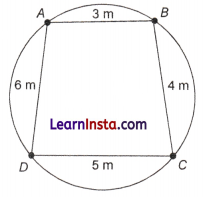
A dynamic architectural frame is in the shape of a variable cyclic quadrilateral whose side lengths are fixed at 3 m, 4 m, 5 m, and 6 m in cyclic order. What is the maximum geometric area that this quadrilateral frame can enclose?
(a) \(\sqrt{360} \mathrm{~m}^2\)
(b) \(\sqrt{54} \mathrm{~m}^2\)
(c) 12 m2
(d) \(\sqrt{105} \mathrm{~m}^2\)
Answer:
(a) \(\sqrt{360} \mathrm{~m}^2\)
Given, sides of the variable cyclic quadrilateral are 3 m, 4 m, 5 m and 6 m.
For fixed side lengths, maximum area Is enclosed when the quadrilateral Is cyclic.
Semi-perimeter.
s = \(\frac{3+4+5+6}{2}\) = 9m
By Brahmagupta’s formula,
Area of cyclic quadrilateral
= \(\sqrt{(s-a)(s-b)(s-c)(s-d)}\)
= \(\sqrt{(9-3)(9-4)(9-5)(9-6)}\)
= \(\sqrt{6 \times 5 \times 4 \times 3}=\sqrt{360} \mathrm{~m}^2\)
Hence, the maximum area is √360 m2.
Question 7.
In ΔABC, AD is a median and P is any point on AD. Which statement is always true?
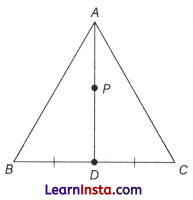
(a) Area (ΔABP) = Area(ΔACP)
(b) ΔABP ≅ ΔACP
(c) AP = BP
(d) Area (ΔABD) = 2 Area(ΔACD)
Answer:
(a) Area (ΔABP) = Area(ΔACP)
In ∆ABC , AD is the median.
Since, a median divides a triangle into two of equal area.
∴ Area (∆ABD) = Area (∆ACD)
Join the line P to B and P to C.
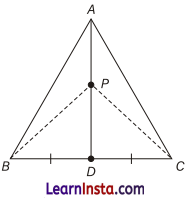
Now, in ∆PBC, PD is also a median.
∴ Area (∆PBD) = Area (∆PCD) ,..(ii)
On subtracting Eq (ii) from Eq (i), we get
Area (∆ABD) – Area (∆PBD)
= Area (∆ACD) – Area (∆PCD)
⇒ Area (∆ABP) = Area (∆ACP)
Question 8.
A bicycle wheel has a diameter of 60 cm. How far will the cyclist have travelled after the wheel has completed exactly 100 rotations? (Use π = 3.14)
(a) 188.4 m
(b) 18.84 m
(c) 1884 m
(d) 376,8 m
Answer:
(a) 188.4 m
Given, diameter of bicycle wheel (d) = 60 cm
We know that, distance covered in 1 rotation
= Circumference of wheel = πd
∴ Distance in 1 rotation = 3.14 × 60 = 188.4 cm
distance covered in 100 rotations
= 188.4 × 100
= 18840 cm
= 188.4 m
Hence, the cyclist will travel 188.4 m.
Question 9.
If the radius of a circle is tripled, how does its area change?
(a) It becomes 3 times the original area.
(b) It becomes 6 times the original area.
(c) It becomes 9 times the original area.
(d) It remains the same.
Answer:
(c) It becomes 9 times the original area.
Let the original radius of the circle be r.
Original area, A = πr2
∴ When the radius is tripled, new radius r1 = 3r.
Now, the new area = πr21 = π(3r)2
= 9πr2
= 9A
Hence, the area becomes 9 times the original area.
Question 10.
A pure copper wire bent into the form of an equilateral triangle encloses an area of 121√3 cm2. If the exact same wire is unbent and reformed into a perfect circle, what is the enclosed area of the newly formed circle? (Use π = \(\frac{22}{7})\)
(a) 34,65 cm2
(b) 616 cm2
(c) 154 cm2
(d) 346,5 cm2
Answer:
(d) 346,5 cm2
Given, area of equilateral triangle = 121√ cm2
Let the side of the equilateral triangle be a cm.
We know that area of equilateral triangle = \(\frac{\sqrt{3}}{4} a^2\)
∴ \(\frac{\sqrt{3}}{4} a^2=121 \sqrt{3}\)
⇒ \(\frac{a^2}{4}\) = 121
⇒ a2 = 484
⇒ a = 22 cm
So, length of wire = 3 × 22 = 66 cm
The same wire is bent into a circle.
∴ Circumference of circle = 66 cm
⇒ 2πr = 66
⇒ [/latex]\frac{22}{7}[/latex] × 10.5 × 10.5 = 346.5 cm2
Now, area of circle = πr2 = [/latex]\frac{22}{7}[/latex] × 10.5 × 10.5 = 346.5 cm2
Hence, the enclosed area of the circle is 346.5 cm2.
Question 11.
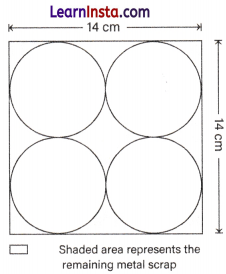
Four identical circular metallic plates of the maximum possible equal size are cut from a solid square sheet of side 14 cm. Find the total area of the remaining metal scrap.
(a) 42 cm2
(b) 84 cm2
(c) 154 cm2
(d) 112 cm2
Answer:
(a) 42 cm2
From the diagram, side of square sheet = 14 cm
Four equal circles are cut from the square sheet.
Since, two circles fit along one side of the square.
∴ Diameter of each circle = [/latex]\frac{14}{2}[/latex] = 7 cm
⇒ r = [/latex]\frac{7}{2}[/latex] cm
Now, area of square sheet = 14 × 14 = 196 cm2
And area of four circular plates = 4 × πir2
= 4x × [/latex]\frac{22}{7}[/latex] × [/latex]\frac{7}{2}[/latex] × [/latex]\frac{7}{2}[/latex] = 154 cm2
Shaded area represents the remaining metal scrap. Remaining area = 196 -154 = 42 cm2.
Hence, the total area of the remaining metal scrap is 42 cm2
Question 12.
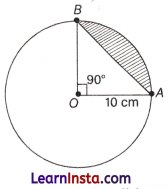
A straight chord of a circle with a radius of 10 cm subtends a right angle (90°) at the centre, Find the area of the corresponding minor segment cut off by this chord, (Use π = 3,14)
(a) 28.5 cm2
(b) 78.5 cm2
(c) 50 cm2
(d) 14.25 cm2
Answer:
(a) 28.5 cm2
Given, radius of circle r = 10 cm
and angle at the centre θ = 90°
Now, area of sector OAB = [/latex]\frac{90^{\circ}}{360^{\circ}}[/latex] × πr2
= [/latex]\frac{1}{4}[/latex] × 3.14 × 10 × 10
= 78.5 cm2
and area of right ∆OAB = [/latex]\frac{1}{2}[/latex] × 10 × 10 = 50 cm2
Now, area of minor segment = Area of sector – Area
of triangle = 78.5 – 50 = 28.5 cm2
Hence, the area of the minor segment is 28.5 cm2.
Question 13.
The minute hand of a clock is 14 cm long. Calculate the exact area swept by the minute hand in exactly 15 minutes. (Use π \(\frac{22}{7}\)
(a) 154 cm2
(b) 308 cm2
(C) 77 cm2
(d) 616 cm2
Answer:
(a) 154 cm2
Given, length of minute hand r = 14 m
In 60 min, minute hand covers = 360°.
So, in 15 min, angle covered = \(\frac{360^{\circ}}{60^{\circ}}\) × 15° = 90°
Now, area swept by minute hand in 15 min
= \(\frac{\theta}{360^{\circ}}\) × πr2
= \(\frac{\theta}{360^{\circ}}\) × [/latex]\frac{22}{7}[/latex] × 14 × 14
= [/latex]\frac{1}{4}[/latex] × 616
= 154 cm2
Question 14.
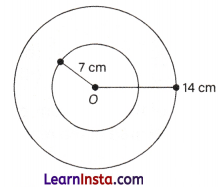
Two concentric circles have radii of 14 cm and 7 cm respectively. What is the area of the ring (shaded) enclosed between them?
(a) 462 cm2
(b) 616 cm2
(c) 154 cm2
(d) 308 cm2
Answer:
(a) 462 cm2
Given, radius of outer circle, R = 14 cm
and radius of inner circle, r = 7 cm
Now, area of ring = πR2 – πr2 = π[R2 – r2)
= [/latex]\frac{1}{4}[/latex] (142 – 72)
= [/latex]\frac{22}{7}[/latex] (196 – 49)
= [/latex]\frac22}{7}[/latex] × 147
= 462 cm2
Hence, the area of the ring is 462 cm2.
Assertion-Reason Questions
Direction (Question Nos. 1-6) Select the correct option from (a), (b), (c), (d) as given below.
(a) Both A and R are true and R is the correct explanation of A.
(b) Both A and R are true but R is not the correct explanation of A.
(c) A is true but R is false.
(d) A is false but R is true.
Question 1.
Assertion (A) If the perimeter of a square is numerically equal to the area of the square, then the, diagonal of that square is exactly 4√2 units.
Reason (R) The area of a square with side length a is a2 and its perimeter is 4a.
Answer:
(a) Let the side of the square be a units.
We know that, area of square = a2 and perimeter = 4a.
Given, perimeter of square is numerically equal to its area.
4a = a2
⇒ a2 – 4a = 0
⇒ a(a – 4) = 0
⇒ a = 4
Now, diagonal of square = a√2 = 4√2 units.
So, Assertion is true.
Clearly, reason is true.
Hence, both Assertion (A) and Reason (R) are true and Reason (R) is the correct explanation of Assertion (A).
Question 2.
Assertion (A) For a fixed perimeter P, a regular polygon (like an equilateral triangle) encloses more area than a non-regular polygon of the same number of sides (like a scalene triangle). Reason (R) Heron’s formula demonstrates that maximising the product (s – a)(s – b)(s – c) happens when the terms a, b and c are identical.
Answer:
(a) Both A and R are true and R is the correct explanation of A.
For a triangle, let its sides be a, b and c.
Given, perimeter is fixed.
a + b + c = P
⇒ s = \(\frac{P}{2}\)
where, s is a semi-perimeter.
By Heron’s formula
Area = \(\sqrt{s(s-a)(s-b)(s-c)}\)
Here, s is fixed. So, area will be maximum when
(s – a) (s – b) [s – c) is maximum.
This happens when all three sides are equal,
i.e. a = b = c
∴ triangle is equilateral
So, for a fixed perimeter, a regular polygon encloses more area than a non-regular polygon of the same number of sides.
Thus, Assertion and reason are true.
Hence, both Assertion (A) and Reason (R) are true and Reason (R) is the correct explanation of Assertion (A).
Question 3.
Assertion (A) A trapezium has parallel sides of length 8 cm and 14 cm. If its height is 6 cm, then its area is 66 cm2.
Reason (R) The area of a trapezium is equal to half the difference of its parallel sides and the corresponding height.
Answer:
(c) A is true but R is false.
Since, Area of trapezium = \(\frac{1}{2}\) (a + b) × h where a and b are two sides and h is a height of trapezium. Given, a = 8 cm, b = 14 cm and h = 6 cm
∴ Area of trapezium = \(\frac{1}{2}\) (8 + 14) × 6 = \(\frac{1}{2}\) × 22 × 6
= 66 cm2
So, Assertion is true.
Clearly, Reason is false.
Question 4.
Assertion (A) A wheel of radius 0.25 cm makes exactly 1000 complete revolutions while travelling a distance of 1570 m (use π = 3.14)
Reason (R) The number of revolutions of a rolling wheel is obtained by dividing the total distance travelled by the circumference of the wheel.
Answer:
(c) A is true but R is false.
Given, radius of the rolling wheel r = 0.25 m
and the total distance travelled is 1.57 km
When a wheel completes one full revolution, it covers a distance equal to its circumference.
∴ Circumference of wheel = 2πr
= 2 × 3.14 × 0.25
= 1.57 m
So, distance covered in one revolution is 1.57 m.
Now, number f revolutions
= \(\frac{\text { Total distance travelled }}{\text { Distance covered in one revolution }}\)
= \(\frac{1570}{1.57}\) = 1000
Thus, the wheel makes exactly 1000 complete revolutions.
So, Assertion (A) is true.
Therefore. Reason (R) is false.
Question 5.
Assertion (A) The total cost of putting a single-strand wire fence around a circular field at the rate of ₹24 per metre is ₹ 5280. This implies the radius of the field is exactly 35 m.
Reason (R) The length of the fencing wire required to completely enclose a circular field is strictly equal to the circumference of that field.
Answer:
(a) Both A and R are true and R is the correct explanation of A.
Given, total cost of fencing the circular field is ₹ 5280 Since, rate of fencing is ₹ 24 per metre.
So, length of fencing wire required = \(\frac{\text { Total cost }}{\text { Rate per meter }}\)
= \(\frac{5280}{24}\) = 220 m
Now, the wire is put around a circular field. So, the length of wire required is equal to the circumference of the circular field.
2πr = 220
2 × \(\frac{22}{7}\) × r = 220
\(\left[\text { Using, } \pi=\frac{22}{7}\right]\)
⇒ \(\frac{44}{7}\)r = 220
⇒ r = 220 × \(\frac{7}{44}\)
⇒ r = 35 m
So, the radius of the field is exactly 35 m.
Therefore, Assertion is true.
Reason is also true because the fencing wire required to enclose a circular field is equal to the circumference of the field.
Hence, both Assertion and Reason are true and Reason is the correct explanation of Assertion.
Question 6.
Assertion (A) A copper wire originally in the shape of a circle with a radius of 28 cm is unbent and reformed into a square. The exact side length of the resulting square is 44 cm.
Reason (R) Whenever a fixed length of wire is reshaped from one closed 2D shape into another, its total enclosed interior area remains strictly constant.
Answer:
(c) A is true but R is false.
Given, the copper wire is originally in the shape of a circle.
∴ Radius of circle, r = 28 cm
When the wire is unbent and reshaped into a square, the length of the wire remains the same.
So, perimeter of square = Circumference of circle Now, circumference of circle = 2πr
= 2 × \(\frac{22}{7}\) × 28 = 176 m
Thus, perimeter of the square is 176 cm.
Let side of the square be a cm.
4a = 176
⇒ a = \(\frac{176}{4}\)
⇒ a = 44 cm
So, the side length of the resulting square is 44 cm.
Therefore, Assertion is true.
The length of boundary remains the same, but the area enclosed may change.
So, Reason is false.
Hence, Assertion is true but Reason is false.
Very Short Answer Questions
Question 1.
What is the area of a square with a 10cm diagonal?
Answer:
Given, diagonal of square = 10 cm
Let side of square be a cm.
∵ Diagonal of a sqaure = a√2
∴ a√2 = 10
⇒ \(a=\frac{10}{\sqrt{2}}=5 \sqrt{2} \mathrm{~cm}\)
Now, area of square
= a2 = (5√2)2 = 50 cm2
Hence, the area of the square is 50 cm2.
Question 2.
In a triangle, the differences between the semi-perimeter and its three individual side lengths are 6 cm, 8 cm and 10 cm respectively. Find the actual side lengths of the triangle.
Answer:
Let the semi-perimeter be s and sides of triangle be a, b and c.
Given, s – a = 6, s – b = 8 and s – c = 10.
On adding, (s – a) + (s – b) + (s – c) = 6 + 8 +10
⇒ 3s – (a + b + c) = 24
But, a + b + c = 2s
∴ 3s – 2s = 24
⇒ s = 24 cm
Now, s – a = 6 ⇒ a = 24 – 6 = 18 cm
s – b = 8 ⇒ b = 24 – 8 = 16 cm
s – c = 10 ⇒ c = 24 – 10 = 14 cm.
Question 3.
The adjacent sides of a parallelogram are 8 cm and 6 cm, If the perpendicular distance between the pair of longer sides is 3 cm, find the area of the parallelogram.
Answer:
Given, the adjacent sides of a parallelogram are 8 cm and 6 cm.
Since, the longer side is 8 cm, so it is taken as the base.
∴ Area of parallelogram = Base × height
= 8 × 3
= 24 cm 2
Question 4.
In Brahmagupta’s formula, what value must one of the side lengths take so that the formula transforms into Heron’s formula for the area of a triangle?
Answer:
We know that, Brahmagupta’s formula for the area of cyclic quadrilateral is
\(\sqrt{(s-a)(s-b)(s-c)(s-d)}\), where
s = \(\frac{a+b+c+d}{2}\)
It becomes Heron’s formula when the quadrilateral becomes a triangle.
This happens when one side becomes zero.
Let d = 0
Then, s = \(\frac{a+b+c}{2}\)
Now, area = \(\sqrt{s(s-a)(s-b)(s-c)}\)
This is Heron’s formula.
Hence, the required condition is d = 0 i.e. one side of the cyclic quadrilateral becomes zero.
Question 5.
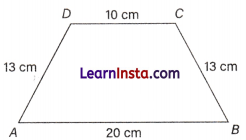
An isosceles trapezium has parallel sides measuring 20 cm and 10 cm. The other two sides are each 13 cm. Find its perpendicular height and area.
Answer:
15. From the diagram,
AB = 20 cm, DC = 10 cm
and AD = BC = 13 cm
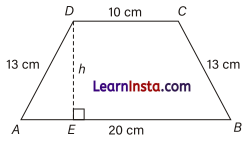
Draw DE ⊥ AB.
Since, AD = BC, the trapezium is isosceles.
Now, difference of parallel sides,
AB – DC = 20 – 10 = 10 cm
So, AE = \(\frac{10}{2}\) = 5cm
In right ∆AED,
AD2 + AE2 + DE2
⇒ 132 = 52 + h2
⇒ 169 = 25 + h2
⇒ h2 = 144
⇒ h = 12cm
Now, area of trapezium
= \(\frac{1}{2}\) × Sum of parallel sides × Height
= \(\frac{1}{2}\) × (20 + 10) × 12
= 180 cm2
Hence, the perpendicular height is 12 cm and the area of the trapezium is 180 cm2.
Question 6.
A rhombic mirror has a perimeter of 80 cm. If one of its diagonals is 24 cm long, find the area of the mirror by dividing it into two congurent triangles.
Answer:
Given, perimeter of rhombus = 80 cm
Side = \(\frac{80}{4}\) = 20 cm
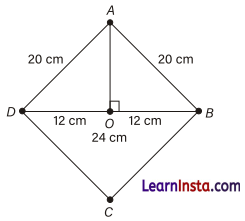
From the diagram,
BD = 24 cm
Diagonal BD divides the rhombus into two equal triangles.
In ∆ABD,
AB = AD = 20 cm and BD = 24 cm
Since, ∆ABD is isosceles, the perpendicular from A divides BD into two equal parts.
BO = \(\frac{24}{2}\) = 12 cm
Using Pythagoras theorem in right ∆AOB,
AB2 = AO2 + BO2
⇒ 202 = AO2 + BO2
⇒ AO2 = 400 – 144 = 256
⇒ AO = 16 cm
∴ Area of one triangle
\(\frac{1}{2}\) × 24 × 16 = 192 cm2
Area of rhombus = 2 × 192 = 384 cm2
Hence, the area of the rhombic mirror is 384 cm2.
Question 7.
Calculate the difference between the total boundary perimeter of a closed semicircle and the arc length of an open semicircle, given both have a radius of 14 cm.
Answer:
Given, radius of both semicircles r = 14 cm.
For a closed semicircle, total boundary includes the curved part and the diameter.
∴ Perimeter of closed semicircle = πr + 2r
= \(\frac{22}{7}\) × 14 + 2 × 14
= 44 + 28 = 72 cm
For an open semicircle, only the curved arc is considered.
∴ Arc length of open semicircle = πr
\(\frac{22}{7}\) × 14 = 44 cm
Now, required difference = 72 – 44 = 28 cm
Hence, the difference is 28 cm.
Question 8.
A piece of wire shaped as a square encloses an area of 121 cm2 If this identical wire is rebent into a perfect circle, calculate the exact radius of the newly formed circle.
Answer:
Given, area enclosed by the square wire is 121 cm2.
Let the side of the square be a cm.
∴ a2 = 121
⇒ a = √121
⇒ a = 11 cm
So, perimeter of the square wire = 4a
= 4 × 11 = 44 cm
When the same wire is rebent into a circle, the length of the wire remains the same.
Let r be the radius of a circle
So, circumference of circle = 44 cm
⇒ 2πr = 44
⇒ 2 × \(\frac{22}{7}\) × r = 44
\(\left[\text { Using } \pi=\frac{22}{7}\right]\)
⇒ \(\frac{44}{7}\)r = 44
⇒ r = 7 cm
Hence, the exact radius of the newly formed circle is 7 cm.
Question 9.
If the ratio of the surface areas of two distinct circles is 16 : 25, what is the exact algebraic ratio of their circumferences?
Answer:
Given, ratio of areas of two circles is 16 : 25.
Let the radii of the two circles be r1 and r2.
We know that area of a circle is πr2.
∴ According to question
\(\frac{\pi r_1^2}{\pi r_2^2}=\frac{16}{25}\)
⇒ \(\frac{r_1^2}{r_2^2}=\frac{16}{25}\)
⇒ \(\frac{r_1}{r_2}=\frac{4}{5}\)
Also we known that circumference of a circle is 2πr.
So, the ration of cricumferences,
\(\frac{C_1}{C_2}=\frac{2 \pi r_1}{2 \pi r_2}=\frac{r_1}{r_2}=\frac{4}{5}\)
Question 10.
The sum of the circumferences of four small identical circles is exactly equal to the circumference of one large circle of radius 28 cm. Find the radius of the small circle.
Answer:
Given, radius of the large circle is 28 cm.
Let the radius of each small circle be r cm.
Now, circumference of large circle = 2π × 28
and circumference of one small circle = 2πr
Since, the sum of circumferences of four small circles is equal to the circumference of the large circle.
4 2πr = 2π × 28
⇒ 8πr = 56π
⇒ r = \(\frac{56 \pi}{8 \pi}\)
⇒ r = 7 cm
Hence, the radius of each small circle is 7 cm.
Question 11.
The minute hand of a clock is 10.5 cm long. Calculate the exact area swept by the minute hand.on the clock face in exactly 10 minutes.
Answer:
Given, length of minute hand r = 10.5 cm
In 60 min, the minute hand covers = 360°
So, in 10 min, angle covered = \(\frac{360^{\circ}}{60}\) × 10 = 60°
Therefore, the minute hand sweeps a sector of angle 60°.
Now, area swept by the minute hand = \(\frac{\theta}{360^{\circ}}\) × πr2
= \(\frac{60}{360}\) × \(\frac{22}{7}\) × 10.5 × 10.5
= \(\frac{1}{6}\) × 346.5 = 57.75 cm2
Hence, the exact area swept by the minute hand is 57.75 cm2.
Question 12.
A full circle is perfectly inscribed inside a square of side 14 cm. Find the simplified algebraic ratio of the area of the circle to the area of the square.
Answer:
Given, side of square = 14 cm
A circle is perfectly inscribed inside the square.
So, diameter of the circle is equal to the side of the square
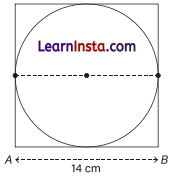
∴ Diameter = 14 cm
Let r be the radius of circle.
⇒ r = \(\frac{14}{2}\) = 7 cm
Now area of circle = πr2 = π × 72 = 49π cm2
and area of square = 142 = 196 cm2
∴ Required ratio = Area of circle : Area of square
= 49π : 196 = π : 4
Hence, the simplified ratio of the area of the circle to the area of the square is π : 4.
Short Answer Questions
Question 1.
A rectangle has a length of 16 cm and a width of 9 cm. Find the side length of a square enclosing the exact same area, and find the difference in their perimeters.
Answer:
Given, length of rectangle = 16 cm and width = 9 cm.
∴ Area of rectangle = 16 × 9 = 144 cm2
Since, square has the same area.
∴ Side of square = √144 = 12 cm.
Now, perimeter of rectangle = 2(16 + 9)
= 2 × 25 = 50 cm
and perimeter of square = 4 × 12 = 48 cm
Now, difference in perimeters = 50 – 48 = 2 cm
Hence, the side of the square is 12 cm and the difference in their perimeters is 2 cm.
Question 2.
An architectural glass panel is designed in the shape of an equilateral triangle. If the perpendicular height (altitude) of this glass panel is measured to be exactly 6√3 cm, calculate its total boundary perimeter and find its interior area.
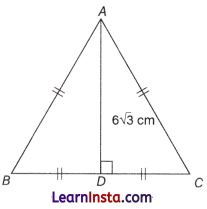
Answer:
From the diagram, AABC is an equilateral triangle and AD = 6√3 cm.
In an equilateral triangle, altitude bisects the base.
Let each side of the triangle be a cm.
∴ BD = \(\frac{a}{2}\)
In right, ∆ADB,
AB2 = AD2 + BD2
⇒ a2 = (6√3)2 + \(\left(\frac{a}{2}\right)^2\)
⇒ a2 = 108 + \(\frac{a^2}{4}\)
⇒ a2 = 144
⇒ a = 12 cm
Now, total boundary perimeter = 3a = 3 × 12 = 36 cm
Interior area = \(\frac{1}{2}\) × BC × AD
= \(\frac{1}{2}\) × 12 × 6√3 = 36√3 cm2
Hence, the perimeter is 36 cm and the area is 36√3 cm2.
Question 3.
The three side lengths of a triangular garden plot are in the continuous ratio 13 :14 :15, and its total boundary perimeter is measured to be 42 m. Using Heron’s formula, calculate the exact land area enclosed by the garden plot.
Answer:
Given, sides are in the ratio 13 : 14 : 15.
Let the sides be 13x, 14x, 15x.
Now, the perimeter = 42 m
13x + 14x + 15x = 42
⇒ 42x = 42
⇒ x = 1
So, the sides are 13 m, 14 m and 15 m.
Semi-perimeter,
s = \(\frac{42}{2}\) = 21 m
By Heron’s formula.
Area = \(\sqrt{s(s-a)(s-b)(s-c)}\)
= \(\sqrt{21(21-13)(21-14)(21-15)}\)
= \(\sqrt{21 \times 8 \times 7 \times 6}=\sqrt{7056}\)
= 84
Hence, the area of the garden plot is 84 m2.
Question 4.
A cyclic quadrilateral ABCD has side segments AB = 3 cm, BC = 4 cm, CD = 5 cm, and DA = 6 cm. Find the semi-perimeter and determine whether its area is larger or smaller than a square possessing the same boundary perimeter length.
Answer:
Given, sides of cyclic quadrilateral are
AB = 3 cm, BC = 4 cm, CD = 5 cm and DA = 6 cm
∴ Perimeter = 3 + 4 + 5 + 6 = 18cm
Semi-perimeter,
s = \(\frac{42}{2}\) = 9 cm
By Brahmagupta’s formula
Area = \(\sqrt{(s-a)(s-b)(s-c)(s-d)}\)
= \(\sqrt{(9-3)(9-4)(9-5)(9-6)}\)
= \(\sqrt{6 \times 5 \times 4 \times 3}\)
= \(\sqrt{360}\) = 6√10 cm2
Now, square has the same perimeter 18 cm. 18
Side of square = \(\frac{18}{4}\) = 4.5 cm
Area of square = 4.5 x 4.5 = 20.25 cm2
Also, 6√10 = 18.97 cm2
So, 18.97 < 20.25
Hence, the area of the cyclic quadrilateral is smaller than the area of the square having the same perimeter.
Question 5.
A rhombus has a perimeter of 52 cm and one diagonal measuring 10 cm. Calculate the length of the second diagonal and its total area.
Answer:
Given, the perimeter of a rhombus = 52 cm
and one diagram = 10 cm
Let the length of side be a
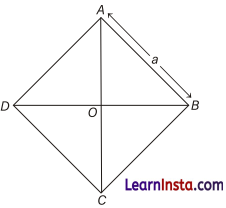
In a rhombus, diagonals bisects each other at right angle.
∴ BA = 10 cm
⇒ OB = \(\frac{18}{4}\) = 5 cm
Now, 4a = 52
⇒ a = \(\frac{52}{4}\) = 15 cm
In ∆AOB, AB2 = AO2 + OB2
⇒ (13)2 = AO2 + 52
⇒ 169 – 25 = AO2
⇒ AO = √144 = 12 cm
So, the length of second diagonal
= 2 × AO = 2 × 12 = 24 cm
Now, area of rhombus = \(\frac{1}{2}\) × AC × BD
= \(\frac{1}{2}\) × 10 × 24 = 120 cm2
Hence, the second diagonal is 24 cm and the area is 120 cm2.
Question 6.
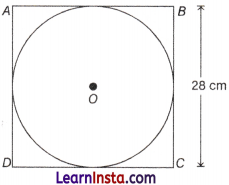
A circle is perfectly inscribed inside a square of side length 28 cm. Calculate the exact combined area of the four remaining corner regions bounded between the square and the circle.
Answer:
From the diagram, a circle is perfectly inscribed inside a square.
Given, side of square = 28 cm
Since, the circle is inscribed in the square, the diameter of the circle is equal to the side of the square.
Let r be the radius of a circle.
∴ Diameter of circle = 28 cm
So, radius of circle r = \(\frac{28}{2}\) = 14 cm
Now, area of square = 28 × 28 = 784 cm2
and area of circle = πr2
= \(\frac{22}{7}\) × 14 × 14
= 616 cm2
The four corner regions are the parts of the square left outside the circle.
So, area of four remaining corner regions
= Area of square – Area of circle
= 784 – 616 = 168 cm2
Hence, the combined area of the four remaining corner regions is 168 cm2 .
Question 7.
A circular pond is exactly 17,5 m in diameter. It is surrounded by a uniformly thick 2 m wide stone path. Find the exact total cost of paving this stone path at the rate of ₹25 per square meter.
(Use π = 22/7) Competency, NCERTPg. 143
Answer:
Given, diameter of the circular pond = 17.5 m.
So, radius of the pond (r) = \(\frac{17.5}{2}\) = 8.75 m
The stone path is 2 m wide all around the pond.
So, outer radius R = 8.75 + 2 = 10.75 m
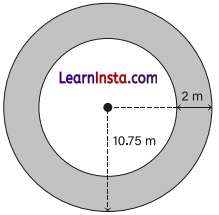
Area of stone path πR2 – πr2 = π(R2 – r2)
= \(\frac{22}{7}\) (10.752 – 8.752)
= \(\frac{22}{7}\) × (10.75 – 8.75)(10.75 + 8.7)
= [∴ (a + b)(a – b) = a2 – b2] ]
= \(\frac{22}{7}\) × 2 × 19.5 = 39
= \(\frac{858}{7}\) m2
∵ Cost of paving 1 m2 = ₹ 25
Therefore, total cost = × 25 = \(\frac{858}{7} \times 25=\frac{21450}{7}\)
= ₹ 3064.29 (approximately)
Hence, the exact total cost of paving the stone path is
\(\frac{21450}{7}\), i.e ₹ 3064.29 approximately.
Question 8.
The length of an arc of a circle is strictly equal to 22 cm and the radius of the circle is 21 cm, Without calculating the central angle, directly compute the exact interior surface area of the sector formed by this specific arc.
Answer:
Given, length of arc (l) = 22 cm
and radius of circle (r) = 21 cm.
For a sector,
∴ Area of sector = \(\frac{1}{2}\) × Arc length × Radius
= \(\frac{1}{2}\) × 22 × 21
= 11 × 21 = 231 cm2
Hence, the exact interior surface area of the sector is 231 cm2.
Question 9.
The interior surface area of a circular sector is 231 cm2 and its central angle is 60° Find the exact radius of the circle and the length of the corresponding arc. (Use π = 22/7)
Answer:
Given, area of the sector = 231 cm2,
central angle θ = 60° and, π = \(\frac{22}{7}\)
Let the radius of the circle be r cm.
∴ Area of sector = \(\frac{\theta}{360^{\circ}}\) × πr2
231 = \(\frac{60}{360}\) × \(\frac{22}{7}\) × r2
⇒ 231 = \(\frac{1}{6}\) × \(\frac{2}{7}\) × r2
⇒ r2 = 231 × \(\frac{21}{11}\)
⇒ r2 = 441
⇒ r = 21 CM
Now, length of the corresponding arc = \(\frac{\theta}{360^{\circ}}\) × 2πr
= \(\frac{60°}{360}\) × 2 × \(\frac{22}{7}\) × 21 = \(\frac{1}{6}\) × 132 = 22 cm
Hence, the radius of the circle is 21 cm and the length of the corresponding arc is 22 cm.
Question 10.
A circular racing track has an inner circumference of 352 m and an outer circumference of 396 m. Calculate the exact uniform width of the track and its total path area.
Answer:
Given, inner circumference of the circular racing track is 352 cm and outer circumference is 396 m.
Let the inner radius be r m and outer radius be R m.
We know, that circumference of the circle = 2πr
For inner circle, 2 × \(\frac{22}{7}\) × r = 352
\(\left[\text { using } \pi=\frac{22}{7}\right]\)
⇒ \(\frac{44}{7}\)r = 356
⇒ r = 352 × \(\frac{7}{44}\)
⇒ r = 56 m
For outer circle,
2 × \(\frac{22}{7}\) × R = 396
⇒ \(\frac{44}{7}\)R 396
⇒ R = 396 × \(\frac{7}{44}\)
⇒ R = 63 m
Now, uniform width of the track = R — r
= 63 – 56 = 7m
So, the uniform width of the track is 7 m.
Now, area of the track is the area between the outer circle and the inner circle.
∴ Area of track = πR2 – πr2 = π(R2 – r2)
= \(\frac{22}{7}\)(632 – 562)
= \(\frac{22}{7}\)(3969 – 3136)
= \(\frac{22}{7}\) × 833
= 2618 m2
Hence, the uniform width of the track is 7 m and the total path area is 2618 m2.
Long Answer Questions
Question 1.
A rectangular plot has an area of 144 m2 .The length of the plot is four times its width.
(i) Find the actual dimensions (length and width) of this rectangular plot.
Answer:
(i) Given, area of rectangular plot = 144 m2
Let width (b) = x m.
Then, length (k) = 4x m.
Area = l × b
⇒ 4x × x = 144
⇒ 4x2 = 144
⇒ x2 = 36
⇒ x = 6
So, width = 6 m and length = 24 m
∴ Perimeter of rectangle = 2(24 + 6) = 60 m
(ii) If this entire plot is reshaped into a perfect square enclosing the same total ground area, find the side length of the square and determine if the fencing boundary length increases or decreases.
Answer:
Now, the plot is reshaped into a square of same area.
Side of square = √l44 = 12m
Perimeter of square = 4 × 12 = 48 m
Since, 48 < 60 the fencing boundary length decreases.
Hence, the dimensions of the rectangle are 24 m and 6 m, the side of the square is 12 m and the boundary length decreases by 12 m.
Question 2.
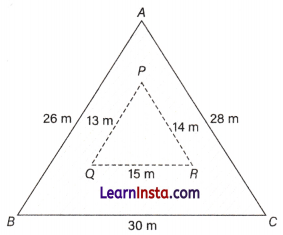
A large triangular advertising billboard has side lengths measuring 26 m, 28 m, and 30 m. A special paint is used to decorate the interior surface, but a small triangular section at the top with side lengths of 13 m, 14 m and 15 m is left out for a neon logo.
(i) Compute the total surface area of the original billboard using Heron’s formula.
Answer:
Given, the billboard is in the shape of a large triangle with side lengths 26 m, 28 m and 30 m.
Semi-perimeter of the large triangle.
s = \(\frac{26+28+30}{2}\)
⇒ s = \(\frac{84}{2}\)
By Heron’s formula
Area = \(\sqrt{s(s-a)(s-b)(s-c)}\)
= \(\sqrt{42(42-26)(42-28)(42-30)}\)
= \(\sqrt{42 \times 16 \times 14 \times 12}\)
= \(\sqrt{112896}\)
= 336 m2
So, the total area of the original billboard is 336 m2.
(ii) Calculate the remaining area that needs to be painted.
Answer:
Now, the small triangular logo has side lengths 13 m, 14 m and 15 m.
Semi-perimeter of the small triangle
s = \(\frac{13+14+15}{2}\)
⇒ s = \(\frac{42}{2}\) = 21 m
Again, by Heron’s formula
Area of logo = \(\sqrt{21(21-13)(21-14)(21-15)}\)
= \(\sqrt{21 \times 8 \times 7 \times 6}=\sqrt{7056}\) = 84 m2
Since, the logo part is left unpainted, the remaining area to be painted is 336 – 84 = 252 m2.
(iii) If the cost of the decorative paint is ₹ 120 per square meter, determine the total cost of painting the billboard.
Answer:
Since, cost of painting 1 m2 = ₹ 120
Therefore, total cost of painting = 252 x 120= ₹ 30240
Hence, the total area of the billboard is 336 m2, the remaining area to be painted is 252 m2 and the total cost of painting is ₹ 30240.
Question 3.
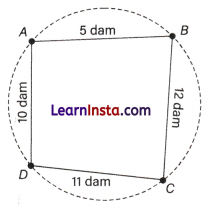
An urban green belt is planned as a cyclic quadrilateral layout with successive boundary lengths equal to 5 decameters, 12 decameters, 11 decameters and 10 decameters.
(i) Find the semi-perimeter of the planned green belt layout.
Answer:
Given, sides of the cyclic quadrilateral are 5 dam, 12 dam, 11 dam and 10 dam.
∴ Semi-perimeter,
s = \(\frac{5+12+11+10}{2}\)
⇒ s = \(\frac{38}{2}\) = 19 dam
(ii) Calculate the total area enclosed by the green belt using Brahmagupta’s formula.
Answer:
(ii) By Brahmagupta’s formula
Area = \(\sqrt{(s-a)(s-b)(s-c)(s-d)}\)
= \(\sqrt{(19-5)(19-12)(19-11)(19-10)}\)
= \(\sqrt{14 \times 7 \times 8 \times 9}=\sqrt{7056}\)
= 84 dam2
So, the area of the cyclic quadrilateral layout is 84 dam2.
(iii) Compare this area to a rectangle having dimensions 12 decameters x 10 decameters and determine which layout encloses more ground area and by how much.
Answer:
Now, area of the rectangular layout having dimensions 12 dam and 10 dam.
Now, area = 12 × 10 = 120 dam2
Difference between the areas = 120 – 84 = 36 dam2
Hence, the semi-perimeter of the green belt is 19 dam and its area is 84 dam2.
The rectangular layout encloses more area by 36 dam2.
Question 4.
An agricultural field is structured in the shape of a parallelogram ABCD with adjacent side dimensions AS = 30 m and BC-14 m. The diagonal connecting vertices A and C measures exactly 40 m, Competency, NCERTPg. 137-138
(i) Calculate the area of the triangular section AABC using Heron’s formula.
Answer:
Given, AB = 30 m, BC = 14 m, AC = 40 m
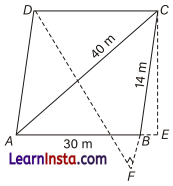
For ∆ABC,
s = \(\frac{30+14+40}{2}\) = 42 m
By Heron’s formula
Area of ∆ABC = \(\sqrt{s(s-a)(s-b)(s-c)}\)
= \(\sqrt{42(42-30)(42-14)(42-40)}\)
= \(\sqrt{42 \times 12 \times 28 \times 2}\)
= \(\sqrt{28224}\) = 168 m2
So, area of ∆ABC = 168 m2.
(ii) Find the total surface area of the entire parallelogram field.
Answer:
Now, diagonal AC divides the parallelogram into two equal triangles.
Area of parallelogram = 2 × 168 = 336 m2
(iii) Determine the length of both perpendicular altitudes: one dropped onto the base AB and the other dropped onto the base BC.
Answer:
Height CE on base AB
Area = AB × CE
⇒ 336 = 30 × CE
⇒ CE = \(\frac{336}{30}\) = 11.2 m
Height (DF) on base BC
336 = 14 × h
⇒ h = \(\frac{336}{14}\) = 24 m
Hence, area of ∆ABC is 168 m2, area of parallelogram is 336 m2, height on AB is 11.2 m, and height on BC is 24 m.
Question 5.
A flexible copper wire is bent to form a complete sector of a circle with a radius of 21 cm, If the total boundary perimeter of this sector is measured to be exactly 64 cm, calculate the central angle subtended by the arc and find the exact enclosed interior area of the sector.
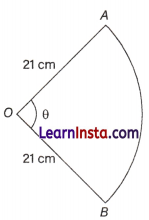
Answer:
Given, radius of the sector (r) = 21 cm.
and total perimeter of sector = 64 cm
Now, perimeter of sector = 2r + Arc length
⇒ 64 = 2(21) + Arc length
⇒ 64 = 42 + Arc length
⇒ Arc length = 22 cm
Now, arc length of a sector = \(\frac{\theta}{360^{\circ}}\) × 2πr
22 = \(\frac{\theta}{360^{\circ}}\) × 2 × \(\frac{22}{7}\) × 21 \(\left[\text { Using } \pi=\frac{22}{7}\right]\)
⇒ 22 = \(\frac{\theta}{360^{\circ}}\) × 132
⇒ θ = \(\frac{22 \times 360^{\circ}}{132}\)
⇒ θ = 60°
Now, area of sector = \(\frac{\theta}{360^{\circ}}\) × πr2
\(\frac{60}{360}\) × \(\frac{22}{7}\) × 21 × 21 = \(\frac{1}{6}\) × 1386
= 231 cm2
Hence, the central angle is 60° and the exact enclosed area of the sector is 231 cm2.
Question 6.
A locomotive wheel has a massive diameter of 1.4 m. If the train is traveling at a constant speed of 66 km/hr, calculate the exact number of complete revolutions each wheel makes in a span of exactly one minute. (Use π = 22/7)
Answer:
Given, diameter of the locomotive wheel = 1.4 m and speed of train 66 km/hr = 66000 m/hr
⇒ Distance covered in 1 min = \(\frac{66000}{60}\) = 1100 m
Now, distance covered by the wheel in one complete revolution is equal to its circumference.
∴ Circumference of wheel = πd
= \(\frac{22}{7}\) × 14
= \(\frac{22}{7}\) × \(\frac{22}{7}\) = 4.4 m.
So, distance covered in one revolution is 4.4 m.
Now, number of revolutions
\(\frac{Distance covered in 1 min}{Distance covered in 1 revolution}\) = \(\frac{1100}{4.4}\) = 250
Hence, each wheel makes 250 complete revolutions in one minute.
Question 7.
A decorative brooch is manufactured using pure silver wire in the form of a perfect circle with a diameter of 35 mm. The silver wire is also used to create 5 straight interior diameters, which divide the circle evenly into 10 identical circular sectors.
(i) Calculate the total length of the silver wire required to construct the entire brooch.
(ii) Calculate the exact interior surface area of each of the 10 equal sectors. (Use n = 22/7)
Answer:
(i) Given, diameter of the circular brooch = 35 mm. The silver wire is used for the circular boundary and also for 5 straight diameters inside the circle.
∴ First length of circular boundary = πd
= \(\frac{22}{7}\) × 35
= 110 mm
Now, length of 5 straight diameters = 5 × 35 = 175 mm
Therefore, total length of silver wire required = 110 + 175 = 285 mm
Hence, the total length of silver wire required is 285 mm.
(ii) The circle is divided into 10 identical circular sectors.
So, central angle of each sector = \(\frac{60°}{10}\) = 36°
Now radius of the circle = \(\frac{35}{2}\) = 17.5 mm
and area of one sector = \(\frac{\theta}{360^{\circ}}\) × πr2
= \(\frac{30°}{360°}\) × \(\frac{22}{7}\) × 17.5 × 17.5
= \(\frac{1}{10}\) × \(\frac{22}{7}\) × \(\frac{35}{7}\) × \(\frac{35}{7}\)
= \(\frac{1}{10}\) × 962.5
= 96.25 mm2
Hence, the interior surface area of each sector is 96.25 mm2 .
Question 8.
A car has two identical windshield wipers which operate simultaneously without overlapping. Each wiper has a blade length of 21 cm and sweeps through a central sector angle of 120°, Calculate the exact total surface area of the glass cleaned by both blades combined at each complete sweep. (Use π = 22/7)
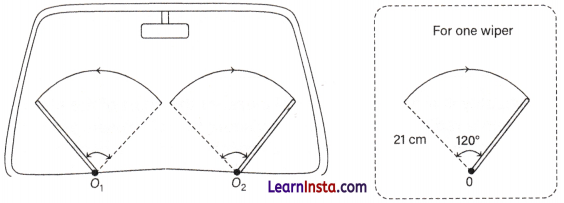
Answer:
Given, each windshield wiper has blade length r = 21 cm
and each wiper sweeps through an angle of 120°. For one wiper.
Area of sector = \(\frac{\theta}{360^{\circ}}\) × πr2 = \(\frac{120}{360} \times \frac{22}{7}\) × 21 × 21
= \(\frac{1}{3} \times \frac{22}{7} \times 441=\frac{1}{3}\) × 1386
= 462 cm2
So, area cleaned by one wiper is 462 cm2.
Since, there are two identical wipers and they do not overlap, the total area cleaned = 2 × 462 = 924 cm2. Hence, the exact total surface area of the glass cleaned by both blades combined is 924 cm2.
Case-Based Questions
Question 1.
A farmer owns a large piece of land. A portion of the land is shaped like a right-angled triangle, where the hypotenuse is 41 m and the base is 9 m. Adjacent to this, there is another quadrilateral farming patch PQRS where the diagonal PR = 28 m. The perpendicular offsets dropped from vertices Q and S onto the diagonal PR are 12 m and 8m, respectively.
Based on the dimensions of the farming plots, answer the following questions:
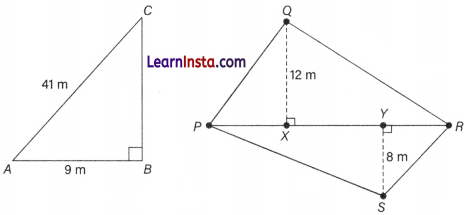
(i) Calculate the perpendicular height of the right-angled triangular plot using the Pythagoras theorem.
Answer:
Given, In right angled ∆ABC,
AC = 41 m and AB = 9 m
By Pythagoras theorem,
AC2 = AB2 + BC2
⇒ 412 = 92 + BC2
⇒ BC2 = 1681 – 81 = 1600
⇒ BC = 40 m
Hence, the perpendicular height is 40 m
(ii) Find the cultivation area of the right-angled triangular plot.
Answer:
Area of the right-angled ∆ABC
= \(\frac{1}{2}\) × base × height
⇒ Area = \(\frac{1}{2}\) × 9 × 40
⇒ Area = 180 m2
Hence, the cultivation area of the right-angled triangular plot is 180 m2.
(iii) (a) Calculate the separate areas of the two triangles formed inside the quadrilateral patch PQRS.
Answer:
In quadrilateral PQRS, diagonal PR = 28 m.
For ∆PQR, height from Q to PR is 12 m.
Area of ∆PQR = \(\frac{1}{2}\) × 28 × 12
= 168 m2
For ∆PRS, height from S to PR is 8 m.
Area of ∆PRS = \(\frac{1}{2}\) × 28 × 8
= 112 m2
Hence, the areas of the two triangles are 168 m2 and 112 m2.
Or
(b) Find the total area of the quadrilateral farming patch PQRS.
Answer:
Total area of quadrilateral PQRS
= Area of ∆PQR + Area of ∆PRS
= 168 + 112
= 280 m2
Hence, the total area of quadrilateral farming patch PQRS is 280 m2.
Question 2.
An architect is designing an eco-friendly building, The front elevation features a massive glass window shaped as an equilateral triangle. The structural blueprint states that the perpendicular altitude (height) of this triangular window is exactly 9√3 meters. Beside the window, a solar panel array is mounted on the wall in the shape of a parallelogram. The adjacent side lengths of this parallelogram array are 14 m and 10 m and the diagonal connecting the opposite corners measures 16 m.
Based on the architectural blueprint, answer the following questions.
(i) Calculate the exact side length of the equilateral triangular glass window.
Answer:
Given, the altitude of the equilateral triangular glass window 9√3 m.
Let the side length of the equilateral triangle be a m.
In an equilateral triangle,
Altitude = \(\frac{\sqrt{3}}{2}\) × side
⇒ 9√3 = \(\frac{\sqrt{3}}{2}\) × a
⇒ a = 18 m
Hence, the side length of the equilateral triangular glass window is 18 m.
(ii) Find the total area of the glass window.
Answer:
Now, base of the triangular glass window = 18 m and height = 9√3 m.
∴ Area of triangle = \(\frac{1}{2}\) × Base × Height
= \(\frac{1}{2}\) × 18 × 9√3
= 81√3 m2
Hence, the total surface area of the glass window is 18√3 m2.
(iii) (a) By splitting the parallelogram solar array into two congruent triangles, use Heron’s formula to calculate the total surface area of the array.
Answer:
The solar panel is in the shape of a parallelogram.
Its adjacent sides are 14 m and 10 m, and one diagonal is 16 m.
∴ This diagonal divides the parallelogram into two congruent triangles.
So, each triangle has sides 14 m, 10 m and 16 m.
For one triangle.
s = \( = 20 m
By Heron’s formula
Area of one triangle = [latex]\sqrt{s(s-a)(s-b)(s-c)}\)
= \(\sqrt{20(20-14)(20-10)(20-16)}\)
= \(\sqrt{20 \times 6 \times 10 \times 4}\)
= \(\sqrt{4800}=40 \sqrt{3} \mathrm{~m}^2\)
Since, the parallelogram has two such congruent triangles.
∴ Area of parallelogram = 2 × 40√3
= 80√3 m2
Hence, the total surface area of the solar panel array is 80√3 m2.
OR
(b) Determine the shortest perpendicular altitude dropped onto the longer base (14 m) of the solar panel array.
Answer:
Shortest perpendicular altitude on the longer base
The longer base of the parallelogram is 14 m.
Let height of the parallelogram be h
∴ Area of parallelogram = Base × Height
⇒ 80√3 = 14 × h
⇒ h = \(\frac{80 \sqrt{3}}{14}\)
⇒ h = [/latex]\frac{40 \sqrt{3}}{7}[/latex] m
Hence, the shortest perpendicular altitude on the longer
base is \(\frac{40 \sqrt{3}}{7}\) m.
Question 3.
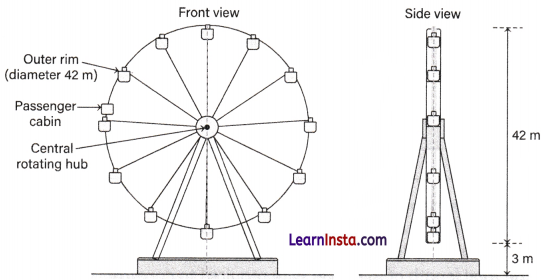
A city carnival features a massive observation wheel. The wheel has a central rotating hub and a sturdy outer rim with a diameter of 42 m. The passenger cabins are attached to this outer rim. For safety reasons, the entire wheel structure is mounted on a supportive base so that its lowest point clears the ground by exactly 3 m. The wheel rotates at a constant speed to give passengers a scenic view of the city. (Use π = 22/7)
Answer:
Given, diameter of the observation wheel = 42 m.
So, radius of the wheel r = \(\frac{42}{2}\) = 21 m.
Also, the lowest point of the wheel is 3 m above the ground.
(i) Calculate the total circumference of the observation wheel’s outer rim.
Answer:
Since, the outer rim of the wheel is circular.
∴ Circumference of circular wheel = 2πr
= 2 × \(\frac{22}{7}\) × 21 = 132m
Hence, the circumference of the observation wheel’s outer rim is 132 m.
(ii) Determine the maximum height above the ground a passenger cabin will reach during the ride.
Answer:
Since, the lowest point of the wheel is 3 m above the ground.
So, maximum height reached by a cabin
= clearance from ground + Diameter of wheel
= 3 + 42 = 45 m
Hence, the maximum height above the ground is 45 m.
(iii) (a) If the wheel makes exactly 12 complete revolutions during one full ride cycle, calculate the total linear distance travelled by a single passenger cabin.
Answer:
Given, total distance travelled by a passenger cabin in 12 revolutions
In one complete revolution, a passenger cabin travels a distance equal to the circumference of the wheel.
Since, distance travelled in one revolution = 132 m So, distance travelled in 12 revolutions = 12 × 132 = 1584 m
Hence, the total linear distance travelled by a passenger cabin is 1584 m.
Or
(b) Find the exact total area of the vertical circular region enclosed by the wheel’s outer rim.
Answer:
Since, the vertical circular region enclosed by the outer rim is a circle of radius 21 m.
∴ Area = πr2
= \(\frac{22}{7}\) × 21 × 21
= 1386 m2
Hence, the total area enclosed by the wheel’s outer rim is 1386 cm2 .
Question 4.
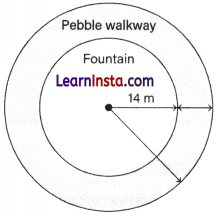
The local municipality is renovating a central plaza. At the heart of the plaza is a large circular water fountain with a radius of 14 m. To allow visitors to walk closely around it without getting wet, the city planners are constructing a decorative anti-slip pebble walkway completely surrounding the fountain, This pebble walkway has a uniform width of 3.5 m.
(i) Determine the inner and outer radii of the decorative pebble walkway.
Answer:
Given, radius of circular water fountain is 14 m width of pebble walkway = 3.5 m.
The Inner radius of the walkway is equal to the radius of the fountain.
∴ Inner radius = 14 m
Outer radius of walkway = 14 + 3.5 = 17.5 m
Hence, the inner radius is 14 m and the outer radius is 17.5 m.
(ii) Calculate the total surface area of the circular water fountain.
Answer:
Now, area of fountain = πr2
= \(\frac{22}{7}\) × 14 × 14
= 616 m2
Hence, the total surface area of the circular water fountain is 616 m2.
(iii) (a) Calculate the exact total surface area of the decorative pebble walkway (the circular ring).
Answer:
(a) The pebble walkway forms a circular ring.
So, area of walkway = πR2 – πr2 = π(R2– r2)
where, R = 17.5 m and r = 14 m
∴ Area = \(\frac{22}{7}\)[(17.5)2 – (14)2]
= \(\frac{22}{7}\)(306.25 – 196)
= \(\frac{22}{7}\) × 110.25
= 346.5 m2
Hence, the total surface area of the decorative pebble walkway is 346.5 m2.
Or
(b) If the municipality assigns a budget of ₹ 60 per square metre for laying the pebbles, calculate the total cost of constructing the walkway. (Use π = \(\frac{22}{7}\))
Answer:
Given, cost of laying pebbles per square metre = ₹ 60
Area of walkway = 346.5 m2
So, total cost = 346.5 m2 × 60
= ₹ 20790
Hence, the total cost of constructing the walkway is ₹ 20790.