Practice with Class 9 Social Science Extra Questions and Class 9 SST Part 2 Chapter 3 Resistance and Resilience 1000-1700 CE Extra Questions to improve your exam performance.
Resistance and Resilience 1000-1700 CE Class 9 Extra Question Answer
Extra Questions of Resistance and Resilience 1000-1700 CE Class 9
Resistance and Resilience 1000-1700 CE Class 9 Very Short Question Answer
Question 1.
What is meant by resistance?
Answer:
Resistance means actively opposing or challenging a force, authority, or threat. During this period, resistance was used to protect political power, territory, interests, and cultural identity. It could take different forms, such as warfare, alliances, diplomacy, and negotiation.
Question 2.
What is meant by resilience?
Answer:
Resilience is the ability of individuals, communities, and societies to endure difficulties and adapt to changing circumstances. It also means sustaining their way of life and preserving their cultural and social traditions despite challenges.
Question 3.
How are resistance and resilience closely connected?
Answer:
Resistance and resilience are closely connected because resilience enables communities to endure difficulties and continue their resistance. It gives people the ability to adapt to changing circumstances while preserving their traditions, identity, and way of life.
Question 4.
How did the Ahoms strengthen their resistance?
Answer:
The Ahoms strengthened their resistance by making effective use of their knowledge of forests, rivers, and the monsoon. They also used alliances, guerrilla tactics, the Paik system, and a river navy to defend their kingdom.

Question 5.
What was the significance of the Battle of Saraighat?
Answer:
The Battle of Saraighat was fought in 1671 between the Ahoms and the Mughals. Under the leadership of Lachit Borphukan, the Ahoms successfully defeated the Mughal forces and defended their kingdom.
Question 6.
What were the main teachings of Guru Nanak?
Answer:
Guru Nanak emphasised devotion to one God, social equality, and the rejection of empty rituals. His teachings helped the Sikh community develop a strong spiritual and social identity.
Question 7.
Why did the Jats rebel against the Mughals?
Answer:
The Jats faced heavy taxes and exploitation under the Mughals, which created economic hardship. These difficulties, along with Aurangzeb’s religious policies, increased resentment among the Jats and contributed to their rebellion.
Question 8.
How did the Bhakti tradition strengthen social resilience?
Answer:
The Bhakti tradition strengthened social resilience by using local languages, devotional songs, and community participation. These practices made its teachings accessibLe to wider sections of society and helped create a sense of shared identity and solidarity.
Question 9.
How did local languages contribute to the spread of the Bhakti tradition?
Answer:
The use of local Languages made devotional teachings easier for ordinary people to understand and follow. It also strengthened shared identities and encouraged a sense of solidarity among different sections of society.
Question 10.
What role did temples play in the socio-economic life of the period?
Answer:
Temples were not only religious centres but also important economic, social, cultural, and political institutions. They provided employment, managed land and resources, supported local traders, and served as centres of education and culture.
Question 11.
What was the importance of irrigation technologies during this period?
Answer:
Irrigation technologies such as rope pulleys, spinning wheels, and Persian wheels helped improve agricultural production. In the Vijayanagara Empire, investment in small-scale irrigation supported agricultural and economic development.
Question 12.
What was a hundi?
Answer:
A hundi was a financial instrument that functioned as a bill of exchange. It facilitated large commercial transactions and long-distance remittances without requiring people to carry large amounts of currency.
Question 13.
What roles did Indian merchants perform during this period?
Answer:
Indian merchants performed several economic and commercial roles. They worked as traders, shippers, bankers, money-changers, and brokers, while some also served as interpreters, diplomats, and bureaucrats.
Question 14.
How did economic strength contribute to resilience?
Answer:
Economic strength supported resilience by providing resources through agriculture, irrigation, markets, merchant networks, financial practices, and trade. These resources helped communities withstand periods of political instability and supported social and economic stability.
Question 15.
How did the Bhakti tradition encourage wider participation in society?
Answer:
The Bhakti tradition emphasised equality and inclusion, which encouraged greater participation of different sections of society, including women. Many women became saints and expressed their spirituality through devotional hymns composed in their own languages.
Resistance and Resilience 1000-1700 CE Class 9 Short Question Answer
Question 1.
What is meant by resistance and resilience? How are they connected?
Answer:
- Resistance means actively opposing or challenging a force, authority, or threat to protect political power, territory, interests, or cultural identity.
- Resistance is the ability of individuals, communities and societies to endure difficulties, adapt to changing circumstances, and sustain their way of life despite challenges.
- Resistance and resilience are closely connected because resilience enables communities to endure difficulties and sustain their resistance while preserving their traditions and identity.
Question 2.
How did the Ahoms strengthen their resistance against the Mughals?
Answer:
- The Ahoms used their knowledge of forests, rivers, and the monsoon to defend their kingdom.
- They used alliances, guerrilla tactics, the Paik system, and a strong river navy to resist their opponents.
- These strategies helped the Ahoms maintain their independence for nearly six centuries and resist Mughal expansion.
Question 3.
What was the importance of the Battle of Saraighat?
Answer:
- The Battle of Saraighat was fought in 1671 between the Ahoms and the Mughals.
- Lachit Borphukan led the Ahom forces during the battle.
- The Ahoms defeated the Mughal forces and defended their kingdom, demonstrating their military resistance and resilience.
Question 4.
How did the Bhakti tradition strengthen social resilience?
Answer:
- The Bhakti tradition used local languages, devotional songs, and community participation, making its teachings accessible to wider sections of society.
- Community singing, or sankirtan, brought people together and created a shared sense of community and collective emotion.
- Its emphasis on equality and inclusion encouraged wider participation, including that of women, and strengthened shared identities and solidarity.
Question 5.
How did temples contribute to the socio-economic and political life of society?
Answer:
- Temples functioned as important economic centres, managing land grants, providing employment and serving as financial institutions for local traders.
- They served as centres of education, culture and social integration, while also supporting various groups of workers.
- Rulers used temple patronage to strengthen their political legitimacy, and temples also played roles in local administration.
Question 6.
What role did irrigation technologies play in the economy during this period?
Answer:
- Irrigation technologies such as rope pulleys, spinning wheels, and Persian wheels were widely used by local populations.
- These technologies helped improve agricultural production and economic output.
- The Vijayanagara Empire invested in small-scale irrigation, with irrigation systems ranging from extensive canal networks to small rain-fed areas.
Question 7.
What was a hundi? How did it help trade?
Answer:
- A hundi was a financial instrument that functioned as a bill of exchange and could be compared in some respects to a modern bank cheque.
- It facilitated large commercial transactions without the need to carry large amounts of currency.
- It provided a trusted means of long-distance remittance and operated through money-changers called sarrafs and their agents, known as gumasthas.
Question 8.
Why did the Jats resist Mughal authority?
Answer:
- The Jats, mainly a farming community of the Ganga-Yamuna Doab, faced heavy taxes and exploitation under the Mughals.
- These economic hardships, along with Aurangzeb’s religious policies, led to growing resentment among the Jats.
- In 1669, Gokul Jat led a rebellion against the Mughal Empire, and Jat resistance continued even after the Mughals gained the upper hand in 1691.
Question 9.
What roles did Indian merchants perform during this period?
Answer:
- Indian merchants worked as traders, shippers, bankers, money-changers and brokers.
- Some also worked as dubhashis (interpreters and translators), diplomats, and bureaucrats.
- Merchant groups in Malabar, Coromandel and Bengal helped facilitate and finance trade and adapted to changing commercial conditions.
Question 10.
How did economic strength contribute to resilience between 1000 and 1700 CE?
Answer:
- Agriculture and irrigation systems supported economic production and provided essential resources to communities.
- Markets, merchant networks, financial practices such as hundi, and trade helped keep the economy dynamic despite political instability.
- Economic strength provided resources that helped communities withstand instability and support political and cultural resistance.
Resistance and Resilience 1000-1700 CE Class 9 Long Question Answer
Question 1.
How did Maharana Pratap and the people of Mewar resist the Mughals?
Answer:
- In 1576, Maharana Pratap fought against the Mughal forces in the Battle of Haldighati and continued the resistance against Mughal expansion.
- Maharana Pratap adopted guerrilla warfare and used the rugged terrain of the Aravalli Hills to launch surprise attacks, raids, and ambushes.
- He continued his resistance and eventually reclaimed most of his ancestral territories in the 1580s.
- The Bhil community provided important tactical and logistical support through their knowledge of the Aravalli terrain, guerrilla warfare, and archery skills.
- Mewar continued its organised resistance, and eventually the Mughals negotiated a treaty that acknowledged Mewar’s continued autonomy.
Question 2.
How did the Marathas strengthen their resistance against powerful opponents?
Answer:
- The Marathas developed the idea of Swarajya, meaning an independent and self-governing territory free from external control.
- They relied on strategic alliances to extend their control over different territories and built a network of tributary relationships.
- Their bravery and military skills played an important role in their resistance against the Mughals and other powers.
- They strategically built forts such as Raigad and Sinhagad, which became important centres of resistance.
- The forts, situated in areas of hills and deep valleys, helped the Marathas launch swift attacks, conduct guerrilla warfare, and retreat safely.
Question 3.
Describe the rise and significance of the Vijayanagara Empire.
Answer:
- The Vijayanagara Empire was established in 1336 by Harihara and Bukka to check the expansion of the Delhi Sultanate into South India.
- The empire used the rugged terrain and natural river defences around Hampi to strengthen its position.
- The rulers supported Kannada, Telugu, Tamil and Sanskrit literature and contributed to the development of culture.
- The empire fought against the Madurai Sultanate and other powers to protect its territory and interests.
- In 1565, the Vijayanagara army was defeated at the Battle of Talikota by an alliance of Deccan sultanates, after which its capital was sacked and the empire later fragmented into Nayaka kingdoms.
Question 4.
How did Sikhism develop into a movement of spiritual and political resilience?
Answer:
- Sikhism was founded by Guru Nanak in the late 15th century and emphasised devotion to one God, social equality, and rejection of rituals.
- Under Guru Nanak and his successors, the Sikh community expanded across regions including Punjab, Sindh and the Gangetic plains.
- Guru Hargobind established the Akal Takht, linking spiritual authority with political organisation.
- Guru Gobind Singh established the Khalsa in 1699, which adopted a distinct martial code in response to the changing sociopolitical environment.
- Due to sustained Mughal hostility, the Sikhs later organised themselves into armed groups called misals to defend their community and territories.
Question 5.
How did the Bhakti tradition promote inclusion and strengthen cultural resilience?
Answer:
- The Bhakti tradition emphasised personal devotion to the divine and was expressed through devotional practices that could reach wider sections of society.
- Bhakti flourished through local songs and community participation, making it accessible to people from different sections of society.
- Saints such as Chaitanya Mahaprabhu and Guru Nanak used community singing to bridge social divides and create a shared sense of community.
- Tulsidas composed the Ramcharitmanas in Awadhi, making the spiritual teachings of the Ramayana accessible to wider sections of society.
- The emphasis on equality and inclusion encouraged women to participate, while the use of local languages strengthened shared identities and a sense of solidarity.
Question 6.
How did temples demonstrate resilience during the period of 1000-1700 CE?
Answer:
- Temples functioned as important socio-economic and political institutions and managed extensive land grants and resources.
- They provided employment to architects, artisans, sculptors, priests, musicians, and administrative staff.
- Temples served as centres of education and culture where artistic traditions were preserved and passed on.
- Even when temples faced destruction and plunder, rulers, merchant groups and religious communities maintained and restored them.
- From the 16th century, some temples adapted their architecture by being located in less visible places and adopting less elaborate external designs, helping them continue their religious and social functions.
Question 7.
How did agriculture, irrigation and trade contribute to the economic resilience of India during this period?
Answer:
- Agriculture expanded during this period, and land revenue became an important source of state income.
- Irrigation technologies such as rope pulleys, spinning wheels, and Persian wheels improved agricultural and economic output.
- Markets and merchant networks connected different regions, while financial instruments such as hundis
facilitated commercial transactions and long-distance remittances. - The Indian Ocean trading network connected India with Arab, Chinese and other merchants, while Gujarati, Malabar, Coromandel and Bengal merchants played important roles in trade.
- Agriculture, irrigation, markets, merchant networks, financial practices and trade provided resources that helped communities withstand periods of instability and contributed to economic resilience.
Question 8.
How did the arrival of Europeans affect the existing Indian Ocean trading system?
Answer:
- From the 16th century, Europeans entered an already established economic system in which local institutions and merchant networks played an important role.
- The Portuguese attempted to establish greater control over oceanic trade and commerce, while the Mughals sought to centralise control over the land revenue system.
- After the Portuguese. the Dutch, English, Danes and French also became involved in trade and developed interactions with Indian merchant networks.
- New merchant groups emerged in coastal and hinterland areas and controlled wealth, production systems and supply chains, while also finding states and supporting political allies.
- Indian merchants continued to work as traders, shippers, bankers, money-changers, brokers, interpreters, diplomats and bureaucrats, making the Indian subcontinent an important centre of commerce and cross-cultural exchange.
Resistance and Resilience 1000-1700 CE Class 9 Source Based Questions
Read the below sources and answer the following questions:
Question 1.
Due to the growing socio-cultural influence of the Sikh Gurus, the Mughal state increasingly intervened in their affairs from the beginning of the 17th century. As the Gurus’ influence was increasing, Jahangir ordered the execution of Guru Arjan Dev (the fifth Sikh guru) on the pretext of the Gum’s alleged support for Jahangir’s rebellious son, Khusrau Mirza. The martyrdom of Guru Arjan Dev marked a significant turning point in the history of the Sikhs and contributed to a gradual shift in their organisational and political orientation. Later, Guru Hargobind (the sixth Sikh Guru) was detained by Jahangir in Gwalior Fort. During this period, the Sikhs visited Gwalior in large numbers and paid their respects to the Guru from outside the fortress. In 1675, Aurangzeb ordered the execution of Guru Tegh Bahadur, the ninth Sikh Guru. The martyrdom proved a turning point in Indian history.
(i) Who ordered the execution of Guru Arjan Dev?
Answer:
Jahangir ordered the execution of Guru Arjan Dev, the fifth Sikh Guru, on the pretext of his alleged support for Jahangir’s rebellious son, Khusrau Mirza.
(ii) Where was Guru Hargobind detained by Jahangir?
Answer:
Guru Hargobind was detained by Jahangir in Gwalior Fort.
(iii) Why was the martyrdom of Guru Arjan Dev significant in Sikh history?
Answer:
- The martyrdom of Guru Arjan Dev marked a significant turning point in the history of the Sikhs.
- It contributed to a gradual shift in the organisational and political orientation of the Sikh community.
Question 2.
Temples functioned as central pillars of the region’s socio-economic and political life. These religious institutions evolved into major economic hubs that managed extensive land grants, provided employment to hundreds of specialised workers, and served as financial institutions for local traders.
Rulers used temple patronage to strengthen their political legitimacy. Beyond their spiritual and religious functions, temples facilitated social integration and served as centres of education and culture, where artistic traditions such as Bharatanatyam and many other art forms were preserved. They also exercised quasi-judicial authority, collecting local taxes and administering legal penalties.
(i) What did temples serve as besides religious institutions?
Answer:
Temples served as major economic hubs, centres of education and culture. and important parts of social and political life.
(ii) How did rulers use temple patronage?
Answer:
Rulers used temple patronage to strengthen their political legitimacy.
(iii) How did temples contribute to the socio-economic and cultural life of the region?
Answer:
- Temples managed extensive land grants, provided employment to specialised workers, and served as financial institutions for local traders.
- Temples promoted social integration and acted as centres of education and culture, preserving artistic traditions such as Bharatanatyam and other art forms.
Resistance and Resilience 1000-1700 CE Class 9 Picture Based Questions
Observe the pictures and answer the following questions:
Question 1.
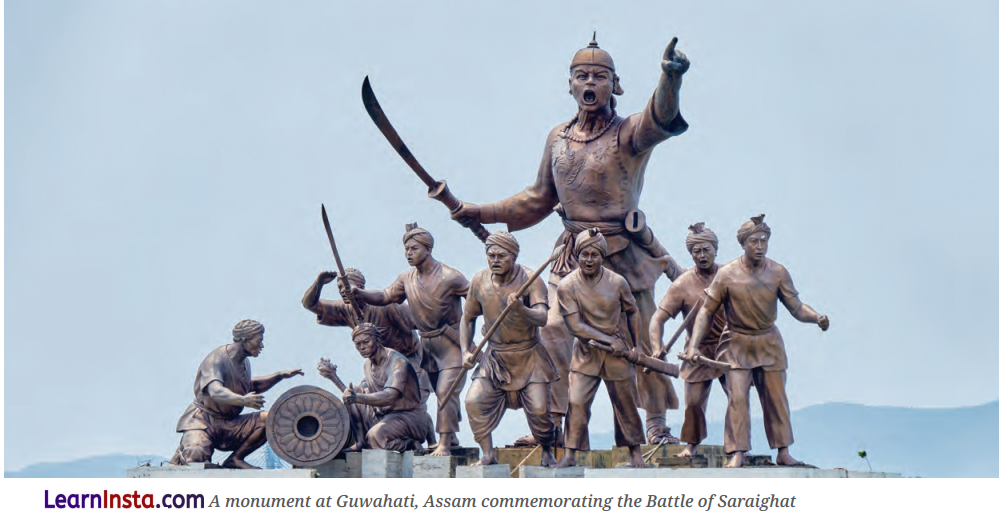
(i) Identify the historical event commemorated by this monument.
Answer:
The monument commemorates the Battle of Saraighat.
(ii) In which year was the Battle of Saraighat fought?
Answer:
The Battle of Saraighat was fought in 1671.
(iii) How did the Ahoms strengthen their resistance against the Mughals?
Answer:
- They used Assam’s difficult geography, including forests and rivers, to their advantage.
- They used strategic alliances, guerrilla tactics, the Paik system, and a strong navy with fast boats for river warfare.
Question 2.
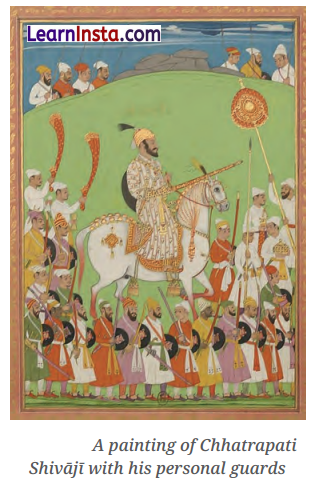
(i) Identify the Maratha ruler shown in it.
Answer:
The picture shows Chhatrapati Shivaji.
(ii) In which year was the independent Maratha state established?
Answer:
The independent Maratha state was established in 1674.
(iii) Why were the Marathas a formidable force in the Deccan?
Answer:
- The Marathas had knowledge of the Deccan’s complex geography and landscape.
- Their bravery and martial abilities made them a formidable force in both administrative and military affairs.
Resistance and Resilience 1000-1700 CE Class 9 Map Based Questions
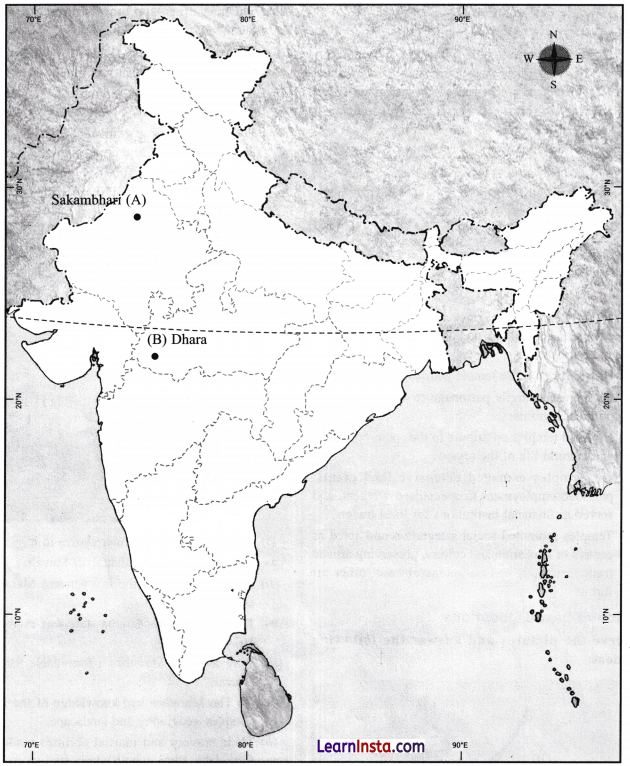
Two places (A) and (B) have been marked on the given map of the Indian subcontinent. Identify them and write their correct names on the lines marked on the map.
(a) The place that was the centre of the Chahamanas.
(b) The place that was the centre of the Paramaras.
Answer:
Class 9 Resistance and Resilience 1000-1700 CE Extra Questions for Practice
Multiple Choice Questions
Question 1.
Which system was used by the Ahoms to organise their manpower for military and other services?
(a) lqta system
(b) Paik system
(c) Mansabdari system
(d) Zamindari system
Question 2.
Which of the following was an important feature of the Vijayanagara economy?
(a) Dependence only on maritime trade
(b) Investment in small-scale irrigation
(c) Abolition of land revenue
(d) Dependence only on forest resources
Question 3.
Which Sikh institution was established by Guru Hargobind?
(a) Khalsa
(b) Akal Takht
(c) Misals
(d) Sangat
Question 4.
Assertion (A): The use of local languages helped the Bhakti tradition reach wider sections of society.
Reason (R): Bhakti traditions used devotional songs and community participation to make their teachings accessible.
(a) Both (A) and (R) are true and (R) is the correct explanation of (A).
(b) Both (A) and (R) are true but (R) is not the correct explanation of(A).
(c) (A) is true but (R) is false.
(d) (A) is false but (R) is true.
Fill in the blanks
1. The Vijayanagara Empire was established in …………………………. by Harihara and Bukka.
2. The Ahoms used their knowledge of forests, rivers and the …………………………. to strengthen their resistance.
3. Guru Gobind Singh established the ……………………………… in 1699.
4. The financial instrument used for large commercial transactions and long-distance remittances was called a ……………………… .
Very Short Answer Type Questions
Question 1.
Why did the Delhi Sultanate face resistance from several kingdoms and chieftains?
Question 2.
What role did the Bhil community play in supporting the resistance of Mewar?
Question 3.
How did forts serve the Marathas during periods of resistance?
Question 4.
What were the two main forms of Bhakti tradition mentioned in the chapter?
Short Answer Type Questions
Question 1.
Explain the importance of the Ahoms knowledge of their natural environment in defending their kingdom.
Question 2.
Describe the role of temples in preserving education and cultural traditions during this period.
Question 3.
How did the Jats continue their resistance against the Mughals during the 17th century?
Question 4.
Explain how Indian merchants contributed to the commercial system between 1000 and 1700 CE.
Long Answer Type Questions
Question 1.
Describe the major factors that helped the Ahom kingdom maintain its independence for nearly six centuries.
Question 2.
Explain the political and cultural significance of the Vijayanagara Empire during the period covered in the chapter.
Question 3.
Discuss the development of Sikh political organisation from the time of Guru Nanak to the formation of the Khalsa.
Question 4.
Explain how agriculture, irrigation, markets, and financial practices contributed to the resilience of the Indian economy between 1000 and 1700 CE.