Practicing Class 9 Social Science MCQ and Class 9 SST Part 2 Chapter 3 Resistance and Resilience 1000-1700 CE MCQ Online Test with Answers daily helps in time management.
Class 9 SST Chapter 3 Resistance and Resilience 1000-1700 CE MCQ
MCQ on Resistance and Resilience 1000-1700 CE Class 9
Resistance and Resilience 1000-1700 CE MCQ Class 9
Question 1.
Which of the following was a major reason for resistance against the Delhi Sultanate?
(a) Decline of agriculture
(b) Preservation of political power and socio-cultural continuity
(c) Expansion of maritime trade
(d) Growth of merchant communities
Answer:
(b) Preservation of political power and socio-cultural continuity
Question 2.
Who defeated Muhammad Ghuri at Kasahrada in 1178?
(a) Rani Rudrama Devi
(b) Queen Naikidevi
(c) Rani Abbakka Chowta
(d) Maharani Durgavati
Answer:
(b) Queen Naikidevi
Question 3.
Read the following statements and choose the correct answer.
Statement I: Resilience means the ability to endure difficulties and adapt to changing circumstances.
Statement II: Resilience is limited only to military strength.
(a) Statement I is correct and Statement II is incorrect.
(b) Statement I is incorrect and Statement II is correct.
(c) Both Statement I and II are correct.
(d) Both Statement I and II are incorrect.
Answer:
(a) Statement I is correct and Statement II is incorrect.
Question 4.
Arrange the following events in chronological order, from the earliest to the latest.
I. Establishment of the Delhi Sultanate
II. Battle of Kasahrada
III. Ascendancy of the Ahoms
IV. Establishment of the Vijayanagara Empire
(a) II, I, III, IV
(b) I, II, III, IV
(c) II, III, I, IV
(d) I, III, II, IV
Answer:
(a) II, I, III, IV
Question 5.
Which of the following best explains Maharana Pratap’s use of the Aravalli terrain?
(a) It helped him develop maritime trade.
(b) It enabled him to use surprise attacks, raids and ambushes.
(c) It helped him establish a new religious order.
(d) It enabled him to expand agriculture.
Answer:
(b) It enabled him to use surprise attacks, raids and ambushes.
Question 6.
Which of the following correctly describes the Ahom method of resistance?
(a) Dependence only on a large standing army
(b) Use of forests, rivers, monsoon knowledge, alliances and guerrilla tactics
(c) Dependence mainly on overseas trade
(d) Avoidance of river routes
Answer:
(b) Use of forests, rivers, monsoon knowledge, alliances and guerrilla tactics
Question 7.
The Battle of Saraighat in 1671 is associated with:
(a) Maharana Pratap
(b) Chhatrapati Shivaji
(c) Lachit Borphukan
(d) Gokul Jat
Answer:
(c) Lachit Borphukan
Question 8.
Which of the following was a major feature of the Vijayanagara Empire’s resilience?
(a) Its location in a region with rugged terrain and natural river defence
(b) Its complete dependence on the Delhi Sultanate
(c) Its rejection of regional languages
(d) Its dependence only on maritime warfare
Answer:
(a) Its location in a region with rugged terrain and natural river defence
Question 9.
Why were forts important to the Marathas?
(a) They were used only as places of worship.
(b) They provided defence, retreat, water, storage and administrative support.
(c) They were mainly centres of maritime trade.
(d) They were used only for collecting taxes.
Answer:
(b) They provided defence, retreat, water, storage and administrative support.
Question 10.
Which of the following best explains the resilience of the Bhakti tradition?
(a) It depended entirely on royal patronage.
(b) It used local languages, devotional practices and community participation.
(c) It avoided participation by ordinary people.
(d) It relied mainly on military resistance.
Answer:
(b) It used local languages, devotional practices and community participation.

Question 11.
Read the following statements about the Bhakti tradition.
I. Bhakti encouraged personal devotion to the divine.
II. Local languages made devotional teachings accessible to wider sections of society.
III. Community singing helped create a shared sense of community.
IV. Bhakti was limited to royal courts.
Which of the following is correct?
(a) I, II and III only
(b) I and IV only
(c) II and IV only
(d) I, II, III and IV
Answer:
(a) I, II and III only
Question 12.
Which work composed by Tulsidas helped make the teachings of the Ramayana accessible to wider sections of society?
(a) Kirtana Ghosha
(b) Ramcharitmanas
(c) Arthashastra
(d) Akbamama
Answer:
(b) Ramcharitmanas
Question 13.
A merchant wants to transfer a large amount of money over a long distance without carrying a large amount of currency. Which financial instrument mentioned in the chapter would be useful?
(a) Iqta
(b) Mansab
(c) Hundi
(d) Paik
Answer:
(c) Hundi
Question 14.
Which of the following correctly describes the role of Indian merchants during the period?
(a) They were involved only in buying and selling goods.
(b) They worked as traders, shippers, bankers, brokers, interpreters and diplomats, among other roles.
(c) They avoided political and economic activities.
(d) They participated only in local village markets.
Answer:
(b) They worked as traders, shippers, bankers, brokers, interpreters and diplomats, among other roles.
Question 15.
Which sequence correctly represents the following events from earliest to latest?
I. Battle of Haldighati
II. Battle of Dewair
III. Gokul Jat’s rebellion
IV. Battle of Saraighat
(a) I, II, III, IV
(b) II, I, III, IV
(c) I, III, II, IV
(d) III, I, II, IV
Answer:
(a) I, II, III, IV
Question 16.
A kingdom faces an external threat but has limited military resources. It has strong community support, knowledge of the local terrain and economic resources. Which approach best reflects the idea of resilience discussed in the chapter?
(a) Depend entirely on military strength.
(b) Abandon cultural traditions and avoid resistance.
(c) Combine local knowledge, community support, economic resources and adaptive resistance.
(d) Stop all economic and cultural activities until the threat ends.
Answer:
(c) Combine local knowledge, community support, economic resources and adaptive resistance.
Question 17.
Look at the picture and identify the ruler associated with the Battle of Dewair (1582).
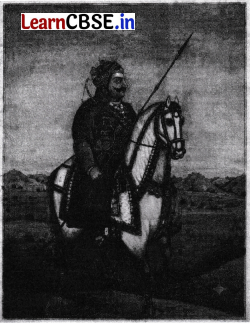
(a) Maharana Pratap
(b) Guru Gobind Singh
(c) Chhatrapati Shivaji
(d) Lachit Borphukan
Answer:
(a) Maharana Pratap
Resistance and Resilience 1000-1700 CE Class 9 Assertion and Reasoning Questions
There are two statements in each question marked as Assertion (A) and Reason (R). Choose your answer as per the option given below:
(a) Both (A) and (R) are true, and (R) is the correct explanation of (A).
(b) Both (A) and (R) are true, but (R) is not the correct explanation of (A).
(c) (A) is true, but (R) is false.
(d) (A) is false, but (R) is true.
Question 1.
Assertion (A): Resilience helped communities sustain resistance during difficult times.
Reason (R): Resilience is the ability to endure difficulties, adapt to changing circumstances, and sustain one’s way of life despite challenges.
Answer:
(a) Both (A) and (R) are true, and (R) is the correct explanation of (A).
Question 2.
Assertion (A): Resistance during this period was limited only to warfare.
Reason (R): Resistance could also take the form of alliances, diplomacy, negotiation and other political actions.
Answer:
(d) (A) is false, but (R) is true.
Question 3.
Assertion (A): Knowledge of local terrain strengthened the resistance of several kingdoms and communities.
Reason (R): The Ahoms used their knowledge of forests, rivers and the monsoon to strengthen their resistance.
Answer:
(b) Both (A) and (R) are true, but (R) is not the correct explanation of (A).
Question 4.
Assertion (A): The Bhakti tradition demonstrated resilience during the period under study.
Reason (R): Bhakti adapted devotional practices, used local languages and encouraged community participation.
Answer:
(a) Both (A) and (R) are true, and (R) is the correct explanation of (A).
Question 5.
Assertion (A): Economic strength contributed to the resilience of communities between 1000 and 1700 CE.
Reason (R): Agriculture, irrigation, markets, merchant networks, financial practices and trade provided resources that helped communities withstand instability.
Answer:
(a) Both (A) and (R) are true, and (R) is the correct explanation of (A).
Question 6.
Assertion (A): The Ahoms were able to maintain their independence for nearly six centuries.
Reason (R): They used forests, rivers, knowledge of the monsoon, alliances, guerrilla tactics, the Paik system and a river navy.
Answer:
(a) Both (A) and (R) are true, and (R) is the correct explanation of (A).
Question 7.
Assertion (A): Temples were important only as places of worship during this period.
Reason (R): Temples also functioned as economic, social, cultural and political centres.
Answer:
(d) (A) is false, but (R) is true.
Question 8.
Assertion (A): The Marathas used forts as an important part of their resistance.
Reason (R): Forts provided defence, places of retreat, water and food storage, armouries and administrative support.
Answer:
(a) Both (A) and (R) are true, and (R) is the correct explanation of (A).
Question 9.
Assertion (A): The Jat resistance ended completely when the Mughals gained the upper hand in 1691.
Reason (R): The Jats continued their resistance even after the Mughals gained the upper hand.
Answer:
(d) (A) is false, but (R) is true.
Question 10.
Assertion (A): Indian merchants played an important role in the economic resilience of the period.
Reason (R): Indian merchants were involved in activities such as trading, shipping, banking, money¬changing, brokerage, interpreting and diplomacy.
Answer:
(a) Both (A) and (R) are true, and (R) is the correct explanation of (A).
Resistance and Resilience 1000-1700 CE Class 9 Fill in the Blanks
Question 1.
The Ahom kingdom maintained its independence for nearly _______________ centuries.
Answer:
six
Question 2.
The battle in which the Ahoms defeated the Mughal forces was the Battle of _______________.
Answer:
Saraighat
Question 3.
Guru Nanak founded a major spiritual movement that later came to be known as _______________.
Answer:
Sikhism
Question 4.
The Sikh order known as the _______________ was established by Guru Gobind Singh in 1699.
Answer:
Khalsa
Question 5.
The Jats were mainly a _______________ community from the Ganga-Yamuna Doab.
Answer:
farming
Question 6.
In 1669, the Jat rebellion was led by _______________ Jat.
Answer:
Gokul
Question 7.
Tulsidas composed the Ramcharitmanas in _______________.
Answer:
Awadhi
Question 8.
The financial instrument used for large commercial transactions and long-distance remittance was called _______________.
Answer:
hundi
Question 9.
The money-changers who operated hundis were known as _______________.
Answer:
sarrafs
Question 10.
The irrigation technology known as the _______________ wheel was widely used to improve agricultural output.
Answer:
Persian
Resistance and Resilience 1000-1700 CE Class 9 True or False
Question 1.
The Khalsa adopted a distinct martial code in response to the changing socio-political environment.
Answer:
True
Question 2.
The Jats stopped resisting the Mughals immediately after their rebellion of 1669.
Answer:
False
Question 3.
Bhakti saints used local languages to make devotional teachings accessible to wider sections of society.
Answer:
True
Question 4.
Chaitanya Mahaprabhu led public sankirtan in Bengal to protest restrictions on devotional practices.
Answer:
True
Question 5.
Tulsidas composed the Ramcharitmanas in Sanskrit.
Answer:
False
Question 6.
Temples served only religious purposes and had no economic functions.
Answer:
False
Question 7.
Temples provided employment to groups such as architects, artisans, sculptors, priests and musicians.
Answer:
True
Question 8.
Hundi required merchants to carry large amounts of currency for long-distance transactions.
Answer:
False
Question 9.
The Vijayanagara Empire invested in small-scale irrigation.
Answer:
True
Question 10.
Indian merchants were involved only in buying and selling goods.
Answer:
False
Resistance and Resilience 1000-1700 CE Class 9 Match the Following
Question 1.
| Column I | Column II |
| (A) Guru Gobind Singh | (i) Ramcharitmanas |
| (B) Gokul Jat | (ii) Khalsa |
| (C) Tulsidas | (iii) 1669 Jat rebellion |
| (D) Chaitanya Mahaprabhu | (iv) Public sankirtan |
Options:
(a) (A) – (ii), (B) – (iii), (C )- (i), (D) – (iv)
(b) (A) – (i), (B) – (ii), (C) – (iii), (D) – (iv)
(c) (A) – (iii), (B) – (ii), (C) – (iv), (D) – (i)
(d) (A) – (i), (B) – (iv), (C) – (iii), (D) – (ii)
Answer:
(a) (A) – (ii), (B) – (iii), (C )- (i), (D) – (iv)
| Column I | Column II |
| (A) Guru Gobind Singh | (ii) Khalsa |
| (B) Gokul Jat | (iii) 1669 Jat rebellion |
| (C) Tulsidas | (i) Ramcharitmanas |
| (D) Chaitanya Mahaprabhu | (iv) Public sankirtan |
Question 2.
| Column I | Column II |
| (A) Battle of Saraighat | (i) Financial instrument |
| (B) Hundi | (ii) Ahom victory |
| (C) Persian wheel | (iii) Irrigation technology |
| (D) Sarrafs | (iv) Money-changers |
Options:
(а) (A) – (i), (B) – (ii), (C) -(iii), (D) – (iv)
(b) (A) – (ii), (B) – (i), (C) – (iii), (D) – (iv)
(c) (A) – (iv), (B) – (iii), (C) – (ii), (D) – (i)
(d) (A) – (i), (B) – (iii), (C) – (iv), (D) – (i)
Answers:
(b) (A) – (ii), (B) – (i), (C) – (iii), (D) – (iv)
| Column I | Column II |
| (A) Battle of Saraighat | (ii) Ahom victory |
| (B) Hundi | (i) Financial instrument |
| (C) Persian wheel | (iii) Irrigation technology |
| (D) Sarrafs | (iv) Moneychangers |