Students often refer to Class 8 Ganita Prakash Solutions and NCERT Class 8 Maths Part 2 Chapter 2 The Baudhayana-Pythagoras Theorem Question Answer Solutions to verify their answers.
Class 8 Maths Ganita Prakash Part 2 Chapter 2 Solutions
Ganita Prakash Class 8 Chapter 2 Solutions The Baudhayana-Pythagoras Theorem
Class 8 Maths Ganita Prakash Part 2 Chapter 2 The Baudhayana-Pythagoras Theorem Solutions Question Answer
2.1 Doubling a Square
NCERT In-Text Questions (Page 34)
Question 1.
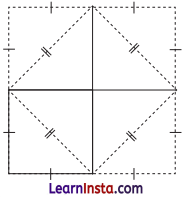
Moreover, all these small triangles are congruent to each other. Can you explain why?
Solution:
Since all these smaller isosceles right triangles have equal sidelengths and equal hypotenuses, all the smaller triangles are congruent.
2.2 Halving a Square
Halving a Square Using Paper
NCERT In-Text Questions (Pages 36-37)
Question 1.
Why is the smaller inside square half the area of the larger square?
Solution:
Let the side of the larger square = a, then the area of the larger square = a2
Then, side of smaller square = \(\frac {a}{2}\) and area of the smaller square = \(\left(\frac{a}{2}\right)^2=\frac{a^2}{4}\)
As each smaller triangle divided the smaller square into 2 parts.
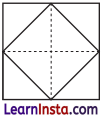
So, the area of each smaller triangle = \(\frac {1}{2}\) of area ot smaller square
= \(\frac{1}{2} \times \frac{a^2}{4}\)
= \(\frac{a^2}{8}\)
So, the area of 4 smaller triangles or the area of the inside smaller square = 4 × \(\frac{a^2}{8}\) = \(\frac{a^2}{2}\)
Hence, the smaller inside square has half the area of the larger square.
Question 2.
Will the square with half the sidelength have half the area? Why not? How many such squares will fill the original square?
Solution:
If the original square has a sidelength s, its area is s2.
If we halve the sidelength to \(\frac {s}{2}\), then the new area becomes \(\left(\frac{s}{2}\right)^2=\frac{s^2}{4}\)
Thus, a square with half the sidelength has one-fourth of the original area, not half.
It would take four such smaller squares to fill the original square.

Question 3.
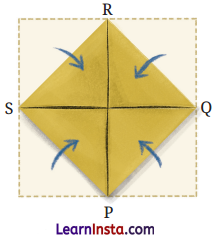
Why is PQRS a square? Why is its area half that of the original paper? Explain by connecting QS and PR, finding the different angles formed, and then using triangle congruence.
Solution:
The diagonals QS and PR are equal in length and intersect at right angles, bisecting each other at the centre.
A quadrilateral with equal diagonals that bisect each other perpendicularly is a square.
When the diagonals QS and PR are drawn, they intersect at right angles and divide the square into 4 congruent triangles.
In each quadrant, the crease splits the region into two identical right-angled triangles.
By SAS congruence, the folded triangle and the corresponding triangle at the centre are congruent, so their areas are equal.
Overall, the original square is divided into 8 congruent triangles, of which PQRS contains 4.
Hence, the area of PQRS is exactly half of the original square.
2.3 Hypotenuse of an Isosceles Right Triangle
Figure it Out (Pages 39-40)
Question 1.
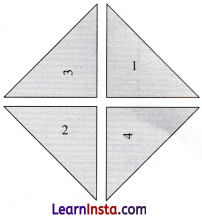
Earlier, we saw a method to create a square with double the area of a given square piece of paper. There is another method to do this in which two identical square papers are cut in the following way.
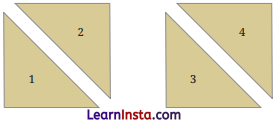
Can you arrange these pieces to create a square with double the area of either square?
Solution:
Yes, to create a square with the double area using these four triangles, we need to arrange them so that their hypotenuses (the longest sides, which were the diagonals of the original squares) become the outer sides of the new square.
Question 2.
The length of the two equal sides of an isosceles right triangle is given. Find the length of the hypotenuse. Find bounds on the length of the hypotenuse such that they have at least one digit after the decimal point.
(i) 3
(ii) 4
(iii) 6
(iv) 8
(v) 9
Solution:
(i) The length of equal sides = 3 units
Let the side length of square PEAR be 3 units, then
Area of PEAR = 3 × 3 = 9 sq. units
We know that, area of REST = 2 × Area of PEAR
= 2 × 9
= 18 sq. units …(i)
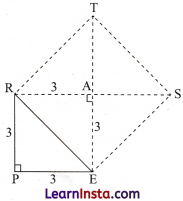
Let the hypotenuse of ΔPER, ER = c
Area of REST = c × c = c2 ……(ii)
From (i) and (ii), c2 = 18
So, the length of the hypotenuse, c = √18 units
Bounds for √18:
Since, 42 = 16 < (√18)2 = 18 < 52 = 25
⇒ 4 < √18 < 5
Since, 4.12 = 16.81
4.22 = 17.64
4.32 = 18.49
So, 4.2 < √18 < 4.3
Further, 4.212 = 17.7241
4.222 = 17.8084
4.232 = 17.8929
4.242 = 17.9776
4.252 = 18.0625
So, 4.24 < √18 < 4.25
Further, 4.2412 = 17.986081
4.2422 = 17.994564
4.2432 = 18.003049
So, 4.242 < √18 < 4.243
(ii) Length of equal sides = 4 units
Using the same procedure as we did in part (i), we get hypotenuse = √32 units
Since, 52 = 25 < (√32)2 = 32 < 62 = 36
⇒ 5 < √32 < 6
Since, 5.12 = 26.01
5.22 = 27.04
5.32 = 28.09
5.42 = 29.16
5.52 = 30.25
5.62 = 31.36
5.72 = 32.49
So, 5.6 < √32 < 5.7
Further, 5.612 = 31.4721
5.622 = 31.5844
5.632 = 31.6969
5.642 = 31.8096
5.652 = 31.9225
5.662 = 32.03 56
So, 5.65 < √32 < 5.66
Further, 5.6512 = 31.933801
5.6522 = 31.945104
5.6532 = 31.956409
5.6542 = 31.967716
5.6552 = 31.979025
5.6562 = 31.990336
5.6572 = 32.001649
So, 5.656 < √32 < 5.657
(iii) Length of equal sides = 6 units
Using the same procedure as we did in part (i), we get hypotenuse = √72 units
Since, 82 = 64 < (√72)2 = 72 < 92 = 81
⇒ 8 < √72 < 9
Since, 8.12 = 65.61
8.22 = 67.24
8.32 = 68.89
8.42 = 70.56
8.52 = 72.25
So, 8.4 < √72 < 8.5
Further, 8.412 = 70.7281
8.422 = 70.8964
8.432 = 71.0649
8.442 = 71.2336
8.452 = 71.4025
8.462 = 71.5716
8.472 = 71.7409
8.482 = 71.9104
8.492 = 72.0801
So, 8.48 < √72 < 8.49
Further, 8.4812 = 71.927361
8.4822 = 71.944324
S.4832 = 71.961289
8.4842 = 71.978256
8.4852 = 71.995225
8.4862 = 72.012196
So, 8.485 < √72 < 8.486
(iv) Length of equal sides = 8 units
Using the same procedure as we did in part (i), we get hypotenuse = √128 units
Since, 112 = 121 < (√128)2 = 128 < 122 = 144
⇒ 11 < √128 < 12
11.12 = 123.21
11.22 = 125.44
11.32 = 127.69
11.42 = 129.96
So, 11.3 < √128 < 11.4
11.312 = 127.9161
11.322 = 128.1424
So, 11.31 < √128 < 11.32
11.3112 = 127.938721
11.3122 = 127.961344
11.3132 = 127.983969
11.3142 = 128.006596
So, 11.313 < √128 < 11.314
(v) Length of equal sides = 9 units
Using the same procedure as we did in part (i), we get hypotenuse = √162 units
Since, 122 = 144 < (√162)2 < 132 = 169
⇒ 12 < √162 < 13
12.12 = 146.41
12.22 = 148.84
12.32 = 151.29
12.42 = 153.76
12.52 = 156.25
12.62 = 158.76
12.72 = 161.29
12.82 = 163.84
So, 12.7 < √162 < 12.8
12.712 = 161.5441
12.722 = 161.7984
12.732 = 162.0529
So, 12.72 < √162 < 12.73
12.7212 = 161.823841
12.7222 = 161.849284
12.7232 = 161.874729
12.7242 = 161.900176
12.7252 = 161.925625
12.7262 = 161.951076
12.7272 = 161.976529
12.7282 = 162.001984
So, 12.727 < √162 < 12.728
Question 3.
The hypotenuse of an isosceles right triangle is 10. What are its other two sidelengths?
[Hint: Find the area of the square composed of two such right triangles.]
Solution:
Consider the isosceles right triangle PQS.
Given, SQ = 10 (hypotenuse)
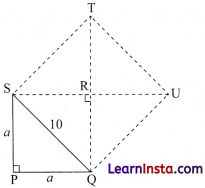
Let the other two sides (i.e., PQ and SP) = a
Area of square PQRS = a × a = a2
Area of square STUQ = 10 × 10 = 100 …..(i)
We know that, area of STUQ = 2 × Area of PQRS = 2 × a2 …..(ii)
From (i) and (ii),
2 × a2 = 100
⇒ a2 = 50
⇒ a = √50
We have, 72 = 49 and 82 = 64
So, the other two sidelengths lie between 7 and 8.
2.4 Combining Two Different Squares
NCERT In-Text Questions (Page 42)
Question 1.
Can you see why the method works in the case where the two squares are the same size? Does it agree with the method we used earlier to combine two squares of the same size into a bigger square?
Solution:
Yes, the method works when the two squares are the same size.
If both squares have sidelength a, then the area of each square = a2, so the combined area is 2a2.
A square with this area has sidelength √2a, which is exactly the diagonal of the original square.
Thus, the method agrees with the earlier construction, where two identical squares are combined to form a larger square whose side is the diagonal of one of the smaller squares.
NCERT In-Text Questions (Page 44)
Question 1.
Explain why all the angles of this new 4-sided figure are right angles, and so it is a square.
Solution:
Let the vertices of the new 4-sided figures be A, B, C, and D, respectively.
Then ∠A = x + (90° – x) = 90°
∠C = 180° – {x + (90° – x)} = 90°
Now, since each angle of a square of sidelength a is 90°.
∴ ∠D = 90° – x + x = 90°
Now, ∠B = 90° – x + x = 90°
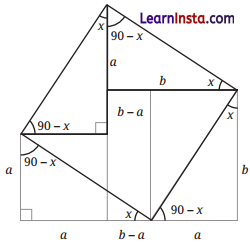
Since all the angles of this new 4-sided figure are right angles and we have already seen that all sidelengths of the new square are equal, it is a square.
Figure it Out (Page 47)
Question 1.
If a right-angled triangle has shorter sides of lengths 5 cm and 12 cm, then what is the length of its hypotenuse? First, draw the right-angled triangle with these sidelengths and measure the hypotenuse, then check your answer using Baudhayana’s Theorem.
Solution:
First, we draw the right-angled triangle:
Draw a horizontal line BC = 12 cm.
Draw a vertical line AB = 5 cm long (the height) starting from one end of the base at an angle of 90°.
Connect the two open ends to form the hypotenuse AC.
If you measure that hypotenuse AC with a ruler, it is exactly 13 cm.
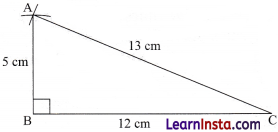
According to the Baudhayana’s Theorem, if a right-angled triangle has sidelengths a (5 cm), b (12 cm), and c,
where c is the length of the hypotenuse, then a2 + b2 = c2
Therefore, 52 + 122 = c2
⇒ 25 + 144 = c2
⇒ c2 = 169
So, c = 13 cm
Thus, the length of the hypotenuse is 13 cm.
Question 2.
If a right-angled triangle has a short side of length 8 cm and a hypotenuse of length 17 cm, what is the length of the third side? Again, try drawing the triangle and measuring, and then check your answer using Baudhayana’s Theorem.
Solution:
Draw a horizontal line BC = 8 cm (the known short side).
Using a compass set to 17 cm, place the point on one end C of your 8 cm line and draw an arc.
From the other end B of the 8 cm line, draw a vertical line at a 90° angle, straight up until it intersects your arc. Mark this point as A.
Measure this vertical line AB, you will find it is exactly 15 cm.

According to the Baudhayana’s Theorem, if a right-angled triangle has sidelengths a (8 cm), b, and c (17 cm), where c is the length of the hypotenuse, then a2 + b2 = c2
Therefore, 82 + b2 = 172
⇒ 64 + b2 = 289
⇒ b2 = 289 – 64 = 225
So, b = 15 cm
Thus, the length of the third side is 15 cm.
Question 3.
Using the constructions you have now seen, how would you construct a square whose area is triple the area of a given square? Five times the area of a given square? (Baudhayana’s Sulba-Sutra, Verse 1.10)
Solution:
To construct a square with triple the area of a given square:
Start with a square of side a, whose area is a2.
First, construct a square with double the area by drawing a square on the diagonal of the given square. This new square has an area 2a2.
Now, combine the original square (area = a2) and the double-area square (area = 2a2).
Using Baudhayana’s method, form a right-angled triangle whose perpendicular sides are a and √2a.

Construct a square on the hypotenuse.
The area of the new square is 3a2, which is three times the area of the original square.
(Because if a right triangle has shorter sides of length a and b, and a hypotenuse of length c, then the areas of the two smaller squares, a2 and b2, add up to the area of the larger square, c2: a2 + b2 = c2)

To construct a square with five times the area of a given square:
Start with a square of side a, whose area is a2.
First, construct a square double the area by drawing a square on the diagonal of the given square.
This new square has an area of 2a2.
Then a square of area 4a2 (by doubling again).

Now, combine the original square (area = a2) and the square of area (area = 4a2).
Using Baudhayana’s method, form a right-angled triangle whose perpendicular sides are a and 2a.
Construct a square on the hypotenuse.
The area of the new square is a2 + 4a2 = 5a2, which is five times the area of the original square.

Question 4.
Let a, b, and c denote the lengths of the sides of a right triangle, with c being the length of the hypotenuse. Find the missing sidelength in each of the following cases:
(i) a = 5, b = 7
(ii) a = 8, b = 12
(iii) a = 9, c = 15
(iv) a = 7, b = 12
(v) a = 1.5, b = 3.5
Solution:
According to the Baudhayana’s Theorem, if a right-angled triangle has sidelengths a, b, and c, where c is the length of the hypotenuse, then
a2 + b2 = c2 ……..(i)
(i) Given, a = 5, b = 7
From (i), we have 52 + 72 = c2
⇒ 25 + 49 = c2
⇒ c2 = 74
⇒ c = √74
(ii) Given, a = 8, b = 12
From (i), we have 82 + 122 = c2
⇒ 64 + 144 = c2
⇒ c2 = 208
⇒ c = √208
(iii) Given, a = 9, c = 15
From (i), we have 92 + b2 = 152
⇒ 81 + b2 = 225
⇒ b2 = 144
⇒ b = 12
(iv) Given, a = 7, b = 12
From (i), we have 72 + 122 = c2
⇒ 49 + 144 = c2
⇒ c2 = 193
⇒ c = √193
(v) Given, a = 1.5, b = 3.5
From (i), we have (1.5)2 + (3.5)2 = c2
⇒ 2.25 + 12.25 = c2
⇒ c2 = 14.5
⇒ c = √14.5
2.5 Right-Triangles Having Integer Sidelengths
NCERT In-Text Questions (Page 48)
Question 1.
List down all the Baudhayana triples with numbers less than or equal to 20.
Solution:
Baudhayana (Pythagorean) triples with all numbers less than or equal to 20 are:
(3, 4, 5), (6, 8, 10), (5, 12, 13), (9, 12, 15), (8, 15, 17), (12, 16, 20)
These are all the right-angled triangle triples that satisfy a2 + b2 = c2.
Question 2.
Is (30, 40, 50) a Baudhayana triple?
Is (300, 400, 500) a Baudhayana triple?
Solution:
Yes, both are Baudhayana triple.
(30, 40, 50)
It is a Baudhayana triple because
302 + 402 = 900 + 1600 = 2500 = 502
(300, 400, 500)
It is also a Baudhayana triple because
3002 + 4002 = 90000 + 160000 = 250000 = 5002
NCERT In-Text Questions (Page 49)
Question 1.
Is (5, 12, 13) a primitive Baudhayana triple? What are the other primitive Baudhayana triples with numbers less than or equal to 20?
Solution:
Yes, (5, 12, 13) a primitive Baudhayana triple.
Since the numbers 5, 12, and 13 have no common factor other than 1, it is a primitive Baudhayana triple.
Other primitive Baudhayana triples with numbers ≤ 20 are as follows:
(3, 4, 5), (8, 15, 17)
Question 2.
Generate 5 scaled versions of each primitive triple. Are these scaled versions primitive?
Solution:
To generate 5 scaled versions, we multiply each of the Primitive triples by a constant integer K(K = 2, 3, 4, 5, 6).
From (3, 4, 5): (6, 8, 10), (9, 12, 15), (12, 16, 20), (15, 20, 25), (18, 24, 30)
From (5, 12, 13): (10, 24, 26), (15, 36, 39), (20, 48, 52), (25, 60, 65), (30, 72, 78)
From (8, 15, 17): (16, 30, 34), (24, 45, 51), (32, 60, 68), (40, 75, 85), (48, 90, 102)
No, since each scaled version has a common factor greater than 1 (the scaling factor k), the scaled versions are not primitive.
Question 3.
If (a, b, c) is non-primitive, and the integers have f – greater than 1 – as a common factor, then is \(\left(\frac{a}{f}, \frac{b}{f}, \frac{c}{f}\right)\) a Baudhayana triple? Check this statement for (9, 12, 15). Justify this statement.
Solution:
Yes. Since (a, b, c) is a Baudhayana triple, so a2 + b2 = c2
Dividing both sides by f2, we get \(\left(\frac{a}{f}\right)^2+\left(\frac{b}{f}\right)^2=\left(\frac{c}{f}\right)^2\)
Hence, \(\left(\frac{a}{f}, \frac{b}{f}, \frac{c}{f}\right)\) is also a Baudhayana triple.
Check for (9, 12, 15):
Here, the common factor is f = 3 > 1
\(\left(\frac{9}{3}, \frac{12}{3}, \frac{15}{3}\right)\) = (3, 4, 5)
Since 32 + 42 = 52, the statement is verified.
Thus, dividing a non-primitive triple by its common factor gives a (primitive) Baudhayana triple.
Figure it Out (Page 50)
Question 1.
Find 5 more Baudhayana triples using this idea.
Solution:
Using (n – 1)2 + (2n – 1) = n2 and choosing (2n – 1) to be an odd square:
2n – 1 = 9 ⇒ n = 5 ⇒ (3, 4, 5)
2n – 1 = 25 ⇒ n = 13 ⇒ (5, 12, 13)
2n – 1 =49 ⇒ n = 25 ⇒ (7, 24, 25)
2n – 1 = 81 ⇒ n = 41 ⇒ (9, 40, 41)
2n – 1 = 121 ⇒ n = 61 ⇒ (11, 60, 61)
So, five Baudhayana triples are: (3, 4, 5), (5, 12, 13), (7, 24, 25), (9, 40, 41), (11, 60, 61).
Question 2.
Does this method yield non-primitive Baudhayana triples?
[Hint: Observe that among the triples generated, one of the smaller sidelengths is one less than the hypotenuse.]
Solution:
No, since in this method, one of the smaller sides is exactly one less than the hypotenuse (n – 1 and n).
Since consecutive integers have no common factor greater than 1, the triple obtained has no common factor.
Hence, the triples produced by this method are primitive.
Question 3.
Are there primitive triples that cannot be obtained through this method? If yes, give examples.
Solution:
Yes, the above method generates only those primitive triples in which one side is one less than the hypotenuse.
Primitive triples that do not satisfy this condition cannot be obtained by this method.
For example: (8, 15, 17) and (12, 35, 37).
These are primitive Baudhayana triples, but neither has a side that is one less than the hypotenuse, so they cannot be generated using this method.
2.6 A Long-Standing Open Problem, 2.7 Further Applications of the Baudhayana Pythagoras Theorem
Figure it Out (Pages 52-54)
Question 1.
Find the diagonal of a square with sidelength 5 cm.
Solution:
Baudhayana’s Theorem on right-angled triangles states that if a right-angled triangle has sidelengths a, b, and c, where c is the length of the hypotenuse, then a2 + b2 = c2
Given a = 5 cm and b = 5 cm.
Now, c2 = a2 + b2
⇒ c2 = 52 + 52
⇒ c2 = 25 + 25 = 50
⇒ c = 5√2 cm
So, the diagonal of a square with sidelength 5 cm is 5√2 cm.
Question 2.
Find the missing sidelengths in the following right triangles:

Solution:
Consider the vertices of each triangle as A, B, and C.
Using a2 + b2 = c2, we have A
(a) Given sidelengths are AB = 7 units and BC = 9 units.

Here, AC2 = 72 + 92 = 49 + 81 = 130
⇒ AC = √130 units
(b) Given sidelengths are AB = 4 units and BC = 10 units.

Here, AC2 = 42 + 102 = 16 + 100 = 116
⇒ AC = 2√29 units
(c) Given sidelengths are AC = 41 units and BC = 40 units.
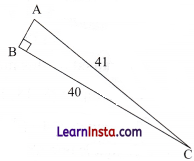
Here, AC2 = AB2 + BC2
⇒ 412 = AB2 + 402
⇒ AB2 = 1681 – 1600 = 81
⇒ AB = 9 units
(d) Given sidelengths are AC = √200 units and BC = 10 units.

Here, AC2 = AB2 + BC2
⇒ (√200)2 = AB2 + 102
⇒ AB2 = 200 – 100 = 100
⇒ AB = 10 units
(e) Given sidelengths are AB = 10 units and BC = √150 units.
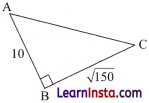
⇒ Here, AC2 = 102 + (√150)2
= 100 + 150
= 250
⇒ AC = 5√10 units
(f) Given sidelengths are AC = 45 units and AB = 27 units.

Here, AC2 = AB2 + BC2
⇒ 452 = 272 + BC2
⇒ BC2 = 2025 – 729 = 1296
⇒ BC = 36 units
Question 3.
Find the sidelength of a rhombus whose diagonals are of length 24 units and 70 units.
Solution:
Given diagonals of the rhombus are of length 24 units and 70 units.
Since we know that the diagonals cut each other in half at their intersection point.
So, BO = OD = 12 units and AO = OC = 35 units.

In triangle AOD, AD2 = AO2 + OD2
⇒ AD2 = 352 + 122
= 1225 + 144
= 1369
⇒ AD = 37 units
Since, in a rhombus, AB = BC = CD = DA
∴ Sidelength of the given rhombus = 37 units.
Question 4.
Is the hypotenuse the longest side of a right triangle? Justify your answer.
Solution:
Yes. In a right triangle, the hypotenuse is opposite the right angle, which is the largest angle in the triangle, and the side opposite the largest angle in any triangle is always the longest.
Also it satisfies c2 = a2 + b2
And, a, b, and c are positive.
So, c > a and c > b.
Question 5.
True or False — Every Baudhayana triple is either a primitive triple or a scaled version of a primitive triple.
Solution:
Every Baudhayana (or Pythagorean) triple is either a primitive triple (where the three numbers have no common divisor other than 1) or a scaled version (a multiple) of a unique primitive triple. So the statement is true.
For example: (15, 36, 39) is a non-primitive triple, which is a scaled version of (5, 12, 13) by a factor of 3 (i.e., 3 × (5, 12, 13)).
Question 6.
Give 5 examples of rectangles whose sidelengths and diagonals are all integers.
Solution:
A rectangle with sides a and b has diagonal c, where a2 + b2 = c2.
Examples:
1. 3 × 4 rectangle, diagonal 5
2. 5 × 12 rectangle, diagonal 13
3. 6 × 8 rectangle, diagonal 10
4. 8 × 15 rectangle, diagonal 17
5. 9 × 12 rectangle, diagonal 15
All these are valid because they satisfy the Baudhayana-Pythagoras relation.
Question 7.
Construct a square whose area is equal to the difference of the areas of squares of sidelengths 5 units and 7 units.
Solution:
Draw a square ABCD of side 7 units, and draw another square PQED of side 5 units inside it.
Now, taking E as centre and a radius of 7 units (the length of BC), draw an arc that intersects AD at G and AB at F. Join GE.

Now, consider the right-angled triangle GDE.
GE = 7 units, DE = 5 units
Applying the Baudhayana Theorem, we get
GD2 + DE2 = GE2
⇒ GD2 + 52 = 72
⇒ GD2 = 72 – 52
Thus, GD corresponds to the side of the square whose area is the difference between the two given squares.
Thus, GDJI is the required square.
Question 8.
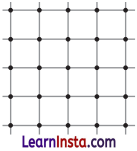
(i) Using the dots of a grid as the vertices, can you create a square that has an area of (a) 2 sq. units, (b) 3 sq. units, (c) 4 sq. units, and (d) 5 sq. units?
(ii) Suppose the grid extends indefinitely. What are the possible integer-valued areas of squares you can create in this manner?
Solution:
(i) We know that the square constructed on the diagonal of a rectangle (or square) is equal in area to the sum of the squares constructed on its two sides,
i.e., if the sides of the rectangle are a and b, then the area of the square constructed on the diagonal is given by Area = a2 + b2
Thus, on a dot grid, the area of any square formed using grid points as vertices must be expressible as the sum of two squares of integers.
(a) Area = 2 sq. units
Since, 2 = 12 + 12
Therefore, a square can be constructed on the diagonal of a 1 × 1 grid.
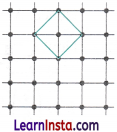
(b) Area = 3 sq. units
3 cannot be expressed as the sum of two perfect squares.
Therefore, the square of area 3 sq. units is not possible on the dot grid.
(c) Area = 4 sq. units
Since, 4 = 22
Therefore, a square of side 2 units can be drawn on the dot grid.
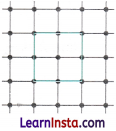
(d) Area = 5 sq. units
Since 5 = 12 + 22
Therefore, a square can be constructed on the diagonal of a 1 × 2 rectangle.
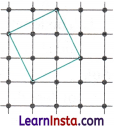
(ii) If the grid extends indefinitely, then all integers that can be written in the form a2 + b2, where a and b are integers, are possible areas of squares.
Hence, the possible integer-valued areas are exactly those integers that are sums of two squares.
Possible areas are: 1, 2, 4, 5, 8, 9, 10, 13, 16, 17, 18, 20, 25,…
Question 9.
Find the area of an equilateral triangle with a side length of 6 units.
[Hint: Show that an altitude bisects the opposite side. Use this to find the height.]
Solution:
Let ABC be an equilateral triangle of sidelength s units, and BD is its altitude from vertex B to side AC.
In right-angled triangles ∆ADB and ∆BDC
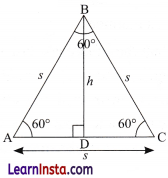
AB = BC (sides of equilateral triangle)
BD = BD (common side)
∠BDA = ∠BDC (right angle)
Therefore, by the RHS congruence rule ∆ABD ≅ ∆CBD.
Hence, AD = DC
⇒ AD = DC = \(\frac {s}{2}\)
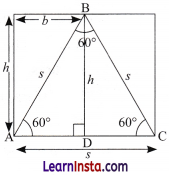
Now, in the right-angled triangle ADB, using the Baudhayana Theorem, we get
h2 + \(\left(\frac{s}{2}\right)^2\) = s2
⇒ h2 = \(s^2-\frac{s^4}{4}=\frac{3 s^2}{4}\)
⇒ h = \(\frac{\sqrt{3}}{2} s\)
So, the area of ∆ADB is:
Given sidelength s = 6 units
⇒ \(\frac {s}{2}\) = 3 units
and h = \(\frac{\sqrt{3}}{2} s\)
= \(\frac{\sqrt{3}}{2}\) × 6
= 3√3 units
Now, draw a rectangle on base AD = \(\frac {5}{2}\)
so that the length of rectangle = h = 3√3 units
Now, area of rectangle = l × b
= 3 × 3√3
= 9√3 units
So, area of triangle ABD = \(\frac{9 \sqrt{3}}{2}\) sq. units (half of rectangle)
So, area of equilateral triangle ABC = 2 × \(\frac{9 \sqrt{3}}{2}\) sq. units = 9√3 sq. units
Puzzle Time (Page 54)
Question 1.
There are 3 closed boxes — one containing only red balls, the second containing only blue balls, and the third containing only green balls. The boxes are labelled RED, BLUE, and GREEN such that ‘no box has the correct label. We need to find which label goes with which box. How can this be done if we are allowed to open only one box?

Solution:
Since none of the boxes has the correct label, every label is wrong. First, open any box, suppose labelled RED. This box cannot contain red balls, so the balls inside must be either blue or green. Suppose the balls inside are blue. Then the box labelled RED actually contains blue balls. The box labelled BLUE cannot contain blue balls (because its label is wrong), so it must contain red balls or green balls. The remaining box labelled GREEN will then contain red balls. So, the red box contains a blue ball, the green box contains a red ball, and the blue box contains a green ball. Thus, by opening only one box and using the fact that all labels are incorrect, we can correctly identify the contents of all three boxes.