Students often refer to Ganita Prakash Class 8 Solutions and Class 8 Maths Chapter 6 We Distribute, Yet Things Multiply NCERT Solutions Question Answer to verify their answers.
NCERT Class 8 Maths Chapter 6 We Distribute, Yet Things Multiply Solutions Question Answer
Ganita Prakash Class 8 Chapter 6 Solutions We Distribute, Yet Things Multiply
NCERT Class 8 Maths Ganita Prakash Chapter 6 We Distribute, Yet Things Multiply Solutions Question Answer
6.1 Some Properties of Multiplication
NCERT In-Text Questions (Pages 136-141)
Increments in Products
Consider the multiplication of two numbers, say, 23 × 27.
Question 1.
By how much does the product increase if the first number (23) is increased by 1?
Solution:
23 × 27 = 621
Now, (23 + 1) × 27 = 24 × 27 = 648
Difference = 648 – 621 = 27
∴ The product increases by 27.
Question 2.
What if the second number (27) is increased by 1?
Solution:
23 × 27 = 621
Now, 23 × (27 + 1) = 23 × 28 = 644
Difference = 644 – 621 = 23.
∴ The product increases by 23.

Question 3.
How about when both numbers are increased by 1?
Solution:
23 × 27 = 621
Now, (23 + 1)(27 + 1) = 24 × 28 = 672
Difference = 672 – 621 = 51
∴ The product increases by 51.
Question 4.
Do you see a pattern that could help generalise our observations to the product of any two numbers?
Solution:
Yes, we observe that:
- When one number increases by 1, the product increases by the value of the other number.
- When both numbers are increased by 1, the increase in the product = the Sum of the given numbers + 1.
Question 5.
What would we get if we had expanded (a + 1)(b + 1) by first taking (b + 1) as a single term? Try it?
Solution:
Consider (a + 1)(b + 1)
First, take (a + 1) as a single term and distribute it over (b + 1), we have
(a + 1) (b + 1) = (a + 1)b + (a + 1)1
= ab + b + a + 1
= ab + a + b + 1
Take (b + 1) as a single term and distribute it over (a + 1), we have
(b + 1)(a + 1) = (b + 1)a + (b + 1)1 = ab + a + b + 1
Hence, the final result remains unchanged, no matter whether we begin by expanding (a + 1) or (b + 1) first.
Question 6.
Will the product always increase? Find 3 examples where k is the product that decreases.
Solution:
Do it yourself.
Question 7.
Use Identity 1 to find how the product changes when
(i) One number is decreased by 2 and the other increased by 3;
(ii) Both numbers are decreased, one by 3 and the other by 4.
Solution:
Let the two numbers be a and b, and their product is ab.
(i) Now, one number is decreased by 2, and the other number is increased by 3.
Then the new numbers are (a – 2) and (b + 3).
New product = (a – 2) (b + 3)
= ab + 3a + (-2)b + (-2)3
= ab + 3a – 2b – 6
∴ Change in product = (ab + 3a – 2b – 6) – ab = 3a – 2b – 6
So, the product changes by 3a – 2b – 6.
(ii) Now both numbers are decreased, one by 3 and the other by 4.
So, the new numbers are (a – 3) and (b – 4).
New product = (a – 3) (b – 4)
= ab + a(-4) + (-3)b + (-3)(-4)
= ab – 4a – 3b + 12
∴ Change in product = (ab – 4a – 3b + 12) – ab = -4a – 3b + 12
So, the product changes by -4a – 3b + 12.
Figure it Out (Pages 142-143)
Question 1.
Observe the multiplication grid below. Each number inside the grid is formed by multiplying two numbers. If the middle number of a 3 × 3 frame is given by the expression pq, as shown in the figure, write the expressions for the other numbers in the grid.
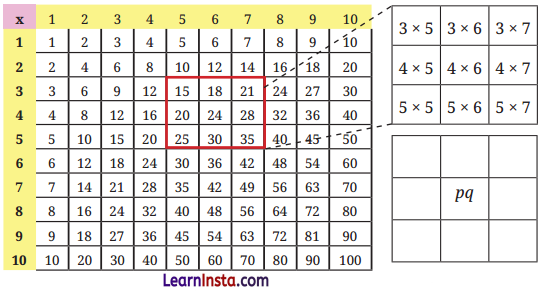
Solution:
The multiplication grid is made by multiplying the row number by the column number.
So, the value at any position in the grid is: Row number × Column number
Given the centre value of the 3 × 3 frame is pq (pth row × qth column).
In a 3 × 3 frame, the rows and columns around the centre are one less and one more than p and q.
So, the rows are: (p – 1), p, and (p + 1), and the columns are: (q – 1), q, and (q + 1)
∴ Expressions for the other numbers in the grid:
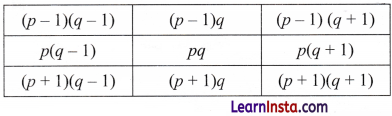
Question 2.
Expand the following products.
(i) (3 + u) (v – 3)
(ii) \(\frac {2}{3}\) (15 + 6a)
(iii) (10a + b) (10c + d)
(iv) (3 – x)(x – 6)
(v) (-5a + b) (c + d)
(vi) (5 + z) (y + 9)
Solution:
(i) We have (3 + u) (v – 3)
= 3(v – 3) + u(v – 3)
= 3v – 9 + uv – 3u
= 3v – 3u + uv – 9
(ii) Here, \(\frac {2}{3}\)(15 + 6a)
= \(\frac {2}{3}\) × 15 + \(\frac {2}{3}\) × 6a
= 10 + 4a
(iii) Here, (10a + b) (10c + d)
= 10a × 10c + 10a × d + b × 10c + b × d
= 100ac + 10ad + 10bc + bd
(iv) Here, (3 – x) (x – 6)
= 3(x – 6) – x(x – 6)
= 3x – 18 – x2 + 6x
= -x2 + 9x – 18
(v) We have, (-5a + b) (c + d)
= -5a(c + d) + b(c + d)
= -5ac – 5ad + bc + bd
(vi) We have, (5 + z) (y + 9)
= 5(y + 9) + z(y + 9)
= 5y + 45 + yz + 9z
Question 3.
Find 3 examples where the product of two numbers remains unchanged when one of them is increased by 2 and the other is decreased by 4.
Solution:
Example 1: 1 × 6 = 6
Now, (1 + 2) × (6 – 4) = 3 × 2 = 6
Example 2: 3 × 10 = 30
Now, (3 + 2) × (10 – 4) = 5 × 6 = 30
Example 3: 5 × 14 = 70
Now, (5 + 2) × (14 – 4) = 7 × 10 = 70
Question 4.
Expand (i) (a + ab – 3b2) (4 + b), and (ii) (4y + 7) (y + 11z – 3).
Solution:
(i) (a + ab + 3b2) (4 + b)
= (a + ab – 3b2)4 + (a + ab – 3b2)b
= 4a + 4ab – 12b2 + ab + ab2 – 3b3
= -3b3 + (ab2 – 12b2) + (4ab + ab) + 4a
= -3b3 + (a – 12)b2 + 5ab + 4a (Combining like terms)
(ii) (4y + 7)(y + 11z – 3)
= (4y + 7)y + (4y + 7)11z – (4y + 7)3
= 4y2 + 7y + 44yz + 77z – 12y – 21
= 4y2 + (7y – 12y) + 44yz + 77z – 21 (Combining like terms)
= 4y2 – 5y + 44yz + 77z – 21
Question 5.
Expand (i) (a-b) (a + b), (ii) (a-b) (a2 + ab + b2), and (iii) (a-b)(a3 + a2b + ab2 + b3). Do you see a pattern? What would be the next identity in the pattern that you see? Can you check it by expanding?
Solution:
(i) (a – b)(a + b)
= (a – b)a + (a – b)b
= a2 – ab + ab – b2
= a2 – b2
(ii) (a – b)(a2 + ab + b2)
= (a – b)a2 + (a – b)ab + (a – b)b2
= a3 – a2b + a2b – ab2 + ab2 – b3
= a3 – b3
(iii) (a – b)(a3 + a2b + ab2 + b3)
= (a – b)a3 + (a – b)a2b + (a – b)ab2 + (a – b)b3
= a4 – a3b + a3b – a2b2 + a2b2 – ab3 + ab3 – b4
= a4 – b4
Yes, we observe that each expression is of the form:
\((a-b)\left(a^n+a^{n-1} b+a^{n-2} b^2+a^{n-3} b^3+\ldots+b^n\right)\)
Thus, in general, we can say that
\((a-b)\left(a^{n-1}+a^{n-2} b+a^{n-3} b^2 \ldots+b^{n-1}\right)=a^n-b^n\)
The next identity would be:
(a – b) (a4 + a3b + a2b2 + ab3 + b4) = a5 – b5
NCERT In-Text Questions (Pages 143-144)
Fast Multiplication Using the Distributive Property
Question 1.
Describe a general rule to multiply a number (of any number of digits) by 11 and write the product in one line. Evaluate
(i) 94 × 11
(ii) 495 × 11
(iii) 3279 × 11
(iv) 4791256 × 11
Solution:
To multiply any number by 11, follow these steps:
- Write the last digit (units place) of the number as the rightmost digit of the answer.
- Add each digit to the digit just before it, moving from right to left. Write each sum.
- Write the first digit (leftmost) of the number as the leftmost digit of the answer.
- Carry over if any sum is 10 or more.
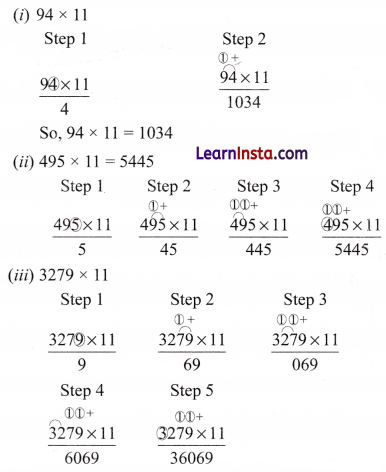
(iv) 4791256 × 11 = 52703816
Question 2.
Can we come up with a similar rule for multiplying a number by 101?
Solution:
Yes, Because, number × 101 = Number × (100 + 1) = Number × 100 + Number
Question 3.
Use this to multiply 3874 × 101 in one line.
Solution:
3874 × 101
3874 × 100 + 3874
Therefore,

Question 4.
What could be a general rule to multiply a number by 101 and write the product in one line? Extend this rule for multiplication by 1001, 10001,…
Solution:
General rule for multiplying any number by 101:
Write the original number.
Add two zeros at the end of it (i.e., multiply by 100).
Below it, write the original number (i.e., add the original number).
Add both numbers.
This works, since
Number × 101 = Number × (100 + 1) = Number × 100 + Number
Similarly, the rule for multiplying by 1001, 10001,…
Write the original number.
Add the same number of zeros at the end as there are zeros in the multiplier (2 zeros for 101, 3 zeros for 1001, 4 zeros for 10001,…).
Write the original number below this.
Add both numbers to get the final answer.
This works, since
Number × 1001 = Number × (1000 + 1) = Number × 1000 + Number
Question 5.
Use this to find
(i) 89 × 101
(ii) 949 × 101
(iii) 265831 × 1001
(iv) 1111 × 1001
(v) 9734 × 99
(vi) 23478 × 999
Solution:
(i) 89 × 101
= 89 × (100 + 1)
= 8900 + 89
= 8989
(ii) 949 × 101
= 949 × (100 + 1)
= 94900 + 949
= 95849
(iii) 265831 × 1001
= 265831 × (1000 + 1)
= 265831000 + 265831
= 266096831
(iv) 1111 × 1001
= 1111 × (1000 + 1)
= 1111000 + 1111
= 1112111
(v) 9734 × 99
= 9734 × (100 – 1)
= 973400 – 9734
= 963666
(vi) 23478 × 999
= 23478 × (1000 – 1)
= 23478000 – 23478
= 23454522
6.2 Special Cases of the Distributive Property
NCERT In-Text Questions (Pages 145-147)
Square of the Sum/Difference of Two Numbers
Question 1.
What if we write 652 as (30 + 35) ^2 or (52 + 13) ^2? Draw the figures and check the area that you get.
Solution:
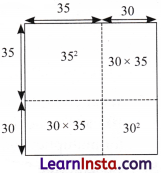
If we write 65 as (30 + 35), then the area of the square of side length 65 is the sum of the areas of all its constituent parts. We get
652 = (30 + 35)2
= 302 + 2 × (30 × 35) + 352
= 900 + 2100 + 1225
So, the area of the square is 4225 sq. units.
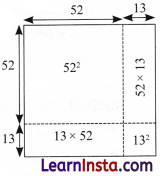
Now, if we write 65 as (52 + 13), then the area of the square of sidelength 65 is the sum of the areas of all its constituent parts.
So, we get 652 = (52 + 13)2
= 522 + 2 × (52 × 13) + 132
= 2704 + 1352 + 169
= 4225
So, the area of the square is 4225 sq. units.
Question 2.
If a and b are any two integers, is (a + b)2 always greater than a2 + b2? If not, when is it greater?
Solution:
We know that (a + b)2 = a2 + 2ab + b2
Now, compare this with a2 + b2: (a + b)2 > a2 + b2
⇒ a2 + 2ab + b2 > a2 + b2, it is possible only if 2ab > 0 or ab > 0
Case I: If both a and b have the same sign, then ab > 0.
So, (a + b)2 > a2 + b2
Case II: If either a or b is 0, then ab = 0
So, (a + b)2 = a2 + b2
Case III: If a and b have opposite signs, then ab < 0.
So, (a + b)2 < a2 + b2
Question 3.
Use Identity 1A to find the values of 1042 and 372.
(Hint: Decompose 104 and 37 into sums or differences of numbers whose squares are easy to compute.)
Solution:
We use identify 1 A: (a + b)2 = a2 + 2ab + b2
1042 = (100 + 4)2
= 1002 + 2 × 100 × 4 + 42
= 10000 + 800 + 16
= 10816
372 = (30 + 7)2
= 302 + 2 × 30 × 7 + 72
= 900 + 420 + 49
= 1369
Question 4.
Use Identity 1A to write the expressions for the following.
(i) (m + 3)2
(ii) (6 + p)2
Solution:
(i) (m + 3)2
= m2 + 2 × m × 3 + 32
= m2 + 6m + 9
(ii) (6 + p)2
= 62 + 2 × 6 × p + p2
= 36 + 12p + p2
Question 5.
Expand (3j + 2k)2 using both the identity and by applying the distributive property.
Solution:
Using the Distributive Property
(3j + 2k)2 = (3j + 2k)(3j + 2k)
= (3j × 3j) + (2k + 3j) + (3j × 2k) + (2k × 2k)
= (3j)2 + 2(3j × 2k) + (2k)2
= 9j2 + 12jk + 4k2
Using the Identity:
(3j + 2k)2 = (3j)2 + 2 × (3j × 2k) + (4k)2 = 9j2 + 12jk + 4k2
Question 6.
Find the general expansion of (a-b)2 using geometry, as we did for 552.
Solution:
Let us assume a square with side length a units.
To find the area of a square of sidelength (a-b) units by taking the area of a square of sidelength a and removing the areas of the two rectangles, of sidelengths b and a, and adding the area of the small square of sidelength b to this expression.
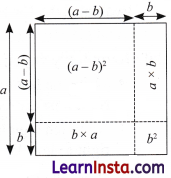
(a – b)2 = a2 – (b × a) – (a × b) + b2
= a2 – ab – ab + b2
= a2 – 2ab + b2
Question 7.
Use the identity (a-b)2 to find the values of (a) 992 and (b) 582.
Solution:
(a) 992 = (100 – 1)2
= 1002 – 2 × 100 × 1 + 12
= 10000 – 200 + 1
= 9801
(b) 582 = (60 – 2)2
= 602 – 2 × 60 × 2 + 22
= 3600 – 240 + 4
= 3364
Question 8.
Expand the following using both Identity 1B and by applying the distributive property.
(i) (b – 6)2
(ii) (-2a + 3)2
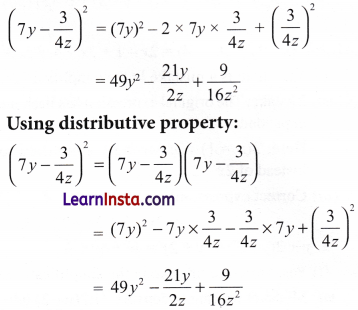
(iii) \(\left(7 y-\frac{3}{4 z}\right)^2\)
Solution:
(i) Using the Identity 1B:
(b – 6)2 = b2 – 2 × b × 6 + 62 = b2 – 12b + 36
Using the distributive property:
(b – 6)2 = (b – 6) (b – 6)
= (b)2 – 6b – b6 + (6)2
= b2 – 12b + 36
(ii) Using Identity 1B:
(-2a + 3)2 = (2a)2 – 2 × 2a × 3 + 32 = 4a2 – 12a + 9
Using the distributive property:
(-2a + 3)2 = (-2a + 3) (-2a + 3)
= (-2a)2 + (-2a)3 + 3(-2a) + 32
= 4a2 – 6a – 6a + 9
= 4a2 – 12a + 9
(iii) Using Identity IB:
NCERT In-Text Questions (Pages 147-149)
Investigating Patterns
Question 1.
Take a pair of natural numbers. Calculate the sum of their squares. Can you write twice this sum as a sum of two squares?
Solution:
Let us assume two natural numbers, 8 and 9.
- The squares of 8 and 9 are 64 and 81, respectively.
- Their sum is 64 + 81 = 145
- Twice this sum is 2 × 145 = 290
- Now, 290 = 289 + 1 = 172 + 12
Question 2.
Use Identity 1C to calculate 98 × 102 and 45 × 55.
Solution:
98 × 102 = (100 – 2) (100 + 2)
= 1002 – 22 [∵ (a + b)(a – b) = a2 – b2]
= 10000 – 4
= 9996
45 × 55 = (50 – 5) (50 + 5)
= 502 – 52
= 2500 – 25
= 2475
Question 3.
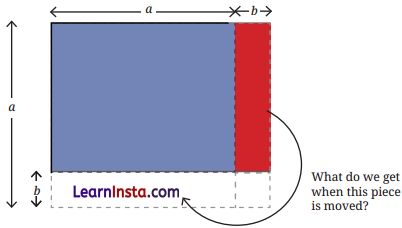
Show that (a + b) × (a – b) = a2 – b2 geometrically.
Hint:
Solution:
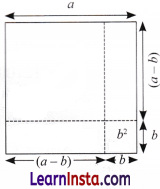
1. Draw a square whose sidelength is a. Its area is a2.
2. Inside this large square, remove a smaller square from one corner with sidelength b. Its area is b2.
3. The remaining area after removing the smaller square = a2 – b2.
4. The remaining area can be cut and rearranged into two rectangles:
- One rectangle has dimensions: a × (a – b)
- The other rectangle has dimensions: b(a-b)
5. Now, place the second rectangle next to the first rectangle along their common side (a – b).
Together, they form a new rectangle of dimensions: (a + b) × (a – b)
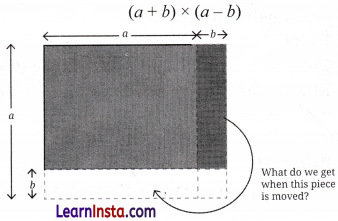
∴ The area of new rectangle = (a + b) × (a – b)
Since this new rectangle is made by rearranging the area of a large square after removing the small square.
So, both areas must be equal.
∴ (a + b) × (a – b) = a2 – b2
Figure it Out (Page 149)
Question 1.
Which is greater: (a-b)2 or (b-a)2? Justify your answer.
Solution:
We know that, (a – b)2 = a2 – 2ab + b2 …..(i)
Now, (b – a)2 = b2 – 2ba + a2 = a2 – 2ab + b2 …(ii)
From (i) and (ii), we see that (a-b)2 = (b-a)2
Question 2.
Express 100 as the difference of two squares.
Solution:
Let two numbers be a and b.
A.T.B., a2 – b2 = 100
⇒ (a + b) × (a – b) = 100
So, we need to find two factors of 100 whose product is 100.
Let us take, a + b = 50 …..(i)
and a – b = 2 …..(ii)
By solving (i) and (ii), we get a = 26 and b = 24
So, 262 – 242 = 100
Question 3.
Find 4062, 722, 1452, 10972, and 1242 using the identities you have learnt so far.
Solution:
4062 = (400 + 6)2
= 4002 + 2 × (400 × 6) + 62
= 160000 + 4800 + 36
= 164836
722 = (70 + 2)2
= 702 + 2 × (70 × 2) + 22
= 4900 + 280 + 4
= 5184
1452 = (150 – 5)2
= 1502 – 2 × (150 × 5) + 52
= 22500 – 1500 + 25
= 21025
10972 = (1100 – 3)2
= 11002 – 2 × (1100 × 3) + 32
= 1210000 – 6600 + 9
= 1203409
1242 = (120 + 4)2
= 1202 + 2 × (120 × 4) + 42
= 14400 + 960 + 16
= 15376
Question 4.
Do Patterns 1 and 2 hold only for counting numbers? Do they hold for negative integers as well? What about fractions? Justify your answer.
Solution:
No. These patterns do not hold only for counting numbers.
They are based on algebraic identities, which are true for all types of numbers (like negative numbers, fractions, etc.).
For negative integers: Let a = -2 and b = -3
Pattern I:
LHS: 2(a2 + b2) = 2{(-2)2 + (-3)2}
= 2(4 + 9)
= 26
RHS: (a + b)2 + (a – b)2 = {(-2) + (-3)}2 + {(-2) – (-3)}2
= (-5)2 + 12
= 25 + 1
= 26
∴ LHS = RHS
Pattern II:
LHS: (a + b) × (a – b) = {(-2) + (-3)} × {(-2) – (-3)} = (-5) × 1 = -5
RHS: a2 – b2 = (-2)2 – (-3)2 = 4 – 9 = -5
∴ LHS = RHS
Yes, the pattern holds for negative integers as well.
For fraction: Let a = \(\frac {1}{2}\) and b = \(\frac {3}{2}\)
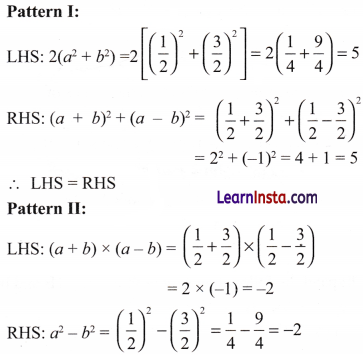
∴ LHS = RHS
Yes, these patterns also hold for fractions.
6.3 Mind the Mistake, Mend the Mistake
NCERT In-Text Questions (Page 150)
Question 1.
We have expanded and simplified some algebraic expressions below to their simplest forms.
(i) Check each of the simplifications and see if there is a mistake.
(ii) If there is a mistake, try to explain what could have gone wrong.
(iii) Then write the correct expression.
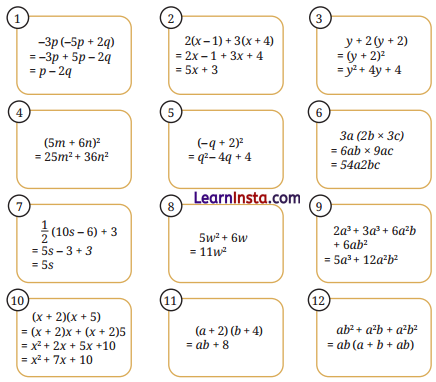
Solution:
1. The given expression is: -3p(-5p + 2q) = -3p + 5p – 2q = p – 2q
(i) Yes, there is a mistake in the simplification.
(ii) Mistake: The original expressions involve multiplication, but it has been wrongly simplified as if they involved only addition and subtraction of terms.
(iii) Correct expression:
Apply the distributive property:
-3p(-5p + 2q) = (-3p) × (-5p) + (-3p) (2q) = 15p2 – 6pq
2. 2(x – 1) + 3(x + 4) = 2x – 1 + 3x + 4 = 5x + 3
(i) Yes, there is a mistake in the simplification.
(ii) Mistake: The original expression has been incorrectly expanded.
Here, 2(x – 1) was wrongly simplified to 2x – 1 instead of 2x – 2.
(iii) Correct expression:
2(x – 1) + 3(x + 4) = 2x – 2 + 3x + 12 = 5x + 10
3. y + 2(y + 2) = (y + 2)2 = y2 + 4y + 4
(i) Yes, there is a mistake in the simplification.
(ii) Mistake: we cannot convert y + 2(y + 2) into (y + 2)2.
(iii) Correct expression:
y + 2(y + 2) = y + 2y + 4 = 3y + 4
4. (5m + 6n)2 = 25m2 + 36n2
(i) Yes, there is a mistake in the simplification.
(ii) Mistake: The Middle term is missing, as we have learnt to identify 1A.
(iii) Correct expression:
(5m + 6n)2 = (5m)2 + 2(5m × 6n) + (6n)2 = 25m2 + 60mn + 36n2
5. (-q + 2)2 = q2 – 4q + 4
There is no mistake.
6. 3a(2b × 3c) = 6ab × 9ac = 54a2bc
(i) Yes, there is a mistake in the simplification.
(ii) Mistake: 3a(2b × 3c) means multiply 3a with the product of 2b and 3c, but here the next step multiplies 6ab × 9ac, which was never the part of the original expression.
Also, multiplying like terms must follow correct algebraic rules.
(iii) Correct expression: 3a(2b × 3c) = 18abc
7. \(\frac {1}{2}\)(10s – 6) + 3 = 5s – 3 + 3 = 5s
There is no mistake.
8. 5w2 + 6w = 11w2
(i) Yes, there is a mistake in the simplification.
(ii) Mistake: This is incorrect because w2 and w are unlike terms, so they cannot be added.
(iii) Correct expression:
5w2 + 6w = 5w2 + 6w
9. 2a3 + 3a3 + 6a2b + 6ab2 = 5a3 + 12a2b2
(i) Yes, there is a mistake in the simplification.
(ii) Mistake: 6a2b + 6ab2 were wrongly added as 12a2b2.
This is not valid because the terms are not like terms.
(iii) Correct expression:
2a3 + 3a3 + 6a2b + 6ab2 = 5a3 + 6a2b + 6ab2
10. (x + 2)(x + 5) = (x + 2)x + (x + 2)5
= x2 + 2x + 5x + 10
= x2 + 7x + 10
There is no mistake.
11. (a + 2)(b + 4) = ab + 8
(i) Yes, there is a mistake in the simplification.
(ii) Mistake: This is incorrect. Only the outermost and innermost terms seem to have been multiplied. They skipped the middle terms.
(iii) Correct expression:
(a + 2)(b + 4) = (a + 2 )b + (a + 2)4 = ab + 2b + 4a + 8
12. ab2 + a2b + a2b2 = ab(a + b + ab)
There is no mistake.
6.4 This Way or That Way, All Ways Lead to the Bay
NCERT In-Text Questions (Pages 150-154)
Question 1.
Use this formula to find the number of circles in Step 15.
Solution:
To find the number of circles in step 15, we use the given expressions k2 + 2k.
Substituting k = 15 in the given expression, we get
152 + 2(15) = 225 + 30 = 255
So, the number of circles in step 15 is 255.
Question 2.
Consider the pattern made of square tiles in the picture below.
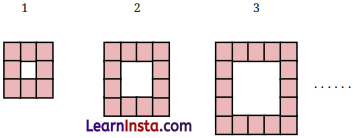
How many square tiles are there in each figure?
Solution:
In Figure 1, the number of tiles = 8
In Figure 2, the number of tiles = 12
In Figure 3, the number of tiles = 16
Question 3.
How many are there in Step 4 of the sequence? What about Step 10?
Solution:
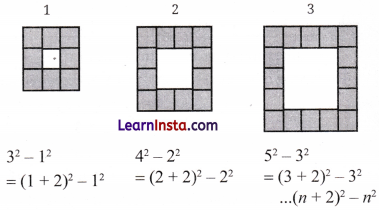
So, the expression is (n + 2)2 – n2 ……(i)
For the number of squares in steps 4, substitute n = 4 in (i).
∴ (n + 2)2 – n2 = (4 + 2)2 – 42 = 36 – 16 = 20
Thus, there will be 20 squares in step 4.
The number of square tiles in step 10 will be:
(10 + 2)2 – 102 = 144 – 100 = 44
Question 4.
Write an algebraic expression for the number of tiles in Step n. Share your methods with the class. Can you find more than one method to arrive at the answer?
Solution:
An expression for the number of tiles in step n = (n + 2)2 – n2
Another method to find the number of tiles:
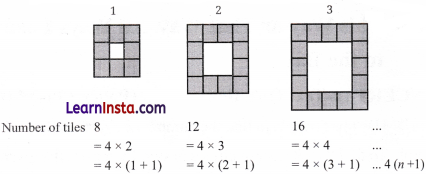
Since both methods describe the same pattern, they should give the same result.
So simplify each expression:
(n + 2)2 – n2 = n2 + 4n + 4 – n2 = 4n + 4
4(n + 1) = 4n + 4
∴ When we simplified, both methods gave the same result. i.e., 4n + 4.
Question 5.
By expanding both expressions, check that (m + n)2 – 4mn = (n – m)2.
Solution:
LHS = (m + n)2 – 4mn
= (m2 + 2mn + n2) – 4mn
= m2 – 2mn + n2
RHS = (n-m)2
= n2 – 2mn + m2
= m2 – 2mn + n2
∴ LHS = RHS
Question 6.
By expanding the expressions, verify that all three expressions are equivalent. If x = 8 and y = 3, find the area of the shaded region.
Solution:
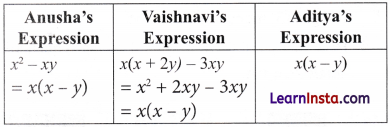
Thus, all expressions are equivalent to x(x-y).
Now, the area of the shaded region = the Area of the three rectangles
= xy + xy + xy
= 3xy
= 3 × 8 × 3 [∵ x = 8 and y = 3 (Given)]
= 72 sq. units
Question 7.
Write an expression for the area of the dashed region in the figure below. Use more than one method to arrive at the answer. Substitute p = 6, r = 3.5, and s = 9, and calculate the area.
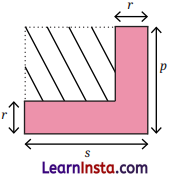
Solution:
Method 1:
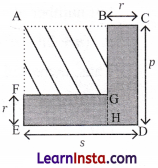
EH = ED – HD = s – r
∴ Required area = Area of ACDE – Area of BCDH – Area of EFGH
= ps – pr – (s – r)r
= ps – pr – sr + r2
= ps – (p + s)r + r2 ……(i)
Method 2:
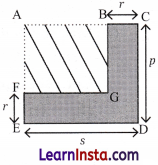
AB = AC – BC = s – r (∵ AC = ED)
and AF = AE – FE = p – r (∵ AE = CD)
Required area = Area of ABGF
= AB × AF
= (s – r) × (p – r)
= ps – sr – pr + r2
= ps – (p + s)r + r2
Area: Substitute p = 6, r = 3.5 and s = 9 in (ii), we get
Area = 6 × 9 – (6 + 9) × (3.5) + (3.5)2
= 54 – 52.5 + 12.25
= 13.75
Figure it Out (Pages 154-156)
Question 1.
Compute these products using the suggested identity.
(i) 462 using Identity 1A for (a + b)2
(ii) 397 × 403 using Identity 1C for (a + b)(a – b)
(iii) 912 using Identity 1B for (a-b)2
(iv) 43 × 45 using Identity 1C for (a + b) (a – b)
Solution:
(i) 462 = (40 + 6)2
= 402 + 2 × 40 × 6 + 62 [∵ (a + b)2 = a2 + 2ab + b2]
= 1600 + 480 + 36
= 2116
(ii) 397 × 403 = (400 – 3) (400 + 3) [∵ (a + b) × (a – b) = a2 – b2]
= 4002 – 32
= 160000 – 9
= 159991
(iii) 912 = (100 – 9)2
= 1002 – 2 × 100 × 9 + 92 [∵ (a – b)2 = a2 + b2 – 2ab]
= 10000 – 1800 + 81
= 8281
(iv) 43 × 45 = (44 – 1) (44 + 1) [∵ a2 – b2 = (a + b) × (a – b)]
= 442 – 12
= 1936 – 1
= 1935
Question 2.
Use either a suitable identity or the distributive property to find each of the following products.
(i) (p – 1) (p + 11)
(ii) (3a – 9b) (3a + 9b)
(iii) -(2y + 5) (3y + 4)
(iv) (6x + 5y)2
(v) \(\left(2 x-\frac{1}{2}\right)^2\)
(vi) (7p) × (3r) × (p + 2)
Solution:
(i) (p – 1)(p + 11)
= (p – 1)p + (p – 1)11
= p2 – p + 11p – 11
= p2 + 10p – 11
(ii) (3a – 9b)(3a + 9b)
= (3a)2 – (9b)2
= 9a2 – 81b2
(iii) -(2y + 5)(3y + 4)
= -(2y + 5)3y – (2y + 5)4
= -6y2 – 15y – 8y – 20
= -6y2 – 23y – 20
(iv) (6x + 5y)2
= (6x)2 + 2(6x)(5y) + (5y)2
= 36x2 + 60xy + 25y2
(v) \(\left(2 x-\frac{1}{2}\right)^2=(2 x)^2-2(2 x)\left(\frac{1}{2}\right)+\left(\frac{1}{2}\right)^2\)
= 4x2 – 2x + \(\frac {1}{4}\)
(vi) (7p) × (3r) × (p + 2)
= 21pr(p + 2)
= 21pr × p + 21pr × 2
= 21p2r + 42pr
Question 3.
For each statement, identify the appropriate algebraic expression(s).
(i) Two more than a square number.
2 + s
(s + 2)2
s2 + 2
s2 + 4
2s2
22s
(ii) The sum of the squares of two consecutive numbers
m2 + n2
(m + n)2
m2 + 1
m2 + (m + 1)2
m2 + (m – 1)2
(m + (m + 1))2
(2m)2 + (2m + 1)2
Solution:
(i) s2 + 2
(ii) m2 + (m + 1)2, m2 + (m – 1)2, (2m)2 + (2m + 1)2
Question 4.
Consider any 2 by 2 square of numbers in a calendar, as shown in the figure.
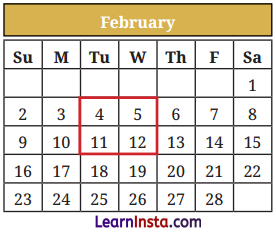
Find products of numbers lying along each diagonal — 4 × 12 = 48, 5 × 11 = 55. Repeat this process for the other two 2 × 2 squares. What do you observe about the diagonal products? Explain why this happens.
Hint: Label the numbers in each 2 by 2 square as
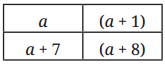
Solution:
In the highlighted square in the question, the product of each diagonal number is 48 and 55.
Difference = 55 – 48 = 7
Now, let us consider a general 2 × 2 square and label the numbers in each 2 × 2 square as
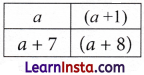
This pattern is consistent because of the structure of the calendar; each date in a row increases by 1, and each date in a column increases by 7.
Product of first diagonal: a(a + 8) = a2 + 8a
Product of second diagonal: (a + 1)(a + 7)
= a2 + a + 7a + 7
= a2 + 8a + 7
Difference between the two products = (a2 + 8a + 7) – (a2 + 8a)
= a2 + 8a + 7 – a2 – 8a
= 7
So, we observe that the difference between the two diagonal products in any 2 × 2 square on a calendar is always 7.
Question 5.
Verify which of the following statements are true.
(i) (k + 1)(k + 2) – (k + 3) is always 2.
(ii) (2q + 1) (2q – 3) is a multiple of 4.
(iii) Squares of even numbers are multiples of 4, and squares of odd numbers are 1 more than multiples of 8.
(iv) (6n + 2)2 – (4n + 3)2 is 5 less than a square number.
Solution:
(i) Simplify the given expression:
(k + 1)(k + 2) – (k + 3)
= k2 + 2k + k + 2 – k – 3
= k2 + 2k – 1
For k = 1, we have
k2 + 2k – 1 = 12 + 2(1) – 1 = 2
For k = 2, we have
k2 + 2k – 1 = 22 + 2(2) – 1 = 7
For k = 3, we have
k2 + 2k – 1 = 32 + 2(3) – 1 = 14
So, the given statement is false.
(ii) (2q + 1)(2q – 3)
= (2q + 1) × (2q) – (2q + 1) × 3
= 4q2 + 2q – 6q – 3
= 4q2 – 4q – 3
Here, 4q2 and -4q are multiples of 4, but -3 is not a multiple of 4.
So, the given expression is not a multiple of 4.
∴ The given statement is false.
(iii) Let 2n is an even number and (2n + 1) is an odd number.
Square of 2n = (2n)2 = 4n2, which is a multiple of 4.
Now, square of (2n + 1) = (2n + 1)2
= 4n2 + 2 × 2n × 1 + 1
= 4n2 + 4n + 1
On subtracting 1 from 4n2 + 4n + 1
= 4n2 + 4n + 1 – 1
= 4n2 + 4n
= 4n(n + 1)
∴ Among any two consecutive integers n and n + 1, one of them is even.
So, the product n(n + 1) is always even, i.e., it is divisible by 2.
Let n(n + 1) = 2k for some integer k.
4n(n + 1) = 4 × 2k = 8k
So, 4n(n + 1) is always divisible by 8.
Hence, the given statement is true.
(iv) (6n + 2)2 – (4n + 3)2
= [(6n + 2) + (4n + 3)] × [(6n + 2) – (4n + 3)]
= (10n + 5) × (2n – 1)
= 20n2 – 5
Now, on adding 5 in the above expression, we get 20n2 – 5 + 5 = 20n2
If n = 1; 20(1)2 = 20, which is not a perfect square.
So, the given statement is false.
Question 6.
A number leaves a remainder of 3 when divided by 7, and another number leaves a remainder of 5 when divided by 7. What is the remainder when their sum, difference, and product are divided by 7?
Solution:
Let the first number be 7a + 3 and the second number be 7b + 5.
Sum of the numbers: (7a + 3) + (7b + 5)
= 7a + 7b + 8
= 7a + 7b + 7 + 1
= 7(a + b + 1) + 1
∴ The remainder = 1
Difference of the numbers = (7a + 3) – (7b + 5)
= 7a + 3 – 7b – 5
= 7(a – b) – 2
∴ The remainder cannot be negative, so we add 7 to (-2) to get a positive remainder.
So, the remainder = 7 + (-2) = 5
Product of the numbers: (7a + 3)(7b + 5)
= 7a × 7b + 7a × 5 + 7b × 3 + 5 × 3
= 7(7ab + 5a + 3b + 2) + 1
∴ The remainder = 1
Question 7.
Choose three consecutive numbers, square the middle one, and subtract the product of the other two. Repeat the same with other sets of numbers. What pattern do you notice? How do we write this as an algebraic equation? Expand both sides of the equation to check that it is a true identity.
Solution:
Let the three consecutive numbers be 3, 4, and 5
A.T.Q. 42 = 16 and 3 × 5 = 15
Difference: 16 – 15 = 1
Choose another set of numbers, say, 7, 8, and 9.
Then, 82 = 64 and 7 × 9 = 63
Difference: 64 – 63 = 1
We observe that the difference is always 1.
Let the three consecutive numbers be (n – 1), n, and n + 1.
A.T.Q., Square of the middle number = n2
Product of the other two numbers = (n – 1) × (n + 1)
Difference: n2 – (n – 1) × (n + 1)
Using the identity (a + b) (a – b) = a2 – b2, we have
(n – 1)(n + 1) = n2 – 1
∴ Difference = n2 – (n – 1) (n + 1) = n2 – n2 + 1 = 1
Therefore, the result is always 1 for any three consecutive numbers.
Question 8.
What is the algebraic expression describing the following steps: add any two numbers? Multiply this by half of the sum of the two numbers. Prove that this result will be half of the square of the sum of the two numbers.
Solution:
Let the two numbers be a and b.
Step 1: a + b
Step 2: (a + b) × \(\frac {1}{2}\) (a + b)
∴ (a + b) × \(\frac {1}{2}\) (a + b) = \(\frac {1}{2}\) (a + b)2
Question 9.
Which is larger? Find out without fully computing the product.
(i) 14 × 26 or 16 × 24
(ii) 25 × 75 or 26 × 74
Solution:
(i) 14 × 26 = (20 – 6) (20 + 6)
= 202 – 62
= 400 – 36
= 364
16 × 24 = (20 – 4) (20 + 4)
= 202 – 42
= 400 – 16
= 384
∵ 384 > 364
∴ 16 × 24 is larger.
(ii) 25 × 75 = (50 – 25) (50 + 25)
= 502 – 252
= 2500 – 625
= 1875
26 × 74 = (50 – 24) (50 + 24)
= 502 – 242
= 2500 – 576
= 1924
∵ 1924 > 1875
∴ 26 × 74 is bigger.
Question 10.
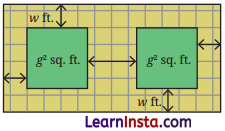
A tiny park is coming up in Dhauli. The plan is shown in the figure. The two square plots, each of area g2 sq. ft., will have a green cover. All the remaining area is a walking path w ft. wide that needs to be tiled. Write an expression for the area that needs to be tiled.
Solution:
Area of each square green plot = g2 sq. ft
side × side = g2
∴ Side of each green plot = g ft.
Length of the park = w + g + w + w + g + w = 4w + 2g
Width of the park = w + g + w = 2w + g
Required area to be tiled = Area of Park (ABCD) – Area of two square green plots
= (4w + 2g) (2w + g) – (g2 + g2)
= 8w2 + 8gw + 2g2 – 2g2
= 8w2 + 8gw
= 8w(w + g) sq. ft
∴ The area to be tiled is 8w(w + g) sq. ft
Question 11.
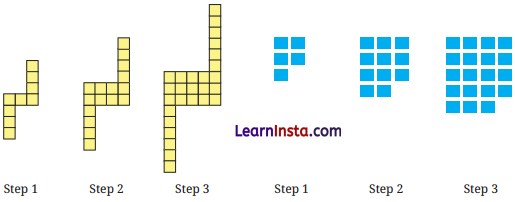
For each pattern shown below,
(i) Draw the next figure in the sequence.
(ii) How many basic units are there in Step 10?
(iii) Write an expression to describe the number of basic units in Step y.
Solution:
Pattern 1 (Yellow Units)
(i) The next figure in the sequence is:
(ii) Number of basic units in step 10 is (10 + 2)2 = 122 = 144.
(iii) Number of basic units in:
Step 1: 9 = 32 = (1 + 2)2
Step 2: 16 = 42 = (2 + 2)2
Step 3: 25 = 52 = (3 + 2)2
∴ Number of basic units in step y = (y + 2)2
Pattern II (Blue units)
(i)
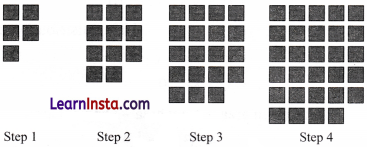
(ii) Number of basic units in step 10 is (10 + 1)2 + 10
= 112 + 10
= 121 + 10
= 131
(iii) Number of basic units in:
Step 1: 5 = 4 + 1 = 22 + 1 = (1 + 1)2 + 1
Step 2: 11 = 9 + 2 = 32 + 2 = (2 + 1)2 + 2
Step 3: 19 = 16 + 3 = 42 + 3 = (3 + 1)2 + 3
∴ Number of basic units in step y = (y + 1)2 + y
It’s Puzzle Time! (Page 158)
Coin Conjoin
Arrange 10 coins in a triangle as shown in the figure below on the left. The task is to turn the triangle upside down by moving one coin at a time. How many moves are needed? What is the minimum number of moves?
A triangle of 3 coins can be inverted (turned upside down) with a single move, and a triangle of 6 coins can be inverted by moving 2 coins.
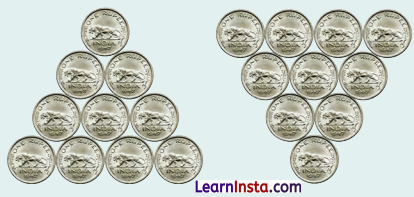
The 10-coin triangle can be flipped with just 3 moves; did you figure out how? Find out the minimum possible moves needed to flip the next bigger triangle having 15 coins. Try the same for bigger triangular numbers.
Is there a simple way to calculate the minimum number of coin moves needed for any such triangular arrangement?
Solution:
Given that a triangle of 3 coins (2 rows) can be inverted in a single move, and a triangle of 6 coins (3 rows) can be inverted by moving 2 coins.
Similarly, a triangle of 10 coins (4 rows) can be inverted by moving 3 coins.
So, every time we add one more row, we only need one more move to flip the triangle.
Thus, if a triangle has n rows, it can be flipped upside down in (n – 1) moves.
A triangle has 15 coins.
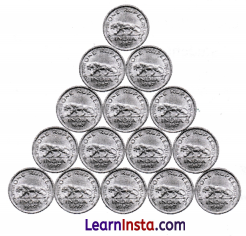
Here, the number of rows is 5. So, the minimum possible moves of the coins needed to flip the triangle are 4.
Therefore, the minimum number of coin moves needed to flip a triangular arrangement of n rows is (n – 1).