Get the simplified Class 8 Maths Extra Questions Part 2 Chapter 2 The Baudhayana Pythagoras Theorem Class 8 Extra Questions and Answers with complete explanation.
Class 8 The Baudhayana Pythagoras Theorem Extra Questions
Class 8 Maths Chapter 2 The Baudhayana Pythagoras Theorem Extra Questions
The Baudhayana Pythagoras Theorem Extra Questions Class 8
Very Short Answer Type Questions
Question 1.
Find the length of the diagonal of a square, whose side is 7 units.
Answer:
Given, the side of the square (a) = 7 units
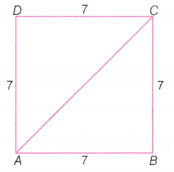
We know that,
AC = a√2
AC = 7√2 units
Hence, the length of diagonal is 7√2 units.
Question 2.
If a triple is (3, 4, 5) then what is the corresponding scaled triple, if k = 3?
Answer:
Given, the Baudhayana triple = (3, 4, 5)
So, a = 3, b = 4 and c = 5
We know that if (a, b, c) is a Baudhayana triple then (ka, kb, kc) is also a Baudhayana triple, where k is any positive integer.
So, for k = 3, the corresponding Baudhayana triple = (3 × 3, 4 × 3, 5 × 3) = (9, 12, 15)
Question 3.
If the area of a square is 100 sq units, what is the length of its diagonal?
Answer:
Given, area of square = 100 sq units
Let a be the length of side.
So, a2 = 100
a = 10 units
We know that the length of diagonal, c = a√2
= 10√2 units

Question 4.
If the sum of the squares of two sides of a triangle is 169, what is the length of the hypotenuse?
Answer:
Let the two equal sides and the hypotenuse of the right-angled triangle be a, b and c.
Given, a2 + b2 = 169
By Baudhayana-Pythagoras theorem,
a2 + b2 = c2
So, c2 = 169 ⇒ c = 13 units
The length of the hypotenuse is 13 units.
Question 5.
If x is bounded by 1.414 < x < 1.415, find the bound for 1000x.
Answer:
We have, 1.414 < x < 1.415
On multiplying by 1000 on every sides,
we get 1.414 × 1000 < x × 1000 < 1.415 × 1000
⇒ 1414 < 1000x < 1415
This is the bound for 100x.
Question 6.
What is the value of n in the equation an + bn = cn for the Baudhayana-Pythagoras theorem to hold?
Answer:
Given, an + bn = cn …(i)
We know that Baudhayana-Pythagoas theorem,
a2 + b2 = c2 …(ii)
From Eqs. (i) and (ii), n = 2
Question 7.
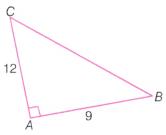
Find the missing sidelengths in the following right-angled triangle.
Answer:
Given, AB = 9 and AC = 12
In right-angled ∆ABC,
BC2 = AB2 + AC2
[by Baudhayana-Pythagoras theorem]
⇒ BC2 = 92 +(12)2
= 81 + 144 = 225
⇒ BC = 15 units
Hence, the missing sidelength is 15 units.
Short Answer Type Questions
Question 1.
In a right-angled triangle, the shorter side is 6 cm and the hypotenuse is 10 cm. What is the length of the third side? Try to construct this triangle to scale, measure the missing side and verify your result using the theorem.
Answer:
Let the two shorter sides and hypotenuse of a right-angled triangle bea,b and c.
Given, a = 6 cm and c = 10 cm
By Baudhayana-Pythagoras theorem,
c2 = a2 + b2
(10)2 = 62 + b2
⇒ 100 = 36 + h2
⇒ b2 = 100 – 36
⇒ b2 = 64
⇒ b = 8 cm
Hence, the length of other side is 8 cm.

From, figure the length of the other side is 8 cm.
Hence verified
Question 2.
If the hypotenuse of an isosceles right-angled triangle is \(\sqrt{50}\) units, find the length of each of the equal sides.
Answer:
Let each equal sides and the hypotenuse of the isosceles right-angled triangle be a and c.
By Baudhayana-Pythagoras theorem,
c2 = a2 + b2
(\(\sqrt{50}\))2 = a2 + a2
⇒ 50 = 2a2
⇒ 25 = a2
⇒ a = 5 units
Hence, each of the equal sides is 5 units.
Question 3.
Find the missing side in each case.
(i) a = 6 cm, b = 8 cm
(ii) a = 15 cm, c = 17 cm
Answer:
(i) Given, a = 6 cm
and b = 8 cm
By Baudhayana-Pythagoras theorem, c2 =a2+b2 => c2 = 62 + 82
⇒ c2 = 36 + 64
⇒ c2 = 100
⇒ c = 10 cm
Hence, the missing side is 10 cm.
(ii) Given, a = 15 cm
and c = 17 cm
By Baudhayana-Pythagoras theorem,
c = a2 + b2
(17)2 = (15)2 + b2
⇒ b2 = (17)2 – (15)2
⇒ b2 = 289 – 225
⇒ b2 = 64
⇒ b = 8 cm
Hence, the missing side is 8 cm.
Question 4.
Check whether (8, 15, 17) is Baudhayana triple or not?
Answer:
Given, Baudhayana triple = (8, 15, 17)
Let a = 8, b = 15 and c = 17.
By Baudhayana-Pythagoras theorem,
c2 = a2 + b2
⇒ LHS = c2
= 172
= 289
⇒ RHS = a2 + b2
= 82 + 152
= 64 + 225
= 289
Hence, given triple is a Baudhayana triple.
Question 5.
Using the relation (n – 1)2 + (2n – 1) = n2 generate a Baudhayana triple by taking 2n – 1 = (17)2.
Answer:
Given the relation,
(n – 1)2 + {2n – 1) = n2
If 2n – 1 = (17)2 = 289
⇒ 2n = 289 + 1
⇒ 2n = 290
⇒ n = 145
So, from Eq. (i),
(145 – 1)2 + (2 × 145 – 1) = (145)2
⇒ (144)2 + (17)2 = (145)2
So, the Baudhayana triple is (17, 144, 145).
Long Answer Type Questions
Question 1.
The hypotenuse of an isosceles right-angled triangle is A/98 units.
(a) Find the length of each equal side.
Answer:
Let each equal sides and the hypotenuse of the
right-angled triangle be a and c.
Given, c = \(\sqrt{98}\)
We know that,
c2 = 2 a2
⇒ 2a2 =98
⇒ a2 =49
⇒ a = 7
(b) Find the upper bound value and lower bound value in which the sidelength lies.
Answer:
From part (a), we have the sidelength = 7
So, it lies between 6 and 8.
6 < 7 < 8
Hence, the upper bound value is 8 and the lower bound value is 6.
Question 2.
Find the value of k such that (5k, 12k, 13k) forms a Baudhayana triple with hypotenuse 39.
Answer:
Given, the Baudhayana triple = (5k, 12k, 13k)
and hypotenuse = 39
Since, hypotenuse is the longest side of right-angled triangle.
So, 13k =39
⇒ k = \(\frac{39}{13}\) = 3
Hence, the value of k is 3.
Question 3.
A rectangular field is 24 m long and 7 m wide then find the length of its diagonal.
Answer:
Given, the length of rectangular field, l = 24 m
and the width of rectangular field, b = 7 m.
Let diagonal be d.

In right-angled triangle, by Baudhayana-Pythagoras theorem,
d2 = (24)2 + (7)2
⇒ d2 = 576 + 49
⇒ d2 = 625
⇒ d = 25 cm
Hence, the diagonal of the rectangular field is 25 m.
Question 4.
Find the sidelength of a rhombus, whose diagonals are 30 cm and 16 cm.
Answer:
Given, the diagonals of the rhombus d, = 30 cm and d2 = 16 cm.
We know that diagonals of the rhombus bisect each other at right angles.

Then, \(\frac{1}{2}\) = 15 cm = OB
and \(\frac{1}{2}\) = 8 cm = OD
Now, in right-angled A DOB, by Baudhayana-Pythagoras theorem,
DB2 = OB2 + OD2
= 152 + 82
= 225 + 64
= 289
DB = 17 cm
Hence, the sidelength of the rhombus is 17 cm.
Question 5.
A ladder reaches the top of a wall of height 12 m. The foot of the ladder is 5 m away from the wall. Find the length of a ladder.
Answer:
Given, the height of the wall = 12 m
and distance of foot of the ladder from wall = 5 m
Let the length of ladder be l.
By Baudhayana-Pythagoras theorem,

⇒ l2 = 122 + 52
⇒ l2 = 144 + 25 = 169
⇒ l = 13 m
Hence, the length of ladder is 13 m.
Skill Based Questions
Question 1.
A square has side a units. Riya says, “To double the area, just make a new square of side 2a”.
Kunal says, “No, that makes the area four times, not twice”.
(a) Who is correct?
Answer:
Kunal
(b) Using Baudhayana’s idea, write the side of the square, whose area is double the original, in terms of a
Answer:
√2a
Question 2.
A square sheet has area 64 sq units.
(a) What is its sidelength?
Answer:
8 units
(b) Using the “tilted inner square” construction (PQRS), a new square is formed with half the area. What is the area and sidelength of this inner square?
Answer:
4√2 units
Question 3.
A square of side 10 cm is cut along a diagonal to form two isosceles right triangles.
(a) Find the length of the hypotenuse of each triangle.
Answer:
10√2
(b) Use an approximate value for √2 to give the hypotenuse correct to 1 decimal place.
Answer:
14.1 cm (approx)
Question 4.
In the lotus problem from Lilavati, suppose instead that the tip of the lotus is 0.5 units above water and when bent, touches the water 4 units away from its original position. Find the depth of the lake.
Answer:
15.75 unit (approx)
Question 5.
A park has to be rectangular with integer side lengths. The designer wants the diagonal also to be an integer and chooses the smallest Baudhayana triple beyond (3, 4, 5), namely (5,12,13).
(a) Take the sides as 5 m and 12 m. What is the diagonal length?
Answer:
13 m
(b) Suggest, why such triples are useful in practical design.
Answer:
Do yourself
Case Study Based Questions
Question 1.
Ravi is working on a geometry project, where he needs to construct a square, whose area is double the area of a given square of side 6 cm. His teacher tells him not to change the side directly but to use a geometrical construction based on diagonals, as explained by Baudhayana.
On the basis of the above information, find the following questions.
(i) Find the area of the original square.
Answer:
Let the side of square be a cm.
Given, a = 6 cm
So, the area of square = a2 = 62 = 36 cm2
(ii) Find the length of the diagonal of the given square.
Answer:
By Baudhayana-Pythagoras theorem,
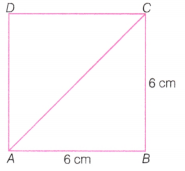
AC2 = AB2 + BC2
= 62 + 62 = 36 + 36
AC2 = 72
⇒ AC = \(\sqrt{72}=\sqrt{36 \times 2}\) = 6√2 cm
(iii) Using the diagonal as the side, find the area of the new square formed.
Answer:
Side of new square = Diagonal of the original square
= 6√2 cm
So, the area of new square = (6√2)2 = 72 cm2
(iv) Verify numerically that the area of the new square is double the area of the original square.
Answer:
From part (i) and (iii), the area of the new square is exactly double the area of the original square.