Practicing Class 9 Maths MCQ and Ganita Manjari Class 9 Maths Chapter 13 Two Variables One Line MCQ Questions Online Test with Answers daily helps in time management.
MCQ on Two Variables One Line Class 9
Two Variables One Line MCQ Class 9
Class 9 Maths Two Variables One Line MCQ
Question 1.
Which of the following ordered pairs is a solution of the equation 2x + 3y = 12?
(a) (3, 2)
(b) (2, 4)
(c)(0, 5)
(d) (6, 2)
Answer:
(a) (3, 2)
Explanation:
Substitute x = 3, y = 2 in 2x + 3y = 12
2(3) + 3(2) = 6 + 6 = 12
Hence, (a) is the correct answer.
Question 2.
A line passing through the points (0, 5) and (5, 0) represents which equation?
(a) x + y = 5
(b) x – y = 5
(c) 2x + y = 52
(d) x + 2y = 5
Answer:
(a) x + y = 5
Explanation:
For (0, 5): 0 + 5 = 5
For (5,0): ‘ 5 + 0 = 5
Both points satisfy x + y = 5.
Hence, (a) is the correct answer.
Question 3.
Which equation represents a line parallel to 3x + 2y = 7?
(a) 6x + 4y = 10
(b) 3x + 2y = 12
(c) 2x + 3y = 7
(d) 3x – 2y = 7
Answer:
(b) 3x + 2y = 12
Explanation:
Parallel lines have the same coefficients of x and y.
\(\frac{a_1}{a_2}=\frac{b_1}{b_2}\)
From the given options line 3x + 2y = 12 must be parallel to given line.
Hence, (b) is the correct answer.

Question 4.
If two lines intersect at exactly one point, then the pair of linear equations has:
(a) No solution
(b) One solution
(c) Infinite solutions
(d) Two solutions
Answer:
(b) One solution
Explanation:
Two intersecting lines have one common point, so the pair has one unique solution.
Hence, (b) is the correct answer.
Question 5.
Which of the following is the standard form of 4x-3y=ll?
(a) 4x – 3y – 11 = 0
(b) 4x – 3y + 11 = 0
(c) 4x + 3y – 11 =0
(d) 3x – 4y – 11 =0
Answer:
(a) 4x – 3y – 11 = 0
Explanation:
4x − 3y = 11 can be written as 4x − 3y − 11 = 0, which is the form ax + by + c = 0.
Question 6.
Which ordered pair is a solution of 2x + 5y = 14?
(a) (1, 2)
(b) (2, 2)
(c) (3, 1)
(d) (4, 0)
Answer:
(b) (2, 2)
Explanation:
On substituting x = 2 and y = 2, we get
2x + 5y = 2(2) + 5(2) = 14
Hence, (2, 2) is a solution.
Question 7.
The graph of 5x – 2y = 0 necessarily passes through
(a) (1, 1)
(b) (0, 0)
(c) (0, 5)
(d) (2, 0)
Answer:
(b) (0, 0)
Explanation:
Here, c = 0 in 5x − 2y = 0.
Therefore, (0, 0) satisfies the equation.
Hence, the graph passes through the origin.
Question 8.
The equation x = -4 represents a line
(a) parallel to the X-axis
(b) parallel to the Y-axis
(c) passing through (0, -4)
(d) having slope 0
Answer:
(b) parallel to the Y-axis
Explanation:
For x = −4, the value of x remains fixed while y can take any real value.
Hence, the line is vertical and parallel to the Y-axis.
Question 9.
The lines represented by linear equations x = a and y = b(a ≠ b) are
(a) intersecting at (a,b)
(b) intersecting at (b, a)
(c) parallel
(d) coincident
Answer:
(a) intersecting at (a,b)
Explanation:
Given, the equations are x = a and y = b (a ≠ b).
The graph of x = a is a line parallel to Y-axis and y = b is a line parallel to X-axis.
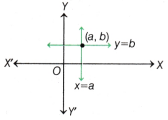
∴ The angle between them is 90° i.e. they intersect each other and the solution is (a, b).
Question 10.
The system of linear equations represented by the lines Z and m is
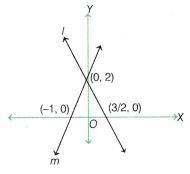
(a) consistent with unique solution
(b) inconsistent
(c) consistent with three solutions
(d) consistent with many solutions
Answer:
(a) consistent with unique solution
Explanation:
It is clear from the given figure that line l and line m intersect at point (0,2). So, the system of linear equations is consistent with a unique solution.
Question 11.
The pair of linear equations \(\frac{3 x}{2}+\frac{5 y}{3}\) = 7 and 9x +107 = 14 is
(a) consistent
(b) inconsistent
(c) consistent with one solution
(d) consistent with many solutions
Answer:
(b) inconsistent
Explanation:
The given pair of linear equations is
\(\frac{3 x}{2}+\frac{5 y}{3}\) = 7
⇒ 9x + 10y = 42 and 9x + 10y = 14
i.e. 9x + 10y – 42 = 0 and 9x + 10y – 14 = 0.
On comparing the above equations with standard form of a pair of linear equations, we get
ax = 9,b, = 10, c, = -42 and a2 = 9,b2 = 10, c2 = -14
Now, \(\frac{a_1}{a_2}=\frac{9}{9}\) = 1
\(\frac{b_1}{b_2}=\frac{10}{10}=\frac{1}{1}\)
and \(\frac{c_1}{c_2}=\frac{-42}{-14}\) = 3
\(\frac{a_1}{a_2}=\frac{b_1}{b_2} \neq \frac{c_1}{c_2}\)
∴ The given pair of linear equations is inconsistent.
Question 12.
Which of the following system of equations has a unique solution?
(a) x = 0, x = 1
(b) x + y = 0, 2x + 2y = 0
(c) x + y = 2, x – y = 3
(d) x + y = 5, x + y = 10
Answer:
(c) x + y = 2, x – y = 3
Explanation:
To determine, which system has a unique solution.
Let’s analyse each option.
Option (A) x = 0 and x = 1
This system has no solution, as both values of x
cannot be true simultaneously.
Option (B) x + y = 0 and 2x + 2y = 0
The second equation is a multiple of the first.
This results in an infinite number of solutions, not a unique one.
Option (C) x + y – 2 and x – y = 3
On adding the two equations, we get (x + y) + (x – y) = 2 + 3
⇒ 2x = 5
⇒ x = \(\frac{5}{2}\)
On substituting x = \(\frac{5}{2}\) in x + y = 2, we get
⇒ \(\frac{5}{2}\) + y = 2
⇒ y = 2 – \(\frac{5}{2}=-\frac{1}{2}\)
Thus, the system has a unique solution
Option (D) x + y = 5 and x + y = 10
This system has no solution, as both equations contradict each other.
Question 13.
If the pair of linear equations a1x + b1x + c1 = 0 and a2x + b2y + c2 = 0 is consistent and dependent, then
(a) \(\frac{a_1}{a_2} \neq \frac{b_1}{b_2}\)
(b) \(\frac{a_1}{a_2} \neq \frac{b_1}{b_2}=\frac{c_1}{c_2}\)
(c) \(\frac{a_1}{a_2}=\frac{b_1}{b_2} \neq \frac{c_1}{c_2}\)
(d) \(\frac{a_1}{a_2}=\frac{b_1}{b_2}=\frac{c_1}{c_2}\)
Answer:
(d) \(\frac{a_1}{a_2}=\frac{b_1}{b_2}=\frac{c_1}{c_2}\)
Explanation:
If the pair of linear equations
a1x + b1x + c1 = 0 and a2x + b2y + c2 = 0 consistent and dependent, then \(\frac{a_1}{a_2}=\frac{b_1}{b_2}=\frac{c_1}{c_2}\)
Question 14.
The slope of the line through P(-2, 1) and Q (2, 9) is
(a) 1
(b) 2
(c) 3
(d) 4
Answer:
(b) 2
Explanation:
Using (-2, 1) and Q(2, 9),
Slope = \(\frac{9-1}{2-(-2)}=\frac{8}{4}\) = 2
Hence, the slope is 2.
Question 15.
The pair of equations ax + 2y = 9 and 3x + by = 18 represent parallel lines, where a, b are integers, if
(a) a = b
(b) 3a = 2b
(c) 2a = 3b
(d) ab = 6
Answer:
(d) ab = 6
Explanation:
Given, the equations are to be parallel, if
\(\frac{a}{3}=\frac{2}{b} \neq \frac{-9}{-18}\)
Taking \(\frac{a}{3}=\frac{2}{b}\) ⇒ ab = 6
Question 16.
The value of k for which the system of equations 3x – ky = 7 and 6x + 10y = 3 is inconsistent, is
(a) -10
(b) -5
(c) 5
(d) 7
Answer:
(b) -5
Explanation:
We know that the system of equations
a1x + b1x + c1 = 0 and a2x + b2y + c2 = 0 is inconsistent, if
So, \(\frac{3}{6}=\frac{-k}{10} \neq \frac{-7}{-3}\)
⇒ -k = \(\frac{3 \times 10}{6}\)
∴ k = -5
Question 17.
The value of k for which the pair of linear equations (k + 1)x + 2(1 – k)y = 15 and 4y = 3x – 8 has no solution, is
(a) 3
(b) \(\frac{1}{5}\)
(c) 5
(d) \(\frac{37}{8}\)
Answer:
(c) 5
Explanation:
The given system of equations has no solution.
∴ \(\frac{a_1}{a_2}=\frac{b_1}{b_2} \neq \frac{c_1}{c_2}\)
⇒ \(\frac{k+1}{3}=\frac{2(1-k)}{-4} \neq \frac{-15}{-8}\)
On solving first two terms, we get k = 5
Question 18.
If the lines given by 3x + 2ky = 2 and 2x + 5y + 1 = 0 are not parallel, then k has to be
(a) \(\frac{15}{4}\)
(b) not equal to \(\frac{15}{4}\)
(c) any rational number.
(d) any rational number having 4 as denominator.
Answer:
(b) not equal to \(\frac{15}{4}\)
Explanation:
Given, lines are 3x + 2ky = 2 and 2x + 5y + 1 = 0.
The given equations can be rewritten as
3x + 2ky – 2 = 0 and 2x + 5y + 1 = 0.
On comparing the given equations with a1x + b1x + c1 = 0 and a2x + b2y + c2 = 0, we get
a1 = 3, b1 = 2k, c1 = – 2 and a2 = 2, b2 = 5, c2 = 1
Also given, the lines are not parallel.
\(\frac{a_1}{a_2} \neq \frac{b_1}{b_2} \Rightarrow \frac{3}{2} \neq \frac{2 k}{5}\)
⇒ k ≠ \(\frac{15}{4}\)
Question 19.
The value of k for which the system of equations 3x – 7y = 1 and kx + 14y = 6 is inconsistent, is
(a) – 6
(b) \(\frac{2}{3}\)
(c) 6
(d) \(\frac{-3}{2}\)
Answer:
(a) – 6
Explanation:
The system of equations is inconsistent, if
\(\frac{a_1}{a_2}=\frac{b_1}{b_2} \neq \frac{c_1}{c_2}\)
Here a1 = 3, b1 = -7, c1 = -1
a2 = k, b2 = 14, c2 = – 6
∴ \(\frac{3}{k}=\frac{-7}{14} \neq \frac{-1}{-6}\)
⇒ 14 × 3 = – 7k
⇒ – 7k = 42
⇒ k = \(\frac{-42}{7}\)
⇒ k = – 6
Question 20.
The sum of the age (in years) of a father and three times the age of his daughter is 59. If the age of the father is x yr and that of his daughter is y yr, the equation representing the given information is
(a) 3x + y = 59
(b) x + y = 59
(c) x + 3y = 59
(d) x + y = 56
Answer:
(c) x + 3y = 59
Explanation:
Given, the age of the father = x and the age of the daughter = y
The sum of the father’s age and three times the daughter’s age is 59.
∴ x + 2y = 59
Question 21.
The slope and y-intercept of 6x + 3y – 9 = 0 are respectively.
(a) 2 and -3
(b) -2 and 3
(c) -3 and 2
(d) 3 and -2
Answer:
(b) -2 and 3
Explanation:
The given equation is 6x + 3y – 9 = 0.
3y = -6x + 9 .
⇒ y = -2x + 3
On comparing with y = mx + d, we get m = -2 and d = 3
Hence, the slope is -2 and the y-intercept is 3.
Question 22.
Which of the following lines has undefined slope?
(a) y = 6
(b) y = 2x + 6
(c) x = 6
(d) x + y = 6
Answer:
(c) x = 6
Explanation:
The equation x = 6 represents a vertical line.
Its run is 0, so its slope is undefined.
Question 23.
The values of x and y satisfying the two equations 32x + 33y = 34 and 33x + 32y = 31 respectively, are
(a) -1 and 2
(b) -1 and 4
(c) 1 and -2
(d) -1 and – 4
Answer:
(a) -1 and 2
Explanation:
Hint Given, the equations are
32x + 33y = 34 …(i)
and 33x + 32y = 31 .. .(ii)
On solving Eqs. (i) and (ii), we get
x = – 1 and y = 2
Question 24.
The ratio of a two-digit number and the sum of its digits is 7 : 1. How many such two-digit numbers are possible?
(a) 1
(b) 4
(c) 9
(d) Infinitely many
Answer:
(b) 4
Explanation:
Hint: Let one’s digit of the number be x and ten’s digit of the number be y.
Two-digit number = lOy + x
According to the question,
\(\frac{10 y+x}{x+y}=\frac{7}{1}\)
⇒ \(\frac{x}{y}=\frac{1}{2}\)
.’. Possible two-digit numbers are 21, 42, 63, 84.
Two Variables One Line Class 9 Assertion and Reason Questions
Two statements are given, one labelled Assertion (A) and the other labelled Reason (R). Select the correct answer from the codes (a), (b), (c) and (d) as given below.
(a) Both Assertion (A) and Reason (R) are true and Reason (R) is the correct explanation of the Assertion (A).
(b) Both Assertion (A) and Reason (R) are true, but Reason (R) is not the correct explanation of the Assertion (A).
(c) Assertion (A) is true, but Reason (R) is false.
(d) Assertion (A) is false, but Reason (R) is true.
Question 1.
Assertion (A): A linear equation in two variables has infinitely many solutions.
Reason (R): A linear equation 2x + 7y = 6 has a unique solution.
Answer:
(c) Assertion (A) is true, but Reason (R) is false.
Explanation:
We can have many values of (x, y) for which equation 2x + 7y = 6 get satisfied. So, given linear equation has many solutions.
Hence, (c) is the correct option.
Question 2.
Assertion (A): The graph of the linear equation 2x + y = 7 passes through the point (2, 3).
Reason (R): Every point lying on graph is not a solution of 2x – y = 1.
Answer:
(c) Assertion (A) is true, but Reason (R) is false.
Explanation:
Put (2, 3) in equation 2x + y = 7, we get
2(2) + 3 = 7
4 + 3 = 7
7 = 7
It means graph of given linear equation passes through the point (2, 3)
All the points lying on the graph are solution of given linear equation.
Hence, (c) is the correct option.
Question 3.
Assertion (A): (0,-2) is a solution of 3x – 2y = 4.
Reason (R): On substituting x = 0 and y = -2, the left-hand side becomes 4, which is equal to the right-hand side.
Answer:
(a) Both A and R are true and R is the correct explanation of A.
Explanation:
On substituting x = 0 and y = -2, we get
3x – 2y = 3(0) – 2(-2) = 4
Thus, the ordered pair satisfies the equation.
Hence, both Assertion and Reason are true, and Reason correctly explains Assertion.
Question 4.
Assertion (A): The graphical representation of x + 2y – 4 = 0 and 2x + 4y – 12 = 0 will be a pair of parallel lines.
Reason (R): Let a1x + b1x + c1 = 0 and a2x + b2y + c2 = 0 be two linear equations and if \(\frac{a_1}{a_2}=\frac{b_1}{b_2} \neq \frac{c_1}{c_2}\), then the pair of equations represent parallel lines and they have no solutions.
Answer:
(a) Both A and R are true and R is the correct explanation of A.
Explanation:
Assertion Let x + 2y – 4 = 0 …(i)
and 2x + 4y – 12 = 0 ……….(ii)
As we know that a1x + b1x + c1 = 0 and a2x + b2y + c2 = 0 be two linear equations represent parallel lines and they have no solutions, then
\(\frac{a_1}{a_2}=\frac{b_1}{b_2} \neq \frac{c_1}{c_2}\)
For Eqs. (i) and (ii), we get
\(\frac{a_1}{a_2}=\frac{1}{2}, \frac{b_1}{b_2}=\frac{1}{2}, \frac{c_1}{c_2}=\frac{1}{3}\)
Satisfy the condition for parallel lines.
Thus, both Assertion and Reason are true and Reason is the correct explanation of Assertion.
Question 5.
Assertion (A): The graph of the linear equations 3x +2 y = 12 and 5x-4y = 10 gives a pair of intersecting lines.
Reason (R): The graph of the linear equations a1x + b1x + c1 = 0 and a2x + b2y + c2 = 0 gives a pair of intersecting lines if \(\frac{a_1}{a_2} \neq \frac{b_1}{b_2}\)
Answer:
(a) Both A and R are true and R is the correct explanation of A.
Explanation:
We have, 3x + 2y – 12 = 0 and 5x – 4y – 10 = 0
On comparing with standard form of a pair of linear equations, we get
a1 = 3, b1 =2 and c1 = -12 and a2 =5, b2 = -4 and c2 = -10
∴ The given pair of linear equations gives a pair of intersecting lines.
∴ Both Assertion and Reason are true and Reason is the correct explanation of Assertion.
Thus, the line y = 5 has zero slope. Hence, both Assertion and Reason are true, and Reason correctly explains Assertion.
Question 6.
Assertion (A): The line y = 5 has zero slope.
Reason (R): For any two distinct points on y = 5, the rise is 0.
Answer:
(a) Both A and R are true and R is the correct explanation of A.
Explanation:
For any two distinct points (x1, 5) and (x2, 5) on the line y = 5.
Rise = y2 – y1 = 5 – 5 = 0
∴ Slope = \(\frac{\text { Rise }}{\text { Run }}=\frac{0}{x_2-x_1}\) = 0
Thus, the line y = 5 has zero slope. Hence, both Assertion and Reason are true, and Reason correctly explains Assertion.
Question 7.
Assertion (A): The value of k for which the system of equations kx – y = 2, 6x – 2y = 3 has a unique solution is 3.
Reason (R) The system of linear equations a1x + b1x + c1 = 0 and a2x + b2y + c2 = 0 has a unique solution, if \(\frac{a_1}{a_2} \neq \frac{b_1}{b_2}\)
Answer:
(d) A is false but R is true.
Explanation:
Given, the system of linear equations has a unique solution, if
\(\frac{k}{6} \neq \frac{-1}{-2} \Rightarrow \frac{k}{6} \neq \frac{1}{2}\)
⇒ k = 3
So, Assertion is false and Reason is true.
Question 8.
Assertion (A): If the pair of linear equations is x + 0.999y = 2.999 and 0.999x + y – 2.998. Then, the value of x – y = 1.
Reason (R): The value of x = 1.5 and y = 1.2.
Answer:
(c) A is true but R is false.
Explanation:
We have, x + 0.999y = 2.999 …(i)
and 0.999x + y = 2.998 (ii)
On adding Eqs. (i) and (ii), we get
1.999x + 1.999y = 5.997
On dividing the whole equation by 1.999, we get
x + 7 = 3 … (iii)
On subtracting Eq. (ii) from Eq. (i), we get
0.001x – 0.001y = 0.001
On dividing the whole equation by 0.001, we get
x – y = 1 … (iv)
On solving Eqs. (iii) and (iv), we get x = 2 and y = 1
Hence, Assertion is true but Reason is false.