Each of our Ganita Prakash Class 8 Worksheet and NCERT Class 8 Maths Chapter 4 Quadrilaterals Worksheet with Answers focuses on conceptual clarity.
Quadrilaterals Worksheet Class 8
Class 8 Maths Quadrilaterals Worksheet
Worksheet On Quadrilaterals Class 8 – Quadrilaterals Class 8 Ganita Prakash Worksheet
Tick (✓) for the correct option
Question 1.
A rectangle is a parallelogram in which
(a) adjacent sides are equal
(b) diagonals are perpendicular
(c) each angle is a right angle
(d) diagonals are equal
Question 2.
The two diagonals are not necessarily equal in
(a) an isosceles trapezium
(b) a rhombus
(c) a rectangle
(d) a square
Question 3.
The quadrilateral whose diagonals are perpendicular bisectors of each other are
(a) trapezium and parallelogram
(b) rectangle and square
(c) rectangle and rhombus
(d) square and rhombus
Question 4.
A rectangle is a square if
(a) diagonals bisect each other
(b) each angle is a right angle
(c) diagonals are at 90° to each other
(d) none of these
Question 5.
Let ABCD be a rectangle. Then
(a) ∠ABC – 90°
(b) AC = BD
(c) AB = CD
(d) All are true

Question 6.
If the three angles of a quadrilateral are 70° , 90° and 120°, then find the measure of the fourth angle.
(a) 100°
(b) 75°
(c) 80°
(d) 60°
Question 7.
Which of the following quadrilaterals has both pairs of opposite sides parallel and all angles equal?
(a) Rhombus
(6) Parallelogram
(c) Square
(d) Trapezium
Question 8.
The measure of two adjacent angles of a parallelogram are in the ratio of 2 : 3. Find the measure of each of the angles of a parallelogram.
(a) 72°, 108°
(b) 54°, 112°
(c) 68°, 99°
(d) 86°, 114°
Question 9.
In a parallelogram, which pair of angles is always supplementary?
(a) Opposite angles
(b) Adjacent angles
(c) Alternate angles
(d) Corresponding angles
Question 10.
Let ABCD be a rhombus. Then
(a) The opposite angles of ABCD are equal
(b) Diagonals bisect the angles of ABCD
(c) The sum of the adjacent angles of ABCD must be less than 180°
(d) At least one is false
Assertion Reason Questions
In questions 1-2, a statement of Assertion (A) is followed by a statement of Reason (R). Choose the correct option.
Question 1.
Assertion (A) : A kite has one pair of equal opposite angles.
Reason (R) : Adjacent sides of a kite are unequal.
(a) Both (A) and (R) are true and (R) is the correct explanation of (A).
(b) Both (A) and (R) are true but (R) is not the correct explanation of (A).
(c) (A) is true but (R) is false.
(d) (A) is false but (R) is true.
Question 2.
Assertion (A) : All the parallelograms are rectangles.
Reason (R) : All the rhombuses are parallelograms.
(a) Both (A) and (R) are true and (R) is the correct explanation of (A).
(b) Both (A) and (R) are true but (R) is not the correct explanation of (A).
(c) (A) is true but (R) is false.
(d) (A) is false but (R) is true.
Fill in the blanks
1. In a rectangle both pairs of opposite sides are _______ and _______.
2. In a rhombus all sides are _______.
3. A simple closed curve made up of line segments is called a _______.
4. The diagonals of a rectangle always intersect at their _______.
5. The diagonals of a parallelogram are _____________ equal.
6. If one diagonal of a parallelogram is 10 cm, then the other diagonal ________________ 10 cm.
7. A trapezium is an isosceles trapezium if its two ___________ sides are equal.
Write (T) for true or (F) for false for the given statements
1. A kite is a trapezoid.
2. A | | gm is a rectangle but a rectangle need not be a gm.
3. Every square is a rhombus, and every rhombus is a parallelogram.
4. The sum of adjacent angles of a rhombus is 180°.
5. In a trapezium, the sum of angles on the parallel sides is always 180°.
6. The diagonals of a rhombus and a square always bisect each other and may not be perpendicular to each other.
Very Short Answer Type Questions
Question 1.
If PQRS is a rhombus. Complete the following statements.
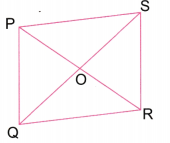
(a) PQ= _____
(b) QR = ______
(c) PQ ∥ ______
(d) QR ∥ _____
(e) ∠P = ∠_____
(f) ∠Q = ∠______
(g) ∠P + ∠Q = ______
(h) ∠Q + ∠R = _______
(i) ∠R + ∠S = ______
(j) ∠S + ∠P = ______
(k) OP = ______
(l) OQ = _____
Question 2.
For the following rhombuses, find the values of the unknowns x, y and z.

Solution:
_______________________________________
_______________________________________
_______________________________________
_______________________________________
_______________________________________
Question 3.
If PQRS is a rectangle complete the following statements.

(a) PQ = ______
(b) QR = ______
(c) PQ ∥______
(d) QR ∥______
(e) ∠P = ( ______)°
(f) ∠Q = ( ______)°
(g) ∠R = ( ______)°
(h) ∠S = ( ______)°
(i) OP = ______
(j) OQ = ______
Question 4.
For the following rectangles, find the values of the unknowns x, y and z.

Solution:
_______________________________________
_______________________________________
_______________________________________
_______________________________________
_______________________________________
Question 5.
If PQRS is a square, complete the following statements.
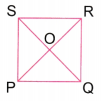
(a) PQ = _____ = _____ = _____ = _____
(b) PQ ∥ _____
(c) QR ∥ _____
(d) ∠P = (_____)°
(e) ∠Q = (_____)°
(f) ∠R = (_____)°
(g) ∠S = (_____)°
(h) OP = _____
(i) OQ = _____
(j) PH = _____
(k) ∠POQ = (_____)°
Question 6.
For the following squares, find the values of the unknowns x, y and z.
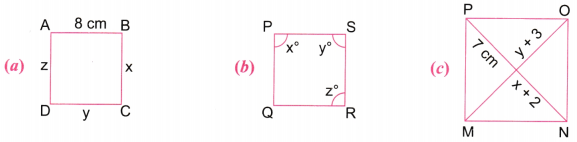
Solution:
_______________________________________
_______________________________________
_______________________________________
_______________________________________
_______________________________________
Question 7.
Identify all the quadrilaterals that have
(a) four right angles
(b) four sides of equal length
Solution:
_______________________________________
_______________________________________
_______________________________________
_______________________________________
_______________________________________
Question 8.
Explain how a square is
(a) a quadrilateral
(b) a parallelogram
(c) a rectangle
(d) a rhombus
Solution:
_______________________________________
_______________________________________
_______________________________________
_______________________________________
_______________________________________
Question 9.
Name the quadrilaterals whose diagonals.
(a) are equal:
(b) bisect each other:
(c) are perpendicular bisectors of each other:
Solution:
_______________________________________
_______________________________________
_______________________________________
_______________________________________
_______________________________________
Question 10.
Explain why a rectangle is a convex quadrilateral.
Solution:
_______________________________________
_______________________________________
_______________________________________
_______________________________________
_______________________________________
Question 11.
A quadrilateral has all four angles of same measure. What is the measure of each?
Solution:
_______________________________________
_______________________________________
_______________________________________
_______________________________________
_______________________________________
Question 12.
If ABCD is a rhombus, find the value of x.
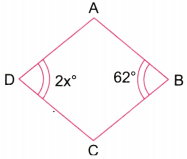
Solution:
_______________________________________
_______________________________________
_______________________________________
_______________________________________
_______________________________________
Question 13.
The angles of a quadrilateral are in ratio 3 : 4 : 5 : 8. Find the angles respectively.
Solution:
_______________________________________
_______________________________________
_______________________________________
_______________________________________
_______________________________________
Question 14.
If ABCD is a kite, find the values of x and y.

Solution:
_______________________________________
_______________________________________
_______________________________________
_______________________________________
_______________________________________
Question 15.
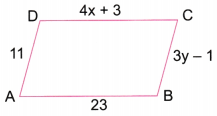
Find the values of x and y for the following parallelogram
Solution:
_______________________________________
_______________________________________
_______________________________________
_______________________________________
_______________________________________
Question 16.
P is an interior point of ∠CAB. PL ⊥ AC and PM ⊥ AB. If ∠LPM = 120°. Find the measure of ∠BAC.
Solution:
_______________________________________
_______________________________________
_______________________________________
_______________________________________
_______________________________________
Question 17.
AP and BP are the bisectors of ∠A and ∠B of quadrilateral ABCD. If ∠D = 60° and ∠C – 30°, find the measure of ∠APB.

Solution:
_______________________________________
_______________________________________
_______________________________________
_______________________________________
_______________________________________
Question 18.
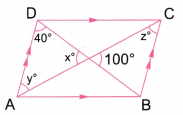
Find the values of x, y and z for the following parallelograms.
Solution:
_______________________________________
_______________________________________
_______________________________________
_______________________________________
_______________________________________
Question 19.
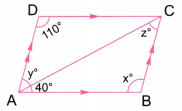
Find the values of x, y and z for the following parallelograms.
Solution:
_______________________________________
_______________________________________
_______________________________________
_______________________________________
_______________________________________
Short Answer Type Questions
Question 1.
Find the angles a, b and c in the parallelogram TUVW as shown in the figure.

Solution:
_______________________________________
_______________________________________
_______________________________________
_______________________________________
_______________________________________
Question 2.
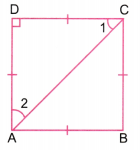
Find ∠DCA in the given square ABCD.
Solution:
_______________________________________
_______________________________________
_______________________________________
_______________________________________
_______________________________________
Question 3.
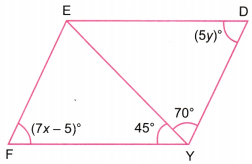
In the given parallelogram, find the values of x and y.
Solution:
_______________________________________
_______________________________________
_______________________________________
_______________________________________
_______________________________________
Question 4.
Is it wrong to write ∆ABD = ∆CBD in the following parallelogram? Why?

Solution:
_______________________________________
_______________________________________
_______________________________________
_______________________________________
_______________________________________
Question 5.
Draw a parallelogram with adjacent sides of lengths 4 cm and 5 cm, and an angle of 30° between them. What are the remaining angles of the parallelogram? What are the lengths of the remaining sides?
Solution:
_______________________________________
_______________________________________
_______________________________________
_______________________________________
_______________________________________
Question 6.
Show that a rhombus is also a parallelogram.
Solution:
_______________________________________
_______________________________________
_______________________________________
_______________________________________
_______________________________________
Question 7.
Are the diagonals of a parallelogram always equal? Explain.
Solution:
_______________________________________
_______________________________________
_______________________________________
_______________________________________
_______________________________________
Question 8.
A rhombus is a parallelogram, and a rectangle is also a parallelogram. How can this be represented using a Venn diagram? Where will the set of squares occur in this diagram?
Solution:
_______________________________________
_______________________________________
_______________________________________
_______________________________________
_______________________________________
Question 9.
Take two cardboard cutouts of a scalene triangle with sides 6 cm, 9 cm, and 12 cm.
(i) What are the different ways they can be joined to get a quadrilateral?
(ii) Are you able to identify the different quadrilaterals that are obtained by joining the triangles? Justify your answer whenever you identify a quadrilateral.
Solution:
_______________________________________
_______________________________________
_______________________________________
_______________________________________
_______________________________________
Question 10.
Take two cardboard cutouts of an isosceles triangle with side lengths 8 cm, 8 cm, and 6 cm.
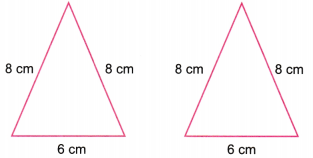
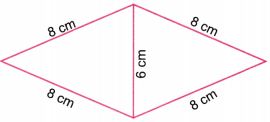
(i) What are the different ways they can be joined to get a quadrilateral?
Joining them in this way you get
Joining them in this way you get
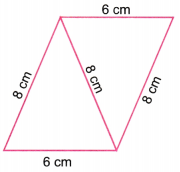
(ii) What quadrilaterals are these? Justify your answers.
Solution:
_______________________________________
_______________________________________
_______________________________________
_______________________________________
_______________________________________
Question 11.
Take two cardboard cutouts of an equilateral triangle of side length 8 cm.
(i) Can you join them to get a quadrilateral?
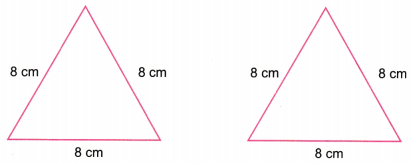
(ii) What type of a quadrilateral is this? Justify your answer.
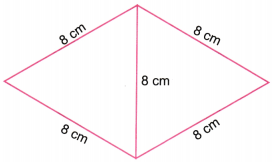
Solution:
_______________________________________
_______________________________________
_______________________________________
_______________________________________
_______________________________________
Question 12.
Is it wrong to write ∆AOE = ∆SOY in the following parallelogram? Why?
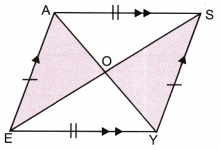
Solution:
_______________________________________
_______________________________________
_______________________________________
_______________________________________
_______________________________________
Case Based Questions
There is a trapezium MNOP. Angle bisectors of ∠M and ∠N meet at point W, and angle bisectors of ∠O and ∠P meet at point X on side MN of trapezium MNOP.
By using the figure answer the following questions:
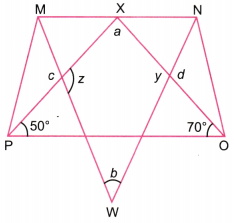
Question 1.
What is the value of a?
Solution:
_______________________________________
_______________________________________
_______________________________________
_______________________________________
_______________________________________
Question 2.
What is the value of d?
Solution:
_______________________________________
_______________________________________
_______________________________________
_______________________________________
_______________________________________
Question 3.
What is the value of e?
Solution:
_______________________________________
_______________________________________
_______________________________________
_______________________________________
_______________________________________