Experts have designed these Class 9 Maths Notes and Chapter 8 Predicting What Comes Next Exploring Sequences and Progressions Class 9 Ganita Manjari Notes for effective learning.
Class 9 Maths Chapter 8 Predicting What Comes Next Exploring Sequences and Progressions Notes
Class 9 Maths Ganita Manjari Chapter 8 Notes
Ganita Manjari Class 9 Chapter 8 Notes – Class 9 Predicting What Comes Next Exploring Sequences and Progressions Notes
This chapter introduces sequences and progressions, helping students understand how numbers follow patterns and rules.
Student will learn to identify and find terms in AP and GP. It also explores real-life applications, patterns like fractals and the Tower of Hanoi.
Sequence
A sequence is a succession of numbers or terms formed according to some rule. The various numbers occuring in a sequence are called its terms generally denoted by a1, a2, a3, …… an, respectively.
Here, a1, a2, a3, ……… an are known as first term, second term, third term, …, nth term, respectively of the sequence. The
nth term is also called general term and is denoted by an.
e.g 2, 6,10, 14, … is a sequence.
Here, a1 = 2, a2 = 6, a3 = 10 and a4 = 14.
Types of Sequence
• Finite Sequence A sequence containing finite number of terms, is called a finite sequence, e.g. 1, 3, 5, 7 ……. is a finite sequence as it contains only 4 terms.
• Infinite Sequence A sequence which is not a finite sequence is known as infinite sequence i.e. in an infinite sequence, number of terms never ends.
e.g. 1, 3, 5, 7,… is an infinite sequence as it contains infinite number of terms.
Example 1.
Find the next three terms of the following sequence 2, 4, 6, 8, ……..
Solution:
Given sequence is 2, 4, 6, 8…
Here, the pattern is adding 2 each term.
∴ The next three terms are 8 + 2 = 10, 10 + 2 = 12 and 12 + 2 = 14.
Hence, the next three terms are 10, 12 and 14.
Explicit (Direct) rule of a Sequence
An explicit rule provides a direct formula to calculate any term of a sequence using its position n. Thus, the nth term depends only on n and not on previous terms. It we know the formula for the nth term, we can write the whole sequence using braces {} i.e an is function of n. e.g. Consider the sequences
(i) 3, 6, 9, 12, 15 ….
(ii) 1, 3, 5, 7, 9 ……..
Find the 6th term (a6).
For sequence (i)
Since, the pattern shows multiples of 3.
∴ an = 3n ⇒ a6 = 3 × 6 = 18
For sequence (ii)
Since, the numbers are odd numbers.
an = 2n – 1 ⇒ a6 = 2 × 6 – 1 = 11
Thus, explicit formulas allow us to directly determine any term without computing earlier ones.
Example 2.
Find the 20th term of the sequence, whose nth terms is an = \(\frac{n(n-2)}{n+3}\).
Solution:
We have, an = \(\frac{n(n-2)}{n+3}\)
On putting n = 20, we get
a20 = \(\frac{20(20-2)}{20+3}=\frac{20 \times 18}{23}=\frac{360}{23}\)
Example 3.
Write first three terms of the sequences.
(i) an = (-1)n-1 5n+1
(ii) an = 2n2 – n + 1
Solution:
(i) We have, an = (-1)n-1 5n+1
On putting n = 1, we get
a1 =(-1)1-151+1 = (-1)°52 = 25
On putting n = 2, we get
a2 = (-1)2-1 52+1 = (-1)153 = -125
On putting n = 3, we get
a3 = (-1)3-1 53+1= (-1)254 = 625
Hence, the first three terms of the given sequence are 25, -125, 625.
(ii) We have, an = 2n2 – n + 1
On putting n = 1, we get
a1 = 2(1)2 – 1 + 1 = 2 – 1 + 1 = 2
On putting n = 2, we get
a2 = 2(2)2 – 2 + 1 = 8 – 2 + 1 = 7
On putting n = 3, we get
a3 = 2(3)2 – 3 + 1 = 18 – 3 + 1 = 16
Hence, the first three terms of the given sequence are 2, 7, 16.

Recursive Rule of a Sequence
A recursive rule of a sequence is way of defining each term using the previous term(s) instead of directly writing a formula for the nth term.
e.g. Consider the sequence 3, 6, 12, 24, …
Here, a1 = 3 and an = 2 × an-1
Thus, each term is found by multiply previous term by 2.
Virahanka-Fibonacci Sequence
Sometimes an arrangement of numbers has no visible pattern but the sequence can be represented by the recurrence relation.
The sequence 1, 2, 3, 5, 8, 13… has no visible pattern but its recurrence relation is a1 =1 and a2 = 2 and an+1 = an + an-1 for n ≥ 2.
This sequence is called Virahanka-Fibonacci sequence.
Let a1, a2, a3 ……… an be a given sequence.
Then, the expression a1 + a2 + a3 +… + an is called the series associated with the given sequence.
Example 4.
Write the recursive rule and hence find the next three terms for the sequence 2, 5, 11, 23, …….
Solution:
Given sequence is 2, 5, 11, 23, ………..
Here, a1 = 2 and recursive rule is an = 2 × an-1 + 1.
Thus, the next three terms are
2 × 23 + 1 = 47
2 × 47 + 1 = 95
and 2 × 95 + 1 = 191.
Example 5.
Determine whether 58 and 102 are terms of the sequence tn = 4n + 2 for n ≥ 1.
Solution:
Let 58 be the nth term of the sequence,
∴ tn = 4n + 2
4n + 2 = 58 ⇒ 4n = 58 – 2
⇒ 4n = 56 ⇒ n = \(\frac{56}{4}\) = 14
So, 58 is 14th term of the sequence, tn =4n + 2.
Let 102 be the nth term of the sequence.
∴ tn = 4n + 2
4n + 2 = 102
⇒ 4n = 102 – 2 ⇒ 4n = 100
⇒ n = \(\frac{100}{4}\) = 25
So, 102 is 25th term of the sequence, tn = 4n + 2.
Progression
Those sequences whose terms always follow certain patterns are called progressions.
e.g. (i) The sequence 3, 5, 7, 9 is a progression as each
term can be found by adding 2 to the term preceding it.
(ii) The sequence 3, 10, 18, 21, 35, … is not a progression as its terms are not following any certain pattern.
All progressions are sequences but all the sequences need not be progressions.
Arithmetic Progressions(AP)
An arithmetic progression (AP) is a list of numbers in which each term is obtained by adding a fixed number to the preceding term except the first term.
This fixed number is called the common difference (d) of the AP. It can be positive, negative or zero.
In other words, a list of numbers av a2,a3,…, an is called an arithmetic progression (AP), if there exists a constant number d (called common difference) such that
a2 – a1 = d
a3 – a2 = d
an– an-1 = d and so on.
In general, a, a + d, a + 2d, a + 3d,… represent an arithmetic progression, where a is the first term and d is the common difference. This is called general form of an AP. If number of terms in an AP is finite then it is called a finite AP, otherwise it is called an infinite AP.
If the common difference of an AP is zero i.e. d = 0 then each term of the AP will be same as the first term of the AP.
Important Points about AP
- If a constant value is added or subtracted from every term of an arithmetic progression (AP), the new sequence formed is also an AP with the same common difference as the original.
- If every term of an arithmetic progression (AP) is multiplied or divided by a non-zero constant k, the resulting sequence is also an AP. The common difference of this new AP is k d or \(\frac{d}{k}\), where d is the common difference of the original AP.
Example 6.
Examine that the list of numbers obtained from following situation, will be in the form of an AP. ‘Amount left with Sandeep (in ₹) out of the total amount of ₹ 12000 which he had in the beginning, when he spends ₹ 500 in the beginning of every month.
Solution:
Given, in the beginning , Sandeep had = ₹ 12000
Also, in the beginning of every month, he spend = ₹ 500
So, in the beginning of 1st month, he had amount,
t1 = ₹ 12000
In the beginning of 2nd month, he had amount, t2 = 12000 – 500 = ₹ 11500
In the beginning of 3rd month, he had amount, t3 =11500 – 500 = ₹ 11000
In the beginning of 4th month, he had amount, t4 = 11000 – 500 = ₹ 10500 and so on.
Now, the list of amounts is 12000, 11500, 11000, 10500,….
Here, t2 – t1 = t3 – t2 = t4 – t3 = – 500
i. e. tk+1 – tk is same everytime.
So, the above list of numbers forms an AP.
Example 7.
Find the common difference of the following APs.
(i) 3, -2, -7, -12,…
(ii) 11, 11, 11, 11,…
(iii) 5\(\frac{1}{2}\), 9\(\frac{1}{2}\), 13\(\frac{1}{2}\), 17\(\frac{1}{2}\),…
(iv) \(\sqrt{3}, \sqrt{12}, \sqrt{27}, \sqrt{48}, \ldots\)
Solution:
(i) Given AP is 3, -2 , -7, -12, ….
Here, a1 = 3, a2 = -2, a3 = -7, a4 = -12 and so on.
∴ Common difference (d) = a2 – a1 = -2 – 3 = -5
(ii) Given AP is 11, 11, 11, 11,….
Here, a1 = 11, a2 = 11, a3 = 11, a4 = 11 and so on.
∴ Common difference (d) = a2 – a1 = 11 – 11 = 0
(iii) Given AP is 5-, 9-, 13-, 17-,….
Here, a1 = 5\(\frac{1}{2}\), a2 = 9\(\frac{1}{2}\), a3 = 13\(\frac{1}{2}\), a4 = 17\(\frac{1}{2}\) and so on.
∴Common difference (d )= a2 – a1 = 9\(\frac{1}{2}\) – 5\(\frac{1}{2}\)
= \(\frac{19}{2}-\frac{11}{2}=\frac{8}{2}\) = 4
(iv) Given AP is \(\sqrt{3}, \sqrt{12}, \sqrt{27}, \sqrt{48}, \ldots\)
Here a1 = √3, a2 = √12, a3 = 2√3, a4 = √27 = 3√3 and so on.
∴ Common difference (d) = a2 – a1 = 2√3 – √3 = √3
Example 8.
Write an AP having 4 as the first term and -3 as the common difference.
Solution:
Given, first term (a) = 4 and common difference (d) = -3
On putting the values of a and d in general form
a, a + d, a + 2d, a + 3d, …, we get
4, 4 – 3, 4 + 2(-3), 4 + 3(-3), …
4, 1, 4 – 6, 4 – 9, …or 4, 1, -2, -5, …, which is the required AP.
nth Term of an AP
If the first term of an AP is a and its common difference is d then its nth term is given by the formula.
an = a + (n – 1) d
The nth term of an AP is also called its general term.
If there are n terms in an AP then nth term is known as last term of an AP and it is denoted by l, which is given by the formula.
l = a + (n – 1)d
Where, a is first term and d is common difference,
Note:
nth term an is also denoted as tn or Tn.
Example 1.
Find the 15th term of the AP 7, 3, -1, -5 ………..
Solution:
Given AP is 7, 3, -1, -5, ….
Here, a = 7 and d = 3 – 7 = – 4
Since, n th term, an = a + (n – 1)d
[∵ a = 7, d = -4 and n = 15]
a15 = a + (15 – 1)d = 7 + 14(-4)
= 7 – 14 × 4 = 7 – 56 =-49
Hence, 15th term of given sequence is – 49.
Problems Based on nth Term of an AP
Type I When nth Term or Last Term of an AP is Given
In this type of problems, an AP with last term is given or AP containing n terms is given (or nth term of an AP is given) and we have to find the value of n.
Example 2.
How many terms are there in the AP
3, 6, 9, 12,……… 111?
Solution:
Given AP is 3, 6, 9, 12,…, 111.
Here, a = 3 and d = 6 – 3 = 3
Let there be n terms in the given AP.
Then, l = 111
⇒ a + (n – 1)d = 111
⇒ -3 + (n- 1) × 3 = 111
⇒ 3(1 + n – 1) = 111
⇒ n = \(\frac{111}{3}\)
⇒ n = 37
Hence, the given AP contains 37 terms.
Example 3.
Check whether 150 is a term in the list of numbers 7, 11, 15, 19,….
Solution:
Given list of numbers is 7, 11, 15, 19, ….
Here, 11 – 7 = 15 – 11 = 19 – 15 ……. = 4
So, it is an AP with first term, a = 7
and common difference, d = 4.
Let 150 be the nth term of this AP.
We know that an = a + (n – 1)d
150 = 7 + (n – 1)(4)
⇒ 143 = (n – 1)(4)
⇒ n – 1 = \(\frac{147}{4}\)
⇒ n = \(\frac{147}{4}\) = 36\(\frac{3}{4}\)
But, the number of terms cannot be a fraction.
∴ 150 is not a term of the given AP.
Example 4.
Find the nth term of the AP 15,11, 7, 3, ………… write the recursive rule for this AP.
Solution:
Given, the AP 15, 11, 7, 3, ……………
Here, first term (a) = 15
and common difference (d) = a2 – a1 = 11 – 15 = – 4.
nth term of an AP, an = a + (n – 1)d = 15 + (n – 1)(-4)
= 15 – 4n + 4 = 19 – 4n
∴ an = 19 – 4n
For the AP 15, 11, 7, 3, ………………
Now, we observe that subtracting 4 to each term to get the next term.
So, the recursive rule for the AP is tn+1 = tn – 4, t1 = 15 for n > 1.
Example 5.
Which term of the AP 3, 15, 27, 39,… will be 120 more than its 21st term? Competency Based Que
Solution:
Given AP is 3,15, 27, 39, ………..
Here, a = 3 and d = 15 – 3 = 12
∴21 st term is given by
T21 = a + (21 – 1)d = a + 20d = 3 + 20 × 12 = 243
Required term = (243 + 120) = 363
Let it be nth term.
»
Then, an = 363 [∵ an means «th term]
⇒ a + (n – 1)d = 363
⇒ 3 + (n – 1) × 12 = 363
⇒ 12n = 372
⇒ n = 31
Hence, 31st term is the required term.
Type II Finding the AP or nth Term or Both
In this type of problems, two terms (or relation between two terms of an AP) is given and we have to find the AP and nth term of AP.
Example 6.
Determine the AP, whose 3rd term is 5 and the 7th term is 9.
Solution:
We have, a3 = a + (3 – 1)d = a + 2d = 5 …(i)
a7 = a + (7 – 1) d = a + 6d = 9 …(ii)
From Eqs. (i) and (ii), we get a = 3 and d = 1
Hence, the required AP is a, a + d, a + 2d
i.e. 3, 3 + 1, 3 + 2 × 1 i.e. 3, 4, 5, 6, … .
Example 7.
If p th term of an AP is q and q th term is p then prove that its nth term is (p + q – n).
Solution:
Given, pth term of AP = q and qth term of AP = p
To prove, nth term of AP = p + q – n
Let a be the first term and d be the common difference of the AP. Since, pth term is q.
ap = q ⇒ a + (p – 1)d = q …(i)
Similarly, qth term is p.
aq = p ⇒ a +(q – 1)d = p …(ii)
On subtracting Eq. (ii) from Eq. (i), we get
(p – 1 – q + 1)d = q – p
⇒ (p – q) d = q – p
⇒ d = – 1
From Eq. (i), a + (p – 1)(-1) = q
⇒ a – p + 1 = q
⇒ a = p + q – 1
n th term, an = a + (n – 1)d = p + q – 1 + (n – 1)(-1)
= p + q – 1 – n + 1
= p + q – n
Hence proved.
Type III Word Problems
In this type of problems, first we write the AP or list of numbers (sequence) with the help of given information and then find the required value.
Example 8.
How many two-digit numbers are divisible by 7?
Solution:
Two-digit numbers are 10, 11, 12, 13, 14, 15, … ,97, 98, 99
in which only 14, 21, 28,…, 98 are divisible by 7.
Here, 21 – 14 = 28 – 21… = 7
So, this list of numbers forms an AP, whose first term, a = 14 and common difference, d = 7.
Let there be n terms in the above sequence such that
an = 98
⇒ a + (n – 1)d = 98
⇒ 14 + (n -1)7 = 98
⇒ 14 + 7n – 7 = 98
⇒ 7n = 91
⇒ n = \(\frac{91}{7}\) = 13
Hence, there are 13 two-digit numbers divisible by 7.
Example 9.
A sum of ₹ 2000 is invested at 7% simple interest per year. Calculate the interest at the end of each year. Do these interest form an AP? If so then find the interest at the end of 20th year making use of this fact.
Solution:
Given, initial money P = ₹ 2000
and rate of interest, R = 7% per year.
Time, T = 1, 2, 3, 4, …
We know that simple interest is given by the following formula,
SI = \(\frac{P R T}{100}\)
∴ SI at the end of 1st year = \(\frac{2000 \times 7 \times 1}{100}\) = ₹ 140,
SI at the end of 2nd year = \(\frac{2000 \times 7 \times 2}{100}\) = ₹ 280
and SI at the end of 3rd year = \(\frac{2000 \times 7 \times 3}{100}\) = ₹ 420
Thus, the required list of numbers is 140, 280, 420,….
Here, 280 – 140 = 420 – 280… = 140.
So, above list of numbers forms an AP, whose first term (d) = 140 and common difference (d) = 140.
Now, SI at the end of 20th year will be equal to 20th term of the given AP.
∴ a20 = a + (20 – 1)d = 140 + 19 × 140 = 140 + 2660 = 2800
Hence, the interest at the end of 20th year will be ₹ 2800.
Graphical Representation of an Arithmetic Progression
The general term of an AP is given by an = a + (n – 1) d, where a = First-term
and d = Common difference
Consider an AP, whose first term is 6 and the common difference is 4.
Let a = 6 and d = 4
an = 6 + (n – 1) × 4 = 6 + 4n – 4 = 2 + 4n
Example 10.
Represent the AP graphically, whose first term a = 4, common difference, d = -2.
Solution:
Given, a = 4 and d = -2
Now, an =4 + (n – 1)(-2) [∵ an =a + (n – 1)d]
= 4 – 2n + 2 = 6 – 2n
Now, finding values ofan corresponding to a few values of n.

Plot the points (1, 6), (2, 10), (3, 14), (4, 18), (5, 22) on a graph paper and draw graph by joining the points consecutively.
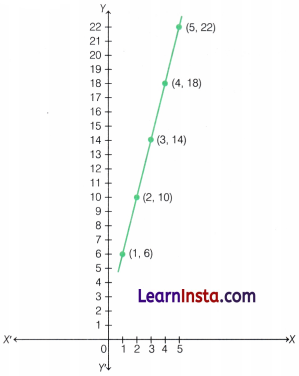
On joining these points, a straight line is obtained.
Here, an = a + (n – 1) d
⇒ an = dn + (a – d)
This is of the form
y = mx + c,
which represents a linear equation.
Hence, the graph of an AP is always a straight line.
Example 10.
Represent the AP graphically, whose first term a=4, common difference. d= —2.
Solution:
Given, a = 4 and d = -2
Now, a = 4 + (n – 1)(-2) [∵ an = a + (n – 1)d)]
= 4 – 2n + 2
= 6 – 2n
Now, finding values of a corresponding to a few values of n.
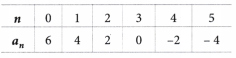
Plot the points (0, 6), (1, 4), (2, 2), (3, 0), (4, -2), (5, -4) on a graph paper and draw graph by joining the points consecutively.
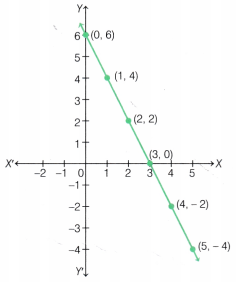
Again, these points lie on a straight line.
Sum of the First n Natural Numbers and Triangular Numbers
Natural numbers 1, 2, 3, ………… form an arithmetic progression with first term, a = 1 and common difference, d = 2 – 1 = 1.
The sum of the first n natural numbers is given by
S = \(\frac{n(n+1)}{2}\)
The nth triangular number represents this sum and it is given by tn = \(\frac{n(n+1)}{2}\)
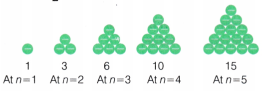
The triangular number sequence is 1, 3, 6, 10, 15, …………………. where each term is the sum of the first n natural numbers.
Thus, the sum of the first n natural numbers is equal to the nth triangular number.
Example 11.
Find
(a) sum of the first 23 natural numbers.
(b) the 16th triangular number.
Solution:
Given, n = 23
The sum of the first n natural numbers, S = \(\frac{n(n+1)}{2}\)
= \(\frac{23(23+1)}{2}=\frac{23 \times 24}{2}\)
= 23 × 12
= 276
Therefore, the sum of the first 23 natural numbers is 276.
(b) Given, n = 16
The nth triangular number,
t2 =
t2 = \(\frac{1}{2}\) = 8 × 17= 136
Therefore, the 16th triangular number is 136.
Geometric Progression (GP)
A sequence of non-zero numbers is said to be a geometric progression if the ratio of each term, except the first one, by its preceding term is always constant.
In other words, we can say that a sequence a1, a2,…,an is called geometric progression (geometric sequence) if each term is non-zero and it follows the relation \(\frac{a_{k+1}}{a_k}\) = r (constant) for all k ∈ N.
The constant ratio is called common ratio of the GP and it is denoted by r. In a GP, we usually denote the first term by a, the nth term by Tn or an.
Thus, a GP can be written as a, ar, ar2, ar3,… .
Three numbers p, q, r are said to be in geometric
progression if \(\frac{q}{p}=\frac{r}{q}\) ⇒ q = pr i.e. square of the middle term is equal to product of the extremes.
General Term of a GP
If a is the first term of a GP and its common ratio is r then general term or nth term,
Tn = arn-1 or l = arn-1
where l is the last term.
Selection of Terms in GP
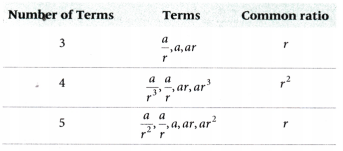
- If the terms of the GP are not given then the terms are chosen as a, ar, ar2, ar3,….
- In a GP, if number of terms is odd then assume the middle term as a and common difference as r.
- If number of terms is even then assume the middle terms as \(\frac{a}{r}\), ar and the common ratio as r2.
Properties of Geometric Progression
- If all the terms of a GP are multiplied by the same quantity then the resulting sequence is also a GP with the same common ratio.
- The reciprocals of the terms of a given GP also form a GP.
- If each term of a GP is raised to same power then the resulting sequence is also a GP.
- In a finite GP, the product of the terms equidistant from the beginning and from the end is always same and is equal to the product of the first and the last terms.
- If a sequence of non-zero, non-negative numbers form a geometric progression (GP) then the logarithms of these numbers will form an arithmetic progression (AP) and vice-versa.
Example 1.
For what values of k, the numbers \(\frac{2}{7}\), k, –\(\frac{7}{2}\) GP?
Solution:
Given, \(\frac{2}{7}\), k, –\(\frac{7}{2}\) are in GP.
Then, \(\frac{1}{2}\)
1:common ratio (r) = \(\frac{1}{2}\)
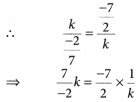
⇒ 7k × 2k = -7x(-2)
⇒ 14k2 = 14 ⇒ k2 = 1
∴ k = ±1
Example 2.
Find the 12th term of the sequence -6, 18, -54, ………….
Solution:
Given, sequence is – 6, 18, – 54,….
Clearly, the successive ratio of the terms is same.
So, the given sequence forms a GP with first term, a = -6 and common ratio, r = \(\frac{18}{-6}\) = -3.
Tn = (-6)(-3)12-1 (∵ Tn = arn-1)
= (— 1)12 6.312-1
= (1) . 6 . 311
= 2.3.311
= 2.312
Hence, 12th term of the given sequence is 2.312-1.
Example 3.
Which term of the GP 5, 10, 20, 40, … is 5120?
Solution:
Given, GP is 5, 10, 20, 40 …………..
Here, a = 5 and r = \(\frac{10}{5}\) = 2
Let nth term of given GP = 5120 i.e. Tn = 5120
Now, Tn = arn-1 = 5120
5(2)n-1 = 5120 [:a =5 and r = 2]
2n-1 = \(\frac{5120}{5}\) = 1024
2n-1= 1024
2n-1 = 210
On equating the powers, we get
n – 1 = 10
n = 10+1 = 11
Hence, 11th term of given GP is 5120.
Example 4.
Which term of the GP 5, 20, 80 is 5120? Write the explicit formula as well as the recursive formula for the nth term.
Solution:
Given, the GP 5, 20,80, …………………..
Let 5120 be the nth term of the GP.
an = a.rn-1
5120 = 5(4)n-1 (∵a = 5 and r = \(\frac{20}{5}\) = 4)
1024 = 4n-1
= 46 = 4n-1
5 = n – 1
n = 6
⇒ n = 6
So, 5120 is the 6th term.
Explicit form, an = 5 . 4n-1
Recursive form, an = 4 .an-1, where a = 5.
Example 5.
If the 4th and 9th terms of a GP are 54 and 13122, respectively then find the GP.
Solution:
Let a be the first term and r be the common ratio of GP. Given, 4th term, Tn = 54
⇒ ar4-1 = 54
⇒ ar31 = 54 …(i)
and 9th term, T9 = 13122
⇒ nr9-1 = 13122 => ar8 = 13122 …(ii)
On dividing Eq. (ii) by Eq. (i), we get
\(\frac{a r^8}{a r^3}=\frac{13122}{54}\)
⇒ r5 = 243
⇒ r5 = (3)5
r = 3
On putting the value of r in Eq. (i), we get
a(3)3 =54
⇒ 27 a = 54
⇒ a = \(\frac{54}{27}\) = 2
Required GP is a, ar,ar2 ,ar3,… i.e. 2, 6,18,54,
Example 6.
The first term of a GP is 1. The sum of the third and fifth terms is 90. Find the common ratio of the GP.
Solution:
Let r be the common ratio of the GP.
It is given that first term of GP is 1.
Third term of GP i.e. a3 = ar2 = r2
and fifth term of GP i.e. a5 = ar4 = r4
Given, a3 + a5 = 90
r2 + r4 =90
⇒ r4 + r4 – 90 = 0
⇒ r4 + 10r4 – 9r4 – 90 = 0
⇒ (r4 + 10)(r4 – 9) = 0
⇒ r4 = 9, r4 ≠ -10
⇒ r = ± 3
Hence, the common ratio of the given GP is -3 or 3.
Example 6.
Find four numbers forming a GP in which the third term is greater than the first term by 9 and the second term is greater than the fourth term by 18.
Solution:
Let the GP be a, ar, ar2, ar3,….
Given, third term = First term +9
⇒ T3 = T1 + 9 ⇒ ar2 = a + 9
⇒ ar2 – a = 9 …(i)
and second term = Fourth term +18
T3 = T4 + 18 ⇒ ar = ar3 + 18
⇒ ar – ar3 = 18 ……….(ii)
On dividing Eq. (i) by Eq. (ii), we get
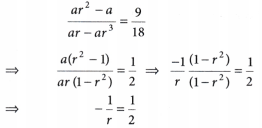
⇒ r = – 2
On putting r = – 2 in Eq. (ii), we get a(- 2) – a(- 2)3 = 18
⇒ – 2a + 8a = 18
⇒ 6a = 18
⇒ a = 3
Required GP is 3, 3(-2), 3(-2)2, 3(-2)3,… i.e. 3, -6, 12, -24,… .
Graphical Representation of an Geometric Progression (GP)
The nth term of a GP is given by an = arn-1
Where, a = First term and r = Common ratio
Consider a GP whose first term is 2 and common ratio is 3
i.e. a = 2, r = 3.
So, an = 2 × (3)n-1
Let us find few values of an corresponding to values of n.
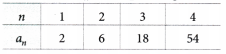
Plot the points (1, 2), (2, 6), (3, 18), (4, 54) on a graph paper and draw graph by joining the points consecutively.
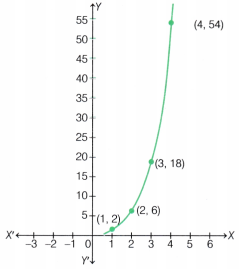
Here, the graph is a curved line.
Example 8.
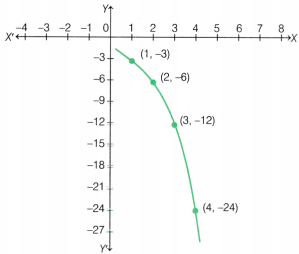
Represent the GP graphically, whose first term, a = -3 and common ratio, r = 2.
Solution:
Given, a = -3 and r = 2
Now, an = -3 × 2n-1 [∵ an = arn-1]
Now, finding values of an corresponding to a few values of n.
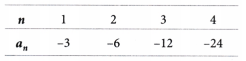
Plot the points (1, -3), (2, -6), (3, -12), (4, -24) on a graph paper and draw graph by joining the points consecutively.
Exploring Fractals Through Geometric Progression
Fractals are intricate mathematical shapes that exhibit self-similarity, meaning they look the same regardless of how much you zoom in. These patterns are built by repeating a specific rule infinitely at smaller scales.
Because these patterns involve constant multiplication (either increasing the number of parts or decreasing the size), they are perfectly modeled by Geometric Progression.
In our previous classes we are read about various fractals such as Sierpinski Carpet, Sierpinski Gasket and Koch Snowflake.
A fractal is a special type of figure that has the following characteristics.
- It shows the same pattern repeatedly at different scales, meaning each smaller part looks similar to the whole shape (self-similarity).
- The pattern can be extended endlessly, without any limit.
- It often possesses unique properties, such as extremely large boundary length or non-integer (fractional) dimensions.
Let us now study these fractal patterns step-by-step with the help of Geometric Progression (GP).
1. The Sierpinski Carpet (Area-Based Fractal)
The Sierpinski Carpet is constructed by dividing a square into a 3×3 grid and removing the central square. This process is then repeated for the remaining 8 squares.
Mathematical Deduction
Let Sn represent the number of shaded squares after each step.
Step 1: S1 = 1 = 8° = 1 × 81-1

Step 2: The single square is replaced by 8 smaller squares.
So, S2 = 8 = 1 × 82-1
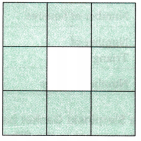
Step 3: Each of those 8 squares produces 8 more.
So, S3 = 1 × 8 × 8 = 1 × 82 = 1 × 83-1
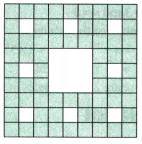
Step 4: Again each square produces 8 new squares.
So, S4 =1 × 8 × 8 × 8 = 1 × 83 = 1 × 84-1
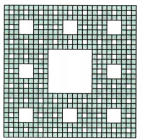
General Formula
The number of squares produced after n steps is Sn = 1 × 8n-1
This is a GP, where the first term, a = 1 and the common ratio, r = 8.
2. The Sierpinski Gasket (Triangular Fractal)
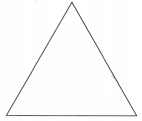
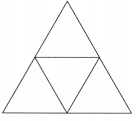
Similar to the carpet, the Sierpinski Gasket (or Triangle) starts with an equilateral triangle. We divide it into 4 smaller triangles by joining the mid-points and remove the central one.
This process is then repeated for the remaining smaller triangles and continue this process recursively for each of the smaller triangles.
Mathematical Deduction
Let Tn be the number of triangles remaining.
Step 1: T1 = 1 = 3° = 1 × 31-1
Step 2: After removing the center, 3 triangles remain.
T2 = 3 = 1 × 32-1
Step 3: Each of the 3 triangles splits to leave 3 more.
T3 = 1 × 3 × 3 = 1 × 32 = 1 × 33-1
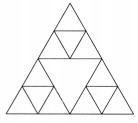
Step 4: Again each triangle produce 3 new triangles
T4 = 1 × 3 × 3 × 3 = 1 × 33 = 1 × 34-1
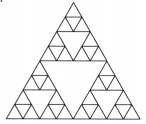
General Formula
The number of triangles remaining after n steps is
Tn = 1 × 3n-1
This is a GP, where the first term, a = 1 and the common ratio, r = 3.
3. The Koch Snowflake (Perimeter-Based Fractal)
The Koch Snowflake begins with an equilateral triangle.
In each step, the middle third of every side is replaced by two sides of an equilateral triangle pointing outwards.
Mathematical Deduction
Let Ln be the number of straight line segments (sides) in the figure.
Step 1: The triangle has 3 sides.
L1 = 3 = 3 × 41-1
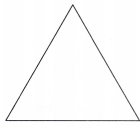
Step 2: Each side is replaced by 4 smaller segments.
L2 = 3 × 4 = 12 = 3 × 42-1

Step 3: Each nf the 12 segments is again replaced by 4 segments.
L3 = 12 × 4 = 48 = 3 × 43-1

Step 4: Each of the 3x4x4 sides is again replaced by 4 segments.
So, L = 3 × 4 × 4 × 4 = 3 × 43 = 3 × 44-1

General Formula
The total number of sides after n steps is Ln = 3 × 4n-1
This is a GP where the first term, a = 3 and the common ratio, r = 4.
Comparative Summary Table
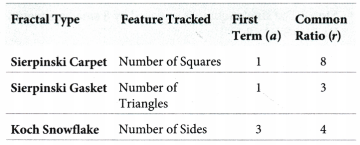
Example 1.
In a Sierpinski Gasket pattern, find the number of triangles present in the 8th step.
Solution:
In a Sierpinski Gasket, the number of triangles follows a GP.
Here, a = 1, r = 3 and n = 8
Using the formula for the nth term,
an = a.rn-1
⇒ a8 = 1 × 38-1
⇒ a8 = 37
⇒ a8 = 2187
Therefore, there are 2187 triangles in the 8th step.
Tower of Hanoi
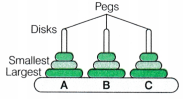
The Tower of Hanoi is a well-known mathematical puzzle introduced by Edouard Lucas in the 19th century. The puzzle consists of
(i) Three vertical rods (pegs), commonly named as Source (A), Auxiliary (B) and Destination (C).
(ii) A set of circular discs of different sizes placed on the source peg. These discs are arranged in decreasing order of size i.e. the largest disc is at the bottom and the smallest is at the top.
The task is to transfer the complete stack of discs from the Source peg (A) to the Destination peg (C), making use of the Auxiliary peg (B).
Conditions to Follow
(i) Only one disc can be moved at a time.
(ii) At any step, only the topmost disc from a peg can be picked up.
(iii) A bigger disc must never be placed over a smaller disc. We will study the puzzle for different values of n and observe a pattern in the number of moves.
Case 1:
When number of discs (n = 1)
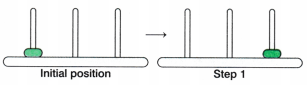
⇒ Minimum number of moves = 1 = 21 – 1
Case 2:
When number of disc (n = 2)
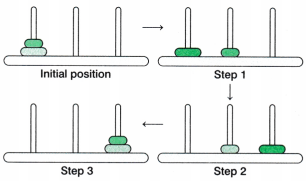
⇒ Minimum number of moves = 3 = 22 – 1
Case 3:
When number of discs (n = 3)
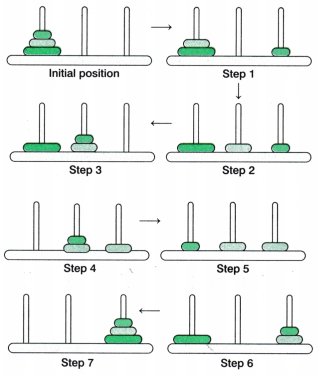
⇒ Minimum number of moves = 7 = 23 – 1
Pattern Observation

This sequence is 1, 3, 7, 15, ………….
General Formula
From the above observation, for n number of discs, the minimum number of moves required to solve the puzzle,
Tn = 2n – 1
⇒ Tn + 1 = 2n
Here, 2n form a GP with n = 1, 2, 3.
So, 2, 4, 8, 16, forms a GP with a = 2, r = 2