Experts have designed these Class 9 Maths Notes and Chapter 6 Measuring Space Perimeter and Area Class 9 Ganita Manjari Notes for effective learning.
Class 9 Maths Chapter 6 Measuring Space Perimeter and Area Notes
Class 9 Maths Ganita Manjari Chapter 6 Notes
Ganita Manjari Class 9 Chapter 6 Notes – Class 9 Measuring Space Perimeter and Area Notes
In this chapter, we learn about important concepts related to area and perimeter of different shapes. We also study Heron’s formula and Brahmagupta’s formula to find the area of triangles and quadrilaterals. We also explore the perimeter, area of circle, area of sector and segment of a circle along with brief history of t. These topics help us apply mathematical formulas to solve real-life problems involving measurement.
Perimeter and Area of Triangle and Quadrilaterals
The perimeter of a closed figure represents the total length of its boundary and is expressed in linear units such as cm, m, in etc. The area of a plane figure refers to the region occupied by it and is measured in square units such as cm2, m2, in2 etc.
In this topic, we shall systematically review the formulas related to perimeter and area of common geometrical figures.
Triangles
General Triangle
Consider a triangle in which base = b, height = h and the remaining sides are a and c.
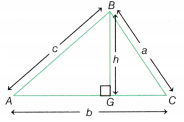
- Perimeter = a + b+c
- Area = \(\frac{1}{2}\) × b × h
Right angled Triangle
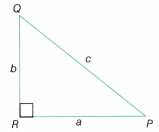
Let the two perpendicular sides be a and b and hypotenuse be c.
- Perimeter = a + b + c
- Area = \(\frac{1}{2}\) × a × b
Equilateral Triangle
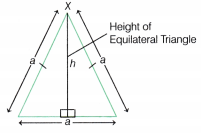
Let each side of the triangle be a.
- Perimeter = 3a
- Area = \(\frac{\sqrt{3}}{4}\)a
- Height = \(\frac{\sqrt{3}}{2}\)a
Isosceles Triangle
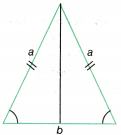
Let the equal sides be a each and base be b.
- Perimeters = 2a + b
- Area = \(\frac{b}{4} \sqrt{4 a^2-b^2}\)

Rectangle
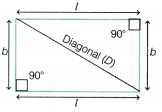
Let length = l and breadth = b
- Perimeter = 2(l + b)
- Area = l × b
- Diagonal = \(\sqrt{l^2+b^2}\)
Square
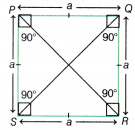
Let each side of the square be a.
- Perimeter = 4a
- Area = a2
- Diagonal = √2a
Parallelogram
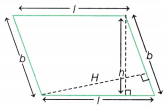
Let adjacent sides be l and b and height be h.
- Perimeter = 2(l + b)
- Area = Base × Height = l × h (or b × H)
Rhombus
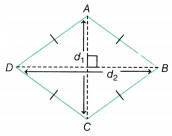
Let each side of rhombus be a diagonals be d1 and d2.
- Perimeter = 4a
- Area = \(\frac{1}{2}\) × d1 × d2
- Side = \(\sqrt{\left(\frac{d_1}{2}\right)^2+\left(\frac{d_2}{2}\right)^2}\)
Trapezium
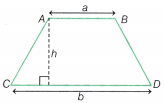
Let the parallel sides be a and b and height be h.
- Perimeter = Sum of all sides
- Area = \(\frac{1}{2}\)(a + b) × h
Example 1.
The perimeter of an equilateral triangle is numerically equal to its area. Find the side and perimeter of the triangle.
Solution:
Let side of equilateral triangle be a units.
Now, perimeter = 3a and area = \(\frac{1}{2}\)a2.
Given, perimeter is equal to its area.
So, 3a = \(\frac{1}{2}\)a2 ⇒ 12a = √3a2
⇒ a = \(\frac{1}{2}\) = 4√3 units
Hence, required side = 4√3 units
Now, perimeter = 3 × Side = 3 × 4√3 = 12√3 units
Example 2.
The equal sides of an isosceles triangle are 13 cm each and its area is 60 cm 2. Find the base and perimeter of the triangle.
Solution:
Let base be b cm.
Given, equal side (a) = 13 cm
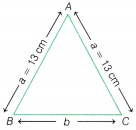
Area – \(\frac{1}{4} b \sqrt{4 a^2-b^2}\)
⇒ 60 = \(\frac{1}{4} b \sqrt{4(13)^2-b^2}\)
⇒ 240 = \(b \sqrt{676-b^2}\)
(240)2 = b2(676 – b2)
57600 = 676b2 – b4
⇒ b4 – 576b2 – 100b2 + 57600 = 0
⇒ b2(b2 – 576) – 100(b2 – 576) = 0
⇒ (b2 – 576)(b2 – 100) = 0
⇒ b = ±24, ±10
⇒ b = 24, 10 [values cannot be negative]
Now, if a = 13 cm and b = 24 cm then
perimeter = 2a + b = 2 × 13 + 24 = 50 cm
and if a = 13 cm and b =10 cm then
perimeter = 2a + b = 2 × 13 + 10 = 36 cm
Hence, the base is either 24 cm or 10 cm and corresponding perimeter is 50 cm or 36 cm.
Example 3.
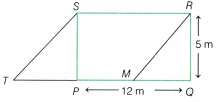
In the given figure, PQRS is a rectangle of length 12 cm and breadth 5 cm. M is the mid-point of PQ. Side QP is extended to a point T such that PT = QM. Find the area of quadrilateral SRMT.
Solution:
Given, PQRS is a rectangle of length 12 cm and breadth 5 cm.
Now, TM= PM + PT = PM + QM [∵PT = QM]
⇒ TM = PQ …(i)
PQRS is a rectangle, so PQ = SR.
TM = SR = 12 cm [∵ from Eq. (i)]
∴ TM is parallel and equal to SR.
So, SRTM is a parallelogram.
So, area of parallelogram SRTM = Base × Height
= 12 × 5
= 60 cm2
Example 4.
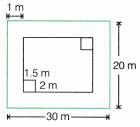
A rectangular park, whose length is 30 m and width is 20 m is shown in the following figure.
(i) What is the total length of the fence surrounding it?
(ii) How much land is occupied by the park?
(iii) A path of 1 m width running inside along the perimeter of the park has to be cemented. How many bags of cement would be required to construct the cemented path, if 1 bag of cement is required to cement 4m2 area?
(iv) There are two rectangular flower beds of size 1.5 m × 2 m each in the park as shown in the given figure and the rest has grass on it. Find the area covered by grass.
Solution:
(i) Total length of the fence surrounding it = Perimeter of the park
= 30 + 20 + 30 + 20 = 100 m
(ii) Land occupied by the park = Area of the park
= 30 × 20 = 600 m2
(iii) Area of cemented path = Area of the park – Area of the park left after cementing the path
= 600 – [(30 – 2) × (20 – 2)]
= 600 – (28 × 18)
= 600 – 504 = 96 m2
∴ Number of cement bags = \(\frac{\text { Area of the path }}{\text { Area cemented by } 1 \text { bag }}\)
= \(\frac{96}{4}\)
= 24
(iv) Area covered by the grass = Area of the park left after cementing the path – Area of rectangular beds
= 504 – 2 × (1.5 × 2)
= 504 – 6
= 498 m2
Example 5.
The area of a trapezium is 180 cm2. One of its parallel sides is twice the other and the height is 6 cm. Find the lengths of the parallel sides.
Solution:
Let ABCD be a trapezium in which AS ∥ DC.
Given, area of trapezium = 180 cm2 and height = 6 cm.
Now, according to question
If CD = x then AB = 2 x.
Area = \(\frac{1}{2}\) (x + 2x) × 6
180 = \(\frac{1}{2}\) (3x) × 6
[∵ area = \(\frac{1}{2}\) × (sum of parallel sides) × height]
⇒ 180 = 9x ⇒ x = 20
Thus, the lengths of the parallel sides are 20 cm and 40 cm.
Example 6.
The area of a rhombus is 96 cm2 and one diagonal is 12 cm. Find its perimeter.
Solution:
Let d1 and d2 be the diagonals of the rhombus ABCD.
Given, area of rhombus is 96 cm2 and one diagonal (d1) is
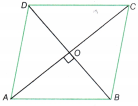
Now, area = \(\frac{1}{2}\) × d1 × d2
[∵ area of rhombus = \(\frac{1}{2}\) × product of diagonals]
96 = \(\frac{1}{2}\) × 12 × d2
⇒ 96 = 6d2
⇒ d2 = 16 cm
Let AC = 12 cm
∴ AO = \(\frac{12}{2}\) = 6 cm and BD = 16 cm
BO = \(\frac{16}{2}\) = 8 cm
Here, AOB is a right angled triangle.
(AB)2 = \(\sqrt{6^2+8^2}\)
[∵ Baudhayana-Pythagoras theorem]
= \(\sqrt{36+64}=\sqrt{100}\) = 10 cm
Now, perimeter of rhombus ABCD = 4 × 10 = 40 cm
Example 7.
A square and an equilateral triangle have the same perimeter. If the side of the square is 12 cm, find area of the triangle.
Solution:
Given, the side of the square is 12 cm.
∴ Perimeter of the square = 4 × 12 = 48 cm
According to the question, square and equilateral triangle have same perimeter.
∴ Perimeter of equilateral triangle = 3 × Side
⇒ 48 = 3 × Side
⇒ Side = \(\frac{1}{2}\) = 16 cm
Now, area of the equilateral triangle = \(\frac{\sqrt{3}}{4}\) × (16)2
= \(\frac{\sqrt{3}}{4}\) × 256
= 64 √3 cm2
Example 8.
Prove that if two triangles have equal bases and equal heights then their areas are equal.
Solution:
Let two triangles be ABC and PQR have equal bases and equal heights i.e. BC = QB and AL = PM.
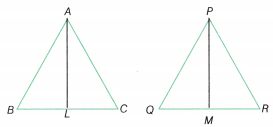
Now, area of ΔABC = \(\frac{1}{2}\) × BC × AL
[∵ area of triangle = \(\frac{1}{2}\) × base × height]
and area of ΔPQR = \(\frac{1}{2}\) × QR × PM
Therefore, area of ΔABC = \(\frac{1}{2}\) × BC × AL
= \(\frac{1}{2}\) QR × PM
[∵ BC = QR and AC = PM]
= Area of ΔPQR
Hence, triangles having equal bases and equal heights are equal in area.
Median of a Triangle
A median of a triangle is the line segment joining a vertex to the mid-point of the opposite side. Every triangle has three medians.
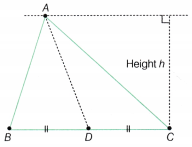
Theorem: A median of a triangle divides it into two triangles with equal area.
Given Consider a ΔABC. Let AD be a median, where D is the mid-point of BC.
Then, BD = DC = \(\frac{1}{2}\)BC …(i)
Construction Draw AN ⊥ BC.
Proof We know that
Area of a triangle = \(\frac{1}{2}\) × Base × Height
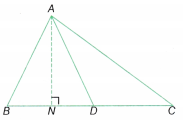
Now, in ΔABD, take BD as base and AN as height.
∴ Area of ΔABD = \(\frac{1}{2}\) × BD × AN …(ìi)
Also, in ΔADC, take DC as base and AN as height.
∴ Area of ADC = \(\frac{1}{2}\) × DC × AN
But, from Eq. (i), BD = DC
So, area of ΔADC = \(\frac{1}{2}\) × BD × AN …(iii)
From Eqs. (ii) and (iii), we get
Area of ΔABD = Area of ΔADC
Hence, a median of a triangle divides the triangle into two regions of equal area.
Example 9.
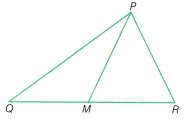
PQR, PM Is a median. If the area of POR = 50 cm2 find the area of ΔPMR.
Solution:
Given, PM is a median of ΔPQR.
∴ ar(ΔPQM) = ar (PMR)
Now, ar(ΔPQR) = ar (ΔPQM) + ar(ΔPMR)
⇒ 50 = ar (ΔPMR) + ar (ΔPMR)
⇒ 50 = 2 ar (ΔPMR)
⇒ ar(ΔPMR) = \(\frac{50}{2}\) = 25 cm2
Therefore, the area of ΔPMR is 25 cm2.
Squaring a Rectangle
It means constructing a square having the same area as a given rectangle using only geometric tools (compass and scale).
Step of Construction
Given A rectangle ABCD.
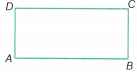
To construct A square equal in area to rectangle ABCD.
Construction
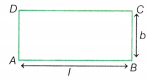
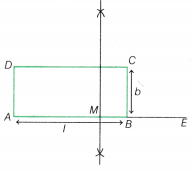
(i) Draw a rectangle ABCD such that AB = 1 and BC = b.
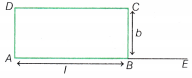
(ii) Extend side AB to a point E such that BE = BC.
(iii) Draw the perpendicular bisector of AE, which meets AE at M i.e. M is the mid-point of AE.
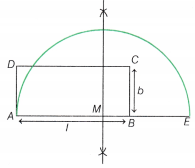
(iv) With centre M and radius MA or ME, draw a semi-circle on AE.
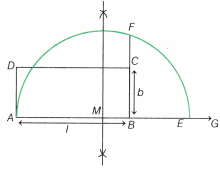
(v) Extend the side BC to meet the semi-circle at point F and with centre B and radius BF, draw an arc to cut extended AE at G.
(vi) With centre F and G and radius BF, draw two arces, which intersects each other at H and join FH and GH.
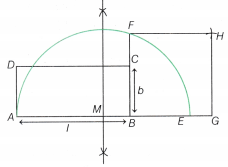
Hence, BGHF is the required square, whose area is equal to the given rectangle ABCD.
Verification
We have, AB = l and BC = b
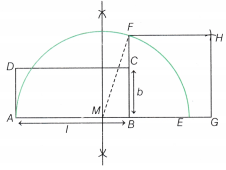
From construction BE = b, so AE = AB + BE = l + b
Since, M is mid-point of AE.
∴ AM = \(\frac{l+b}{2}\)
Now, in right angled ΔBMF,
BF2 = MF2 – MB2 [by Pythagoras theorem]
But, MF = MA = \(\frac{l+b}{2}\) [radii of semi-circle]
and MB = ME – BE = 6 = MA – BE [∵MA = ME]
\(\frac{l+b}{2}\) – b = \(\frac{l-b}{2}\)
BF2 = \(\left(\frac{l+b}{2}\right)^2-\left(\frac{l-b}{2}\right)^2=\frac{(l+b)^2-(l-b)^2}{4}=\frac{4 l b}{4}\)
⇒ BF2 = lb
Hence, area of square BGHF = (BF)2 = lb = Area of rectangle ABCD
Example 10.
Construct a square equal in area to a rectangle, whose length is 8 cm and breadth is 2 cm and verify it.
Solution:
Steps of construction
(i) Draw a rectangle ABCD such that
AB = 8 cm and BC = 2 cm.
(ii) Extend AB to a point E such that BB = 2 cm.
(iii) Find the mid-point M of AB.
(iv) With centreMand radiusMA, draw a semi-circle on AE.
(v) Extend the side BC to meet the semi-circle at point F and with centre B and radius BF draw an arc to cut extended AB at G.
(vi) With centre F and G and radius BF, draw two arcs, which intersects each other at H. Join FH and GH.
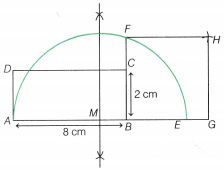
Hence, BGHF is the required square.
Verification
We have, AB = 8 cm and BC = 2 cm
∴ Area of rectangle ABCD = 8 × 2 = 16 cm2
Here, AE = AB + BE = AB + BC = 8 + 2 = 10 cm
Since, M is mid-point of AE.
∴ AE = \(\frac{A E}{2}=\frac{10}{2}\) = 5 cm
Also, MF = MA = 5 cm [radii of semi-circle]
and MB = ME – BE = MA – BE = 5 – 2 = 3 cm
Now, in right angled ΔBMF,
BF2 = MF2 – MB2 [by Pythagoras theorem]
= (5)2 – (3)2 = 25 – 9 = 16
∴ Area of square BGFH – (BF)2 – (4)2 = 16 cm2 …(ii)
Hence, from Eqs. (i) and (ii), we get
Area of rectangle ABCD = Area of square BGFH.
Area of a Cyclic Quadrilateral (Brahmagupta’s Formula)
In geometry, we often study figures bounded by four sides, known as quadrilaterals.
However, when all four vertices of a quadrilateral lie on a single circle, the figure is called a cyclic quadrilateral. Brahmagupta (598-668 CE), a renowned Indian mathematician and astronomer, introduced a remarkable formula to determine the area of a special type of quadrilateral using only the lengths of its sides. This result is known as Brahmagupta’s formula.
Quadrilateral
A closed figure formed by four line segments is called a quadrilateral. e.g. Square, rectangle, rhombus, parallelogram and trapezium.
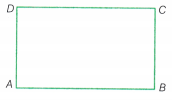
Cyclic Quadrilateral
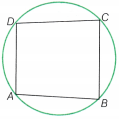
A quadrilateral is said to be cyclic if all its four vertices lie on a circle.
In other words, it can be inscribed in a circle.
If even one vertex does not lie on the circle then the quadrilateral is not cyclic.
So, ABCD is a cyclic quadrilateral.
Brahmagupta’s Formula
Consider a cyclic quadrilateral whose sides are a, b, c and d.
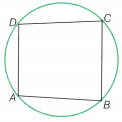
Let s = \(\frac{a+b+c+d}{2}\) be the semi-perimeter.
Then, the area of the cyclic quadrilateral is given by Area = \(\sqrt{(s-a)(s-b)(s-c)(s-d)}\)
Note:
It is applicable only, when the quadrilateral is cyclic.
Example 1.
Find the area of a cyclic quadrilateral whose sides are 7 cm, 8 cm, 9 cm and 10 cm.
Solution:
Given sides of cyclic quadrilateral are
a = 7 cm, b = 8 cm, c = 9 cm and d = 10 cm.
∴ Semi-perimeter, s = \(\frac{7+8+9+10}{2}=\frac{34}{2}\) = 17 cm
By using Brahmagupta’s formula, we get
Area = \(\sqrt{(17-7)(17-8)(17-9)(17-10)}\)
= \(\sqrt{10 \times 9 \times 8 \times 7}\)
= \(\sqrt{5040}\)
= 12\(\sqrt{35}\) cm2
Example 3.
Find the area of a square of side 6 cm using Brahmagupta’s formula.
Solution:
Given, sides of the square = a = b = c = d = 6 cm
Now, s = \(\frac{6+6+6+6}{2}=\frac{24}{2}\) = 12 cm
∴ Required area = \(\sqrt{(12-6)(12-6)(12-6)(12-6)}\)
= \(\sqrt{6 \times 6 \times 6 \times 6}\)
= \(\sqrt{(40)^2}\)
= 62 = 36 cm2
Example 3.
Find the area of a rectangle with length 8 cm and breadth 5 cm using Brahmagupta’s formula.
Solution:
Given sides are a = 8 cm,b = 5 cm, c = 8 cm and d = 5 cm.
Now, s = \(\frac{8+5+8+5}{2}=\frac{26}{2}\) = 13 cm
∴ Area = \(\sqrt{(13-8)(13-5)(13-8)(13-5)}\)
= \(\sqrt{5 \times 8 \times 5 \times 8}\)
= \(\sqrt{(40)^2}\)
= 40 cm2
Heron’s Formula
Let the lengths of the three sides of a ∆ABC be a, b and c.
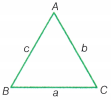
Then, area of ∆ABC = \(\sqrt{s(s-a)(s-b)(s-c)}\)
where s is the semi-perimeter of the triangle i.e. s = \(\frac{a+b+c}{2}\)
This formula is given by Heron that is why it is known as Heron’s formula. This formula can be used for any triangle to calculate its area, when height of the triangle cannot determined easily.
Heron’s formula is generally used for calculating area of scalene triangle.
Example 4.
Find the area of a triangle, whose sides are 12 cm, 16 cm and 20 cm, respectively.
Solution:
Let the sides of triangle be a = 12 cm, b = 16 cm and c = 20 cm.
We know that semi-perimeter, s = \(\frac{a+b+c}{2}\)
∴ s = \(\frac{12+16+20}{2}=\frac{48}{2}\) = 24 cm
Area of triangle = \(\sqrt{s(s-a)(s-b)(s-c)}\) [by Heron’s formula]
= \(\sqrt{24(24-12)(24-16)(24-20)}\)
= \(\sqrt{24 \times 12 \times 8 \times 4}\)
= \(\sqrt{9216}\)
= 96 cm2
Hence, area of the given triangle is 96 cm2.
Example 5.
Find the area of a triangle, two sides of which are 16 cm and 22 cm and the perimeter is 64 cm.
(as shown below).
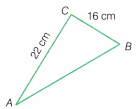
Solution:
Here, we have perimeter of the triangle = 64 cm
Let a = 16 cm and b = 22 cm.
Third side, c = 64 – (16 + 22) = 26 cm
So, 2s = 64 i.e. s = 32 cm.
Therefore, area of the triangle = \(\sqrt{s(s-a)(s-b)(s-c)}\)
= \(\sqrt{32(32-16)(32-22)(33-26)}\)
= \(\sqrt{32 \times 16 \times 10 \times 6}\)
= 32\(\sqrt{30}\) cm2
Example 6.
Find the area of an isosceles triangle, by using Heron’s formula having base 4 cm and length of ope of equal side as 6 cm.
Solution:
Let the given sides of isosceles triangle be a = 4 cm and b = c = 6 cm.
Then, semi-perimeter, s = \(\frac{a+b+c}{2}=\frac{4+6+6}{2}\)
= \(\frac{16}{2}\) = 8 cm
Now, area of isosceles triangle
= \(\sqrt{s(s-a)(s-b)(s-c)}\) [by Heron’s formula]
= \(\sqrt{8(8-4)(8-6)(8-6)}\)
= \(\sqrt{8 \times 4 \times 2 \times 2}=\sqrt{128}\) = 8√2 cm2
Hence, the area of isosceles triangle is 8√2 cm2.
Example 7.
A triangular park PQR has sides 160 m, 100 m and 80 m (as shown below).
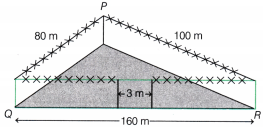
A gardener Sarita has to put a fence all around it and also plant grass inside. How much area does she need to plant grass? Find the cost of fencing it with barbed wire at the ratio of ₹ 16.25 per metre leaving a space 3 m wide for a gate on one side.
Solution:
For finding the area of given park PQR, we have
a = 80 m, b = 100 m and c = 160 m.
We know that semi-perimeter,
s = \(\frac{a+b+c}{2}=\frac{80+100+160}{2}\) = 170 m
Therefore, area of the park
= \(\sqrt{s(s-a)(s-b)(s-c)} \mathrm{s}\) [by Heron’s formula]
= \(\sqrt{170(170-80)(170-100)(170-160)}\)
= \(\sqrt{170 \times 90 \times 70 \times 10}\) = 300\(\sqrt{119}\) m2
Hence, Sarita needs the area to plant grass is 300\(\sqrt{119}\) m2
Also, perimeter of the park = PQ + QR + RP = 340 m
Therefore, length of the wire needed for fencing
= 340 – 3 [to be left for gate]
= 337 m
So, the cost of fencing = ₹ 16.25 × 337 = ₹ 5476.25
Example 8.
The length of the sides of a triangle are in the ratio 3 : 4 : 5 and its perimeter is 144 cm. Find the area of the triangle.
Solution:
Given, perimeter = 144 cm and ratio of the sides = 3 : 4 : 5.
Sum of ratio terms = 3 + 4 + 5 = 12
First side, a = 144 × \(\frac{3}{12}\) = 36 cm
Second side, b = 144 × \(\frac{4}{12}\) = 48 cm
Third side, c = 144 × \(\frac{5}{12}\) = 60 cm
Now, semi-perimeter of the triangle,
s = \(\frac{a+b+c}{2}=\frac{36+48+60}{2}=\frac{144}{2}\) = 72 cm
Area of triangle = \(\sqrt{s(s-a)(s-b)(s-c)}\)
[by Heron’s formula]
= \(\sqrt{72 \times(72-36)(72-48)(72-60)}\)
= \(\sqrt{72 \times 36 \times 24 \times 12}\)
= \(\sqrt{(36)^2 \times(24)^2}\)
= 36 × 24
= 864 cm2
Hence, the area of the given triangle is 864 cm2
Example 9.
The sides of a triangular park are 8 m, 10 m and 6 m, respectively. A small circular area of diameter 2 m is to be left out and the remaining area is to be used for growing roses. How much area is used for growing roses? [take π = 3.14]
Solution:
Let sides of the triangle be a = 8 m, b = 10 m and c = 6m
Now, semi-perimeter of a triangle,
s = \(\frac{a+b+c}{2}=\frac{8+10+6}{2}=\frac{24}{2}\) = 12 m
∴ Area of the triangle, = \(\sqrt{s(s-a)(s-b)(s-c)}\) [by Heron’s formula]
= \(\sqrt{12(12-8)(12-10)(12-6)}\)
= \(\sqrt{12 \times 4 \times 2 \times 6}\)
= 24 m2
and area of the circle = πr2 = 3.14 × 12 [∵ r = \(\frac{d}{2}=\frac{2}{2}\) = 1]
= 3.14 m2
∴ Area for growing roses = Area of a triangle – Area of a circle
= 24 – 3.14 = 20.86 m2
Example 10.
Two identical circles with same internal design as shown in the figure are to be made at the entrance. The identical triangle leaves are to be painted yellow and the remaining portion are to be painted red. Find the total area to be painted yellow.
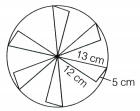
Solution:
Let the sides of one identical triangular leaf be a = 13 cm, b = 12 cm and c = 5 cm.
Now, s = \(\frac{a+b+c}{2}=\frac{8+10+6}{2}=\frac{24}{2}\) = 15 cm
By Heron’s formula,
Area of one triangular leaf = \(\sqrt{s(s-a)(s-b)(s-c)}\)
= \(\\sqrt{15(15-13)(15-12)(15-5)}\)
= \(\sqrt{15 \times 2 \times 3 \times 10}\)
= 30 cm2
There are 6 leaves in a circle.
So, total number of leaves in 2 circles = 2 × 6 = 12
∴ Area of 12 leaves = 12 × 30 cm2 = 360 cm2
Hence, total area to be painted yellow = 360 cm2
Circumcircle and Incircle of a Triangle
For any ΔABC, there exists one and only one circle, which passes through all its three vertices. This circle is known as the circumcircle of the triangle.
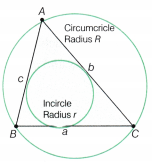
Similarly, there is exactly one circle that lies completely inside the triangle and touches all its three sides. This circle is called the incircle of the triangle.
Let the sides of ΔABC be a, b and c. Let R be the radius of the circumcircle and r be the radius of the incircle. Then, the area of the triangle can be expressed in two ways.
∴ Area of ΔABC = \(\frac{a b c}{4 R}\) and area of ΔABC = \(\frac{r(a+b+c)}{2}\)
Example 11.
In ΔABC, the sides are a = 6 cm, b = 8 cm and c = 10 cm. If the circumradius is R = 5 cm, find the area of the triangle.
Solution:
Given, in ΔABC, a = 6 cm, b = 8 cm, c = 10 cm and
circumradius (R) = 5 cm.
Now, area of triangle in terms of its sides and
circumradius, ar(ΔABC) = \(\frac{a b c}{4 R}\)
On substituting the given values, we get
ar(ΔABC) = \(\frac{6 \times 8 \times 10}{4 \times 5}=\frac{480}{20}\) = 24 cm2
Hence, the area of the triangle is 24 cm2.
Example 12.
In ΔXYZ, the sides are 13 cm, 14 cm and 15 cm. If the area of the triangle is 84 cm2, find the inradius of the triangle.
Solution:
Given, sides of ΔXTZ are 13 cm, 14 cm and 15 cm, and area = 84 cm 2.
Now, first find the semi-perimeter,
s = \(\frac{13+14+15}{2}=\frac{42}{2}\) = 21cm
Also, we know that ar(ΔXTZ) = r × s, where s is the semi-perimeter.
Are,of ΔABC = \(\frac{r(a+b+c)}{2}\)
On substituting the values, we get
84 = r × 21 ⇒ r = \(\frac{84}{21}\) = 4 cm
Hence, the inradius of the triangle is 4 cm.
Perimeter (Circumference) and Area of a Circle
The boundary length of circle is called its circumference. Just like a square has a perimeter, a circle also has a measurable boundary and this boundary is measured in units like cm, m, etc.
If we measure many circles and divide their circumference by their diameter, the ratio of circumference to dia meter always remains the same. This constant ratio is called the C/D ratio and it is denoted by π (pi).
It is a Greek letter with an approximate value of \(\frac{22}{7}\) or 3.14.
Thus, \(\frac{\text { Circumference }(C)}{\text { Diameter }(d)}\) = n
⇒ C = dπ
Since, diameter, d = 2r [where, r is radius]
∴ C = 2πr
Irrationality of π
Let us assume that the value of π is a rational number.
We know that any number, which can be represented as \(\frac{p}{q}\), where p and q are integers and q ≠ 0 is called rational
number.
Let π = \(\frac{p}{q}\) …(i)
The decimal expansion of π is non-terminating and non-repeating.
On the other hand, one of the properties of rational numbers is that their decimal expansions are either terminating or repeating.
From the above observation, we get contradiction, that on left hand side of Eq.(i), π has non-terminating and non-repeating decimal expansion, while on right-hand side the fraction \(\frac{p}{q}\) must have a decimal expansion that is either terminating or repeating.
Since, both sides can not be true simultaneously our initial assumption is wrong.
Thus, conclude that n is an irrational number.
Understanding π (Pi): History and Methods of Approximation
Early Understanding of π
The concept of π (pi), which represents the ratio of the circumference of a circle to its diameter has been known for thousands of years.
- Ancient civilisations attempted to estimate its value through measurement.
- The Babylonians used a value close to 3.125.
- The Egyptians estimated it to be about 3.16.
These values were not exact but were obtained by observing real circular objects.
First Mathematical Approach
A major breakthrough came from the Greek mathematician Archimedes (3rd century BCE). He introduced a systematic method instead of relying on rough measurements.
Contributions by Later Mathematicians
- Aryabhata (India, 5th century CE) calculated it correct up to four decimal places.
- Zu Chongzhi (China, 5th century CE) gave a highly accurate fractional value.
- The symbol n was first used by William Jones (1706), derived from the Greek word perimetros, meaning perimeter.
Archimedes’ Method (Polygon Method)
Archimedes estimated n using geometry.
- He drew regular polygons inside and outside a circle.
- He began with a 6-sided figure (hexagon) and gradually increased the number of sides upto 96.
- As the number of sides increased, the perimeter of the polygon became closer to the circumference of the circle.
Using this idea, he showed
\(\frac{223}{71}\) < π< \(\frac{22}{7}\)
Thus, π ≈ \(\frac{22}{7}\) ≈ 3.142857
This approximation is still commonly used.
Aryabhata’s Method
Aryabhata developed a numerical rule to estimate π.
Start with 100 Add 4 → 100 + 4 = 104
Multiply by 8 → 104 × 8 = 832
Add 62000 → 832 + 62000 = 62832
Now, using the relation
π = \(\frac{\text { Circumference }}{\text { Diameter }}=\frac{62832}{20000}\)
π ≈ 3.1416
Accuracy
The actual value of π is 3.14 159265….
Aryabhata’s value is correct upto four decimal places, which is highly precise for that time.
Zu Chongzhi’s Contribution
Zu Chongzhi improved earlier methods and provided very accurate values of it.
He obtained
a simple approximation π ≈ \(\frac{1}{2}\)
a more accurate approximation π ≈ \(\frac{355}{113}\)
converting into decimal \(\frac{355}{113}\) ≈ 3.14l5929
This value remained one of the most accurate estimates for nearly 1000 years.
Example 1.
The radius of a circular garden is 2.8 m. Find its circumference.
Solution:
Given, radius of circular garden, r = 2.8 = \(\frac{14}{5}\)
∴ Circumference = 2πr
= 2 × \(\frac{22}{7} \times \frac{14}{5}=\frac{44 \times 2}{5}=\frac{88}{5}\) = 17.6m
Example 2.
A cIrcular track has cIrcumference 44 m. Find its radius.
Solution:
Let r be the radius of the circular track.
Given, circumference = 44 m.
∴ 2πr = 44
2 × \(\frac{22}{7}\) × r = 44 ⇒ r = \(\frac{44 \times 7}{44}\) = 7m
Hence, radius of the circular track is 7 m.
Example 3.
A circular pond has dIameter 28 m. How far will a person walk In 3 rounds?
Solution:
Given, diameter of circular pond, d = 28m
∴ Circumference of the circular pond = πd
= \(\frac{22}{7}\) × 28 = 88 m
Since, the person walks 3 round.
∴ Distance covered in 3 round = 3 × 88 = 264 m
Example 4.
How many circular rings of radius 3.5 cm can be made from a wire of length 220 cm?
Solution:
Given, radius of circular rings, r = 3.5 = \(\frac{7}{2}\) cm
∴ Circumference of one ring = 2πr = 2 × \(\frac{22}{7} \times \frac{7}{2}\) = 22 cm
Now, number of rings = \(\frac{\text { Length of wire }}{\text { Circumference of one ring }}\)
= \(\frac{220}{22}\) = 10
Example 5.
A wheel of a cart has diameter 56 cm. Find the distance travelled in 500 revolutions.
Solution:
Given, diameter of wheel = 56 cm
∴ Circumference of the wheel = πd = \(\frac{22}{7}\) × 56 = 176 cm
Now, distance travelled in 500 revolutions = 176 × 500
= 88000 cm
= 880 m
Example 6.
Find the perimeter of a semi-circle, whose diameter is 42 cm.
Solution:
Given, diameter of the semi-circle = 42 cm
∴ Perimeter of the semi-circle = \(\frac{1}{2}\) (Circumferences)
= \(\frac{1}{2}\)(2πr) + 42 = \(\frac{1}{2}\) × 21 + 42
= 66 + 42
= 108 cm
Example 7.
The inner and outer circumferences of a circular path are 440 m and 528 m. Find the width of the path.
Solution:
Let the inner and outer radii of the circular path be r and R, respectively.
Then, 2πr = 440 and 2πR = 528
⇒ 2 × \(\frac{22}{7}\) × r = 440 and 2 × latex]\frac{22}{7}[/latex] × R = 528 7 7
⇒ r = \(\frac{22}{7}\) and R = latex]\frac{22}{7}[/latex]
⇒ r = 70 m and R = 84 m
Now, width of the circular track = R – r = 84 – 70 = 14 m
Example 8.
A bicycle covers 6.6 km in 3000 revolutions. Find the diameter of its wheel.
Solution:
Given, distance covered by the bicycle in 3000 revolution
= 6.6 km = 6600 m
∴ Distance covered by the bicycle in one revolution
= \(\frac{\text { Total distance covered }}{\text { Number of revolutions }}=\frac{6600}{3000}\) = 2.2 m = 220 cm
Also, distance covered in one revolution = Circumference of wheel = 220 cm
⇒ πd = 220
⇒ d = \(\frac{220 \times 7}{22}\) = 70 cm
Example 9.
The difference between circumference and diameter of a circle is 22 cm. Find its radius.
Solution:
Let d be the diameter of given circle.
We have, πd – d = 22
d(π – 1) = 22 ⇒ d(\(\frac{22}{7}\) – 1) = 22
d × \(\frac{15}{7}\) = 22 ⇒ d = \(\frac{22 \times 7}{15}=\frac{154}{15}\)
∴Radius of the circle = \(\frac{77}{15}\) cm [∵r = \(\frac{d}{2}\)]
Example 10.
A fan makes 120 rotations per minute. If the radius of the fan is 21 cm, find the distance covered by a point on the tip in 1 min.
Solution:
Given, radius of the fan (r) = 21cm
∴ Distance covered by a point on the tip in one rotation
= 2πr = 2 × \(\frac{22}{7}\) × 21= 132 cm 7
Now, in 1 min distance covered by fan = 132 × 120
= 15840 cm
= 158.4 m
Area of a Circle
Let r be the radius of the circle.
- Area of the circle = πr2
- Area of semi-circle = \(\frac{1}{2}\)πr2
- Area of quadrant of a circle = \(\frac{1}{4}\)πr2
Example 11.
Find the area of a circle, whose radius is 7 cm.
Solution:
Given, radius of the circle = 7 cm
∴ Area of the circle = πr2 = \(\frac{22}{7}\) × 7 × 7 =
= 22 × 7
= 154 cm2
Example 12.
Find the radius of a circle, whose area is 154 cm2.
Solution:
Let r be the radius of the circle.
Given, area of the circle = 154 cm2
⇒ πr2 = 154
⇒ \(\left(\frac{22}{7}\right)\) × r2 = 154
⇒ r2 = \(\frac{(154 \times 7)}{22}\)
⇒ r = \(\sqrt{49}\) = 7 cm
Hence, the radius of the circle is 7 cm.
Example 13.
Find the area of a circle, whose circumference is 44 cm.
Solution:
Let r be the radius of the circle.
Given, circumference of the circle = 44 cm
⇒ 2πr = 44
⇒ 2 × \(\frac{22}{7}\) × r = 44 = \(\frac{44}{7}\) × r = 44
r = \(\frac{44 \times 7}{44}\) = 7cm
Now, area of the circle= πr2 = \(\frac{22}{7}\) × (7)2 = 154cm2
Example 14.
Find the area of a ring formed between two concentric circles of radii 7 cm and 14 cm.
Solution:
Let the radius of larger circle be R = 14 cm
and radius of smaller circle be r = 7 cm.
Area of ring = Area of larger circle – Area of smaller circle
= πR2 – πr2
= π(R2 – r2)
= π(142 – 72) – π(196 – 49)
= π × 147
= \(\left(\frac{22}{7}\right)\) × 147
= 22 × 21 = 462 cm2
Example 15.
A wire of length 66 cm is bent to form a circle. Find its area.
Solution:
Given, length of the wire = 66 cm
Since, total length of the wire is equal to circurnterence of the circle.
∴ Circumference of the circle = 2πr
⇒ 66 = 2 × \(\left(\frac{22}{7}\right)\) × r
⇒ 66 = \(\left(\frac{44}{7}\right)\) × r
⇒ r = \(\frac{(66 \times 7)}{44}\)
= 10.5cm
Now, area of the circle = πr2
= \(\left(\frac{22}{7}\right)\) × (1o.5)2 = \(\left(\frac{22}{7}\right)\) × 11025
=22 × 15.75
= 346.5 cm2
Example 16.
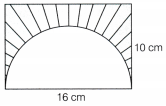
In the figure, a rectangle of length 16 cm and breadth 10 cm contains a semi-circle touching the longer side. Find the area of the shaded region.
Solution:
Area of the given rectangle = 16 × 10 = 160 cm2
Also, diameter of the semi-circle = 16cm
∴ Radius (r) of the semi-circle = \(\frac{16}{2}\) = 8cm
Now,area of the semi circle = \(\frac{1}{2}\)πr2 = \(\frac{1}{2}\) × π × 8 × 8
= \(\frac{1}{2} \times \frac{22}{7}\) × 64 = \(\frac{704}{7}\) cm
Now, area of the shaded region
= Area of rectangle – Area of semi-circle
= 160 – \(\frac{704}{7}=\frac{1120-704}{7}=\frac{41}{7}\) cm
Example 17.
A wire of length 88cm Is bent to form a circle. Find its area. If the same wire Is bent to form a square, find the area of the square. Which figure encloses greater area? [take n = 22/7]
Solution:
Given, length of the wire = 88 cm
For circle Circumference the of the = 2πr
= 2 × \(\frac{22}{7}\) × r = 88 r = \(\frac{88 \times 7}{44}\) = 14cm
Now, area of the circle = πr2 = \(\frac{22}{7}\) × 14 × 14
= 22 × 28 = 616 cm2
For square
Perimeter of the square = 88cm
∴ Side of the square = \(\frac{88}{4}\) = 22 cm
Now, area of square = side2 = 22 × 22 = 484 cm2
Since, area of circle is greater than area of square.
Therefore, the circle encloses more area.
Example 18.
From a rectangular sheet of length 20 cm and breadth 14 cm. two identical semi-circles removed from Its shorter sides. Find the remaining area.
Solution:
Given, length of rectangular sheet = 20cm
and breadth of rectangular sheet = 14cm
∴ Area of rectangular sheet = 20 × 14 = 280 cm2
Diameter of each semi-circle = 14 cm
∴Radius (r) of each semi-circle = 7cm
Now, area of one semicircle = πr2 = \(\frac{1}{2}\) × π × 7 × 7
= \(\frac{1}{2} \times \frac{22}{7}\) × 49 = 77 cm
∴ Area of two semi-circles = 2 × 77 = 154 cm2
Now, remaining area Area of rectangle – Area removed
= 280 – 154 = 126 cm2
Sector and Segment of a Circle
The portion of the circular region enclosed by two radii and the corresponding arc of a circle is called the sector of circle.
In the figure given below, shaded region OAPBO is a sector of the circle with centre O. Here, ∠AOB is called the angle of sector.
The sector containing minor arc is called minor sector (shaded region OAPBO) and the sector containing major arc is called major sector (unshaded region OACBO).
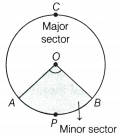
Angle of minor sector is less than 180° and angle of major sector is more than 180°. The sum of angles of major and minor sector is 360°.
Area of Sector of a Circle
Let there be a circle of radius r having a minor sector with angle θ.
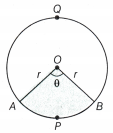
Then, Area of the sector = \(\frac{\theta}{360^{\circ}}\) × πr2
Also, Area of major sector = πr2 – Area of minor sector
Area of minor sector = πr2 – Area of major sector
If θ = 180° then sector becomes a semi-circular region and its area = \(\frac{1}{2}\)πr2.
If θ = 90° then sector becomes a quadrant of a circle and its area = \(\frac{1}{4}\)πr2.
Example 1.
The length of minute hand of a clock is 14 cm. Find the area swept by the minute hand in 1 min.
[take, π = \(\frac{22}{7}\)]
Solution:
The minute hand of a clock describes a circle of radius equal to its length i.e. 14 cm in 1 h.
So, the angle described by minute hand in 60 min = 360°
∴ Angle described by minute hand in 1 min = \(\frac{360^{\circ}}{60}\) = 6°
So, the area swept by the minute hand in 1 min is the area of a sector of angle 6° in a circle of radius 14 cm
Thus, the required area = \(\frac{\theta}{360^{\circ}}\) × πr2 = \(\frac{6^{\circ}}{360^{\circ}} \times \frac{22}{7}\) × (14)2
= \(\frac{1}{60} \times \frac{22}{7}\) × 14 × 14
= 10.27 cm
Length of an Arc of a Sector
The arc corresponding to a sector is called the arc of the sector.
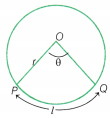
If the radius ola circle is r and the angle of sector is θ then length of an arc of a sector, l = \(\frac{\theta}{360}\) × 2πr.
Also, area of sector in terms of length of arc = \(\frac{1}{2}\)lr
Example 2.
In a circle of radius 21 cm, an arc subtends an angle of 60° at the centre. Find the area of the sector formed by the arc and the area of corresponding major sector. Also, find the length of the arc.
Solution:
Given, radius (r) = 21 cm and angle of the sector, θ = 60°.
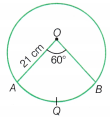
∴ Area of the sector = \(\frac{1}{2}\) × πr = \(\frac{1}{2}\) × 21 × 21
= 231 cm2
Length of the arc = \(\frac{1}{2}\) × 2πr = \(\frac{1}{2}\) × 2 × \(\frac{22}{7}\) × 21
= 22 cm
Hence, area of corresponding major sector
= πr2 – Area of the sector OAQBO
= \(\frac{22}{7}\) × 21 × 21 – 231 = 1155 cm2
Example 3.
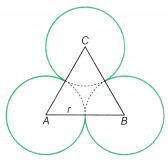
Three congruent circles of radius r units are arranged such that each circle touches the other two externally.
Find the total length of the outer boundary of the figure formed.
Solution:
Let the centres of the three congruent circles be A, B and C.
Since, each circle touches the other two externally, the centres form an equilateral triangle.
So, the angle between the two radii drawn to the points of contact in each circle is 60°.
Now, in each circle, the arc lying inside the figure is 60°. Hence, the outer arc of each circle = 360° – 60° = 300°
Also, length of outer arc of one circle
= \(\frac{300^{\circ}}{360^{\circ}}\) × 2πr = \(\frac{5}{6}\) × 2πr = \(\frac{5 \pi r}{3}\)
Therefore, total length of outer boundary = 3 × \(\frac{5 \pi r}{3}\) = 5πr
Hence, the total length of the outer boundary is 5πr units.
Segment of a Circle
The portion of the circular region enclosed by a chord and the corresponding arc of the circle is called the segment of the circle.
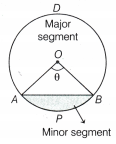
In the figure, shaded region APB is segment of circle containing the arc APB.
The segment containing the minor arc is called the minor segment and the segment containing the major arc is called the major segment.
In other words, we can say that the segment which is less than semi-circular region is called minor segment and the other segment is called major segment.
Area of Segment of a Circle
Let r be the radius of circle and 0 be the angle of sector. Then,
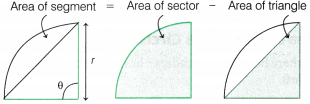
Area of a segment
= Area of corresponding sector – Area of triangle formed by chord and the radii of the circle
Also,
Area of major segment = πr2 – Area of minor segment
Area of minor segment = πr2 – Area of major segment
Note:
When we write segment and sector, we will mean the ‘minor segment’ and the ‘minor sector’ respectively, unless stated otherwise.
Example 4.
In the given figure, AB is a chord of a circle of radius 7 cm and centred at 0. Find the area of the shaded region if ∠AOB = 90°. Also, find length of minor arc AB.
Solution:
Here, area of A OAB = \(\frac{1}{2}\) × Base × Height
= \(\frac{1}{2}\) × OA × OB
= \(\frac{1}{2}\) × 7 × 7 = \(\frac{49}{2}\) cm2
and area of sector OAPBO = \(\frac{\theta}{360^{\circ}}\) × πr2
= \(\frac{90^{\circ}}{360^{\circ}} \times \frac{22}{7}\) × 7 × 7
= \(\frac{77}{2}\) cm
∴ Area of shaded region = Area of sector OAPBO – Area of AAOB
= \(\frac{77}{2}-\frac{49}{2}\)
= \(\frac{28}{2}\) = 14 cm2
and length of minor arc AB = \(\frac{\theta}{360^{\circ}}\) × 2πr
= \(\frac{90^{\circ}}{360^{\circ}}\) × 2 × \(\frac{22}{7}\) × 7
= 11 cm
Example 5.
In the given figure, ABand CDare diameters of a circle with centre 0perpendicular to each other. If 0A = 14 cm then find the area of shaded region.
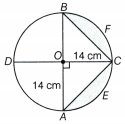
Solution:
Given, OA = 14 cm = r [let]
∴ OC = 14 cm
Also, AB ⊥ CD ⇒ ∠AOC = 90°
Now, Area Of Sector OAECO = \(\frac{90^{\circ}}{360^{\circ}}\) × πr2
= \(\frac{1}{4} \times \frac{22}{7}\) × 14 × 14
= 154 cm2
and area of ∆AOC = \(\frac{1}{2}\) × OA × OC
\(\frac{1}{2}\) × 14 × 1 4 = \(\frac{196}{2}\)
= 98 cm2
∴ Area of minor segment AEC = Area of sector OAEC – Area of ΔAOC = 154 – 98 = 56 cm2
Similarly, area of minor segment CFB = 56 cm2
∴ Required area of shaded region = 56 + 56 = 112 cm2
Example 6.
Find the area of the major segment (in terms of n) of a circle of radius 5 cm, formed by a chord subtending an angle of 90° at the centre.
Solution:
Given, radius of the circle, r = 5 cm
and angle subtended by arc at the centre, θ = 90°.
Now, area of the minor sector = \(\frac{90^{\circ}}{360^{\circ}}\) × πr2
= \(\frac{90^{\circ}}{360^{\circ}}\) × π × 25
= \(\frac{25}{4}\) π cm2
and area of triangle formed by end points of chord and centre = \(\frac{1}{2}\) × Base × Height = \(\frac{1}{2}\) × 5 × 5 = \(\frac{25}{2}\) cm2
∴ Area of minor segment = Area of the sector – Area of triangle
= \(\left(\frac{25 \pi}{4}-\frac{25}{2}\right)\) cm2
and area of major segment = Area of circle – Area of minor segment
= πr2 – \(\left(\frac{25 \pi}{4}-\frac{25}{2}\right)\)
= 25π – \(\frac{25 \pi}{4}+\frac{25}{2}\)
= \(\left(\frac{75 \pi}{4}+\frac{25}{2}\right)\) cm