Class 6 Social Science Chapter 2 Notes Oceans and Continents
→ The Earth appears mostly blue from space due to the vast coverage of water on its surface.
→ Almost three-fourths of the Earth’s surface is covered with water.
→ Early astronauts called Earth the ‘blue planet.
→ The largest water bodies on Earth are called oceans.
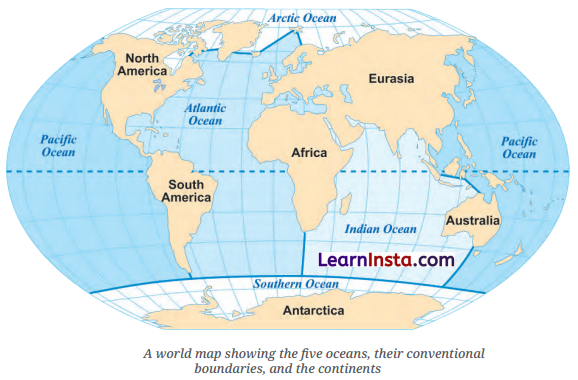
→ Oceans cover most of the planet’s water, with five major ones: Pacific, Atlantic, Indian, Arctic, and Southern.
→ Land covers a little over one-fourth of the Earth’s surface.
→ Large bodies of land are called landmasses or continents.
→ Continents and oceans play vital roles in shaping Earth’s climate.
→ They impact all aspects of life, including plants, animals, and humans.

→ The Indian Navy’s emblem contains the motto “Sam noh Varunah,” invoking the deity Varuna associated with oceans.
→ Oceans and continents are unevenly distributed between the Northern and Southern Hemispheres.
→ The oceans have Smaller extensions called seas, bays, and gulfs.
→ Seawater is salty and unfit for consumption by most land animals.
→ Freshwater, a small proportion of Earth’s water, is found in glaciers, rivers, lakes, the atmosphere, and underground.
→ The five major oceans are interconnected, despite the divisions on maps.
→ Seawater flows across different oceans, supporting diverse marine life.
→ Marine flora includes algae and seaweeds; marine fauna includes fish, dolphins, whales, and deep-sea creatures.
→ The Indian Ocean is bordered by Asia, Africa, Australia, and the Southern Ocean.
→ The Arabian Sea lies to the west of India, and the Bay of Bengal to the east.
→ Clouds, visible from space, bring rain to continents, crucial for agriculture and life.
→ Oceans can cause storms, such as cyclones, which affect coastal regions.
→ Tsunamis are powerful waves caused by underwater earthquakes or volcanic eruptions.
→ The 2004 Indian Ocean tsunami caused widespread damage and loss of life.
→ Early warning systems, like the Indian Ocean Tsunami Warning System, help protect lives and property.
→ Disasters like tsunamis are managed by national disaster management authorities.
→ Continents are large landmasses, and their count varies from four to seven based on classification.
→ The seven-continent model includes Africa, Antarctica, Asia, Australia, Europe, North America, and South America.
→ The five Olympic rings represent five inhabited continents: Africa, America, Asia, Australia, and Europe.
→ Islands are smaller landmasses surrounded by water.
→ Greenland is the largest island in the world.
→ India has over 1,300 islands; including Andaman and Nicobar Islands and Lakshadweep Islands.
→ Antarctica is a continent with a very cold climate and harsh environment.
→ India has established scientific bases in Antarctica, such as ‘Dakshin Gangotri.’
→ Oceans send rain to continents as part of the Earth’s water cycle.
→ Oceans produce more than half of the world’s oxygen, earning them the title ‘the planet’s lungs.’
→ Oceans have historically been used for migration, trade, military campaigns, and fishing.
→ Coastal cultures have legends and tales about the sea, its dangers, and blessings.
→ World Oceans Day is celebrated on June 8 to highlight the ocean’s importance.
→ Human activities pollute oceans, throwing millions of tonnes of plastic waste into them annually.
→ Protecting oceans is a collective responsibility to ensure the future of the planet and humanity.
→ Globe : A spherical representation of the Earth.
→ Surface : The outermost layer or boundary of an object or area.
→ Oceans : The vast bodies of saltwater that cover most of the Earth’s surface.
→ Continents : Large continuous expanses of land on Earth.
→ Landmass : A large area of land.
→ Hemisphere : Half of the Earth, divided into Northern and Southern Hemispheres by the equator.
→ Marine : Related to the sea or ocean.
→ Flora : Plants of a particular region or environment.
→ Fauna : Animals of a particular region or environment.
→ Climate : The long-term pattern of weather in a particular area.
→ Freshwater : Water that is not salty and is suitable for drinking.
→ Seawater : Water from the sea, which is salty.
→ Tsunami : A large, powerful wave caused by underwater seismic activity.
→ Cyclone : A system of winds rotating inward to an area of low atmospheric pressure, often bringing heavy rain.
→ Monsoon : A seasonal wind pattern that causes heavy rains, especially in South Asia.
→ Disaster Management : The organization and management of resources and responsibilities for dealing with emergencies.
→ Algae : Simple, typically aquatic, plants that can photosynthesize.
→ Bay : A broad inlet of the sea where the land curves inward.
→ Gulf : A large area of sea partially enclosed by land.
→ Groundwater : Water held underground in the soil or in pores and crevices in rock.
→ Eurasia : The combined continental landmass of Europe and Asia.
→ Ecosystem : A biological community of interacting organisms and their physical environment.
→ Biosphere : The global sum of all ecosystems, including all life forms and their relationships.
→ Pollution : The introduction of harmful substances or products into the environment.
→ Overfishing : The depletion of fish stocks by excessive fishing.
→ Antarctica : The southernmost continent, known for its harsh climate and icy conditions.
→ Dakshin Gangotri : India’s first scientific base station in Antarctica.
→ World Oceans Day : An international day observed on June 8 to celebrate and protect the world’s oceans.
→ Marine Life : The plants, animals, and other organisms that live in the ocean.
→ Varuna : A Vedic deity associated with water, the oceans, and the sky.