Students often refer to Ganita Manjari Class 9 Solutions and Part 1 Class 9 Maths Chapter 7 The Mathematics of Maybe Introduction to Probability Solutions to verify their answers.
The Mathematics of Maybe Introduction to Probability Class 9 Solutions
Class 9 Ganita Manjari Chapter 7 Solutions
Class 9 Maths Ganita Manjari Chapter 7 Solutions The Mathematics of Maybe Introduction to Probability
Think and Reflect (NCERT Pages 156)
Question 1.
Such unpredictability can be useful sometimes! For example, in a cricket match, the fact that a coin is tossed to decide which team will bat first is considered to be a fair method. Can you explain why?
Solution:
Tossing a coin is a fair method because
(i) Equally Likely Outcomes: There are only two possibilities, Head (H) and Tail (T), each with an equal chance of occurring.
∴ P(H) = P(T) = \(\frac {1}{2}\) = 50%
(ii) Unpredictability: The result is a random experiment that cannot be predicted in advance.
(iii) No Bias: Since both teams have an equal 50% chance, the method is completely unbiased.
Hence, the coin toss is fair because its outcomes are equally likely and determined purely by chance.
Ex 7.1 Class 9 Ganita Manjari Solutions – Ganita Manjari Class 9 Exercise 7.1 Solutions
Exercise 7.1 Class 9 Ganita Manjari Solutions – Ganita Manjari Class 9 Ex 7.1 Solutions
Question 1.
Rank the following events on a scale from 0 (Impossible) to 1 (Certain). Label each event: Impossible, less likely, equally likely (even chance), more likely, certain. Give reasons why you gave each event its ranking.
(i) The next Monday will come after Sunday.
(ii) It will snow in Mumbai in July.
(iii) An elephant will walk through your classroom today.
(iv) You will greet atleast one friend at school tomorrow.
Solution:
(i) According to the standard calendar, Monday always follows Sunday.
There is no possibility of any other day occurring after Sunday.
Hence, the ranking is 1 (Certain).
(ii) Mumbai has a tropical climate, where temperatures remain high even during the monsoon in July; snowfall in such geographical conditions is not possible.
Hence, the ranking is 0 (Impossible).
(iii) While not strictly impossible (as an elephant could theoretically be brought to a school for an event or escape from a nearby sanctuary), it is an extremely rare and improbable occurrence in a normal classroom setting.
Hence, the ranking is less likely.
(iv) Under normal circumstances, schools are social environments where students interact daily.
While it is not a mathematical certainty, the probability of meeting and greeting atleast one friend is very high.
Hence, the ranking is more likely.

Ex 7.2 Class 9 Ganita Manjari Solutions – Ganita Manjari Class 9 Exercise 7.2 Solutions
Exercise 7.2 Class 9 Ganita Manjari Solutions – Ganita Manjari Class 9 Ex 7.2 Solutions
Question 1.
A teacher mixes a large bag of sweets of different colours and randomly selects a sample of 30 sweets. She counts the number of sweets of each colour.
10 red sweets | 8 green sweets | 7 yellow sweets | 5 blue sweets
(i) Calculate the probability that a randomly picked sweet from the sample is green.
(ii) If there are 600 sweets in total in the large bag, estimate how many are likely to be yellow, based on the sample results.
Solution:
Number of all possible outcomes in sample = 10 + 8 + 7 + 5 = 30
(i) Number of favourable outcomes = 8 (green sweets)
P(picking a green sweet) = \(\frac {8}{30}\) = 0.266… = 0.267 or 26.7%
(ii) Number of favourable outcomes = 7 (yellow sweets in sample)
P(picking a yellow sweet from the sample) = \(\frac {7}{30}\) = 0.2333… or 23.3%.
An estimate of the probability that sweets are likely to be yellow is \(\frac {7}{30}\).
So approximately 140 (\(\frac {7}{30}\) of 600) sweets are yellow.
Question 2.
A survey is conducted at a school, where a random sample of 40 students is asked about their favourite club. The responses are
14 students: Science Club | 11 students: Arts Club | 9 students: Sports Club | 6 students: Debate Club
Assume there are 800 students in the whole school.
(i) What is the probability that a randomly chosen student from the sample prefers the Arts Club?
(ii) Using the sample results, estimate how many students in the whole school are likely to prefer the Sports Club.
Solution:
Total number of students in the sample = 14 + 11 + 9 + 6 = 40
(i) Given, the number of students who prefer the art club = 11
P(preferring the Arts Club) \(=\frac{\text { Number of students in Arts Club }}{\text { Total number of students in sample }}=\frac{11}{40}\)
(ii) Given, the number of students who prefer the sports club = 11
P(preferring the Sports Club) \(=\frac{\text { Number of students in Sports Club }}{\text { Total number of students in sample }}=\frac{9}{40}\)
and given the total number of students in the school = 800
So, estimated number of students = \(\frac {9}{40}\) × 800
= 9 × 20
= 180
Question 3.
Toss a coin 20 times and record the result each time (heads or tails).
(i) How many times did you get heads?
(ii) How many times did you get tails?
(iii) Calculate the experimental probability of getting heads.
(iv) If you toss the coin once more, what is the probability of getting tails?
Solution:
(i) It is a practical experiment. Results will vary for each student.
Assume that we get a ‘head’ 13 times.
(ii) We get a tail 7 times (20 – 13).
(iii) Experimental Probability = \(\frac{\text { No. of times heads appeared }}{\text { Total no. of tosses }}=\frac{13}{20}\)
(iv) On tossing the coin once more, we may get a ‘head’ or a ‘tail’.
Case 1. When ‘head’ appears
Probability of getting tails = \(\frac {7}{21}\)
Case 2. When ‘tail’ appears
Probability of getting tails = \(\frac {8}{21}\)
Question 4.
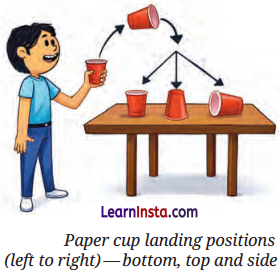
Toss a paper cup into the air 100 times. After each toss, record whether the cup lands on its bottom, upside down on its top, or on its side. Assign probabilities to the outcomes by using experimental probability.
Solution:
This is a practical experiment.
Results will vary for each student.
Assume that the cup lands on its bottom 38 times, and lands on its top 30 times.
This means the cup lands on its side 32 times (100 – 38 – 30).
Therefore, P(cup lands on its bottom) = \(\frac{\text { No. of times cup lands on bottom }}{\text { Total no. of tosses }}\) = \(\frac {38}{100}\)
P(cup lands on its top) = \(\frac{\text { No. of times cup lands on top }}{\text { Total no. of tosses }}\) = \(\frac {38}{100}\)
P(cup lands on its side) = \(\frac {32}{100}\)
Question 5.
What is the probability of getting an even number when rolling a fair 6-sided die?
Solution:
Number of all possible outcomes = 6 (numbers 1, 2, 3, 4, 5, 6)
Number of favourable outcomes = 3 (even numbers 2, 4, 6)
P(getting an even number) \(=\frac{\text { Number of favourable outcomes }}{\text { Number of all possible outcomes }}\)
= \(\frac {3}{6}\)
= 0.5 or 50%
Question 6.
Suppose you roll a 6-sided die 12 times and get a ‘3’ three times.
(i) What is the experimental probability of rolling a ‘3’?
(ii) What is the theoretical probability of rolling a ‘3’?
(iii) Why might these probabilities be different? What would you expect to happen if you rolled the die 60, 600, or 6000 times?
Solution:
(i) Given that the die is rolled 12 times and a ‘3’ is obtained three times.
Let P(E) be the experimental probability of rolling a ‘3’.
Since experimental probability is based on actual trials.
Number of times ‘3’ appeared
P(E) \(=\frac{\text { Number of times ‘ } 3 \text { ‘ appeared }}{\text { Total number of trials }}\)
= \(\frac {3}{12}\)
= \(\frac {1}{4}\)
(ii) Given a fair 6-sided die.
Let P(T) be the theoretical probability of rolling a ‘3’.
Since there is only one ‘3’ out of 6 possible outcomes
P(T) = \(\frac{\text { Number of outcomes favourable to ‘ } 3 \text { ‘ }}{\text { Total number of possible outcomes }}=\frac{1}{6}\)
(iii) Since experimental probability is based on a limited number of trials, it may vary due to chance.
Theoretical probability, however, is what we expect to happen in the long run.
As the number of trials increases (to 60, 600, or 6000), we expect the experimental probability to get closer and closer to the theoretical probability of \(\frac {1}{6}\).
Ex 7.3 Class 9 Ganita Manjari Solutions – Ganita Manjari Class 9 Exercise 7.3 Solutions
Exercise 7.3 Class 9 Ganita Manjari Solutions – Ganita Manjari Class 9 Ex 7.3 Solutions
Question 1.
When a single 6-sided die is rolled, what is the total number of possible outcomes in the sample space?
Solution:
Sample Space (S): {1, 2, 3, 4, 5, 6}
Number of all possible outcomes: 6
Description: Since each face of the die represents a unique result, there are six distinct possibilities.
Question 2.
For the following experiments, write down the sample space S.
(i) Rolling a die and tossing a coin together.
(ii) Choosing a random integer between -5 and +5.
(iii) A box containing 5 green and 7 red balls. One ball is drawn at random.
Solution:
(i) Rolling a die and tossing a coin together:
S = {1H, 1T, 2H, 2T, 3H, 3T, 4H, 4T, 5H, 5T, 6H, 6T}
where the number represents the die outcome, and H/T represents the coin outcome.
(ii) Choosing a random integer between -5 and +5:
S = {-5, -4, -3, -2, -1, 0, 1, 2, 3, 4, 5}
(iii) A box contains 5 green and 7 red balls.
One ball is drawn at random:
S = {Green, Red}
Question 3.
In a village fair, there are 3 popular snacks available: Samosa, Pakora, and Bhaji. For drinks, villagers can choose either Chai or Lassi.
(i) List the sample space of all possible snack and drink combinations a person could choose at the fair.
(ii) List the event ‘Selecting Samosa as a snack’.
Solution:
(i) Given, snacks are Samosa, Pakora, Bhaji, and drinks are Chai, Lassi.
Let S be the sample space of all possible combinations.
Since every snack can be paired with every drink.
So, S ={(Samosa, Chai), (Samosa, Lassi), (Pakora, Chai), (Pakora, Lassi), (Bhaji, Chai), (Bhaji, Lassi)}
∴ n(S) = 6
(ii) Let E be the event of ‘Selecting Samosa as a snack’.
Since we only consider pairs where the snack is a Samosa.
E = {(Samosa, Chai), (Samosa, Lassi)}
∴ n(E) = 2
Ex 7.4 Class 9 Ganita Manjari Solutions – Ganita Manjari Class 9 Exercise 7.4 Solutions
Exercise 7.4 Class 9 Ganita Manjari Solutions – Ganita Manjari Class 9 Ex 7.4 Solutions
Question 1.
There are two fruit baskets, A and B. Basket A has one apple and two oranges. Basket B has one banana and one mango. You randomly pick one fruit from each basket.
(i) Draw a tree diagram showing all possible pairs of fruits.
(ii) List the sample space.
(iii) What is the probability of picking one apple and one banana?
Solution:
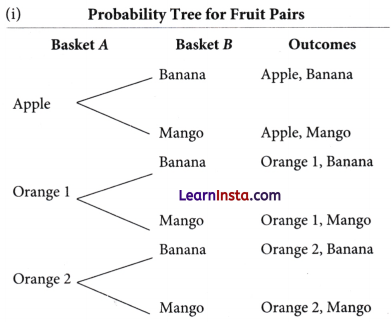
(ii) Let S be the sample space of all possible pairs.
∴ S = {(Apple, Banana), (Apple, Mango), (Orange 1, Banana), (Orange 2, Banana), (Orange 1, Mango), (Orange 2, Mango)}
∴ n(S) = 6
(iii) Let T be the event of picking one apple and one banana.
Since the only outcome satisfying this is (A, B).
T = {(A, B)}
∴ n(T) = 1
Therefore, P(T) = \(=\frac{\text { Number of outcomes in } T}{\text { Total number of outcomes }}\)
∴ P(T) = \(\frac {1}{6}\)
Question 2.
Let us say that you have a box containing 3 red pens, 4 black pens, and 2 green pens. You pick a pen (without looking) from the box and put it back. Then, your friend does the same.
(i) What are the possible outcomes of the pen colours? Can you draw a tree diagram representing the possible outcomes?
(ii) Can you use the tree diagram to guess the probability that both you and your friend pick pens of the same colour?
Solution:
Given, a box contains 3 Red (R), 4 Black (B), and 2 Green (G) pens.
∴ Total number of pens = 3 + 4 + 2 = 9
Since the first pen is put back before the second person picks, there are 3 × 3 = 9 possible color combinations.
Therefore, sample Space, (S) = {(R, R), (R, B), (R, G), (B, R), (B, B), (B, G), (G, R), (G, B), (G, G)}
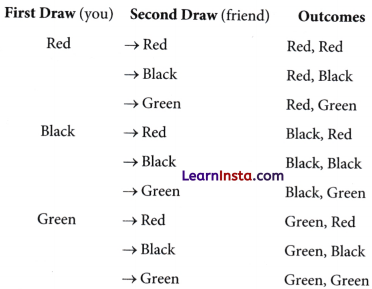
(ii) Let Esame be the event of picking pens of the same color.
This includes outcomes (R, R), (B, B), and (G, G).
Now, P(R) = \(\frac {3}{9}\), P(B) = \(\frac {4}{9}\), and P(G) = \(\frac {2}{9}\)
[∵ Probability \(=\frac{\text { number of favourable outcomes }}{\text { number of total outcomes }}\)]
Since these are independent events, we calculate the probability of each matching pair and then add them together.
P(R, R) = \(\frac{3}{9} \times \frac{3}{9}=\frac{9}{81}\)
P(B, B) = \(\frac{4}{9} \times \frac{4}{9}=\frac{16}{81}\)
P(G, G) = \(\frac{2}{9} \times \frac{2}{9}=\frac{4}{81}\)
∴ P(Esame) = \(\frac{9}{81}+\frac{16}{81}+\frac{4}{81}\) = \(\frac {29}{81}\)
Ganita Manjari Class 9 Maths Chapter 7 End of Chapter Exercise Solutions
The Mathematics of Maybe Introduction to Probability End of Chapter Exercise Solutions
Question 1.
Fill in the blanks.
(i) The probability of an impossible event is ______________
(ii) The set of all possible outcomes of a random experiment is called the ______________
(iii) The probability of an event that is certain to happen is ______________
(iv) Tossing a fair coin has a probability of ______________ for getting heads.
Solution:
(i) The probability of an impossible event is 0.
(ii) The set of all possible outcomes of a random experiment is called the sample space.
(iii) The probability of an event that is certain to happen is 1.
(iv) Tossing a fair coin has a probability of \(\frac {1}{2}\) (or 0.5) for getting heads.
Question 2.
In a survey of 50 students, 15 students said they liked football. The number of students, who like football is 15, and the ______________ (frequency/relative frequency) is ______________ (fill in the fraction or decimal).
Solution:
Given, total number of students in the survey = 50
∴ Total number of outcomes = 50
Let E1 be the event that a student likes football.
Number of students who like football = 15
∴ Number of outcomes favourable to E1 = 15
∴ P(E1) = \(\frac{15}{50}=\frac{3}{10}\) = 0.3
Hence, the number of students who like football is 15 and the relative frequency is 0.3 (or \(\frac {3}{10}\)).
Question 3.
Which of the following experiments have equally likely outcomes? Explain.
(i) A driver attempts to start a car. The car starts or does not start.
(ii) Tossing a fair coin once.
(iii) Rolling a fair 6-sided die.
(iv) Choosing a marble randomly from a bag that contains 3 red marbles and 7 blue marbles.
(v) A baby is born. It is a boy of a girl.
Solution:
(i) The starting of a car depends on many factors such as the condition of the engine, battery, and fuel level.
It is not a matter of pure chance where each outcome has the same probability.
Hence, it is not equally likely.
(ii) A fair coin has only two possible outcomes, Head and Tail, and both have an equal chance of occurring.
Hence, it is equally likely.
(iii) In a fair 6-sided die, every number from 1 to 6 has the same probability (\(\frac {1}{6}\)) of appearing.
Hence, it is equally likely.
(iv) The number of blue marbles (7) is greater than the number of red marbles (3), so picking a blue marble is more probable than picking a red one.
Hence, it is not equally likely.
(v) The birth of a baby as a boy or a girl is generally considered to have an equal chance for either outcome.
Hence, it is equally likely.
Question 4.
Write the sample space and calculate the probability based on the given information.
(i) Two coins are tossed at the same time. What is the probability of getting atleast one head?
(ii) Ten identical cards numbered 1 to 10 are placed in a box. One card is drawn at random. What is the probability of drawing a card with an even number?
(iii) A die is rolled once. What is the probability of getting a number greater than 4?
(iv) A bag contains 3 red balls, 2 blue balls, and 1 green ball. One ball is picked at random. What is the probability that it is not red?
(v) Three coins are tossed simultaneously. What is the probability of getting exactly two heads?
Solution:
(i) Given that two coins are tossed at the same time.
Let S be the sample space.
Here, S = {HH, HT, TH, TT}
∴ n(S) = 4
Let E be the event of getting at least one head.
Here, E = {HH, HT, TH}
∴ n(E) = 3
Therefore, P(E) \(=\frac{\text { Number of outcomes with at least one head }}{\text { Total number of outcomes }}\) = \(\frac {3}{4}\)
(ii) Given ten identical cards numbered 1 to 10 are placed in a box.
Let S be the sample space.
S = {1, 2, 3, 4, 5, 6, 7, 8, 9, 10}
∴ n(S) = 10
Let E be the event of drawing a card with an even number.
The even numbers are 2, 4, 6, 8, and 10.
Here, E = {2, 4, 6, 8, 10}
∴ n(E) = 5
Therefore, P(E) \(=\frac{\text { Number of even numbered cards }}{\text { Total number of cards }}\)
= \(\frac {5}{10}\)
= \(\frac {1}{2}\)
(iii) Given that a die is rolled once.
Let S be the sample space.
Here, S = {1, 2, 3, 4, 5, 6}
∴ n(S) = 6
Let E be the event of getting a number greater than 4.
The numbers greater than 4 are 5 and 6.
E = {5, 6}
∴ n(E) = 2
Therefore, P(E) \(=\frac{\text { Number of outcomes greater than } 4}{\text { Total number of outcomes }}\)
= \(\frac {2}{6}\)
= \(\frac {1}{3}\)
(iv) Given that a bag contains 3 red, 2 blue, and 1 green ball.
Let S be the total number of balls.
∴ n(S) = 3 + 2 + 1 = 6
Let E be the event that the ball is not red.
Since “not red” means the ball is either blue or green,
∴ n(E) = 2 + 1 = 3
Therefore, P(E) \(\frac{\text { Number of balls that the not red }}{\text { Total number of balls }}=\frac{3}{6}=\frac{1}{2}\)
(v) Given that three coins are tossed simultaneously.
Let S be the sample space.
S = {HHH, HHT, HTH, THH, HTT, THT, TTH, TTT}
∴ n(S) = 8
Let E be the event of getting exactly two heads.
E = {HHT, HTH, THH}
∴ n(E) = 3
Therefore, P(E) \(=\frac{\text { Number of outcomes with exactly two heads }}{\text { Total number of outcomes }}\) = \(\frac {3}{8}\)
Question 5.
A bag has 3 candies: strawberry, lemon, and mint. One is picked at random. What is the probability of picking a strawberry candy?
Solution:
Given: total number of candies in the bag = 3
∴ Total number of outcomes = 3
Let E1 be the event of picking a strawberry candy.
∵ There is 1 strawberry candy in the bag.
∴ Number of outcomes favourable to E1 = 1
∴ P(E1) = \(\frac {1}{3}\)
Question 6.
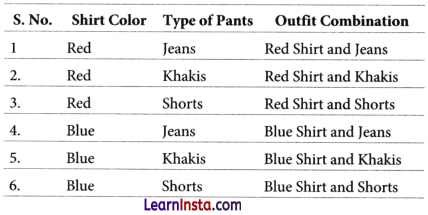
A child has 2 shirts (one red and one blue) and 3 types of pants (jeans, khakis, and shorts). List all the possible combinations of outfits consisting of one shirt and one pair of pants. Display your answer in a table format.
Solution:
Number of shirts = 2 (Red, Blue)
Number of pants = 3 (Jeans, Khakis, Shorts)
∴ Total number of possible combinations = 2 × 3 = 6
The possible combinations of outfits are displayed in the table below.
Question 7.
A tyre company records distances before replacement in 1000 cases.
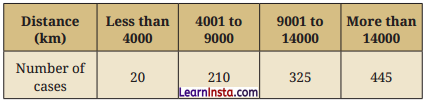
Find the probability that a randomly chosen tyre lasts.
(i) Less than 4000 km.
(ii) Between 4000 and 14000 km.
(iii) More than 14000 km.
Solution:
Given the total number of cases (tyres) recorded by the company is 1000.
Let n(S) be the total number of trials.
∴ n(S) = 1000
(i) Let E1 be the event that a tyre lasts less than 4000 km.
Since the number of cases for this distance is 20.
∴ n(E1) = 20
P(E1) \(=\frac{\text { Number of tyres lasting less than } 4000 \mathrm{km}}{\text { Total number of tyres }}\)
∴ P(E1) = \(\frac{20}{1000}=\frac{1}{50}\)
(ii) Let E2 be the event that a tyre lasts between 4000 and 14000 km.
Since this includes the categories “4001 to 9000” and “9001 to 14000”.
∴ n(E2) = 210 + 325 = 535
∴ P(E2) = \(\frac{535}{1000}=\frac{107}{200}\) (or 0.535)
(ii) Let E3 be the event that a tyre lasts more than 14000 km.
Since the number of cases for this distance is 445.
∴ n(E3) = 445
P(E3) = \(\frac{445}{1000}=\frac{89}{200}\) (or 0.445)
Question 8.
The letters of the word ‘PEACE’ are placed on cards. Leela draws a card without looking.
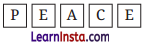
(i) What is the probability that it is a P, E, or C?
(ii) What is the probability that it is not an E?
Solution:
(i) Given that the word ‘PEACE’ is placed on cards.
Let S be the sample space of letters {P, E, A, C, E}
∴ n(S) = 5
Let T be the event of drawing a P, E, or C.
Since the favourable cards are P, E, C, and the other E.
T = {P, E, C, E)
∴ n(T) = 4
Therefore, P(T) = \(=\frac{\text { Number of cards with } \mathrm{P}, \mathrm{E} \text { or } \mathrm{C}}{\text { Total number of cards }}\)
∴ P(T) = \(\frac {4}{5}\)
(ii) Given that the total number of cards is 5.
Let W be the event that the letter drawn is not an E.
Since “not an E” means the card is P, A, or C.
W = {P, A, C}
∴ n(W) = 3
Therefore, P(W) \(=\frac{\text { Number of cards that are not } \mathrm{E}}{\text { Total number of cards }}\)
Number of cards that are not E.
Total number of cards
∴ P(W) = \(\frac {3}{5}\)
Question 9.
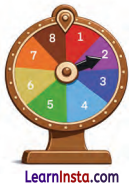
A game of chance consists of spinning an arrow, which comes to rest pointing at one of the numbers 1, 2, 3, 4, 5, 6, 7, 8, and these are equally likely outcomes. What is the probability that it will point at
(i) 8?
(ii) an odd number?
(iii) a number greater than 2?
(iv) a number less than 9?
(v) a multiple of 3?
Solution:
Total number of points on the circle = 8
So, the total number of outcomes = 8
(i) Let E1 be the event of getting an arrow at number 8.
∴ Number of outcomes favourable to E1 = 1
∴ The probability that the arrow comes at number 8,
P(E1) = \(\frac {1}{8}\)
(ii) Let E2 be the event of getting an arrow at an odd number.
Here, odd numbers are 1, 3, 5, and 7.
∴ Number of outcomes favourable to E2 = 4
∴ The probability that the arrow comes at an odd number
P(E2) = \(\frac{4}{8}=\frac{1}{2}\)
(iii) Let E3 be the event of getting an arrow at a number greater than 2
i.e., at 3, 4, 5, 6, 7, or 8.
∴ Number of outcomes favourable to E3 = 6
∴ The probability that the arrow comes at a number greater than 2,
P(E3) = \(\frac{6}{8}=\frac{3}{4}\)
(iv) Given that the arrow points at a number less than 9.
Let E4 be the event of getting a number less than 9.
Since all numbers on the spinner {1, 2, 3, 4, 5, 6, 7, 8} are less than 9,
E = {1, 2, 3, 4, 5, 6, 7, 8}
∴ n(E4) = 8
∴ P(E4) \(=\frac{\text { Number of outcomes less than } 9}{\text { Total number of outcomes }}\)
= \(\frac {8}{8}\)
= 1
(v) Given that the arrow points at a multiple of 3.
Let E5 be the event of getting a multiple of 3.
Since the multiples of 3 between 1 and 8 are 3 and 6,
E5 = {3, 6}
∴ n(E5) = 2
∴ P(E5) \(=\frac{\text { Number of multiples of } 3}{\text { Total number of outcomes }}\)
= \(\frac {2}{8}\)
= \(\frac {1}{4}\)
Question 10.
A basket contains 4 red balls and 5 blue balls. One ball is drawn and laid aside, and a second ball is drawn. Draw a tree diagram to represent the possible outcomes and probabilities. Use the tree diagram to answer the following questions.
(i) What is the probability of drawing a red ball and then a blue ball?
(ii) What is the probability of drawing 2 blue balls?
Solution:
Given, a basket contains 4 red balls (R) and 5 blue balls (B).
∴ Total balls = 4 + 5 = 9
Since the first ball is “laid aside,” it is not replaced.
This means the total number of balls decreases for the second draw.
Now, total balls = 9 – 1 = 8
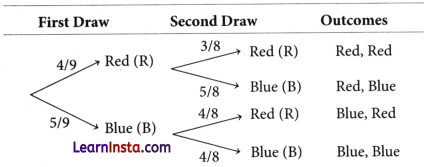
(i) Let E1 be the event of (Red, Blue).
Since these are dependent events, we multiply the probabilities along the branch.
∴ P(E1) = P(Red first) × P(Blue second)
= \(\frac{4}{9} \times \frac{5}{8}\)
= \(\frac {20}{72}\)
= \(\frac {5}{18}\)
(ii) Let E2 be the event of (Blue, Blue).
Since a blue ball was removed first, only 4 blue balls remain out of 8 total.
∴ P(E2) = P(Blue first) × P(Blue second)
= \(\frac{5}{9} \times \frac{4}{8}\)
= \(\frac {20}{72}\)
= \(\frac {5}{18}\)
Question 11.
I throw a pair of 6-sided dice. Write down an event that has a probability of 0 and an outcome that has a probability of 1.
Solution:
Probability of 0 (Impossible Event): getting a sum of 13, since the maximum is 12.
Probability of 1 (Certain Event): getting a sum less than 14, since all sums are from 2 to 12.
Question 12.
Write the sample space and calculate the probability based on the given information.
(i) Two dice are rolled. What is the probability that the sum is a prime number greater than 5?
(ii) A bag contains 4 red, 3 green, and 2 blue balls. Two balls are drawn without replacement. What is the probability that both are of different colours?
(iii) Three coins are tossed. What is the probability that the first coin shows heads and exactly two heads occur in total?
(iv) A four-digit number is formed using the digits 1, 2, 3, and 4 with no repetition. What is the probability that the number is even?
(v) A student takes a multiple-choice test with 3 questions, each having 4 options (A, B, C, D), with only one correct answer. What is the probability that the student guesses and gets exactly 2 answers correct?
Solution:
(i) Given that two dice are rolled.
Let S be the sample space.
S = {(1, 1), (1, 2),…, (6, 6)}
∴ n(S) = 36
Let A be the event that the sum is a prime number greater than 5.
The prime numbers greater than 5 are 7 and 11.
Sums of 7 = {(1, 6), (2, 5), (3, 4), (4, 3), (5, 2), (6, 1)}
Sums of 11 = {(5, 6), (6, 5)}
Therefore, P(A) \(=\frac{\text { Number of outcomes in } A}{\text { Total number of outcomes }}\)
= \(\frac {8}{36}\)
= \(\frac {2}{9}\)
(ii) Given, 4 red (R), 3 green (G), and 2 blue balls (B)
Total = 9
Two balls are drawn without replacement.
Let n(S) be the total number of ways to draw 2 balls.
Let B be the event that both balls are of different colors.
Since it is easier to find the probability of the “same color” first.
P(Same) = P(RR) + P(GG) + P(BB)
P(same) = \(\left(\frac{4}{9} \times \frac{3}{8}\right)+\left(\frac{3}{9} \times \frac{2}{8}\right)+\left(\frac{2}{9} \times \frac{1}{8}\right)\)
= \(\frac{12+6+2}{72}\)
= \(\frac {20}{72}\)
∴ P(B) = 1 – P(same)
= 1 – \(\frac {20}{72}\)
= \(\frac {52}{72}\)
= \(\frac {13}{18}\)
(iii) Given that three coins are tossed.
Let S = {HHH, HHT, HTH, THH, HTT, THT, TTH, TTT}
∴ n(S) = 8
Let C be the event that the first coin is Head and exactly two heads occur.
Since we look for outcomes starting with ‘H’ having exactly two ‘H’s,
C = {HHT, HTH}
∴ n(C) = 2
Therefore, P(C) = \(\frac{n(C)}{n(S)}=\frac{2}{8}=\frac{1}{4}\)
(iv) Given digits 1, 2, 3, 4 are used without repetition.
Let n(S) be the total four digits numbers, which are formed using the digits 1, 2, 3, and 4 and without repetition.
Since there are 4 choices for the first place, 3 choices for the second, 2 choices for the third, and 1 choice for the last place.
So, the total numbers = 4 × 3 × 2 × 1 = 24
Let D be the event that the number is even.
Since a number is even if it ends in 2 or 4
If it ends in 2: 3 × 2 × 1 = 6 ways.
If it ends in 4: 3 × 2 × 1 = 6 ways.
∴ n(D) = 6 + 6 = 12
Therefore, P(D) = \(\frac{12}{24}=\frac{1}{2}\)
(v) Given 3 questions with 4 options each (1 correct, 3 wrong).
Each question has 4 options, so the total number of possible outcomes = 4 × 4 × 4 = 64
Since each question has only one correct option, there is 1 way to answer a question correctly and 3 ways to answer it wrongly.
Favourable outcomes to E are
Correct, Correct, Wrong = 1 × 1 × 3 = 3
Correct, Wrong, Correct = 1 × 3 × 1 = 3
Wrong, Correct, Correct = 3 × 1 × 1 = 3
∴ Number of favourable outcomes to E
i.e., n(E) = 3 + 3 + 3 = 9
So, P(E) = \(\frac{n(E)}{n(S)}=\frac{9}{64}\)
Question 13.
A box contains 4 balls numbered 1 to 4. Record a sample space using a tree diagram for the following experiments:
(i) A ball is drawn, and the number is recorded. Then the ball is returned, and a second ball is drawn and recorded.
(ii) A ball is drawn and recorded. Without replacing the first ball, the experimenter draws and records a second ball.
(iii) What are the sizes of these two sample spaces?
Solution:
(i)
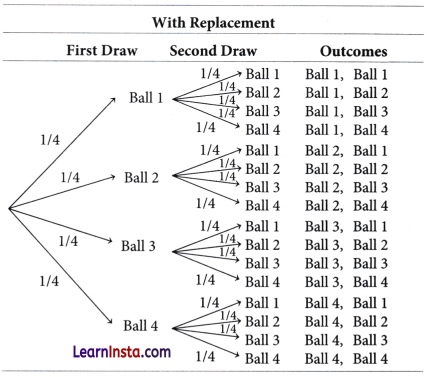
The diagram above represents the outcomes when the first ball is recorded and then returned to the box before the second draw.
∴ Sample space (S1) = {(1, 1), (1, 2), (1, 3), (1, 4), (2, 1), (2, 2), (2, 3), (2, 4), (3, 1), (3, 2), (3, 3), (3, 4), (4, 1), (4, 2), (4, 3), (4, 4)}
Here, 1, 2, 3, and 4 represent ball number 1, ball number 2, ball number 3, and ball number 4, respectively.
(ii)
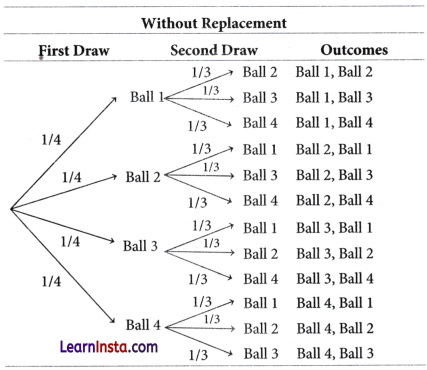
The diagram above represents the outcomes when the first ball is recorded and not replaced, meaning the same number cannot be picked twice.
Sample space (S2) = {(1, 2), (1, 3), (1, 4), (2, 1), (2, 3), (2, 4), (3, 1), (3, 2), (3, 4), (4, 1), (4, 2), (4, 3)}
Here, 1, 2, 3, and 4 represent ball number 1, ball number 2, ball number 3, and ball number 4, respectively.
(iii) For experiment (i)
There are 4 options for the first draw and 4 options for the second draw.
∴ n(S1) = 4 × 4 = 16
For experiment (ii)
There are 4 options for the first draw and 3 remaining options for the second draw.
∴ n(S2) = 4 × 3 = 12
Question 14.
List the elements of a sample space for the simultaneous tossing of a coin and drawing of a card from a set of 6 cards numbered 1 through 6.
Solution:
Given that a coin is tossed and a card is drawn from a set of 6 cards numbered 1 through 6 simultaneously.
Let S be the sample space of all possible outcomes.
Since the coin has 2 outcomes {H, T} and the cards have 6 outcomes {1, 2, 3, 4, 5, 6}, every coin result can be paired with every card number.
S = {H1, H2, H3, H4, H5, H6, T1, T2, T3, T4, T5, T6}
∴ n(S) = 12
Question 15.
Three coins are tossed, and the number of heads is recorded. Which of the following lists is a sample space for this experiment? Why do the other lists fail to qualify as a sample space?
(i) {1, 2, 3}
(ii) {0, 1, 2}
(iii) {0, 1, 2, 3, 4}
(iv) {0, 1, 2, 3}
Solution:
(iv) Given that three coins are tossed, and the number of heads is recorded.
Let S be the correct sample space.
The sample space, or set of all possible outcomes, is {HHH, HHT, HTH, HTT, THH, THT, TTH, TTT}.
Since there are three coins, the possible number of heads can be 0, 1, 2, 3.
So, the sample space for this experiment.
∴ S = {0, 1, 2, 3}
(i) {1, 2, 3}
This list fails because it excludes the possibility of 0 heads (getting all tails), which is a valid outcome.
(ii) {0, 1, 2}
This list fails because it excludes the possibility of 3 heads (getting all heads), which is a valid outcome.
(iii) {0, 1, 2, 3, 4}
This list fails because it includes 4 heads, which is impossible since only three coins are tossed.
A sample space must only contain possible outcomes.
Question 16.
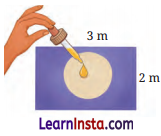
Suppose you drop a dye at random on the rectangular region shown in the given figure. What is the probability that it will land inside the circle with a diameter of 1 m?
Solution:
Given a rectangular region with length 3 m and breadth 2 m, and a circle inside it with a diameter of 1 m.
Let S represent the total rectangular area (the sample space).
∴ Area of a rectangle = Length × Breadth
Area (S) = 3 × 2 = 6 m2
Let E be the event that the drop lands inside the circle.
Given the diameter of the circle is 1 m and the radius (r) is 0.5 m or \(\frac {1}{2}\) m.
∴ Area of circle = πr2
Area (E) = \(\pi \times\left(\frac{1}{2}\right)^2=\frac{\pi}{4} m^2\)
Therefore, P(E) \(=\frac{\text { Area of event region } E}{\text { Total area of sample space } S}\)
= \(\frac{\frac{\pi}{4}}{\frac{4}{6}}\)
= \(\frac{\pi}{24}\)