Working through Class 9 English Notes and Class 9 English Kaveri Chapter 2 The Pot Maker Summary in English simplifies the understanding of long chapters.
Summary of The Pot Maker Class 9
The Pot Maker Summary Class 9
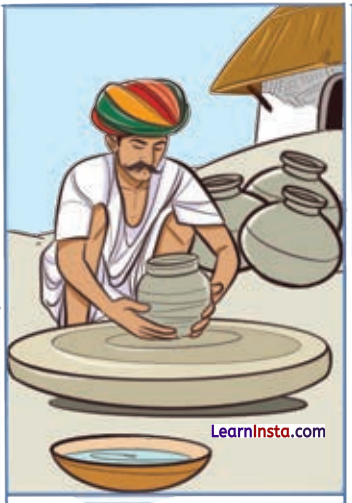
- This chapter narrates the journey of Sentila, a young girl who dreams of becoming a pot maker like her mother and grandmother.
- Although Sentila shows deep interest and determination in learning pottery, she initially fails to learn the craft when it is formally taught to her.
- The story shows that true learning happens naturally through patience, observation and practice.
About the Author
- Temsula Ao was an Indian writer and academic from Nagaland. Her writing reflects village life, oral traditions, women’s experiences and indigenous culture.
- She was known for her sensitive portrayal of ordinary lives and the wisdom found in everyday experiences.
Main Characters
SENTILA
A young girl who dreams of becoming a pot maker like her mother and grandmother. She is curious and deeply fascinated by the craft.
MESOBA (FATHER)
Sentila’s father who respectfully explains to the village council that Sentila will learn the craft when she becomes stronger.

ARENLA (MOTHER)
An experienced pot maker who understands the physical hardship and low income of the craft. She prefers her daughter learns weaving, which is easier and more profitable.
ONULA
A kind, middle-aged widow who quietly helps Sentila. She understands that fear and tension block learning and guides Sentila with patience.
The Pot Maker Summary in English
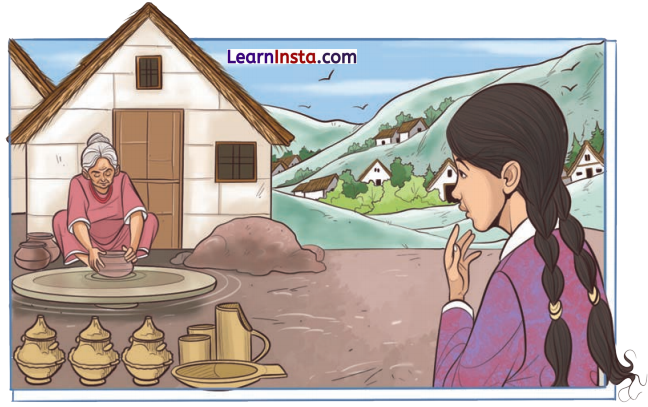
Sentila’s Dream and Her Mother’s Resistance
- Sentila grew up accompanying her mother to the fields and forests and dreamt of becoming a pot maker like her mother and grandmother.
- However, her mother Arenla wanted her to learn weaving, as pot making involved hard labour and brought very little income.
- Whenever Sentila stayed at home, she secretly observed expert potters, who were amused by her determination.
Arenla’s Struggle with Pot Making
- Sentila overheard her parents discussing her future. Arenla spoke of the physical exhaustion, long journeys to the riverbank and tedious clay work involved in pot making.
- Arenla believed weaving was cleaner, easier and more profitable, and therefore refused to teach Sentila.
Sentila’s Continued Fascination with the Craft
- Despite resistance, Sentila continued watching potters at work.
- She observed the careful process of shaping, drying and firing pots. Her frequent visits soon became village gossip.
- Village Council and Responsibility of Tradition
- The villagers worried that if skills were not passed on, the craft would disappear.
- Sentila’s father Mesoba was summoned by the village council to explain why Arenla was not teaching pot making to Sentila. He assured them that Sentila would be taught when she became stronger.
- The elders reminded him that traditional skills belonged to the community and must be passed on to future generations.
Arenla Begins Teaching but Sentila Struggles
- The next year, Arenla finally took Sentila to the riverbank and taught her how to prepare clay.
- Sentila learned the preparation process quickly but failed to shape pots properly. Arenla watched silently and often took over the work herself.
Onula’s Guidance and Sentila’s Breakthrough
- Sentila later stayed in a girls’ dormitory supervised by Onula, a kind widow.
- Onula noticed Sentila’s tension and lack of confidence and guided her patiently. With Onula’s encouragement, Sentila successfully shaped a pot and gained confidence.
Learning Through Observation and Practice
- Onula pointed out that the mouth of the pot was not shaped correctly. She advised Sentila to observe her mother closely, especially the shaping of the mouth of the pot.
- During the next session, Sentila carefully watched Arenla’s hand movements and rhythm.
- On a bright sunny day, Arenla asked Sentila to take over the work while she rested.
- Sentila began working confidently and matched her mother’s speed and skill.
Tragic Loss and the Birth of a Pot Maker
- After working hard, Sentila went inside and found her mother not breathing. Shocked and heartbroken, she called for help, and the villagers gathered as Arenla passed away.
- Filled with guilt and sorrow, Sentila cried out for forgiveness, while Onula sensed that something significant had taken place.
- Later, Onula entered the shed and saw two identical rows of freshly made pots, realising that Sentila had truly mastered the craft.
- The story ends with the symbolic line, “A new pot maker was born,” showing both loss and the continuation of tradition.
Why the Title is Appropriate
The title ‘The Pot Maker’ reflects the central idea of the story. Literally, it refers to the craft of pot making. Symbolically, it represents Sentila’s journey of learning and growth. Just as clay is shaped with patience, Sentila becomes a pot maker through observation and maturity, not force. Thus, the title captures both the craft and the learner’s transformation.
Themes (Main Ideas) of The Pot Maker

Learning as a Natural Process
True learning happens when the learner is emotionally ready.
Dignity of Labour
Pot making is hard but meaningful and honourable work.
Tradition and Continuity
Skills are cultural heritage passed across generations.
Growth and Independence
Sentila’s journey reflects emotional and personal growth.
Literary Devices of The Pot Maker
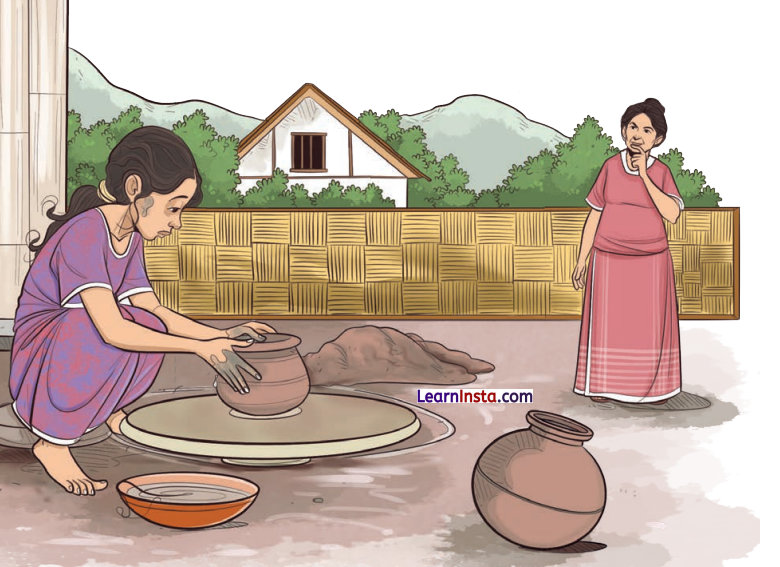
- Contrast The contrast between Sentila’s repeated failure and her final success highlights that learning cannot be forced and happens naturally over time.
- Imagery Detailed descriptions like ‘they pushed their left hand into a lump of the softened clay’ and ‘they rotated the lump as they started giving shape to the rotating clay’, create vivid pictures that help readers visualise the craft and understand the effort behind traditional labour.
- Irony Sentila fails when she is formally taught but succeeds when no one expects her to, reinforcing the idea that true learning depends on inner readiness.
Symbolism Clay and pot making symbolise human potential and the learning process, showing that growth requires patience, care and the right emotional readiness. - Foreshadowing Sentila’s constant observation of expert potters hints at her eventual transformation into a skilled pot maker.
- Metaphor The shaping of clay serves as a metaphor for shaping a learner’s mind, suggesting that mastery develops gradually and gently.
The Pot Maker Class 9 Word Meanings
- Outgrow – To lose interest as one grows older
- Resolved – Firmly determined
- Pounding – Repeated beating to soften clay
- Tedious – Tiring and exhausting
- Deftly – Skillfully and smoothly
- Wearily – In a tired manner
- Momentum – Driving force
- Tally – A count or total
- Threshold – Entrance of a room
- Momentous – Of great importance
- Profound – Deep and powerful
- Kiln – Oven used to bake pots
- Indifference – Lack of interest or concern
- Dao – An instrument used to dig clay
- Malleable – Able to be shaped without breaking
- Pittance – A very small amount of money
- Spatula – Tool used by a potter to shape a pot
- Followed suit – Did the same thing as someone else
- Slackened – Relaxed or loosened
- Dexterity – Skill, especially of the hands
- Misshapen – Badly or irregularly shaped
- Intuitively – Based on instinct or feeling
- Phenomenon – Unusual or remarkable incident
- Revelation – Sudden moment of realisation