Students often refer to Ganita Manjari Class 9 Solutions and Part 2 Class 9 Maths Chapter 12 Quadrilaterals Solutions to verify their answers.
Quadrilaterals Class 9 Solutions
Class 9 Ganita Manjari Chapter 12 Solutions
Class 9 Maths Ganita Manjari Chapter 12 Solutions Quadrilaterals
Think and Reflect (NCERT Textbook Page No. 51)
Question 1.
Can we use any given quadrilateral to tile the plane? If not, which quadrilaterals can be used and which cannot?
Solution:
Do it yourself.
Think and Reflect (NCERT Textbook Page No. 52)
Question 1.
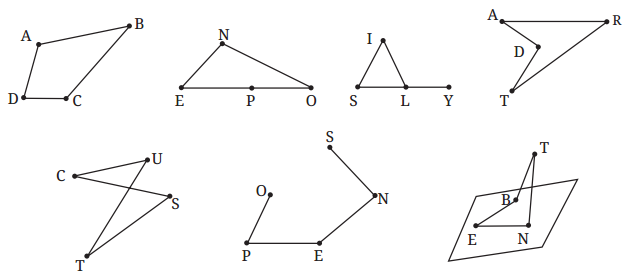
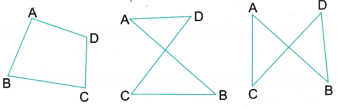
Informally, a quadrilateral is a figure with four straight sides, as in the first figure ABCD in Fig. 12.2 below. But consider the other six figures in Figure. the five plane figures NOPE, SILY, DART, CUTS, OPENS and the non-planar BENT. Should we call all these figures quadrilaterals? If you answer ‘no’ for any of them, how will you define a quadrilateral so that such a figure is excluded? As you can see, some care is needed to precisely define what we think of as a quadrilateral.
Solution:
Do it yourself.
Think and Reflect (NCERT Textbook Page No. 53)
Question 1.
Can we similarly define a quadrilateral ABCD?
Solution:
Do it yourself.
Think and Reflect (NCERT Textbook Page No. 59)
Question 1.
The angles of a quadrilateral add up to 360°. Therefore, if the opposite angles are equal, what can we say about adjacent angles? Is the converse of your answer true?
Conclude that Theorem 3 can also be stated as follows. “If each pair of adjacent angles in a quadrilateral ABCD … then ABCD is a parallelogram.” Fill in the blank.
Solution:
“If each pair of adjacent angles in a quadrilateral ABCD is supplementary (adds up to 180°), then ABCD is a parallelogram.”
Converse Validity: Yes. If consecutive interior angles sum to 180°, consecutive pairs of sides are parallel by the consecutive interior angle properties, proving it is a parallelogram.

Think and Reflect (NCERT Textbook Page No. 62)
Question 1.
Try to prove directly that the four smaller triangles are congruent. You will see that no congruence test applies, because many quantities are unknown.
Solution:
Do it yourself.
Think and Reflect (NCERT Textbook Page No. 63)
Question 1.
Read the statement of the Midpoint Theorem again. The following questions seem natural to ask. What can we say about (1) a segment PQ (with P on side AB and Q on side AC) that is parallel to the third side and has half the length, and (2) the line that passes through the midpoint of one side and is parallel to another side? We will address question (1) in Exercise 22 at the end of the chapter. For now, experiment and see if you can make a guess about question (2). It appears that this line must bisect the remaining side! Let us try to justify this.
Solution:
Do it yourself.
Think and Reflect (NCERT Textbook Page No. 66)
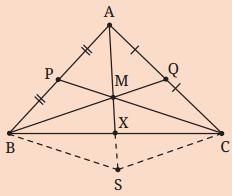
Give another proof of the Centroid Theorem using a clever construction that we will describe only partly and ask you to complete. Once again let M be the intersection point of the two medians CP and BQ. We want to show that the intersection point of line AM with side BC is the midpoint of BC. For this, extend AM up to a carefully chosen point S such that BSCM becomes a parallelogram. (Hint: To arrange MC || BS, first note that PM and MC are along the same line. Now where should M be on segment AS? Does your placement of S also prove MB || CS?)
Solution:
Theorem: In ∆ABC, the three medians are concurrent. That is, if M is the intersection of medians CP and BQ, the line AM meets BC at its midpoint X.
Construction: Extend the segment AM beyond M to a point S such that AM = MS, i.e., choose S so that M is the midpoint of segment AS.
Join BS and CS.
Proof: Consider ∆ABS
- P is the midpoint of AB (given, since CP is a median).
- M is the midpoint of AS (by construction).
By the Midpoint Theorem, we have PM || BS
Since P, M, and C all lie on the same straight line (the median CP):
MC || BS …(1)
Similarly, applying the Midpoint Theorem in AACS, we have
QM ||CS
Since Q, M, and B lie along the same straight line (the median BQ):
MB ||CS …(2)
From (1) and (2), we have
⇒ BSCM is a parallelogram.
In parallelogram BSCM, let the diagonals BC and MS intersect at point X.
⇒ BX = XC
(The diagonals of any parallelogram bisect each other)
Thus, X is the midpoint of side BC, which proves that the line AX (passing through A and M) is the third median of ∆ABC.
Additional Remark (The 2:1 Ratio)
From the construction and diagonal bisection,
AM = MS (by construction)
= MX + XS = 2MX (since X bisects MS)
⇒ \(\frac{\mathrm{AM}}{\mathrm{MX}}=\frac{1}{2}\)
This also proves the property that the centroid divides each median in the ratio 2:1.
Ex 12.1 Class 9 Ganita Manjari Solutions – Ganita Manjari Class 9 Exercise 12.1 Solutions
Exercise 12.1 Class 9 Ganita Manjari Solutions – Ganita Manjari Class 9 Ex 12.1 Solutions
Question 1.
Let ABCD be a quadrilateral.
(i) List all sides of ABCD adjacent to side AB. List all sides opposite to AB.
(ii) List all angles of ABCD adjacent to ∠A. List all angles opposite to ∠A.
(iii) Define a pair of opposite sides and a pair of opposite angles without using vertex names.
Solution:
(i) Sides adjacent to AB are AD and BC.
The side opposite to AB is CD.
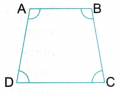
(ii) Angles adjacent to ∠A are ∠B and ∠D.
The angle opposite to ∠A is ∠C.
(iii) Opposite sides: Two sides of a quadrilateral that do not have a common endpoint are called opposite sides.
Opposite angles: Two angles of a quadrilateral that do not share a common side are called opposite angles.
Question 2.
You have used internal angles of quadrilaterals, but they also need an exact definition, just as we gave one for a quadrilateral. Precisely define the internal angle of a quadrilateral at a given vertex. Your answer should work for a non-convex quadrilateral too, (Hint: use the opposite vertex as well.)
Solution:
Let a simple (non-self-intersecting) quadrilateral be defined by four vertices in cyclic order: A, B, C, and D.
Suppose we want to precisely define the internal angle at vertex B.
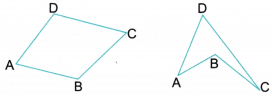
Σ The adjacent vertices are A and C.
Σ The opposite vertex is D.
Σ The rays BA and BC partition the 2D plane into two distinct angular regions: one convex angle (<180°) and one reflex angle (>180°).
Construct line l that passes through the adjacent vertices A and C. This line divides the plane into two open half-planes. Because the quadrilateral is non-degenerate and simple, neither B nor D lies on line l.
To identify the internal angle at B, we evaluate the positions of the target vertex B and the opposite vertex D relative to the line l.
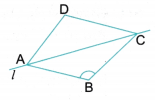
There are exactly two distinct cases:
Case 1: B and D lie in opposite half-planes
If the line l separates B and D, the quadrilateral is convex in this region.
Definition: The internal angle at vertex B is the angular region bounded by rays BA and BC, that is strictly less than 180°.
Case 2: B and D lie in the same half-plane
If B and D fall on the same side of line l, the quadrilateral is non- convex (a dart or concave shape).
In this scenario, one of those two vertices is the “dent” (the reflex vertex). To determine if B is that vertex, we use D to form a reference triangle, ∆ACD.
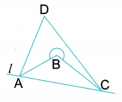
When B is the reflex vertex: If vertex B lies strictly inside ∆ACD, then B is the concave “dent” of the quadrilateral.
Definition: The internal angle at vertex B is the angular region bounded by rays BA and BC that is strictly greater than 180°.
When Bis an acute tip: If vertex B lies strictly outside ∆ACD (which implies D is inside ∆ABC), then the dent is at D, not B.
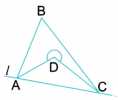
Definition: The internal angle at vertex B is the angular region bounded by rays BA and BC that is strictly less than 180°.
Question 3.
In quadrilateral ABCD, suppose AB || DC. Can ABCD be non-convex? What if we instead assume AB = CD? What if we instead assume ∠A = ∠C?
Solution:
Let ABCD be a quadrilateral with vertices taken in order.
Case 1: If AB || DC, can ABCD be non-convex?
No. If two sides are parallel, the vertices A and B lie entirely on one side of line CD, and C and D lie entirely on one side of line AB. Thus, all interior angles remain strictly less than 180°. And both diagonals lie entirely inside figure.

Case 2: If we assume AB = CD, can ABCD be non-convex?
Yes. For example, construct an arrowhead (dart) where one pair of non-adjacent edges AB and CD has equal lengths.
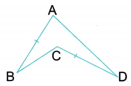
Case 3: If we assume ∠A = ∠C, can ABCD be non-convex?
Yes, ABCD can be non-convex.
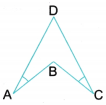
The equality of opposite internal angles:
∠A = ∠C does not by itself force the quadrilateral to be convex. A concave or non-convex quadrilateral can have equal angles at two opposite vertices if one of the angles is interpreted as a reflex internal angle.
Therefore, this condition alone also does not guarantee convexity.
Question 4.
Consider three non-collinear points A, B, C and draw the lines AB, BC, CA. For every possible location of point D in the plane outside these lines, decide if ABCD is self- intersecting, non-convex, or convex. (Hint: the three lines divide the plane into 7 regions.)
Solution:
Given: Three non-collinear points A, B, C and three lines AB, BC, CA.
Three lines, where each pair intersects and no three lines pass through the same point, divide the plane into 7 regions.
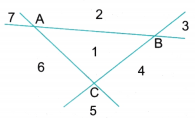
To determine whether the quadrilateral with fixed cyclic order A → B → C → D → A (edges AB, BC, CD, DA) is convex, non-convex, or self-intersecting, test each of the 7 regions formed by the lines AB, BC, and CA and point D:
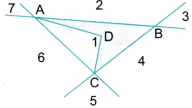
Region 1 (inside AABC): If D is placed inside AABC, segments DA and DC show that quadrilateral ABCD is non-convex (a dart shape).
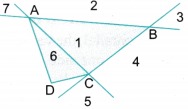
Region 6 (Across segment AC, opposite B): Points B and D lie on opposite sides of line AC, and line segment BD intersects line segment AC i.e., diagonals AC and BD intersect internally. Neither edge crosses the other. Joining A-B-C-D-A produces a convex quadrilateral.
Regions 2 and 4 (Across segments AB and BC):
Connecting the sequence A-B-C-D-A forces one segment to cross another, resulting in a self-intersecting quadrilateral.
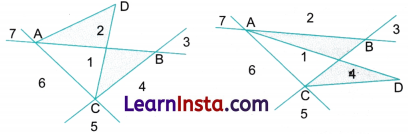
Regions 3, 5 and 7 (Behind vertices B and A): Connecting the sequence A-B-C-D-A forces that quadrilateral ABCD is non-convex.
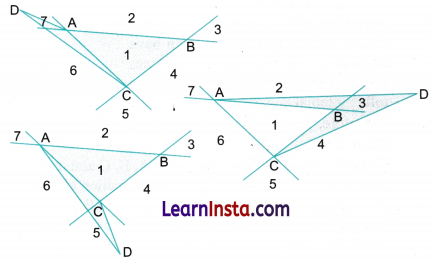
The classification depends on the position of D with respect to the three lines.
Question 5.
Can a quadrilateral be both self-intersecting and non- planar?
Solution:
No. A self-intersecting quadrilateral must have all four vertices in the same plane. A non-planar quadrilateral has vertices that do not lie in the same plane.
Therefore, a quadrilateral cannot be both self-intersecting and non-planar.
Ex 12.2 Class 9 Ganita Manjari Solutions – Ganita Manjari Class 9 Exercise 12.2 Solutions
Exercise 12.2 Class 9 Ganita Manjari Solutions – Ganita Manjari Class 9 Ex 12.2 Solutions
Question 1.
True or False?
(i) A parallelogram with a right angle is a rectangle.
(ii) A rhombus with perpendicular diagonals is a square.
(iii) If the diagonals of a parallelogram are equal, then it is a rectangle.
Solution:
(i) True. In a parallelogram, opposite angles are equal and adjacent angles are supplementary.
If one angle is 90°, then all four angles become 90°. Therefore, the parallelogram is a rectangle.
(ii) False. The diagonals of every rhombus are already perpendicular to each other; it is a square, if the diagonals are equal or one of the comer angle is 90°. Therefore, a rhombus with perpendicular diagonals may not be a square.
(iii) True. In a parallelogram, equal diagonals imply that the parallelogram has right angles.
Therefore, it becomes a rectangle.
Question 2.
The diagonal AC of a parallelogram ABCD bisects ∠A. Show that it also bisects ∠C and that ABCD is a rhombus.
Solution:
Given: ABCD is a parallelogram.
Proof: AC bisects ∠A, therefore,
∠BAC = ∠CAD …(1)
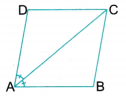
In parallelogram ABCD, AB || CD and AD || BC
∠BAC = ∠ACD and ∠CAD = ∠BCA
(Alternate interior angles)
⇒ ∠ACD = ∠BCA (Using (1))
Also, ∠BAC = ∠ACD
⇒ ∠ACD = ∠CAD (Using (1))
AD = DC (In ∆ADC, sides opposite to equal angles are equal)
But in a parallelogram, AB = CD and AD = BC Therefore, AB = BC = CD = DA
Hence, all sides are equal. Therefore, ABCD is a rhombus.
Question 3.
The following questions examine converses of true properties. Answer them with Yes or No. If your answer is No, what extra condition can you add so that the answer becomes Yes?
(i) If the diagonals of a quadrilateral ABCD bisect its angles, must ABCD be a rhombus?
(ii) If the diagonals of a quadrilateral ABCD bisect each other at right angles, must ABCD be a rhombus?
(iii) If the diagonals of a quadrilateral ABCD are of equal length, must ABCD be a rectangle? (In the ancient Indian study of quadrilaterals, equality of diagonals was considered significant. Quadrilaterals were first classified according to whether their diagonals were equal or not, before considering equality of sides.)
Solution:
(i) Yes
Reasoning: Consider diagonal AC bisecting ∠A and ∠C.
In ∆ABC and ∆ADC,
AC = AC (common)
∠BAC = ∠DAC (since AC bisects ∠A).
∠BCA = ∠DCA (since AC bisects ∠C).
By ASA congruence, ∆ABC ≅ ∆ADC. Therefore, AB = AD and BC = DC.
Similarly, considering diagonal BD bisecting ∠B and ∠D, ∆ABD ≅ ∆CBD by ASA congruence, which gives AB = BC and AD = CD.
Combining these equalities yields AB = BC = CD = DA. A quadrilateral with four equal sides is by definition a rhombus.
(ii) Yes
Reasoning: Let the diagonals AC and BD intersect at point O.
Since the diagonals bisect each other, OA = OC and OB = OD.
Since they meet at right angles, ∠AOB = ∠BOC = ∠COD = ∠DOA = 90°.
By SAS congruence on the four right-angled triangles sharing vertex O,
∆AOB ≅ ∆COB ≅ ∆COD ≅ ∆AOD
This implies that their hypotenuses are all equal,
i. e., AB = BC = CD = DA
Thus, all four sides are equal, making ABCD a rhombus.
(iii) No
Counter example: An isosceles trapezoid has diagonals of equal length, but its adjacent angles along the non-parallel legs are not 90°, so it is not a rectangle. Non-trapezoidal quadrilaterals can also easily be constructed with equal diagonals (for instance, an equidiagonal kite).
Extra condition to make it Yes (Rectangle): Condition: The quadrilateral is a parallelogram (or its diagonals bisect each other).
Alternative Condition: Its opposite angles are supplementary and opposite sides are parallel.
Question 4.
Let ABCD be a parallelogram with AB ≠ BC. Show that the pairwise intersection points of the four angle bisectors form the vertices of a rectangle (see Figure). Why did we assume AB ≠ BC?
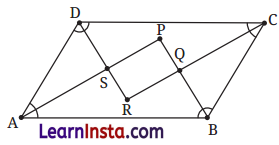
Solution:
Adjacent angles of a parallelogram are supplementary.
∠A + ∠B = 180°
⇒ \(\frac{1}{2}\)(∠A + ∠B) = 90°
⇒ ∠PAB + ∠PBA = 90° …(1)
(Since PA and PB are angle bisectors of ∠A and ∠B)
In ∆APB, ∠PAB + ∠PBA + ∠APB = 180°.
⇒ 90° + ∠APB = 180°
⇒ ∠APB = 180° – 90° = 90°
⇒ ∠SPQ = 90°
Similarly, we can find that all four interior angles of PQRS are 90°
i. e., ∠SRQ = ∠PSR = ∠PQR = ∠QRS = 90°
Thus, PQRS is a rectangle.
Why assume AB ≠ BC?
If AB = BC, ABCD is a rhombus. In a rhombus, angle bisectors meet at a single point (intersection of diagonals), collapsing the inner rectangle into a single degenerate point.
Ex 12.3 Class 9 Ganita Manjari Solutions – Ganita Manjari Class 9 Exercise 12.3 Solutions
Exercise 12.3 Class 9 Ganita Manjari Solutions – Ganita Manjari Class 9 Ex 12.3 Solutions
Question 1.
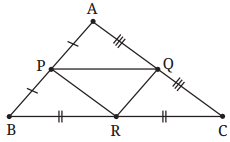
(i) If P, Q, R are the midpoints of sides AB, AC, BC respectively of ∆ABC, show that ∆PQR is congruent to AQPA and to two other triangles which you B should identify.
(ii) Suppose someone erases ∆ABC, leaving only ∆PQR on the paper. Can you reconstruct ∆ABC from ∆PQR?
Solution:
(i) Given: P, Q, R are the midpoints of sides AB, AC, BC, respectively, of ∆ABC.
By the Midpoint Theorem,
PQ = \(\frac{1}{2}\) BC = BR = RC,
QR = \(\frac{1}{2}\) AB = AP = PB
and PR = \(\frac{1}{2}\)AC = AQ = QC.
By SSS congruence criterion, we have
∆PQR ≅ ∆QPA ≅ ∆RBP ≅ ∆CRQ
Hence, the four smaller triangles are congruent.
(ii) Yes, ∆ABC can be reconstructed by drawing lines through P parallel to QR, through Q parallel to PR, and through R parallel to PQ. The three intersection points of these lines are the original vertices A, B, C. Connecting these three vertices A, B, and C gives the original ∆ABC
Question 2.
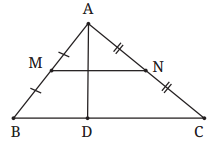
In ∆ABC, let M and N be midpoints of AB and AC respectively. Let D be any point on BC. Show that MN bisects AD.
Solution:
Given: ∆ABC, M and N are midpoints of two sides AB and AC respectively. By Midpoint Theorem, MN || BC. Now D lies on BC. Therefore, MN || BD
In ∆ABD, M is the midpoint of AB.
By the converse of the Midpoint Theorem, a line through M parallel to BD, bisects the third side, z’.e., MN meets AD at its midpoint.
Hence, MN bisects AD.
Question 3.
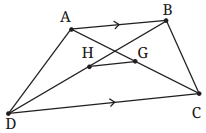
In a quadrilateral ABCD, suppose AB || DC and AB ≠ CD. Suppose G and H are the midpoints of AC and BD respectively. Prove that GH || AB. (Why did we assume AB ≠ CD?)
Solution:
Given: G and H are the f midpoints of AC and BD respectively.
Construction: Let K be the midpoint of BC. Join GK.
In ∆ABC, G is the midpoint of AC and K is the midpoint of BC.
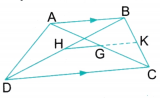
By the Midpoint Theorem, GK || AB and GK = \(\frac{1}{2}\) AB.
In ∆BDC, H is the midpoint of BD and K is the midpoint of BC. Join HK.
By the Midpoint Theorem, HK || CD and HK = \(\frac{1}{2}\) CD.
Since, AB || CD, GK and HK are both parallel to AB and pass through K. By Euclid’s parallel postulate, G, H, K are collinear.
Hence, line segment GH lies on line GK, meaning GH || AB.
Why AB CD? If AB = CD, ABCD is a parallelogram, in which case the diagonals bisect each other, so G and H coincide as one single point.
Therefore, the condition AB 7r CD ensure that the point G and H are distinct, forming a well-defined line segment GH.
Question 4.
Suppose the midpoints of sides AB, BC, CD and DA of quadrilateral ABCD. are P, Q, R and S respectively.
(i) Show that PR and QS bisect each other.
(ii) Show that if AC = BD, then PR and QS are perpendicular. Is the converse true?
Solution:
(i) By Varignon’s Theorem,
PQRS is a parallelogram.
Segments PR and QS are the diagonals of this parallelogram. The diagonals of any parallelogram bisect each other, so PR and QS bisect each other.
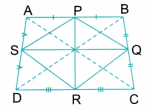
(ii) By the Midpoint Theorem, adjacent sides of PQRS have lengths
PQ = \(\frac{1}{2}\)AC and PS = \(\frac{1}{2}\)BD
If AC = BD, then PQ = PS, making PQRS a rhombus.
Diagonals of a rhombus are perpendicular, so PR ⊥ QS.
Converse: Yes. If PR ⊥ QS, parallelogram PQRS has perpendicular diagonals, making it a rhombus, which implies PQ = PS ⇒ AC = BD.
Question 5.
Suppose PQRS is the Varignon parallelogram of ABCD.
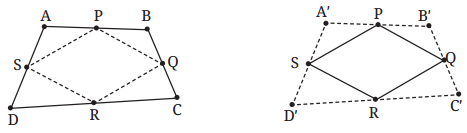
(i) Copy only PQRS on another paper. Show how you will recreate a congruent copy A’B’C’D’ of ABCD from PQRS. This will be relevant when we return to study tilings at the end of this chapter. (Hint: How will you place vertex A’? How will you place B’, C’ and D’?)
(ii) There are multiple ways to construct A’B’C’D’ in (z). Justify why the quadrilateral A’B’C’D’ you constructed is congruent to ABCD. You may need to show why S is collinear with the points A’ and D’ that you constructed, and similarly for P, Q and R. (Hint: Use congruence of triangles, for example ΔSDR ≅ ΔSD’R.)
(iii) Show that if PQRS is a square, then AC and BD are perpendicular and equal. Prove the converse.
Solution:
(i) Given the parallelogram PQRS (which is the Varignon parallelogram of quadrilateral ABCD, where P, Q, R, S are the midpoints of AB, BC, CD, DA respectively):
1. Place A’: Choose any starting position for A’ such that the side lengths A’P and A’S match AP and AS, and ∠PA’S = ∠PAS (or simply copy ΔAPS directly onto the side PS so that ΔA’PS ≅ ΔAPS).
2. Place B’: Since P is the midpoint of A’B’, extend the segment A’P through P to a point B’ such that PB’ = A’P (i.e., reflect A’ across the point P).
3. Place C’: Since Q is the midpoint oTB’C’, extend B’Q through Q to a point C’ such that QC’ = B’Q (i.e., reflect B’ across the point Q).
4. Place D’: Since R is the midpoint ofC’D’, extend C’R through R to a point D’ such that RD’ = C’R (i.e., reflect C’ across the point R).
5. Join D’ to A’. The resulting quadrilateral is A’B’C’D’.
(ii) ΔA’PS = ΔAPS by initial placement.
In ΔPB’Q and ΔPBQ: PB’ = PB, B’Q = BQ, and because PQ is common, ΔPB’Q = ΔPBQ by SSS (or SAS since the Varignon geometry fixes the angles). Similarly, ΔQC’R = ΔQCR and ΔRD’S = ΔRDS. Because all four corresponding comer triangles are pairwise congruent and assembled around the same central parallelogram PQRS, all side lengths and interior angles of A’B’C’D’ match those of ABCD: A’B’C’D’= ABCD
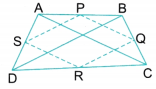
(iii) Equivalence: PQRS is a AC ⊥ BD and AC = BD
By the Midpoint Theorem ΔADC and ΔADC:
PQ || AC and PQ = \(\frac{1}{2}\)AC
RS || AC and RS = \(\frac{1}{2}\)AC
Similarly, applying the Midpoint Theorem to ΔABD and ΔCBD:
PS || BD and PS = \(\frac{1}{2}\)BD
QR||BD and QR = \(\frac{1}{2}\)BD
Given: PQRS is a square.
Since PQRS is a square, its adjacent sides are perpendicular:
PQ ⊥ PS.
Since PQ || AC and PS || BD, it follows directly that AC ⊥ BD
In a square, all sides are equal, PQ = PS.
Since PQ = \(\frac{1}{2}\) AC and PS = \(\frac{1}{2}\) BD:
\(\frac{1}{2}\) AC = \(\frac{1}{2}\) BD
⇒ AC = BD
Converse:
Given: Diagonals AC and BD of ABCD are equal in length (AC = BD) and perpendicular to each other (AC 1 BD).
To Prove: PQRS is a square.
Proof: We have PQ = \(\frac{1}{2}\) AC and PS = \(\frac{1}{2}\) BD
Since AC = BD, so PQ = PS
Since PQRS is a parallelogram with adjacent sides equal, PQRS is a rhombus.
AC ± BD, and PQ || AC while PS || BD, the angle between PQ and PS is’ equal to the angle between AC and BD.
∠QPS = 90°
A rhombus with a right angle (90°) is a square. Thus, the converse is proved.
Ex 12.4 Class 9 Ganita Manjari Solutions – Ganita Manjari Class 9 Exercise 12.4 Solutions
Exercise 12.4 Class 9 Ganita Manjari Solutions – Ganita Manjari Class 9 Ex 12.4 Solutions
Question 1.
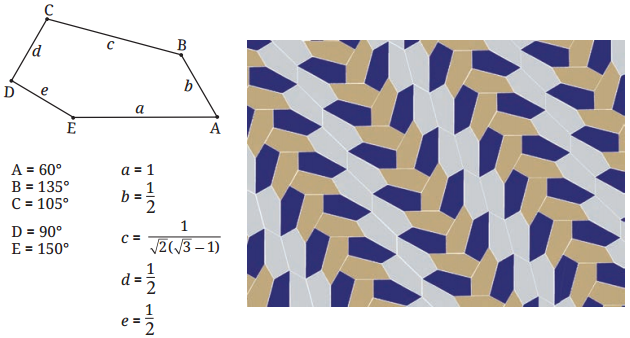
Justify why the plane cannot be tiled with a regular pentagon. (Hint: Read the first 3 sentences of ‘Think and Reflect’ in the section on tiling.) (There are many ways to tile the plane using a suitable irregular pentagon. The most recent method was found in 2015.)
Solution:
Each interior angle of a regular n-gon is \(\frac{(n-2) \times 180^{\circ}}{n}\)
For a regular pentagon (n = 5):
Interior Angle = \(\frac{(5-2) \times 180^{\circ}}{5}=\frac{540^{\circ}}{5}\) = 108
For regular polygons to tile the plane around a vertex, the vertex angle must divide 360° evenly into an integer. 360°
\(\frac{360^{\circ}}{108^{\circ}}\) = 3.333 … not an integer.
Three pentagons leave a gap of 360° – 3(108°) = 36°, and four pentagons causing overlap (432° > 360°). Thus, it cannot tile the plane.
Question 2.
Draw a non-convex 4-gon DART. Show how we can tile the plane with copies of DART. Both methods that we discussed earlier will work. Which do you prefer?
Solution:
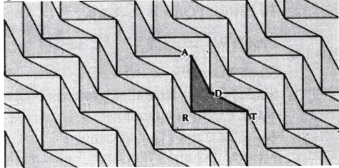
Method 1: Rotation Method
(i) Draw a non-convex quadrilateral DART.
(ii) Make an identical copy of DART.
(iii) Rotate the copy by 180° about the midpoint of one of its sides.
(iv) The rotated copy fits exactly along the original side.
(v) Repeat the same process along every exposed side. This creates a repeating pattern that covers the plane without gaps or overlaps.
The method works because two identical copies of any quadrilateral placed with a 180° rotation around the midpoint of a side fit together perfectly.
Method 2: Varignon Parallelogram Method
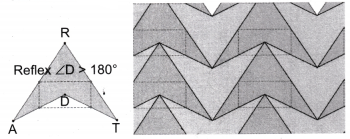
(i) Mark the midpoints of the four sides of DART.
(ii) Join these midpoints to form the Varignon parallelogram.
(iii) First tile the plane using copies of this parallelogram.
(iv) Place copies of DART inside the parallelogram grid.
(v) Continue the pattern to cover the entire plane.
The chapter explains that the Varignon parallelograms of copies of a 4-gon form a grid, which can be used to construct the tiling.
Preferred Method: I prefer the rotation method because it is simpler and easier to construct. It only requires copying the shape and rotating it, whereas the Varignon method requires constructing additional midpoints and parallelograms.
Ganita Manjari Class 9 Maths Chapter 12 End of Chapter Exercise Solutions
Quadrilaterals End of Chapter Exercise Solutions
Question 1.
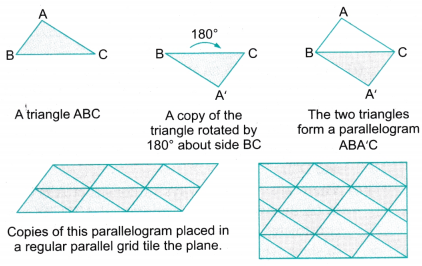
Using a fact about parallelograms, show how to tile the plane using any given triangle. (Hint: Can you use the parallelogram tiling in the introduction?)
Solution:
Take two copies of any given triangle and rotate one by 180° along any side to join them. This forms a parallelogram. Since every parallelogram tiles the plane via a regular parallel grid joining triangles into parallelograms tiles the plane.
Question 2.
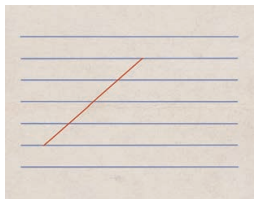
Mark the midpoint of the line drawn on the paper (see Figure), given that the horizontal lines are equally spaced. Justify your answer.
Solution:
Let the given slanted line segment be AB, where A is the lower endpoint and B is the upper endpoint.
The horizontal lines are equally spaced parallel lines. The segment starts on one horizontal line and ends on another horizontal line.
From the figure,
Σ The lower endpoint A lies on the second horizontal line from the bottom.
Σ The upper endpoint B lies on the sixth horizontal line from the bottom.
So, the segment crosses 6 – 2 = 4 equal vertical gaps.
The midpoint must divide the segment into two equal parts. Since the segment crosses 4 equal gaps, the midpoint will be halfway between the second and sixth horizontal lines.
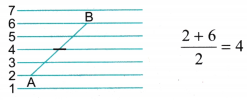
Therefore, the midpoint lies on the fourth horizontal lines.
Question 3.
You know that the sum of angles of a quadrilateral is 360°, even for a non-convex quadrilateral. (Recall the proof.) Now consider a self-intersecting quadrilateral ABCD, where AB and CD intersect at point E. Show that ∠A + ∠B + ∠C + ∠D < 360°. Can you construct ABCD such that ∠A + ∠B + ∠C + ∠D = 2°?
Solution:
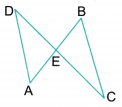
Let non-adjacent edges AB and CD cross at point E.
This forms two triangles: ΔEAD and ΔEBC.
In ΔEAD, ∠A + ∠D + ∠AED = 180° … (1)
In ΔEBC, ∠B + ∠C + ∠BEC = 180° … (2)
Summing (1) and (2) gives: (∠A + ∠B + ∠C + ∠D) + (∠AED + ∠BEC) = 360°
Since vertically opposite angles ∠AED = ∠BEC > 0°, the sum of the four angles is
∠A + ∠B + ∠C + ∠D = 360° – 2∠AED < 360°
To achieve a sum of 2°, set 2∠AED = 358°
⇒ ∠AED = 179°.
Making the crossing lines meet at an angle of 179° leaves each triangle extremely needle-thin with vertex angle sums of 1 ° each.
Question 4.
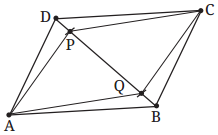
In a parallelogram ABCD, two points P and Q are taken on diagonal BD such that DP = BQ (see Figure). Show that APCQ is a parallelogram.
Solution:
Join AC.
In parallelogram ABCD, diagonals AC and BD bisect each other at O.
Thus, OA = OC and OB = OD.
We are given DP = BQ.
On subtracting, we have OP = OD – DP = OB – BQ = OQ.
In quadrilateral APCQ, diagonals AC and PQ share midpoint O (OA = OC and OP = OQ).
By Theorem 4, since its diagonals bisect each other, APCQ is a parallelogram.
Question 5.
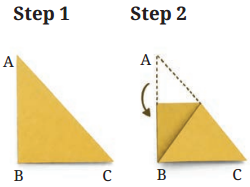
A right-triangle shaped cut-out of a paper is folded such that point A touches point B (Figure.). Show that the crease line can be used to find the midpoint of not only AB but also that of AC.
Solution:
When A is folded onto B, the crease is the perpendicular bisector of leg AB, meeting AB at its midpoint M.
Since the triaiigle has ∠B = 90°, the crease is parallel to side BC (90° altemate/corresponding angles).
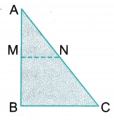
By the Converse of the Midpoint Theorem, a line passing through the midpoint M of AB and parallel to BC bisects hypotenuse AC at point N.
Question 6.
You saw how to use the Midpoint Theorem to divide a given triangle into 4 congruent triangles. Can we divide a triangle into 3 congruent triangles? This exercise shows us how to do that and more, provided we are allowed to cut and reassemble.
(i) Draw medians AP, BQ and CR of ∆ABC, meeting in a common point M. Cut along each median to get 6 triangles. Show with justification how to assemble the 6 pieces into 3 congruent triangles! (Hint: Align AMPB and AMPC along equal sides PB and PC, matching P with itself and B with C.) Prove that you get a triangle. What are its side lengths?
(ii) Repeat the procedure with each of the 3 assembled triangles you got in (i). Show that each of the
resulting 9 triangles has sides \(\frac{1}{2}\) and \(\frac{1}{2}\).
The procedure and the result above were unnoticed till 2014, when they were discovered by Lee Sallows, an amateur mathematician!
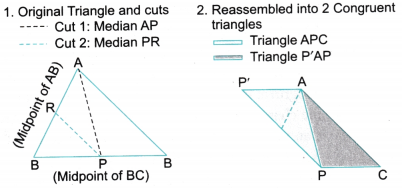
(iii) Naturally, we can next ask about the possibility of cutting a triangle and reassembling it into 2 congruent triangles. You were asked this question in the chapter Measuring Space: Perimeter and Area. Can you solve this now? (Hint: Use median AP in ∆ABC and then a median of ∆APB.)
For any two given figures with straight sides, we can ask whether one figure can be cut (using only straight cuts) into, pieces and reassembled to make the other. This notion is called scissors congruence. The figures need not be in the plane. Research on such questions at a higher level is ongoing.
Solution:
(i) Centroid M divides each median in ratio 2:1. By joining ∆MPB and ∆MPC along PB = PC, the resulting base is MM’.
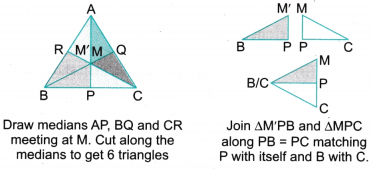
So, ∆M’PB and ∆MCP together form ∆MB/CM’. And by centroid theorem MM’ = 2MP
∴ AM = \(\frac{2}{3}\)AP, M’C = \(\frac{2}{3}\)CR and MB = \(\frac{2}{3}\)BQ
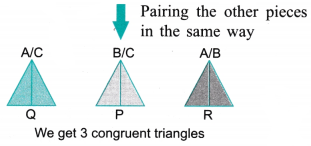
Each has sides equal to \(\frac{2}{3}\) of three medians.
(ii) Repeating the trisection construction on the 3 assembled pieces splits each further, yielding 9 sub¬
triangles whose edge lengths are scaled down by \(\frac{1}{3}\),
i. e., \(\frac{\mathrm{AB}}{3}, \frac{\mathrm{AB}}{3}\) and \(\frac{\mathrm{AC}}{3}\), all congruent by SSS.
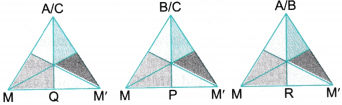
(iii) Draw median AP in ∆ABC, then draw median PD of ∆APB. Cut triangle ABC along two medians : AP and PR (Creating three triangular pieces APC, ARP and BRP). Rearranging along equal segments produces 2 congruent triangles, together form a parallelogram P’ACP.
Question 7.
A more general midpoint theorem and its converse. In a quadrilateral ABCD, suppose AB || DC. Recall that such ABCD is called a trapezium.
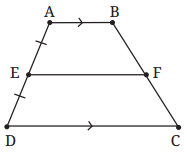
Let E be the midpoint of AD.
A line drawn through E intersects side BC at F.
(i) If EF || AB, then show that F is the midpoint of BC.
Conclude that EF = \(\frac{A B+C D}{2}\).
(ii) If F is the midpoint of BC, then show that EF || AB. There are at least two ways to solve (ii). Do it directly by using the midpoint M of BD and showing that EM and FM are the same line. Or use (i) along with the same idea used in the second proof of the converse of the Midpoint Theorem.
Which way do you think is simpler?
Solution:
(i) Draw diagonal AC meeting EF at K.
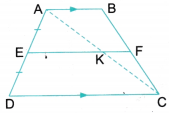
In ∆ADC, E is the midpoint of AD and EK || CD, so by Theorem 7, K is the midpoint of AC and
EK = \(\frac{1}{2}\)CD.
so F is the midpoint of BC and KF = \(\frac{1}{2}\) AB. Thus,
EF = EK + KF = \(\frac{\mathrm{AB}+\mathrm{CD}}{2}\)
(ii) Way 1 (direct): Let M be the midpoint of BD. In ADAB, E and M are midpoints of DA and DB, so EM || AB. In ∆BDC, M and F are midpoints of BD and BC, so MF || DC || AB. EM and MF are both lines through M parallel to AB, so they are the same line. Hence E, M, F are collinear and EF || AB.
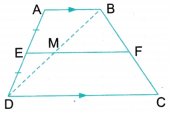
Way 2: If F is given as the midpoint of BC, let the line from E parallel to AB meet BC at F’. By using the explanation of part (i), F’ is the midpoint of BC.
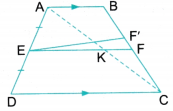
Since a line segment has only one midpoint, F and F’ coincide, i.e., F’ = F, which implies EF || AB. Way 2 is shorter and simpler.
Question 8.
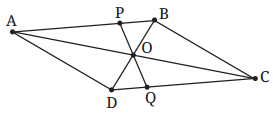
The diagonals AC and BD of a parallelogram ABCD intersect at O. A line through O meets AB and CD at points P and Q respectively. Show that O is the midpoint of PQ. (Multiple proofs are possible. Which is the simplest?)
Solution:
Proof 1: ASA Congruence (The Simplest Method)
In parallelogram ABCD, diagonals bisect at O, so OA = OC and OB = OD.
In ∆OBP and ∆ODQ,
∠POB = ∠QOD (vertically opposite)
OB = OD,
and ∠PBO = ∠QDO (alternate interior angles, AB || CD).
By ASA congruence, ∆OBP = ∆ODQ
Therefore, OP = OQ, which means O is the midpoint of PQ.
Alternative: Point Reflection/Central Symmetry (The Most Elegant):
- Every parallelogram has point symmetry (half-turn symmetry) about the intersection of its diagonals, O.
- Under a 180° rotation about O:
- Point A → C and B → D, so the segment AB maps onto CD.
- Any line passing through the centre of rotation O maps onto itself.
- The intersection of line POQ with AB (which is P) must map to the intersection of line POQ with CD (which is Q).
- Since rotation by 180° about O sends P to Q, O must be the midpoint of PQ.
Proof 1 (ASA Congruence) is the simplest for instructional and classroom purposes because it uses elementary Euclidean concepts with only four lines of working.
Proof 2 (Central Symmetry) is conceptually the shortest and most insightful, showing why the property holds universally for any centrally symmetric figure.
Question 9.
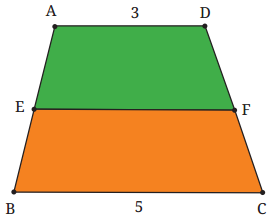
ABCD is a trapezium with parallel sides AD = 3 cm and BC = 5 cm. E and F are the midpoints of the non-parallel sides. Find the ratio of the areas of the 4-gons AEFD and EBCF.
Solution:
The parallel sides are AD = 3 cm and BC = 5 cm.
Midline EF = \(\frac{A D+B C}{2}=\frac{3+5}{2}\) = 4 cm
Since E and F are midpoints, the heights of trapeziums
AEFD and EBCF are equal (h1 = h2 = h).
Area (AEFD) = \(\frac{1}{2}\)(AD + EF)h = \(\frac{1}{2}\)(3 + 4)h = \(\frac{7}{2}\)h.
Area (EBCF) = \(\frac{1}{2}\)(EF + BC)h = \(\frac{1}{2}\)(4 + 5)h = \(\frac{9}{2}\)h.
Ratio of areas = \(\frac{\text { Area }(\mathrm{AEFD})}{\text { Area }(\mathrm{EBCF})}=\frac{7}{9}\)
Question 10.
Consider 4 points A, B, C, D in the plane with no three collinear. Answer the following questions. Some answers may require you to consider different cases, depending on how the points are positioned in the plane.
(i) How many different quadrilaterals do they form if the quadrilateral is allowed to be self-intersecting or non-convex?
(ii) How many of these quadrilaterals are self- intersecting? How many are convex?
Solution:
(i) A quadrilateral is uniquely defined by the cyclic order of its four vertices. For any 4 distinct points, 3 distinct quadrilaterals they form if the quadrilateral is allowed to be self-intersecting or non-convex.
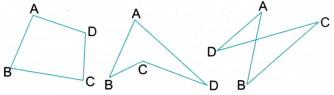
(ii) If one point is inside the triangle formed by the other three: Exactly 0 are convex, all 3 are non-convex/ self-intersecting.
Question 11.
Suppose P is a point on side AB of ∆ABC and the line through P parallel to BC meets AC in point Q. For parts (i) to (iii), assume AP = 1, AQ = √5 and see Figure.
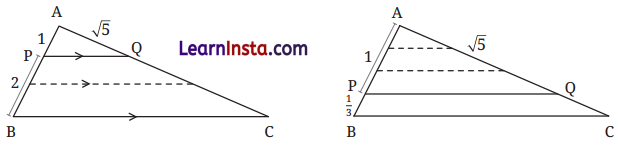
(i) If PB = 2 find QC. (Hint: See the dotted line)
(ii) If PB = \(\frac{1}{3}\) find QC. (Hint: See the dotted lines)
(iii) If PB = \(\frac{2}{3}\) find QC.
(Hint: Divide both PB and AP suitably.)
(iv) Show that if \(\frac{\mathrm{AP}}{\mathrm{~PB}}\) is a rational number, then \(\frac{A P}{P B}=\frac{A Q}{Q C}\). In Grade 10, you will prove this equality without assuming \(\frac{\mathrm{AP}}{\mathrm{~PB}}\) is rational.
That will require a new idea.
Solution:
Part (i): If PB = 2, find QC
Given: AP = 1, PB = 2, AQ = √5 and PQ || BC.
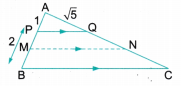
Let the line through M parallel to BC (the dotted line in Figure), intersecting AC at point N.
Analysis: In ∆AMN:
Since AP = 1 and PM = 1, P is the midpoint of AM.
Since PQ || MN (both are parallel to BC), by the Converse of the Midpoint Theorem, Q must be the midpoint of AN.
Therefore: QN = AQ = √5
AN = AQ + QN = 2√5
In the trapezium PQCB or ∆ABC
In ∆ABC, AM = AP + PM = 1 + 1 = 2, and MB = 1.
Consider the trapezium formed between parallel lines:
In trapezium PQCB, M is the midpoint of PB. Since MN || BC || PQ, the three equidistant parallel lines PQ, MN, BC cut off equal intercepts on any transversal:
– On transversal AB: AP = PM = MB = 1.
– On transversal AC: AQ = QN = NC.
Since AQ = √5, it directly follows that:
QN = √5 and NC = √5
Therefore: QC = QN + NC = √5 + √5 = 2√5
Part (ii): If PB = \(\frac{1}{3}\), find QC
Given: AP = 1, PB = \(\frac{1}{3}\), AQ = √5 and PQ ||BC.
Divide AP into 3 equal segments of length \(\frac{1}{3}\) each (the dotted lines in Figure right).
Let the division points on AP be D1 and D2 such that:
AD1 = D1D2 = D2P = PB = \(\frac{1}{3}\)
Let lines through D1 and D2 parallel to BC, meeting AQ at E1 and E2
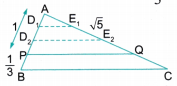
Analysis using the Midpoint Theorem:
In triangle ∆AD2E2, D, is the midpoint of AD2 and D1E1 ∥ D2E2.
By the Converse of the Midpoint Theorem, E] is the midpoint of AE2, so:
AE1 = E1E2
In trapezium D1PQE1 the parallel line through the midpoint of D1P bisects the other leg, giving:
E1E2 = E2Q
Thus, the 3 equal segments on AP create 3 equal segments on AQ:
AE1 = E1E2 = E2Q = \(\frac{\mathrm{AQ}}{3}=\frac{\sqrt{5}}{3}\)
Now, D2P = PB = \(\frac{1}{3}\), so P is the midpoint of D2B.
Since PQ ∥ BC ∥ D2E2, by the same midpoint intercept property on segment E2C:
QC = E2Q = \(\frac{\sqrt{5}}{3}\).
Part (iii): If PB = \(\frac{2}{3}\), find QC.
Given: AP = 1, PB = \(\frac{2}{3}\), AQ = √5
Construction:
Divide AP into 3 equal pieces of length \(\frac{1}{3}\): points D1 D22 with AD1 = D1D2 = D2P = \(\frac{1}{3}\)
Divide PB into 2 equal pieces of length \(\frac{1}{3}\) point M with
PM = MB = \(\frac{1}{3}\).
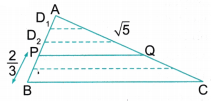
This divides the entire segment AB into 5 equal segments of length \(\frac{1}{3}\) each.
Draw lines parallel to BC through each division point, intersecting AC.
Analysis:
By repeated application of the Midpoint Theorem on consecutive double-segments (as established in parts i and ii), these equally spaced parallel lines divide the transversal AC into equal segments.
Since AP contains 3 such units and AQ = √5:
Length of each unit on AC = \(\frac{\mathrm{AQ}}{3}=\frac{\sqrt{5}}{3}\)
Since PB contains 2 such units, the corresponding segment QC contains 2 equal units on AC:
QC = 2 × \(\frac{\sqrt{5}}{3}=\frac{2 \sqrt{5}}{3}\)
Part (iv): General Proof for Rational Ratio \(\frac{\mathrm{AP}}{\mathrm{~PB}}\)
Let the rational ratio be:
\(\frac{\mathrm{AP}}{\mathrm{~PB}}=\frac{m}{n}\) (m, n ∈ N)
Step 1: Divide AP into m equal parts, each of length x = \(\frac{\text { AP }}{m}\)
Step 2: Divide PB into n equal parts of the exact same PB length x = \(\frac{\mathrm{PB}}{n}\).
Step 3: Through each of these (m + n – 1) division points, draw lines parallel to BC.
Step 4: Applying the Converse of the Midpoint Theorem pairwise across every two adjacent intervals shows that all consecutive intercepts made by these parallel lines on AC are mutually equal.
Let each intercept on AC have lengthy.
Then: AQ = m × y ⇒ y = \(\frac{\mathrm{AQ}}{m}\)
QC = n × y ⇒ y = \(\frac{\mathrm{QC}}{n}\)
Step 5: Equating the two expressions for y:
\(\frac{\mathrm{AQ}}{m}=\frac{\mathrm{QC}}{n}\)
⇒ \(\frac{m}{n}=\frac{\mathrm{AQ}}{\mathrm{QC}}\)
Since \(\frac{\mathrm{AP}}{\mathrm{~PB}}=\frac{m}{n}\), we obtain:
Question 12.
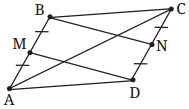
(i) Suppose ABCD is a parallelogram and M. N are midpoints of AB and CD respectively. Show that segments DM and BN trisect segment AC.
(ii) Use part (I) to find a procedure to trisect any given segment PQ. Find two other ways to trisect PQ. one using Exercise 11 above and a third using the Centroid Theorem.
Solution:
(i) Let DM intersect AC at X. and BN intersect AC at Y.
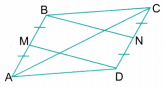
In ∆ABY, M is the midpoint of AB and MX || BY (since MD || BN).
By Theorem 7, X is the midpoint of AY, so
AX = XY …(1)
In ∆CDX, N is the midpoint of CD and NY || DX. By Theorem 7, Y is the midpoint of XC, so
XY = YC …(2)
From (1) and (2),
AX = XY = YC
Hence, segments DM and BN trisect segment AC.
(ii) Three methods to trisect a segment PQ:
1. Embed PQ as a diagonal of a parallelogram and construct the midpoints of the opposite sides as in part (i).
2. Draw an auxiliary ray, mark 3 equal segments using a compass, and draw parallel lines to project the divisions onto PQ (using Q11).
3. Construct a triangle with base PQ and locate its centroid, which naturally creates a 2 :1 trisection of medians (Centroid Theorem).
Question 13.
Is the Midpoint Theorem for Quadrilaterals (Theorem 9) true when the quadrilateral is non-convex? How about when it is self-intersecting? Experiment and check. The pictures may look strange, but the theorem appears to be true.
(i) Can you explain why this is so? See the geometric reasoning in the text.
(ii) There is one exception: In a very special case the Varignon parallelogram becomes a single segment. When will this happen?
(iii) Does your reasoning apply even when ABCD is non-planar?
Solution:
(i) The proof relies only on the midpoint Theorem on sub-triangles sharing a comrflon diagonal
(PQ || AC || SR and PQ = SR = \(\frac{1}{2}\) AC). This holds for convex, non-convex, and self – intersecting configurations.
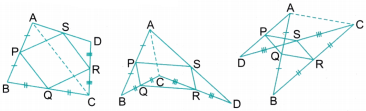
(ii) The parallelogram collapses into a single line segment if all four midpoints become collinear, which happens when the four original vertices lie on the lines of a single degenerate crossed planar configuration (or degenerate collinear vertices).
(iii) Yes, it holds even for non-planar (skew) quadrilaterals in 3D space because the sub-triangles ΔABC and AADC are planar, so PQ and SR are still both parallel and equal to \(\frac{1}{2}\)AC in 3D space.
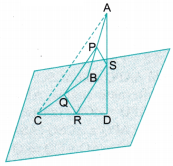
Question 14.
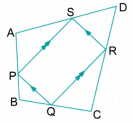
Let P, Q, R, S be four points on sides AB, BC, CD and DA respectively of a quadrilateral ABCD. Suppose PQRS is a parallelogram. Must P, Q, R and S be midpoints of the respective sides? This can be considered a possible converse question to Theorem 9.
Solution:
No. If PQRS is a parallelogram, the points P, Q, R, S do not need to be midpoints; they can be chosen such that \(\frac{\mathrm{AP}}{\mathrm{~PB}}=\frac{\mathrm{CQ}}{\mathrm{QB}}=\frac{\mathrm{CR}}{\mathrm{RD}}=\frac{\mathrm{AS}}{\mathrm{SD}}\) preserving parallel opposite sides without dividing each edge in a 1 : 1 ratio.
Question 15.
(i) Complete the following proof of the Midpoint Theorem. Extend segment PQ beyond Q until point S. By how much should we extend PQ?
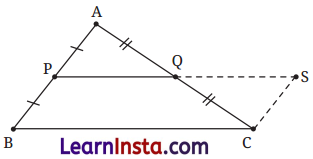
It would be good to be able to prove that ΔAPQ ≅ ΔCSQ. (Why?)
Else this as a guide to specify the location of S and then complete this proof.
(ii) Give a similar proof of the converse of the Midpoint Theorem (Theorem 7). Start by extending PQ up to a suitable point S.
Solution:
(i) Extend PQ to S such that QS = PQ. Join CS.
In ΔAPQ and ΔCSQ,
AQ = QC (given)
∠AQP = ∠CQS (vertically opposite angles)
and PQ = QS (construction)
Thus, ΔAPQ ≅ ΔCSQ by SAS.
This gives CS = AP = PB and ∠PAQ = ∠SCQ
⇒ CS || AB (alternate angles).
Therefore, BCSP has one pair of opposite sides equal and parallel (BP= CS and BP || CS). By Theorem 5, BCSP is a parallelogram.
Hence, PS || BC ⇒ PQ || BC,
and PQ = \(\frac{1}{2}\)PS = \(\frac{1}{2}\) BC.
(ii) Converse: Now P is the midpoint of AB and PQ || BC, with Q on AC.
Extend PQ to S so that PS = BC.
PS || BC and PS = BC, so PBCS is a parallelogram (Theorem 5).
Hence CS || PB (i.e. CS || AB) and CS = PB = AP.
In ΔAPQ and ΔCSQ: AP = CS, ∠PAQ = ∠SCQ (alternate angles, AB || CS, transversal AC), ∠APQ = ∠CSQ (alternate angles, transversal PS). So ∠APQ = ∠CSQ (ASA).
Therefore AQ = CQ
⇒ Q is the midpoint of AC PS BC
And PQ = QS = \(\frac{P S}{2}=\frac{B C}{2}\)
⇒ PS = BC.
Question 16.
Review all the properties of a rhombus/rectangle/square that you proved in Grade 8. Formulate a converse of each. Decide if the converse is true. There are many possibilities here!
Solution:
(i) Properties of a Rhombus
Property A (Sides): All four sides of a rhombus are equal.
Converse: If all four sides of a quadrilateral are equal, it is a rhombus.
True. (By definition and by SSS congruence across a diagonal, opposite sides are equal and parallel, making it a parallelogram with equal sides).
Property B (Diagonals-Perpendicular): The diagonals of a rhombus are perpendicular to each other.
Converse: If the diagonals of a parallelogram are perpendicular to each other, it is a rhombus. So converse (True)
Converse B (in a general quadrilateral): If the diagonals of a quadrilateral are perpendicular, it is a rhombus. (False)
Counterexample: A kite or an arbitrary orthogonal quadrilateral has perpendicular diagonals, but all four sides are not necessarily equal.
Property C (Diagonals-Angle Bisec(ors): The diagonals of a rhombus bisect its interior angles. Converse: If the diagonals of a parallelogram bisect its interior angles, it is a rhombus. (True)
(ii) Properties of a Rectangle
Property A (Angles): All four interior angles of a rectangle are right angles (90°).
Converse: If a quadrilateral has four right angles, it is a rectangle. (True)
Converse A (in a parallelogram): If the diagonals of a parallelogram are equal, it is a rectangle.
True. (In ∆ABC and ∆DCB, SSS congruence gives ∠B = ∠C; since adjacent angles sum to 180°, each angle is 90°).
Converse B (in a general quadrilateral): If the diagonals of a quadrilateral are equal, it is a rectangle.(False)
Counterexample: An isosceles trapezoid has equal diagonals (AC = BD), but its angles are not 90° and it is not a rectangle.
(iii) Properties of a Square
A square combines the properties of both a rhombus and a rectangle.
Property A (Sides and Angles): A square has all four sides equal and all four angles equal to (90°). Converse: If a quadrilateral has all four sides equal and all four angles equal to 90°, it is a square. (True) Property B (Diagonals): The diagonals of a square are both equal in length and perpendicular to each other.
Converse: If the diagonals of a parallelogram are both equal and perpendicular, it is a square. (True)
Converse B (in a general quadrilateral): If the diagonals of a quadrilateral are equal and perpendicular, it is a square. (False)
Counterexample: A quadrilateral whose diagonals are equal and perpendicular, but do not bisect each other, is neither equilateral nor equiangular. Hence, not a square.
Question 17.
Show that the sum of angles of a non-planar quadrilateral is always less than 360°. Can you find a non-planar quadrilateral ABCD for which ∠A + ∠B + ∠C + ∠D = 2°?
(Hint: Think of a diagonal, say AC, as a hinge around which triangles ABC and ADC can rotate.) What happens to each angle of ABCD as you do this rotation? ‘
Solution:
Let the Starting Flat on the Table:
When the shape lies perfectly flat, all four interior angles (∠A, ∠B, ∠C, and ∠D) add up to exactly 360°, just like every standard flat cpnvex quadrilateral.
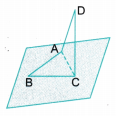
Thus, Flat Quadrilateral: ∠A + ∠B + ∠C + ∠D = 360°
Lifting Along the Hinge: Hold the lower triangle (ΔABC) stationary against the tabletop, and gently lift the upper triangle (ΔADC) along the diagonal fold AC into the air. Corners B and D Remain Unchanged: Because ΔABC and ΔADC are rigid pieces of paper, lifting comer B does not bend or stretch either triangle internally. The angles ∠B and ∠D stay exactly what they were.
Comers A and C Must Shrink: In the flat position, comers B and D are spread as far apart as possible on opposite sides of the diagonal. As comer B rotates upward, the spatial distance between B and D gets shorter. With the sides AB, AD, CB, and CD staying the same length, a shorter gap across BD forces the opening angles ∠DAB (at comer A) and ∠BCD (at comer C) to pinch shut and decrease. Because comers B and D remain constant while comers A and C strictly decrease the instant the shape leaves the plane, the total sum of the four angles in any non-planar (skew) quadrilateral is always strictly less than 360°. Thus, for Non-Planar (Skew) Quadrilateral:
∠A + ∠B + ∠C + ∠D < 360°
Now, let us see can we get a non-planar quadrilateral ABCD for which ∠A + ∠B + ∠C + ∠D = 2°.
Yes. Not only can the angle sum be less than 360°, but it can also be made arbitrarily small—including reaching exactly 2°.
Here is how that is achieved:
Step 1: Choose Two Very Needle-Thin Triangles Start with two extremely thin, elongated triangles sharing the hinge base AC:
- In ΔABC: ∠B = 0.4°, ∠BAC = 90.0°, ∠BCA = 89.6°
- In ΔADC: ∠D = 0.4°, ∠D AC = 89.7°, ∠DCA = 89.9°
When unfolded completely flat, the sum of all angles is 90° + 89.7° + 0.4° + 89.6° + 89.9° + 0.4° = 360°.
Step 2: Fold the Shape Completely Shut (180° Fold) Rotate ΔADC all the way around the hinge AC until it collapses flat against ΔABC, like closing a book cover completely onto the other page.
- Comers B and D remain exactly 0.4° each.
- The angles at A overlap almost perfectly, leaving a tiny difference: |90.0° – 89.7°| = 0.3°.
- The angles at C also overlap almost completely:
|89.9° – 89.6°| = 0.3°. - Fully folded sum: 0.4° + 0.4° + 0.3° + 0.3° = 1.4°.
Step 3: Continuous Rotation Hits Exactly 2°
Because the fold is continuous, as you rotate the triangle from completely open (360°) to completely closed (1.4°), the sum of the angles takes every single value between 360° and 1.4°.
Since 2° lies comfortably between 1.4° and 360°, there is a definite point during the 3D rotation—before the shape fully closes—where the angle sum is precisely 2°.
Thus, we can say that any non-planar quadrilateral has an interior angle sum strictly less than 360°, and through suitable choice of triangle proportions and fold angle, the sum can achieve any target value in the interval (0°, 360°).
Question 18.
Let us see a third method to tile the plane using a 4-gon. Focus on only two coloured copies of SOME sharing a vertex. What do you see? It appears that each 4-gon is just a shifted copy of the other. Let us see exactly how. Draw two copies of SOME as shown in Figure so that the diagonals EO and E’O’ are collinear with O = E’. Now place a cutout of one copy on top of SOME with diagonal EO drawn on it. Slide this cutout so that segment EO moves along EO’ until EO matches E’O’.
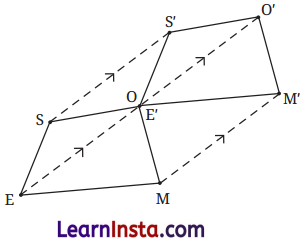
Verify that your cutout exactly matches S’O’M’E’.
(i) Prove the exact match of SOME with S’O’M’E’ using four parallelograms.
(ii) Follow the described procedure along each diagonal of the starting coloured 4-gon in both directions to get 4 new 4-gons. Using these 4 copies, repeat the procedure 4 more times to place 4 new copies, resulting in a 3 by 3 grid of 9 copies exactly like the 9 coloured copies in Figure. These 9 copies meet each other only at vertices and once again the blank spaces among them also form 4-gons congruent to SOME!
Solution:
(i) A pure slide is called a translation. When any shape slides along a straight line:
- Every corner moves in the exact same direction (parallel to line EO).
- Every comer travels the exact same distance (equal to the length of line EO).
| Parallelogram | Why it is a Parallelogram | What it Proves |
| ESS’E’ | EE’ and SS’ are parallel and equal in length (both equal to shift EO). | Opposite side ES = E’S’ and ES || E’S’ |
| SOO’S’ | SS’ and OO’ are parallel and equal in length (both equal to shift EO). | Opposite side SO = S’O’ and SO || S’O’ |
| OMM’O’ | OO’ and MM’ are parallel and equal in length (both equal to shift EO). | Opposite side OM = O’M’ and OM || O’M’ |
| MEE’M’ | MM’ and EE”are parallel and equal in length (both equal to shift EO). | Opposite side ME = M’E’ and ME || M’E’ |
Thus, all four sides of S’O’M’E’ are identical in length and parallel to the sides of SOME. Because side lengths and all corner angles are strictly preserved, the shifted copy matches the original shape perfectly!
(ii) Translating the 4-gon along the diagonal vector EO shifts every vertex by the same displacement vector, preserving side lengths and internal angles identically. Connecting corresponding vertices creates four parallelograms, confirming that the copy is congruent and correctly oriented.
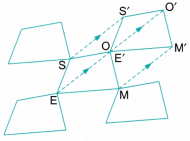
Propagating translations in the same way along both diagonals generates an unbroken 2D periodic lattice of 4-gons.
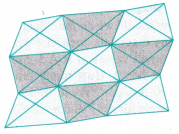
Question 19.
Is there a 4-gon with given side lengths?
(i) Recall the following fact about triangles and check it by construction. For given positive numbers a, b, c, is there a triangle whose sides have these lengths? The answer is ‘Yes’ exactly when the sum of any two numbers is greater than the third. If we arrange the numbers in increasing order (suppose a < b < c), then this amounts to requiring a + b > c. (Hint: Start by drawing a segment of length c.)
(ii) Suppose a 4-gon has 2, 5, 11 as three side lengths. Can the length of the fourth side be 100? Can it be 10? Can it be 1 ? What are the possible lengths of the fourth side?
(iii) For given positive numbers a, b, c, d, how will you decide if there is a 4-gon whose sides have these lengths?
Solution:
(i) Consider three sets of numbers: 2, 3, 6; 1, 2, 3; and 4, 5, 6 for construction of a triangle.
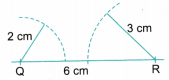
Not possible because 2 + 3 < 6 im-62 Not possible because 1 + 2 = 3 im-63 Possible because 4 + 5 > 6
Thus, for a triangle, a + b > c.
(ii) In a 4-gon with sides 2, 5, 11 and unknown side x, the longest side must be strictly less than the sum of the remaining three sides.
x < 2 + 5 + 11 = 18 and 11 < 2 + 5 ⇒ x > 4
Thus, 4 < x < 18. Can it be 100? No(100 > 18).
- Can it be 10? Yes(4 < 10 < 18).
- Can it be 1? No(1 < 4).
(iii) Four positive side lengths a, b, c, d form a quadrilateral if and only if each side is strictly less than the sum of the other three.
max(a, b, c, d) < \(\frac{a+b+c+d}{2}\)
Question 20.
Counting dlagoiials of a polygon.
(i) How should we define a diagonal of an n-gon? How many diagonals does an n-gon have? Make a table for small values of n. A 3-gon has no diagonals. A 4-gon has 2. How many diagonals does a 5-gon have? A 6-gon? Try to find a pattern and guess the answers for n 7 and n = 8, Check your guesses by systematic counting.
Solution:
Table:
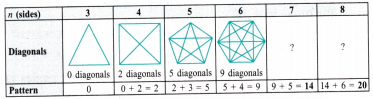
(ii) Can you guess a formula for the number of diagonals? How many diagonals get added when we increase the number of sides by 1? Can you now justify why the formula you guessed is true for all n?
Solution:
Formula: Each of the n vertices connects to (n – 3) non-adjacent vertices, and each diagonal is shared between two endpoints. So, the total number of diagonals a w-gon can have:
Diagonals = \(\frac{n(n-3)}{2}\)
When we increase the number of vertices from n to (n + 1), the number of added diagonals is (n – 1).
Justification: For n = 3,
No. of diagonals = \(\frac{3(3-3)}{2}\) = 0
For n = 6, No. of diagonals = \(\frac{6(6-3)}{2}\) = 9 and so on.
Question 21.
Sum of angles of a polygon. What is the sum of angles of a (planar non-self-intersecting) n-gon? We know that the answer is 180° for n = 3 and 360° for n = 4. Find the next few values. Then find a formula in terms of n and prove it.
Solution:
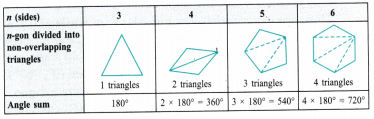
From the table, we observe that:
- Triangulate from any single vertex into n – 2 non-overlapping triangles.
- Each time a side is added to a polygon, the interior angle sum increases by exactly 180°.
- Total interior angle sum = (n – 2) × 180°
Proof by Triangulation
The most elegant way to prove this formula for any non-self-intersecting polygon is through triangulation from a single vertex.
- Choose any single vertex of the w-gon.
- Draw all possible diagonals from this chosen vertex to all other non-adjacent vertices.
- Since a vertex cannot draw a diagonal to itself or its two immediate neighbours, you can draw exactly (n – 3) diagonals.
- These (n – 3) diagonals slice the entire polygon cleanly into (n – 2) distinct triangles.
- Because the polygon is non-self-intersecting, the sum of the interior angles of all these sub-triangles combines perfectly to equal the total sum of the interior angles of the parent polygon.
Since the angle sum of any single triangle is strictly 180°, the total interior sum for the w-gon is:
Total Sum = (Number of Triangles) × 180° = (n – 2) × 180°
Question 22
Multiple converses to a theorem.
Let us see how multiple statements can be considered converses to the Midpoint Theorem and how Theorem 7 is one of them.
To formulate a converse, we should express the original statement in “If… then… “ form. For a complex statement, there may be multiple ways to do that. The Midpoint Theorem starts with AABC and points P and Q on sides AB and AC respectively.
The theorem has two assumptions and two conclusions, which we have named for further discussion.
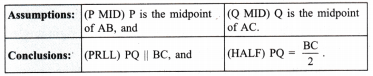
Let us use these four named conditions to discuss various possible statements.
(i) A natural converse of the Midpoint Theorem would be: “If (PRLL) and (HALF) are true, then (P MID) and (Q MID) are true.” Write out this statement fully. Experiment and see that it seems to be true! Prove the statement. (Hint: Try to run a proof of the Midpoint Theorem backwards.)
(ii) To see Theorem 7 as a converse of the Midpoint Theorem, we first write the Midpoint Theorem as follows: “Suppose P is the midpoint of side AB of AABC and Q is a point on side AC. If Q is the midpoint of AC then PQ || BC.” (Also PQ = \(\frac{\mathrm{BC}}{2}\) but let us set that aside for now.) Write the converse of the second sentence in quotes by keeping the first sentence the same. Verify that Theorem 7 is what you get! (And PQ = \(\frac{\mathrm{BC}}{2}\) also follows.) Now write
Theorem 7 in terms of the four named conditions.
(iii) The discussion so far suggests that it is reasonable to take two of the four listed statements as assumptions and ask if the other two are true. Verify that only one such combination remains to be examined. “If (P MID) and (HALF) are true, then can we conclude (Q MID) and/or (PRLL)?” Write this out in words. This is a precise version of question (1) stated before Theorem 7. Can you answer it?
In the text, why did we focus only on Theorem 7 among the multiple possibilities? Because Theorem 7 turns out to be particularly useful. It is still important to pursue various avenues while exploring a subject: often it is only after examining multiple possibilities that we can judge what is most valuable:
Solution:
(i) Full statement: “If in ΔABC, a line segment PQ with P on AB and Q on AC is parallel to BC
and PQ = \(\frac{1}{2}\) BC, then P is the midpoint of AB, and Q is the midpoint of AC.”
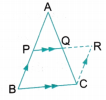
Proof: Construct CR || AB meeting PQ extended at R.
Then BCRP is a parallelogram.
Since PQ = \(\frac{1}{2}\) BC = \(\frac{1}{2}\) PR, Q is the midpoint of PR.
In ΔAPQ and ΔCRQ,
∠AQP = ∠CQR (Vertically opposite angles)
PQ = QR (proved above)
∠PAQ = ∠RCQ (Alternate interior angles)
By the AAS Congruence Criterion, ΔAPQ = ΔCRQ
⇒ AP = CR = PB and AQ = QC.
(ii) “Suppose P is the midpoint of side AB of ΔABC and Q is a point on side AC. If PQ || BC, then Q is the midpoint of AC.”
This matches Theorem 7 statement.
(iii) Remaining condition: “If (PMID) and (HALF) hold, must (PRLL) and (QMID) follow?”
No. With centre P and radius \(\frac{1}{2}\) BC, a circle can intersect line AC in two points: one is the midpoint Q (where PQ || BC), but another point Q’ can exist where the segment has length \(\frac{1}{2}\) BC without being parallel to BC.
Because two different configurations are possible, the conditions are insufficient to uniquely conclude (Q MID) or (PRLL).
Question 23.
Validity of tiling methods. Show using reasoning that each of the three tiling methods we saw produces a tiling of the plane using the given 4-gon. You have to prove that when we place new copies using any of the three procedures, the entire plane is covered with no gaps and no overlaps. First, think carefully about what it means to prove this. Then find a proof for each procedure.
Solution:
At each grid junction, the internal angles of the four quadrilateral copies meet in cyclic order (∠1 + ∠2 + ∠3 + ∠4 = 360°). Because their sum forms a complete angular turn of 360° and adjacent side lengths match by construction (180° rotation or displacement), the shapes fit without overlaps or gaps.
What Does It Mean to Prove a Tiling?
To prove that tiles cover the plane without gaps or overlaps, we must show:
(i) Edges match: Meeting edges have the exact same length.
(ii) Vertices add up: The angles meeting at every vertex sum to 360°.
(iii) Edges stay straight: Adjacent angles along a seam form straight lines (180°), so tiles never bump into each other.
Proofs for the Three Methods
Let the angles of any quadrilateral be ∠A, ∠B, ∠C, ∠D, where: ∠A + ∠B + ∠C + ∠D = 360°
(i) Rotating 180° (Around midpoints)
- Edge match: A 180° turn about the midpoint of any side brings that side onto itself. The two copies share that side perfectly.
- Straight lines: A 180° turn keeps lines straight through the midpoint, preventing tiles from overlapping.
- At every vertex: As you keep rotating around midpoints, all four angles (∠A, ∠B, ∠C, ∠D) meet at every junction. Since they sum to 360°, they fill the space with no gaps.
(ii) Grouping into a Hexagon
- Rotate one quadrilateral by 180° around one side to form a 6-sided shape (hexagon).
- Because of the 180° rotation, the opposite sides of this hexagon are equal and parallel.
- Any hexagon with opposite sides equal and parallel fits together purely by sliding (translation), like bricks on a wall, leaving zero gaps.
(iii) Combining 4 Tiles into a Parallelogram
- Join four copies around a central point such that each copy brings a different angle (∠A, ∠B, ∠C, ∠D).
- Because ∠A + ∠B + ∠C + ∠D = 360°, they close up neatly with no space left at the centre.
- The outer border of these 4 joined tiles forms a large parallelogram.
- Any parallelogram tiles the whole plane easily by regular grid shifts (translations).
Question 24.
What fraction of the square is shaded?
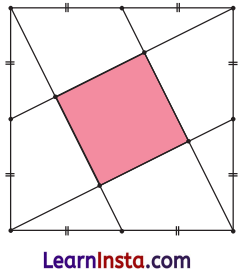
Solution:
Consider the four right-angled triangles outside the central shaded square.
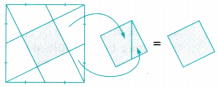
Looking closely at the segments along the edges of the central square:
By the Midpoint Theorem, each comer right triangle is divided by the intersecting line into a small right-angled triangle and a trapezium.
The small triangle at the comer can be cut off and moved into the indentation next to the central square. Reassembling these 4 outer trapezium and 4 small comer triangles creates 4 congruent squares, each having the exact same dimensions as the central shaded square. Since the entire original large square is composed of: Area of large square
= 1 (central shaded square) + 4 (congruent outer squares)
= 5 (identical squares)
Therefore, each small square occupies one-fifth of the whole square, i.e., Fraction of the shaded part: \(\frac{1}{5}\)