Students often refer to Ganita Manjari Class 9 Solutions and Part 2 Class 9 Maths Chapter 9 Propositions and their Converses Solutions to verify their answers.
Propositions and their Converses Class 9 Solutions
Class 9 Ganita Manjari Chapter 9 Solutions
Class 9 Maths Ganita Manjari Chapter 9 Solutions Propositions and their Converses
Think and Reflect (NCERT Textbook Page No. 1)
We have proved the first statement in an earlier grade. Is the second statement true? Can you prove it?
(Hint: Draw the altitude from the vertex containing the third angle.)
Solution:
Statement 2: If two angles of a triangle are equal, then the sides opposite the equal angles have equal lengths.
The statement is true.
Proof: In the adjoining A figure, ABC.
Let ∠B = ∠C
Construction: Draw an altitude from vertex A to side BC. Let it meet BC at D.
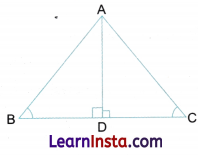
In triangles ADB and ADC,
∠ADB = ∠ADC = 90° (Altitude from A)
∠ABD = ∠ACD (Given)
And AD = AD (Common)
Therefore, by AAS congruence.
∆ADB ≅ ∆ADC
Hence. AB = AC (By CPCT)
Therefore, the sides opposite the equal angles are equal.
Hence, statement 2 is true.
Example 2 (Page No. 2)
- Proposition P: If a number is a multiple of 6, then it is a multiple of 3.
- Converse Q: If a number is a multiple of 3, then it is a multiple of 6.
Proposition P is true. Justify why this is so.
Does this now mean that all multiples of 3 are also multiples of 6? This corresponds to the converse statement Q. Determine if it is true and if not, give a counterexample.
Solution:
Proposition P is true.
A multiple of 6 can be written as: 6n = 3(2n)
Therefore, every multiple of 6 is also a multiple of 3. Converse Q is false.
Counterexample: Take the number 9.
9 is a multiple of 3, but it is not a multiple of 6.
Therefore, the converse is false.
Example 4 (Page No. 3)
- Proposition P: If two triangles have the same area, then they are congruent.
- Converse Q: If two triangles are congruent, then they have the same area.
Determine if these statements are true or not. Justify the true statements and give a counterexample for each false statement.
Solution:
Proposition P is false.
Counterexample: Consider two right-angled triangles as shown.
For ∆ABC, BC = 6 cm,
AB = 4 cm
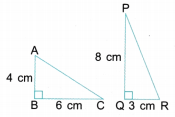
Area of ∆ABC = \(\frac{1}{2}\) × 6 × 4
= 12 cm2
For ∆PQR, QR = 3 cm,
PQ = 8 cm
Area of ∆PQR = \(\frac{1}{2}\) × 3 × 8
= 12 cm2
Both triangles have the same area, but their corresponding side lengths are different. Hence, they are not congruent. Therefore, the proposition is false.
Converse Q is true.
Congruent triangles have the same shape and size. Therefore, their corresponding bases and heights are equal. Since the area of a triangle depends on its base and corresponding height.
Area of triangle = \(\frac{1}{2}\) × base × height
The areas of the two congruent triangles are equal. Hence, the converse is true.

Think and Reflect (NCERT Textbook Page No. 3)
It can also happen that both the proposition and converse are false! Can you give an example?
Solution:
Yes, both the proposition P and its converse Q can be false.
For example:
Proposition P: If a quadrilateral is a rectangle, then it is a rhombus.
Proposition P is false.
Counterexample: A rectangle of dimensions 5 cm × 3 cm has all angles equal to 900, but all its sides are not equal.
Therefore, it is not a rhombus. Hence, proposition P is false.
Converse Q: If a quadrilateral is a rhombus, then it is a rectangle.
Converse Q is false.
Counterexample: Consider a rhombus AHCD with all sides equal to 4 cm and angles:
∠A = 60°, ∠B = 120°, ∠C = 60°, ∠D = 120°.
It is a rhombus because all four sides are equal. However, it is not a rectangle because not all its angles are right angles.
Therefore, the converse Q is false.
Hence, both the proposition P and its converse Q are false.
(Example may vary)
Think and Reflect (NCERT Textbook Page No. 5)
Identify real-life examples in which a proposition is true but not the converse. Give nice counterexamples!
The following are some real-life examples of propositions and their converses in which the proposition is true but the converse is false.
(a) Proposition P: If a person is in New Delhi, then the person is in India.
Status: True
Justification: New Delhi is a city located within the boundaries of India. Therefore, a person in New Delhi will always be in India.
Converse Q: If a person is in India, then the person is in New Delhi.
Status: False
Counterexample: A person in Mumbai is in India, but the person is not in New Delhi. Therefore, the converse Q is false.
(b) Proposition P: If an animal is a tiger, then it is a mammal.
Status: True
Justification: A tiger belongs to the class of mammals. Therefore, every tiger is a mammal.
Converse Q: If an animal is a mammal, then it is a tiger.
Status: False
Counterexample: A cow is a mammal, but it is not a tiger. Therefore, the converse Q is false.
(Examples may vary)
Question 2.
Give more examples from geometry as well as number theory in which a proposition is true but not its converse. Give appropriate counterexamples.
Solution:
Geometry:
(a) Proposition P: If a quadrilateral is a square, then it is cyclic.
Status: True
Justification: The vertices of every square lie on a circle. Therefore, every square is a cyclic quadrilateral. Converse Q: If a quadrilateral is cyclic, then it is a square.
Status: False
Counterexample: A rectangle is a cyclic quadrilateral, but it is not a square because all its sides are not equal. Therefore, the converse Q is false.
(b) Proposition P: If a triangle has sides 3 cm, 4 cm and 5 cm, then it is a right-angled triangle.
Status: True
Justification: By Baudhayna-Pythagoras theorem
32 + 42 = 52
Therefore, by the converse of the Baudhayna- Pythagoras theorem, the triangle is right-angled. Converse Q: If a triangle is right-angled, then its sides are 3 cm, 4 cm and 5 cm.
Status: False
Counterexample: A triangle with sides 5 cm, 12 cm and 13 cm is right-angled, but its sides are not 3 cm, 4 cm and 5 cm.
Therefore, the converse Q is false.
Number Theory:
(a) Proposition P: If a number greater than 2 is prime, then it is odd.
Status: True
Justification: 2 is the only even prime number. Therefore, every prime number greater than 2 is odd. Converse Q: If a number greater than 2 is odd, then it is prime.
Status: False
Counterexample: 9 is an odd number greater than 2, but it is not prime because 9 = 3 × 3
Therefore, the converse Q is false.
(Examples may vary)
Ex 9.1 Class 9 Ganita Manjari Solutions – Ganita Manjari Class 9 Exercise 9.1 Solutions
Exercise 9.1 Class 9 Ganita Manjari Solutions – Ganita Manjari Class 9 Ex 9.1 Solutions
Frame the converse for each of the propositions in questions 1-12. Then, determine if each of the two statements is true or not. Justify the true statements and give a counterexample for each false statement.
Question 1.
If two lines are parallel, then the corresponding angles formed by a transversal are equal.
Solution:
Proposition (P): If two lines are parallel, then the corresponding angles formed by a transversal are equal. Status: True
Justification: When a transversal intersects two parallel lines, the lines have the same inclination relative to the transversal, making the corresponding angles identical in measure. This is the Corresponding Angles Property. Converse Q: If the corresponding angles formed by a transversal with two lines are equal, then the two lines are parallel.
Status: True
Justification: This is the Converse of the Corresponding Angles Property, if a transversal cuts two lines such that a pair of corresponding angles is equal, it guarantees that the two lines run in the same direction and will never intersect, proving they are parallel.
Hence, the converse Q is also true.
Question 2.
If a quadrilateral is a square, then all its angles are equal.
Solution:
Proposition (P): If a quadrilateral is a square, then all its angles are equal.
Status: True
Justification: By definition, a square is a regular quadrilateral, meaning it is both equilateral (all sides are equal) and equiangular (all angles are equal). Every angle in a square measures exactly 90 degrees.
Converse (Q): If all the angles of a quadrilateral are equal, then it is a square.
Status: False 4
Counterexample: A rectangle with side lengths of 4 cm and 6 cm is a quadrilateral with four equal angles (all 90°), but it is not a square because its adjacent sides are not equal.
Question 3.
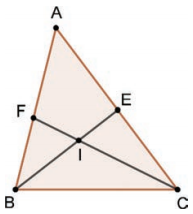
Given any AABC, let us bisect the angles A at B and C. The bisectors meet at the incentre I of the triangle. E
Now extend the bisectors beyond I till they meet the opposite sides at E and F respectively, as shown.
Proposition: If AB = AC, then IE = IF.
Solution:
Proposition: If AB = AC, then IE = IF.
Status: True
Justification: If AB = AC, then AABC is an isosceles triangle.
Therefore, ∠B = ∠C
In ABIC, ∠IBC = ∠ICB
(Since BE and CF are angle bisectors)
Therefore, BI = IC (Sides opposite to equal angles)
Now, consider ∆FIB and ∆EIC.
∠FBI = ∠ECI (Halves of ∠B and ∠C)
BI = IC
∠BIF = ∠CIE (Vertically opposite angles)
Therefore, AFIB = AEIC (By ASA congruence criterion)
Hence, IE = IF (By CPCT)
Converse (Q): If IE = IF, then AB = AC.
Status: False
Counterexample: Let ABC be a triangle and I be its incentre. BE and CF are angle bisectors of ZB and ZC respectively. Let the radii IP and IQ meet AB and AC at P and Q, respectively.
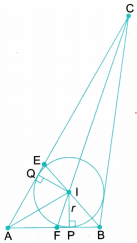
Consider ∆AIP and ∆AIQ.
We have: AI = AI
(Common side)
IP= IQ
(Radii of the same circle)
∠API = ∠AQI = 90°
∴ ∆AIP ≅ ∆AIQ
Hence, ∠AIP = ∠AIQ
Now, ∠AIF = ∠AIP – ∠PIF
and ∠AIE = ∠AIQ + ∠QIE
Since ∠AIP = ∠AIQ, subtracting ∠PIF from one angle and adding ∠QIE to the other gives:
∠AIF < ∠AIE
Adding \(\frac{1}{2}\)∠A to both sides:
∠AIF + \(\frac{1}{2}\)∠A < ∠AIE + \(\frac{1}{2}\)∠A
∴ ∠BFI < ∠CEI (Exterior angle property) Taking their supplements: 180°- ∠BFI > 180°- ∠CEI
In ABIFand ACIE,
∠BIF + ∠IBF = 180° – ∠BFI and
∠CIE + ∠ICE = 180° – ∠CEI
Hence,
∠BIF + ∠IBF > ∠CIE + ∠ICE
Since, ∠BIF = ∠CIE (Vertically opposite angles)
We get ∠IBF > ∠ICE
But BI and Cl are angle bisectors, so
∠IBF = \(\frac{1}{2}\)∠B
and ∠ICE = \(\frac{1}{2}\)∠C
\(\frac{1}{2}\)∠B > \(\frac{1}{2}\)∠C
which gives ∠B > ∠C
Hence, AC > AB
∴ AB ≠ AC
Question 4.
If x = y, then a + x = a + y, where x, y and a are any three numbers.
This proposition and its converse are routinely used while solving equations.
Solution:
Proposition: If x = y, then a + x = a + y, where x, y and a are any three numbers.
Status: True Justification:
Given: x = y
Adding a to both sides, we get a + x = a + y
Hence, the proposition is true.
Converse: If a + x = a + y, then x = y, where x, y and a are any three numbers.
Status: True Justification:
Given, a + x = a + y Subtracting a from both sides, x = y
Hence, the converse is true.
Question 5.
If a and b are perfect squares, then ab is a perfect square.
Solution:
Proposition: If a and b are perfect squares, then ab is a perfect square.
Status: True
Justification: Given, a and b are perfect squares.
Let a = m2 and b = n2, where m and n are integers.
Then, ab = m2 x n2
ab = (mn)2
Since mn is an integer, (mn)2 is a perfect square. Therefore, ab is a perfect square.
Hence, the proposition is true.
Converse: If ab is a perfect square, then a and b are perfect squares.
Status: False Counterexample:
Take a = 2, b = 18
Then, ab = 2 × 18 = 36 .
36 is a perfect square but 2 and 18 are not perfect squares. Therefore, the converse is false.
Question 6.
If x = y, then x2 = y2.
Solution:
Proposition: If x = y, then x2 = y2.
Status: True
Justification: Given x = y.
Squaring both sides, we get:
x2 = y2
Hence, the proposition is true.
Converse: If x2 = y2, then x = y.
Status: False
Counterexample: Let x = 2, y = – 2.
Then, x2 = 22 = 4
and y2 = (-2)2 = 4
Therefore, x2 = y2 but,
x = y
Hence, the converse is false.
Question 7.
If x = y, then x3 = y3.
Solution:
Proposition: If x = y, then x3 = y3.
Status: True
Justification: Given x = y.
Cubing both sides, we get:
x3 = y3
Hence, the proposition is true.
Converse: If x3 = y3, then x = y.
Status: True
Justification: Given x3 = y3. Taking cube root on both sides,
x = y
Hence, the converse is true.
Question 8.
If n is divisible by 24, then it is divisible by both 4 and 6.
Solution:
Proposition: If n is divisible by 24, then it is divisible by both 4 and 6.
Status: True
Justification: Given that n is divisible by 24.
So, n = 24k where A: is a positive integer.
Since, 24 = 4 × 6 We can write: n = 4(6k)
Therefore, n is divisible by 4.
Also, n = 6(4k)
Therefore, n is divisible by 6.
Hence, the proposition is true.
Converse: If n is divisible by both 4 and 6, then it is divisible by 24.
Status: False
Counter example: Let n = 12.
12 is divisible by both 4 and 6.
But, 12 ÷ 24 is not a whole number.
Therefore, 12 is not divisible by 24. Hence, the converse is false.
Question 9.
If n is divisible by 60, then it is divisible by both 5 and 12.
Solution:
Proposition: If n is divisible by 60, then it is divisible by both 5 and 12.
Status: True
Justification: Given that n is divisible by 60.
So, n = 60k, where A is a positive integer.
Since, 60 = 5 × 12
We can write: n = 5(12k)
Therefore, n is divisible by 5.
Also, n = 12(5k)
Therefore, n is divisible by 12.
Hence, the proposition is true.
Converse: If n is divisible by both 5 and 12, then it is divisible by 60.
Status: True
Justification: Since 60 = 5 × 12, and 5 and 12 have no common factor other than 1, a number divisible by both 5 and 12 will be divisible by their product 60.
Hence, the converse is true.
Question 10.
If n is the square of a prime number, then it has exactly 3 factors.
Solution:
Proposition: If n is the square of a prime number, then it has exactly 3 factors.
Status: True
Justification: Given that n is the square of a prime number. Let p be a prime number.
Then, n = p2
The factors of p2 are: 1, p, p2
Since p has no other factors except 1 and itself, p22 has exactly three factors.
Hence, the proposition is true.
Converse: If n has exactly 3 factors, then n is the square of a prime number.
Status: True
Justification: Given that n has exactly 3 factors.
Let the factors of n be 1, p and n, because every number has 1 and itself as factors.
Since n has exactly three factors, there is only one factor between 1 and n. Let this factor be p.
Now, p cannot be composite; otherwise, it would have factors other than 1 and itself, giving more than three factors of n. Therefore, p is a prime number.
Since p divides n, let n = p × k.
But p is already the only factor between 1 and n. Hence, k=p.
Therefore, n = p2
Hence, n is the square of a prime number.
Therefore, the converse is true.
Question 11.
If n is a product of two unequal prime numbers, then it has exactly 4 divisors.
Solution:
Proposition: If n is a product of two unequal prime numbers, then it has exactly 4 divisors.
Status: True
Justification: Given that n is a product of two unequal prime numbers.
Let n = p × q, where p and q are two different prime numbers.
The divisors of n are: 1, p, q, pq
Therefore, n has exactly 4 divisors.
Hence, the proposition is true.
Converse: If n has exactly 4 divisors, then n is a product of two unequal prime numbers.
Status: False
Counterexample: Let n = 8.
The factors of 8 are 1, 2, 4 and 8.
Thus, it has exactly 4 divisors.
But, 8 = 2 × 2 × 2
It is not a product of two unequal prime numbers.
Hence, the converse is false.
Question 12.
If n and n + 3 have no factors in common, then n is not a multiple of 3.
Solution:
Proposition: If n and n + 3 have no factors in common, then n is not a multiple of 3.
Status: True
Justification: Given that n and n + 3 have no factors in common.
Assume that n is a multiple of 3.
Then, n = 3k, where k is an integer.
Therefore, n + 3 = 3k + 3 = 3(k + 1)
So, both n and n + 3 are divisible by 3.
Hence, they have a common factor 3.
This contradicts the given condition that they have no factors in common.
Therefore, n is not a multiple of 3.
Hence, the proposition is true.
Converse: If n is not a multiple of 3, then n and n + 3 have no factors in common.
Status: True
Justification: Given that n is not a multiple of 3.
Let d be a common factor of n and n + 3.
Then, d divides n and d divides (n + 3).
Therefore, d must also divide their difference:
(n + 3) – n = 3 So, d divides 3
The factors of 3 are only 1 and 3.
Hence, the common factor d can only be 1 or 3.
But n is not a multiple of 3, so 3 cannot be a factor of n. Therefore, the only common factor of n and n + 3 is 1. Hence, n and n + 3 have no factors in common. Therefore, the converse is true.
Question 13.
There are no known ‘neat’ expressions that generate only primes! Find counterexamples to the following claims.
(i) All numbers of the form 4n2 + 1 are prime.
(ii) All numbers of the form n2 + n + 11 are prime.
(iii) All numbers of the form 4n + 3 are prime.
Solution:
(i) Take n = 4. Then,
4n2 + 1
= 4(4)2 + 1
= 4(16) + 1
= 65
65 is not a prime because,
65 = 5 × 13
Therefore, the claim is false.
(ii) Take n = 11. Then,
n2 + n + 11
= 112 + 11 + 11
= 121 + 22
= 143
143 is not a prime because,
143 = 11 × 13
Therefore, the claim is false.
(iii) Take n = 4. Then,
44 + 3 = 256 + 3 = 259
259 is not a prime because,
259 = 7 × 37
Therefore, the claim is false.
Question 14.
Find counterexamples to the following statements.
(i) If n is a prime number, then 2n – 1 is a prime number.
(ii) If n is an even number, then 2n + 1 is a prime number.
Solution:
(i) Taken = 11.
11 is a prime number.
Now, 211 – 1 = 2048 – 1 = 2047
But, 2047 = 23 × 89
Therefore, 2047 is not prime.
Hence, the statement is false.
(ii) Take n = 6.
6 is an even number.
Now, 26 + 1 = 64 + 1 = 65
But, 65 = 5 × 13
Therefore, 65 is not prime.
Hence, the statement is false.
Question 15.
Consider the statement: “If a number is divisible by 8, then it is divisible by both 2 and 4”.
(i) Justify the statement.
(ii) Recall the divisibility shortcuts that we have studied for different numbers. To check whether a given number is divisible by 8, is it enough to check whether it is divisible by 2 and 4? Why or why not?
Solution:
(i) Let the number be n. If n is divisible by 8, then n = 8k,
where & is an integer.
Since, 8 = 2 × 4
We can write,
n = (2 × 4)k
n = 2(4k)
and n = 4(2k)
Therefore, n is divisible by both 2 and 4.
Hence, the statement is true.
(ii) No, it is not enough to check whether a number is divisible by 2 and 4. A number can be divisible by both 2 and 4 but may not be divisible by 8.
12 is divisible by 2 and 4.
But 12 ÷ 8 does not give a whole number.
Therefore, 12 is not divisible by 8.
Hence, checking divisibility by 2 and 4 is not sufficient.
Question 16.
Recall that a shortcut to check whether a given number is divisible by 3 is to add the digits of the number and check if the sum is a multiple of 3. Express the relationship between ‘number is divisible by 3’ and ‘sum of the digits is a multiple of 3’ using ‘If-then’ sentences.
Solution:
Proposition: If the sum of the digits of a number is a multiple of 3, then the number is divisible by 3. Converse: If a number is divisible by 3, then the sum of its digits is a multiple of 3.
Both the statement and its converse are true.
Question 17.
We have identified different types of quadrilaterals— squares, rectangles, parallelograms, rhombi, kites and
a category of quadrilaterals that have equal-length opposite sides). Suppose we have identified a category of quadrilaterals called Q, and we have to construct a quadrilateral of this type. For this, we are to use two thin sticks, put them together as diagonals so that the quadrilateral obtained by joining their endpoints is of type Q (see the Figure).
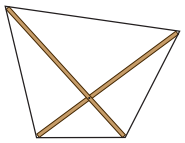
(i) Suppose Q satisfies the following property.
If a quadrilateral is of type Q, then it has equal-length diagonals.
(a) Should the two sticks be of equal length? Why or why not?
(b) Will it matter how the two sticks are put together?
Solution:
(a) Yes, the two sticks should be of equal length. The sticks represent the diagonals of the quadrilateral. Since every quadrilateral of type Q has equal- length diagonals, the two sticks must be equal.
(b) Yes, it will matter how the two sticks are put together. Equal-length diagonals can form different quadrilaterals depending on their position and the angle at which they intersect. Therefore, the arrangement of the sticks is important.
(ii) Instead of the property mentioned above, suppose Q satisfies the following property.
If a quadrilateral has equal diagonals, then it is of type Q.
What will be your answers to (a) and (b) now?
Solution:
(a) Yes, the two sticks should be of equal length. Since a quadrilateral with equal diagonals is of type Q, the diagonals must be equal. Therefore, the two sticks representing the diagonals should have the same length.
(b) No, it will not matter how the two sticks are put together. According to the given property, any quadrilateral having equal diagonals will be of type Q. Therefore, as long as the two sticks are of equal length, their arrangement will not affect the type of quadrilateral formed.