Each of our Ganita Prakash Class 7 Worksheet and Class 7 Maths Chapter 5 Parallel and Intersecting Lines Worksheet with Answers Pdf focuses on conceptual clarity.
Class 7 Maths Chapter 5 Parallel and Intersecting Lines Worksheet with Answers Pdf
Parallel and Intersecting Lines Class 7 Maths Worksheet
Class 7 Maths Chapter 5 Worksheet with Answers – Class 7 Parallel and Intersecting Lines Worksheet
Tick (✓) for the correct option
Question 1.
Vertically opposite angle of 45° is equal to:
(a) 35°
(b) 135°
(c) 45°
(d) None of these
Question 2.
Sum of vertically opposite angles is always:
(a) equal to 180°
(b) less than 360°
(c) equal to 360°
(d) None of these
Question 3.
Two lines are perpendicular if the vertically opposite angles between lines is:
(a) 450
(b) 135°
(c) 90°
(d) None of these
Question 4.
If two lines are parallel then:
(а) lines are not intersecting
(b) lines never meet when extended to any side
(c) angle between them is 0°
(d) All are true.
Question 5.
If a transversal intersects two lines, then corresponding angles:
(a) may be equal
(b) are never equal
(c) are always equal
(d) None of these

Question 6.
If a transversal intersects two parallel lines, then corresponding angles:
(a) are always unequal
(b) are always equal
(c) may be equal
(d) None of these
Question 7.
What is the measure of each of corresponding angles which forms a supplementary angle pair?
(a) 360°
(b) 90°
(c) 270°
(d) 180°
Question 8.
How many pairs of corresponding angles are formed by a transversal of two parallel lines?
(a) 2
(b) 4
(c) 6
(d) 8
Question 9.
What is the value of x in the given figure.

(a) 127
(b) 53
(c) 63
(d) None of these
Question 10.
What is the value of x in the given figure.
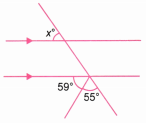
(a) 55
(b) 59
(c) 66
(d) None of these
Question 11.
In the following figure, which pair of angles are not corresponding angles?

(a) ∠1, ∠5
(b) ∠2, ∠6
(c) ∠3, ∠7
(d) ∠3, ∠5
Question 12.
If l is parallel to m, then find the value of x.
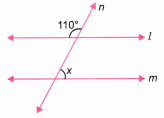
(a) 70°
(b) 80°
(c) 110°
(d) 90°
Question 13.
In parallelogram ABCD, AB is parallel to DC, and AD is parallel to BC. AB is produced to E, such that ZCBE = 55°. BC is produced to F, such that BCF is a straight line. The values of x, y and z, respectively, are

(a) 125°, 55°, 125°
(b) 125° , 125° , 55°
(c) 55°, 125°, 125°
(d) 55° , 125°, 125°
Assertion-Reason Questions
In questions 1 to 5, a statement of Assertion (A) is followed by a statement of Reason (R). Choose the correct option.
Question 1.
Assertion (A): If two lines intersect and form four equal angles, then each angle is 90°.
Reason (R) : Lines intersecting at right angles are called perpendicular lines.
(a) Both (A) and (R) are true, and (R) is the correct explanation of (A).
(b) Both (A) and (R) are true, but (R) is not the correct explanation of (A).
(c) (A) is true, but (R) is false.
(d) (A) is false, but (R) is true.
Question 2.
Assertion (A) : Vertically opposite angles are always equal when two lines intersect.
Reason (R) : This happens because adjacent angles in a straight line always add up to 90°.
(a) Both (A) and (R) are true, and (R) is the correct explanation of (A).
(b) Both (A) and (R) are true, but (R) is not the correct explanation of (A).
(c) (A) is true, but (R) is false.
(d) (A) is false, but (R) is true.
Question 3.
Assertion (A) : When a transversal intersects two parallel lines, corresponding angles are equal.
Reason (R) : Equal corresponding angles are a characteristic feature of parallel lines.
(a) Both (A) and (R) are true, and (R) is the correct explanation of (A).
(,b) Both (A) and (R) are true, but (R) is not the correct explanation of (A).
(c) (A) is true, but (R) is false.
(d) (A) is false, but (R) is true.
Question 4.
Assertion (A) : If ?3 = 50° and ?6 = 130°, the two lines cut by the transversal are parallel.
Reason (R) : Alternate interior angles must be supplementary for lines to be parallel.
(a) Both (A) and (R) are true, and (R) is the correct explanation of (A).
(b) Both (A) and (R) are true, but (R) is not the correct explanation of (A).
(c) (A) is true, but (R) is false.
(d) (A) is false, but (R) is true.
Question 5.
Assertion (A) : Two lines that do not intersect on a plane are always perpendicular.
Reason (R) : Parallel lines never meet, hence they form 90° angles with each other.
(a) Both (A) and (R) are true, and (R) is the correct explanation of (A).
(b) Both (A) and (R) are true, but (R) is not the correct explanation of (A).
(c) (A) is true, but (R) is false.
(d) (A) is false, but (R) is true.
Question 6.
Assertion (A): If a transversal cuts two parallel lines, then each pair of corresponding angles is equal.
Reason (R): A transversal intersects two parallel lines. If the measure of one of the angles is 50°, then the measure of its corresponding angle is 50°.
Choose the correct option as:
(a) Both (A) and (R) are true, and (R) is the correct explanation of (A).
(b) Both (A) and (R) are true, but (R) is not the correct explanation of (A).
(c) (A) is true, but (R) is false.
(d) (A) is false, but (R) is true.
Fill in the blanks
1. Sum of linear angles is equal to ___________________.
2. Vertically opposite angles are always equal and their difference is equal to ___________________
3. We can draw __________ lines perpendicular to a given line.
4. The intersecting edges of a cube are ___________ to each other.
5. We can draw __________ lines parallel to a given line.
6. The opposite sides of a black board are __________ to each other.
7. For the given figure, answer the following questions:
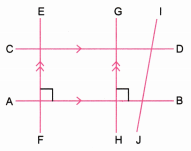
1. Lines AB and IJ are __________________ lines.
2. Lines CD and AB are _______________ lines.
3. Lines CD and EF are __________________ lines.
4. Lines EF and GH are _______________ lines.
5. Lines EF and IJ are __________________ lines.
6. Lines IJ and AB are ___________________ lines.
7. Lines GH and CD are __________ lines.
8. Two corresponding angles measure (9x + 10)° and 55°. The value of x is .
9. If two lines intersect at a point, then these lines may have transversals.
10. For non-parallel lines, if a transversal intersects them, then the corresponding angles formed are .
11. Consider the following diagram and answer the following questions:
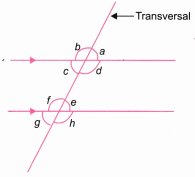
(а) ∠a and __________ are corresponding angles.
(b) ∠g and __________ are corresponding angles.
(c) ∠a and ∠d are __________ angles.
(d) ∠f and ∠h are __________ angles.
(e) ∠c and ∠g are __________ angles.
(f) Sum of angles ∠a, ∠f, ∠c and ∠h is equal to __________
(g) Sum of angles ∠a and ∠h is equal to __________.
12. In the following figure, the values of x, y and 2 are respectively __________, __________ and __________.

13. Look at the road intersections shown below.

The letters __________ and __________ represent corresponding angles.
14. If a __________ intersects two parallel lines, the alternate angles are equal.
15. Two angles are called a pair of __________ angles if their arms form two pairs of opposite rays.
16. The angle measurement between two perpendicular lines is __________.
17. If a transversal intersects a pair of lines in such a way that the sum of interior angles on the same side of the transversal is 180°, then the lines are __________.
Write (T) for true or (F) for false for the given statements
1 An angle of 67° can be made by using a protractor.
2. When two lines intersect at a point, we get only one pair of vertically opposite angles.
3. When two lines intersect at a point, we get four pairs of linear angles.
4. We cannot draw two lines perpendicular to a given line.
5. Perpendicular lines always intersect at a point.
6. There can be three lines parallel to a given line.
7. Two parallel lines may or may not meet when extended to both sides.
8. If corresponding angles are equal then the lines may be parallel.
9. Upper case letter ‘F’ has corresponding angles.
10. If corresponding angles are unequal then the lines are not parallel lines.
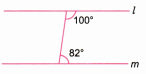
11. In the given figure, lines l and m are parallel lines.
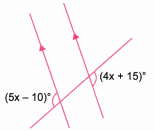
12. In the following figure, the value of x is equal to 25.
Match the Following
Question 1.
In the following figure, AB is parallel to CD. Match Column I with Column II.
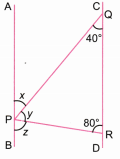
| Situation | Expression |
| (a) The value of x is | (i) 80° |
| (b) The value of y is | (ii) 40° |
| (c) The value of 2 is | (iii) 20° |
| (d) The value of x + y- z is | (iv) 60° |
Very Short Answer Type Questions
Question 1.
In the adjoining figure, AB is parallel to CD. Find the value of p.

Solution:
__________________________
__________________________
Short Answer Type Questions
Question 1.
Find the value of x from the following figure:

Solution:
__________________________
__________________________
Question 2.
Name some perpendicular lines you can spot in your classroom.
Solution:
__________________________
__________________________
Question 3.
Which pairs of lines appear to be perpendicular to each other in the given figure.

Solution:
__________________________
__________________________
Question 4.
Name some parallel lines you can spot in your classroom.
Solution:
__________________________
__________________________
Question 5.
Which pairs of lines appear to be parallel to each other in the given figure.

Solution:
__________________________
__________________________
Question 6.
Identify intersecting, perpendicular and parallel lines in the given figures.

Solution:
__________________________
__________________________
Question 7.
Draw some perpendicular lines to the lines given on the dot paper in the given figure.
Solution:

Question 8.
In the shapes given below, mark parallel lines using single arrow, double arrow etc. Also, mark the angle between perpendicular lines using a square symbol.
Solution:

Question 9.
Using your sense of how parallel lines look, draw parallel lines to the given line segments on this dot paper.
Solution:

Question 10.
Consider the following figures and find the value of x:

Solution:
__________________________
__________________________
Question 11.
The values of two equal corresponding angles are (7y – 12)° and (5y + 6)°. What is the value of y?
Solution:
__________________________
__________________________
Question 12.
AB and CD are parallel lines. Find the value of x in the figure given below:
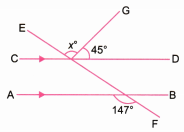
Solution:
__________________________
__________________________
Question 13.
In the given figure, identify:
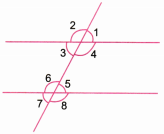
(i) The pairs of vertically opposite angles.
(ii) The pairs of corresponding angles.
Solution:
__________________________
__________________________
Question 14.
Draw a line parallel to given line Z and passing through given point P by using a ruler and a set square.
Solution:

Question 15.
Draw a line parallel to given line Z and passing through given point P by using paper folding method.
Solution:
Question 16.
In the given figures, find the value of x.

Solution:
__________________________
__________________________
Question 17.
In the given figure, lines l and m are intersected by the transversal t. If ∠1 = 67° and ∠7 = 58°, are lines l and m parallel to each other?

Solution:
__________________________
__________________________
Question 18.
On the diagram below, mark the following angles,

(i) A pair of vertically opposite angles with letter x.
(ii) A pair of corresponding angles with letter y.
(iii) A pair of alternate angles with letter z.
Solution:
__________________________
__________________________
Question 19.
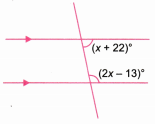
Find the value of x from the following figure.
Solution:
__________________________
__________________________
Question 20.
From the following figure, find the value of x.

Solution:
__________________________
__________________________
Question 21.
Find the value of z, using the following figure.

Solution:
__________________________
__________________________
Long Answer Type Questions
Question 1.
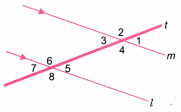
In the given figure, lines l and m are parallel to each other and intersected by the transversal t. If ∠8 is 143°, what are the measures of the other angles?
Solution:
__________________________
__________________________
Question 2.
In the given figures, find the value of x.

Solution:
__________________________
__________________________
Question 3.
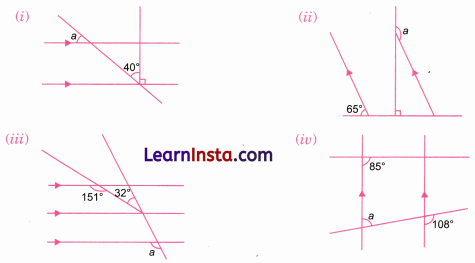
Find the angle represented by the letter a in the following figures.
Solution:
__________________________
__________________________
Question 4.
Find the values of x and y in the following figures.
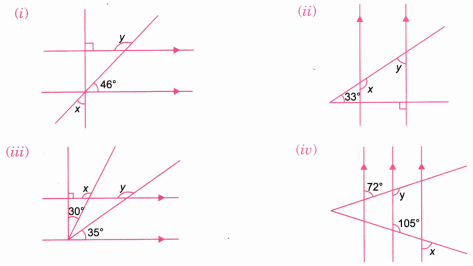
Solution:
__________________________
__________________________
Question 5.
What is the value of x in the given figure?
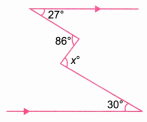
Solution:
__________________________
__________________________
Question 6.
Calculate the size of the missing angle x°. Justify your answer.

Solution:
__________________________
__________________________
Question 7.
Find the values of x and y from the following diagram.

Solution:
__________________________
__________________________
Case Based Questions
Consider the following figure and answer the given questions.

Question 1.
Which angle is the corresponding angle of angle c?
Solution:
__________________________
__________________________
Question 2.
Which angle is the alternate angle of angle f?
Solution:
__________________________
__________________________
Question 3.
Which angle is the vertically opposite angle of angle e?
Solution:
__________________________
__________________________
Question 4.
Which angle is the interior angle of angle e?
Solution:
__________________________
__________________________
Question 5.
Which angle is the corresponding angle of angle e?
Solution:
__________________________
__________________________
Question 6.
Which angle is the alternate angle of angle c?
Solution:
__________________________
__________________________
Question 7.
Which angle is the vertically opposite angle of angle h?
Solution:
__________________________
__________________________
Question 8.
Which angle is the interior angle of angle c?
Solution:
__________________________
__________________________
Crossword Puzzle
Complete the crossword puzzle using the given directions:
Directions:
Across
4. Interior angles formed by a transversal intersecting a pair of parallel lines are always equal to each other.
7. When two lines intersect each other at a point and the two pairs of angles formed without any common arm are called angles.
8. If two lines touch each other in such a way that there is a point in common then these lines are called lines.
Down
1. When two lines intersect and the angles formed are 90°, the lines are said to be perpendicular to each other.
2. Angles formed by a transversal intersecting a pair of parallel lines are always equal to each other.
3. When two lines never intersect on a plane, they are called __________ lines.
5. When a line intersects another pair of lines at distinct points, it is called a __________.
6. A pair of adjacent, supplementary angles form a pair of angles.
