Students can use Exploration Class 9 Science Solutions Chapter 11 Reproduction How Life Continues Question Answer NCERT Solutions as a quick reference guide.
Class 9 Science Exploration Chapter 11 Question Answer
Class 9 Science Ch 11 Reproduction How Life Continues Question Answer
Reproduction How Life Continues Class 9 Questions and Answers (Exercise)
Revise, Reflect, Refine (NCERT Textbook Page No. 225 – 226)
Question 1.
A flower’s anthers are removed before it matures. Later, pollen from another plant of the same species is dusted onto its stigma and seeds are produced. Which process has been ensured here?
(i) Self-pollination
(ii) Cross-pollination
(iii) Fertilisation
(iv) Tissue culture
Answer:
(ii) Cross – pollination:
The anthers (which produce pollen) were removed, so self-pollination could not take place. Pollen was brought from a different plant of the same species, making this cross-pollination.
Question 2.
Arrange the following stages of sexual reproduction in plants in the correct order:
(i) Pollen germination on stigma
(ii) Fertilisation
(iii) Pollination
(iv) Formation of zygote
Answer:
(iii) Pollination → (i) Pollen germination on stigma → (ii) Fertilisation → (iv) Formation of zygote

Question 3.
Assertion (A): The zygote formed after fertilisation immediately attaches to the uterus wall.
Reason (R): The uterus wall is always prepared to receive the zygote.
(i) Both Assertion (A) and Reason (R) are true and Reason (R) is the correct explanation of Assertion (A).
(ii) Both Assertion (A) and Reason (R) are true, but Reason (R) is not the correct explanation of Assertion (A).
(iii) Assertion (A) is true, but Reason (R) is false.
(iv) Assertion (A) is false, but Reason (R) is true.
Answer:
(iv) A is false, but R is true:
The Assertion (A) is clearly false: the zygote does not attach immediately. It first undergoes several rounds of mitotic division while travelling through the oviduct and reaches the uterus after a few days. Only then does it implant into the uterine lining. The Reason (R) is treated as true because during the middle of the menstrual cycle, the uterus lining is made ready to receive a fertilised egg.
Question 4.
Why does asexual reproduction produce off springs that are genetically identical to the parent?
Answer:
Asexual reproduction produces genetically identical offspring because it involves only one parent and no fusion of gametes. The new organism is formed through mitotic cell division, so the genetic material (DNA) is copied exactly from the parent to the offspring. Hence, the offspring are clones of the parent.
Question 5.
Explain why the menstrual cycle stops during pregnancy.
Answer:
During pregnancy, the fertilised egg implants itself into the thickened, blood-vessel-rich lining of the uterus, which nourishes the developing embryo. Hormones released during pregnancy keep this lining intact throughout the nine months of pregnancy. Since the uterine lining is not shed, menstruation does not occur until after childbirth.
Question 6.
Why are flowers that bloom at night white or light in colour as compared to flowers that bloom during the day?
Answer:
Flowers that bloom at night are usually white or light-coloured so they are easily visible in low light. This helps attract nocturnal pollinators like moths and bats.
Question 7.
Why do vegetatively propagated plants tend to be more vulnerable to diseases than sexually reproduced plants?
Answer:
- Vegetatively propagated plants are clones of the parent and are genetically identical to each other.
- They lack genetic variation.
- If one plant is susceptible to a disease, all of them are equally susceptible, and the disease can damage an entire crop.
- Sexually reproduced plants show genetic variation, so some individuals are likely to have natural resistance, which helps the species to survive.
Question 8.
If all flowers in a type of plant were only capable of self-pollination, how would it affect the genetic diversity over several generations? Explain.
Answer:
(i) If a plant could only self-pollinate, genetic material would come from the same individual in every generation.
(ii) Over several generations, this would cause a sharp fall in genetic diversity.
(iii Reduced diversity would make the plant species more vulnerable to diseases and less able to adapt to changes in climate or soil.
(iv) It would reduce its long-term chances of survival.
Question 9.
A farmer wants to produce a large number of genetically identical plants quickly. Suggest suitable reproduction methods and explain why they are effective.
Answer:
The farmer should use asexual methods such as cutting, grafting, layering, or tissue culture. These methods are effective because
(a) they involve only one parent, so all offspring are clones with the same desirable traits.
(b) they are much faster than growing plants from seeds.
(c) by tissue culture, in particular, thousands of disease-free plantlets can be produced in a short span of time. For example, as is done in banana farming.
Question 10.
Suresh prepares slides with pollen grains in different sugar concentrations (0 %, 2.5 %, 5 %, 7.5 %, 10 %) to study the germination of pollen.
(i) What are the different hypotheses which can be tested using this set-up?
(ii) What parameters should be kept the same in this set-up?
Answer:
(i) Hypotheses that can be tested:
- Pollen germination depends on the concentration of sugar solution.
- There is an optimum sugar concentration at which pollen germination is maximum.
- Very low or very high sugar concentrations inhibit pollen germination.
(ii) Parameters that should be kept the same:
- Type and source of pollen grains
- Temperature and environmental conditions
- Volume of solution on each slide
- Time allowed for germination
- Light conditions
- Method of slide preparation
- These controlled factors ensure that only sugar concentration affects the results.
Question 11.
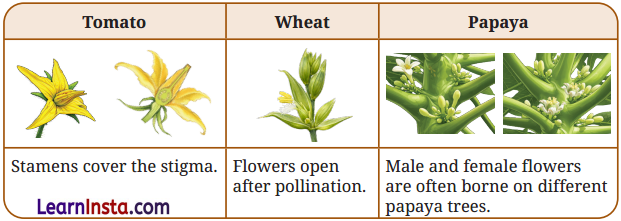
Look at the picture given below and, in line with the given prompts, find out which type(s) of pollination might have been followed in these flowers —
Answer:
Tomato:
Self-pollination. The stamens cover the stigma, so pollen falls directly onto the stigma of the same flower.
Wheat:
Self-pollination. The flowers open only after pollination has already taken place inside the closed flower.
Papaya:
Cross-pollination. Male and female flowers are usually borne on separate papaya trees, so pollen has to travel from one tree to another.
Question 12.
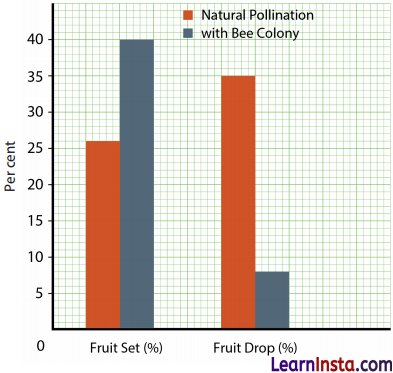
In the lower Himalayan region of northern India, apples are an important cash crop that contribute significantly to farmer’s livelihoods. The fruit yield in apple cultivation is declining continuously, associated with climate change and a significant decline in the population of natural pollinators. A researcher-farmer group set up two experimental apple orchards at two distinct locations: Places A and B. In the apple orchards at Place A, they allowed natural pollinators to pollinate the flowers of the apple. In apple orchards at Place B, they applied mixed farming techniques of beekeeping. Along with honey, the farmer yielded apples. The yield of apples is depicted in Fig. below, in terms of fruit setting (number of fruits/the total number of corresponding fruit-bearing branches) and fruit drop (premature falling of developing fruits) in the two types of experimental places of apple orchards.
(i) What are the hypotheses the researcher-farmer group has thought of for this investigation?
(ii) What are the different parameters in the experiment?
(iii) Compare and analyse the data of two experimental orchards Places A and B, in terms of high yields of apple fruits.
(iv) Based on your analysis, what do you infer from the data?
Answer:
(i) Hypothesis:
Introducing managed bee colonies in apple orchards increases the rate of pollination, leading to higher fruit set and lower fruit drop than orchards depending only on natural pollinators.
(ii) Independent variable: Pollination method(natural vs. bee colonies).
Dependent variables: Fruit set percentage and fruit drop percentage.
Controlled variables: Apple variety, orchard size, climate, soil, irrigation, and farm management.
(iii) Place B (with bee colonies) shows a higher fruit set (about 40%) compared to Place A (about 26%). Fruit drop is much lower at Place B (about 8%) than at Place A (about 35%).
(iv) Introducing bee colonies greatly improves pollination efficiency, leading to higher fruit yield and reduced premature fruit drop. Farmers should consider beekeeping along with fruit farming to improve income and support declining pollinator populations.
Question 13.
A student claims, “In humans, ovulation always happens on day 14 of the menstrual cycle”. Critically examine this claim and state whether the claim is correct or not. Give at least two reasons for your answer.
Answer:
The claim is not fully correct. Day 14 is just the average for a typical 28-day cycle.
Reasons to support this answer are:
- Menstrual cycles vary from person to person and can range from 21 to 35 days, so the day of ovulation also varies.
- Ovulation is controlled by hormones, which can be affected by stress, illness, diet, or travel, so the exact day can change from one cycle to another in the same person.
The correct statement is that ovulation ‘usually’ occurs around day 14 of a typical 28 – day cycle.
Class 9 Science Chapter 11 Reproduction How Life Continues Question Answer (InText)
Think It Over (NCERT Textbook Page No. 208)
Question 1.
When does a farmer prefer asexual or sexual methods of reproduction for crop production?
Answer:
A farmer prefers asexual methods (cutting, grafting, layering, or tissue culture) when the goal is to quickly produce a large number of genetically identical plants with desirable traits like high yield or disease resistance.
Sexual methods using seeds are preferred when the farmer wants variation among offspring, which helps crops adapt to new conditions, or when developing new hybrid varieties through controlled breeding.
Question 2.
Why do you think most complex animals and flowering plants use sexual reproduction, while many simple organisms like yeast and Hydra mainly reproduce asexually?
Answer:
Complex animals and flowering plants use sexual reproduction because it creates genetic variation among offspring. These variations help the species survive diseases, adapt to changing environments, and evolve.
Simple organisms like yeast and Hydra reproduce asexually because it takes less time, needs only one parent, and helps them multiply quickly when conditions are favourable. When conditions become unfavourable, many of them can switch to sexual reproduction for better survival.
Pause and Ponder (NCERT Textbook Page No. 217)
Question 1.
In a China-rose (hibiscus or gudhal) plant, a pollen tube grows and continues through the style after pollen lands on the stigma. Which process is about to happen next?
Answer:
After the pollen tube grows through the style, the next process is fertilisation, where the male gamete fuses with the female gamete in the ovule.
Question 2.
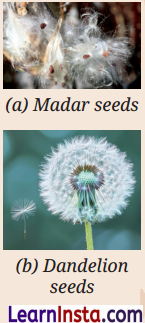
Look at the pictures (Fig. below) of calotropis (madar) seeds and dandelion seeds given below. Can you guess what kind of seed dispersal these seeds are adapted for?
Answer:
- Both Calotropis (madar) and Dandelion seeds are adapted for wind dispersal.
- They have light, hairy, or feathery structures that act like tiny parachutes, helping them to be carried easily by air currents over long distances.
Question 3.
A farmer plants two varieties of maize side by side, but notices that seeds form only when pollen from one variety reaches the stigma of the other. What type of pollination is this?
Answer:
This is cross-pollination. Pollen is transferred from the anther of a flower on one plant to the stigma of a flower on a different plant of the same species.
Pause and Ponder (NCERT Textbook Page No. 218)
Question 4.
Why do animals with external fertilisation generally produce more eggs than animals with internal fertilisation?
Answer:
In external fertilisation, eggs and sperms are released into water where many eggs are destroyed by water currents, eaten by predators, or simply fail to get fertilised. To make sure at least some offsprings survive, these animals produce a very large number of eggs.
In internal fertilisation, the eggs are well protected inside the female body, so producing many eggs is not necessary.
Question 5.
In animals, which fertilisation method are the gametes more protected?
Answer:
In animals, internal fertilisation provides more protection to the gametes, as fertilisation occurs inside the body of the female, safeguarding them from external hazards.
Pause and Ponder (NCERT Textbook Page No. 222)
Question 6.
Ravi suddenly notices that he is growing taller rapidly, his shoulders are broadening, and his voice cracks. What stage of life is he entering?
Answer:
- Ravi is entering puberty (adolescence).
- During puberty, male hormones cause rapid growth in height, broadening of shoulders, deepening of voice, and the growth of facial and body hair in boys.
Question 7.
Rina’s period occurs every 28 days. Her last period was on the 5th of March. On which day is she most likely to get her next period?
Answer:
Rina’s next period is most likely to start on the 2nd of April (28 days after 5th March).
Question 8.
A human zygote has just formed. How many chromosomes does it have?
Answer:
A human zygote has 46 chromosomes (23 from the sperm and 23 from the egg) as it is formed by fusion of sperm with egg.
Pause and Ponder (NCERT Textbook Page No. 223)
Question 9.
What protective devices can be used during sexual activity to reduce the spread of STIs?
Answer:
Condoms (male or female) can be used to reduce the spread of sexually transmitted infections. They act as a physical barrier that prevents the transmission of STIs and also help prevent pregnancy.
Question 10.
If a couple uses oral contraceptive pills but not condoms, which risks remain and why?
Answer:
- The risk of sexually transmitted infections remains.
- Oral pills only prevent pregnancy by altering hormones to stop the release of eggs.
- They do not act as a physical barrier and cannot stop the transmission of infections like HIV, gonorrhoea, or syphilis.
- For protection against both STIs and pregnancy, condoms should also be used.
Pause and Ponder (NCERT Textbook Page No. 224)
Question 11.
In many animals, the young ones can walk or find food soon after birth, but human babies are completely dependent for a long time. What might be some advantages and disadvantages of this for humans as a species?
Answer:
Advantages: The long period of dependency allows human babies to develop a large, complex brain and to learn skills like language, social behaviour, and problem-solving. This extended learning period is the foundation of human intelligence, culture, and civilisation.
Disadvantages: Parents must invest a lot of time, energy, and resources in caring for each child. This limits the total number of offspring, and the young ones remain vulnerable to danger for many years.
Class 9 Science Chapter 11 Question Answer (Activities)
Activity 11.1:
Let us Explore (NCERT Textbook Page No. 210)
- Interact with gardeners working in your school garden or farmers working in a field.
- Observe the techniques of cutting, grafting and layering followed by them. Discuss these techniques with them and record your observations in your notebook.
Answer:
In cutting:
- Pieces of shoot (of a rose plant) about 15 to 20 cm long, each with 3 to 4 nodes, are taken in the morning.
- Leaves from the lower half are removed.
- The cuttings are planted in compost-mixed soil at an angle of 45 to 60 degrees and watered regularly.
- New shoots and roots develop within a few weeks.

In grafting:
- A stem piece (scion) from another plant of the same family is inserted into this slit and tied firmly with cotton cloth or wrapping film.
- After a few weeks, the graft heals, and the scion starts growing along with the stock.

In layering:
- A flexible thin twig of a shrub (like lemon or jasmine) is bent, and its middle part is buried in moist soil. Within 10 to 15 days, roots develop from the buried part.
- The twig is then cut from the parent plant and grows as a new plant.
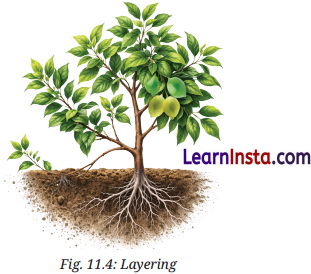
All these are methods of vegetative propagation, a type of asexual reproduction. They are useful because they produce many genetically identical plants in less time with desired qualities.
Activity 11.2:
Let us Explore (NCERT Textbook Page No. 209)
- Add a pinch of yeast to 20 mL of sugar solution (1 g sugar in 10 mL water) in a test tube.
- Cover the mouth with a cotton plug and keep it warm for 1 to 2 hours.
- Place a drop of the mixture on a slide with a coverslip and observe under a compound microscope
Answer:
- Small round outgrowths (buds) are seen on the parent yeast cells. With the passage of time, the buds grow larger and finally separate from the parent cell to form new yeast cells. This is asexual reproduction by budding.
- It shows how yeast multiplies rapidly in warm, sugary conditions and is used in bread making and brewing.
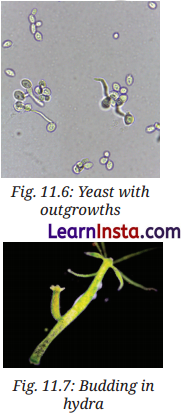
Note:
In the multicellular animal Hydra, small outgrowths called buds grow at a specific site on the parent body. These buds enlarge and separate from the parent to live independently. This process is called budding.
Activity 11.3:
Let us experiment (NCERT Textbook Page No. 211)
- Place a moist slice of bread or roti in a moist chamber with a wet cotton substratum.
- Keep it in a warm, dark place for 3 days and observe daily.
- Transfer a small amount of the mould to a slide, add cotton blue stain, and observe under a microscope.
Answer:
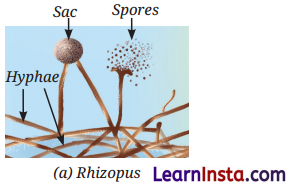
After three days, fuzzy mould growth covers the bread. Under the microscope, thread-like structures (hyphae) with round sacs at their tips are visible.
Tiny round spores can be seen inside the sacs.
- The mould grew from spores that were already present in the air.
- The spores settled on the moist bread and germinated into hyphae.
This experiment shows asexual reproduction by spore formation in fungi.
Activity 11.4:
Let us Explore (NCERT Textbook Page No. 213)
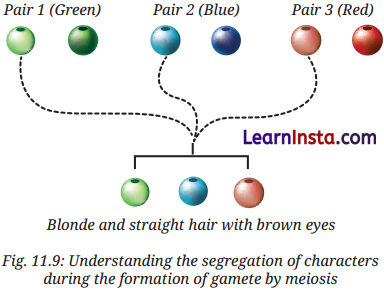
- Take three pairs of coloured beads, each pair representing two contrasting traits on different chromosomes.
- Pick one bead from each pair randomly to form a combination.
- Count the number of possible combinations.
Answer:
- With three pairs of traits, 2 × 2 × 2 = 8 different combinations
- In humans, there are 23 pairs of chromosomes, which can give over 8 million different combinations in gametes.
- This enormous variation explains why every child is genetically unique and different from parents and siblings.
- This is the main reason sexual reproduction is so useful for creating diversity.
Activity 11.5:
Let us Explore (NCERT Textbook Page No. 214)
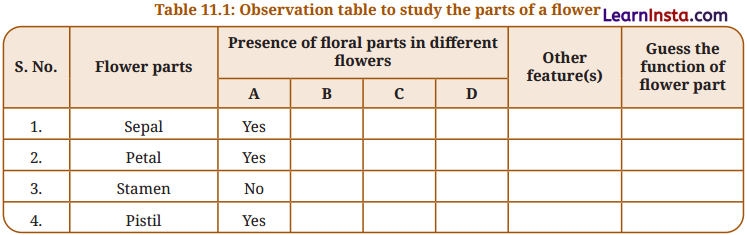
- Collect different types of flowers.
- Carefully observe and note down the parts present: sepals, petals, stamens, and pistil.
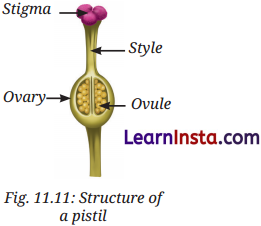
- Cut a transverse and a longitudinal section of the ovary and observe under a dissecting microscope.
Answer:
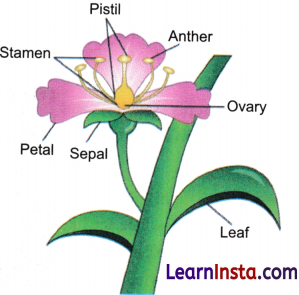
A complete flower has four main parts:
(i) sepals (green outer covering that protects the bud),
(ii) petals (coloured, attract pollinators),
(iii) stamens (male part with anther that makes pollen), and
(iv) pistil (female part with stigma, style, and ovary).
(v) A section of the ovary shows small structures called ovules inside, which contain the egg cells.
Activity 11.6:
Let us Investigate (NCERT Textbook Page No. 215)
- On a sweet pea or garden pea plant, select two juvenile buds and three freshly blossomed flowers.
- Remove stamens from one bud and one flower.
- Cover selected flowers with muslin cloth bags.
- Leave one freshly blossomed flower uncovered.
- Observe them regularly for many days and notice the development of fruits in place of flowers.
- Draw inferences from this Activity.
Answer:
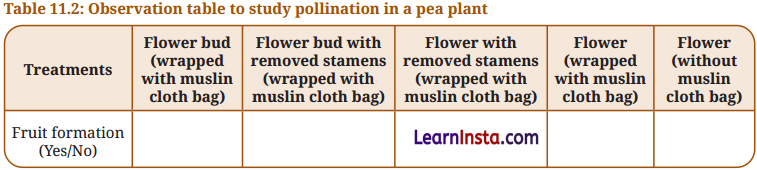
- Fruits form in all treatments except the one where stamens were removed from the flower bud and the bud was covered with a muslin bag.
- This shows that the transfer of pollen from the anther to the stigma (pollination) is essential for fruit formation.
- In the covered bud with intact stamens, self-pollination occurs inside the closed flower. When stamens are removed and the flower is covered, no pollen is available, so no fruit is formed.
- We infer that the transfer of pollen grains from the anther to the stigma is necessary for fruit formation.
Activity 11.7:
Let us Find out (NCERT Textbook Page No. 217)
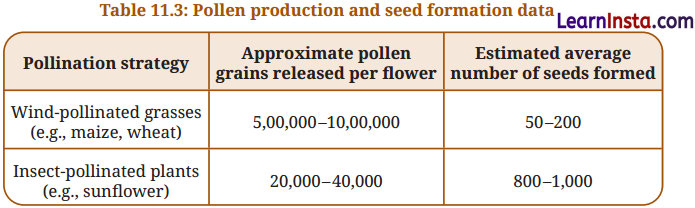
1. Compare and analyse the two strategies in terms of (Table)
- Pollen to seed ratio
- Efficiency of pollination and seed formation
2. Explain why producing a very large number of pollen grains can still be an effective pollination strategy.
Answer:
- Wind-pollinated plants have a very high pollen-to-seed ratio because most pollen is wasted as the wind carries it in all directions.
- However, producing millions of pollen grains is still effective because even though they are in large numbers, a tiny fraction reaching a stigma is enough to ensure reproduction.
- Insect-pollinated plants have a much lower pollen-to-seed ratio because insects deliver pollen directly to the stigma of another flower of the same species, making the strategy far more efficient.